Hydrogen Bus Fleet Project Gains Momentum
The title of this post, is the same as that of this article from Energy Live News.
This is the sub-heading.
Luxfer Gas Cylinders and Ricardo have formed a partnership to advance a project that aims to deploy 150 hydrogen-powered buses on UK routes by 2024
I first came across this project in June 2022 and wrote Ricardo Repowers Double Decker Diesel Bus With Hydrogen Fuel Cells, where I said this.
The title of this post, is the same as that of this press release from Ricardo.
Ricardo, a global strategic, environmental, and engineering consulting company, in partnership with Stagecoach North East, has repowered a diesel, double decker bus with a hydrogen fuel cell propulsion system. Delivering zero tailpipe emissions, Ricardo is now seeking to secure customers to invest in the production of a fleet of passenger vehicles fit for the future of sustainable shared mobility.
The project, part funded by the Department of Transport, through its Hydrogen Transport Hub Demonstration competition, saw Ricardo, working with Stagecoach North East to retro-fitted hydrogen fuel cell technology into an existing double decker bus. It created a zero emissions demonstrator that is now undergoing a ten-week test and demonstration programme around the Tees Valley and Brighton and Hove. Feedback and data from the trials will support the team to explore future market opportunities and applications with bus operators and other partners across the UK and beyond.
Given that there are around 38,000 existing buses in the UK, many of which still have a few years of life left, this surely must be an affordable way of creating more zero-carbon hydrogen buses.
It appears that Ricardo are aiming to have an initial batch of 150 buses in service from late 2024.
It looks to me, that this project is certainly gaining momentum.
Extra Luggage Racks For Lumo
The title of this post, is the same as a small article in the November 2023 Edition of Modern Railways.
Thiese are the first two paragraphs.
Lumo is to remove eight seats from each of its five Class 803 EMUs to make way for additional luggage racks.
Two seats will be removed from four of the five vehicles in each unit to make space for the luggage racks. The move has required a variation of Lumo’s track access agreement, with the Office of Road and Rail, which as originally approved specified that each train must have 400 seats.
The article also states that Lumo has stopped carrying bikes and the bike areas are now used for luggage.
Batteries For Lumo?
The article finishes with this paragraph.
Lumo celebrated its second birthday in late October and was also set to mark the carriage of its two-millionth passenger. It is understood Lumo is interested in augmenting its fleet, such has been the success of the service; while many operators favour bi-mode units, Lumo is proud of its all-electric credentials so straight EMUs are still preferred, although the possibilities of including batteries which could power the trains may be pursued (the ‘803s’ have on-board batteries, but only to provide power to on-board systems if the electricity supply fails).
I find this development very interesting.
As an electrical engineer, I’ve always believed that the emergency batteries in the Class 803 trains are very similar to the traction batteries that Hitachi are developing for the Class 802 trains.
- One design of battery must surely save time and costs in design and testing.
- The difference between the two batteries might be only software and the total capacity of the lithium-ion cells.
- In service testing under real operating conditions can be carried out in Lumo’s Class 803 trains.
- Traction and emergency batteries would be interchangeable, so some operators, who didn’t always need traction but wanted emergency on-board power could be setup as required for the route.
If traction batteries gave the train a range of perhaps 15-20 miles, this might well be enough range, for the train to get through or to the next station, if there was to be an incident like catenary failure or a derailed freight train blocking the line. Obviously, Lumo will have records of all external failures that have affected them.
Consider.
- I have calculated that Peterborough and Doncaster via Lincoln is 88.5 miles.
- I also believe it is likely that in the future, there may be some electrification at Lincoln to charge battery-electric trains.
- Lincolnshire is flat.
Would it be possible for Lumo trains to use a single traction battery to take the Great Northern and Great Eastern Joint Line to get round engineering works on the East Coast Main Line?
What Length Of Trains Could Lumo Run?
In Ten-Car Hull Trains, I talked about Hull Trains running ten-car trains to Hull.
I would expect that all Lumo’s stops are possible with ten-car trains.
As the trains are all Plug-and-Play, Lumo could either run pairs of trains or perhaps lengthen all trains to any size between six and nine cars.
Could Lumo Piggy-Back An Aberdeen Service On An Edinburgh Train?
The line between Edinburgh and Ladybank is being electrified and Ladybank is just 91.4 miles South of Aberdeen.
- A pair of Class 803 trains could leave King’s Cross running as a ten-car formation.
- The leading train would be a Class 803 train equipped with a traction battery.
- The trailing train would be a Class 803 train equipped with the normal emergency battery.
- Aberdeen passengers would get in the leading train.
- The train would run as normal to Edinburgh.
- At Edinburgh the two trains would split with the leading train going on to Aberdeen and the trailing train getting ready to return to London.
The train going to Aberdeen would need sufficient battery range to cover the 91.4 miles to Aberdeen, where it would recharge to make the journey back to Ladybank, Edinburgh and the South.
What About Inverness?
Dunblane is the nearest electrified station to Inverness, but it is 146.2 miles away over a route with lots of steep climbs.
I doubt that a battery-electric train could handle that route.
Conclusions
Luggage seems to be getting more of a problem on trains and buses.
It does appear that a very innovative battery philosophy from Hitachi is emerging.
A Community Engagement App For The Hope Valley Line Upgrade
The Hope Valley Line Upgrade has its own web site.
This is the sub-heading.
We’re upgrading the railway between Manchester and Sheffield to provide more reliable and faster journeys for passengers
The first paragraph gives the project timeline.
The project started in Spring 2021 and is due to be completed in Spring 2024.
There is also a section, that is entitled Community Engagement, where this is said.
Communication is very important to us and we will be writing to local residents with plenty of notice before work starts, as well as holding public engagement events throughout the project to keep the local community informed on its progress.
For regular updates on the main improvement work, you can also download the Hope Valley Railway Upgrade community engagement app, which will contain details of upcoming work activities, news, and initiatives and events for the local community.
That is new territory for Network Rail or at least the first time, I’ve seen one.
Until proven otherwise, it looks like it could be a good idea.
Trucks On Moorgate
I took these pictures of trucks on Moorgate this morning in one twenty minute period.
















Note.
- All of the large trucks were diesel-powered.
- Some smaller vans might have been electric.
- Six of the trucks were concrete mixer trucks.
- One of the concrete mixer trucks was advertising ECOPact The Green Concrete.
Surely, if large heavy good vehicles, like these were hydrogen-powered, it would cut carbon footprints and reduce pollution.
I doubt we’ll see many hydrogen trucks in London, until we have a Mayor, who has a hydrogen policy that isn’t to ignore hydrogen and hope it goes away.
Old Street Station – 25th October 2023
I took these pictures this morning, as my bus passed Old Street roundabout.





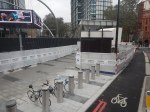





It does seem that it is at last approaching completion.
Lumo Carbon Data Shows Its Trains Are 22 Times Greener Than Flying
The title of this post, is the same as that of this article on Rail Advent.
These paragraphs detail how the figures were obtained.
To mark the second anniversary of its branding as ‘Lumo’, the operator commissioned consultancy firm Arup to provide an independent report about all direct emissions from its operations; emissions from the grid-supplied energy it uses; and other emissions in its supply chain.
Scope 1: Direct emissions from operations that are owned and controlled by Lumo;
Scope 2: Emissions from the use of grid-supplied electricity, heat, steam and/or cooling by Lumo;
Scope 3: All other emissions that occur in the value chain of Lumo.In the last two years, Lumo has carried over two million passengers. The figures reveal that, per passenger, emissions from a London-to-Edinburgh journey are twenty-two times the level for flying (149 kgCO2e) than for using Lumo (6.8kgCO2e).
I have a few thoughts.
Carbon Savings With LNER
LNER’s Class 801 trains are similar to Lumo’s Class 803 trains.
The main difference, is that the LNER have emergency diesel engines, whereas Lumo have emergency batteries to run the trains systems, if the catenary goes down.
So LNER on balance will generate a bit more carbon than Lumo.
But the difference will be marginal.
Carbon Savings With Avanti West Coast
Avanti’s Class 390 trains to Scotland, are all-electric, so there will be a carbon-saving.
Probably about the same as with LNER.
Avanti West Coast’s New Class 807 Trains
If the Class 807 trains were cars, they would be Lotuses.
- They are electric only and have no heavy diesel engines or traction batteries.
- They don’t even have emergency batteries for when the catenary fails.
- They have a redesigned nose. Is it more aerodynamic?
- The heavy tilt mechanism is history.
- As with all the other Hitachi high speed trains, they are capable of 125 mph, or 140 mph if the signalling permits.
These trains will undoubtedly have faster acceleration and deceleration and could probably knock minutes off the timings at all the stops.
Tucked away beside the Grand Union Sets Out Stirling Ambitions article in the December 2022 Edition of Modern Railways is a report on Avanti West Coast’s application for a second service between Euston and Liverpool.
This is said.
Avanti West Coast has applied for access rights for its second hourly Euston to Liverpool service, starting from December 2023, although a phased introduction of the new service is likely. This would make use of Avanti’s new fleet of 10×7-car Class 807 Hitachi EMUs, which are expected to enter service from Autumn 2023. The ‘807s’ would be deployed on the current hourly Liverpool service, on which a call at Liverpool South Parkway would be added. (provision is made for this in the December 2022 timetable.).
Pendolinos would then operate the second service each hour, calling at Lichfield Trent Valley and Tamworth.
A linespeed project is in progress to raise the permissible speed for non-tilting trains on the West Coast Main Line, and Avanti’s new Hitachi trains will take advantage of this.
I can’t wait to go to Liverpool in one of these trains.
Their carbon emissions should be in line with Lumo.
Avanti West Coast’s New Class 805 Trains
These are equivalent to the Class 802 trains, but with probably Class 807 train interiors and looks.
I wonder how long these trains will keep their diesel engines before battery power is the most affordable option.
Once they go battery-electric, their carbon emissions should be in line with Lumo.
Conclusion
I can’t see any other mantra than.
Electric good, diesel bad
Especially, if like most computers, it’s just plug and play.
Interview: Rethinking ‘Unusual And Special’ CrossCountry
The title of this post, is the same as that of this article on Railway Gazette.
This is the sub-heading.
CrossCountry’s National Rail Contract came into force on October 15, giving the business some medium-term certainty and Managing Director Tom Joyner a chance to reflect with Rail Business UK on its evolving role as a truly national train operator.
These are thoughts based on what is said in the article.
Unusual And Special
This paragraph is Tom Joyner’s explanation of what he meant.
‘CrossCountry is unusual and special. The fact that we’re a long-distance operator that connects so many places means we can be there for something different’, believes Managing Director Tom Joyner as he reflects on the operator’s short and medium-term future following the award on September 20 of its National Rail Contract.
I have found CrossCountry useful in the past to efficiently visit some towns and cities in the past, when Ipswich Town are playing away.
Arriva UK’s Contract To Run CrossCountry
This paragraph details the operating contract.
Under the NRC, incumbent Arriva UK Trains will continue to run the non-London inter-city passenger business as it has since November 2007. Commencing on October 15, the contract has a guaranteed core term of four years and an option for this to be extended to eight. The government will take the revenue risk, as it has done since the pandemic, with Arriva receiving a fixed fee to operate the business, with limited bonuses on offer if certain performance targets are met.
As a resident of London, I rarely use CrossCountry. But my only obvious improvement would be that CrossCountry ran trains with a smaller carbon footprint.
Post Pandemic Purpose
This paragraph details their post-pandemic purpose.
‘CrossCountry hasn’t benefitted from re-franchising in the last 10 years and this has presented challenges, particularly from a rolling stock perspective. We’ve been working closely with DfT to agree the post-pandemic purpose and vision for CrossCountry and how these fit into our railway network’, Joyner reports.
Most rail operators in the UK are London-centric or regional. Perhaps CrossCountry should become more ‘Unusual And Special’ to serve the important places, that other rail operators cannot reach.
One place would be the National Memorial Arboretum, which I wrote about in New Station Proposed For National Arboretum.
There must be lots of other places.
It could surely be the transport network for those who wanted to roam the UK on a holiday.
Could it be at the heart of levelling up the regions of the UK?
Fleet Under Pressure
This paragraph describes the current fleet and its condition.
Perhaps most reassuring for regular users of CrossCountry is news that the NRC will allow the operator to deliver some improvements to its train fleet, the backbone of which are the Class 220 and 221 DEMUs Arriva inherited from Virgin Trains in 2007. Other than some minor cosmetic work, these have not been refurbished since they were introduced in 2001. These 200 km/h Voyager trainsets are augmented by a fleet of Class 170 Turbostar DMUs for 160 km/h operation on regional routes to Cardiff and Stansted Airport; CrossCountry withdrew its last ex-British Rail IC125 High Speed Trains on September 18.
I do think, that some way must be found to reduce the operators large carbon footprint.
Are Battery Trains The Answer?
This paragraph gives Tom Joyner’s view on battery trains.
He is equally sceptical about the prospects for alternative traction technology to replace diesel. ‘I keep hearing views from industry colleagues who say, “electrification isn’t the answer, battery is the answer”. But you can’t get a battery that’s got the range that we need, even on the regional services currently worked by Class 170s.’
Birmingham New Street and Leicester is only 39.8 miles, so this route for a Class 170 train, might be possible for battery-electric trains, when there is electrification or charging at Leicester.
Perhaps the plan would be to run battery-electric trains between Birmingham and Leicester and see how the passengers react and how this will change the economics of the other Class 170 services?
A Lot More Food For Thought
There are some more sections in the article, that are worth a read.
- Sustainability Challenge
- Service Offering
- Commuters’ ‘Coventry Conundrum’
- Doing Something Different
This paragraph towards the end of the article makes the levelling up case, that CrossCountry can fulfil.
He suggests that the operator may not need as structured a timetable, and that its operating model could involve serving more destinations rather than the current largely fixed hourly axes crossing in Birmingham. ‘We serve regional Britain and when we talk about levelling up, the railway company best placed to level up in terms of connecting the whole of Britain is us’, he insists. This ethos is reflected in the daily Cardiff – Edinburgh service, with Joyner noting that this will not be a repeating service through the day.
Read the whole article.
I wish Tom Joyner the best of luck!
Cardiff – Edinburgh Open Access Train Service Proposal Under Development
The title of this post, is the same as that of this article on Railway Gazette.
This is the first paragraph.
Grand Union has begun industry consultation over a proposal to operate five open access services a day between Cardiff and Edinburgh, and separately is looking at rolling stock options for its planned London – Carmarthen and London – Stirling services.
These are my thoughts.
Current Train Services Between Cardiff and Edinburgh
I have chosen Monday, the 4th of December and find, that the basic fare is £120.40 with changes at Birmingham New Street and Preston, for a journey of six hours and 52 minutes.
There would appear to be three other sensible trains on that day and the others take around seven hours and cost over £230.
Cardiff and Edinburgh, is one of those routes, where the one-third saving of a railcard will pay for the card on the first trip.
Current Flights Between Cardiff and Edinburgh
I have again chosen Monday, the 4th of December and there is one direct flight that takes one hour and 15 minutes and costs £130.
There are flights under forty pounds, via Dublin or Belfast City airports, which take 4½ and 9 hours.
What About The Sleeper?
If you live in Cardiff and want to get to Edinburgh, early on the 4th, it’s probably better to take an evening train to London on the day before and then get the Caledonian Sleeper to Scotland.
An ideal train could be a sleeper between Plymouth and Edinburgh, that could be picked up at Bristol Parkway, that I wrote about in Would A North-East And South West Sleeper Service Be A Good Idea?.
But that train is only a proposal.
Although, there could be a luxury coach or conveniently-timed direct train to link Swansea, Cardiff Central and Cardiff Bay to Bristol Parkway for the sleeper.
I Feel That A Cardiff and Edinburgh Service May Have Possibilities
Grand Union are proposing to operate five open access services a day between Cardiff and Edinburgh, which seems about right.
I estimate that the service would take around seven hours. But that time is based on the fastest journeys to Birmingham New Street from both ends of the route.
Breaking it down further into three legs via Birmingham New Street and Doncaster, following times could be possible.
- Cardiff and Birmingham New Street – two hours and five minutes
- Birmingham New Street and Doncaster – two hours and five minutes
- Doncaster and Edinburgh – three hours and ten minutes
Note.
- These times are based on average of the better times of the day.
- They could probably be improved by more electrification and a bi-mode train like a Class 802 or Class 755 train.
They total up to seven hours and twenty minutes.
Intermediate Stops
These are listed as Cardiff, Newport, Severn Tunnel Junction, Gloucester, Birmingham New Street, Derby, Sheffield, Doncaster, York, Newcastle and Edinburgh.
Times and distances for the various legs are as follows.
- Cardiff and Severn Tunnel Junction – 21.6 miles – Electrified – 26 mins
- Severn Tunnel Junction and Bromsgrove – 72.5 miles – Not Electrified – One hour and thirteen mins
- Bromsgrove and Birmingham New Street – 14.3 miles – Electrified – 21 mins
- Birmingham New Street and Derby – 41.2 miles – Not Electrified – 33 mins
- Derby and Sheffield – 36.4 miles – Being Electrified – 30 mins
- Sheffield and Doncaster – 16.8 miles – Not Electrified – 24 mins
- Doncaster and Edinburgh – 237.1 miles – Electrified – two hours and 54 mins
These add up to six hours and 21 minutes.
Is Cardiff and Edinburgh An Ideal Route For A Battery-Electric Train?
The route has three unelectrified sections
- Severn Tunnel Junction and Bromsgrove – 72.5 miles
- Birmingham New Street and Derby – 41.2 miles
- Sheffield and Doncaster – 16.8 miles
Note.
- I am assuming Derby and Sheffield is electrified, under the Midland Main Line Electrification.
- The longest unelectrified section is the 72.5 miles between Severn Tunnel Junction and Bromsgrove.
- All three unelectrified sections are sandwiched between two electrified sections, that are long enough to charge the trains.
A battery-electric train with a range of 80-90 miles should be able to handle the route.
As Cardiff and Swansea is only 45.7 miles, with a range of 100 miles, the service could be extended to Swansea.
Competition
This article on Rail Advent is entitled New Cardiff – Scotland Train Service Announced As Part Of New CrossCountry Contract.
This is the relevant paragraph.
Building on the changes made to the timetables in May this year, further enhancements will include a new direct service daily between Cardiff and Edinburgh to strengthen connections across Great Britain.
Will this bang a hole in Grand Union’s plans or is there room in the market for two operators?
On the other hand LNER and Hull Trains run a 1/5 split on the King’s Cross and Hull route.
Tourism
In the past ten years, I’ve travelled regularly between London and Edinburgh by train.
- On those trips, I’ve met a large number of tourists from countries like Canada, Germany, Italy and the United States.
- Many were also visiting Paris using the Eurostar.
- Cardiff, Edinburgh and King’s Cross all have excellent hotels nearby.
- There are other historic and/or large cities on the route, who might like to get in on the act, like Bath, Birmingham, Bristol, Durham, Glasgow, Newcastle, Sheffield and York.
- Cities, hotels, museums and the train companies could form a marketing group.
Cardiff and Edinburgh would complete a very useful triangular route for anoraks, business travellers and tourists.
Conclusion
Cardiff and Edinburgh could be a new route that would work well!
Balmoral Launches New Scour Protection System For Jacket Foundations
The title of this post, is the same as that of this article on offshoreWIND.biz.
This is the sub-heading.
Following the launch of its HexDefence scour protection solution for monopile foundations earlier this year, Balmoral has now launched a HexDefence system specifically designed for offshore wind jacket foundations.
This is the first paragraph.
At the beginning of this year, the Scottish engineering company introduced HexDefence for monopile structures, which integrates seabed protection and flow reduction to minimise operational costs and prevent cable failure. Balmoral said the solution could potentially cut costs by up to 70 per cent when compared to the conventional method of rock dumping.
Balmoral have now developed the system, so it can be used for jacket foundations.
Check out Balmoral’s web site and the HexDefence web site.
Positive Traction Launches 08e – “The Future Of Sustainable Depot Operations”
The title of this post is the same as this article on Rail UK.
This is the first two paragraphs.
Positive Traction has launched the UK’s first re-engineered battery powered shunting locomotive – the 08e.
Free from carbon, NOx and particulate emissions the 08e can fulfil day-to-day operating needs as well as meet the demanding ESG requirement of shareholders, customers, employees and neighbouring communities.
Note.
- 996 Class 08 locomotives were originally produced between 1952 and 1962.
- Around a hundred are still in use on the UK rail network.
- This page on the Positive Traction web site, gives more details.
This could be a sensible use of technology, that carves itself a profitable niche market.
 The Anonymous Widower