Rolls-Royce And Zero Petroleum Join Forces To Develop Sustainable Future
The title of this post, is the same as that of this press release from Rolls Royce.
This is the sub-heading.
Rolls-Royce has entered a landmark agreement with breakthrough Energy company Zero Petroleum to promote further development of the company’s power and propulsion solutions with fossil-free synthetic fuels.
These two paragraphs outline the agreement.
The new agreement will see the two parties collaborate to demonstrate Rolls-Royce engines for aviation, marine and defence with Zero® synthetic fuels.
This has the potential to include Zero’s entire range of synthetic fuels – petrol, diesel and jet fuel – with data gathered from engine testing used to prove the credentials required to achieve international fuel certification standards. Synthetic fuels deployed by Rolls-Royce in engine tests will directly reduce associated carbon emissions.
Are Rolls-Royce going to do their engine testing using synthetic fuels to reduce their carbon emissions?
It certainly looks like they might and I suppose it does two tests at the same time.
Rolls-Royce Seem To Be Using Technology To Save The Company
Big companies like Rolls-Royce, who are very much toed up with fossil fuels have two options; give up or fight using the only weapons they have; superb technology and a lot of experience.
There are only a small group, that seem to be fighting to succeed. To Rolls-Royce, I would add Cummins, Fortescue Future Industries, Ricardo and SSE, and possibly BP and Centrica.
Scottish Project To Explore Tugdock Tech Application To Accelerate Floating Wind Development
The title of this post, is the same as that of this article on offshoreWIND.biz.
This is the sub-heading.
The joint venture behind the Salamander floating wind project and the UK developer of marine buoyancy technology, Tugdock, have signed a memorandum of understanding (MOU) to collaborate on research and innovation related to the development of technologies and supply chain for floating wind energy in Scotland.
This is the introductory paragraph.
The 100 MW floating wind farm, developed jointly by Simply Blue Group and Ørsted, and Subsea7 as a minority partner, is one of the 13 projects selected in Scotland’s Innovation and Targeted Oil and Gas (INTOG) leasing round and one of the five INTOG innovation projects which signed exclusivity agreements with Crown Estate Scotland in May.
There is more about Tugdock on their web site.
I like the concept, but then I did a lot of simulation of floating structures in the 1970s, which I wrote about in The Balaena Lives.
UK Investor Takes Stake In Hornsea Two Transmission Assets
The title of this post, is the same as that of this article on offshoreWIND.biz.
This is the sub-heading.
London-based international investor and manager, John Laing Group, has acquired a stake in the transmission assets for the 1.3 GW Hornsea Two offshore wind farm in the UK, as part of a portfolio acquisition from HICL Infrastructure.
These two paragraphs outline the deal.
John Laing Group has agreed to acquire HICL Infrastructure’s entire equity interest in four UK public-private partnership projects, including a 37.5 per cent stake in the Hornsea Two offshore transmission assets for a total consideration of GBP 204 million (EUR 236 million).
All five acquisitions are expected to be completed before the end of March 2024.
I wrote World’s Largest Wind Farm Attracts Huge Backing From Insurance Giant in November 2018.
Funds and investors with money don’t seem to be losing their appetite for assets, that can provide a regular income.
Wrightbus To Provide Hydrogen Buses For Sizewell C Nuclear Plant
The title of this post, is the same as that of this article on the BBC.
This is the sub-heading.
Ballymena bus manufacturer Wrightbus is providing four hydrogen buses to the Sizewell C nuclear power site as part of a pilot scheme.
These first three paragraphs outline the scheme.
If successful, up to 150 buses could be ordered, making it one of the largest hydrogen bus fleets in the world.
Construction of the plant is to begin next year and multiple vehicles will be needed to move workers to and from the site.
Sizewell C will test the performance of four double-decker buses.
As I used to live in that area, I know the buses are bad and this will surely help.
Biggest Untapped UK Oil Field, Rosebank, Approved By Regulators
The title of this post, is the same as that of this article on the BBC.
This is the BBC’s summary so far.
- The UK’s largest untapped oil field has been approved by regulators
- Rosebank, 80 miles west of Shetland, is estimated to contain 500 million barrels of oil
- The UK government welcomes the decision, saying it will raise billions of pounds and “make us more secure against tyrants like Putin”
- But Scotland’s First Minister Humza Yousaf says he’s “disappointed”, while the Green Party calls the decision “morally obscene”
- Regulators said net zero considerations had been taken into account
This is my summary.
I have been reading Equinor’s web site on Rosebank.
Production will use what is known as a Floating Production Storage and Offloading Vessel or FPSO, which means, when they’ve finished, it can just sail away.
The FPSO will also be electrification-ready, so that all operations on the vessel will probably be powered by green electricity from a nearby wind farm, instead of by a gas turbine engine on the vessel, which burns gas.
This means that the offshore operations will be as carbon-free as is reasonably possible. But importantly, we will pipe the maximum amount of gas from the field for either our own use or selling to the gas-thirsty Germans.
We will need the gas for some time to back up wind and solar with gas-fired power stations.
But what about the emissions from the power stations?
Capturing carbon dioxide from a power station is getting easier, but more importantly, researchers are finding more and more innovative ways of using the carbon dioxide.
H & M and Zara are even selling clothes made from captured carbon dioxide.
Ways are also being developed using plasma electrolysis to strip the carbon out of natural gas to leave useful hydrogen.
Natural gas will be our friend for many decades yet, if we can turn it into a zero-carbon fuel, which I believe we can!
Fourth Phase Could Bring 2 GW More To World’s Already Largest Offshore Wind Farm Under Construction
The title of this post, is the same as that of this article on offshoreWIND.biz.
This is the sub-heading.
Dogger Bank D, the potential fourth phase of the Dogger Bank Wind Farm, whose first three phases totalling 3.6 GW are currently being built, is planned to have a generation capacity of around 2 GW. If built, the fourth phase would bring the total installed capacity of the UK project – already the world’s largest offshore wind farm under construction – to over 5.5 GW.
This is the introductory paragraph.
SSE Renewables and Equinor, which own the Dogger Bank A, B and C offshore wind farms through a consortium that also comprises Vårgrønn, have now launched a public consultation period on the Dogger Bank D proposals that runs until 7 November.
As RWE are developing the 3 GW Dogger Bank South, the Dogger Bank wind farm will be up to 8.5 GW in a few years.
Yorkshire To See More LNER Services And Longer Trains
The title of this post, is the same as that of this article on Rail UK.
These are the two introductory paragraphs.
London North Eastern Railway (LNER) is meeting an increase in demand from leisure travellers by adding more services and thousands more seats on trains between Yorkshire and London every Sunday.
Sundays are now one of the most popular days for journeys with 30% more customers travelling across the 956-mile LNER network than in 2019.
From December 2023, three new services and longer trains will be introduced on Sundays between London and Yorkshire.
Flotation Energy, Cobra File Onshore Planning Application For 100 MW Celtic Floater
The title of this post, is the same as that of this article on offshoreWIND.biz.
This is the sub-heading.
Flotation Energy and Cobra have submitted an onshore planning application to North Devon Council for their 100 MW White Cross floating offshore wind farm in the Celtic Sea.
These two paragraphs outline the project.
The proposed White Cross floating offshore wind farm will feature six to eight floating wind turbines installed some 52 kilometres off the North Devon coast.
The project’s associated cable route is proposed to make landfall at Saunton Sands, connecting to the electricity grid at the East Yelland substation.
The wind farm has its own web site.
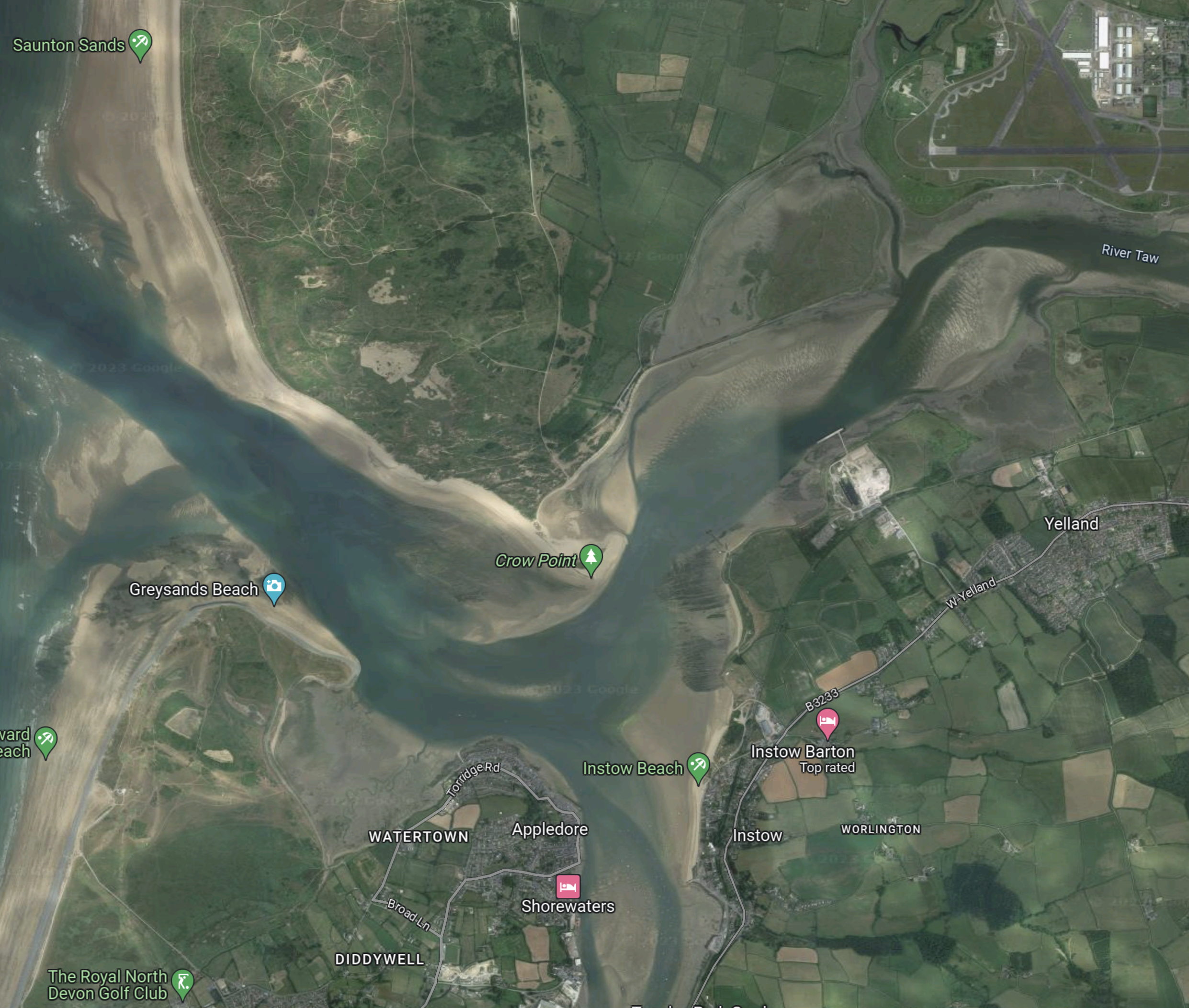
This Google Map shows Saunton Sands and the village of Yelland
Note.
- Saunton Sands is indicated by the green marker in North-West corner of the map.
- Yelland is in the middle of the Eastern side of the map.
- I suspect there are innovative ways to connect the White Cross wind farm to the substation at East Yelland.
- The town of Appledore is on the estuary at the bottom of the map.
This second Google Map shows the town of Appledore.
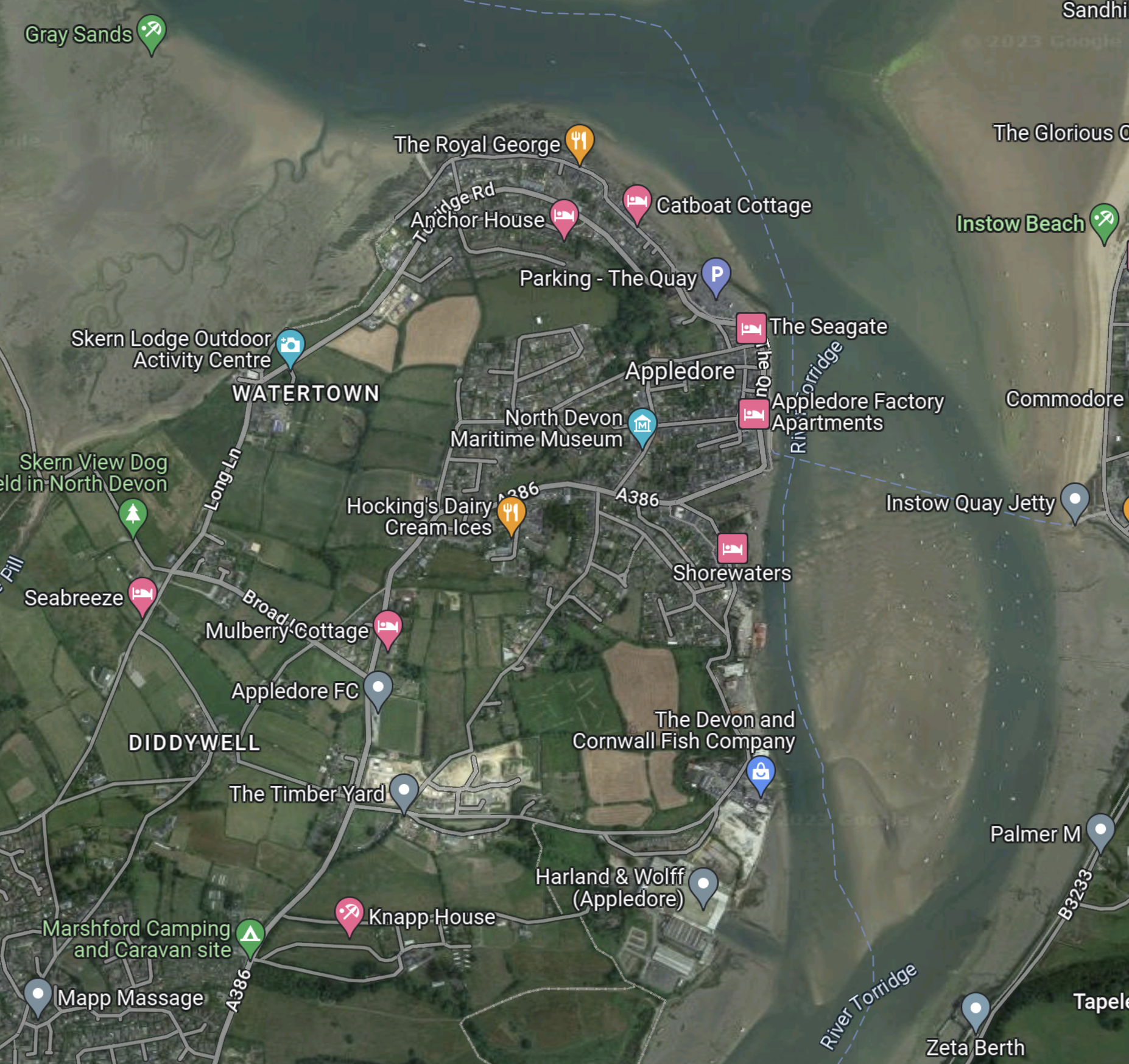
At the bottom of the map is a marker labelled Harland & Wolff (Appledore).
Harland & Wolff (Appledore) has a web site, with these introductory paragraphs.
Located in North Devon at the mouth of the River Torridge, Harland & Wolff (Appledore) has a rich history of shipbuilding. More than 300 vessels have been built here including military craft, bulk carriers, LPG carriers, superyachts, ferries, and oil-industry support vessels.
The site features a 119m long covered drydock as part of the main building yard as well as the adjacent repair, commissioning and outfitting quay.
The Appledore Yard was founded in 1855. It constructed elements of the two Queen Elizabeth class aircraft carriers, bow sections for HMS Queen Elizabeth and built two Róisín class patrol boats for the Irish Naval Service.
The web site then lists an impressive list of facilities, which it underlines with this statement.
An expert team that is perfectly positioned to support the needs of the shipping and offshore industry.
I wouldn’t be surprised to see that Harland & Wolff (Appledore) will bid for the eight floaters for White Cross wind farm.
RWE To Start Building Battery Storage That Will Support Dutch Offshore Wind Farm
The title of this post, is the same as that of this article on offshoreWIND.biz.
This is the sub-heading.
RWE has finalised its investment decision for a battery storage project in the Netherlands that will optimise the OranjeWind offshore wind farm’s integration into the Dutch energy system. The company plans to invest approximately EUR 24 million into the project.
This paragraph outlines the system.
The system, which will have an installed power capacity of 35 MW and a storage capacity of 41 MWh, will consist of a total of 110 lithium-ion battery racks that will be installed at RWE’s biomass plant in Eemshaven and will be virtually coupled with RWE’s power plants in the Netherlands.
There is also an explanatory infographic.
Note.
I visited Eemshaven in The Train Station At The Northern End Of The Netherlands.
- The wind farm has a capacity of 760 MW.
- Solar panels will float between the wind turbines.
- Surplus energy will be turned into hydrogen.
The OranjeWind wind farm has a web site, with a video that explains RWE’s philosophy.
The web site has a section, which is entitled Innovations At OranjeWind, where this is said.
In order to realise system integration and accelerate the energy transition, RWE is working together with a number of innovators on new developments in offshore wind farms. The company is realising and testing these innovations in the OranjeWind wind farm.
These innovations include offshore floating solar, a subsea lithium-ion battery, LiDAR power forecasting system and a subsea hydro storage power plant off-site.
Three innovations are discussed in a bit more detail, with links to more information.
- Subsea pumped hydro storage power plant – Ocean Grazer – More…
- Floating solar – SolarDuck – More…
- Intelligent Subsea Energy Storage – Verlume – More…
Big companies should always support innovation.
Development Around Liverpool Street Elizabeth Line Station
After my Full English breakfast in Leon this morning, I walked around the area between the two entrances to Liverpool Street station on the Elizabeth Line, before entering the station at the Liverpool Street entrance.
I took these pictures as I walked.


















































Note.
- The large development with the naked concrete towers is the Western extension to Broadgate.
- The old entrance to Moorgate Underground station and two pubs are squeezed in between the modern buildings.
- The cylindrical building behind the Globe pub, is Moor House.
- Some buildings are brand new and others are older ones, that have been refurbished and/or reskinned.
There is hardly any space left to put in a dog kennel.
 The Anonymous Widower