They’re Only A Five-Pack Of Mens’sTrunks
With all this hot weather, I needed some more Marks and Spencer’s trunks to keep myself comfortable and cool.
I liked the overall packaging, so I took these pictures.





Note.
- Most of the packaging is a piece of carefully cut and folded cardboard.
- It was probably done with love by a robot.
- It’s almost folded into a pair of crocodile’s jaws, so the product is held safely.
- All five pairs were still in the packaging, when I brought them home.
But then as the product was made in Bangladesh, where crocodiles are native, I would expect them to get this type of packaging right.
In some ways the hook, is the most interesting part of the packaging, as it appears to have been stamped out of a sheet of quality laminated cardboard.
My father was a letterpress printer in the 1950s and one of the specialties of his business was stamping out components like these on one of his two Original Heidelberg printing machines.
Around the turn of the last century, I had a friend, who could design origami packaging like this. Quality and sustainable ideas like these will keep going around and around.
Does Scotland Have A Plan To Build A Railway With Invisible Electrification?
There is an article in Rail Technology Magazine, which is entitled £20m Upgrade Secures Future Of Scotland’s First Electrified Railway.
This is the sub-heading.
A £20 million investment is underway to renew overhead power infrastructure on Scotland’s original electrified railway, safeguarding one of the country’s most operationally critical commuter networks for decades to come.
These two paragraphs give more details.
The programme focuses on key sections of the North Clyde lines, which operate from Helensburgh, Balloch and Milngavie through Glasgow’s west end and low‑level stations. As the busiest suburban railway outside London, the corridor plays a pivotal role in keeping Scotland’s wider rail network moving.
First electrified in 1960, the North Clyde routes marked the beginning of modern rail travel in Scotland. More than six decades on, that early investment continues to influence today’s network, underpinning electric services on routes including East Kilbride and Barrhead, with further electrification projects progressing across Fife and the Scottish Borders.
Surely at over 65-years-old, the electrification needs pensioning off and replacing with the best that the mid-2020s can provide.
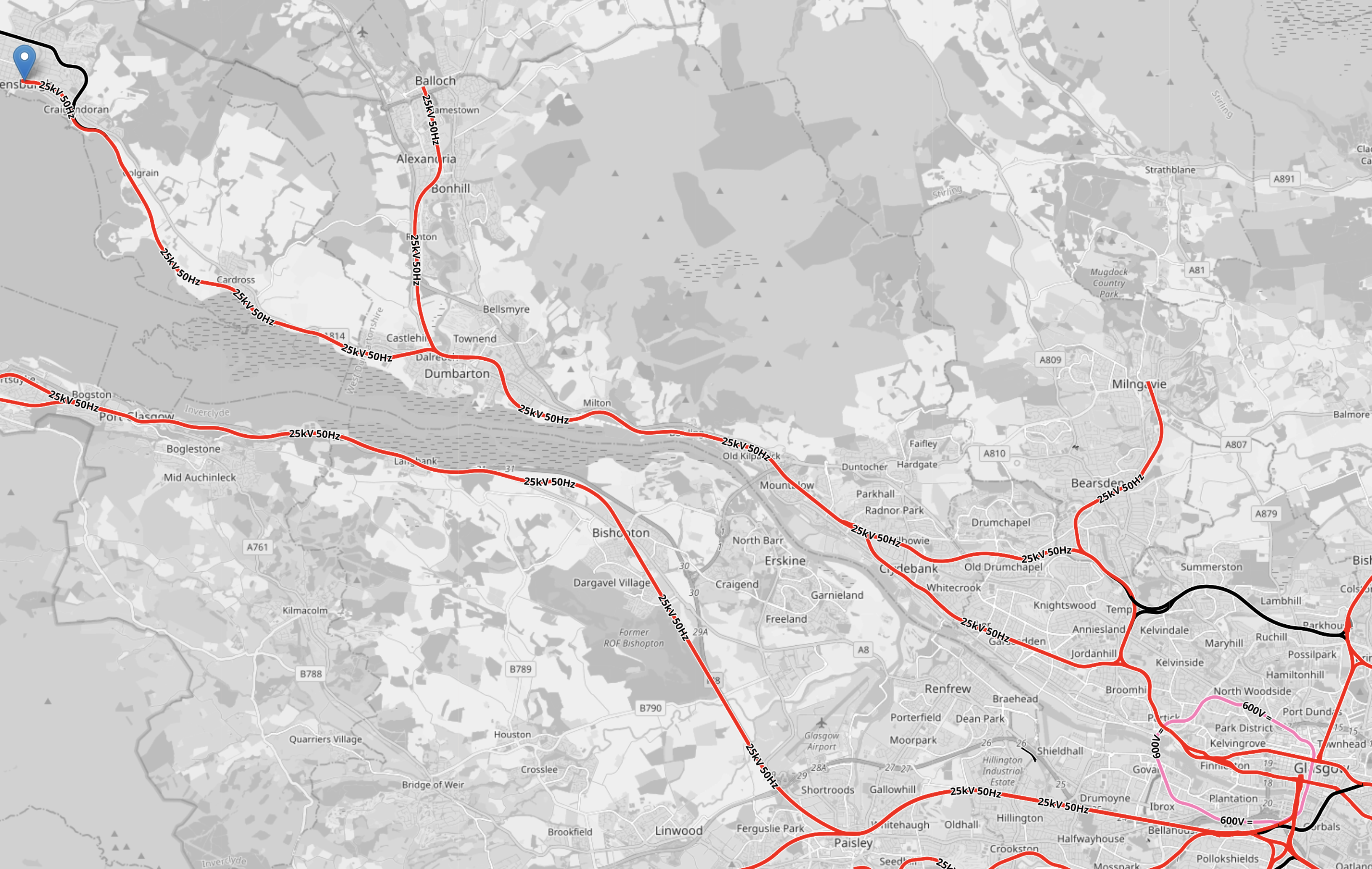
This OpenRailwayMap shows the 1960s electrification.
Note.
- The red tracks are electrified with 25 KVAC overhead electrification.
- The black tracks are not electrified.
- Helensburgh Central station is in the North-West corner of the map and marked with a blue arrow.
- The City of Glasgow is in the South-East corner of the map.
- The branch going North in the middle of the map terminated at Balloch station.
- Milngavie station is the terminus of the branch going North from the Glasgow area.
- The circular pink track is the Glasgow Underground.
I wonder if this is the start of a cunning Scottish electrification extension , that has been designed by Baldrick’s Scottish cousin?
Onward From Helensburgh
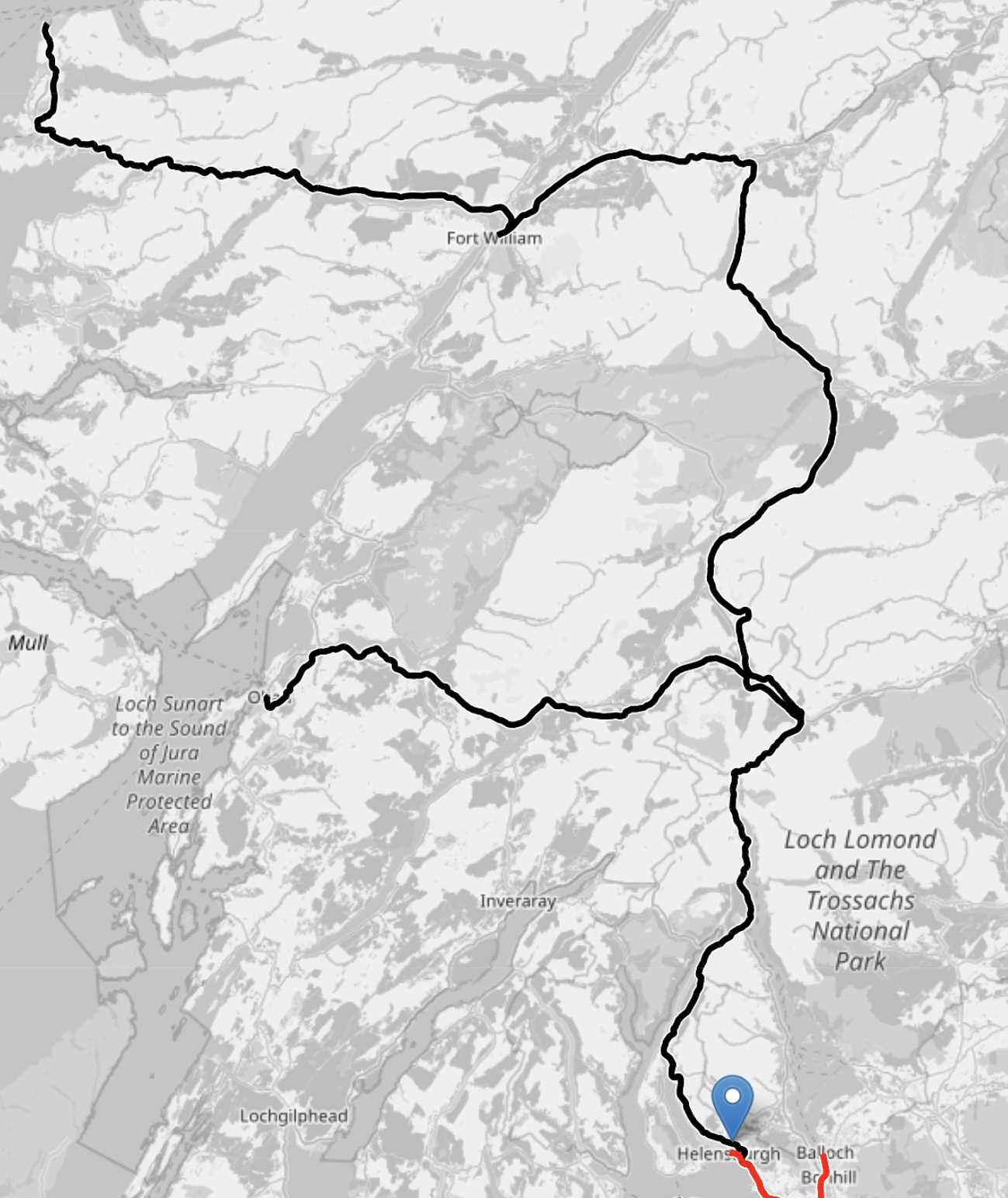
This OpenRailwayMap shows the tracks North of Helensburgh.
Note.
- The red tracks are electrified with 25 KVAC overhead electrification.
- The black tracks are not electrified.
- Helensburgh Upper station is in the South-East corner of the map and marked with a blue arrow.
- The two electrified lines from Glasgow to Helensburgh Central and Balloch stations are just visible in red.
- Oban station is at the Western end of the first branch line going North.
- Mallaig station is at the Western end of the first branch line going North.
- Helensburgh Upper and Oban stations are 76.1 miles apart.
- Mallaig station is at the Western end of the second branch line going North.
- Helensburgh Upper and Mallaig stations are 137.5 miles apart.
- The Mallaig branch also goes through Fort William station.
- Helensburgh Upper and Fort William stations are 97.4 miles apart.
- There is a Caledonian Sleeper that runs both ways between Helensburgh Upper and Fort William stations, which is hauled by a Class 66 diesel locomotive.
- There also appear to be paths for MOD trains hauled by GB RailFreight.
I feel that at some point in the next ten years, battery-electric trains or hydrogen locomotives, will be taking passengers and/or cargo to Cruachan, Fort William, Mallaig and Oban.
- Battery-electric trains and battery locomotives will charge their batteries between Helensburgh Upper and Glasgow at the Southern end of the route.
- Battery-electric trains and battery locomotives will charge their batteries at terminal stations at the Northern end of the route, using offshore wind power.
- Hydrogen trains and locomotives would probably fill up in the Glasgow area.
It could be a zero-carbon line. What would be the effect of a zero-carbon line on tourism?
Could Class 99 Locomotives Be Used On The Caledonian Sleeper?
Ever since the Class 99 locomotive was announced, there has been speculation, that these powerful bi-mode locomotives could handle the routes without an engine change.
I asked Google AI the question in the title of this section and received this reply.
Yes, Class 99 locomotives could eventually be used on the Caledonian Sleeper, as the bi-mode locomotives were designed with potential passenger use in mind. However, the standard Class 99 models cannot currently pull the sleeper trains off-the-shelf and would require specific modifications to do so.
The main factors influencing their deployment on the route include:
Equipment Needs: To haul sleeper carriages, the locomotives must be fitted with Electric Train Supply (ETS/ETH) to power lighting, heating, and air conditioning, as well as specific Dellner couplers to mate with the modern Mk5 carriages.
Sub-Class Fleet Order: While GB Railfreight (GBRf) ordered 30 Class 99s, the standard versions have a top speed of 75 mph (intended strictly for freight).
A specific sub-class (the 99/4) has been proposed to include passenger-standard acceleration, higher speeds of 100 mph to fit into existing timetable paths, and the required ETS equipment.
Bi-Mode Flexibility: Because they operate as bi-mode (using 25kV overhead electric wires and an onboard diesel engine), Class 99s could potentially run the entire route—from London to the Scottish Highlands—without requiring a locomotive change at electrified/non-electrified boundaries.
In Cummins Fuel-Agnostic X Series Platform, there is a Cummins video, which explains their philosophy of building engines that can run on diesel, hydrogen or natural gas.
With those engines, Class 99 locomotives could take the Caledonian Sleeper, or any other luxury or heavy freight train for that matter, anywhere.
FlixBus Launches New Coach Services For Luton DART Parkway
The title of this post, is the same as that of this article on Luton Today.
These paragraphs describe the service.
Coach brand FlixBus is announcing the launch of a new service between Norwich and Luton DART Parkway from 25 May.
Tickets between Norwich and Luton DART Parkway start at £8.99, while tickets between Thetford and Luton DART Parkway start at £8.49, and tickets between Cambridge and Luton DART Parkway start at £6.99.
Six daily departures each way will offer travellers a convenient, affordable link between East Anglia, Cambridgeshire and Luton airport, ahead of the busy summer season.
Could This Service Be Run By A Hydrogen-Powered Coach?
Luton and Norwich is around 160 km.
So six round trips would be under 2,000 km, which could be run, by two coaches having one fill-up per day.
The Coach Calls At The University Of East Anglia
This will be very convenient for some.
Should The Coach Stop At Newmarket?
Because of the horse racing industry, there are a lot of people travelling between Newmarket and the Dublin area, and the most convenient route is to fly between Luton and Dublin.
Conclusion
This service will be a winner.
Wrightbus To Supply 20 Electroliner Buses To Hong Kong
The title of this post, is the same as that of this article on bus-news.
These are the first two paragraphs, which give more details.
Wrightbus has received a major order for a set of 20 of its 6×2 StreetDeck Electroliner double-deck buses.
The vehicles have been ordered by Hong Kong’s Citybus, marking the first global order for the new triple-axle vehicles.
I feel very strongly after a very terrible Bank Holiday weekend, that these are the buses we need on the 141 route in London, that I use most days.
Currently, we have BYD’s Chinese Junks and the batteries are too small.
- On Saturday, I had a doctor’s appointment and had to wait 45 minutes for a bus.
- On Sunday, I had to take a taxi.
- On Monday, it was a twenty minute wait and in the end I took a 76, which are Routemasters and walked.
- On Tuesday, I was rescued by an elderly Wrightbus, after twenty minutes wait.
The article on bus-news says this about the three-axle buses.
Measuring 12-metres in length; the StreetDeck Electroliners are capable of carrying up to 82 seated passengers (130 total), and possess an operating range of up to 300km.
That would do us fine in De Beauvoir Town, so we could travel reliably to London Bridge and Palmers Green.
As an engineer, I suspect the longer buses with an extra axle can carry a larger battery. I also suspect that BYD’s batteries don’t perform well in hot weather.
Instead, we get Chinese Junks and Hong Kong will be getting quality British buses built in Malaysia.
The March Of The Batteries
One of my Google alerts picked up this story from the Solar Power Portal, which is entitled Gresham House To Acquire 480MW BESS, Completes Financing On 397MW Portfolio.
This is the sub-heading.
Gresham House Energy Storage Fund signed a Sale and Purchase agreement (SPA) for the conditional acquisition of a 480MW BESS project, while also completing funding on a 397MW portfolio that will begin construction.
I asked Google AI, “How Big Is Gresham Houuse’s Portfolio Of Batteries?” an received this answer.
Gresham House Energy Storage Fund (GRID) operates a portfolio exceeding 1GW of utility-scale battery capacity in the UK, with an active pipeline of future and recently financed projects.
Their operational capacity features:
Operational Capacity: Exceeds 1GW (approx. 1,072MW/1,701MWh) across dozens of sites.
Market Share: Owns roughly 17% to 20% of all utility-scale batteries in Great Britain.
Haven’t they done well!
When Will Highview Power Complete The Carrington Battery?
Highview Power is building a 50 MW/300 MWh liquid air battery at Carrington, near Manchester.
I asked Google AI,the title of this section and received this reply.
Highview Power’s Carrington liquid air energy storage facility in Greater Manchester is scheduled to be operational by late 2026.
The grid stabilization phase is set to begin early in the year, with full long-duration operations following shortly after.The £300 million project at the Trafford Low Carbon Energy Park is a pioneering commercial-scale “cryobattery” that liquefies and stores air to capture excess renewable energy.
Key details of the completed facility:
Capacity: 300 MWh of storage (delivering 50 MW for six hours)
Reach: Capable of supplying electricity to approximately 480,000 homes
Technology: Liquid Air Energy Storage (LAES)
When Will Highview Power Complete The Livingstone Battery?
Highview Power is building a300 MW/3.2 GWh liquid air battery at Livingstone near Glasgow.
I asked Google AI, the title of this section and received this reply.
Highview Power is not currently building a battery in Livingstone. They are developing a major \(2.5 \text{ GWh}\) liquid air energy storage (LAES) plant in Hunterston, Scotland, which is scheduled to come online by 2030.
According to the Highview Power web site, a 300 MW/3.2 GWh “cryobattery” is being built at the site.
How Much Offshore Wind Power Will Be Installed This Year?
In UK Offshore Wind In 2030 – Calculated May 2026, I said that 2635 MW would be commissioned this year.
Conclusion
We’re running hard, but will we keep ahead of the tsunami of offshore wind and solar panels we are installing.
In UK Offshore Wind In 2030 – Calculated May 2026, my latest calculations show that by 2036, we will have installed 61,337 MW of offshore wind alone.
How Many Of Their 300 MW/3.2 GWh Liquid Air Batteries Do Highview Power Think They Can Install?
I asked Google AI, the title of this section and received this reply.
Highview Power plans to install several of their 300 MW/3.2 GWh “Millennium Series” cryogenic plants. They are specifically developing two initial flagship sites in the UK, with the intention to scale up rapidly over the next decade to capture a significant share of national long-duration energy storage targets.
Highview Power is executing a multi-billion-pound programme to build out these multi-technology storage facilities, which combine liquid air energy storage and lithium-ion batteries.
The two primary 3.2 GWh projects advancing through the UK regulatory system include:
Hunterston, North Ayrshire (Scotland): Slated as the first of the Millennium Series, designed to provide up to 3.2 GWh of capacity (powering around 650,000 homes).It is advancing through the regulatory assessment and construction phases.
Killingholme, Lincolnshire (England): A second 3.2 GWh facility.
Both the Hunterston and Killingholme sites were deemed eligible for support under the UK government’s “cap and floor” super-battery scheme.
Two 300 MW/3.2 GWh “Millennium Series” cryogenic plants will do very nicely!
Engineering is the science of the possible, whereas politics is dreams of the impossible.
Mooir Vannin Offshore Wind Farm
This is a wind farm off the Isle of Man, that I missed as it is not on Wikipedia’s List of Offshore Wind Farms In The United Kingdom.
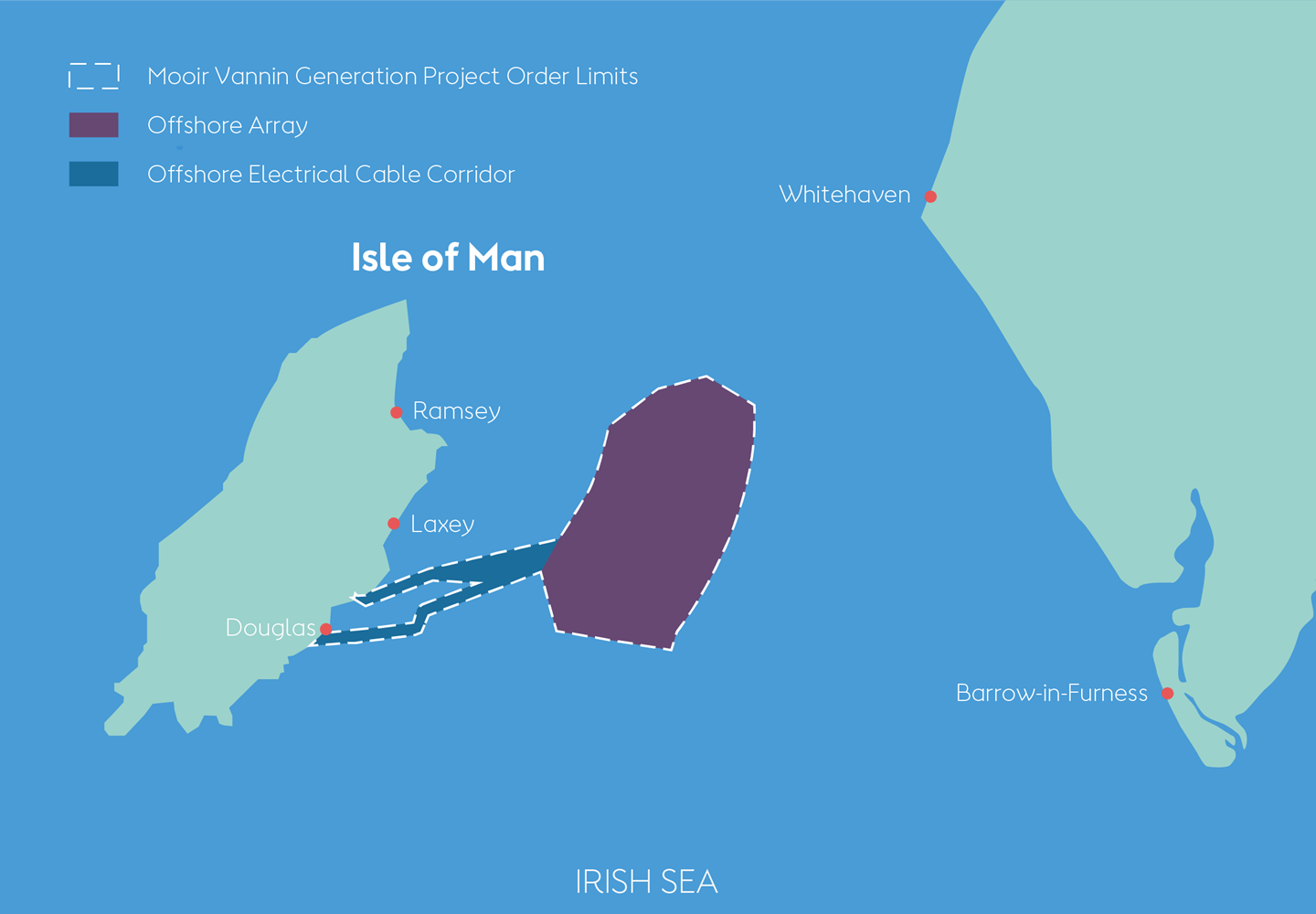
But it does have a web site, which has this handy map.
Note.
- The wind farm will have a capacity of 1.4 GW.
- Ørsted is building the web farm.
- It has planning permission.
- The operations base for the proposed Mooir Vannin Offshore Wind Farm will be located at Douglas Harbour on the Isle of Man.
- The Port is Owned By The Isle Of Man Government.
- Anticipated operational start date is the mid 2030s. I’ll assume 2035.
- According to the web site, connection will be to Douglas on the Isle of Man and Penwortham, Lancashire in the UK.
- Penwortham is part of Preston.
- Penwortham substation already has a 50 MW/50 MWh BESS and may get a bigger one.
- Current fossil-fuel power stations on the Isle of Man, include a number of diesel power stations and a 64 MW CCGT. They also have a 23 MW steam generator.
It looks like Mooir Vannin is large enough to give the island a carbon-free energy supply, backed up, by the UK National Grid at Penwortham.
I asked Google AI, “If The Isle of Man Was Going Into The Data Centre Business”, and received this reply.
The Isle of Man is actively positioning itself as a premier hub for data centres, tech firms, and AI companies. The government is utilizing its robust infrastructure, strong regulatory environment, and competitive tax policies to attract high-value data businesses to the island.
It also looks like they have a water system, that has a hydro-electric power-station.
Ørsted Is Danish
Ørsted is Danish and all of those countries to the North East of the UK have lots of islands.
So I asked Google AI, this question.”Does Denmark Have Any Islands With Power Stations?”, and received this comprehensive answer.
Yes, Denmark has several islands with power stations, ranging from natural islands utilizing large wind and biomass facilities to massive, pioneering “Energy Islands” built specifically as offshore power hubs.
Key Examples Include:
Bornholm (Baltic Sea): Designated as a major green “Energy Island” hub. It functions as a massive collection and distribution point for surrounding offshore wind farms, routing renewable energy to both the Danish grid and neighboring countries like Germany.
SamsØ (Kattegat strait): Known globally as a renewable energy island.
It is entirely powered by local onshore and offshore wind turbines and uses a mix of solar and battery storage systems to manage its energy needs, including marina charging.
North Sea Energy Island (VindØ): This is a colossal artificial island project (located roughly 80–100 km off the coast of Jutland) designed to act as an offshore power plant.
It acts as a hub to harvest and convert wind energy from hundreds of surrounding turbines.
Are Ørsted and Highview Power Still Talking?
In Highview Power, Ørsted Find Value In Integrating Offshore Wind With Liquid Air Energy Storage, it appeared that they still were.
As it appears that Highview Power’s Liquid Air Energy Storage can be sized to the application, I wouldn’t be surprised to see one of their batteries on an island powered by Danish wind turbines.
In Is Sumitomo Heavy Industries Highview Power Energy Storage System On Line At Hiroshima?, I describe how a Highview Power application, that uses cold, solar panels and a small Highview Power battery to increase the efficiency of a CNG Terminal.
How Many Of The UK’s Power Stations Are On Islands?
I asked Google AI this question and I received this answer.
There are three major, conventional thermal power stations on the UK’s offshore islands (two in Scotland and one in the Channel Islands), alongside several small-scale community-owned renewable plants that operate entirely off-grid.
The main island-based power stations include:
Lerwick Power Station (Shetland): A 66-73 MW diesel-fired plant commissioned in 1953. It provides a baseline of electricity for the Shetland mainland.
Sullom Voe Terminal Power Station (Shetland): An independent gas-fired station (roughly 92 MW capacity).
Its primary purpose is to serve the Sullom Voe gas terminal, but it also supplies the Shetland grid.
Queen’s Road Power Station (Jersey): A multi-engine facility in the Channel Islands that uses a mix of gas turbines and diesel generators to maintain island capacity.
(Note: Major UK islands, like the Isle of Wight, Anglesey, and the Isle of Skye, are physically connected to the mainland electricity grid via subsea cables, so they do not house their own large-scale, standalone power stations).
Beyond these conventional thermal stations, several smaller Scottish islands run on micro-grid, renewable-only power stations.
For instance:The Isle of Eigg: Powered entirely by a micro-grid of hydro, wind, and solar, completely disconnected from the UK grid.
It looks to me, that the Isle of Man, Shetland and Jersey, are the three most likely islands to get upgraded power systems and it also looks like Ørsted have the experience to make a good fist of it.
Conclusion
I have asked the question, I asked for the UK for a range of countries and I have received some interesting answers from Google AI. But the general trend seems to be to use appropriately-size medium-size and upwards, zero-carbon power stations with microgrids as on the Island of Eigg in the UK.
But I do believe that applying the technology that Ørsted, Highview Power and others are rolling out, that we can give the remote islands and places of Buckminster Fuller’s Spaceship Earth, the zero carbon power they need.
Is There A Cure For Uncomplicated Pancolonic Diverticular Disease?
I asked Google AI this question and received this answer.
There is no definitive cure for uncomplicated pancolonic diverticular disease, as the structural pouches (diverticula) in the colon are permanent. However, the condition is highly manageable. The primary goal is symptom control and preventing flare-ups using diet and lifestyle modifications.
Management & Control Strategies
Once diverticular disease is present, the condition is managed conservatively rather than cured:
High-Fiber Diet: Consuming whole grains, fruits, and vegetables helps maintain regular bowel movements and reduces pressure on the colon.
Lifestyle Adjustments: Regular exercise, adequate hydration, and weight management are highly recommended to reduce the risk of the condition progressing.
No Food Restrictions: Contrary to outdated advice, you do not need to avoid nuts, seeds, popcorn, or fruit skins, as they do not increase the risk of complications.
Managing Flare-ups (Diverticulitis)
If uncomplicated diverticular disease flares up into uncomplicated diverticulitis, it is typically treated with:
Conservative Rest: For mild, uncomplicated flare-ups, symptoms often resolve on their own with a temporary liquid or low-residue diet and bowel rest.
Medication: Healthcare providers may prescribe oral antibiotics and pain relievers if needed.
Outpatient Care: Most uncomplicated episodes can be safely treated at home without the need for hospital admission.
I then asked Google AI, this supplementary question.
I Am coeliac. Is That A Hindrance Or A Help?
I received this answer.
Having coeliac disease is both a structural help and a practical hindrance when managing pancolonic diverticular disease.
While your mandatory gluten-free diet naturally protects your colon from a major source of gut irritation, it simultaneously makes getting the required amount of daily fibre significantly more challenging.
How Coeliac Disease Helps (The Benefits)
Reduced Inflammatory Load: Because you maintain a strict gluten-free diet to protect your small intestine, you are already avoiding the widespread gut inflammation, severe bloating, and irregular bowel habits that gluten triggers in coeliac patients.
This lack of abdominal bloating lowers the internal “pressure cooker” effect inside your colon, reducing the risk of your diverticular pouches becoming irritated.
The “Healthy Diet” Trap Avoided: Many individuals without coeliac disease are told to aggressively load up on wholewheat bread, bran cereals, and standard pasta to treat diverticulosis. If they have an underlying, undiagnosed gluten sensitivity, this advice backfires terribly, causing massive gas and straining. Your coeliac status safely keeps you far away from this trap.
How Coeliac Disease Hinders (The Challenges)The Fibre Deficit: The primary medical recommendation for pancolonic diverticular disease is a high-fibre diet.
Unfortunately, mainstream high-fibre staples in the UK are typically wheat-based. Standard gluten-free replacement products (like gluten-free breads or white flour blends) are notoriously low in fibre, often relying heavily on refined starches.
Symptom Confusion:
Coeliac accidental cross-contamination and diverticular flare-ups share highly overlapping symptoms, including severe abdominal cramps, bloating, and altered bowel habits. This can make it difficult to determine whether a sudden bout of gastric pain is an autoimmune reaction in your small intestine or a flare-up in your colon.
Balancing Both Conditions Successfully
To ensure your coeliac disease does not hinder your diverticular health, focus your diet entirely on naturally gluten-free, high-fibre foods rather than processed gluten-free substitutes.
One of my favourite foods, is to eat a whole punnet of Dyson’s year-round strawberries with a small pot of Marks and Spencer’s luxury heather honey and ginger logurt, around tea-time.
I asked Google AI a supplementary question, if this was good practice
I received this answer.
Eating a whole punnet of Dyson’s strawberries with a pot of M&S Heather Honey and Ginger yoghurt is a highly effective, delicious practice for your conditions, but with one important nutritional caveat regarding the sugar and fat content in that specific luxury yoghurt.
The Good: Why Your Timing and Ingredients Alignment is Excellent
The Perfect Tea-Time Window: Eating a heavy dose of fibre at tea-time (late afternoon) is excellent practice.
It ensures your digestive system stays active and hydrated into the evening, preventing nighttime constipation and reducing bowel pressure while you sleep.
Naturally Gluten-Free: Both components of this snack are 100% naturally gluten-free. Checking the official ingredients, the M&S Collection Heather Honey and Ginger Yogurt uses cornflour as its thickener rather than wheat starch, making it perfectly safe for your coeliac disease.
The Anti-Inflammatory Ginger Boost: Real diced and ground ginger in the yoghurt acts as a natural prokinetic (speeding up gastric emptying) and has mild anti-inflammatory properties, which can soothe a sensitive, diverticula-prone colon.
Hydration and Stool Bulk: A full Dyson Farming punnet (typically 250g to 400g) packs massive fluid volume and 5 to 8 grams of stool-softening dietary fibre, ticking a massive box for your pancolonic management.
The Caveat: The “Luxury” Trade-off
While the strawberries are an absolute nutritional green light, the M&S Luxury Collection yoghurt is explicitly designed as an indulgent treat rather than a health food.
High Added Sugars: This specific yoghurt contains added refined white sugar and muscovado sugar on top of the natural heather honey, resulting in roughly 14.8g of sugar per 100g. High sugar loads can occasionally ferment rapidly in the lower bowel, triggering gas and bloating that stretches the diverticular pouches.
High Saturated Fat: Made with 15% Devonshire whipping cream, a single 150g pot delivers a substantial dose of saturated fat. While this does not harm your coeliac disease, an overly rich tea-time snack can slow down stomach emptying for some individuals.
The Verdict & How to Optimise It
It is perfectly fine to keep enjoying this exact combination if it is currently making your gut feel great! Your personal symptom response is always the best guide.
However, if you want to make it an elite, everyday “best practice” for your long-term health, consider this simple tweak: use half the pot of the luxury M&S yoghurt mixed with an equal amount of plain, unsweetened Greek yoghurt.
This retains the live cultures, the fiery ginger punch, and the luxury honey flavour while cutting the sugar and saturated fat in half.
Would you like some recommendations for other gut-friendly, naturally gluten-free ways to sweeten plain probiotic yoghurt, or would you like to explore other high-fibre tea-time snacks?
I probably have the snack, three times a week.
How Much B12 In A Marks & Spencer Smoked Salmon Parcel?
I asked Google AI this question and received this answer.
A standard 55g serving (one parcel) of Marks & Spencer Smoked Salmon Parcels contains roughly 2 to 3 micrograms of Vitamin B12. This single serving provides over 100% of your recommended daily adult allowance, as oily fish is exceptionally rich in this nutrient.
I usually eat two parcels a week, each on a slice of gluten-free bloomer cut into four portions, as a couple of lunches.
At Least 90 Dead In Chinese Coal Mine Explosion, State Media Reports
The title of this post, is the same as that as this article on the BBC.
This is the sub-heading.
At least 90 people have been killed in a coal mine blast in northern China, according to the country’s state media.
These two paragraphs add more detail.
The gas explosion happened at the Liushenyu Coal Mine, run by the Tongzhou Group, in Shanxi Province.
Hundreds of rescuers have been sent to the site. Footage from state media showed paramedics carrying stretchers at the site, with ambulances in the background. More than 100 people are said to have been taken to hospital, with rescue work at the site still under way.
It does seem that if you deep mine coal, you are going to get accidents. Does Opencast Coal Mining Have Less Accidents?
I asked Google AI, my question in the previous line and received this answer.
Yes, opencast (or open-pit) coal mining generally experiences significantly fewer fatal accidents than underground mining.
The primary reasons for this include better natural ventilation, better visibility, easier evacuation routes, and the absence of high-risk confined-space hazards like cave-ins, roof collapses, and toxic gas accumulations.
However, while fatal and catastrophic accidents are rarer, opencast mining introduces its own set of occupational risks:
Heavy Machinery Incidents: The use of massive excavators and haul trucks means that collisions, vehicle rollovers, and reversing accidents are leading causes of injuries.
Slope and Bench Failures: Unstable pit walls or overburden dumps can collapse, resulting in severe equipment damage and worker injuries.
Blasting Hazards: Routine use of explosives carries inherent risks, such as accidental detonation and flying rock (flyrock).
Environmental & Dust Exposure: Workers in open-cast mines can be heavily exposed to respirable silica and coal dust, which poses long-term respiratory health risks like pneumoconiosis.
It appears to me, that if you want to work in mining, you’re best option is probably to work for someone like JCB making mining equipment.
Conclusion
But then some countries put a lower value on human life than others.
I believe that what finished deep coal mining in the UK was the Aberfan Disaster in 1966, which is described in this Wikipedia entry. This is the first paragraph.
The Aberfan disaster (Welsh: Trychineb Aberfan) was the catastrophic collapse of a colliery spoil tip on 21 October 1966. The tip had been created on a mountain slope above the Welsh village of Aberfan, near Merthyr Tydfil, and overlaid a natural spring. Heavy rain led to a build-up of water within the tip which caused it to suddenly slide downhill as a slurry, killing 116 children and 28 adults as it engulfed Pantglas Junior School and a row of houses. The tip was the responsibility of the National Coal Board (NCB), and the subsequent inquiry placed the blame for the disaster on the organisation and nine named employees.
Let the Aberfan Disaster be a warning from the Welsh Valleys of the dangers of coal mining.
It is the sixieth anniversary of the Aberfan Disaster this year, so should an appropriate international ceremony be held to press home to the world, that coal mining is a disaster for the whole human race and all the other species we share our planet with.
An AI-Based Bit Of Fun For The Bank Holiday
Most of us know the old Monty Python joke about X is not a messiah, he’s a very naughty boy.
So what do you get if you put in some real or imaginary people into Google?
Robert Maxwell
I used the past tense.
Robert Maxwell wasn’t the messiah, he was a very naughty boy.
This is the AI Overview, that I received from Google AI.
He wasn’t the messiah, but “Captain Bob” was certainly a very naughty boy.
The British media tycoon looted hundreds of millions from his own employees’ pension funds to prop up a multi-billion-pound debt mountain.
His empire spectacularly collapsed when he mysteriously fell from his yacht in 1991.
Ghislaine Maxwell
What do you get from his evil daughter.
Ghislaine Maxwell wasn’t the messiah, she is a very naughty girl.
This is the AI Overview, that I received from Google AI.
It is a brilliant Monty Python reference, but legally speaking, she was convicted of child sex trafficking.
Currently serving a 20-year sentence in federal prison, her projected release date is July 17, 2037.
She recently appeared before the House Oversight Committee where she invoked her Fifth Amendment right to remain silent, and Acting Attorney General Todd Blanche has officially stated he will not recommend a presidential pardon for her.
How To Play The Game
Split everybody into two groups, who each choose a subject for Google AI to analyse.
The funniest analysis wins.

