Heathrow Expansion Could Open The Door To Five Additional UK Routes, According To New Research
The title of this post, is the same as that of this press release from the Heathrow Media Centre.
These three bullet-points act as sub-headings.
- New research identifies Belfast International, Cornwall Airport Newquay, Leeds Bradford Airport, Liverpool John Lennon and Teesside International Airport as most likely to gain Heathrow connections through expansion
- New links could unlock £335m in additional gross tourism spend, boosting trade, investment and jobs. This builds on the estimated £1.2bn in gross tourism spending across the UK from travellers supported by current Heathrow domestic routes
- Regional airports and businesses support this Government’s backing of Heathrow expansion and urge the project to be progressed as fast as possible
This is the first paragraph.
New research by Frontier Economics has identified the UK airports most likely to benefit from new or restored connections to Heathrow, when additional airport capacity is delivered by a third runway.
Surprise surprise! Research paid for by an airport shows more flights to the airport are a good idea after a new runway has been added.
I will look at each airport mentioned in the report in detail.
Belfast International
Belfast International Airport handles nearly seven million passengers a year, as opposed to the 2.5 million passengers that use the smaller Belfast City Airport.
Consider.
- Belfast International has flights to Gatwick, Luton and Stansted.
- I’ve only flown into Belfast twice and it was once to each airport.
- I did fly myself into Belfast City, when I was taking a friend to see Shorts, as he might have bought a Skyvan.
- If I wanted to go, I’d probably go from London City to Belfast City unless say, I was being picked up from Belfast International and perhaps going some distance from Belfast, in which case it would be Gatwick Airport.
- Note that I only travel with a small amount of hand baggage. As an an aside, what do travellers put in their mammoth suitcases?
- The press release talks of Belfast’s growing screen and cultural industries.
I wonder, if Belfast International needs flights from Heathrow, because there is increasing amounts of connecting travellers for Belfast and the aircraft to Belfast City aren’t large enough to carry all the cases.
Cornwall Airport Newquay
Newquay has flights to Gatwick and Stansted.
I’ve only been to Newquay once and I went by train, which I wrote about in Newquay Station – 9/10th February 2024.
- I changed once at Par.
- But soon, if not already, there will be direct trains from Paddington.
- Details on the summer-only Atlantic Coast Express are given on its Wikipedia entry.
- Will there be Pullman Dining, as I experienced on On The 10:45 From Paddington? That journey was the best train breakfast I’ve ever had!
Paddington and Heathrow isn’t a difficult journey to get the train for Newquay.
Leeds Bradford Airport
I used to fly light aircraft and I have friends in aviation. One phrase you regularly hear from pilots is “Time to spare, go by air!”
- Basically, unless you’re flying in a business jet, leave plenty of time.
- Leeds Bradford is a good airport and they did a good job, when I presented them with a problem, that I wrote about in Incident At Leeds.
- If I came into Heathrow, I would probably use Heathrow Express to Paddington and then get the Metropolitan Line to King’s Cross to get to Yorkshire.
- Leeds is also getting a Metro.
- LNER and other train companies are developing their services to the Leeds-Bradford area and there are now services to Bradford, Doncaster, Harrogate, Hull, Leeds, Shipley, Skipton and York.
- Leeds station has two trains per hour to and from London.
- Leeds station has lots of taxis.
Google AI gives this AI Overview of parking at Leeds-Bradford airport.
Parking at Leeds Bradford Airport (LBA) is highly streamlined, offering a range of on-site and off-site options. It features a popular Free 1-Hour Zone for drop-offs, premium options right outside the terminal, and competitive long-stay parking. Pre-booking online is heavily recommended to secure spaces and get the best
I doubt that flying between Heathrow and Leeds Airport will be popular, unless you’re parking at the airport
Liverpool John Lennon Airport
A lot of the things said about Leeds Bradford Airport can be said about Liverpool airport.
But Liverpool already has a comprehensive Metro.
Google AI gives this AI Overview of parking at Liverpool airport.
Parking at Liverpool John Lennon Airport is extremely convenient because all official car parks are located directly on-site within a 1 to 5-minute walk of the terminal building—meaning no shuttle buses are required.
As with Leeds-Bradford Airport, I doubt that flying to Heathrow will be popular, unless you’re parking at the airport
Teesside International Airport
Reading the Wikipedia entry for Teesside International Airport doesn’t give the impression, the airport is not in the best of health.
But this is said about parking on the Teesside International Airport web site.
Teesside Airport parking is situated directly opposite the terminal building.
Wherever you’re coming from for your flight, be it Middlesbrough, Hartlepool or down the road in Darlington, our parking is closer and safer than parking anywhere else to access the airport. It is monitored 24/7 and has been awarded safe parking status by Park Mark.
Dropping off or picking up? There’s free parking for up to two hours when you spend minimum of £5 in our Landside Café or landside terminal shops. Receipt must be shown for validation.
I suspect if you’re going to one of its eight destinations and you want to take your car, then you might use Teesside International Airport.
Although several local stations seem to have good train services to King’s Cross, it does appear that Teesside International Airport could be using parking to attract business with customer-friendly parking.
I have some thoughts.
Do Many Passengers Take A Coach To Heathrow?
Google AI gave this answer, when I asked the question in the title of this section.
Yes, absolutely. Over 5 million passengers take coaches to Heathrow every year.
The airport’s Central Bus Station is one of the busiest coach hubs in the UK, and coaches provide an incredibly popular, cost-effective alternative to trains and taxis.
The main reasons so many travelers choose to take the coach include:
Direct Terminal Access: Coaches drop you off directly at the Heathrow Central Bus Station (for Terminals 2 and 3) or right outside Terminals 4 and 5.
This saves you from dragging heavy luggage through the London Underground or navigating complex rail changes.
Cost-Effective: Advance tickets often start as low as \(£10.50\), making it substantially cheaper than black cabs, airport parking, or premium rail lines like the Heathrow Express.National Connectivity: Coaches connect Heathrow to over 500 locations across the country.
Major hubs like Bristol, Oxford, Cambridge, and Southampton have direct, frequent services without requiring a change in Central London.
Early Morning Travel: Because the airport is a 24-hour operation, many coaches run throughout the night, offering crucial connections before local trains even begin operating.
An alternative at some of these smaller airports could be better coach travel.
Is Anybody Proposing A Small Airliner Powered By Hydrogen Fuel Cells?
I believe a smaller airliner powered by hydrogen fuel cells could suit feeder flights from smaller airports.
Google AI gave this answer, when I asked the question in the title of this section.
Yes, several aerospace companies are actively developing and testing hydrogen fuel cell airliners, ranging from retrofitted commuter planes to clean-sheet regional aircraft.
The leading proposals and active development programs include:
Airbus ZEROe: Airbus is designing a 100-seat regional airliner powered by four 2.4-megawatt hydrogen fuel cell engines.
After verifying the concept’s feasibility, Airbus is currently assembling a 1.2MW powertrain demonstrator for testing, with the aircraft targeted for entry into service in the late 2030s.
ZeroAvia: ZeroAvia is focused on retrofitting existing regional airframes (such as the Dornier 228) with hydrogen-electric engines.
They are currently testing their ZA600 powertrain for 19-seat aircraft and are actively developing larger systems (up to 80 seats) to enter commercial service in the coming years.
.H2Fly: This company focuses on small regional aircraft and has test flights slated for their 4-seat air taxis and larger regional prototypes.
They advocate for starting with smaller planes to avoid the complex infrastructure challenges of larger models.
Beyond Aero: They are developing “ONE,” a hydrogen-electric business aircraft designed specifically for executive travel, aiming to reduce both costs and carbon emissions compared to traditional jet fuel.
Hopefully, hydrogen fuel cell powered aircraft will be quiet.
Labour To Adopt Some Of World’s Most Ambitious Climate Targets
The title of this post, is the same as that of this article on The Times.
This is the sub-heading.
No 10 moves to lock in sweeping emissions cuts, seeking to outflank the Greens on net zero while setting up a clash with Reform UK and the Tories
What I find strange is that there is no mention of hydrogen in the Times article.
I believe there are certain applications, where hydrogen is essential.
I asked Google AI,”Is Hydrogen An Essential Route To Decarbonise Some Industries?” and received this reply.
Yes, hydrogen is widely considered an essential route to decarbonise “hard-to-abate” sectors where direct electrification is inefficient or impossible.
It acts both as a clean-burning fuel for high-temperature heat and as a vital chemical feedstock.
Why Hydrogen Is Essential
High-Temperature Heat: Certain industries (e.g., steel, cement, glass) require intense heat that standard electric furnaces cannot practically achieve.
Hydrogen can replace natural gas in these combustion processes.
Chemical Feedstock: Hydrogen is required for chemical transformations rather than just energy.
For instance, it is indispensable in the manufacture of ammonia (fertilizers) and methanol.Material Reduction: In steelmaking, hydrogen can strip oxygen from iron ore, producing water vapor as a byproduct instead of carbon dioxide.
Key “Hard-to-Abate” Industries
Iron & Steel: Using hydrogen as a reducing agent replaces coal and coke, potentially cutting up to 95% of the emissions from traditional blast furnaces.
Chemicals & Refining: Clean hydrogen can replace “grey” hydrogen (which is currently produced using fossil fuels) in oil refining and fertilizer creation.
Long-Haul Transport: For heavy-duty vehicles, maritime shipping, and aviation.
A Walk Between Barbican Station And Snow Hill – 18th May 2026
When I wrote What Housing Is Being Built At Cockfosters Station?, I rambled off about the building of the London Museum over the tracks underneath Smithfield.
So this morning, I went and took these pictures, whilst I walked between Barbican Station and Snow Hill.












































Note.
What Housing Is Being Built At Cockfosters Station?
I was looking for something to watch on the television and noticed that Cockfosters FC were in the FA Vase final today at Wembley against AFC Stonham.
For the first sixteen years or so of my life, I lived in Cockfosters, and until now, I never knew they had a football team, which is actually based just around the corner from the church, where I got married to C on September 7th 1968.
This Google Map shows the area.
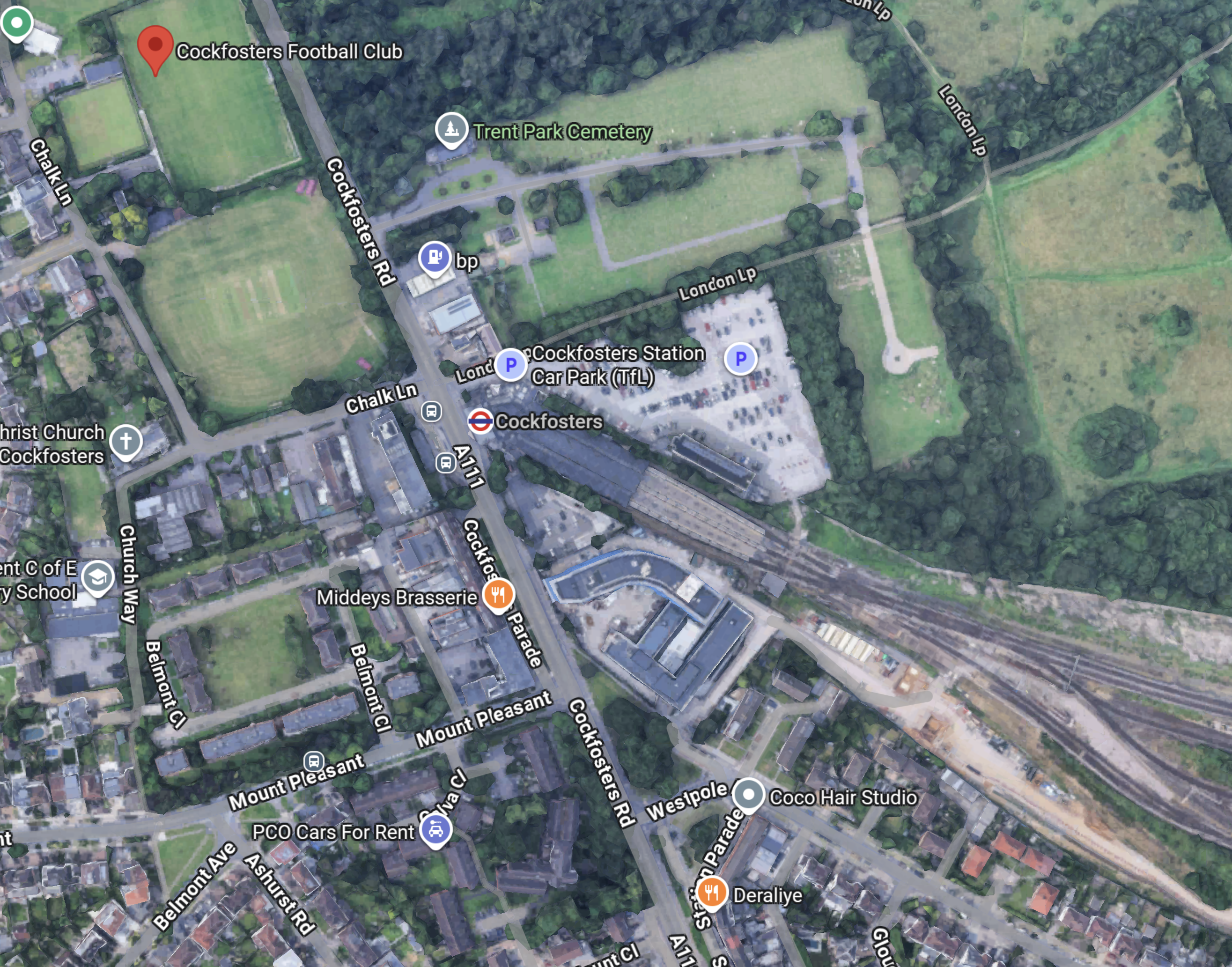
Note.
- The red arrow at the top of the map indicates Cockfosters F.C.
- Christ Church, Cockfosters is to the South of the football club.
- Cockfosters Road runs slightly diagonally down the map.
- Cockfosters station on the Piccadilly Line is indicated by the London Transport roundel.
- Cockfosters station has extensive car parking to the North-East of the station
- Cockfosters Depot is to the South-East of the station.
Our house was just off the Southern edge of the map, by Southgate School.
A 3D Image Of Cockfosters Station
This Google Map shows a 3D image of Cockfosters station and the buildings around it.

Note.
- Cockfosters station is indicated by the roundel.
- The station is a Grade II Listed building.
- The station has an elevation of 97 metres.
- Half of the station car park is going to be turned into housing.
- Trent Park lies to the North of the station.
- The road in front of the station is Cockfosters Road, which to the North joins the M25 at Junction 24.
- The building between Cockfosters Road and the railway used to be offices, but it is now being converted into starter housing.
In Starter Homes At Cockfosters, I write about starter homes being developed on the South side of the station.
Artificial Intelligence On The Housing In The Car Park
I asked Google AI the question in the title of this post and received this answer.
Places for London (Transport for London’s property arm) and Barratt London are building 373 residential apartments across four tower blocks on the former Cockfosters Station car park site. The largely car-free, mixed-use scheme includes 40% affordable housing, new public open spaces, and revamped TfL staff facilities.
Key Project Details
Total Homes: 373 apartments (a mix of 1, 2, and 3-bedroom properties).
Housing Tenure: All flats will be built for rent, with 40% of them allocated as “affordable” (including social rent and intermediate housing).
Building Heights: Four tower blocks ranging between 5 and 15 storeys tall.
Station Parking: The development is largely car-free.
Around 68 parking spaces will be retained at the station, including 12 dedicated Blue Badge spaces.
Public Amenities: The scheme introduces about 4,500 square meters of publicly accessible open space, children’s play areas, cycle storage, and minor commercial floor space.
Development Background
While planning permission for housing on the site was originally granted by Enfield Council in 2022, the project faced years of delays.
In late 2025 and early 2026, revised plans were submitted to add an extra storey to each building to accommodate updated fire safety legislation—adding 22 more homes to the initial 351 proposal.
You can track local planning updates and track progress via the Enfield Council Planning Portal.
I have some thoughts about this development.
Was There Any Opposition To Building Flats On Cockfosters Station Car Park?
From when I lived in the area, I remember that Cockfosters car park was well used in the 1960s and that trains on the Piccadilly Line were exceedingly busy, as I sometimes used to get them to travel to school.
I asked Google AI the question in the title of this section and received this answer.
Yes, there was intense opposition to the proposal to build flats on the Cockfosters Station car park.
The plans to build over 350 homes across blocks reaching up to 14 storeys faced major pushback from local residents, commuters, and Conservative MPs.
The primary points of contention included:
Loss of Parking: Opponents were concerned that wiping out hundreds of park-and-ride parking spaces would reduce the station’s accessibility.
It sparked fears that it would increase traffic on local roads and make journeys impossible for many, particularly blue-badge holders.
Over-development: The proposed height and density were heavily criticized for being out of character for the surrounding outer-suburb.
Heritage and Green Belt Impact: Residents argued that the massive tower blocks would negatively impact the neighboring Trent Park Conservation Area and the Charles Holden-designed Grade 2-listed station building.
Despite the controversy—which generated nearly 3,000 objections and was temporarily halted by the government in 2022—the project was officially given the green light to proceed. You can find full details on the planning outcomes via the Enfield Council Planning Portal or by reviewing the BBC News coverage of the development’s approval.
Do Any Train Depots Have Housing On Top?
I feel that we should maximise housing and in estates like the Barbican, there is extensive housing on top of car parking and even some active railways.
So why not on top of train depots like Cockfosters?
I asked Google AI the question in the title of this section and received this answer.
Yes, train depots and railyards increasingly feature housing built directly on top of them. Because large, open plots are scarce in dense cities, decking over active railway infrastructure has become an innovative engineering solution to generate new residential spaces.
Prominent examples of housing built over railway land include:
Royal Mint Gardens (London, UK): luxury residential and mixed-use development built directly above active train tracks on the approach to London Fenchurch Street.
Hudson Yards (New York, USA): The largest private real estate development in the U.S. features numerous residential skyscrapers built on a massive elevated platform constructed directly over the active John D. Carolan West Side Yard.
North Manhattan Rail Yards (New York, USA): Several multi-family residential projects, such as the Triangle Equities development over the MTA’s East 180th Street depot, utilize air rights to stack housing above active transit operations.
Hong Kong (Global Pioneer): Many of the city’s MTR depots (such as the Tseung Kwan O or Siu Ho Wan depots) and their surrounding stations have extensive private residential estates (known as Rail + Property Developments) built directly onto elevated decks atop the facility.
How is it done?
Building over a depot or railway requires constructing a heavy-duty “crash deck” or podium over the tracks. To prevent the noise, vibrations, and emissions of the trains from disturbing residents, developers use advanced building vibration isolation techniques. The residential buildings are structurally separated from the rail lines using specialized acoustic bearings and shock-absorbing foundations.
As we haven’t got the land in our big cities we should go for it.
Is The New London Museum Built Over Train Tracks?
This link shows all my posts on the new London Museum, as it will be called.
But what does Google AI say in answer to my question?
Yes, the new London Museum at Smithfield Market is built directly over and intertwined with active railway infrastructure.
The multi-billion-pound cultural project is located over or alongside a number of key transport elements:
Thameslink Tunnels: The subterranean galleries and historic brick vaults of the museum sit adjacent to active Thameslink railway lines that pass through a combined basement complex.
Historical Goods Depot: The museum’s underground level occupies what was originally the Great Northern Railway’s Farringdon goods depot.
Train Viewing Area: The museum features a specialized window where visitors can watch passing trains rumble by.
London Museum
To explore the building’s design, you can read more about it on the London Museum Buildings Guide.
News From Four Big Projects On The 15th May 2026
Are things hotting up in the offshore wind business in the UK? Or is it just a coincidence?
But these four projects were all announced on the 15th May 2026.
Aberdeenshire Council Greenlights Onshore Plans For 1 GW Scottish Floating Wind Project
The Buchan Offshore Wind consortium, comprising BayWa r.e., Elicio, and BW Ideol, has received planning consent from Aberdeenshire Council for the onshore infrastructure that will connect the proposed 1 GW Buchan floating wind farm to the grid. Commissioning in 2033.
Ocean Winds Receives Full Onshore Planning Consent for 2 GW Caledonia Offshore Wind Farm
Ocean Winds, a 50-50 joint venture owned by EDP Renewables and ENGIE, has received full onshore planning consent for its 2 GW Caledonia offshore wind farm following approval by Aberdeenshire Council’s Infrastructure Services Committee on 14 May. Commissioning in 2032.
UK Grants Development Consent For 3 GW Dogger Bank South Offshore Wind Project.
The UK Department for Energy Security and Net Zero has granted development consent for two Dogger Bank South (DBS) offshore wind farms, Dogger Bank South West and Dogger Bank South East, which are planned to have a combined installed capacity of 3 GW. Commissioning in 2031 (DBS West) and 2032 (DBS East).
RWE and SSE Secure Consent For 1 GW North Falls Offshore Wind Farm
The North Falls Offshore Wind Farm joint venture between RWE and SSE Renewables has been granted development consent for its 1 GW project by the UK Department for Energy Security and Net Zero (DSNEZ). Commissioning in 2030.
It looks like another 7 GW of onshore wind is on its way! The commissioning dates are my best estimates based on past history.
Digger Engines Drive JCB’s Attempt On Hydrogen-Powered Land Speed Record
The title of this post, is the same as that of this article in The Times.
This is the sub-heading.
The Hydromax is expected to exceed 350mph on Bonneville Salt Flats in August in a vehicle driven by the fastest man on earth — Wing Commander Andy Green
These three paragraphs introduce the story.
The British construction firm JCB will attempt to break the world hydrogen-powered land speed record this summer, using engines from the company’s latest diggers.
The record attempt will take place at the famous Bonneville Salt Flats in Utah, where Sir Malcolm Campbell broke the 300mph barrier in 1935 with Blue Bird.
The vehicle, driven by the fastest man on earth — Wing Commander Andy Green OBE — is a bespoke streamliner dubbed the JCB Hydromax.
My first job on leaving Liverpool University with a degree in Control Engineering, was in ICI’s hydrogen plant at Runcorn.
In those days, ICI had little use for the gas and except for use as a feedstock for some niche and unusual products, and research all over the country, most of the gas produced was mixed with coal gas and sent down the power station to raise steam.
But talk around the Research Department on Runcorn Heath and some older employees had memories from World War II of hydrogen being used in transport experiments.
I asked Google AI,”Was Research In World War II In The UK Done Into Hydrogen Powered Vehicles?” and received this answer.
Yes, research and development into hydrogen-powered systems were conducted in the UK during World War II, primarily focused on fuel cells for submarines rather than hydrogen-powered road vehicles, which were more commonly powered by “coal gas” or “producer gas”.
So I suspect Runcorn provided the hydrogen for the research.
In Sutton Station To Gatwick Airport By Hydrogen-Powered Bus, I describe how I made the trip to the airport in a hydrogen-powered bus. And all for free because I have a Freedom Pass and in a mouse-quiet vehicle!
These buses from Wrightbus in Northern Ireland are superb influences for the use of hydrogen as a zero-carbon fuel.
Hopefully, the JCB Hydromax will persuade more people to think positively of hydrogen.
I wish Lord Bamford and his team, the best of luck.
UK Offshore Wind In 2030 – Calculated June 2026
The next general election is likely to be held in 2029, so how much wind energy will be added before the next Parliament?
The Current Position
The Wikipedia entry for the list of operational wind farms in the UK, says this.
In July 2025, there were offshore wind farms consisting of 2,809 turbines with a combined capacity of 16,035 megawatts.
Due To Be Commissioned In 2026
It would appear these wind farms will come on-line in 2026.
- Dogger Bank A – 1235 MW – Fixed
- Sofia – 1400 MW – Fixed
This would add 2 wind farms and 2635 MW to give a total of 18,670 MW.
Due To Be Commissioned In 2027
It would appear these wind farms will come on-line in 2027.
- Dogger Bank B – 1235 MW – Fixed
- Dogger Bank C – 1218 MW – Fixed
- East Anglia 1 North – 800 MW – Fixed
- East Anglia 2 – 900 MW – Fixed
- East Anglia 3 – 1372 MW – Fixed
- Hornsea 3 – 2852 MW – Fixed
- Inch Cape – 1080 MW – Fixed
- Llŷr 1 – 100 MW – Floating
- Llŷr 2 – 100 MW – Floating
- Norfolk Boreas – 1380 MW – Fixed
- Pentland – 100 MW – Floating
- Whitecross – 100 MW – Floating
This would add 12 wind farms and 11237 MW to give a total of 29,907 MW.
Due To Be Commissioned In 2028
It would appear these wind farms will come on-line in 2028.
- Morecambe – 480 MW – Fixed
This would add 1 wind farm and 480 MW to give a total of 30,387 MW.
Due To Be Commissioned In 2029
It would appear these wind farms will come on-line in 2029.
- Mona – 1500 MW -Fixed
- West Of Orkney – 2000 MW – Fixed
This would add 2 wind farms and 3500 MW to give a total of 33,887 MW.
Due To Be Commissioned In 2030
It would appear these wind farms will come on-line in 2030.
- Ramplion 2 Extension – 1200 MW – Fixed
- Norfolk Vanguard East – 1380 MW – Fixed
- Norfolk Vanguard West – 1380 MW – Fixed
- Awel y Môr – 1100 MW – Fixed
- Berwick Bank – 4100 MW – Fixed
- Outer Dowsing – 1500 MW – Fixed
- Caledonia – 2000 MW – Fixed
- N3 Project – 495 MW – Fixed/Floating
- North Falls – 504 MW – Fixed
This would add 9 wind farms and 13,659 MW to give a total of 47,656 MW.
Due To Be Commissioned In 2031
It would appear these wind farms will come on-line in 2031.
- Awel y Môr – 775 MW – Fixed
- Berwick Bank – 1380 MW – Fixed
- Dogger Bank SW – 1500 MW – Fixed
- Morven Phase 1 – 1500 MW – Fixed
- Spiorad na Mara – 840 MW – Mixed
This would add 5 wind farms and 5,995 MW to give a total of 53,651 MW.
Due To Be Commissioned In 2032
It would appear these wind farms will come on-line in 2032.
- Caledonia – 2000 MW – Fixed
- Dogger Bank SE – 1500 MW – Fixed
- Seagreen Phase 1A – 500 MW – Fixed
This would add 3 wind farms and 4,000 MW to give a total of 57,651 MW.
Due To Be Commissioned In 2033
It would appear these wind farms will come on-line in 2033.
- Ayre 1008 MW – Fixed
- Bowdun – 1008 MW – Fixed
- Buchan – 960 MW – Floating
- Morven Phase 2 – 1500 MW – Fixed
This would add 4 wind farms and 4,476 MW to give a total of 62,017 MW.
Due To Be Commissioned In 2035
It would appear these wind farms will come on-line in 2035.
- Dogger Bank D – 1320 MW – Fixed
- Mooir Vannin – 1400 MW -Fixed
This would add 2 wind farms and 2,720 MW to give a total of 64,737 MW.
Due To Be Commissioned In 2036
It would appear these wind farms will come on-line in 2036.
- Havbredey – 1,500 MW – Fixed
This would add 1 wind farm and 1,500 MW to give a total of 66,347 MW.
Capacity Summary
- 2025 – None – 16,035 MW
- 2026 – 2635 MW – 18,670 MW
- 2027 – 11237 MW – 29,907 MW
- 2028 – 480 MW – 30,387 MW
- 2029 – 3500 MW – 33,887 MW
- 2030 – 13,659 MW – 47.656 MW
- 2031 – 5,995 MW – 53,651 MW
- 2032 – 4,000 MW – 57,651 MW
- 2033 – 4,476 MW – 62,127 MW
- 2034 – None – 62,127 MW
- 2035 – 2,720 MW – 64,847 MW
- 2036 – 1,500 MW – 66,347 MW
Note.
- The first figure is my estimate of what will be added in the year.
- The second figure is my estimate of what will be the total at the end of the year.
- Currently, we’re generating and importing a total of 29.33 GW.
We’re still be adding capacity into the 2030s.
The Average Size Of A Wind Farm
This is 1.26 GW.
Campaign Saves Airport Upgrade After Reform Council Threatened Funding Cut
The title of this post, is the same as that of this article from Construction News.
These three paragraphs introduce the story.
A campaign by a coalition of interests has protected £57m of council funding for an upgrade to Doncaster Sheffield Airport, which was at risk.
The GMB union said Reform councillors had threatened to cancel the loan for upgrades to the airport, but that a campaign by unions, workers and politicians had resolved the situation.
Doncaster Sheffield Airport has been closed since 2022, when its then owner Peel Group said the site was “not commercially viable”.
Does this mean that Reform UK want Doncaster Sheffield Airport?
The BBC and ITVX seem to be saying that the loan will go ahead.
Are Centrica Entering The Bunkering Market For Low-Carbon-Fuelled Ships?
I asked Google AI, the question in the title of this post and received this answer.
Yes, Centrica is actively entering the low-carbon shipping fuel market, specifically by strengthening its ability to supply bio-LNG (liquefied natural gas) for the shipping industry.
Key developments in 2026 indicate a strategic push into this sector:
Bio-LNG Expansion: Centrica Energy has strengthened its bio-LNG bunker fuel offering through ISCC certification.
Strategic Partnerships: Centrica is supporting Gasrec in the UK to supply bio-LNG and bio-CNG to fleets, and is investing in large-scale carbon storage at Morecambe Bay, which can serve shipping.
Decarbonisation Focus: This move aligns with Centrica’s target to become a net-zero business by 2040 and to support customer emission reductions.
This could be a nice little business.
Could A Gluten-Free Version Of The M & S Microwavable Full English Breakfast Be Created?
This link shows the product on the Ocado web site.
These are some details about the product.
- It costs £4
- It lasts two days including the delivery day.
- In How Much Vitamin B12 Is There In A Leon Full English Breakfast Egg Pot?, I got Google AI to analyse one of Leon’s very similar egg pots and these contain a good dose of B12.
These are the ingredients.
Baked Beans (50%) (Haricot Beans · Tomato Paste · Water · Sugar · Cornflour · Salt · Vinegar · Dried Onions · Natural Colour: Paprika Extract · Ground Paprika · Natural Flavouring · Garlic Extract · Onion Oil · Vegetable Oil (Sunflower/Rapeseed)) · British Pork Chipolata Sausages (20%) (Pork (73%) · Water · Wheatflour* · Pea Protein Isolate · Dextrose · Wheat Starch · Salt · Ground Spices (White Pepper · Black Pepper · Coriander · Mace · Nutmeg) · Dried Onions · Salt · Yeast Extract · Dried Sage · Raising Agent: E503) · Poached Egg (18%) · Chestnut Mushrooms (7%) · Smoked British Bacon (2.5%) (Pork Belly (made with 185g of Raw Pork per 100g of Cooked Bacon) · Curing Salt (Salt · Preservative: Sodium Nitrate, Sodium Nitrite) · Sugar · Natural Flavouring · Antioxidant: E301) · Rapeseed Oil · Salt · Coarse Black Pepper.
Sausages filled into natural pork collagen casings.
*Fortified with Calcium, Iron, Vitamins B3, B1 and Folic Acid.For allergens, including cereals containing Gluten, see ingredients in bold.
Note the added gluten, which can be swapped for a gluten-free flour.
How I Would Use These Meals
I was told by Addenbrooke ‘s Hospital, when I was first diagmosed as a coeliac to always start the day with a good meal, as if you are travelling the next meal might not be easy to find.
Given the rate at which coeliac-friendly restaurants are closing, no dietician ever made a better prediction.
So if say I was going to Liverpool for the day, I could put one of these in my fridge and have a good breakfast before I leave home. This also means I can leave home earlier and catch an earlier train.

