Effects Of The ULEZ In West London
This page on the Transport for London web site is entitled ULEZ Expansion 2023.
This is the first paragraph.
To help clear London’s air and improve health, the Ultra Low Emission Zone (ULEZ) is expanding across all London boroughs from 29 August 2023.
These are some points from the rest of the page.
- Poor air quality is impacting the health of Londoners, and it’s mainly caused by polluting vehicles.
- Air pollution even contributes to the premature death of thousands of Londoners every year.
- 9 out of 10 cars seen driving in outer London already meet the ULEZ emissions standards.
- If you drive anywhere within the ULEZ and your vehicle does not meet the emissions standards, you could face a daily charge of £12.50.
- Residents of the ULEZ are not exempt from the charge.
- Any money received from the scheme is reinvested into running and improving London’s transport network, such as expanding bus routes in outer London.
There is no reference to trucks or HGVs.
These are my thoughts.
Objections To The ULEZ
If you type ULEZ into Google and look at the News page, you get a lot of stories that don’t show the ULEZ in a good light.
Here are a few headlines.
- BBC – ULEZ: Labour MPs Seek Support For Non-Londoners
- BBC – Firms In Essex Could Close Due To ULEZ, Warns Business Leader
- Big Issue – London’s Ulez Plans Could Hit Disabled People, Charities And Small Businesses The Hardest
- Daily Mail – Sadiq Khan Claims That Nazis Have Infiltrated Anti-Ulez Protests
- Guardian – EU Motorist Fined Almost £11,000 After Falling Foul Of London Ulez Rule
- Guardian – London’s Mayor Faces High Court Challenge Over Ulez Expansion
- Kent Live – Anti-ULEZ Campaign Group Support Soars As Kent Drivers ‘Unfairly Targeted’
- LBC – No More Ulez? Sadiq Khan Considers Scrapping Controversial Scheme And Replacing It With ‘Pay-As-You-Drive’ System
- Slough Observer – Ulez Faces High Court Challenge
- Which? – Why It Could Cost £17.50 To Drop A Loved One At Heathrow This Summer
It looks like Sadiq Khan has fallen into a hole.
And he hasn’t stopped digging!
To make it worse, he has suggested a Pay-As-You-Drive System. I seem to remember, that a Dutch Prime Minister, who tried it, lost the next election.
But then Sadiq Khan likes tolls as the new Silvertown Tunnel and the Blackwall Tunnel will be tolled in a few years.
Heathrow Airport
Heathrow Airport is one of the world’s busiest airports and 76,000 people work at the airport, with many more employed nearby.
The airport handled 61.6 million passengers in 2022, which is a few short of 170,000 per day.
If you consider that those that work at the airport do two trips per day and passengers generally do one, that means there are 322,000 trips per day to or from the airport.
But as it now so easy to get to the Airport using the Elizabeth Line will more people use the new line to meet and greet and say goodbye to loved ones or business associates. Since the Elizabeth Line opened, I’ve met a couple of friends at Heathrow, who were passing through.
I wonder, if that daily journey total of 322,000 could be nearer to 350,000 or even 400,000.
If the ULEZ charge makes some passengers and staff switch from their car to using a bus or train, this probably means that public transport to and from the airport, will need to be boosted by a substantial amount.
But improving public transport to Heathrow wouldn’t be easy.
- The Elizabeth Line seems to have put a big hole in the finances of Heathrow Express.
- How many more trains can be squeezed into the Heathrow Tunnel?
- The Western Rail Link to Heathrow would probably need to be built. But that seems to be in limbo.
- New trains for the Piccadilly Line are a few years away.
It might have been better to build a different scheme for Western access to Heathrow like the Heathrow Southern Railway.
I suspect that there will be a lot more passengers on the Elizabeth Line to and from Heathrow.
A ULEZ For Heathrow
This article on fleetworld, from four years ago, is entitled Heathrow To Introduce Charging ULEZ In 2022.
It hasn’t happened, but that doesn’t mean it won’t be implemented in the future.
If it did happen, there would be more passengers for the Elizabeth Line.
The Elizabeth Line
I have written three posts about how busy the Western section of the Elizabeth Line can get.
- Very Busy Lizzie
- Elizabeth Line: Commuters Say Service ‘Not What Was Promised’
- So Many Cases On A Train!
Is there sufficient capacity to accommodate all the ULEZ-dodgers on the trains to and from Heathrow?
To make matters worse, there is a large Asian population from the Indian sub-continent living along the Elizabeth Line between Ealing Broadway and Reading.
- They seem to be enthusiastic users of the line.
- Having ridden several times on crowded Indian trains, perhaps using trains is very much part of South Asian culture.
- I also suspect that a lot of Indian families have spread themselves along the line, just like my mother’s close family spread themselves along the 107 bus route.
In Very Busy Lizzie, I said this.
Reading needs four tph to Central London.
The ULEZ will make this even more essential.
The Piccadilly Line
The Piccadilly Line may be getting new trains, but it is not a line that is blessed with lots of step-free stations.
The West London Orbital Railway
It does appear that the West London Orbital Railway may be more likely to be built, than a few months ago.
In Is There Progress On The West London Orbital Railway?, I wrote about a report, that consultants were being chosen.
This railway could ease pressure on the railways in West London.
Cutting Pollution In London From Trucks
London like all big cities has a lot of trucks.
As the average truck has a much larger engine than the average car, I would suspect it gives out more pollution.
One way to cut pollution from large vehicles would be to run them on hydrogen.
But unlike some cities in the UK, London has no hydrogen policy and filling stations to fill them up.
The Mayor could at least get a workable hydrogen policy.
Conclusion
I suspect the next Mayor of London will have to have a rethink on the ULEZ and implement a hydrogen policy.
East-West Rail: Bedford’s Mayoral Candidates Split On Rail Project
The title of this post, is the same as that of this article on the BBC.
This is the first sentence.
Part of the route of the controversial East-West Rail project will not be decided before we know the winner of Bedford’s mayoral elections.
Unfortunately, the four candidates for Mayor all seem to have different ideas for East-West Railway through the town.
I have a few thoughts and observations.
Thameslink
Thameslink has the following connections to the East West Railway.
- Four tph at Bedford.
- Three tph at Cambridge.
Note.
- tph is trains per hour.
- All Bedford trains terminate at Bedford.
- The half-hourly Luton Airport Express between London St. Pancras and Corby stops at Luton Airport Parkway, Luton, Bedford, Wellingborough and Kettering.
- Cambridge trains may extend to Cambridge North station.
- Cambridge has additional through services between London King’s Cross and Ely and/or King’s Lynn.
Both Bedford and Cambridge will be busy stations.
Extra Tracks At Bedford
Bedford station has four tracks; two which are generally used by Thameslink services and two main lines used by through trains.
- The fast lines must accommodate the following trains.
- East Midlands Railway – 6 tph in both directions. Two tph stop in Bedford station.
- Freight Trains – 2 tph in both directions.
- East West Railway – 2 tph in both directions. All trains will stop in Bedford station.
It strikes me, that the station may need at least one and possibly two extra tracks.
If there are extra tracks, there will need to be some demolition of houses.
Freight Trains
In Roaming Around East Anglia – Newmarket Station, I wrote this about the plans of the East West Rail Consortium in the area.
In this document on the East-West Rail Consortium web site, this is said.
Note that doubling of Warren Hill Tunnel at Newmarket and
redoubling between Coldham Lane Junction and Chippenham Junction is included
in the infrastructure requirements. It is assumed that most freight would operate
via Newmarket, with a new north chord at Coldham Lane Junction, rather than
pursuing further doubling of the route via Soham.
So would it be possible to create a double-track railway through Newmarket station?
In the related post, I came to this conclusion.
Newmarket can benefit from East West Rail, but the two parties must agree objectives that don’t cause problems for the other.
But I do think, that Newmarket will not welcome the building of a double-track railway through the town.
I do wonder, if the East West Rail Consortium plan to run freight trains between Felixstowe and South Wales and the West of England through Bedford and Oxford.
Four freight tph, through Bedford would certainly need extra tracks and the demolition of houses in the centre of Bedford.
Electrification
Two of the candidates for Bedford’s mayor, think that the line needs to be electrified.
As the route is full or partially-electrified at Didcot, Bletchley, Bedford and Cambridge, I believe that battery-electric trains could handle the route.
But then there are no plans to purchase any passenger trains of this type.
Freight trains would still need to be diesel hauled, unless more progress is made fairly quickly in the development of hydrogen-powered freight locomotives.
The Cambridge Effect
Cambridge is one of the most important cities in the world, because of its strength in innovation in high technology industries.
But Cambridge is bursting at the seams and needs more space for laboratories, advanced manufacturing and housing.
A fully-developed double-track and electrified East West Railway would open up Bletchley, Milton Keynes, Bedford, Newmarket, Bury St. Edmunds and Ipswich to act as satellites to help Cambridge build a shared and successful future.
The Felixstowe Effect
If Cambridge will stimulate the growth of passenger traffic, then Felixstowe will promote the growth of East-West freight traffic.
Conclusion
It may not be initially built that way, but probably by 2040, the East West Railway will be a fully-electrified double-track railway between Didcot and Felixstowe.
Extra tracks will also be needed through Bedford. This will mean demolition of houses.
UK Government Grants £30 Million For Long Duration Energy Storage Projects
The title of this post, is the same as that of this article on Solar Power Portal.
These two paragraphs outline the grants and their recipients.
The UK Department for Energy Security and Net Zero (DESNZ) is providing £30 million in grants for three long-duration energy storage (LDES) projects using novel energy storage technologies.
The three projects awarded funding are from Synchrostor, Invinity Energy Systems and Cheesecake Energy. Synchrostor and Cheesecake Energy are to receive £9.4 million each to fund thermal energy storage systems and Invinity Energy Systems receiving £11 million to develop a vanadium flow battery.
The UK Government seems to give out a lot of these grants for research and development purposes and from feedback I have received from recipients and also by applying my own experience, I am of the opinion, that they are spending tax-payers money more in a wise, rather than a foolish direction.
Cheesecake Energy
I wrote about Cheesecake Energy’s grant in Cheesecake Energy Collects £9.4m Government Funding.
The Government’s press release says this about Cheesecake’s grant.
Cheesecake Energy Ltd, Nottingham, which will receive £9.4 million to test their FlexiTanker technology which stores electricity using a combination of thermal and compressed air energy storage and uses a reversible air compression / expansion train to charge and discharge. They will then install pilot units at 2 sites within a microgrid development in Colchester.
If this project proves successful, it surely is one that can be duplicated in many places.
I have had my eye on Cheesecake Energy for some time and this could be their breakthrough.
Invinity Energy Systems
I first wrote about Invinity Energy Systems in UK’s Pivot Power Sees First Battery On Line By 2021.
The Government’s press release says this about Invinity’s grant.
Invinity Energy (UK) Limited, Scotland, which will receive £11 million to develop and manufacture their 7MW, 30MWh 4-hour Vanadium Flow Battery (VFB), the largest in the UK. Invinity will manufacture the 30 MWh VFB at the Company’s factory in West Lothian, Scotland. The location of the plant will be confirmed in due course.
In this article on renews.biz, which is entitled Invinity Wins Funds For 30MWh UK Battery, these two paragraphs introduce the project.
Invinity Energy Systems plc has today been awarded £11m in funding by the Department for Energy Security and Net Zero to build what it says is the largest grid-scale battery ever manufactured in the UK.
The £11m in funding will come from the Longer Duration Energy Storage Demonstration (LODES) Competition, with funding matched by Invinity’s, as yet unnamed, project partner.
These are other points from the article.
- It will be a fast-response 30MWh battery.
- The battery will be assembled at Bathgate in Scotland.
- It will operate as a stand-alone energy storage asset.
- It will be connected to the National Grid.
- Invinity’s vanadium flow batteries are an alternative to lithium-ion.
The aim is to go live by 2025.
This paragraph indicates the differences between a vanadium flow battery and a traditional lithium ion one.
Invinity said this battery is safer as they cannot catch fire, more durable as they do not degrade with use and are almost completely recyclable at the end of their 25+ year life, reducing environmental impacts and disposal costs for project owners.
I believe that there will come a point, when fully-developed vanadium flow batteries, will become very attractive for financial reasons to the successful energy storage funds like Gresham House and Gore Street.
If the UK government’s funding hastens the day, when energy storage funds feel that these new-fangled vanadium flow batteries are a safe investment, then it is money well spent.
It is not as though the money is going to an early start-up, as this page on the Invinity Energy Systems web site indicates at least a dozen installations.
This project for an as yet unnamed customer, which has a capacity of 30 MWh, is probably much bigger and the Government help is probably very much welcomed.
SynchroStor
SynchroStor was new to me, today.
The Government’s press release says this about SynchroStor’s grant.
Synchrostor, Edinburgh, Scotland, which will receive £9.4 million to build a Pumped Thermal Energy Storage (PTES) grid-connected demonstration plant operating at 1MW, with the ability to charge and discharge for a period of 10 hours, longer than current battery technology.
This page named Technology on their web site, explains their technology, both with words and diagrams.
It is probably the most complex technologies of the three batteries, but I don’t think that will be a problem.
Conclusion
The Government has given grants to three different storage technologies.
If all goes well three good sizable pilot plants will be created and those companies like Centrica, Gore Street, Gresham House, National Grid, Ørsted, SSE and others, will be able to judge, which system is best for their needs.
Manchester For The Weekend By Air?
For some weeks now, Manchester has been advertising itself as a weekend break on the giant advertising screen over Silicon Roundabout.












The adverts also seem to be backed by British Airways and are advertising flights from London City Airport.
Perhaps, these are in response to Avanti West Coast’s problems?
Moorgate And Luton Airport Parkway
This morning I went by train from Moorgate to Luton Airport Parkway to have a look at the Luton DART.
I used the following route.
- Elizabeth Line – Moorgate to Farringdon.
- Thameslink – Farringdon to Luton Airport Parkway.
I came back from Luton Airport Parkway on a Luton Airport Express.
I took these pictures on the route.
























Note.
- The change at Farringdon station was very easy.
- You walk past toilets at the Farringdon change.
- There are two bridges, lots of escalators and lifts at Luton Airport Parkway station.
- I didn’t take the DART to the airport.
These are some detailed thoughts.
Luton Airport Parkway Station
It is a much improved station, but still has some work to do.
- There was a problem with one escalator.
- Some of the signage is not finalised.
- I had a problem with ticketing, as I was sold the wrong ticket.
- Staff probably need a bit more training.
But then the station has only been open three weeks.
Luton Airport Express
East Midland Railway’s St. Pancras and Corby service is now branded as Luton Airport Express.
- It has its own web site.
- Trains only stop at Luton Airport Parkway, Luton, Bedford, Wellingborough and Kettering.
- Trains take as little as twenty-two minutes between St. Pancras and Luton Airport Parkway.
- Class 360 trains are used.
- Trains run every thirty minutes.
As it serves the local area, I wonder how many airport employees, now use this train to get to work?
Is There Progress On The West London Orbital Railway?
This short news item is being shown on Railnews under a sub-heading of Overground Plan.
The Mayor of London Sadiq Khan is reported to have predicted that a new London Overground route in west London could be open by the early 2030s. The link had been proposed by the Mayor in his 2018 Transport Strategy. It would run from Hounslow to Acton Central and the new HS2 station at Old Oak Common. From there it would continue to Acton Wells Junction and then along the Dudding Hill line, which is presently used only for freight, via the existing stations on the Euston-Watford Overground route at Harlesden and the Jubilee Line station at Neasden. Trains would continue from Neasden along the Midland Main Line in both directions to West Hampstead Thameslink and Hendon. It is understood that engineering consultants are being chosen to develop a detailed design.
So is there progress at last on what I feel is a much-needed and affordable addition to London’s railway network?
The West London Orbital Railway
In TfL Advances Plans For DLR And Overground Extensions, I said the following about the West London Orbital Railway.
I have written extensively about this railway and you can see my posts here.
This map from the Mayor’s Transport Strategy shows the route.
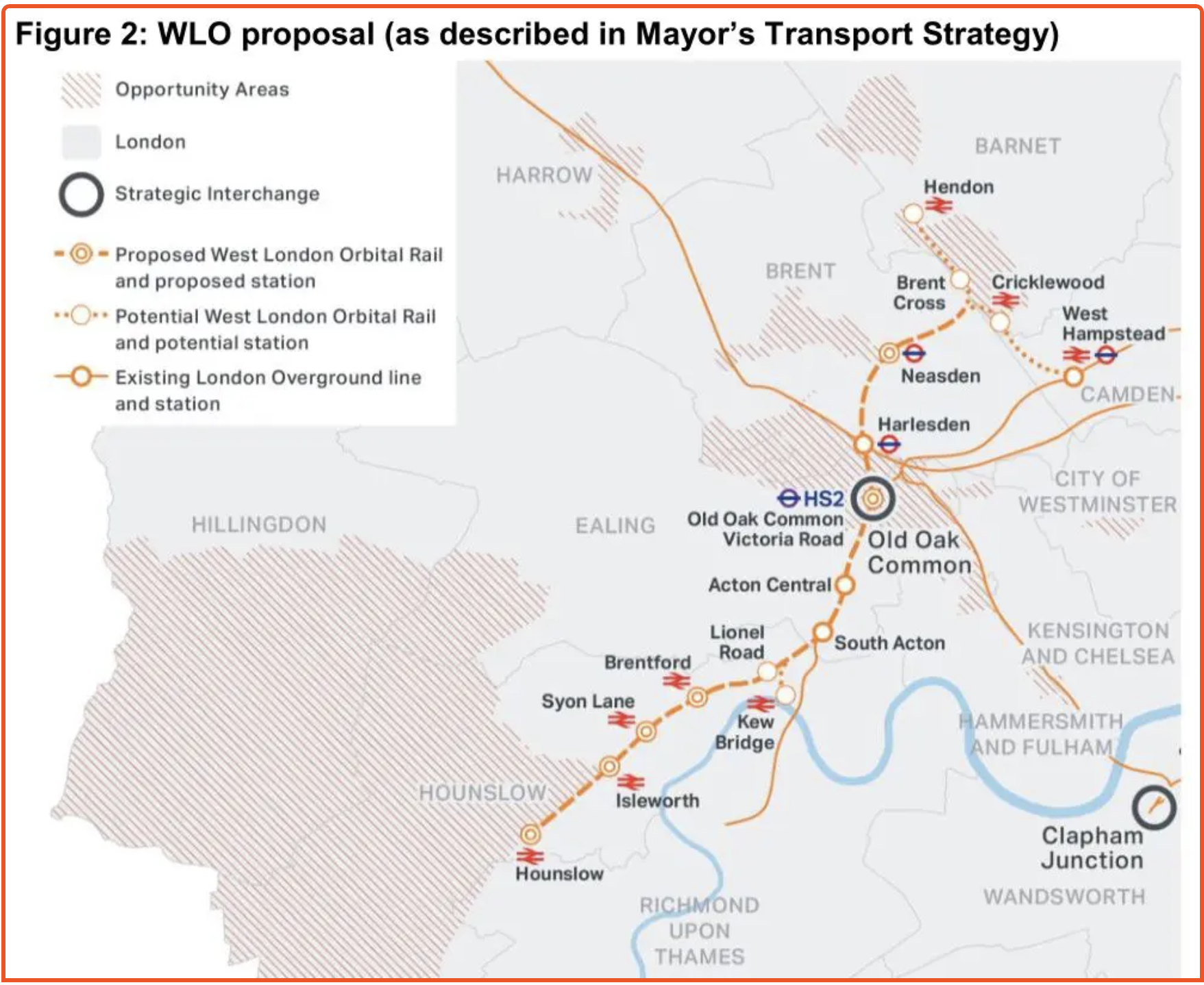
I believe this railway could do the following.
- Level-up much of North-West London.
- Provide better access to Heathrow.
- Link West London to High Speed Two and the Elizabeth Line.
It would also provide better links to Brentford’s new stadium.
The New Civil Engineer says this about funding.
TfL now confirms that the West London Alliance has commissioned feasibility work for the scheme. Meanwhile, TfL is considering options for a Borough Community Infrastructure Levy to help pay for it and has been investigating development opportunities on the route that could unlock funds via Section 106 planning obligations and Carbon Offset funding.
Conclusion
It does appear there are ways and means to fund these schemes, without expecting the rest of the UK to fund London’s transport network.
Cheesecake Energy Collects £9.4m Government Funding
The title of this post, is the same as that of this article on UKTN.
These two paragraphs outline how they will use the grant.
Cheesecake Energy will use the government funding to install its energy storage solution as a microgrid in Colchester to help with local grid limitations.
University of Nottingham spinout Cheesecake Energy’s installation will collect energy made by a solar farm with a capacity of 8MW and a central heat pump that supplies a district heat pump network.
Cheesecake Energy have been on my list of possible successful energy storage systems for some time and this sounds like a very neat application for energy storage.
Cheesecake Energy bill themselves on their web site as The World’s Greenest Battery, which is a big claim to make.
This outline of their technology is given on their Our Technology page.
Cheesecake Energy’s eTanker energy storage system is a stationary, medium to long-duration energy storage solution which delivers cheap, reliable, efficient energy storage in a modular, containerised package.
The technology stores energy in the form of heat and pressurised air, re-tasking ex-service truck engines to become zero-emission electrical power-conversion machines for putting energy into storage and recovering it from storage. The resulting system does not use diesel or any fuel. It is safe, straightforward to operate, has a lifetime of up to 25 years and can deliver turnaround efficiencies of around 70%.
I like the idea of using recycled truck engines at the heart of the system.
Conclusion
The World’s Greenest Battery could be right!
N-Sea To Connect German Offshore Wind Farm To Dutch Gas Platform
The title of this post, is the same as that of this article on offshoreWIND.biz.
This is the sub-heading.
Dutch upstream oil and gas company, ONE-Dyas, has awarded N-Sea with a contract to install a subsea power cable between the Riffgat offshore wind farm in the German North Sea and the new, to-be-built N05-A gas production platform.
At a first look it appears that wind power is being used to power the gas production platform.
Other points from the article include.
- The distance of the connecting cable is ten kilometres.
- The Dutch government approved the scheme in June 2022.
- A final investment decision was made in September 2022.
I have some thoughts and further information.
Borkum, Rottumerplaat and Schiermonnikoog
The article says this about the position of the gas platform.
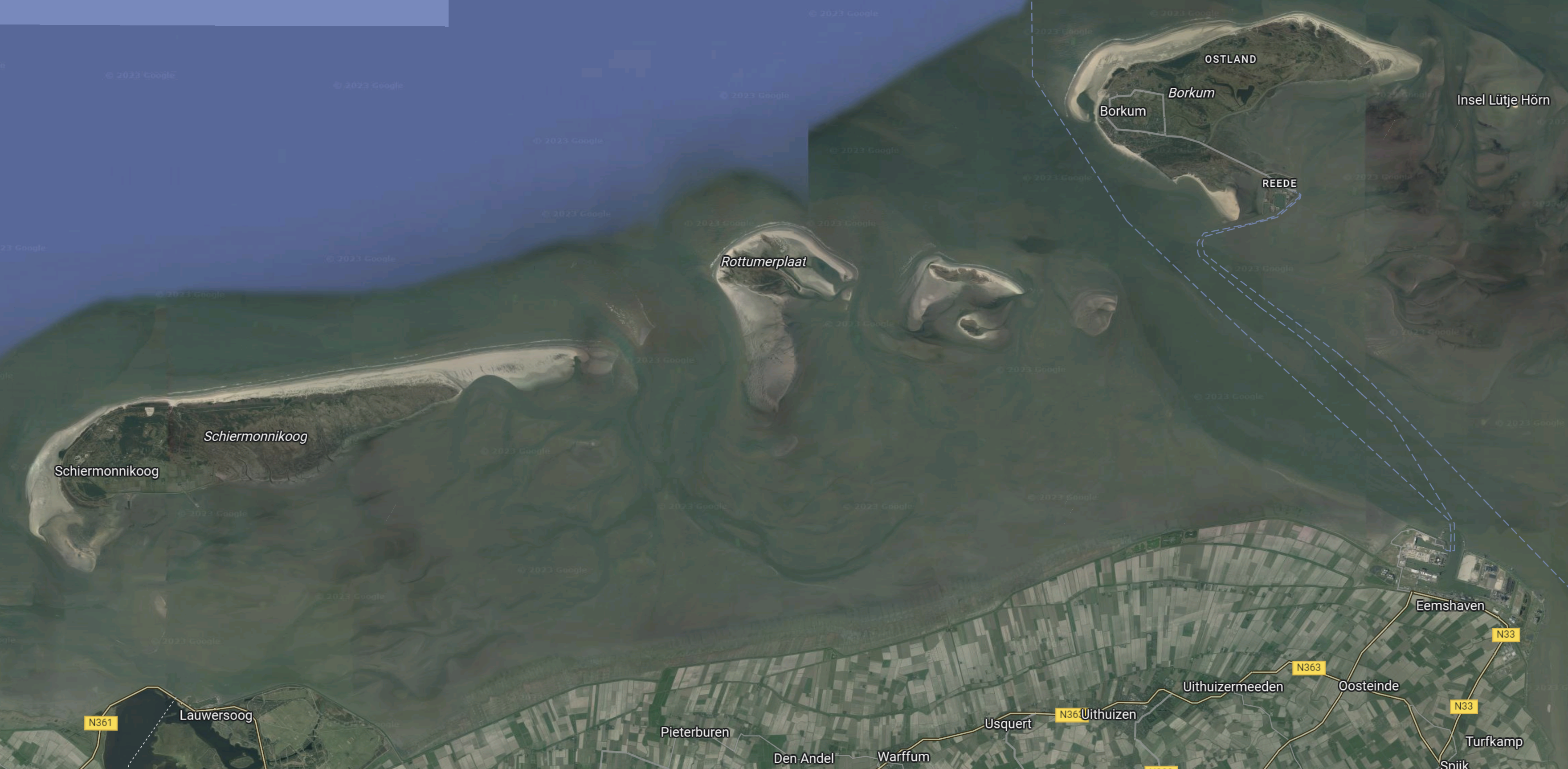
The N05-A platform will be installed some 20 kilometres north of the islands of Borkum, Rottumerplaat and Schiermonnikoog, and approximately one and a half kilometres from German waters.
This Google Map shows the three islands.
Note.
- Borkum is the horseshoe-shaped German island in the North-East corner of the map.
- Schiermonnikoog is the long and thin island in the West.
- Rottumerplaat is the larger of the two Dutch islands in middle map.
- Eemhaven, which I wrote about in The Train Station At The Northern End Of The Netherlands, is in the South-East corner of the map.
Shipping routes run up the River Ems and German-Dutch border in the East of the map
Riffgat Wind Farm
This web page on the EWE web site, gives this description of the wind farm.
EWE has built the first commercial wind farm in the German North Sea in summer 2013 with Riffgat. The modern wind farm has a total capacity of 108 megawatts of power and can supply around 120,000 households with environmentally friendly electricity. In just 14 months of construction, the 30 wind turbines of the 3.6 megawatt class have been installed 15 kilometers off the north seas of Borkum. The rotor diameter of the units is 120 meters, while the hub height is 90 meters, which corresponds to the height of the Bremen dome. Overall, the plants are 150 meters high from the water surface to the top rotor blade tip. They are founded on 70 meter long steel foundations (monopiles), 40 meters deep in the sea bottom. The water depth in the wind farm is between 18 and 23 meters. In addition to the wind power plants, Riffgat also consists of a substation which transports the generated electricity to a better transportable voltage level.
It looks a pretty standard 100 MW wind farm with fixed foundations.
The N05-A Platform
The article says this about the N05-A project.
The N05-A project is part of the so-called GEMS area, an area approximately 20 to 80 kilometres north of the Ems estuary. ONE-Dyas, together with partners Hansa Hydrocarbons and EBN, aims to extract natural gas from the N05-A field as well as surrounding fields in the German and Dutch North Sea.
The GEMS area has a web site with a URL with a .co.uk extension.
It has an informative video, which I don’t think would go down with Dutch chapter of Just Stop Oil.
The North Sea’s First Gas Platform To Run Entirely On Wind Power
The article says this about the N05-A project.
While the N05-A platform will not be the first in the North Sea to run on wind energy, it will be the first to do so entirely.
Hywind Tampen floating wind farm will be the first.
Conclusion
This looks like a good pragmatic solution to me.
I can see more connections between offshore wind farms and oil and gas facilities all over the world.
Farewell! Mary Quant!
This is a true story I heard, when I worked for ICI.
Do you remember those horrible drip-dry shirts, that men used to wear in the 1960s?
I suspect I took some to University, as my mother felt I could wash them.
Did you know that Mary Quant was partly responsible for their demise?
Mathematics tell us, that a pair of tights need a lot more nylon, than a pair of stockings.
As Mary Quant got a lot more ladies wearing tights to go with mini-skirts, there was a shortage of nylon.
ICI, who made much of the UK’s nylon, decided unilaterally to divert nylon from men’s shirts to ladies’ hosiery.
Bye bye! Nylon shirts!
RIP Dame Mary
BP And EnBW Hire Kent For 2.9 GW Scottish Offshore Wind Project
The title of this post, is the same as that of this article on offshoreWIND.biz.
This is the sub-heading.
Engineering and design service provider Kent has been awarded a contract by EnBW and BP to carry out pre-Front End Engineering Design (FEED) studies for the 2.9 GW Morven offshore wind project in Scotland.
Morven offshore wind farm would appear to be on its way.
According to Wikipedia’s list of UK offshore wind farms, the water depth in the Morven wind farm is between 65-75 metres.
- Total power is given as 2907 MW, which indicates that 14 MW turbines could be used.
- Siemens Gamesa 14 MW turbines have a blade length of 108 metres and their 10 MW have a blade length of 94 metres.
- This would seem to indicate that the wind turbine will be as much as 160 to 185 metres above the sea-bed.
A radical design of fixed foundation will be needed.
In Entrion Wind Wins ScotWind Feasibility Deal For Its 100-Metre Depth Foundation Tech, I look at technology that might work.
I also say this about work I did in Cambridge in the early 1970s.
The structures, I mathematically-modelled were for a company called Balaena Structures, that had been started by two Cambridge University engineering professors. The structures were about a hundred metres high and perhaps thirty metres in diameter.
They would have been built horizontally in the sort of dock, where you would build a supertanker and would have been floated into position horizontally. Water would then be let in to the cylinder and they would turn to the vertical. From that position, they would be lowered to the sea-bed by adjusting the water in the cylinder. They had a method of holding the Balaena to the seabed, which relied mainly on the weight of the structure and what they called the gum-boot principle.
Sadly, they never sold any platforms and the company folded.
Until recently, you could find the expired patents on the Internet.
I believe that a development of the Balaena design could be the solution to deep water fixed foundations.
 The Anonymous Widower