Thoughts On Extending The Northern Line To Clapham Junction
As I wrote in Northern Line Could Be Extended To Clapham Junction In Regeneration Plans, the extension of the newly-built extension to Battersea Power Station station could be further extended to Clapham Junction station.
Railways Between Battersea And Clapham
This map from OpenRailwayMap shows the tracks that run between the two stations.

Note.
- Battersea Power Station station is in the North-East corner of the map.
- The orange and yellow lines going North from that corner go to Victoria station.
- The orange and yellow lines going North-East from that corner go to Waterloo station.
- The yellow line going West is the West London Line to Shepherds Bush and Willesden Junction stations.
- Clapham Junction station is in the South-West corner of the map.
I estimate that the distance between Battersea Power Station and Clapham Junction stations is about three kilometres.
This map from OpenRailwayMap shows an enlargement of the tracks around Battersea.
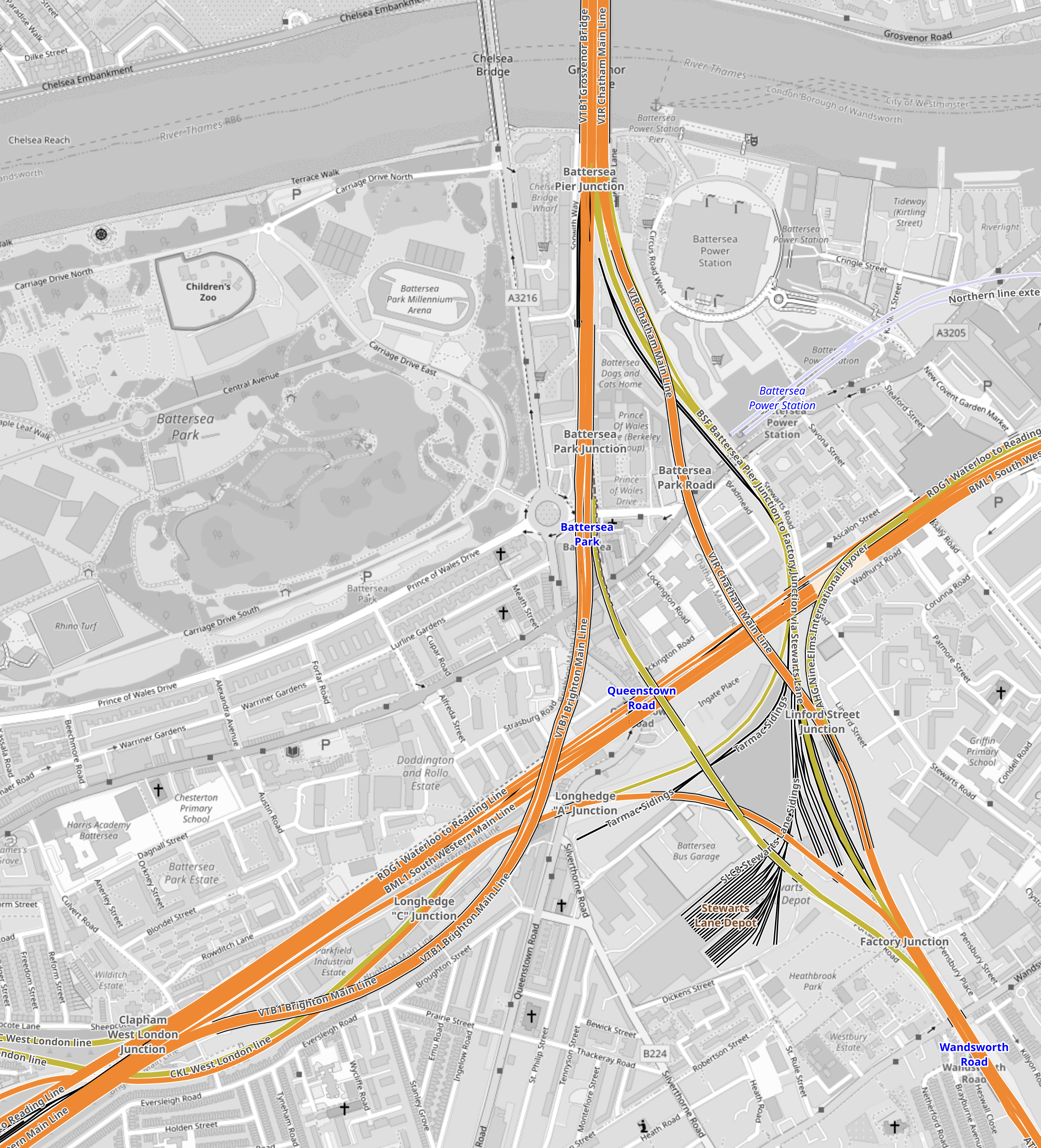
Note.
- The tracks going North over the River to Victoria station.
- The tracks going East to Waterloo station.
- The tracks going South West to Clapham Junction station.
- The tracks from Victoria pass over and then join the tracks from Waterloo to continue to Clapham Junction station.
Battersea Power Station station can be seen to the North-East of the junction.
This map from OpenRailwayMap shows an enlargement of the tracks around Battersea Power Station station.
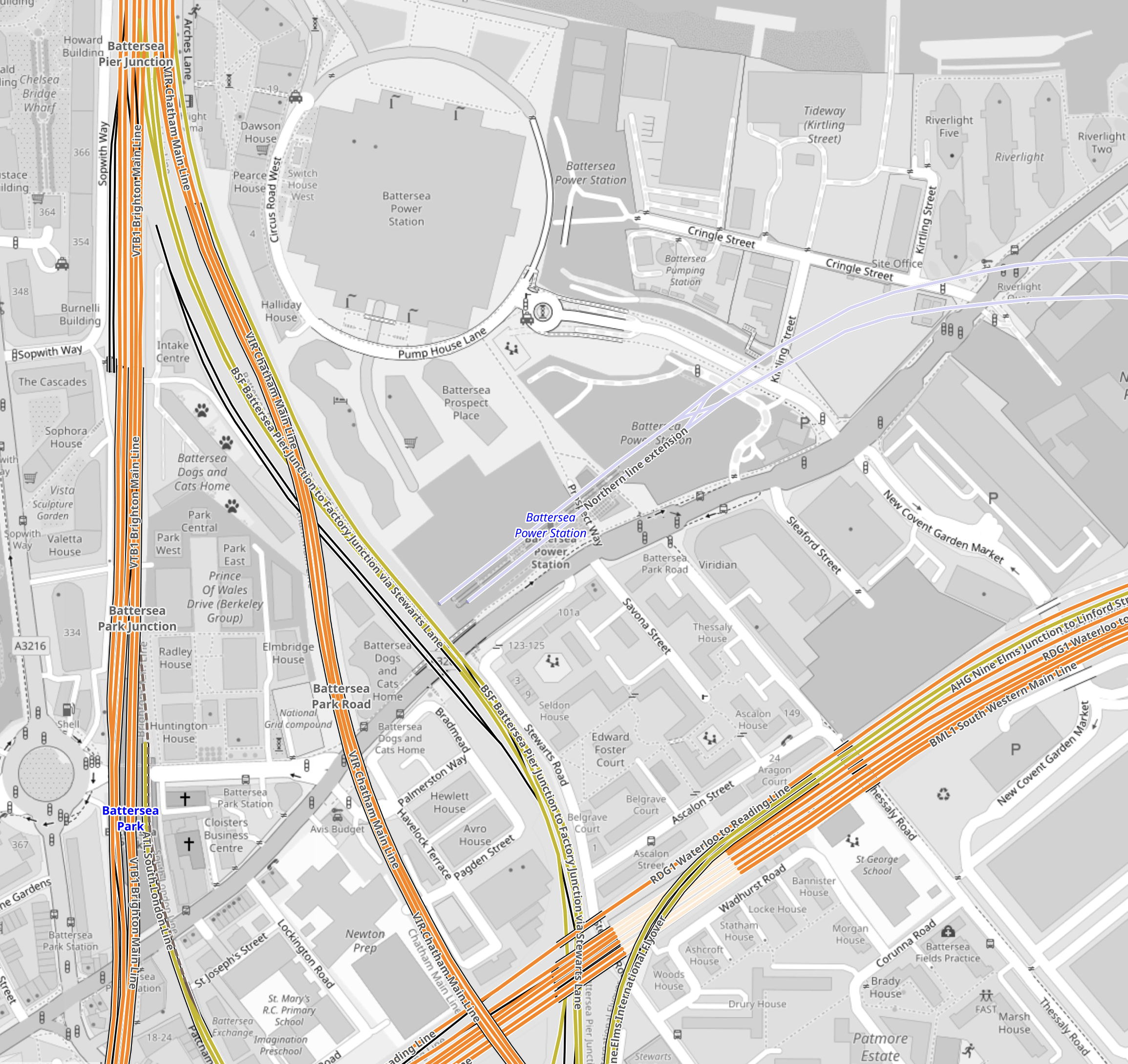
Note how the tracks go through Battersea Power Station station and terminate just before the lines into Victoria station.
It should also be noted that the platforms at Battersea Power Station station are reached using two sets of escalators, so they could be over forty metres below the surface. This would surely make the construction of tower blocks with deep foundations easier over the Northern Line.
But the depth would also enable an extended Northern Line to be below any existing or future construction.
This map from OpenRailwayMap shows the approaches to Clapham Junction station.
There are certainly a lot of tracks through Clapham Junction station.
Reasons For The Extension Of The Northern Line To Clapham Junction
These reasons come to mind.
To Enable Development In The Area
This is always a good reason.
In Network Rail To Outline Business Case For Clapham Junction Redevelopment, I said this.
The Rail Technology Magazine article talks of decking over the whole station and putting two million square feet of development on top. But it also cautions, it would be very expensive.
With that amount of development, there would be a need for as many transport links as possible.
To Improve Access To The Elizabeth Line For Passengers On Trains To And From Victoria
Victoria station does not have an Underground Line, that connects to easily the Elizabeth Line.
The best route to use is described in The Lizzie Line And Circle/District Line Interchange At Paddington – 1st July 2022, where you use the Circle to Paddington.
- To go to the West on the Elizabeth Line, take the Circle/District Line to Paddington.
- To go to the East on the Elizabeth Line, take the District Line to Whitechapel.
- To go to Liverpool Street take the Circle Line all the way.
Getting to the stations between Paddington and Liverpool Street means a change at either of those stations.
At Waterloo, you can use the Northern Line, which has a direct connection to Tottenham Court Road on the Elizabeth Line.
Connecting to the Northern Line at Clapham Junction will give Victoria-bound passengers, the advantages of those going to Waterloo.
An Alternative Way Of Connecting Victoria To The Elizabeth Line
The lack of an easy connection between the Victoria and the Elizabeth Line is a pain and I believe that it was a major omission in the design of the Elizabeth Line.
- Dear Old Vicky has a frequency of upwards of thirty trains per hour (tph)
- With some improvements at stations like Oxford Circus, Highbury & Islington and Walthamstow Central, the line could handle some more passengers.
- More step-free access would also help increase capacity.
- Engineers are a competitive bunch and I could see the day, when Vicky is running at 40 tph.
If Vicky was running at forty full tph, it would be moving 45120 passengers per hour.
This would mean that to match the passenger capacity of the older line, the Elizabeth Line would have to be running at a frequency of thirty tph.
As passengers at the ends of the line have difficulty getting to places like Paddington and Heathrow, a connection between the two Queens would really help.
Vicky was universe-class in the 1960s and now she needs updating to the 21st Century.
This map from cartometro shows the Lines through Bond Street and Oxford Circus stations.
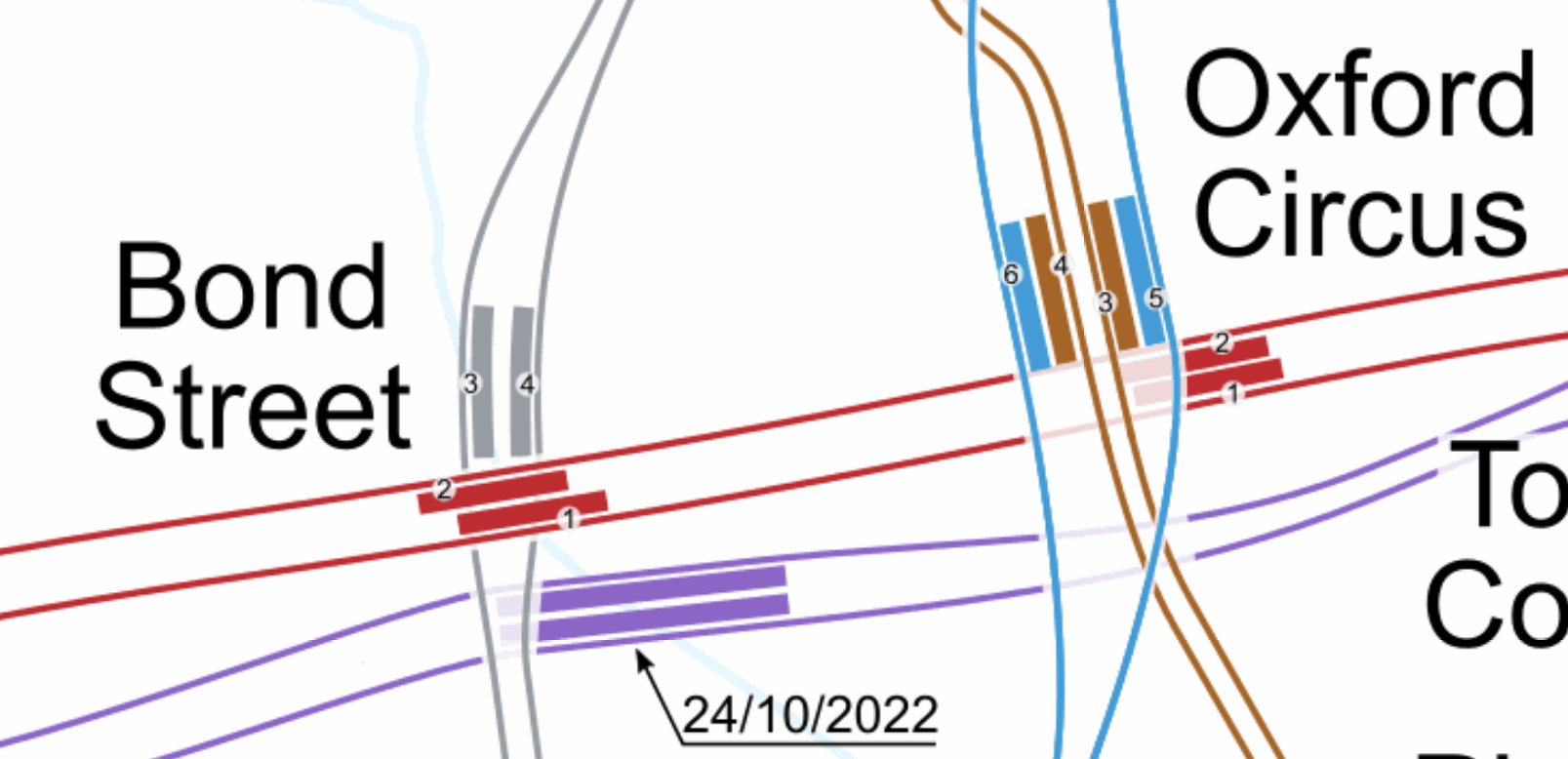
Note.
- The Bakerloo Line is shown in brown.
- The Central Line is shown in red.
- The Elizabeth Line is shown in purple.
- The Victoria Line is shown in light blue.
- The Elizabeth Line is the deepest line.
In addition, consider.
The Eastern exit of the Elizabeth Line at Bond Street station has three escalators and lifts. It also opens onto Hanover Square, so it won’t suffer from overcrowding problems outside.
- Hanover Square is just a garden, with no car park underneath, so pedestrian tunnels could pass under it
- I also suspect there are no existing or planned buildings between the two stations with deep foundations that would block a pedestrian tunnel.
- With the capability and ingenuity of three-D design software, I can see wide tunnels being created that would link Oxford Circus and the two Bond Street stations.
- The new wide tunnels at Bank station have opened up the station’s capacity and all the tunnels were dug traditionally.
- If it was felt to be needed, moving walkways could be added, just as they have been at Bank station.
I am absolutely sure, that by using the ideas and methods, that have worked so well in the upgrade of Bank station, that Oxford Circus and Bond Street stations could be turned into a London Superhub Station, that connects all the Underground lines together and has entrances all over the area.
The benefits of such a station would be.
- It would provide a high-capacity link between London’s two highest-capacity Underground Lines; Elizabeth and Victoria.
- It would provide a high-capacity link between the Elizabeth Line and Euston, St. Pancras and King’s Cross.
- It would provide a high-capacity link between the Elizabeth Line and Victoria.
- It would provide a high-capacity link between the Elizabeth Line and High Speed Two.
- Areas like Brixton, Haringey and Walthamstow would gain a much needed link to the Elizabeth Line for Heathrow and Paddington.
Wikipedia says this about the building of the Bank Station Upgrade.
As part of the development of the scheme, TfL worked with potential bidders to improve the design of the station from TfL’s original design. The design proposed in the winning bid by Dragados was 9.7% cheaper than the original design (saving TfL £60m), took 10 months less time to construct than the original design (the proposed closure of the Northern line was also 5 weeks shorter), and the layout of the station was more efficient. This substantially improved the benefit–cost ratio by 45% to 3.5:1.
The Mayor should be knocking on the door of Dragados and asking them for a price for a design and build for a West End Superhub station.
A Possible Route For The Extension Of The Northern Line To Clapham Junction
I suspect that the simplest route for the extension of the Northern Line would be to bore or dig a twin-track railway underneath the numerous other railways in the area.
It could terminate in two underground platforms at Clapham Junction station.
This is the first map of this post and it shows the tracks that run between the two stations.
Note.
- Battersea Power Station station is in the North-East corner of the map.
- Clapham Junction station is in the South-West corner of the map.
The Western of the pair of orange Lines going off the map in the North-East corner of the map is the Brighton Main Line.
It passes through Battersea Park station.
It passes over the South Western Main Line out of Waterloo.
It then loops to the West and joins the lines to Clapham Junction on the Southern side.
It serves four platforms at Clapham Junction; 12 and 14 are up platforms and 13 and 15 are down platforms.
This Google Map shows an overview of Clapham Junction station.
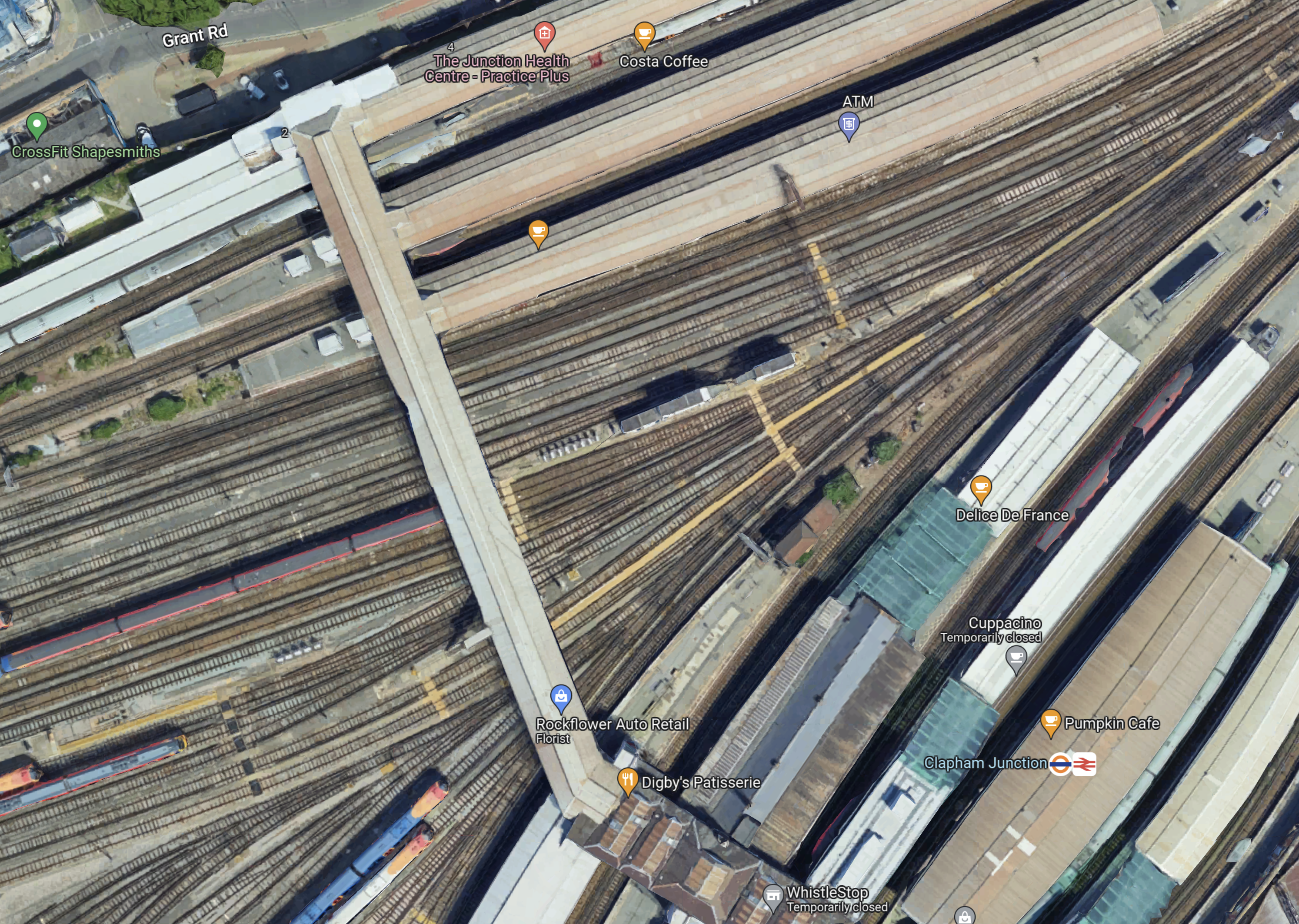
Note.
- Platforms 1 and 2 at the top of the map, handle London Overground services.
- Platforms 3 to 11 handle South Western Train services.
- Platforms 12 to 17 handle Southern services.
- Platforms 9 and 10 have a Delice de France cafe.
- Platforms 11 and 12 have a Cuppacino cafe.
- Platforms 13 and 14 have the logos.
- All platforms have full step-free access with lifts to the wide footbridge that connects all platforms.
The platforms don’t seem to be very wide and putting stairs and escalators down to underground platforms could be a difficult proposition.
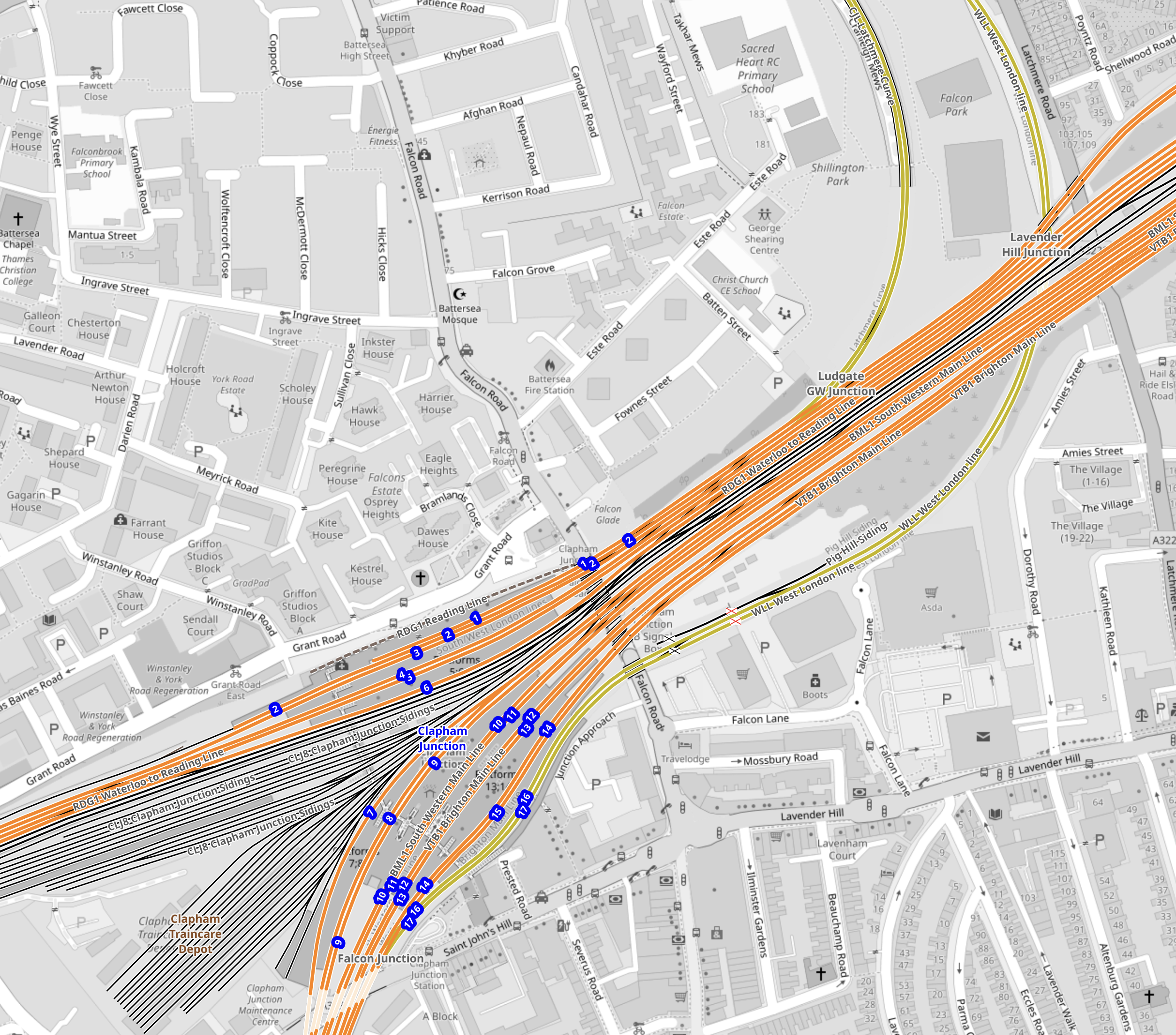
This map from OpenRailwayMap shows shows the platforms at Clapham Junction station and the track layout to the West of the footbridge.
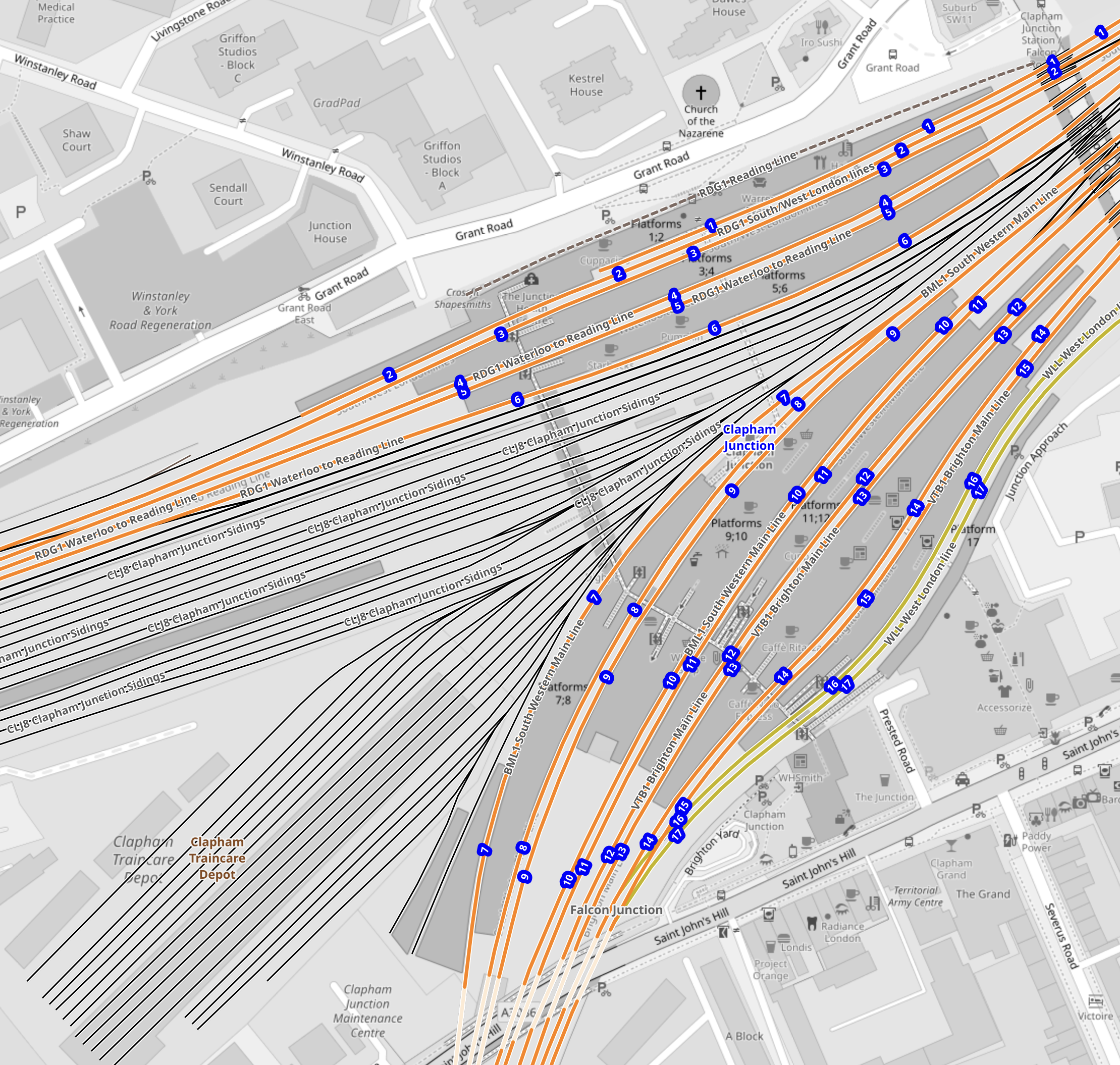
Note.
- The tracks through the platforms are shown in orange.
- The blue dots are platform numbers.
- The bridge connecting all the platforms is shown shaded in the middle of the map.
- To the West of the bridge are Clapham Junction Sidings and Clapham Traincare Depot.
These pictures were taken from the bridge.
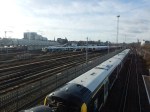


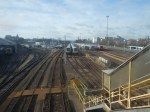
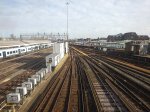



Note.
- The top row of pictures were taken looking West.
- The bottom row of pictures were taken looking East.
- Many of the tracks are electrified.
- There is a lot of space to park trains.
Will all the space be needed now, that a new depot has been built at Feltham.
Could Two New Surface Platforms Be Built For The Extension Of The Northern Line To Clapham Junction?
Consider.
- The step-free bridge across all the platforms at Clapham Junction station works well.
- It is connected to the streets around the station at both ends.
- Clapham Junction station will be redeveloped and surplus depot land could be used for housing.
- As the maps show, there is a large gap in the platforms between the South Western Railway and the Southern sides of the station.
- As Battersea Power Station station can turn services on the Northern Line with only two platforms, there would only need to be the same number of Northern Line platforms at Clapham Junction.
So could an extra pair of platforms be built under the bridge, with stairs and a lift similar to the existing platforms?
- The platform would have full step-free access.
- The platforms could be long enough for any future trains.
- There could be sidings for a few trains.
- The tunnels from Battersea Power Station would surface just outside the station.
- There would need to be a crossover or a turnback siding for operational reasons.
I also think, that once the depot and sidings at Clapham Junction have released the space, the new platforms and tracks could be installed without interrupting main line services through the station.
Would The Extension Of The Northern Line Be Electrified?
Consider.
- Merseyrail were not allowed to use third-rail electrification to Headbolt Lane station and had to use batteries.
- The Northern Line was extended to Battersea Power Station station using London’s four-rail electrified system.
- Clapham Junction station has third-rail electrification everywhere.
I think that the authorities would be very churlish not to allow electrification to Clapham Junction.
Conclusion
I believe it is possible to extend the Northern Line to two new surface platforms at Clapham Junction station.
But I also believe that using similar methods to those used in the Bank Station Upgrade, that a full interchange between the Elizabeth and Victoria Lines can be built at Oxford Circus and Bond Street.
.
Elizabeth Line Sees 100 million Journeys Since May 2022
The title of this post, is the same as that of this article on the BBC.
These two paragraphs outline the figures.
More than 100 million journeys have been made on the Elizabeth line in its first eight months.
Since opening in May 2022, about 600,000 trips have been made every day across the line, which links Reading and Heathrow to Shenfield and Abbey Wood, Transport for London (TfL) said.
Note.
-
- There have been complaints, which I wrote about in Elizabeth Line: Commuters Say Service ‘Not What Was Promised’.
- I also tend to avoid trains to and from Heathrow, as I wrote about in So Many Cases On A Train!
But how do you know a train has come from Heathrow? Only because it’s full of cases.
Surrey Quays Station On The London Overground Getting Step-Free Access
This is part of the package of upgrades that I wrote about in More Frequent Trains And A New Station For The London Overground, that was published in 2019.
It looks like the upgrade will start this year. and be finished in 2026.
Disused Railway Land In Lowestoft Gets A New Lease Of Life
The title of this post, is the same as that of this article on Rail Advent.
This is the sub-heading.
The land has been cleared and 30 willow trees planted by a Network Rail team in a bid to increase biodiversity.
I can see many small pieces of land getting a similar treatment.
UK And Welsh Governments To Explore New Rail Links Between South Wales And England
The title of this post, is the same as that of this press release from the UK Government.
These are the three bullet points.
- UK and Welsh governments today (2 February 2023) announce a new study to improve transport connectivity between south-east Wales and west of England
- the study, backed by £2.7 million of UK government funding, will look at options for new railway stations and rail services on the South Wales Main Line
- this project will focus on relieving congestion on the M4, a vital connector between south Wales and the rest of the UK
The stations are not named, but it is said that they could be between Cardiff and the Severn Tunnel.
The last paragraph changes direction a bit.
Lord Peter Hendy also proposed reviewing the route connecting north Wales to the north-west of England, better connectivity with HS2 and a package of railway improvements to increase connectivity and reduce journey times between Cardiff, Birmingham and beyond.
I find this development very interesting, but typical of the sensible approach one would expect from Lord Peter.
In Could High Speed Two Serve Holyhead?, I looked at the route and came to this conclusion.
London Euston and Holyhead could be a serious proposition.
With some development and a new fast ferry, it could also open up a practical zero-carbon route between Great Britain and Ireland.
Times of four and a half hours between London Euston and Dublin could be possible.
I suspect that time would appeal to green tourists, especially those in First with a good meal.
Hydrogen Train To Be Demonstrated In Québec
The title of this post is the same as that of this article on the Railway Gazette.
These two paragraphs outline the project.
An Alstom Coradia iLint hydrogen fuel cell multiple-unit is to operate demonstration passenger services on the Chemin de fer de Charlevoix from June 17 to September 30.
The return service along the St Lawrence River between Parc de la Chute-Montmorency on the outskirts of Québec City and Baie-St-Paul is being organised by the province, short line operator Chemin de fer Charlevoix, tourist train operator Train de Charlevoix, hydrogen production technology company HTEC and Harnois Énergies, which will produce the green hydrogen at its Québec City site.
The Train de Charlevoix runs along the St. Lawrence River and is described on the web site as a unique experience.
I have felt for some time, that one of the uses of zero-carbon trains is as tourist trains, on quiet lines, where noise is probably not welcome.
It might even change the future of some lightly-used lines.
Climate Change: The Paper Mill Using Elephant Poo To Go Greener
The title of this post, is the same as that of this article on the BBC.
There is a video and these two paragraphs.
You might think of paper mills as being part of Victorian England but there is one just outside of London which is trying to change the way we think about and use paper.
Frogmore Paper Mill in Apsley, near Hemel Hempstead, is considered to be the birthplace of paper’s industrial revolution, housing the oldest mechanised paper mill in the world.
Frogmore Paper Mill sounds like a good place for a visit.
Nikola Highlights Its Integrated Hydrogen Solution And Introduces New Hydrogen Energy Brand “HYLA”
The title of this post, is the same as that of this press release from Nikola Motor.
This is the first paragraph.
Nikola Corporation, a global leader in zero-emission transportation and energy supply and infrastructure solutions, announced at a special event today that it has created a new global brand, HYLA, to encompass the company’s energy products for producing, distributing and dispensing hydrogen to fuel its zero-emissions trucks. More than 300 fleet, government, supplier, energy and media representatives were on site for the announcement at Nikola’s U.S. headquarters in Phoenix, which highlighted the progress made by Nikola’s energy and truck businesses.
The CEO is also quoted as saying.
Nikola is the only company that is successfully integrating a revolutionary new product, the hydrogen fuel cell truck, and the full hydrogen energy infrastructure supply chain under one roof
I suspect that other companies are or will be making similar claims, about similar products.
JCB are certainly showing everything you need for hydrogen-powered construction and agricultural equipment on their web site, as I pointed out in JCB: Building A Hydrogen Future.
When I see anything about Nikola Motor, I feel Elon Musk made a big mistake.
He chose well with the name Tesla, but shouldn’t he have registered Nikola and all its derivatives.
JCB: Building A Hydrogen Future
The title of this post, is the same as that of this page on the JCB web site.
The page contains this statement from Lord Bamford, who is JCB’s chairman.
I’m often asked, why hydrogen? Two years ago, I set the challenge that we should be making hydrogen engines for the construction industry and for agriculture. Two years later, we have hydrogen engines working in the kind of equipment that JCB makes. A solution that delivers power in the same way as conventional engines, but with none of the fossil fuels. We’re proving daily that hydrogen does work, that it’s a clean, renewable, transportable fuel.
Bold thinking, a lot of hard work, a lot of innovation – the kind of thing JCB has been delivering for over 75 years.
It is followed by a series of articles on hydrogen and JCB.
An Elegant Solution
There’s an old English expression about couples lying in bed like spoons.
I wonder, if this analogy is used in other languages like Swedish.
Swedish company; Bassoe Technology have certainly used the stacking technique of spoons or bodies in the design of their innovative wind-turbine floats, which they call D-Floaters.
This visualisation shows five D-floaters being transported on a ship.
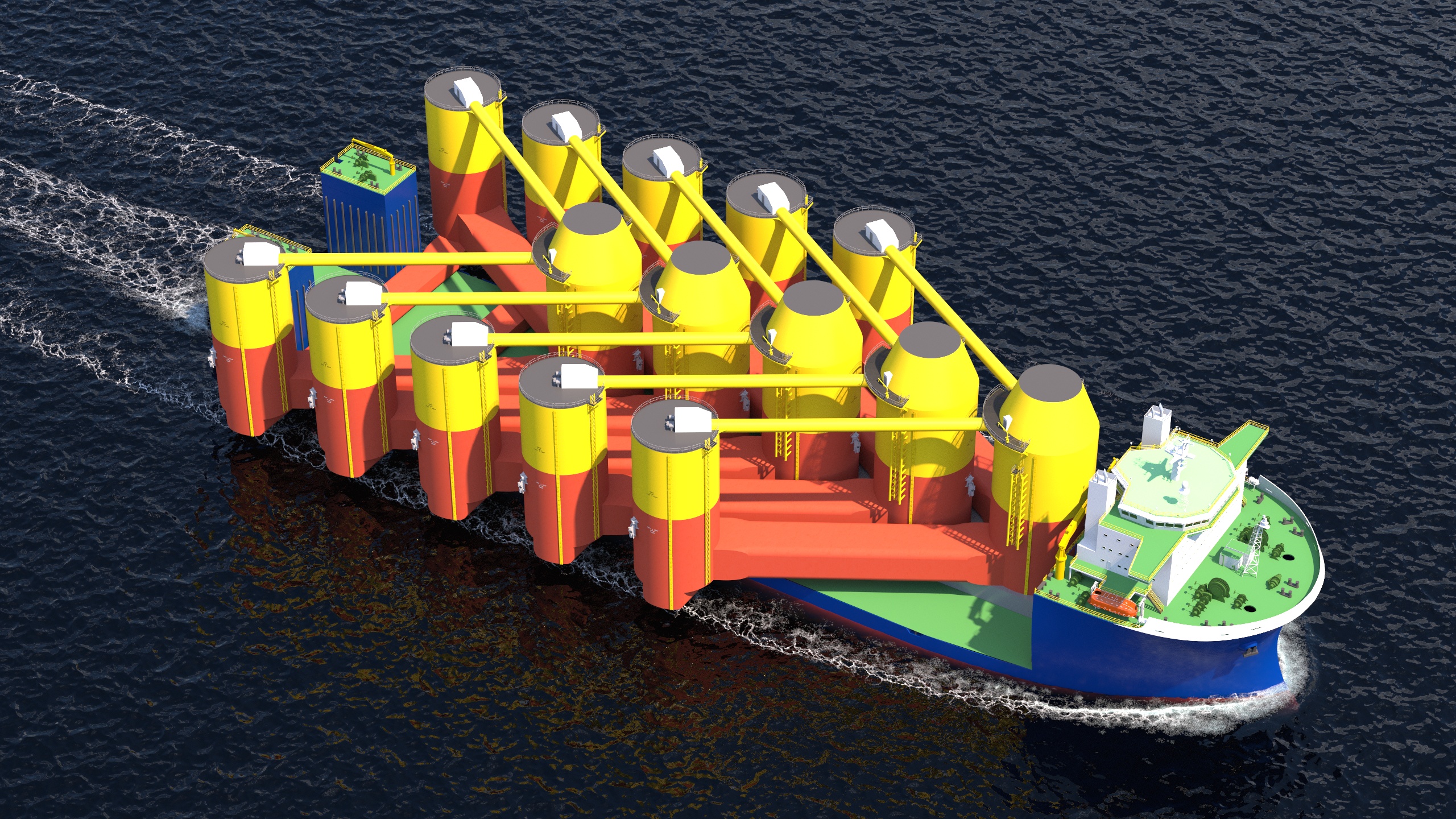
Note.
- The D-Floaters do look strong and sturdy.
- There are several competing floats for wind turbines based on triangles.
- There is probably an optimal cost between transporter ships and D-Floaters.
Given that these structures may be moved thousands of miles before installation, this method of transportation must be economic.
The loaded ship does remind me of one of the bath toys my kids had in the 1970s.
 The Anonymous Widower