An Unusual Find In My Food Cupboard
I found this can of Heinz Tomato Soup in my food cupboard.




What happened to it?
- It looks like a half-eaten tin of meat.
- It is dated March 2014.
I never usually buy tomato soup.
Property Buyers Want Train To Take The Strain, Says Rightmove
The title of this post is the same as that of this article in today’s Times.
Aooarently people are buying houses within an hour’s commute to London, with Chelmsford, Crewe and Sittingbourne being especially popular.
Note.
- Chelmsford will soon be served by a new train fleet.
- Sittingbourne is served by Southeastern’s HighSpeed trains.
- Crewe is served by fast services and will be on High Speed Two, earlier than many places.
Liverpool and Birmingham City Centres are also popular according to the article.
Could The Morocco-UK Power Project Be Developed Into A Western Europe And Africa Interconnector?
This page on the Xlinks web site, describes the Morocco-UK Power Project, which is proposed to generate solar and wind power in Morocco and deliver it to the UK.
- The plan envisages 10.5 GW of electricity being generated.
- There will be a 5GW/20GWh battery in Morocco.
- They will export 3.6 GW of electricity to the UK for at least twenty hours per day.
- The electricity will be exported to the UK by an Interconnector that skirts to the West of Spain, Portugal and France.
- The interconnector will be 3,800 kilometres long.
I described the project in detail in Moroccan Solar-Plus-Wind To Be Linked To GB In ‘Ground-Breaking’ Xlinks Project.
This Google Map shows Western Europe And North Africa.

Note.
- The light blue of the Continental Shelf
- The darker blue of deeper water.
- The Southern end of the Morocco and the UK interconnector will at Guelmim Oued Noun in the South of Morocco, which is indicated by the red arrow.
- The UK end of the cable will be at Alverdiscott between Barnstaple and Bideford in North Devon.
- Southern Morocco and Algeria look to be mainly in the Sahara Desert.
If we look at the route of the cable, it connects a lot of possible renewable energy sources.
- Morocco – Solar and wind
- Spain – Solar and wind
- Portugal – Solar and wind
- France – Nuclear, tidal and wind
- UK – Nuclear and wind.
Could the UK and Morocco interconnector be developed into a bigger power project?
- Solar and wind power from Algeria could be added.
- Tidal power from a Severn Barrage could be added.
- Connections could be added to Gibraltar, the Irish Republic and Wales.
I believe that there could be a large amount of electricity developed on the Western costs of Europe and Africa.
An interconnector would move it to where it is needed.
Quinbrook To Build The UKs Largest Consented Solar + Battery Storage Project
The title of this post, is the same as that article on Financial Buzz.
This is the first paragraph.
Quinbrook Infrastructure Partners (“Quinbrook”), a specialist global investment manager focused exclusively on renewables, storage and grid support infrastructure investment, today announced that it has acquired a consented 350MW Solar + Battery storage project, located in Kent, UK (“Project Fortress”). Quinbrook expects to commence construction of the project in the first half of 2022.
I have also read about Quinbrook on their web site.
A section on the site is entitled Our Industry Pedigree, where this is said.
Quinbrook is led and managed by a senior team of power industry professionals who have collectively invested over US$ 8.2 billion in energy infrastructure assets since the early 1990’s, representing over 19.5GW of power supply capacity. Our team brings an industrial perspective to investing in low carbon and renewables infrastructure.
Could companies like this be one of the keys to get more renewable power sources delivered?
How Clean Energy And Jobs Can Flow From Morocco to The UK
The title of this post, is the same as that of this article in The Times.
- The article has been written by Simon Morrish, who is the founder and CEO of Xlinks.
- The article is about his plans to build a 10.5 GW solar and wind power complex in Morocco and connect it to the UK, by an undersea power cable running up the coasts of Morocco, Spain, Portugal and France.
- This page on the Xlinks web site gives details of the project.
These are some points from the article.
Relationship With The Exchequer
He makes these points about the projects relationship with the Exchequer.
- The company will be a net contributor.
- The project will not require government subsidy of finance.
- Energy will be delivered under the Contract for Difference (CfD) price of £48/MWh.
- This compares with a CfD price of £92/MWh for Hinckley Point C.
Simon Morrish also claims they will be energised before Hinckley Point C.
That sounds good to me.
Finance
I wonder if at the CfD price quoted in the article, could this mean that this is a project that could be financed in the City of London or from a Sovereign Wealth Fund?
As Simon is confident the project can be completed before Hinckley Point C, I suspect that the finance might be in place, even if it hasn’t been signed off.
The 20GWh/5GW Battery
Simon says this about the battery.
Alongside the consistent output from its solar panels and wind turbines, a 20GWh/5GW battery facility will ensure power generated can be delivered every day, resulting in a dedicated, near-constant source of flexible and predictable renewable energy, designed to complement renewable energy generated in the UK.
In Moroccan Solar-Plus-Wind To Be Linked To GB In ‘Ground-Breaking’ Xlinks Project, I forecast that the battery would be from Highview Power, but given the delivery date before Hinckley Point C, I would suspect that Xlinks have a battery supplier in mind.
Employment Benefits
Simon says this about employment benefits.
Thousands of jobs will be created in Morocco and also at home.
If the project goes ahead, given its size, I don’t think many would disagree with that.
Simon also claims the project will create 1350 permanent jobs by 2024. Sites mentioned include Hunterston, Port Talbot and the North East of England.
Simon’s Conclusion
This is Simon’s conclusion about the project.
I love the idea of clean electricity flowing, all the way from Morocco to the UK. I hope it may inspire other ambitious renewable energy projects too — which, together, will provide clean, secure and stable energy, at affordable prices, for businesses and households to rely on and help to protect this special planet.
If you can, I suggest you read the full article on The Times.
Conclusion
The more I read about this project, the more I tilt towards it being feasble
Engineering is the science of the possible, whereas politics is dreads of the impossible.
Bio-Coal Trials Show Promise
The title of this post, is the same as that of this article on Rail Engineer.
These were the first two paragraphs.
Norfolk’s Bure Valley Railway (BVR) has held an extensive trial of bio-coal as the heritage rail sector looks towards a carbon-free future.
The event, which took place in June, was the result of cooperation between members of the Advanced Steam Traction Trust (ASTT), Bure and the Heritage Railway Association.
It probably makes sense to experiment with steam locomotives and fuels that create less carbon dioxide emissions.
Network Rail And Vivarail Bring The Next-Generation Battery Train To COP26
The title of this post, is the same as that of this article on Network Rail.
These are the first two paragraphs.
Network Rail and Vivarail today announced that Vivarail’s next-generation battery train will be launched at COP26 and will run daily services throughout the international climate change conference.
This zero-emission train uses new batteries, developed by Vivarail, to combine maximum range with the ability to recharge quickly. The result is a train that can travel for up to 80 miles on battery power and recharge in only 10 minutes using Vivarail’s patented Fast Charge system.
That is an excellent range coupled with a fast turnround time.
How will other companies like CAF, Hitachi and Stadler respond?
If all battery-electric trains can reach this range, I don’t think we’ll need hydrogen for multiple units, but we will probably need it for freight and other locomotives.
UK’s Tevva Uses Submarine Tech To Power Electric Trucks
The title of this post, is the same as that of this article on The Times of Israel.
The article is from April 2017 and starts with this paragraph.
Startup founded by Asher Bennett, brother of Israel’s education minister, aims to provide digital, emission-free vehicles.
This paragraph gives details of the man behind the company and their first sales.
Meanwhile, one UK company — Tevva Motors — has already got its first orders for repowering the trucks of delivery giants UPS, DHL and Switzerland’s Kuehne+Nagel with its components, including the batteries and motor, according to Tevva’s 48-year-old Israeli founder Asher Bennett. Bennett is the older brother of former entrepreneur turned right-wing politician Naftali Bennett, who is Israel’s education minister.
Since the article was written, Naftali Bennett has become Israel’s Prime Minister.
This paragraph explains how the trucks work.
The trucks Tevva repowers as well as those the company is planning to build from scratch next year at its new facility in Chelmsford are fully digital. “Every piece of information on our trucks is on the cloud,” Bennett said. The software and algorithms developed by the company automatically calculate the most efficient use of the battery and instruct the range extender when to kick in, without any input from the driver.
We’re already starting to see trains using similar techniques.
But as a time-expired Control Engineer, I would go a similar route.
It is a fascinating article, that deserves a full read.
Tevva Presents 7.5 Tonne Truck With Range Extender
The title of this post, is the same as that of this article on Electrive.
This is the first paragraph.
The English company Tevva has presented a 7.5-tonne truck that is supposed to have a range of up to 250 kilometres in electric drive mode and a range of up to 500 kilometres with the FC range extender activated. Production of the Tevva truck is scheduled to start in July 2022.
I like the concept, as it appears to give a reasonable range.
- The design team behind the truck have a good pedigree.
- The trucks are of a size to handle a useful load.
- Larger trucks will be produced later.
- The trucks will be built in a factory in the London Freeport.
I think we’ll see a lot more larger battery-electric vehicles with hydrogen range extenders.
Bank Station Upgrade – 28th September 2021
I walked past the works to upgrade Bank station this morning and took these pictures.








The first two pictures were taken on King William Street and the others were taken as I walked up Cannon Street to Cannon Street station.
This 3D Google Map shows the new section of the station from the South.

The construction site is surrounded by two roads and a lane.
- Cannon Street runs East-West in front of the construction site.
- King William Street is on the Eastern side of the construction site.
- Abchurch Lane runs Northward between the church of St. Mary Abchurch and the construction site.
There will be a lot more construction on top of the station.
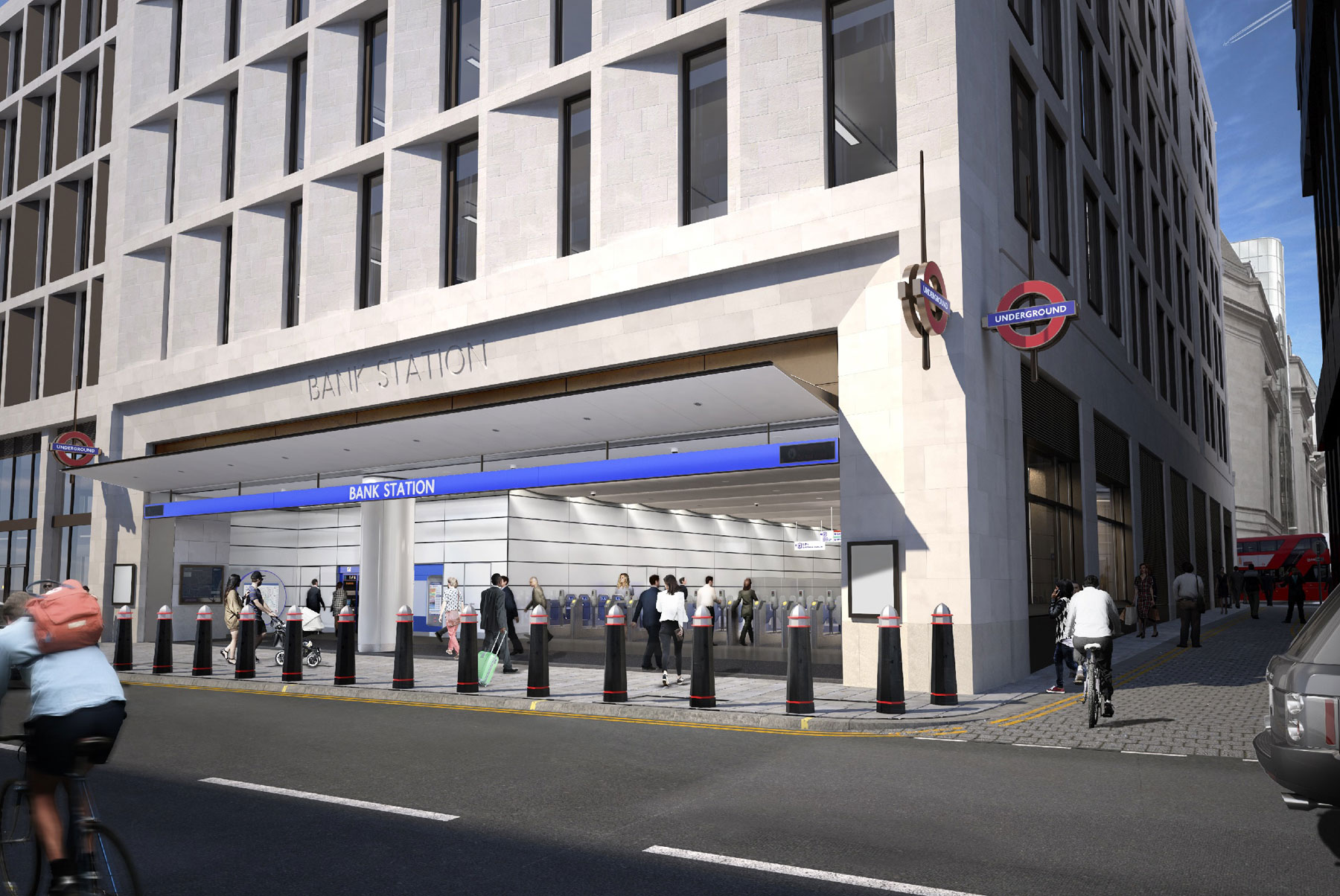
This TfL image shows how it will look in 2022.
 The Anonymous Widower