Nespresso
Just heard the CEO of Nrdpresso defending his product, where seventy-two percent of the product goes into landfill.
Ridiculous!
My tea-bag goes straight into the food composting bin!
So much more environmentally-friendly!
Could Platforms 1 And 2 At Manchester Piccadilly Station Become A Tram-Train Terminal?
Tram-trains often pass through a city in the following manner.
- They arrive in the city as trains and take to the tram system.
- They use the tram system to go through the city centre,
- At the other side of the city, they take to the rail lines and go to the final destination.
I took this picture in the main square in Kassel in Germany.

A continuous stream of trams and tram-trains pass through going across the city.
Isn’t it just like Piccadilly Gardens in Manchester? except that at present, they’re all trams on the Manchester Metrolink!
In Manchester Metrolink Extensions In A Sentence, I gave this quote from the Manchester Evening News.
It includes tram extensions to Port Salford, Middleton and Stalybridge, plus ‘tram trains’ to Hale, Warrington, Gorton and Glossop.
Currently, services to Hale, Gorton, Glossop and other places like Guide Bridge, Marple and New Mills Central come into low-numbered platforms in Manchester Piccadilly station.
The original plans for High Speed Two were rather unimaginative and probably very expensive, envisaged four High Speed platforms on the Northern side of the station.
In Changes Signalled For HS2 Route In North, I analyse the latest thinking on High Speed Two and I believe there is a chance, that Manchester Piccadilly will have underground through platforms deep underneath the current station.
These pictures show platforms 1 and 2 at Piccadilly station.


Currently, several of the lines that terminate in these two platforms are run by life-expired Pacers and they will be replaced by Class 195 trains.
But, as the quoted sentence shows, some of the routes into these platforms could be turned over to tram-train operation.
In Manchester Metrolink To Gorton And Glossop, I showed how it might be possible to connect the tram stop under Piccadilly station to the Glossop Line.
On the other hand the tram-trains might be able to run into these two platforms.
Conclusion
If Manchester acquires a few tram-trains, their rail and tram networks would appear to have lots of opportunities to use them efficiently.
It does also look, that it would be very advantageous, if the High Speed platforms could be through platforms underneath the main station.
- Two well-designed through platforms would be able to handle a lot of trains and passengers.
- The station could be refurbished, rather than demolished and rebuilt.
- Fewer new platforms would be needed.
But above all updating the station would have a lower cost and would cause less disruption to all users.
The Future Of TransPennine Express
TransPennine Express operates services across the Pennines.
In Changes Signalled For HS2 Route In North, I explored the possibilities of merging the infrastructure of High Seed Two and Northern Powerhouse Rail, as proposed by this report on the Transport for the North web site, which is entitled At A Glance – Northern Powerhouse Rail.
In my post, I proposed this service pattern across the Pennines, after sketching it on one of the 5 x 3 inch cards, that I use for notes.
- High Speed Two – Two tph between London and Hull via Manchester Airport, Manchester Piccadilly and Leeds
- High Speed Two – One tph between London and Edinburgh via Manchester Airport, Manchester Piccadilly, Leeds, York and Newcastle.
- Northern Powerhouse Rail – One tph between Liverpool and Edinburgh via Manchester Airport, Manchester Piccadilly, Leeds, York and Newcastle.
- Northern Powerhouse Rail – Two tph between Liverpool and Sheffield via Manchester Airport and Manchester Piccadilly
- Northern Powerhouse Rail – Two tph between Liverpool and Hull via Manchester Airport, Manchester Piccadilly and Leeds
- Northern Powerhouse Rail – One tph between Liverpool and Sunderland via Manchester Airport, Manchester Piccadilly, Leeds, York and Middlesbrough.
But how do proposed services across the Pennines like these, fit with the current TransPennine Express services?
Manchester Airport And Middlesbrough
The Liverpool and Sunderland service covers the same route. at the same frequency of one tph.
Manchester Airport And Newcastle
The London and Edinburgh and Liverpool and Edinburgh services cover the same route, at a doubled frequency of two tph.
Liverpool And Newcastle
The Liverpool and Edinburgh service covers the same route, at the same frequency of one tph.
Liverpool And Scarborough
I didn’t put this in thew original proposed schedule, so it would need to be added at one tph.
Manchester Piccadilly And Hull
The London and Hull and Liverpool and Hull services cover the same route, at an increased frequency of four tph.
Manchester Piccadilly And Huddersfield And Huddersfield And Leeds
These two services, either side of Huddersfield, are effectively local services and could either stay with TransPennine Express or be moved to Northern.
Manchester Airport And Cleethorpes
The Liverpool and Sheffield service covers the same route, at a doubled frequency of two tph, as far as Sheffield.
One tph could be extended to |Cleethorpes.
Manchester Airport And Glasgow Central
If there is a connection between the Northbound West Coast Main Line and Westbound Northern Powerhouse Rail then this service will be possible at the current frequency of one tph.
There would need to be a West-facing terminating platform at Manchester Airport.
Alternatively, this could remain a Classic service.
Manchester Airport and Edinburgh
The London and Edinburgh and Liverpool and Edinburgh services cover the same route, at a doubled frequency of two tph.
Liverpool And Glasgow Central
If there is a connection between the Northbound West Coast Main Line and Eastbound Northern Powerhouse Rail then this service will be possible at the soon-to-be-introduced frequency of one tph.
It could use Liverpool’s High Speed station.
Alternatively, this could remain a Classic service.
New Services
I could also throw in a few other services.
Liverpool And Nottingham
Could a service between Liverpool’s new High Speed station and Nottingham be introduced with a frequency of one tph?
The route would be via Manchester Airport, Manchester Piccadilly and Sheffield on Northern Powerhouse Rail before reversing at Sheffield and travelling to Nottingham via Chesterfield and Alfreton.
Scarborough And Llandudno
Why not?
If the demand is there various services might be viable.
Extra Stations
I think we will also see more station calls, by both High Speed and TransPennine Express trains.
Conclusion
TransPennine Express will be a very different franchise in the future.
Huddersfield And High Speed Two
There are only nine Grade I Listed Railway Stations In The UK and Huddersfield station is one of them.





As you can see, it also has several long platforms and two pubs.
In addition, the station is step-free and has connecting local services to Leeds, Manchester and Sheffield.
This Google Map shows the basic layout of the station and its position on St. George’s Square.
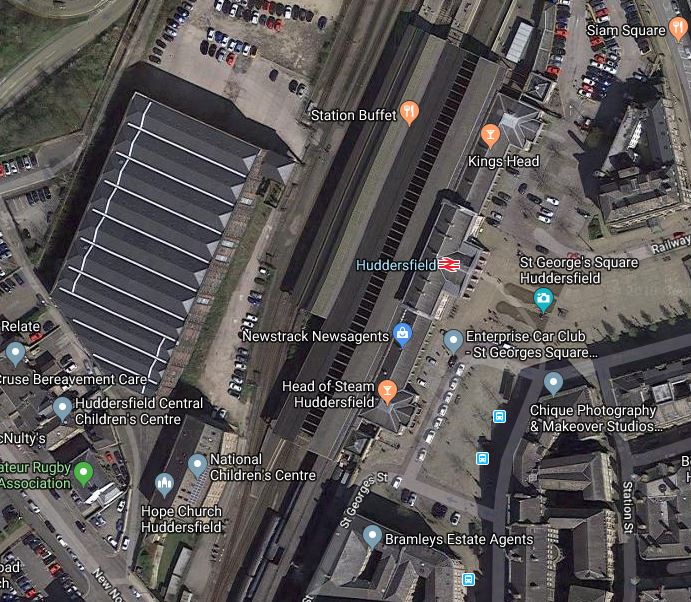
Manchester is to the South and Leeds is to the North.
Huddersfield station has no direct services to London, but there are three routes to and from London with a single change.
These are best times.
- Euston changing at Manchester Piccadilly – two hours and fifty-five minutes
- Kings Cross changing at Leeds – two hours and forty-eight minutes
- St. Pancras changing at Sheffield – two hours and forty-eight minutes
There’s not really much in it!
I bought an Off Peak Return from London Terminals to Huddersfield, travelling North via Euston and Manchester Piccadilly and returning South via Sheffield and St. Pancras.
How Long Will A Journey To And From London By High Speed Two Take?
In Changes Signalled For HS2 Route In North, I looked at proposals to effectively merge High Speed Two and Northern Powerhouse Rail into a comprehensive High Speed Rail system for the North of England.
My thoughts in the related post, were based on this report on the Transport for the North web site, which is entitled At A Glance – Northern Powerhouse Rail.
This map from the Transport of the North report, shows Western section of the rail system.

There are three routes going East from Manchester.
- The yellow route is a possible new route to Leeds via Bradford, which I feel will probably be largely in tunnel.
- The black toute is the upgraded existing Huddersfield Line between Manchester and Leeds via Huddersfield, which is shown.
- The purple route is the upgraded Hope Valley Line to Sheffield.
I feel that the upgraded black route will be created first, with the faster yellow route, which I suspect will be mainly in tunnel, being added later.
In Changes Signalled For HS2 Route In North, I said that I believed that both London and Liverpool and London and Manchester services could be below seventy minutes.
In that report I also quoted a figure from a Transport for the North report, that said that Manchester and Leeds services would take twenty-five minutes.
I think the following timings, should be possible by High Speed Two trains.
- London and Manchester – 70 minutes
- Manchester and Huddersfield – 20 minutes
What would a ninety minute time between London and Huddersfield do for the town?
Conclusion
High Speed Two should call at Huddersfield station.
Are East Midlands Railway Jumping The Gun?
The pictures show the Class 222 train, that I rode from Sheffield to London, after my trip to Huddersfield




I thought East Midlands Railway don’t take over the franchise until the 18th of August!
I suppose it’s only an interim livery.
Hands-Free Phone Ban For drivers ‘Should Be Considered’
The title of this post, is the same as that of this article on the BBC.
This is the introductory paragraph.
Drivers could be banned from using hands-free mobile phones in England and Wales, a group of MPs has suggested.
I don’t drive and I rarely use a mobile phone to make or receive a phone all, so it won’t bother me much.
But sitting in my preferred slightly-raised position in the downstairs facing-seats on a New Routemaster bus, it’s amazing the number of drivers you see having a phone conversation or typing.
Recently, I nearly had a collision whilst walking along Moorgate.
A young lady going the other way was having a video call with her phone in front of her face. I went left to pass on the road side, as gentlemen are supposed to do and she went the same way.
Luckily, she saw me at the last minute!
So if drivers are to be banned from mobile use, whilst driving, what about banning pedestrians from mobile use, whilst walking on busy streets?
Thoughts On Last Week’s Major Power Outage
This article on the BBC is entitled Major Power Failure Affects Homes And Transport.
This is the first two paragraphs.
Nearly a million people have been affected by a major power cut across large areas of England and Wales, affecting homes and transport networks.
National Grid said it was caused by issues with two power generators but the problem was now resolved.
This second article on the BBC is entitled UK power cut: Why it caused so much disruption, and gives these details.
It started with a routine blip – the gas-fired power station at Little Barford in Bedfordshire shut down at 16:58 BST due to a technical issue.
Then, a second power station, the new Hornsea offshore wind farm, also “lost load” – meaning the turbines were still moving, but power was not reaching the grid.
These are my thoughts on the incident.
Power Stations Do Fail
Any complex electro-mechanical system like Little Barford gas-fired power station or Hornsea offshore wind farm can fail.
- Little Barford gas-fired power station was built in 1994 and is a 746 MW gas-fired power station.
- Hornsea offshore wind farm obtained planning permission in 2014 and is being built in phases. It will eventually have a maximum capacity of 8 GW or 8,000 MW.
Compare these figures with the iconic coal-fired Battersea power station, which had a maximum output of 503 MW in 1955.
I will not speculate as to what wet wrong except to say that as the Hornsea wind-farm is relatively new, it could be what engineers call an infant mortality problem. Complex systems or even components seem to fail in the first few months of operation.
Why Do We Have Gas-Fired Stations?
According to this page on Wikipedia, there are around forty natural gas fired power stations in England.
Most gas-fired stations are what are known as CCGT (Combined Cycle Gas Turbine), where a Jumbo-sized gas-turbine engine is paired with a steam turbine powered by the heat of the exhaust from the engine.
This form of power generation does produce some carbon dioxide, but to obtain a given amount of electricity, it produces a lot less than using coal or ioil.
By combining the gas turbine with a steam turbine, the power station becomes more efficient and less carbon dioxide is produced.
Power stations of this type have three various advantages.
- They have a very fast start-up time, so are ideal power stations to respond to sudden increases in electricity demand.
- As they are a gas-turbine engine with extra gubbins, they are very controllable, just like their cousins on aircraft.
- They are relatively quick, easy and affordable to build. The Wikipedia entry for a CCGT says this. “The capital costs of combined cycle power is relatively low, at around $1000/kW, making it one of the cheapest types of generation to install.”
- They don’t need a complicated and expensive transport infrastructure to bring in coal or nuclear fuel.
- They can also be powered by biogas from agricultural or forestry waste, although I don’t think that is a comm practice in the UK.
The carbon dioxide produced is the only major problem.
Gas-Fired Power Stations In The Future
If you read the Wikipedia entry for combined cycle power plants, there is a lot of information on CCGTs, much of which is on various ways of improving their efficiency.
I believe that one particular method of increasing efficiency could be very applicable in the UK.
Under Boosting Efficiency in the Wikipedia entry, the following is said.
The efficiency of CCGT and GT can be boosted by pre-cooling combustion air. This is practised in hot climates and also has the effect of increasing power output. This is achieved by evaporative cooling of water using a moist matrix placed in front of the turbine, or by using Ice storage air conditioning. The latter has the advantage of greater improvements due to the lower temperatures available. Furthermore, ice storage can be used as a means of load control or load shifting since ice can be made during periods of low power demand and, potentially in the future the anticipated high availability of other resources such as renewables during certain periods.
The UK is the world’s largest generator of power using offshore wind and as we are surrounded with sea and wind, the UK is only going to produce more of the power it needs in this or other way.
This method could be used to store the wind energy produced when the demand is low and recover it, when it is needed.
Could The UK Develop A Chain Of Carbon-Neutral Gas-Fired Power Stations?
In parts of the UK, there is a unique mix of resources.
- A plentiful supply of natural gas, either from offshore fields or interconnectors to Norway.
- Large amounts of electricity generated by offshore wind, which will only get larger.
- Worked out gas-fields still connected to the shore, through redundant platforms and pipes.
- Closeness to agricultural areas.
Technologies under development or already working include.
- Offshore creation of hydrogen using electricity generated by offshore wind and then using the redundant gas pipes to bring the hydrogen to the shore.
- Using a hydrogen-fired CCGT power station without producing any carbon-dioxide.
- Feeding carbon dioxide to plants like salad and fruit to make them grow better.
- Using excess electricity from renewable sources to cool the air and improve the efficiency of CCGT power stations.
I can see all these technologies and development coming together in the next few years and a chain of carbon-neutral gas-fired power stations will be created
- Hydrogen produced offshore on redundant gas platforms, using electricity from nearby wind farms, will be turned back into electricity, where it is needed by onshore hydrogen-fired power stations.
- Redundant gas platforms will be refurbished and reused, rather than demolished at great expense.
- Some natural gas will still be used for power generation
- I’m not quite sure, but I think there could be dual-furled CCGTs, that could run on either hydrogen or natural gas.
- Any carbon dioxide generated will be stored in the worked out gas fields or fed to the crops.
- Gas storage onshore will ensure that the gas-fired power station can respond quickly.
I also believe that there is no technological and engineering challenges, that are too difficult to solve.
This strategy would have the following advantages.
- It should be carbon-neutral.
- Because there could have as many as two hundred individual power stations, the system would be very reliable and responsive to the loss of say a cluster of five stations, due to a tsunami, a volcanic eruption or a major eathquake.
- If power from renewable sources like offshore wind is low, extra stations can be quickly switched in.
- It is not dependent on fuel from dodgy dictators!
- It would probably be more affordable than developing nuclear power stations.
There is also the possibility of bringing more hydrogen onshore to be used in the decarbonisation of the gas-grid.
Conclusion
A chain of carbon-neutral gas-fired power stations, linked to hydrogen created offshore by wind farms is very feasible.
Last week, after the double failure, extra stations would have immediately been switched in.
Energy Storage
The fastest response system is energy storage, where a giant battery holds several gigawatt-hours of eklectricity.
Electric Mountain
The biggest energy storage facility in the UK is Dinorwig Power Station.
This is the introduction to its Wikipedia entry.
The Dinorwig Power Station , known locally as Electric Mountain, is a pumped-storage hydroelectric scheme, near Dinorwig, Llanberisin Snowdonia national park in Gwynedd, northern Wales. The scheme can supply a maximum power of 1,728-megawatt (2,317,000 hp) and has a storage capacity of around 9.1-gigawatt-hour (33 TJ)
It is large and has a rapid response, when more electricity is needed.
We probably need another three or four Electric Mountains, but our geography means we have few suitable sites for pumped-storage, especially in areas, where large quantities of electricity are needed.
There are one other pumped-storage system in Wales and two in Scotland, all of which are around 350 MW or a fifth the size of Electric Mountain.
In the Wikipedia entry entitled List Of Power Stations In Scotland, this is said.
SSE have proposed building two new pumped storage schemes in the Great Glen; 600 MW at Balmacaan above Loch Ness, and 600 MW at Coire Glas above Loch Lochy, at £800m. Scotland has a potential for around 500 GWh of pumped storage
I’m sure the Scots will find some way to fill this storage.
If all else fails, there’s always Icelink. This is the description from Wikipedia.
Icelink is a proposed electricity interconnector between Iceland and Great Britain. As of 2017, the project is still at the feasibility stage. According to current plans, IceLink may become operational in 2027.
At 1000–1200 km, the 1000 MW HVDC link would be the longest sub-sea power interconnector in the world.
The project partners are National Grid plc in the UK, and Landsvirkjun, the state-owned generator in Iceland, and Landsnet, the Icelandic Transmission System Operator (TSO)
Plugging it in to Scotland, rather than London, probably saves a bit of money!
Conclusion
Increasing our pumped-storage energy capacity is feasible and would help us to survive major power failures.
Batteries In Buildings
Tesla have a product called a Powerwall, which puts energy storage into a home or other building.
This was the first product of its kind and there will be many imitators.
The Powerwall 2 has a capacity of 13.5 kWh, which is puny compared to the 9.1 GWh or 9,100,000 kWh of Electric Mountain.
But only 674,074 batteries would need to be fitted in the UK to be able to store the same amount of electricity as Electric Mountain.
The big benefit of batteries in buildings is that they shift usage from the Peak times to overnight
So they will reduce domestic demand in the Peak.
Conclusion
Government should give incentives for people to add batteries to their houses and other buildings.
Could Hydrogen Work As Energy Storage?
Suppose you had a hydrogen-fired 500 MW hydrogen-fired CCGT with a hydrogen tank that was large enough to run it at full power for an hour.
That would be a 0.5 GWh storage battery with a discharge rate of 500 MW.
In an hour it would supply 500MWh or 500,000 kWh of electricity at full power.
In Hydrogen Economy on Wikipedia, this is said, about producing hydrogen by electroysis of water.
However, current best processes for water electrolysis have an effective electrical efficiency of 70-80%, so that producing 1 kg of hydrogen (which has a specific energy of 143 MJ/kg or about 40 kWh/kg) requires 50–55 kWh of electricity.
If I take the 40 KWh/Kg figure that means that to provide maximum power for an hour needs 12,500 Kg or 12.5 tonnes of hydrogen.
Under a pressure of 700 bar, hydrogen has a density of 42 Kg/cu. m., so 12.5 tonnes of hydrogen will occupy just under 300 cubic metres.
If I’ve got the figures right that could be a manageable amount of hydrogen.
Remember, I used to work in a hydrogen factory and I had the detailed guided tour. Technology may change in fifty years, but the properties of hydrogen haven’t!
Gas-Fired Versus Coal-Fired Power Stations
Consider.
- The problem of the carbon dioxide is easier with a gas-fired power station, than a coal-fired power station of the same generating capacity, as it will generate only about forty percent of carbon dioxide.
- Gas-fired power stations can be started up very quickly, whereas starting a coal-fired power station probably takes all day.
- Coal is much more difficult to handle than gas.
Using hydrogen is even better than using natural gas, as it’s zero-carbpn.
Conclusion
I believe we can use our unique geographic position and proven technology to increase the resilience of our power networks.
We need both more power stations and energy storage.
The Traction System Of A Class 385 Train
This document on the Hitachi web site is entitled Development of Class 385 Semi-customised/Standard Commuter Rolling Stock for Global Markets.
The Hitachi document gives a schematic of the traction system of a Class 385 train.
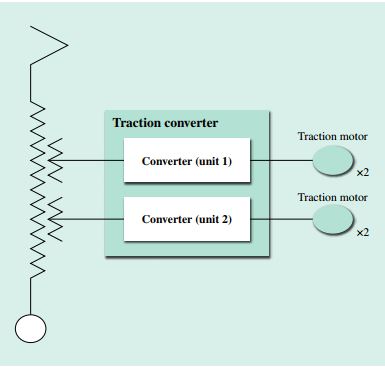
This is the description, that accompanies the diagram.
Railway businesses in the UK include ROSCOs, TOCs, and track maintenance and management companies. The TOCs pay fees, called track access charges, which are based on the weight of rolling stock and the distance travelled, and are obliged to pay the track maintenance and management company for the electrical power consumed in train operation. Because lighter trains put less load on the track, they incur lower track access charges. As lighter trains also consume less electrical power, there was strong demand from the TOC to make the rolling stock lighter, right from the pre-contract stage.
There are two types of Class 385, a four-car train set and a three-car train set. The four-car train set has two motor cars (M) and two trailer cars (T) in what is called a 2M2T configuration. For a three-car train set, in contrast, sufficient traction capacity is provided by 1.5 M cars. Accordingly, the Class 385 adopts a system in which the traction unit (converter) is split into two drive systems, with each car having two motor bogies that are controlled separately (see Fig. 4). This means that three-car train sets can have a 1.5M1.5T configuration in which one of the bogies on one of the two M cars is a trailer bogie, thereby eliminating two traction motors and one traction unit drive system. This configuration reduces the weight of a three-car train set by approximately 1.5 tonnes.
Next time you design a train, will you stand more chancw of getting the order, if you think out of the box?
 The Anonymous Widower