The Mathematics Of Fast-Charging Battery Trains Using Third-Rail Electrification
In Vivarail Unveils Fast Charging System For Class 230 Battery Trains, I talked about how Vivarail are proposing to fast-charge their Class 230 trains.
- The trains are fitted with special high-capacity third rail shoes.
- Third-rail electrification is laid in stations.
- The third rail is powered by a bank of bstteries, that are trickle-charged from the mains or perhaps even solar power.
- When the train connects to the rail, the rail is made live and a fast transfer takes place between third-rail and train.
So how much electricity could be passed to a train during a stop?
The most powerful locomotive in the UK, that can use 750 VDC third-rail electrification is a Class 92 locomotive.
According to Wikipedia, it can produce a power output of 4 MW or 4,000 kW, when working on third-rail electrification.
This means, that in an hour, four thousand kWh will be transferred to the train using conventional third-rail electrification.
Or in a minute 66.7 kWh can be transferred.
In Vivarail’s system, because they are transferring energy between batteries, enormous currents can be passed.
To illustrate how batteries can can deliver enormous currents here’s a video of a guy using two car batteries to weld things together.
These currents are possible because batteries have a low impedance and when the battery on the train is connected to the battery bank on the station, the two batteries will equalise their power.
If we take the example of the Class 92 locomotive and conventional electrification, this would be able to transfer 200 kWh in three minutes or 400 kWh in six minutes.
But I believe that battery-to-battery transfers could be at a much higher current
Thus in a typical one or two minute stop in a station, upwards of 200 kWh could be transferred to the train.
On this page of their web-site, Vivarail say this.
Due to the high currents required for the train Vivarail uses a carbon ceramic shoe able to withstand the heat generated in the process – without this shoe the charge time would make operational running unfeasible.
The devil is always in the details! From what I’ve seen and heard about the company, that would fit!
Market Harborough Station – 11th July 2019
Compare these pictures taken today, with those in Market Harborough Station – 10th May 2019.
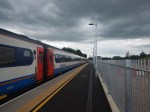
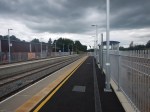

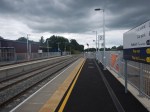


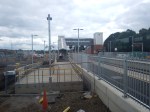

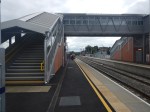

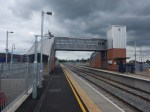
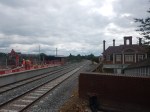
In the intervening two months, there have been major changes at Market Harborough station.
Two Shorter Curved Platforms Have Been Replaced
The two shorter curved platforms have been replaced by two long straight platforms.
- They can handle the longest trains likely to stop in the station.
- As they are straight, it is likely that there will be a smaller gap to mind, between platform and train.
- The platforms and the tracks have been moved to the West by several metres.
- The platforms are now furnished to a high standard, with shelters and information screens.
The new platforms and tracks are a great improvement for passengers, staff and train operators.
But they also mean.
- Trains that stop at the station, can perform faster stops, as the better train-platform interface speeds passengers entering or leaving the train.
- Passing trains can benefit from a higher speed limit through the station.
This should mean a faster journey time along the Midland Main Line.
The Land Released Will Be Used To Extend The Car Park
Several hundred new car parking spaces will be provided on the Eastern side of the line, in the land released by moving the platforms and tracks.
There Is A Fully Working Step-Free Bridge
The new step-free bridge is now fully working.
- The steps are wide enough for bi-directional traffic.
- There are lifts on both sides.
It is asymmetric, with the steps probably leading in the direction most passengers will be walking to and from.
- On the Eastern London-bound platform, passengers will be walking to and from the car park.
- On the Western Leicester-bound platform, passengers will be walking to and from the main station building with the exit to the town, the ticket office and the cafe.
The bridge will certainly handle commuters to London or Leicester, who drive to the station and have to cross the tracks before or after one journey.
It will also handle commuters, who walk or cycle from the town centre.
This bridge has been placed by someone, who knows what they’re doing!
There Are A Pair Of Crossovers To The North Of the Station
I don’t know whether these are new, but they certainly will give operational advantages, if for instance, a train should fail in Market Harbprough station.
As it is likely, that the Midland Main Line will be electrified as far North as Market Harborough station, could they be used for other purposes?
125 mph electric services could be run between London and Market Harborough.
- The two crossovers would easy turnback of the trains or the building of a stabling siding, North of the station.
- Trains would probably take under an hour.
- They could stop at intermediate stations like Luton Airport Parkway Luton, Bedford and Wellingborough.
- Market Harborough station has a lot of parking.
- It could be a second electric service into St. Pancras.
It could be a useful complimentary service or an alternative one whilst planned major regeneration work is ongoing at Leicester station.
Market Harborough Station Has A Bigger Capacity
Consider.
- The longer platforms will allow longer trains with more seats to call at the station.
- The shorter dwell times at the station of stopping trains will allow more trains to stop in the station every hour.
- The step-free bridge is additional capacity for crossing the tracks.
- There will be a massive increase in car parking.
It looks to me that the station has been upgraded to fulfil a need for more trains.
These figures show the population and passenger numbers at stations around Market Harborough.
- Corby – 70,800 – 300,000 – 4.24
- Kettering – 56,200 – 1,070,000 – 19
- Market Harborough – 22,900 – 900,000 – 39.3
- Wellingborough -49,100 – 1,015,000 – 20.7
The last figure was obtained by dividing the number of journeys by the population.
Does Market Harborough’s high figure mean that there is a high demand for travellers living around Market Hsrborough and the large amount of extra car parking will be well-used.
Note.
- I travelled to Market Harborough with a lady and her two young children, who wee actually going to Leicester and were being picked up by family at the earlier station due to all the traffic problems around Leicester station.
- There used to be four stations between Market Harborough and Leicester, but all closed in 1968.
- There used to be two stations between Market Harborough and Kettering, but all closed in the 1960s.
- Market Harborough is well-connected by roads.
So is Market Harborough station used by locals as a Leicester South station?
As an aside, I wouldn’t be surprised to see a new parkway station developed in conjunction with a large housing development, built between Kettering and Leicester, at some point in the future..
Future Electrification
There is a section entitle Electrification in the Wikipedia entry for the Midland Main Line.
This is the last paragraph.
On 26 February 2019 Andrew Jones, Parliamentary Under Secretary of State for Transport, announced that electrification would be extended northwards from Kettering to Market Harborough, enabling the connection of the railway to a new power supply point at Braybrooke.
I will assume that this means, that electric trains will be able to run to Market Harborough station.
As I said earlier, there are a pair of crossovers to the North of the station, which could be useful for turning trains or giving easy access to a couple of stabling sidings.
Hopefully, electrifying the station will not be difficult, as it has only recently been built and foundations for the electrification gantries have either been built or surveyed thoroughly.
Battery Trains Through Market Harborough Station
One thing that won’t be needed at Market Harborough station is a charging station for battery-electric trains, as this will be handled by the electrification.
Bi-mode and battery-electric trains would either raise or lower the pantograph at speed or at a stop in the station.
The operation of a battery-electric train going North could be interesting.
If it wasn’t scheduled to stop in the station, the train would go through Market Harborough station, with maximum charge in the onboard storage, after being charged by the overhead electrification, on the way up from London. The train would also run through the station, at the highest possible speed, as allowed by the track, so that the train had the highest possible kinetic energy.
Electrification to Market Harborough will act like a catapult to send trains North at their maximum kinetic energy and they could probably glide all the way to Leicester station using little of their energy stored in the onboard battery.
The electrification would probably go a short way North of Market Harborough station, so that sropping trains could be accelerated to full speed using the electrification.
There Is Still Work To Be Done
Work to be done appears to include.
- Refurbishing the original subway to give access between the London-bound platform and the station building.
- Finishing the shelters and other platform furnishings.
- Landscape the car-park and create ramped access to the London-bound platform.
A notice said the subway would reopen in December 2019.
Conclusion
Market Harborough now has a much higher capacity modern station.
France Stops Funding Homeopathy
The title of this post is the same as an article on page 31 of Thursday’s copy of The Times.
This is the first paragraph.
French patients, who use more homeopathic remedies than almost anyone else, will no longer have them funded by the health service after scientists deemed them useless.
The French have shown a lot of sense here!
An Unnecessary Diesel-Hauled Train
I took these picture at Blackhorse Road station this morning.
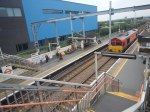


This train from Moss End to Dagenham Dock is pathed to be electric-hauled. So why was it hauled by a noisy and polluting Class 66 locomotive?
Class 710 Train Roofs At Blackhorse Road Station
I took these pictures at Blackhorse Road station.


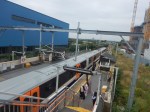


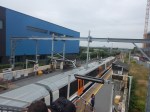

I couldn’t spot any resistor banks on the roofs, that could be used to burn off excess energy, that is generated by regenerative braking.
Consider.
- The roofs do have a rather clean aerodynamic look.
- I’ve never seen resistor banks placed anywhere other than on the roof of a train.
- Regenerative braking must either return the energy through the electrification or store in in some form of onboard energy storage.
It looks to me, that Bombardier have designed a very efficient train.
Carbon Capture From Cement Manufacturing Nears Market Readiness
The title of this post, is the same as that of this article on The Fifth Estate.
In Climate Change: The Massive CO2 Emitter You May Not Know About, I talked about the carbon dioxide that is released, by the manufacture of cement, mainly referring to this article on the BBC.
This is the first three paragraphs of the BBC article.
Concrete is the most widely used man-made material in existence. It is second only to water as the most-consumed resource on the planet.
But, while cement – the key ingredient in concrete – has shaped much of our built environment, it also has a massive carbon footprint.
Cement is the source of about 8% of the world’s carbon dioxide (CO2) emissions, according to think tank Chatham House.
However, the article on The Fifth Estate, raises hopes that new processes for making cement may reduce the carbon footprint of this important material.
This is the first paragraph of tThe Fifth Estate article.
A consortium led by Australian firm Calix is now well on the way to completing a pilot plant for its breakthrough technology that will capture carbon emissions from the manufacture of lime cement. Other projects with similar aims to reduce the global warming impact of construction with concrete are also racing to the marketplace.
It certainly looks like the Australians are doing something concrete about climate change!
Kremlin Lets Women Drive The Trains
The title of this post is the same as that of an article in The Times on Friday.
This was the first two paragraphs.
For decades, Russian girls who have dreamt of becoming train drivers or mechanics or captaining a ship have been forced to abandon their ambitions.
Laws prohibiting women from physically demanding employment, or jobs that could harm their chances of bearing children, were introduced by the Soviet Union in 1974, and updated by President Putin in 2000.
No wonder Russia a basket case, as they are not making best use of their resources. As do countries like Iran, Iraq and Syria!
Remember, that during the Second World War, the Nazis didn’t let women work in the war effort.
I seem to remember they lost!
 The Anonymous Widower