Network Rail To Outline Business Case For Clapham Junction Redevelopment
The title of this post is the same as that of this article on Rail Technology Magazine.
This is the first two paragraphs.
Network Rail have timetabled their plans to publish a strategy outline business case (SOBC) for the redevelopment of Clapham Junction station.
The public body told delegates at a rail conference in London that it intends to lay out the strategy by the end of the year.
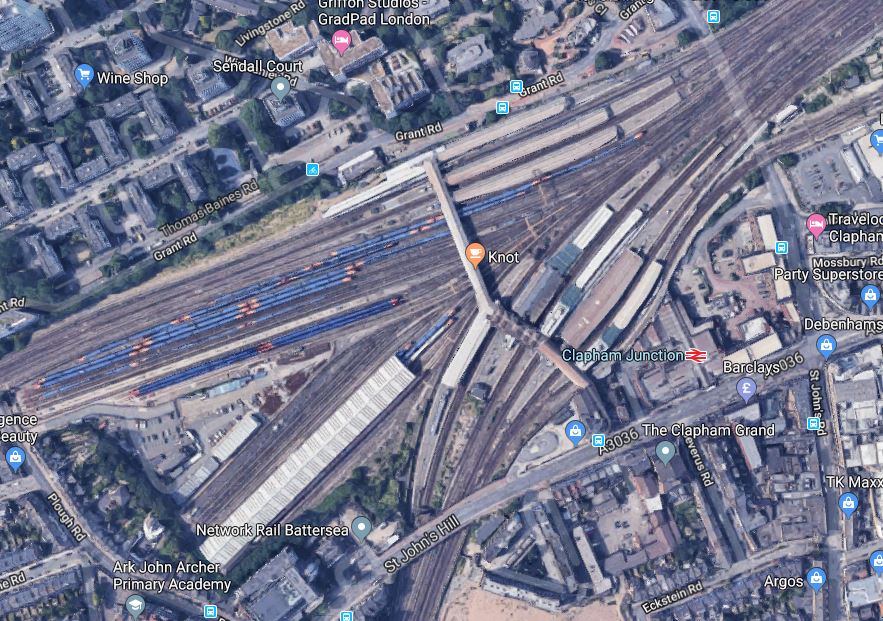
To get a better idea of Clapham Junction station, this Google Map shows the station.
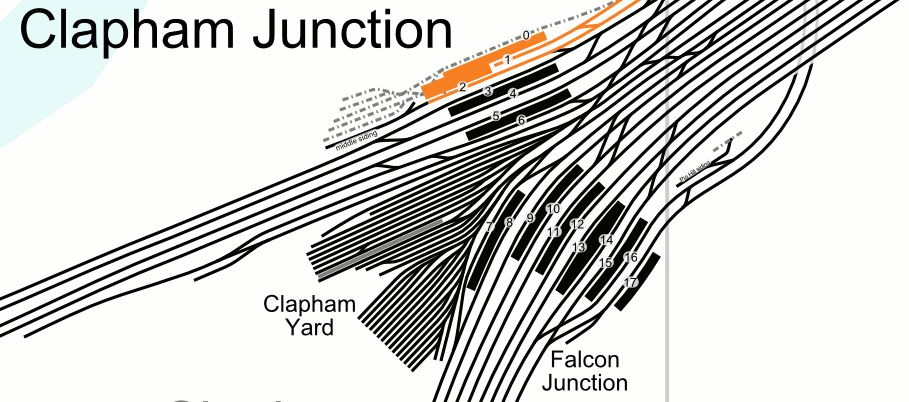
And this map from carto.metro.free.fr shows the track layout.
Note.
- The track layout is extremely complicated.
- A large amount of the area of the station is used for stabling of trains.
- The large number of platforms connected by a pedestrian bridge in the middle.
- There are a lot of stairs and lifts between the bridge and the platforms.
This description of the amount of traffic through the station is from Wikipedia.
Routes from London’s south and south-west termini, Victoria and Waterloo, funnel through the station, making it the busiest in Europe by number of trains using it: between 100 and 180 per hour except for the five hours after midnight. The station is also the busiest UK station for interchanges between services.
All of this adds up to a challenging problem, that if it can be solved, will fulfil these objectives.
- Greatly improve the passenger experience.
- Increase the train and passenger capacity of the station.
- Create more and longer platforms.
- Create or release lots of space for housing and other developments.
- Make the station ready for the Northern Line Extension from Battersea and Crossrail 2.
All of the development must be carried out with as little disruption to trains and passengers.
I’m no architect, but neither are Network Rail or were their predecessor British Rail, but they are good at creating well-thought out track layouts.
I suspect somewhere in a drawer or on a computer, is a British Rail plan for how the station could be laid out.
Such a plan probably existed for London Bridge station and with the design from good architects and structural engineers on top, one of the best terminal stations in the World has been built.
The Rail Technology Magazine article talks of decking over the whole station and putting two million square feet of development on top. But it also cautions, it would be very expensive.
- Could an imaginative architect create a unique development?
- Clapham Junction station, is the best-connected railway station in the South of London.
- Could the development be built with very little provision for car parking?
- Is the land strong enough for a cluster of high tower blocks?
- Could green space be provided?
I’ve lived in the Barbican with a young family and that estate works. But it should be remembered that the City of London had a completely cleared site at the Barbican, due to Nazi bombing.
So would decking over the station, be the way to create a cleared site to create a high-quality eco-friendly development for all?
I think it would and I think it could allow the development to be built at an affordable price.
I also feel that the important objective of building the development without disrupting trains and passengers can be met, by arranging construction in the right order.
Conclusion
Clapham Junction station is a unique site on which to build and like the Barbican, if we build it right, it will be admired fifty years later.
Will Sky Ever Broadcast A Freeview Sports Channel?
Yesterday, Sky held the rights to both the Cricket World Cup Final and The British Grand Prix.
But in the end Sky shared the coverage of both events with Channel 4!
Now that both events have successfully concluded, Sky will have the details of the following.
- Number of viewers.
- Advertising revenue on both Sky and Channel 4.
- Reaction from politicians, some of whom are not very pleased with Sky.
This will enable the company to decide, whether it is in the company’s interest to do it again.
- I can also see a scenario, where if a Sky Freeview channel exists, that sports would want to do promotional deals to get their sport in front of viewers, by perhaps having the top level on satellite and lower levels on Freeview.
- Sky uses a lot of repeats on its Sports Channels at Off Peak times.
- Freeview technology will also be allowing more channels.
- Sky must be a bit worried about competition from other broadcasters woth bottomless pockets.
I don’t think we can rule anything out, as Sky are an innovative and ambitious broadcaster.
The East-West Rail Link Plans For Services Between Reading And East Anglia
This report on the East-West Rail web site is entitled Eastern Section Prospectus and gives full details of their proposals for the train services along the East-West Rail Link.
This post is particularly about services to Reading and the report says this about services between Reading and East Anglia.
Proposed Core Train Services
This is a sentence.
It has been assumed that, by this stage, a half hourly service will operate on the Central and Western sections between Oxford – Cambridge.
The report then goes on to add.
25 minutes are added to the Oxford journey time to represent the option of one service being extended to / from Reading with a Reading – Oxford non-stop.
So that looks like there will be a core hourly service between Reading and Cambridge, which will take 98 minutes.
The report then goes on to detail how various towns and cities in East Anglia will be connected to Reading.
Bury St. Edmunds
2h16 hourly with cross-platform changes at Cambridge and new A14 Parkway station.
Great Yarmouth
3h14 hourly direct
Ipswich
2h43 hourly with cross-platform changes at Cambridge and new A14 Parkway station.
Lowestoft
3h30 hourly with change at Norwich and cross platform change at Reedham.
Norwich
2h40 hourly direct
Trains For The Route
It looks like there will be two direct hourly train services.
- Reading and Great Yarmouth via Cambridge and Norwich, which will take three hours and fourteen minutes.
- Oxford and Ipswich via Cambridge and Bury St. Edmunds, which will take two hours and nineteen minutes.
The long term service pattern, envisages extending the Oxford and Ipswich service to Manningtree, which would add twenty-five minutes.
These are long services and given the overcrowding that happens on the current service between Norwich and Liverpool, I would think that the trains should be as follows.
- At least four or five cars.
- An on-board buffet.
- At least 100 mph operation.
I also think the trains should be bi-mode trains, able to use 25 KVAC overhead electrification or onboard power.
How Many Trains?
It looks like the Reading and Great Yarmouth service would be a seven-hour round trip, which would need seven trains.
The future Oxford and Manningtree service would be a six-hour round trip, which would need six trains.
So add in an allowance for maintenance and a spare, I suspect the fleet should be sixteen trains.
Big Companies And Contactless Ticketing
I use contactless ticketing a lot and have never had a problem that has cost me any money or even inconvenience.
I also check my credit card statement regularly to make sure everything is as it should be.
But what annoys me is that you use your card in some multiple outlets and the information on your statement, isn’t that precise.
I know Leon; the natural fast-food chain aren’t that big, but every transaction from them is precise and identifiable.
Some big companies could follow Leon’s example.
Kinetic Energy Of A Five-Car Class 801 Train
The standard argument against the bi-mode Class 800 train, was that it would be lugging heavy diesel engines around the country wasting energy.
The Class 801 train is the all-electric version of the Hitachi train.
- Wikipedia says each coach weighs 41 tonnes.
- An empty five car train will therefore weigh 205 tonnes.
- A five-car train seats 315 passengers.
- If each passenger with baggage, bikes and buggies weighs 90 Kg, this mean they weigh 28.35 tonnes.
- So the train has a weight of 233.35 tonnes.
- The train is travelling at 125 mph.
Putting these figurea into Omni’s Kinetic Engine Calculator gives a kinetic energy of 101.2 kWh.
Five-car Class 801 trains have one underfloor MTU 12V 1600 R80L diesel engine, which weigh seven tonnes, whereas the bi-mode Class 800 trains have three.
The engines have a rating pf 700 kW in the Class 802 trains and are derated to 560 kW in the other two classes.
So adding engines and repeating the calculation gives.
- One engine – 104.2 kWh
- Two engines – 107.2 kWh
- Three engines – 110.3 kWh
To accelerate a train with three engines to 125 mph will need an extra six kWh compared to a train with only one engine.
There will be a small acceleration penalty. But as three engines have a total power of 1,680 kW (Class 800) or 2,100 kW (Class 802), the penalty would be measured in seconds.
When the train is at the cruising speed of 125 mph, the only difference will be a two tonne difference in axle loading on some axles.
All Class 80x trains will have to overcome the same air resistance and provide similar hotel power., so I’m fairly certain, that all trains will consume very similar amounts of power in the cruise.
Power Comparison With An InterCity 125
Each Class 43 power car of an InterCity 125 has a single diesel engine rated at 1,700 kW.
Divide this by three and you get 566.7 kW
The de-rated MTU diesel engines in the Class 800 train are rated at 560 kW.
So did Hitachi look at the power of half an InterCity 125, feel that they could put diesel engines in three cars of a five-car train and then size the engines to get InterCity 125 power, with two trains working as a pair.
All they would then need to do is to design the cars of the new train to have aerodynamics, dynamics, performance and power usage as good or better than a forty-year-old train.
As they knew that the InterCity 125 had the capabilities needed for the routes, it would mean that their new train would perform, as required.
And if they needed more power for some routes, there was a 700 kW engine available. Great Western Railway did need some more powerful trains and ordered thirty-six extra Class 802 trains with the larger engine.
If imitation is the sincerest form of flattery, the Japanese have been showing tremendous respect to the InterCity 125.
Conclusion
It really is extraordinary, that the installed power of two five-car Class 800 trains, is little different to that of an InterCity 125.
The vindication is that both trains work well.
Battersea Power Station To Outshine Typical Tourist Attraction Sites In The UK
The title of this post is the same as this article in the New Straits Times.
This is the first paragraph.
Malaysia-owned Battersea Power Station project is expected to outshine many prime property developments in London after seeing a 36 per cent capital appreciation for units offered under its first phase.
The article goes on to give an interesting view on how Malaysian investors and tourists see London.
On Tourism
This is a paragraph.
It is expected that when it opens, 40 million people will visit Battersea Power Station annually.
That is around 109,000 visitors for every day of the year.
Will the Northern Line Extension and the roads cope?
On Investment
This is two paragraphs.
“London is never going to be cheap. Those who wanted to invest, better do it now. A lot of people from overseas have already started investing in London,” he added.
Mason said London would still remain attractive place for investors globally due to its higher capital returns for the property sector.
Londoners like me, don’t look on their City as an investment, but as an exciting and fulfilling place to live.
How Much Power Is Needed To Run A Train At 125 Or 100 mph?
In an article in the October 2017 Edition of Modern Railways, which is entitled Celling England By The Pound, Ian Walmsley says this in relation to trains running on the Uckfield Branch, which is not very challenging.
A modern EMU needs between 3 and 5 kWh per vehicle mile for this sort of service.
Can I get any other figures for running at 125 mph, that agree or disagree with these figures?
Class 801 Train
I have found this on this page on the RailUKForums web site.
A 130m Electric IEP Unit on a journey from Kings Cross to Newcastle under the conditions defined in Annex B shall consume no more than 4600kWh.
This is a Class 801 train.
- It has five cars.
- Kings Cross to Newcastle is 268.6 miles.
- Most of this journey will be at 125 mph.
- The trains have regenerative braking.
- I don’t know how many stops are included
This gives a usage figure of 3.42 kWh per vehicle mile.
InterCity 125
Note that the Class 43 power cars of the InterCity 125 (HST) put 1,300 kW to the rail and have a 1,700 kW engine. Two of these powerful beasts giving out a total of 3,400 kW,, can sustain a ten-car train (two power cars and eight passenger cars) at 125 mph.
In the roughly thirty seconds, it would take to cover a mile, an HST could use 3400/120 kWh or 28.3 kWh.
Counting the locomotives as a car and dividing by ten gives 2.83 kWh per vehicle mile.
This is actually a maximum figure, as the driver could throttle-back if required.
This figure is not out of line with the 3.42 kWh per vehicle mile for a Class 801 train, that I stated earlier.
The force was with Terry Miller and his team.
Class 222 Train
The Class 222 trains have one 580 kW engine in each car.
In the thirty seconds, it would take to cover a mile, a Class 222 train would use 580/120 or 4.83 kWh per vehicle mile.
Again this must be a maximum figure.
Class 170 Train
The Class 170 train is a 100 mph train with a 315 kW engine in each car.
In the thirty-six seconds, it would take to cover a mile at 100 mph, a Class 170 train would use 315/100 or 3.15 kWh per vehicle mile.
Again this must be a maximum figure.
Conversion Of 125 mph Figures to 100 mph Figures.
The resistance of any vehicle goes up with the square of the speed.
100*100/125/125 is 0.64.
My crude calculations give.
- Class 801 train – 125 mph 3.42 kWh per vehicle mile
- Class 801 train – 100 mph 2.19 kWh per vehicle mile
- InterCity 125 – 125 mph 2.83 kWh per vehicle mile
- InterCity 125 – 100 mph 1.81 kWh per vehicle mile
- Class 222 train – 125 mph 4.83 kWh per vehicle mile
- Class 222 train – 100 mph 3.09 kWh per vehicle mile
I’d love to know the real values.
Conclusions
I know this was a rather rough and ready calculation, but I can draw two conclusions.
- Trains running at 125 mph seem to need between three and five kWh per vehicle mile.
- The forty year old InterCity 125 has an efficient energy use, even if the engines are working flat out to maintain full speed.
The only explanation for the latter is that Terry Miller and his team, got the aerodynamics, dynamics and structures of the InterCity 125 almost perfect. And this was all before computer-aided-design became commonplace.
In future for the energy use of a train running at 125 mph, I shall use a figure of three kWh per vehicle mile.
It is also probably a good starting point for a 100 mph train.
After all, if a forty-year-old diesel-electric train built from steel can achieve that figure, surely a modern electric train built from aluminium can do better!
East Midlands Parkway Station – 11th July 2019
I took these pictures at East Midlands Parkway station.
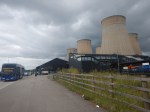
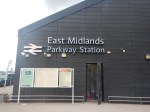
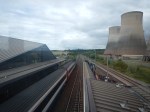
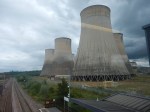
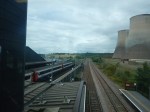
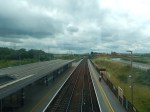
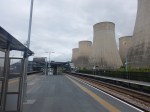
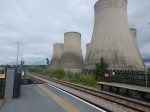
These are some of my thoughts.
Ratcliffe-on-Soar Power Station
The station is dominated by the coal-fired Ratcliffe-on-Spar power station, with its eight massive cooling towers.
When I was leaving Liverpool University in the late-1960s, I don’t think any of my fellow students thought coal had a future.
Several of my group of Electrical Engineers went into nuclear engineering, but many like me went into computing, electronics and instrumentation.
But still the Government ploughed on with mining coal and burning the filthy stuff to produce electricity.
Now the current government has decided, that they’ll all be gone by 2025!
And good riddance to them!
It has amazed me, they have survived this long.
I can remember reading in the Guardian in the 1980s of proposals by enlightened thinkers to retrain miners as insulation teams to insulate our terrible pre-war housing stock, which wastes vast amounts of energy.
But politicians of the left, including some who are still around today, glory in the honest toil of working in a coal mine.
I’m afraid, that I’ve met so many children of miners, whose major advice from their father, was to never go down a mine except as a tourist.
Burning coal, has been one of the worst cul-de-sacs of the human race.
An Inadequate Train Service
I have scarcely been to a station with such an inadequate train service.
Logic suggests, that it would have a service something like two or four trains per hour (tph) to major cities within half-an-hour.
But read what is said under Services in the Wikipedia entry for the station.
Here’s the first two paragraphs.
Fears were raised by various bodies, notably East Midlands Airport, about the service pattern proposed for the new station.
Donington Park motor racing circuit is nearby, and its owners have expressed their desire for spectators to use the station or coach services when travelling to the circuit. The owners are also in support of any future light rail transport to East Midlands Airport itself.
On my visit, I took a train from Leicester and then had to wait nearly an hour to get one back to where I started.
Abellio certainly have scope to improve the service.
In Leicester Station – 11th July 2019, I wrote that I felt that if Abellio apply similar logic to that which they are applying in East Anglia, that there could be a significant improvement in services on the Midland Main Line, to the North of Leicester.
- Three tph – Fast trains between Leicester and Sheffield via Derby and Chesterfield
- One tph – Stopping train between Leicester and Sheffield via Derby and Chesterfield
- Three tph – Fast trains between Leicester and Nottingham
- One tph – Stopping train between Leicester and Nottingham
- One tph – Stopping train between Leicester and Lincoln
As the new trains will have a better performance, more could stop at East Midlands Parkway to even out the terrible stopping pattern.
Station Usage
Wikipedia gives the station usage as just over 300,000 passengers per year.
This compares with Louthborough station, which is the next station to the South having a usage of 1,300,000 passengers per year.
Even the new Ilkeston station further North with only two platforms and of a much simpler design, had a usage of 250,000 passengers in its first year.
As this Google Map shows, the car parking has attracted a few takers.
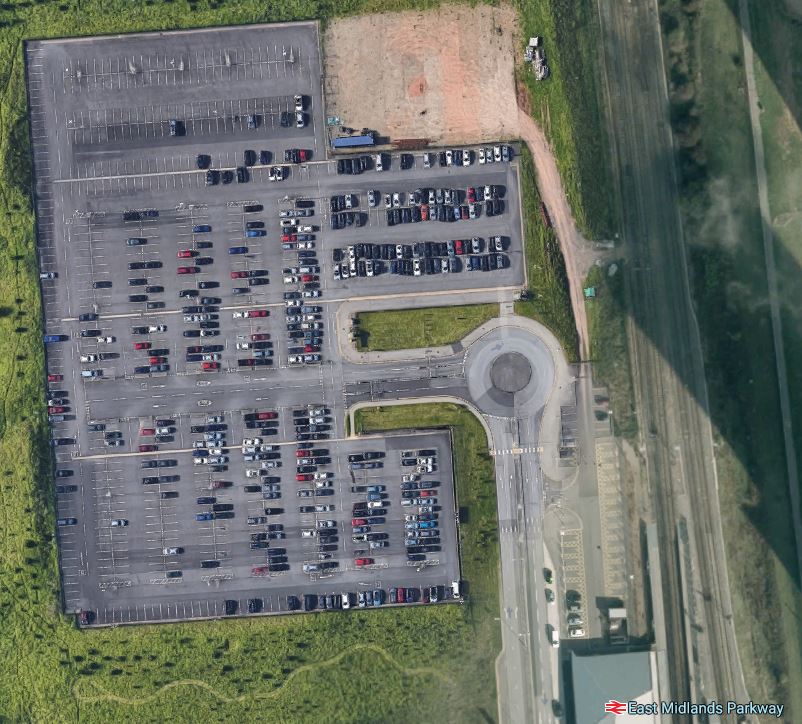
I do question though, if the station should ever have been built!
I hope Abellio have a plan to breathe some life into the station.
Megabus
Note the Stagecoach Megabus in the pictures.
This provides services all over Yprkshire and is decribed under Multi-Modal in the Wikipedia entry for the station.
This is the first paragraph.
From 30 March 2009, the station has been used as an interchange station for combined multi-modal journeys using Megabus-branded services run by Stagecoach (the operators of both East Midlands Trains and of Megabus). The MegabusPlus services transport passengers from cities in the north of England to East Midlands Parkway, where passengers transfer to rail for the service to London.
At a first glance, it looks like a crazy idea.
But Stagecoach wouldn’t run it, if it wasn’t needed or profitable.
Charging Battery Electric Trains
In The Mathematics Of Fast-Charging Battery Trains Using Third-Rail Electrification, I showed how a third-rail-based fast charging sstem, like that proposed by Vivarail could transfer several hundred kWh to the batteries of a train stopped in the station, for a few minutes.
East Midlands Parkway station with pairs of tracks between generously-spaced platforms with a gap between the tracks, would be an ideal location for such a charging system.
- The two third-rail would be laid together between the two tracks.
- The third-rails could be shielded, but as they would only be live with a train on the top, would it be necessary?
- The driver would only need to stop the train in the correct position, but they do that anyway.
- An adequate electricity supply shouldn’t be too much of a problem!
In a three minute contact between the train and the third-rail, I believe it would be possible to transfer up to 200 kWh to the batteries of the train.
Conclusion
This station has problems.
I’ll be interested to see how Abellio attract more passengers and use the station to passengers and their own benefit.
Leicester Station – 11th July 2019
I took these pictures at Leicester station today.
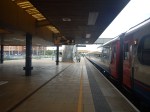
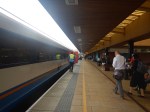
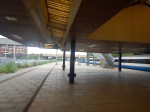

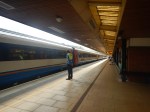
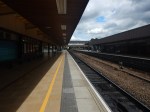
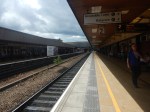
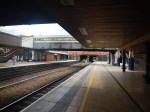


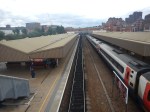
These are a few of my thoughts.
Long Straight Platforms
The two main platforms for trains to and from London are long and straight and can easily accommodate the longest trains that do or will use the station.
Wide Spacious Platforms
The two island platforms are wide and spacious.
In my time at the station, I didn’t see any trains use the outer platforms and I do wonder if the station is used to the maximum capacity allowed by the layout.
The Station Could Have More Trains And Be A Better Interchange
When you arrive at Ipswich station on a fast train from London, one of the half-hourly services has an easy connection to either Bury St. Edmunds and Cambridge, Felixstowe, Lowestoft and/or Peterborough. and staff and information screens are there to speed you on your way.
Leicester station doesn’t seem to welcome you to continue your journey elsewhere
Abellio And Ipswich Station
Abellio with their new trains and timetable, will be increasing frequencies, so that Suffolk’s County Town with a population of 133,000, will have the following services.
- Two trains per hour (tph) to Bury St. Edmunds. – Doubled from current.
- One tph to Cambridge – A second hourly service will be available with a change at Ely.
- One tph to Felixstowe – Might be doubled, now thst the Felixstowe branch has more capacity.
- Three-four tph to London – Faster and up from two expresses and a stopping train per hour.
- One tph to Lowestoft – Better timetable and faster.
- Three tph to Norwich – Up from two tph
- One tph to Peterborough – Doubled from current one train per two hours.
The creation of the East-West Rail Link will see a doubling of the service to Cambridge and one train per two hours to Oxford.
Applying Abellio’s East Anglian Rules To Leicester
Leicester is a city and County Town, with a population of 330,000.
These appear to be the current services.
- Two tph to Birmingham
- One tph to Cambridge, Peterborough and Stansted Airport
- Two tph to Derby
- One tph to Lincoln – Stopping train via Loughborough and East Midlands Parkway.
- Four tph to London
- Two tph to Nottingham
- Two tph to Sheffield
Leicester doesn’t seem to have the sort of train service the City deserves.
This is the London, Ipswich and Norwich philosophy as proposed by Abellio and in the process of being delivered.
- New maximum-length and maximum-speed high-capacity Class 745 trains will provide more seats on the route.
- A fifty per-cent increase in train frequency from two tph to three tph.
- Four express services per day, only stopping at Ipswich, have been introduced, giving a ninety minute service between London and Norwich.
- Four trains per day between Lowestoft and London.
What would a similar philosophy for London Midland Main Line, look like at Leicester?
- Three tph to Derby, Chesterfield and Sheffield.
- Six tph to London
- Three tph to Nottingham
- All trains would be maximum-length with a capacity at least similar to a 2+8 HST.
- Greater Anglia’s Class 745 trains will have 757 seats in two classes and a buffet. Expect a similar specification on the Midland Main Line.
- Services will be faster, with I suspect no trains taking longer than an hour from Leicester to London or Sheffield.
- Could there be a couple of non-stop trains every hour between London and Leicester?
This service would be a lot better and it only needs.
- An extra tph between London and Sheffield via Derby and Chesterfield
- An extra tph between London and Nottingham.
- Enough new maximum-length trains, which will probably be bi-mode trains, that are scheduled to arrive in 2022.
Four tph between London and Sheffield and London and Nottingham would surely be the ideal, but there just isn’t the capacity to the South of Kettering and in St. Pancras station.
So will we see extra services on the Midland Main Line to boost services North of Leicester?
- One tph between Leicester and Sheffield via Louthborough, East Midlands Parkway, Long Eaton, Derby and Chesterfield.
- One tph between Leicester and Sheffield via Louthborough, East Midlands Parkway, Ilkeston, Langley Mill, Alfreton and Chesterfield.
- One tph between Leicester and Nottingham via Louthborough, East Midlands Parkway and Beeston.
- The one tph Leicester to Lincoln service could also be included.
The services would be as follows.
- Trains would probably be shorter versions of the maximum-length bi-mode Midland Main Line trains.
- They would use the outer platforms at Leicester station to give cross-platform interchange with the frequent London trains.
- Services could possibly be extended past Sheffield to Leeds and past Nottinghm to Newark or Lincoln.
Leicester’s excellent platform design would see an increase in the number of trains and hopefully passengers.
Leicester And East-West Services
I also think, that there is sufficient capacity in Leicester station to add the following East-West services.
- Four tph to Birmingham
- Four tph to Cambridge
- Four tph to Peterborough
The following should be noted.
- Abellio has a substantial interest in all three stations and Leicester.
- The routes are often run by two-car Class 170 trains.
- The trains are often full.
- There is only short sections of lines that are electrified.
I believe that there should be the following service between Birmingham and Cambridge.
- Four tph
- At least four-car bi-mode trains.
- At least a 100 mph capability.
- Stops would include Coleshill Parkway, Nuneaton, Leicester, Melton Mowbray, Oakham, Stamford, Peterborough, March and Ely.
- At the Birmingham end, services could go via Birmingham International and Coventry.
- At the Cambridge end. perhaps two tph could be extended to Audley End and Stansted Airport.
- At Leicester there would be an easy interchange to London, the East Midlands and Sheffield.
- At Peterborough, there would be an easy interchange to London, Leeds, Newcastle and Scotland
It could be argued that if there is a need for a Cambridge and Oxford rail link, then Britain’s fastest growing high-technology hub, needs to have a high quality rail link to Birmingham via Leicester, Coventry and Birmingham International.
One overcrowded hourly two-car diesel train is not suitable for this important rail route.
Currently, trains take two hours forty-five minutes between Birmingham and Cambridge, which means with a fifteen minute turnround at either end, twenty-four trains would be needed for the service.
So it is probably not feasible, but I suspect it could be an aspiration for Abellio.
- I wouldn’t be surprised to see Abellio try to take over the Birmingham and Stansted Airport service from CrossCountry.
- Greater Anglia’s four-car Class 755 trains would double the capacity and be able to use electrification at both ends of the route.
- Greater Anglia have a few spare Class 755 trains, so is this takeover in their ambitions.
- Would the service be easier for Abellio to run, than CrossCountry?
This is a service to watch over the next couple of years.
Class 755 Trains In The East Midlands
I also suspect that Class 755 trains could be in Abellio’s plans for the East Midlands. Lincolnshire’s railways are little different to those of East Anglia.
The Bridges At The Southern End Of The Station
A trusted source told me, that one of the problems of electrifying through Leicester station with 25 KVAC overhead wires, is that the bridges at the Southern end of the station are a problem.
The general impression, I got was that the structure under the bridges is so complicated, that there would need to be a massive reconstruction of the railway.
To make matters worse a major sewer is in or under the bridges.
So if this meant that the railway had to be closed for a number of months, is this the reason for only electrifying as far as Market Harborough?
Surely, if the Midland Main Line is only to be partly-electrified, then Leicester would be a better changeover point.
Charging Battery Electric Trains
In The Mathematics Of Fast-Charging Battery Trains Using Third-Rail Electrification, I showed how a third-rail-based fast charging sstem, like that proposed by Vivarail could transfer several hundred kWh to the batteries of a train stopped in the station, for a few minutes.
Leicester station with the two tracks between widely-spaced platforms with a gap between the tracks, would be an ideal location for such a charging system.
- The two third-rail would be laid together between the two tracks.
- The third-rails could be shielded, but as they would only be live with a train on the top, would it be necessary?
- The driver would only need to stop the train in the correct position, but they do that anyway.
In a three minute contact between the train and the third-rail, I believe it would be possible to transfer up to 200 kWh to the batteries of the train.
Conclusion
Leicester station is a station, that suits the ambitions of the City.
But the unimaginative train service as provided by Stagecoach, is very fourth-rate and has left Abellio with a lot of scope to improve the train service throughout the East Midlands.
Stagecoach have only themselves to blame for losing the franchise.
 The Anonymous Widower