Ricardo’s Hydrogen Fuel Cell Module Successfully Reaches Full Power
The title of this post is the same as that of this press release from Ricardo.
This is the sub-heading.
Ricardo, a global strategic, environmental, and engineering consulting company, today announces a significant milestone in clean energy innovation with its new high-powered, multi-stack hydrogen fuel cell module technology successfully reaching 393kW of net electrical power, achieved within three months development from initial start-up.
These are the first two paragraphs.
This achievement was made possible due to Ricardo’s virtual engineering toolchain, which reduces physical prototyping costs and risks, accelerates development timelines, and provides a deeper understanding of system behaviours under diverse conditions.
Initially developed as part of the Sustainable Hydrogen Powered Shipping (sHYpS) Horizon Europe project for the maritime sector, Ricardo’s multi-stack hydrogen fuel cell module is designed to deliver high energy output with zero emissions. Its modular architecture integrates multiple fuel cell stacks to provide unmatched power density, and scalability while meeting the evolving energy demands of diverse applications, such as maritime, stationary power generation, rail and off-highway.
It certainly looks like Ricardo have developed a heavy end hydrogen fuel cell, that can be applied to a range of applications, in a very short time. Now that’s what I call world class engineering.
The last paragraph of the press release indicates what is possible.
To support the adoption of hydrogen technology, Ricardo has also developed a containerised solution, able to combine multiple fuel cell modules, enabling power output to be scaled up to 3MW per container, with the DC-DC power conversion on board, all without sacrificing efficiency or durability. When scaled up to incorporate multiple fuel cell modules housed within two bespoke containers, a total net electrical plant output of 6MW can be delivered. This is sufficient to power a 50,000 tonne 1,000 passenger cruise ship through important zero-emission mission cycles.
Although, this family of fuel cells, was originally developed for maritime applications, as an example of the flexibility of the system, it would surely be applicable for replacing any diesel engine from 2 MW upwards in a large number of rail, stationary and on and off-road applications.
This picture shows one of several hundred Class 66 locomotives on UK railways.

As they have an electric transmission, the 2 MW diesel engine could be fairly easily changed for a hydrogen fuel-cell of an appropriate size.
Ryanair Flies Into Sahara on Sea (And Africa’s Oldest Conflict)
The title of this post, is the same as that of this article in The Times.
This is the sub-heading.
Chieftains fighting for a strip of land claimed by Morocco are threatening to step up attacks as the tourist industry grows
These are the first three paragraphs.
Towards the end of the flight on Ryanair’s new route to Dakhla a vast expanse of apparently pristine desert coastline unfurls below.
But this land is nowhere near as tranquil as it looks from above. Instead the Irish airline’s choice of destination has flown the company into the heart of Africa’s longest-running conflict.
These direct flights from Madrid and Lanzarote take its planes to the coastal town in Western Sahara, a tract of desert the size of Britain that tribal chieftains and three countries have struggled to control through the centuries.
This is a Google Map showing the location of Western Sahara with respect to the Canary Islands.
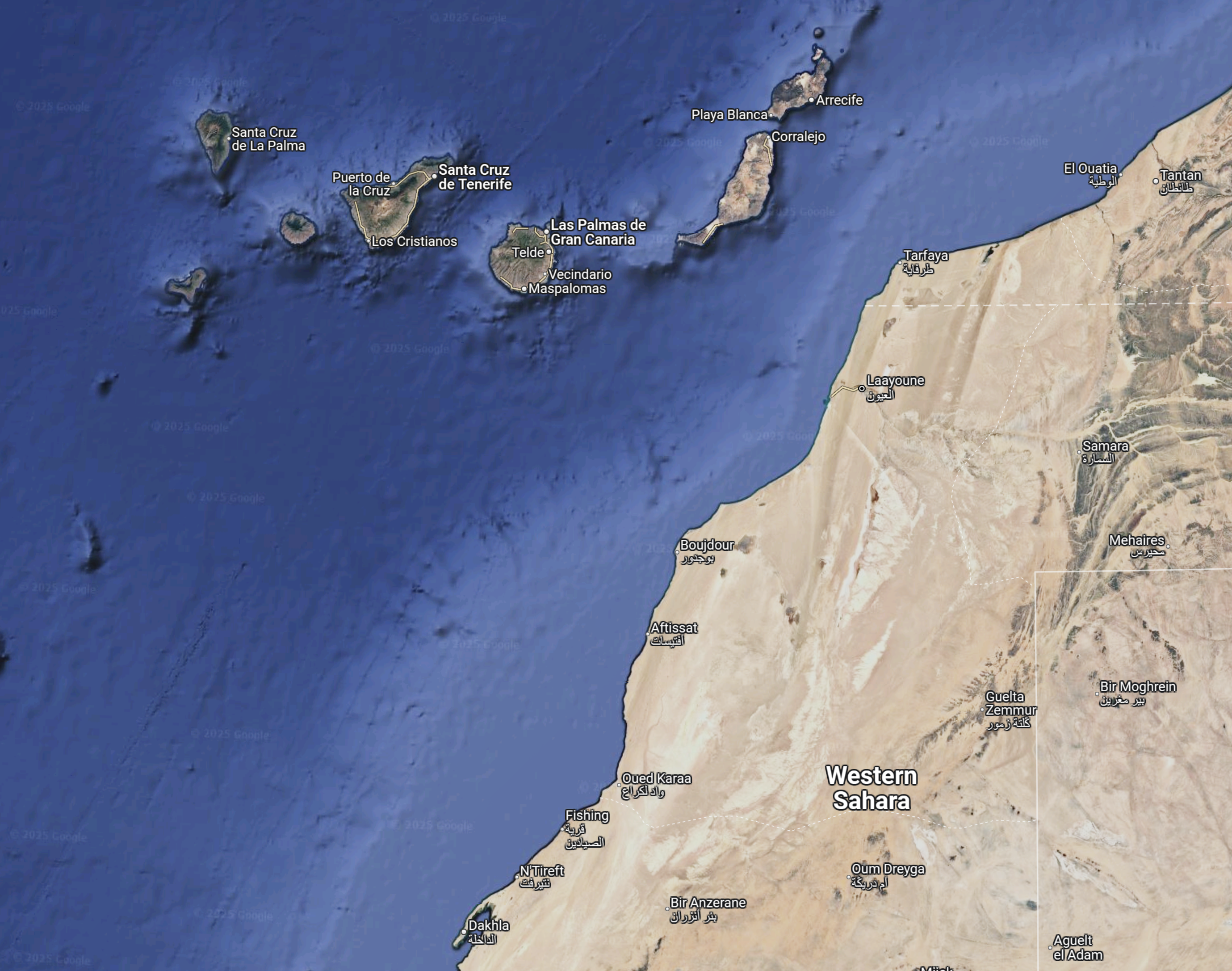
Note.
- The islands off the recognisable coast of North West Africa are the Canary Islands.
- Lanzarote is the Southermostof the two North-Eastern islands.
- Western Sahara is to the South-East of the Canary Islands.
- Dakhla is on the Africa coast at the Southern edge of the map.
The map will be enlarged if you click on it.
I have my thoughts on this article.
Western Sahara And Coeliac Disease
I have a feeling that this area has one of the highest levels of coeliac disease in the world.
- It all started some years ago, when they had a terrible famine, so the US donated a lot of wheat to alleviate the famine.
- But the people of Western Sahara don’t grow wheat and their bodily systems can’t cope with gluten.
- This gave the people a lot of coeliac disease, which can be passed on genetically.
A similar process went on during the slave trade, where the slavers fed their captives on bread made from wheat and water. Consequently, many of the slaves suffered from various problems and that could be why many died on the crossing. These days there is coeliac genes among the Caribbean and American black population that has been passed down through the generations.
After their first actions, it only looks like Trummkopf and his sidekick are going to make matters worse, after their destruction of US Aid.
Scotch Whisky Is In A Unique Position
Scotland has so much zero-carbon energy now, let alone in a few years, that Scotch whisky would not be the most difficult of industries to make completely zero-carbon, which could marketing-wise completely trump any tariffs, that Trummkopf might impose.
- Already some small distilleries are using hydrogen to distill the whisky.
- Some glass bottles are already made using hydrogen instead of natural gas to make zero-carbon malt whiskies.
- I’m sure Cummins in Darlington, JCB in Rocester and Ricardo in Sussex will be pleased to help make farm machinery, mechanical handling and road transport zero carbon.
- Soft fruit like raspberries are already used to absorb the carbon dioxide from the distillation process in some areas of Scotland. I’m sure dealing with more quality raspberries would not be a problem.
- A large electrolyser is planned for Kintore in the North of Scotland. Think of the good publicity for say Centrica or SSE, if they built the world’s largest hydrogen plant to help make zero-carbon whisky.
These are some more thoughts.
Taste Is Everything
As only the method of providing heat and electricity will have been changed, I can’t see there will be any change to the taste.
It’s Already Happening
This page on the Annandale Distillery web site is entitled Annandale Distillery Pioneers Zero-Carbon Whisky Production with EXERGY 3 Project.
The Kintore Electrolyser
These figures summarise the Kintore Electrolyser.
- Total Electrolyser Capacity – 3 GW
- First Phase – 500 MW
- Hydrogen – 200 kTonnes per year
Explore the Kintore Hydrogen web site.
Marketing Advantage
Scotland, is probably, the only country, where the main ingredients for whisky come together in abundance ; barley, energy, tradition and water.
It also is all produced in a single country in many different brands and types, which could all be produced in a zero-carbon manner.
Conclusion
Let’s give Trump a beating and the planet a kiss.
Is Another “I Was There” Event Happening At Brisbane Road?
As I start to write this amazingly, Leyton Orient are one-nil up in the F. A. Cup at home to Manchester City.
Is it going to be one of those events, where in years to come, people will claim they were at Brisbane Road to watch it?
I thought about going, but didn’t buy a ticket. In a way, I’m glad I didn’t, as the weather wasn’t too good today.
The goal that Leyton Orient scored was one of the most spectacular goals ever scored in the F. A. Cup. But I saw everything on television!
This page on the BBC is entitled ‘Strike of a lifetime’ – an own goal that belongs in FA Cup folklore.
It contains a video clip which shows the goal, which was an own goal scored off a rebound of a shot from Jamie Donley.
The classic event of this type happened on the 31st October, 1972, when Llanelli famously beat the All Blacks 9-3 in a Rugby match.
The Wikipedia entry for the match has this first paragraph.
As part of their 1972–73 tour of the Northern Hemisphere, the New Zealand national rugby union team’s fourth match saw them take on Llanelli RFC of Wales at Stradey Park, Llanelli, on 31 October 1972. In one of the most famous results in rugby union history, Llanelli won the match 9–3 in front of 20,000 spectators. Llanelli centre Roy Bergiers scored the only try of the game, charging down a clearance by All Blacks scrum-half Lin Colling after a penalty from Phil Bennett rebounded back into play off the crossbar. New Zealand full-back Joe Karam scored a penalty to give them their only points of the game, before Llanelli wing Andy Hill hit a penalty to secure victory for the Scarlets. The result was immortalised by Welsh entertainer Max Boyce, whose poem 9–3 appears as the opening track on his Live at Treorchy album.
A much larger number of people claimed to have been at the match, than actually were.
Sadly unlike Llanelli, Leyton Orient didn’t hang on.
But according to the BBC, the goal has acquired legendary status.
British Gas Partners With heata On Trial To Reuse Waste Heat From Data Processing
The title of this post, is the same as that of this news item from Centrica.
This is the sub-heading.
British Gas has partnered with sustainable cloud computing provider, heata, on an innovative trial to explore how harnessing waste heat generated by computer servers can save households money on their bills.
These two paragraphs describe heata’s system.
heata’s innovative model distributes cloud computing workloads to servers in homes. In a data centre, the heat generated during processing is a waste product, and energy-intensive cooling systems are required to stop the servers from overheating.
To overcome this, heata has created a ‘virtual data centre’ – a network of servers distributed in people’s homes. Each server is attached to the home’s hot water cylinder, and as they process data, the heat they generate is transferred into the water. This reduces the energy needed to heat water in the home, and as this is typically provided by gas boilers, it reduces the amount of gas used, lowering the carbon impact as a result. heata pays for the electricity the heata unit uses, which means the household pays less to heat their hot water.
Note.
- I would expect that future systems would also heat the house.
- I would be an ideal system for my house, as I have an unusual skin, that is better with a daily bath.
- I also wash my eyes most days with clean warm water, as they are often full of sleep.
- heata has a web site.
- heata has an about page, which describes the company and the technology.
- heata is supported by British Gas, Innovate UK and Sustainable Futures.
- Thermify is a similar system.
These three paragraphs describe the trial.
As part of a three-month trial, 10 heata units will be installed in the homes of British Gas employees, and the energy provider’s computing workloads will be processed on these units. As a result British Gas will be providing free hot water for its own employees as a byproduct of their own cloud compute.
The trial will provide feedback around performance and customer experience, as well as demonstrating the associated CO2 and energy cost savings to further co-develop customer propositions in 2025.
According to heata, the devices can provide up to 4kWh of hot water per day, with the technology expected to save households up to £340 per year when offsetting electrically heated hot water, and up to £120 when offsetting gas heated hot water.
I shall certainly think about fitting one.
North Sea Oil Group Equinor Scales Back Investment In Renewables
The title of this post, is the same as that of this article in The Times.
This is the sub-heading.
Equinor, which is attempting to develop one of the largest untapped oilfields in UK waters, also raised its fossil fuel production targets
This is the first paragraph.
The Norwegian state-backed oil company that is attempting to develop one of the largest untapped oil fields in UK waters, has dramatically scaled back its investment in renewables and raised its fossil fuel production targets, becoming the latest of the world’s energy giants to row back on the push towards green power.
A quiet revolution is happening that will change our use of natural gas very much for the better.
- In Rhodesia, which is a suburb of Worksop, a 24 MW Rolls-Royce mtu diesel peaker power plant, that runs on natural gas, but is also hydrogen-ready, has been installed to boost the electricity supply. The diesel engine is fitted with carbon capture and produces food-grade CO2, which is sold for food and engineering uses.
- Most of the excellent British tomatoes and soft fruit, we have been eating this winter, is grown in greenhouses, heated by natural gas-powered combined heat and power units, where the CO2 produced is captured and fed to the plants.
- HiiROC is a start-up from Hull, who are backed by Centrica, who use a plasma process to split any hydrocarbon gas including waste gas from a chemical plant, biomethane from a sewage works or natural gas into pure hydrogen and carbon black, which is needed to manufacture tyres and other products, and also to improve soil.
- In the last few months, a HiiROC device has been installed at Brigg power station, to generate zero-carbon electricity from natural gas.
- Imagine a housing or factory estate, a farm or perhaps a large country house, that wants to decarbonise. The gas feed to the property would be fitted with a HiiROC device and all gas appliances and boilers would be converted to hydrogen.
- I also believe that houses and other premises could have their own hydrogen pumps to fill up cars, ride-on mowers and other vehicles.
- Avnos is a company from the US, that captures CO2 from the air. What makes Avnos unique is that for every ton of CO2 it captures, it captures five tons of pure water.
More ideas like these are being developed.
What is wrong in using natural gas, to generate heat and electricity, if it doesn’t emit any CO2 into the atmosphere?
I suspect, that Equinor believe there will be a market for natural gas for years, as more and more clever ways to use it and turn it into hydrogen are developed.
Sail Into The Future In Style With Super-Realistic Virtual Tour Of The New Mersey Ferry
The title of this post is the same as this page on the Liverpool Region web site.
These five bullet points act as sub-headings.
- Immersive, interactive VR tour offers stunning detail of new Mersey Ferry
- Vessel designed to reflect Mersey Ferries’ world-famous new vessel will feature event spaces, bars, bike storage and improved accessibility
- Offers world-class experience to passengers and unique, stylish venue for conferences and private events
- Built by Cammell Laird and part of £26m investment in modernising ferries
- Due to set sail in summer 2026
Good to see, that it will be a locally-built ferry.
The current ferries were there, when I first went to the city in the 1960s.
Click here to take a tour on the new vessel.
Ministers Will Relax Rules To Build Small Nuclear Reactors
The title of this post is the same as that of this article in The Times.
This is the sub-heading.
Britain’s five nuclear power stations, which generate about 6GW in total, powering 13 million homes, are all nearing the end of their lives
These first three paragraphs indicate the reasons why, the government wants to relax the rules.
Ministers are preparing to relax planning rules to make it easier to build mini nuclear power plants in more parts of the country in order to hit green energy targets and boost the industry.
They are also examining whether it is possible to streamline the process for approving the safety of new nuclear power plants as a way to reduce construction delays.
At present rules state that only the government may designate sites for potential nuclear power stations, of which there are eight, severely limiting where they can be built.
The article includes a vote and surprisingly to me, the vote embedded in the article, shows 92 % in favour of relaxing the rules and only 8 % against.
I must admit these figures surprise me, as I’d have thought more would have been against.
Certain Words Frighten The Public
It is because nuclear is one of those words, that I felt that the vote in favour would have been much lower.
Regular readers of this blog will know, that in the 1960s,, I worked for ICI doing itinerant computing and instrumentation tasks, in my first job after leaving Liverpool University with a degree in Control Engineering.
I can now classify the experience as a superb apprenticeship, where I learned a lot that has been useful to me in later life.
For a time, I was working on nuclear magnefic resonance or NMR scans. ICI Mond Division in Runcorn had one of the best installations for analysing chemicals using this technique, which is described in this Wikipedia entry, which starts with these sentences.
Nuclear magnetic resonance (NMR) is a physical phenomenon in which nuclei in a strong constant magnetic field are disturbed by a weak oscillating magnetic field (in the near field) and respond by producing an electromagnetic signal with a frequency characteristic of the magnetic field at the nucleus. This process occurs near resonance, when the oscillation frequency matches the intrinsic frequency of the nuclei, which depends on the strength of the static magnetic field, the chemical environment, and the magnetic properties of the isotope involved; in practical applications with static magnetic fields up to ca. 20 tesla, the frequency is similar to VHF and UHF television broadcasts (60–1000 MHz).
One day, the Senior Scientist, who ran the machine came in to work and announced that the property of nuclear magnetic resonance would be replacing X-rays, as the technology had just been used to give a three-dimensional image of something like the tail of a mouse.
Now fifty-five years later, many if not most of us have had MRi scans.
The Wikipedia entry for Magnetic Resonance Imaging or MRi, explains, what happened to the dreaded N-word.
MRI was originally called NMRI (nuclear magnetic resonance imaging), but “nuclear” was dropped to avoid negative associations.
Perhaps, it would be easier to build nuclear power stations, if the level of science teaching in the UK was better.
The Three Paragraphs In Detail
Earlier, I copied three paragraphs from The Times, into this post.
I shall now look at each in detail.
Paragraph 1
Ministers are preparing to relax planning rules to make it easier to build mini nuclear power plants in more parts of the country in order to hit green energy targets and boost the industry.
I was in Suffolk, when the planning of Sizewell B was undertaken.
There appeared to be little strong opposition, but the general feeling was what there was from second home owners, who were worried that the value of their holiday home would decline.
Employment and commerce created by Sizewell B was certainly good for the area in lots of ways.
At the time, my late wife; C was practicing as a family barrister in chambers in Ipswich. She believed that the building of Sizewell B had had a good effect on the area, as it had injected work and money, which had created the finance to allow a couple to end a marriage, that had long since died. She stated a couple of times, that Sizewell B was good for her practice.
Paragraph 2
They are also examining whether it is possible to streamline the process for approving the safety of new nuclear power plants as a way to reduce construction delays.
My worry about streamlining the process for approving safety, is that we approve nuclear power stations so rarely, do we have the qualified personnel to replace elapsed time with people. I would suggest that we don’t.
But we could have.
- We have some excellent universities, where Nuclear Engineering can be studied.
- How many personnel leave the Royal Navy each year, who could be trained as nuclear safety inspectors?
- If say Rolls-Royce and/or Hitachi are building several small modular nuclear reactors a year in the UK, then nuclear engineering will become fashionable, as electronics was for my generation of engineers and it will attract the brightest students.
Perhaps an established university, with access to the needed skills should be funded to set up a Nuclear Safety Institute
Paragraph 3
At present rules state that only the government may designate sites for potential nuclear power stations, of which there are eight, severely limiting where they can be built.
I can envisage new small modular nuclear reactors being built in the UK, where there is a need for lots of electricity to support developments like.
- Offshore wind farms
- Data centres
- Green steelmaking
- Metal refining
- Hydrogen production.
Rolls-Royce have said that their small reactors will be around 470 MW, so I could imagine power stations of this size being placed on disused coal-fired power station sites to boost power in an area. I have already suggested building some on Drax in The Future Of Drax Power Station.
In some locations, the choice could be between a small modular nuclear reactor and some form of energy storage.
Powering Germany
But there is one controversial area, where we can take advantage.
- The Germans are very short of electricity because of their reliance on coal and Russian gas that needs to be replaced.
- The 1.4 GW NeuConnect interconnector is being built by European and Japanese money between the Isle of Grain and Wilhelmshaven.
- The AquaVentus hydrogen system could be extended to Humberside to link with UK hydrogen production and storage.
- A couple of small modular nuclear reactors could be built on Humberside to back up hydrogen production, when the wind isn’t blowing.
But Rolls-Royce and other companies have been putting small nuclear reactors close to the sea bed safely for decades, so why no design an offshore reactor that can be placed at a safe distance offshore?
We would need to solve the Putin and friends problem first, but I can see the UK exporting a lot of electricity and hydrogen produced by nuclear energy.
Ørsted’s Earnings from Operational Offshore Wind Farms Up 20 Pct
The title of this post, is the same as that of this article on offshoreWIND.biz.
This is the sub-heading.
Ørsted has reported 2024 earnings from its operational offshore wind farms of DKK 23.8 billion (approximately EUR 3.2 billion), up by 20 per cent compared to 2023.
And this is the introductory paragraph.
The global offshore wind developer said on 6 February the increase was mainly due to the ramp-up of generation at Greater Changhua 1 and 2a offshore wind project in Taiwan, South Fork in the US, and Gode Wind 3 in Germany, as well as higher wind speeds, higher pricing of the inflation-indexed CfDs and green certificates. The increase in 2024 was dampened by lower availability, according to the company.
I don’t think Trummkopf would get those sort of returns, if he invested any of his own money in his plan for the “Riviera of the Middle East”.
Although my American friend ; Jack and his family enjoyed themselves in the Lebanon in the 1960s, when he lectured at the American University of Beirut.
On the other hand this article in The Times is entitled Trump’s Gaza Plan Watered Down Amid Backlash From Allies.
Show Me The Way To Motspur Park
A few days ago, I saw on a web site, that Motspur Park station had been made step-free.
I tried to go yesterday, but I made a big mistake – I started from Moorgate station and intended to use the Waterloo and City Line to get to Waterloo station, from where I could get a direct train.








But after taking forever to walk between the Northern and Waterloo and City Line at Bank station, I arrived at Waterloo station, too late to get to Motspur Park station before dark.
Today, I looked up Transport for London’s Journey Planner and it told me to do the following.
- Walk to Newington Green Road, which is rather a long walk for my 77-year-old legs.
- Get a 341 bus to Manor House Station.
- Get a Piccadilly Line train to Finsbury Park station.
- Get a Victoria Line train to Vauxall station. This is a cross-platform interchange.
- Walk to Vauxall National Rail station.
- Get a South Western Railway train to Motspur Park station.
Note.
- Normally, I would use a variation of this route and take a 141 bus from the corner of my road to Manor House station.
- But due to road works, the 141 is not stopping near my house, so I have no easy way to get to Manor House station.
- But in some ways to start a journey to the South-West, by going North to Manor House station is a bit silly.
- This detour is caused because neither the Victoria or Piccadilly Lines have an exchange station with the Lizzie Line.
If the 141 bus were running, I’d take that to Moorgate, then take Lizzie to Bond Street and the Jubilee Line to Waterloo for a train to Motspur Park.
I would have taken this route yesterday from Moorgate, but I was advised otherwise by a station guy at Moorgate.
In the end today, I took a bus to King’s Cross and got the Victoria Line from there.
I took these pictures of the elderly Class 455 train en route.








Although at forty, it was still in good condition.
I took these pictures of the new bridge at Motspur Park station.























Note.
- The two-button lift controls. Would they be faster if single-button?
- I am surprised that solar roofs weren’t fitted as at Denmark Hill station.
- The station must be the only station in London with an island platform and three lifts. See Picture 6.
- PPicture 6 also clearly shows a ticket machine on the platform, which serves both entrances.
It certainly looks to be a comprehensive job well done.
 The Anonymous Widower