Cost Of Widening The Last Section Of The A465 Will Be More Than The Entire South Wales Metro
The title of this post, is the same as that of this article on Wales Online.
The article is a good example of comparing costs between road and rail and is well worth a read.
Ludgate Circus And Blackfriars Station
This morning, I had an excellent full English breakfast with a large mug of tea in Leon at Ludgate Circus.
It is unusual for a fast-food restaurant, in that it has acres of space, alcohol, including gluten-free beer, for those who want it, five or six large tables that seat ten and an outdoor area for a sunny and warm day.
So at ten in the morning, I can always find a place to lay out my copy of The Times and read it at leisure.
Others seemed to be having breakfast meetings or encounters.
The Wikipedia entry for Ludgate Circus has a section on Stations, which says this.
Had the Fleet line of the London Underground been built, it would have had a station at Ludgate Circus. However, the Fleet line’s proposed route evolved into what is now the Jubilee line, which went south of the River Thames before reaching Ludgate Circus. In 1990 however, St. Paul’s Thameslink (later renamed City Thameslink) was opened on the site of the proposed Ludgate Circus station.
North-South Thameslink services through the double-ended City Thameslink station, with its numerous escalators and lifts, will reach twenty-four trains per hour (tph), from the current sixteen tph by the end of next year.
I could have taken Thameslink to Blackfriars station, but I walked and took these pictures on the way.








It is not a pleasant walk with all the traffic.
Next time, I’ll take Thameslink!
The reason, I went to Blackfriars, was to catch a Circle or District Line train to Tower Hill station.
Where is the Fleet Line, when you need it?
Phase one of the line ran to Charing Cross station, where it was extended to become the Jubilee Line, we have today.
The original plan for the Fleet Line as given by Wikipedia was.
Phase 2: would have extended the line along Fleet Street to stations at Aldwych, Ludgate Circus, Cannon Street and Fenchurch Street. Parliamentary approval for this phase was granted on 27 July 1971.
Phase 3: would have seen the line continue under the river to Surrey Docks (now Surrey Quays) station on the East London Line, taking over both of the ELL’s branches to New Cross Gate and New Cross stations, with an extension to Lewisham.
Parliamentary approval for this phase as far as New Cross was granted on 5 August 1971 and the final section to Lewisham was granted approval on 9 August 1972.
Phase 2 would have whisked me to Fenchurch Street station and Phase 3 sounds a lot like the current proposal for the Bakerloo Line Extension.
I very much feel that there is a need for a line across London on the route of the Fleet Line and Transport for London have a plan to extend the Docklands Light Railway, that I wrote about in A Connection Between City Thameslink Station And The Docklands Light Railway.
This map from Transport for London, shows the possible Western extension of the DLR.
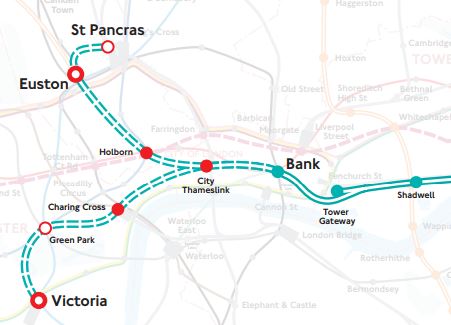
With all the problems of the funding of Crossrail 2, that I wrote about in Crossrail 2 Review Prompts Fresh Delays, could this extension of the DLR, be a good idea?
It would certainly provide an East-West route at City Thameslink station.
Crystal Balls For Brexit
The title of this post is the same as that of this article on Rail Technology Magazine.
This is the first paragraph.
Have you noticed how it is almost impossible to have a sensible debate on the impacts of Brexit? The rules seem to be: take a firm, preferably dogmatic, position; talk about how history supports that position; refuse to entertain dissent; retreat to meet likeminded people; remain strangely bemused by the question, ‘what will happen next?
The article then goes on to give the author’s view on what Brexit will mean for the rail industry.
He comes to the following conclusion.
Brexit will bring costs, uncertainty, and a one-off opportunity to refresh our industry, reaching further into the communities that rail serves. Let’s grab it.
The article is well worth a detailed read.
Would You Want To Buy Part Of A Used Insurance Company From This Man?
There is an article in today’s Times, which is entitled Arron Banks Wants To Sell £4million Stake In Firm.
My answer would be a big no!
The City Of London Reaches For The Sky And Keeps More Feet On The Ground
This article on Construction News is entitled City of London To ‘Encourage’ New Skyscrapers.
This is the first two paragraphs.
The City of London Corporation has opened the door to a new wave of towers and an overhaul of one of its main routes as part of draft new local and transport plans.
The local authority wants to encourage the development of new towers able to provide an “iconic image of the City” that will enhance its global standing in the finance, professional services and commerce sectors.
The main route to be upgraded will be Bishopsgate between Liverpool Street station and London Bridge.
- Pedestrians will have more priority.
- Cycling and walking will be improved.
- The public realm will be upgraded.
It the Peak hours, it could become one the busiest walking and cycling routes in the world.
- At the Northern End, there is Liverpool Street station and Crossrail.
- At the Southern End, there is London Bridge, London Bridge station, Southwark Cathedral and the River Thames.
- Just to the West, is the massive Bank station complex.
- Just to the East, is the soon-to-be-redeveloped Fenchurch Street station.
In addition, the road is fringed on either side with alleys, side streets and the impressive Leadenhall Market, many of which are full of restaurants, cafes, pubs and retail outlets.
Conclusion
In the article, Brexit wasn’t mentioned once, but a large increase in employment wasn’t.
Has the City of London, just put several handfuls of fingers up to the selfish plans of others?
Drilling Starts For ‘Hot Rocks’ Power In Cornwall
The title of this post is the same as that of this article on the BBC.
For as long as I can remember, there have been plans to tap the ‘hot rocks’ under Cornwall for heat and convert it into electricity.
Geothermal power is used in many places around the world.
The Wikipedia entry is worth a read and the Utility-Grade Stations section has this paragraph.
The largest group of geothermal power plants in the world is located at The Geysers, a geothermal field in California, United States. As of 2004, five countries (El Salvador, Kenya, the Philippines, Iceland, and Costa Rica) generate more than 15% of their electricity from geothermal sources.
This is also said.
Enhanced geothermal systems that are several kilometres in depth are operational in France and Germany and are being developed or evaluated in at least four other countries.
As the Cornish project appears to have a degree of EU funding, it looks like Cornwall is one of the four other countries.
The BBC also had a report on the Cornish drilling this morning. They made a point to say that this project has nothing to do with fracking.
Fracking is an emotive project, but we seem to forget that a lot of the engineering and drilling techniques used in the process are also used in other applications, like obtaining fresh water and drilling very deep holes, as is proposed in Cornwall.
It is also enlightening to look at this Wikipedia entry, which describes geothermal power in Germany.
This is said about the sustainability of the power source in Germany.
n the same year (2003) the TAB (bureau for technological impact assessment of the German Bundestag) concluded that Germany’s geothermal resources could be used to supply the entire base load of the country. This conclusion has regard to the fact that geothermal sources have to be developed sustainably because they can cool out if overused.
Based on this, I can understand the enthusiasm for using the technique in Cornwall.
On the BBC this morning, it was said that the Cornish borehole could produce enough electricity for 3,000 homes.
A page on the OVO Energy website, says this.
Household electricity use in the UK dropped under 4,000kWh for the first time in decades in 2014. At an average of 3,940kWh per home, this was about 20% higher than the global average for electrified homes of 3,370kWh.
At 4,000 kWh a year, a home would use an average of 0.46 kW per hour.
This means that to run 3,000 houses needs 1.4 MW per hour.
A typical price of a kWh of electricity is thirteen pence excluding VAT, which means that this plant could earn around £178 per hour or £1.6million a year.
A Project Video
Access the project video here.
Conclusion
I feel that geothermal power could have a promising future in Cornwall.
Large Hydropower Dams ‘Not Sustainable’ In The Developing World
The title of this post is the same as that of this article on the BBC.
This is the first four paragraphs.
A new study says that many large scale hydropower projects in Europe and the US have been disastrous for the environment.
Dozens of these dams are being removed every year, with many considered dangerous and uneconomic.
But the authors fear that the unsustainable nature of these projects has not been recognised in the developing world.
Thousands of new dams are now being planned for rivers in Africa and Asia.
I think the report has a sound basis and we should think much deeper before we build a large dam.
Storing energy and preventing of floods are probably good reasons, whereas others are not, considering, that solar and wind power are becoming more affordable.
Is The End Of The Beginning Approaching For The STAR Upgrade?
I changed trains at Tottenham Hale station today and looked at Greater Anglia’s list of closed days, so that work could proceed on the STAR project, which will create a third track between Stratford and Angel Road stations..
It would appear that after the 12th of January, services could include a two trains per hour service between Stratford and Tottenham Hale stations.
There is a disclaimer on the timetable, which says that you should check, but it looks to me, that there’s a chance, that at least the third track will be completed sometime in January.
I shall be watching progress with interest.
Am I The Only Person Who Feels That Wheelie Cases Should Be Restricted?
I have a vision defect, which means I sometimes miss things low down on the left.
I haven’t flattened a toddler yet, but I’m always on the lookout in case I do.
But I’m getting rather fed up with people who wheel more than one case at the same time.
Several times, I’ve been sent to the ground, as someone has wheeled a case from behind my left side and then turned sharply in front of me.
The latest fad, is that one case isn’t enough, so let’s have more.



I got mixed up with a party of about twelve tourists in Bond Street station, where I was walking at a moderate pace between the Piccadilly and Victoria Lines. One meadow lady twice tried to bump me out of the way.
I did swear!
And then I had my revenge. We all needed to get up a short flight of stairs and I deliberately crossed from left to right twice on the stairs, whilst they were struggling with their heavy cases.
Luckily the stairs and the heavy cases slowed them down and I was able to get my |Victoria Line train.
I do think though, that something should be done to curb the number of heavy cases people take on the Underground.
Regularly, you see people with two and in one case I saw someone with four!
How Do Porterbrook’s Battery/FLEX Trains Compare With Eversholt’s Hydrogen-Powered Trains?
In the two green corners of this ultra-heavyweight fight to provide electric trains for rail routes without electrification, there are two ROSCOs or rolling stock operating companies.
Eversholt Rail Group
Eversholt Rail Group‘s product is the Class 321 Hydrogen, which is an upgrade of a Class 321 train with batteries and hydrogen-power.
Porterbrook
Porterbrook‘s product is the Class 350 Battery/FLEX, which is an upgrade of a Class 350 train with batteries.
How Do The Two Trains Compare?
I will list various areas and features in alphabetical order.
Age
The Class 350 trains date from 2008-2009 and others were introduced to the UK rail network as early as 2004.
The Class 321 trains date from the 1990s, but that shouldn’t be too much of a problem as they are based on the legendary Mark 3 Coach.
Scores: Porterbrook 4 – Eversholt 3
Batteries And Supercapacitors
This is an area, where the flow of development and innovation is very much in favour of both trains.
Currently, a 1000 kWh battery would weigh about a tonne. Expect the weight and volume to decrease substantially.
Scores: Porterbrook 5 – Eversholt 5
Battery Charging – From Electrification
No problem for either train.
Scores: Porterbrook 5 – Eversholt 5
Battery Charging – From Rapid Charging System
I believe that a third-rail based rapid charging system can be developed for battery/electric trains and I wrote about this in Charging Battery/Electric Trains En-Route.
No problem for either train.
Scores: Porterbrook 5 – Eversholt 5
Development And Engineering
Fitting batteries to rolling stock has now been done successfully several times and products are now appearing with 400 kWh and more energy storage either under the floor or on the roof of three and four-car electrical multiple units.
I feel that adding batteries, supercapacitors or a mixture of both to typical UK electric multiple units is now a well-defined process of engineering design and is likely to be achieved without too much heartache.
It should be noted, that the public test of the Class 379 BEMU train, was a rare rail project, where the serious issues found wouldn’t even fill a a thimble.
So I have no doubt that both trains will get their batteries sorted without too much trouble.
I do feel though, that adding hydrogen power to an existing UK train will be more difficult. It’s probably more a matter of space in the restricted UK loading gauge.
Scores: Porterbrook 5 – Eversholt 3
Electrification
Both types of train currently work on lines equipped with 25 KVAC overhead electrification, although other closely-related trains have the ability to work on 750 VDC third-rail electrification.
Both trains could be converted to work on both systems.
Scores: Porterbrook 5 – Eversholt 5
Interiors
The interior of both trains will need updating, as the interiors reflect the period, when the trains were designed and built.
Eversholt have already shown their hand with the Class 321 Renatus.
The interiors is a design and refurbishment issue, where train operating companies will order the trains and a complimentary interior they need, for the routes, where they intend to run the trains.
Scores: Porterbrook 5 – Eversholt 5
Operating Speed
Both trains in their current forms are 100 mph trains.
However some versions of the Class 350 trains have been upgraded to 110 mph, which allows them to work faster on busy main lines and not annoy 125 mph expresses.
I am pretty sure that all Class 350 trains can be 110 mph trains.
Scores: Porterbrook 5 – Eversholt 4
Public Perception
The public judge their trains mainly on the interiors and whether they are reliable and arrive on time.
I’ve talked to various people, who’ve used the two scheduled battery/electric services, that have run in the UK.
All reports were favourable and I heard no tales of difficulties.
In my two trips to Hamburg, I didn’t get a ride on the Coradia iLint hydrogen-powered train, but I did talk to passengers who had and their reactions were similar to those who travelled to and from Harwich in the UK.
I rode on the Harwich train myself and just like Vivarail’s Class 230 train, which I rode in Scotland, it was impressive.
I think we can say, that the concept and execution of battery/electric or hydrogen-powered trains in the UK, will be given a fair hearing by the general public.
Scores: Porterbrook 5 – Eversholt 5
Range Without Electrification
Alstom talk of ranges of hundreds of miles for hydrogen trains.and there is no reason to believe that the Class 321 Hydrogen trains will not be capable of this order of distance before refuelling.
Bombardier, Vivarail and others talk of battery ranges in the tens of miles before a recharge is needed.
The game-changer could be something like the technique for charging electric trains, I outlined in Charging Battery/Electric Trains En-Route.
This method could give battery trains a way of topping up the batteries at station stops.
Scores: Porterbrook 3 – Eversholt 5
Conclusion
The total scores are level at forty-seven.
All those, who say that I fiddled it, not to annoy anybody are wrong.
The level result surprised me!
I feel that it is going to be an interesting engineering, technical and commercial battle between the two ROSCOs, where the biggest winners could be the train operating companies and the general public.
I wouldn’t be surprised to see two fleets of superb trains.
 The Anonymous Widower