From Reading To Gatwick Airport Along The North Downs Line
After writing Connecting Reading And The West To Gatwick Airport And Eurostar, I decided to go and look at the reality of the North Downs Line between Reading and Gatwick Airport stations.
I took my usual route to Reading, which is to go to Moorgate and get the Elizabeth Line direct to Reading using my Freedom Pass, after having breakfast in the Leon on Moorgate.
- I then had to leave the station at Reading, so that I could buy my ticket to Gatwick Airport.
- It would be so much easier, if there ere a couple of ticket machines on the bridge or platform at Reading station, so that passengers, who were changing trains could buy tickets quickly and easily.
In the end, I caught the 11:24 train to Gatwick with only a few minutes to spare.
From Reading To Gatwick Airport Along The North Downs Line
Along the North Downs Line, the train was a well-refreshed Great Western Railway Class 165 train.
These are some of the pictures, that I took on the route.








































Note.
- The route goes through a lot of typical Surrey heathland.
- I noticed several pubs along the way.
- I suspect that there are some good walks from the stations.
- Reading and Guildford are university cities.
- Sandhurst is home to the Royal Military Academy.
- Farnborough Airport used to be home to the Royal Aircraft Establishment.
- Most of the seats on the train were taken.
I would expect that for a mainly rural route it is fairly busy.
Hitachi’s Intercity Battery Trains
Hitachi have developed an Intercity battery train and it is described on this page on their web site, where this is said about converting the trains to battery-electric operation.
A quick and easy application of battery technology is to install it on existing or future Hitachi intercity trains. Hitachi Rail’s modular design means this can be done without the need to re-engineer or rebuild the train and return them to service as quickly as possible for passengers.
Replacing one diesel engine with just one battery reduces emissions by more than 20% and offers cost savings of 20-30%. Our intercity battery powered trains can cover 70km on non-electrified routes, operating at intercity speeds at the same or increased performance.
That performance is certainly enough for Reading and Ashford via Gatwick, as only 37.7 miles in total, is not electrified.
Does The North Downs Line Mirror The East-West Rail?
Consider.
- The East West Rail will encircle London to the North, between Oxford and Cambridge.
- The North Downs Line encircles London to the South, between Reading and Ashford.
They could be considered two complimentary rail lines.
A Milton Keynes And Ashford International Service
Looking at the track layout on OpenRailwayMap, it would appear that one of Hitachi’s proposed Intercity Battery Trains fitted with dual voltage could pick its way elegantly along the East West Rail and the North Downs Line between Milton Keynes and Ashford International via Oxford, Reading and Gatwick Airport.
An Occasional Sheffield And Ashford International Service
If you could run a service between Milton Keynes and Ashford International, why not extend it to Bedford or even Sheffield in the North?
I believe if you put these Hitachi’s proposed Intercity Battery Trains on a cross-country route, that they will quickly suffer from London Overground Syndrome. This is my definition of the syndrome.
This benign disease, which is probably a modern version of the Victorian railway mania, was first identified in East London in 2011, when it was found that the newly-refurbished East London Line and North London Line were inadequate due to high passenger satisfaction and much increased usage. It has now spread across other parts of the capital, despite various eradication programs.
Put simply, it can probably be summed up as Quality Attracts Passengers.
Serving Heathrow
There have been various plans to get rail access into Heathrow from the West, but none have so far got off the starting blocks.
It is my view, that in the interim period, after my trip last weekend in the superb Wrightbus hydrogen double deck bus from Sutton to Gatwick, that I wrote about in Sutton Station To Gatwick Airport By Hydrogen-Powered Bus, that we should ask Wrightbus, who are designing a hydrogen-powered coach, to design the ultimate coach to connect rail hubs to major airports.
I would then run these coaches every ten minutes between Reading station and Heathrow Airport.
Serving Attractions
I believe that pairing Hitachi’s proposed Intercity Battery Trains with Wrightbus’s hydrogen coach could be a winner for passengers and operators.
As an example, Lumo are hoping to run an open access service between Paddington and Carmarthen, if Heidi the Spoilsport permits. Would it not be sensible, if one of Wrightbus’s hydrogen coaches did the last mile duties to the ferry for Ireland at Fishguard harbour.
SeAH Steel Holdings’ UK Monopile Factory To Launch With Major Offshore Wind Deals
The title of this post is the same as that of this article on the CHOSUN Daily.
These three paragraphs give more details.
SeAH Wind, the British offshore wind structure subsidiary of SeAH Steel Holdings, is set to begin commercial operations at its local plant next month, bolstering annual revenue growth projected to reach billions of dollars. The facility has received a total investment of £900 million ($1.1 billion or 1.6 trillion won), and the company has already secured orders surpassing the plant’s construction costs, ensuring a solid foundation for stable operations, according to industry sources.
Located in Teesside, northeastern England, the plant is in the final stages of equipment installation and test production ahead of its commercial launch. The facility has an annual production capacity of up to 400,000 metric tons of monopiles—cylindrical steel structures welded from thick steel plates—which serve as seabed foundations for offshore wind turbines.
The £900 million SeAH Wind plant was established with support from various group affiliates. SeAH Steel Holdings founded SeAH Wind in the UK in 2021, initially investing approximately 400 billion won ($274 million or £217 million) in the facility. Additional funding was secured through capital increases, with contributions from SeAH Steel Holdings, its steel pipe subsidiary SeAH Steel, and overseas branches, including U.S.-based SeAH Steel America and South Korea-based SeAH Steel International.
As the UK’s sole offshore wind monopile supplier, SeAH Wind has attracted significant attention. On Feb. 13, King Charles III visited the plant to inspect its production facilities, underscoring its strategic role in the country’s renewable energy sector.
The plant is making monopiles for the Hornsea 3 and Norfolk Vanguard wind farms.
Connecting Reading And The West To Gatwick Airport And Eurostar
I have just checked the electrification between Reading and Ashford International using OpenRailwayMap.
- Between Cardiff and Reading the electrification is 25 KVAC overhead.
- Between Reading and Wokingham the electrification is 750 VDC third-rail.
- Between Wokingham and Reigate is not electrified.
- Between Reigate and Gatwick Airport the electrification is 750 VDC third-rail.
- Between Gatwick Airport and Ashford International the electrification is 750 VDC third-rail.
Only 37.7 miles is not electrified.
Hitachi’s Intercity Battery Trains, have a range on battery power of seventy kilometres or forty-five miles, so these trains could go between Reading or any station to the West to any station on the North Downs Line, including Guildford, Redhill, Gatwick Airport, Tonbridge and Ashford International stations.
The trains would need to be dual voltage and I’m fairly sure, that no new infrastructure would be needed.
A Green No-Fly Route Between Europe And Ireland
Consider.
- The Great Western Main Line is electrified to Cardiff.
- There is no electrification to the West of Cardiff.
- Cardiff and Fishguard Hsrbour is 115.6 miles.
- There is a ferry between Fishguard and Rosslare.
I suspect Hitachi could configure one of their Intercity Battery Trains, that could connect Ashford International and Fishguard Harbour stations.
Gatwick’s Hydrogen Advantage Over Heathrow
The Future Of Hydrogen In Aviation
I believe that hydrogen will have a big future in aviation.
Powering Aircraft
It will be some years, but not as many as some people think, before we see hydrogen-powered aircraft in the air.
Airbus have produced this infographic of three possible hydrogen-powered aircraft.

Discover the three zero-emission concept aircraft known as ZEROe in this infographic. These turbofan, turboprop, and blended-wing-body configurations are all hydrogen hybrid aircraft.
I wrote a bit more about these three hydrogen-powered concepts in ZEROe – Towards The World’s First Zero-Emission Commercial Aircraft.
My best estimate is that we’ll see hydrogen-powered aircraft in the air by 2035.
Towing Aircraft Around
Most aircraft are very heavy and towing them around needs a lot of zero-carbon energy.
So I think it is likely, that at some time in the near future,tugs to tow large aircraft around an airport will be hydrogen powered.
If you type “hydrogen-powered aircraft tug” into Google, you get several sensible product developments, including ones from.
- Exeter Airport
- Teesside Airport
- The Royal Air Force.
- The US Air Force
Note.
- The involvement of the military.
- At least two of the tugs are conversions of existing equipment.
- The extra weight of the battery in an electric-powered tug, may make the realisation of a viable electric aircraft-tug difficult.
I suspect we’ll see hydrogen-powered aircraft tugs in use on airports around the world in the near future.
Long-Term Car-Park Buses
I would have thought that using hydrogen-powered or battery-electric buses to serve long-term car-parks at an airport would be an obvious application. But it does appear that airports using zero-carbon buses to serve long-term car-parks are not very common.
- Gatwick uses a large fleet of hydrogen buses to bring passengers and staff to the airport, but these don’t appear to be linked to car parking.
- Incheon Airport in Korea does appear to use hydrogen-powered buses.
Please let me know, if you know of any other uses of hydrogen-powered vehicles at airports.
Hydrogen For Heathrow
This Google Map shows Heathrow Airport.
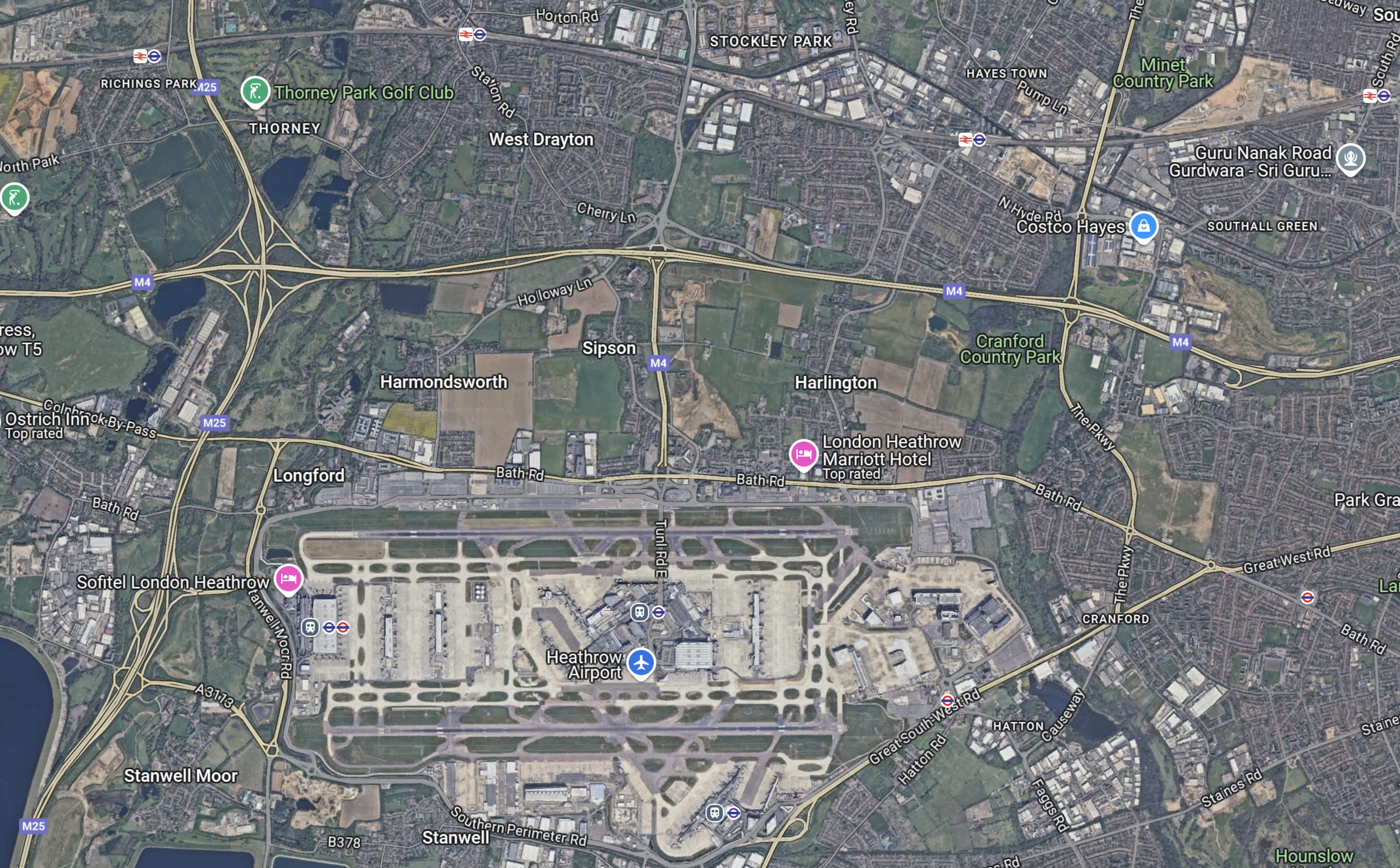
Note.
- The M4 going across the map.
- The two main runways.
- A new third runway would go between the M4 and the Northern runway.
It is likely if the third runway goes ahead, the village of Harmondsworth will be flattened.
It is likely that supplying hydrogen to Heathrow will mean a hydrogen terminal somewhere South of the M4, which could be supplied by rail tankers.
Hydrogen For Gatwick
This Google Map shows Gatwick Airport.
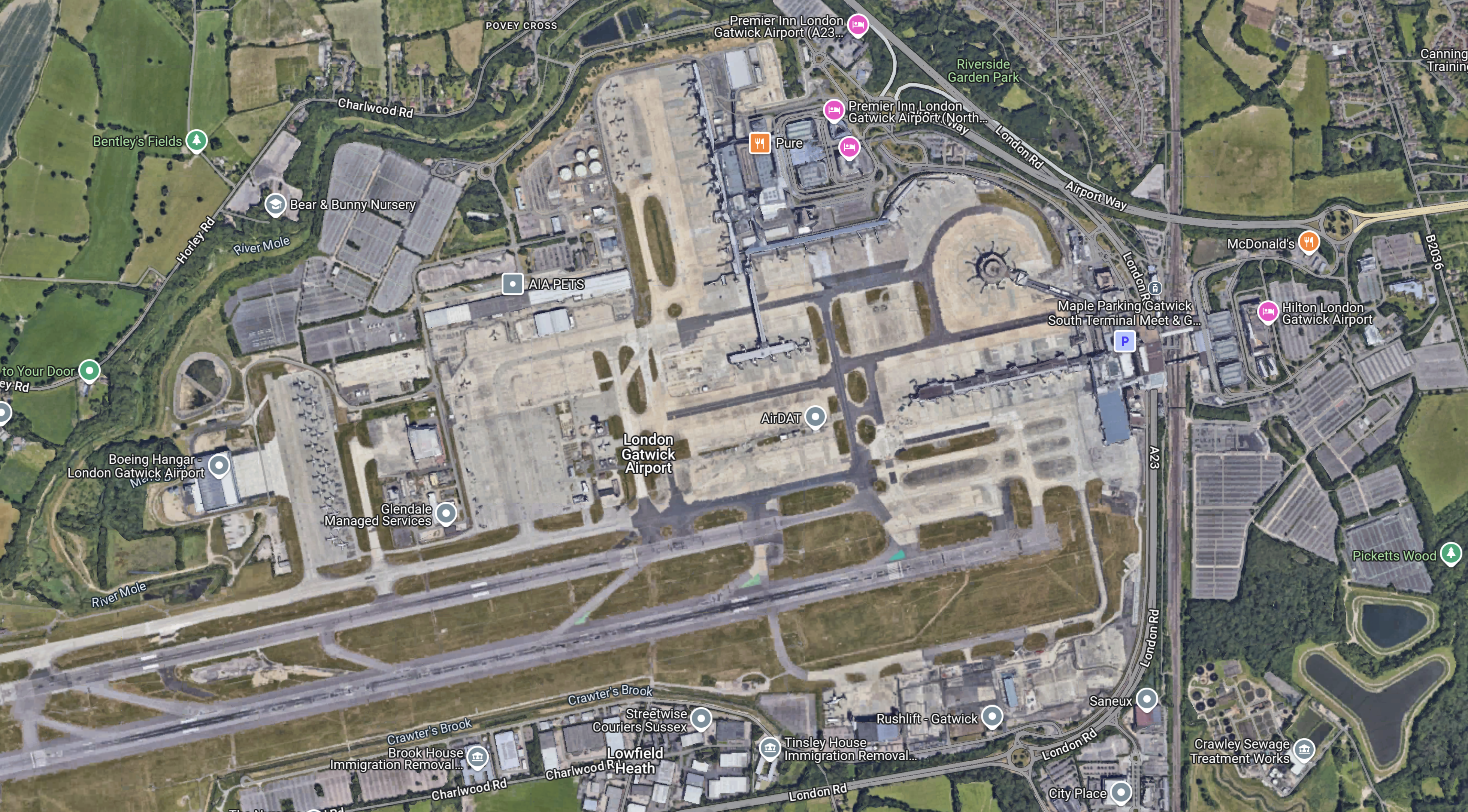
Note.
- The current main runway with the emergency runway to its North.
- Because the runways are too close together they cannot be used simultaneously.
- To create a second runway, the two runways would be moved further apart and the current emergency runway would be enlarged.
- The Brighton Main Line runs North-South past the Eastern end of the main runway.
Gatwick’s expansion plan doesn’t appear to require any properties outside the airport boundaries to be demolished.
This Google Map shows Sussex between Gatwick Airport and Brighton.
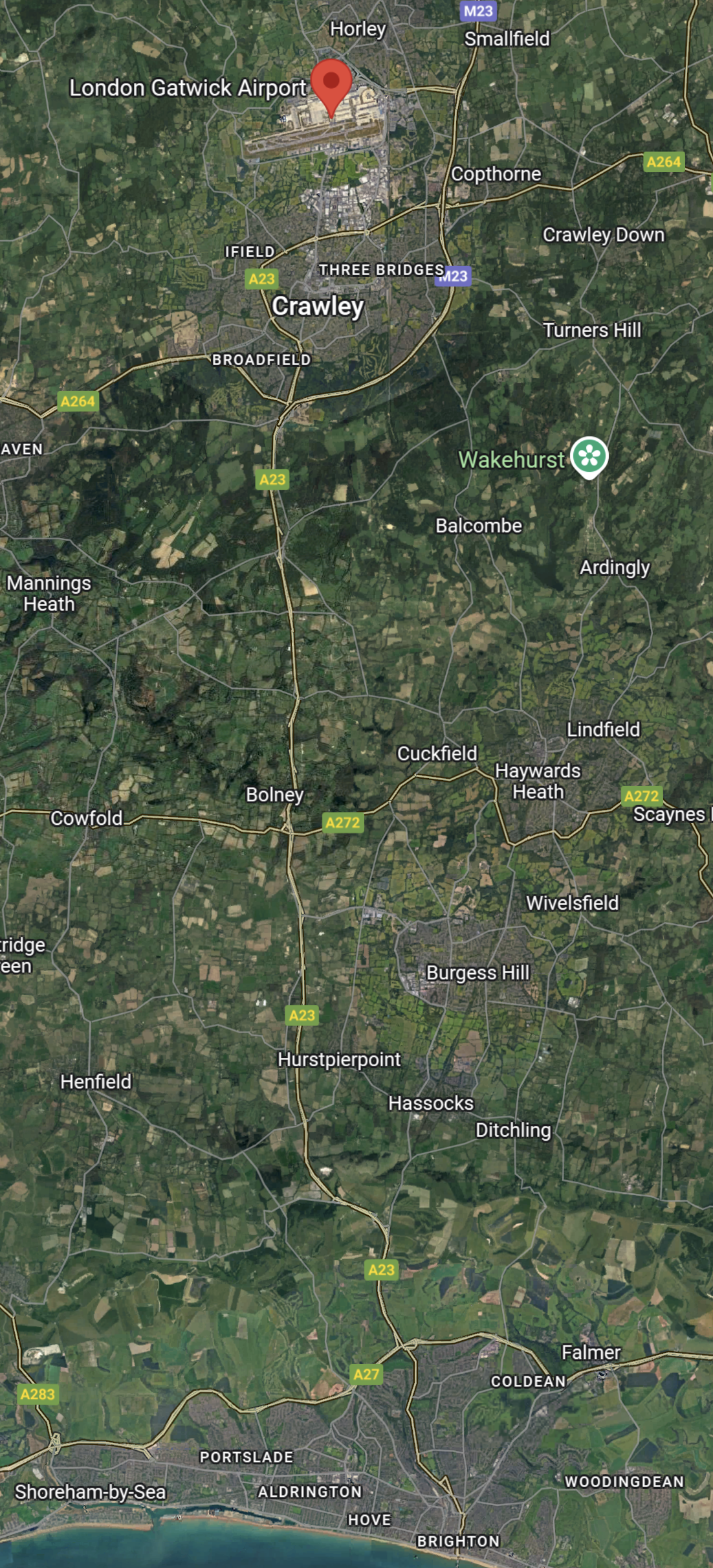
Note.
- Gatwick Airport is indicated by the red arrow at the top of the map.
- Gatwick’s runways can be picked out under the red arrow.
- The South Coast is at the bottom of the map.
- The M23 and the Brighton Main Line connect Gatwick Airport and Brighton.
- Shoreham and Brighton are on the South Coast.
- Click the map to show on a larger scale.
Under current plans, the Ramplion offshore wind farm off the South Coast is going to be increased in size to 1.6 GW.
The simplest plan to provide large amounts of green hydrogen to Gatwick would be to build a large electrolyser in the Port of Shoreham and pipe it along the railway to Gatwick Airport. Hydrogen could also be shipped at night into the Airport using rail tankers.
There’s no doubt in my mind, that it will be much easier to supply large quantities of hydrogen to Gatwick, rather than Heathrow.
In 2023, I wrote Discover How Greater Brighton Is Championing The Transition To Hydrogen, which probably indicates that the locals and their politicians, would welcome the investment in hydrogen in their city.
It should also be noted that world class consultants Ricardo, who are very much involved in the development and promotion of hydrogen technology are based in Shoreham.
Liquid hydrogen could also be imported and distributed from the Port of Shoreham.
Brighton could end up as the South of England’s Hydrogen City.
Ocado’s Computing Has Been Spot On So Far
I first used Ocado for my weekly shop in June last year and have used them about 30 times since.
There have been no computing mistakes.
Only a couple of substitutions have been made and they have caused me no trouble.
All orders have been delivered within the delivery window and nothing seems to have been damaged in transit.
I shall continue to keep using them.
London’s Elizabeth Line: Business Pays, Drivers Strike
The title of this post, is the same as that of this article on RailTech.com.
This is the sub-heading.
London’s Elizabeth Line is hugely popular with passengers. Maybe not so popular with the businesses who have to pay a premium for the privilege of sitting above it – and will soon have to pay more. Also maybe not so popular with the drivers who want more pay for sitting in the front seat.
Enough Said!
DfT Objects To Eight Open Access Applications
The title of this post is the same as that of an article in the March 2025 Edition of Modern Railways.
Surprise! Suprise! There are no prizes for innovation and risk, to be given out by Starmer’s Government Of All The Lawyers.
- Alliance Rail – Cardiff and Edinburgh – opposed
- Grand Central – London and York – opposed
- Hull Trains – London and Hull – opposed
- Hull Trains – London and Sheffield – opposed
- Lumo – London and Glasgow – opposed
- Lumo – London and Rochdale – opposed
- Virgin Trains – London and Liverpool – opposed
- Virgin Trains – London and Glasgow – opposed
Wrexham, Shropshire and Midlands Railway – London and Wrexham – supported.
Splitting And Joining Of Trains
Several of the objections, seem to be on grounds of capacity.
So why not pair up some services and split and join at a convenient station?
Hull Trains – A Hull and a Sheffield service could start together in London and split in Retford.
Lumo – A Newcastle and an Edinburgh service could start together in London and split in Newcastle.
Lumo – An Edinburgh and a Glasgow service could start together in London and split in Edinburgh.
Virgin Trains – A Liverpool and a Glasgow service would start together in London and split in Crewe.
A Bad Decision
I believe the Government’s decision is a very bad one.
At the weekend I wrote Sutton Station To Gatwick Airport By Hydrogen-Powered Bus, about my trip in a hydrogen-powered bus to Gatwick-Airport.
- The quality, performance and roadholding of this new zero-carbon bus was superb.
- I can’t wait to try out Wrightbus’s new hydrogen-powered coach in the next twelve months.
- In the future, I can see high speed hydrogen coaches steaming along the motorways of the UK and Ireland.
Hydrogen-powered coaches will do for cheap travel on the roads of these islands, what Ryanair and easyJet for did above our heads.
Tea Removes Toxic Heavy Metals From Water, Study Suggests
The title of this post, is the same as that of this article on The Times.
This is the sub-heading.
The longer tea is steeped, the more contaminants are removed
These are the first three paragraphs, which give a flavour of the research.
A daily cup of tea may do more than just perk you up — it can also purge the water of toxic heavy metals, a study suggests.
Researchers found that tea leaves will trap lead, cadmium, and other unwanted contaminants during the brewing process. These metals bind to the leaves and remain there until they are thrown away.
Benjamin Shindel of Northwestern University, Illinois, who led the research, said that while other materials might achieve a similar effect, tea’s popularity made it unique. “What is special about tea is that it’s the most consumed beverage in the world,” he explained.
My late wife was a coffee drinker and I only have the odd cup of cappuccino, although, I do drink lots of zero-alcohol beer, hot chocolate and decaffeinated tea.
I would assume that from his name Professor Benjamin Shindel is quite likely to be Jewish.
So did he ask all his friends and relatives round for a tea party?
The Professor certainly wouldn’t have had to have stinted on the cakes, as they wouldn’t have got near the water, which was the real subject of the research.
But he wouldn’t have been short of volunteers to brew their favourite tea!
Eyes Full Of Sleep
I can remember my mother telling my wife a; C, about myself, when I was a baby. She said that my eyes got terribly bunged up with muck, what she called sleep. She also said she’d spend time cleaning out my eyes and ears.
Last night, I was finding, that my eyes were so full of muck, that I couldn’t type, with one in about five letters wrong.
I thought it just could be be my eyes full of sleep, so I ran a deep bath and gave my eyes a thorough flush.
After that I could see and type properly.
I slept well.
In fact I slept so well, that I overslept until nine. Which is very unlike me.
I also wasn’t sure of the day, when I woke up. But at least, I got my drugs right.
An Incident As A Child
In one incident as a child, when I was about five, I can remember my mother picking me up, taking me upstairs, running a bath and then undressing me quickly and putting me in it. I also remember that I was very red.
Any ideas about what she was doing?
Never Mind Heathrow: Gatwick Airport Is Close To Getting A New Runway
The title of this post, is the same as that of this article on The Times.
A friend passed through at Gatwick Airport yesterday, so I went to wish him well. For a change , I took a Metrobus from Sutton station to the South terminal – This route is free and doesn’t need a ticket with a Freedom Pass!
The bus was no ordinary bus, but a brand new Wrightbus hydrogen double decker from Ballymena.
It took a round-about route, as its main function is to bring local workers and passengers into the airport and handle traffic to Redhilll, Reigate and East Surrey Hospital.
But if this is the shape of buses to come, then I’m for it. Quality was more coach than bus and performance was sparkling with little or no noise and vibration.
Gatwick and Metrobus are building a network of local hydrogen buses to bring workers and passengers into the airport and I suspect, if the Airport has the fuel, they’ll use it for other purposes, like air-side vehicles, aircraft tow-trucks and car park buses.
Gatwick unlike Heathrow has a close-by source of electricity to produce hydrogen in the soon-to-be-extended 1.6 GW Ramplion offshore wind farm, just off Brighton.
Airbus are talking about bringing hydrogen aircraft into service by 2035 and I believe that by this date we’ll be regularly seeing hydrogen-turboprops on short routes.
As someone, whose software planned the Channel Tunnel, I think it reasonable by 2035, the following projects will be completed.
- Zeroavia are talking of converting aircraft to hydrogen in the next few years.
- A number of short-haul hydrogen aircraft are in service.
- Gatwick’s new runway and terminals are built.
- Ramplion is pumping hydrogen to the airport.
- The station has been updated.
- The Thameslink frequency of trains will have been increased.
Gatwick could be the first major airport to use large amounts of hydrogen, to cut emissions.
 The Anonymous Widower