Chester To Liverpool Via Runcorn
This new service between Chester and Liverpool Lime Street stations via Runcorn station and the Halton Curve, started a couple of weeks ago.
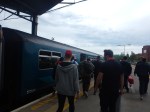
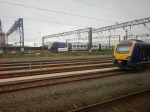
I took these pictures of the journey.








Note.
- The service was busy, as everybody seemed to be going to Liverpool to prepare for the evening’s match.
- The Class 150 train kept up a good speed, which indicates that Network Rail didn’t cut quality on the link.
- Runcorn is about the halfway point of the journey.
- The route is electrified between Runcorn and Liverpool Lime Street stations.
- The Class 150 train was a bit tired.
I wouldn’t be surprised to see a hybrid train working this route.
- Transport for Wales have ordered some electro-diesel Class 769 trains.
- Alstom are converting Class 321 trains into hydrogen-powered Class 321 Breeze trains at nearby Widnes.
- Porterbrook are converting Class 350 trains into Battery/FLEX trains.
- Hitachi are talking to ScotRail about Class 385 trains with batteries.
- I’m also sure Bombardier have a battery-electric Aventra.
Operation would be as follows.
- All these trains work be capable of 100 mph using 25 KVAC overhead electrification between Liverpool Lime Street and Runcorn stations.
- Power changeover would be at Runcorn station.
- Between Runcorn to Chester stations is only about fourteen miles.. This will be well within battery range in a few years.
Transport for Wales will be obtaining trains from a crowded market.
More Halton Curve Services
Under Planned Improvements in the Wikipedia entry for Transport for Wales, this is said.
Introduction of a new hourly Liverpool to Llandudno and Shrewsbury service, and a new two-hourly Liverpool to Cardiff Central service from December 2022.
Adding these to the current hourly service, this would mean that two trains per hour (tph) would normally run between Liverpool Lime Street and Chester stations, with three trains in every alternate hour.
I think that, there would be a marketing advantage in running hybrid trains on these routes. Hydrogen would be ideal, as these would not need recharging like battery trains after a long trip.
To go through the single-track Halton Curve appears to take trains about five minutes, so up to eight tph could probably be feasible, which would mean four tph between Liverpool and Chester via Runcorn in both directions.
If Trains for Wales are going to compete with the Merseyrail electric services, they need a four tph frequency in both directions.
Flexible Ticketing
Currently, if you want to buy a ticket between the Chester and Liverpool Lime Street, you have to buy an appropriate ticket for your chosen route.
Surely, tourists and others might like to do the out and back journeys by a different route.
If London Underground and some train companies can share ticketing, then surely Merseyrail and other train companies can do the same.
Conclusion
This new service will be surprisingly well-used and needs an iconic hybrid train.
- Diesel is not appropriate for the long term, although in Northern Connect Between Chester And Leeds To Start In May, I did report a rumour that Class 769 trains might be running between Chester and Leeds.
- Hydrogen is non-polluting and has a longer range, that could make services between Liverpool and Holyhead possible.
- Battery will probably need a charging infrastructure.
My money is on hydrogen power.
What Is The Kinetic Energy Of A Class 710 Train?
I finally got a good look at a Class 710 train at Gospel Oak station this morning.
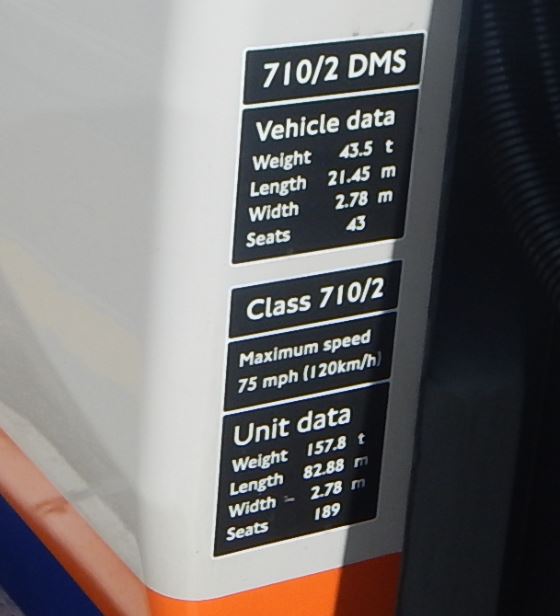
The picture shows the plate on the end of a DMS car.
- The weight of the train is 157.8 tonnes. Note that the four-car Class 378 trains weigh 172.1 tonnes.
- 700 passengers at 90 Kg each with baggage, bikes and buggies would be 63 tonnes.
- That would be a total weight of 220.8 tonnes.
- The operating speed is shown as 75 mph., which is the same as the Class 315 train, that many Class 710 trains will replace.
Using the Omni Kinetic Energy Calculator gives a kinetic energy of 34.5 kWh.
For completeness these are the figures for different speeds.
- 50 mph – 15.3 kWh
- 60 mph – 22.1 kWh
- 90 mph – 49.4 kWh – Operating speed of a Crossrail Class 345 train.
- 100 mph – 61.3 kWh – Operating speed of many electric multiple units.
Note that the amount of energy is proportional to the square of the speed.
What Do The Kinetic Energy Figures Show?
These are a few of my thoughts.
What Is Regenerative Braking?
A full Class 710 is travelling along at 75 mph, ihas 34.5 kWh of kinetic energy. Whenit needs to stop at a station, this energy has to be dissipated.
With normal friction brakes, the energy will be converted into heat and wasted.
But with regenerative braking, the traction motors are used in reverse to generate electricity.
This electricity is generally handled in one of three ways.
- It is passed through resistors on the roof of the train and turned into heat and wasted.
- It is fed back into the electrification and used by nearby trains. This needs special transformers feeding the electrification.
- It is stored in a battery or other energy storage device on the train.
The last method is the most efficient, as the stored energy can be used to help restart the train and regain line speed.
Can The Lea Valley Lines Electrification Handle Regenerative Braking?
This question must be asked, as if the lines can’t then running trains with batteries could be the best way to handle regenerative braking and improve efficiency and reduce the electricity bill.
It should be noted, that the Chingford and Enfield Town routes are not shared with any other trains, so running Class 710 trains on these routes may have advatages in the maintenance of the electrification, if the trains handle the regenerative braking.
On the Cheshunt route, there are also some Greater Anglia services, but these will generally be run by Class 720 trains, which are also Aventras.
On the other hand, the electrification on the Gospel Oak to Barking Line has probably been installed to handle the reverse currents.
Do Class 710 Trains Have Regenerative Braking?
Search the Internet for “Class 710 train regenerative braking” and you find little in addition to my ramblings.
But other Aventras, like Crossrail’s Class 345 trains have been stated to have regenerative braking.
I also repeated my views in an article in Rail Magazine, which I described in I’ve Been Published In Rail Magazine.
No-one has told me that they disagree with my views and I was talking rubbish!
So I will assume that Class 710 trains do have regenerative braking!
The Aventra’s Electrical Systems
In this article in Global Rail News from 2011, which is entitled Bombardier’s AVENTRA – A new era in train performance, gives some details of the Aventra’s electrical systems. This is said.
AVENTRA can run on both 25kV AC and 750V DC power – the high-efficiency transformers being another area where a heavier component was chosen because, in the long term, it’s cheaper to run. Pairs of cars will run off a common power bus with a converter on one car powering both. The other car can be fitted with power storage devices such as super-capacitors or Lithium-ion batteries if required.
This was published eight years ago, so I suspect Bombardier have refined the concept.
But even in 2011, Bombardier were thinking about energy storage on the train.
How Much Storage Would A Class 710 Train Need?
As I said earlier, I train would need sufficient energy storage to store the kinetic energy of a train.
As my calculations show that a full train travelling at the maximum speed of 75 mph, then the energy storage for this version of a Class 710 train must be able to store at least 34.5 kWh, at all times.
The size of the on board energy storage could be around 40-50 kWh, which is readily available in a lithium ion battery, that has been designed for transport use.
Where Would The Energy Storage Be Placed?
The extract above says that two cars hold the electrical systems.
These pictures show the pantograph car and driver car next to it.
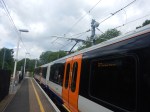
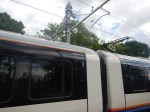

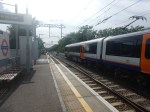
Note that underneath the pantograph car is a transformer.
So are these, the pair of cars, the extract describes? They certainly could be!
This is a selection of pictures of the underneath of the driver car.
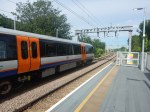
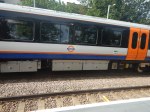
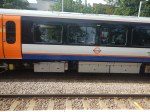

Note.
- There are two large boxes with latches under both driver cars.
- Next to these boxes is a smaller box. At the pantograph end of the train, it is open and looks like a cooling system for the two boxes
- At the other end of the train, the smaller box appears to have a blanking plate, so perhaps the boxes are empty.
The only sensible use I can think of for the boxesis to store the batteries or capacitors.
I
I would estimate that each of the four large boxes.
- Is about a metre wide.
- Is about 0.3 metres high.
- Is sized to fit within the 2.7 metre width of the train. Perhaps 2.5 metres.
These give a column of 0.75 cubic metres.
Bombardier used to manufacture a Primove 50 kWh battery, which was built to power trams and trains, that had the following characteristics.
- A weight of under a tonne.
- Dimensions of under two x one x half metres.
Were these boxes under the floor of the driver cabs of the Class 710 train designed to hold a Primove 50 kWh or similar battery?
Four batteries could give the train as much as 200 kWh of energy storage.
But surely for trundling along the Gospel Oak to Barking Line. a smaller battery capacity would be sufficient. I suspect that you fill the boxes with how many batteries you need and the computer does the rest.
Perhaps, just one 50 kWh battery would be enough! This could explain, why the cooling system appears to be blanked off at one end of the train.
Could The Batteries Be Used To Power The Class 710 Train?
In an article in the October 2017 Edition of Modern Railways, which is entitled Celling England By The Pound, Ian Walmsley says this in relation to trains running on the Uckfield Branch, which is not very challenging.
A modern EMU needs between 3 and 5 kWh per vehicle mile for this sort of service.
So a 50 kWh bsttery would give the following ranges with these consumption rates for a four-car Class 710 trains.
- 3 kWh – 4.2 miles
- 4 kWh – 3.1 miles
- 5 kWh – 2.5 miles
It looks to me, that battery power would be possible over the extension to Barking Riverside station, which is about a mile long.
Battery power would also other uses.
- Moving the train to a safe place for passenger evacuation, when the overhead electrification fails.
- Moving the train in a depot or sidings, without overhead power.
- Running innovative on-board services for maintenance and train preparation, when the train is parked overnight.
Reliable battery power has a lot of uses on a train.
West London Orbital Railway
The West London Orbital Railway would have less than ten miles of lines without electrification, with several electrified miles on either side.
I believe that Class 710 trains with the right amount of batteries could bridge the gap and make a massive difference to rail transport in North and West London.
I think that jumping a gap of a few miles on battery power, may well be easier than doing an Out-and-Back service..
A Flexible System
As it appears, each Class 710 train has got four battery boxes, I suspect that batteries can be installed as to the needs of the route.
- Standard operation on Gospel Oak to Barking, Watford DC Lines and Lea Valley Lines could be one or two batteries to handle regenerative braking.
- Out-and-Back to Barking Riverside station ,might need two batteries.
- West London Orbital services might need three or four batteries.
These battery boxes also could be designed to allow an easy and quick change of battery, as batteries on buses have given Transport for London trouble in the past.
Conclusion
Bombardier’s design of the Aventra has been designed with battery operation in mind, which opens up lots of possibilities!
Abbey Line Passing Loop Proposed
The title of this post is the same as that of an article in the June 2019 Edition of Modern Railways.
Bricket Wood station used to be an important station on the Abbey Line, with grand buildings and a passing loop to allow trains to run a teo trains per hour (tph) service as opposed to the current inconvenient train every forty-five minutes.
Consultants have now said that a traditional passing loop, with a second platform and a bridge would cost up to £10million, which is probably not viable.
The Penryn Solution
The article says this about the consultants’ alternative solution.
The platform at Bricket Wood be lengthened such that trains stop at different ends of a single platform, similar to the solution adopted in Penryn on the branch line from Truro to Falmouth, which would help to minimise costs.
This Google Map shows Penryn station.
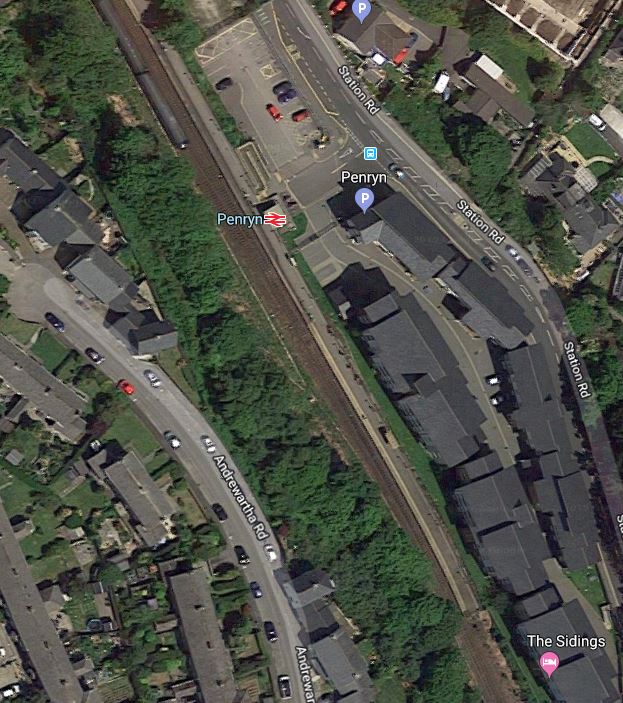
Note the long single platform in the station.
This section in the Wikipedia entry called Signalling, gives a full explanation of the method of operation at Penryn.
Truro-bound trains use the northern end of the station (Platform 2), arriving before the Falmouth-bound train, which will pass through the new loop and to the southern end of the platform (Platform 1), allowing the Truro-bound train to continue its journey north. This gives a rare situation in the United Kingdom where trains run on the right, instead of on the left as is usual in this country. Trains are scheduled to depart simultaneously for Truro and Falmouth.
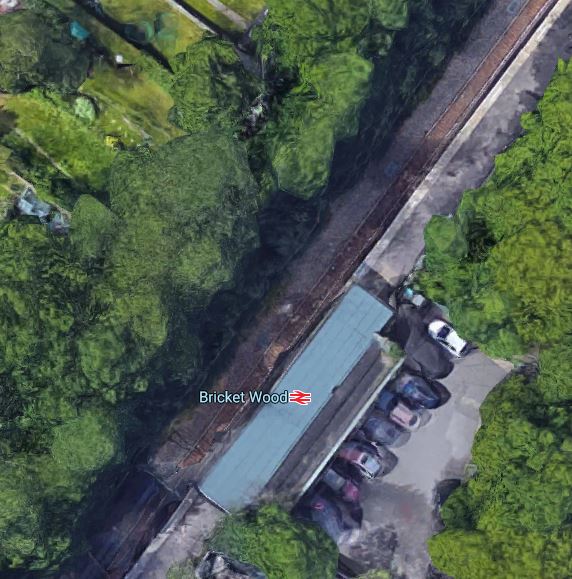
Bricket Wood station already has a platform, that can take a comfortably take a four-car Class 319 train, as this Google Map shows.
Consider.
- I estimate from Google Maps, that the single platform at Bricket Wood station is currently around 190 metres long.
- Looking at the map, it might be possible to add another ten metres or so to the platform length.
- The current Class 319 trains are 79.5 metres long or 159 metres for a pair.
- It wouldn’t matter, if for reasons of safety, the front of the trains were allowed to extend for perhaps ten metres past the end of the platform.
- There also appears to be space to put a second track alongside the current single track.
I also suspect, that Network Rail have track design software, that can precisely calculate the size and position of the points, so that the manoeuvre can be safely executed every time.
I very much feel, that a design can be produced, that will staff, passengers and regulators.
Can This Proposal Handle More Than Two tph?
If you look at the timings of the train, it takes eight minutes to run these legs.
- Watford Junction and Bricket Wood
- Bricket Wood and St. Albans Abbey
The times are identical, irrespective of direction.
If times are the same after installation of the novel loop. A train will take sixteen minutes plus however much time, it takes to turnback the train to get back to Bricket Wood.
As trains will be running every thirty minutes and both trains will leave Bricket Wood at the same time, the train must be able to run the out-and-back journey from Bricket Wood in thirty minutes or less.
- The out and back legs both take eight minutes.
- This means that the turnback time must be less than fourteen minutes.
Currently, turnback times are fourteen minutes or less.
- If you look at four tph, there is a train every fifteen minutes. As each leg is eight minutes long, it would appear another method of operation will have to be used.
- If you look at three tph, there is a train every twenty minutes. Would it be possible to turn back the trains in under four minutes? It might be possible, but it would be a tough call.
I would suspect, that for a reliable service, the proposed method of operation has a maximum frequency of two tph.
I suspect, that the only way to get more than two tph, would be to fully double track the route, with two platforms at all stations on the route.
Does The New Track Need To Be Fully-Electrified?
There would be around two hundred metres of new track and if electrification were to be installed, a pair of the current Class 319 trains could provide a two tph service.
Surely Network Rail can manage to put up this amount of new electrification without massive cost and time overruns?
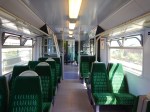
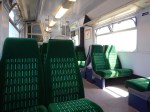
Despite being over thirty years old, the Class 319 trains scrub-up well as these pictures show.
But what could be done if electrification was deemed to be outside the budget? Or it was decided that new zero-carbon trains should be used on the Abbey Line?
Battery trains are coming and there are several trains that can use both electric and battery power under development, in the UK, Europe, China and Japan.
Battery Power On The Abbey Line
Bricket Wood station is 3.5 miles from the Watford Junction end of the Abbey Line and perhaps three miles from the St. Albans end.
In an article in the October 2017 Edition of Modern Railways, which is entitled Celling England By The Pound, Ian Walmsley says this in relation to trains running on the Uckfield Branch, which is not very challenging, as is the Abbey Line.
A modern EMU needs between 3 and 5 kWh per vehicle mile for this sort of service.
So if a four-car electric-battery hybrid train was to handle the whole of the 6.5 mile route, it would need a battery of between 156-260 kWh to go between Watford Junction and St. Albans Abbey stations and back. It would also need charging at one or both ends of the route.
But supposing trains used the current electrification between Watford Junction and Bricket Wood stations to both power the train and charge their batteries.
- The trains would only be doing six miles on batteries, so the battery would be between 72-120 kWh.
- Trains would raise and lower their pantographs at Bricket Wood station.
- No new electrification would be required.
- If trains needed to top-up their batteries, they would do this using the electrification in the two terminal stations.
It might even be preferential to remove electrification between St. Albans Abbey and Bricket Wood stations to save maintenance costs and improve safety.
Could West Midlands Trains’ Class 730 Trains Be Used?
The current franchise holder; West Midlands Trains has ordered a large fleet of Class 730 trains for services between London and the West Midlands and for local electric services in the West Midlands.
Included are thirty-six three-car trains for working suburban services across Birmingham. These have twenty-four metre long cars, so are eight metres shorter than the four-car Class 319 trains, so they are another possibility, unless their longer car length would cause problems in the Bricket Wood manoeuvre.
Should The Abbey Line Be Transferred To Transport for London?
There have been suggestions in the past, that the route be transferred to Transport for London.
I’ll leave the politics aside, but electric-battery hybrid versions of London Overground’s Class 710 trains, which will soon be serving Watford Junction station would probably be ideal.
As they are dimensionally similar to the Class 319 trains, they may also be able to work the route under electric power.
Conclusion
There are certainly, several affordable ways to improve the Abbey Line.
My preferred solution would be go for the Penryn solution, using a fleet of Class 319 trains.
- Penryn seems to be working well.
- Track would need to be re-laid through Bricket Wood station, to add the passing loop.
- About two hundred metres of extra electrification would need to be erected.
- There would probably need to be some modification to the signalling, as there was at Penryn.
- Three trains as a minimum, would be needed, two for the service and one as a spare or as maintenance cover.
- West Midlands Trains already have fifteen Class 319 trains, so finding a viable fleet in top-class condition, shouldn’t be difficult.
- If slightly shorter trains could be needed, the trains might be able to be shortened to three-car trains.
- Staff training would be minimal.
- The current trains are liked by drivers.
- The trains would be zero-carbon.
- The current trains are in very good condition.
- The current trains even have toilets, which are probably not needed on a six-and-a-half mile journey
- If say in ten years time, new trains are needed, I suspect there will be fleets of suitable electric multiple units, less than eighty metres long.
It is probably the most affordable solution.
Bedwyn, Didcot Parkway And Oxford Services After Crossrail Opens To Reading
When Crossrail opens to Reading as it is rumoured with happen in December 2019, what will happen to the Great Western Railway (GWR) services to Bedwyn, Dicot Parkway and Oxford?
The Current Services
These services currently run to these destinations from London Paddington station.
- Bedwyn station has an hourly service, that goes non stop between London and Reading and then calls at all stations between Reading and Bedwyn.
- Didcot Parkway station has a two trains per hour (tph) stopping service, that stops at most stations, including those between Reading and Didcot Parkway.
- Oxford station has a two tph fast service.
- Reading station has a two tph stopping service, that stops at most stations.
- The Didcot Parkway and Reading services give London and Reading a four tph electric service.
- Other trains stop at important stations and there are some shuttle trains serving Reading, Didcot Parkway and Oxford.
Recent developments have included
- Oxford and Bedwyn services now generally seem to run from the main station.
- The fast Oxford services now run by Class 802 trains.
GWR are also testing running Class 802 trains to Bedwyn.
Future Services To Bedwyn
The turnback facility at Bedwyn station has been upgraded, so that it can take a five-car Class 802 train.
When some sighting and safety issues are settled, it is likely that Class 802 trains will take over services to Bedwyn.
- Five-car bi-mode Class 802 trains will be used.
- Trains will not stop between London and Reading.
- Trains will stop at all station between Reading and Bedwyn.
- Trains will run on electric power between London and Newbury.
- Trains will run on diesel power between Newbury and Bedwyn.
Will the current seventy minute time be reduced by the faster trains, running at higher speed between London and Reading?
Battery Trains To Bedwyn
In Hitachi Plans To Run ScotRail Class 385 EMUs Beyond The Wires, I wrote about how batteries could be added to Class 385 trains, so they could run services without electrification.
Consider.
- Class 802 and Class 385 trains are both both members of Hitachi’s A-Train family, sharing many features and systems.
- Newbury to Bedwyn and back is about thirty miles.
- Batteries could be charged between London and Newbury.
I very much feel that if Hitachi apply battery technology to the Class 802 trains, that Bedwyn could be an ideal test destination.
Extension Of Bedwyn Services To Marlborough
In A Station For Marlborough, I wrote about a local plan to open a new station in the twon of Marlborough, which would be on a single track branch, that leaves the main line to the West of Bedwyn.
Class 802 trains with a battery capability, would be the ideal trains for this extension.
Future Services To Oxford
GWR have started running bi-mode Class 802 trains to Oxford at a frequency of two tph
- Services stop at Slough and Reading.
- I have seen nine-car trains on this route.
- Trains run on electric power between London and Didcot Parkway
- Trains run on diesel power between Dicot Parkway and Oxford.
The service is augmented with a diesel shuttle between Oxford and Didcot Parkway.
- This service runs at a frequency of two tph
- One train every two hours is extended to Banbury.
- This service is the only way to get to the intermediate stations of Appleford, Culham and Radley.
I very much feel that services between London and Oxford can be improved.
Four tph To Oxford
If train companies feel that Reading is worth four tph on Crossrail between the city and London, surely Oxford needs a four tph GWR service to the capital.
- Two would be fast trains stopping only at Reading and Slough.
- Two would stop at Slough and all stations between Reading and Oxford.
- Bi-mode Class 802 trains would be used.
- Trains run on electric power between London and Didcot Parkway
- Trains run on diesel power between Dicot Parkway and Oxford.
Note.
- All intermediate stations would have a direct two tph service to London, Reading and Oxford.
- Currently, many journeys involve a long wait or a change at Didcot Parkway.
In addition, no station between Reading and Didcot Parkway gets a worse service than they do now, with the Class 387 trains to Didcot Parkway.
Battery Trains To Oxford
If Hitachi develop them, why not?
A Reading And Oxford Shuttle
I very much believe that important commuter routes need a frequency of four tph, as this enables a Turn-Up-And-Go service and encourage passenger numbers. Especially on a route like Reading and Oxford, where there is a lot of new housing being built.
If two tph are run between London and Oxford, stopping at all staions between Reading and Oxford, perhaps the way to give this service would be to run a shuttle between Reading and Oxford using bi-mode Class 769 trains.
- A two tph shuttle would give four tph at all intermediate stations.
- Trains would run on electric power between Reading and Didcot Parkway.
- Trains would run on diesel power between Didcot Parkway and Oxford.
- Some or all trains could be extended to Banbury.
- I estimate that four trains would,d be needed for two tph.
Oxford would only be getting the quality of railway system a city of its size and standing needs.
Conclusion
There is a lot of scope to improve the train services in the Thames Valley, whether or no Crossrail takes over the Reading services.
East Midlands Class 222 Trains
The Class 222 train is the workhorse of the Midland Main Line.
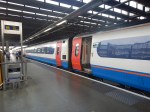
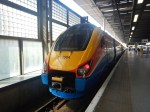
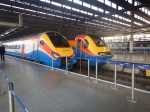
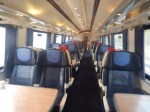
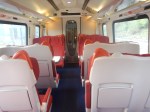
Where will they go, when they are replaced by new bi-mode trains in 20222?
They have some good properties.
- Built in 2003-2005 and refurbished in 2011-2012.
- 125 mph capability
- Lots of tables.
- Meet all the access reguilations.
- Good ride on FLEX-Eco bogies.
But there is the annoying noise of the under-floor diesel engines.
In Have Bombardier Got A Cunning Plan For Voyagers?, I commented on a statement by Bombardier to upgrade these trains with batteries, to give full regenerative braking, improve their efficiency and require less running of the engines in stations.
Abellio’s Plans For London And Melton Mowbray Via Corby And Oakham
This page on the Department for Transport web site is an interactive map of the Abellio’s promises for East Midlands Railway.
These are mentioned for services to Oakham and Melton Mowbray.
- After electrification of the Corby route there will continue to be direct service each way between London and Oakham and Melton Mowbray once each weekday, via Corby.
- This will be operated with brand new 125mph trains when these are introduced from April 2022.
This seems to be a very acceptable minimum position.
In Abellio’s Plans For London And Corby, I suggested that Class 379 trains could be used on the route and that the trains might be fitted with batteries.
- Corby and Melton Mowbray are about twenty-fives apart.
- Batteries and their fast-charging technology has come on at a fast pace since Abellio participated in the Class 379 BEMU Trial in 2015.
Are Abellio thinking about extending some Croby services using battery technology?
The technology is certainly capable, but is there a proven passenger need?
Turning Trains At Melton Mowbray stations
This Google Map shows Melton Mowbray station.
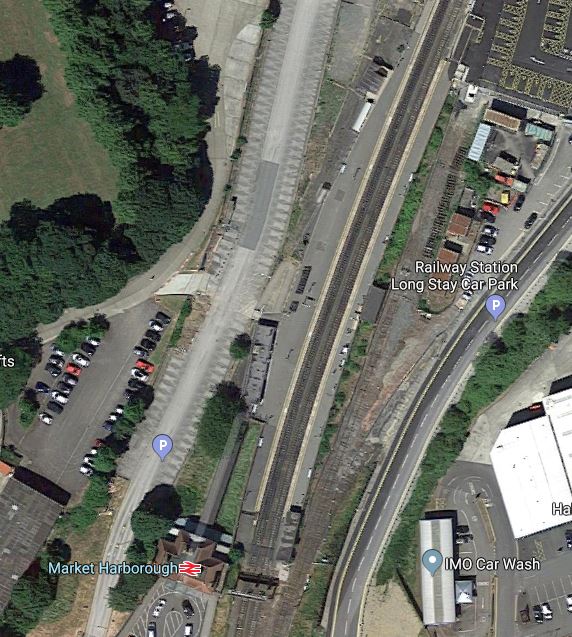
It looks to be a station on a large site with more than adequate car parking and I suspect building a bay platform with charging facilities would not be the most difficult of projects.
Conclusion
As current trains take about thirty minutes between Corby and Melton Mowbray, with a bay platform at the latter station, I think it would be possible to run hourly Class 379 trains with batteries to and from St. Pancras.
Thoughts On Eurostar To North Netherlands And North West Germany
I have now taken Eurostar to Hamburg twice, with a change at Amsterdam Centraal.
The first time, I took two German Inter City trains, with a change at Osnabruck. I wrote about it in From Amsterdam To Hamburg The Hard Way.
On my latest trip, I took the following route.
- An overnight stay in Amsterdam
- Train from Amsterdam Centraal to Groningen with changes at Almere Centrum and Zwolle
- An overnight stay in Groningen
- Rail Replacement Bus from Groningen to Leer
- Train from Leer to Bremen
- Train from Bremen to Bremerhaven
- Train from Bremerhaven to Hamburg
Note.
- There are no direct trains between Amsterdam Centraal and Groningen. Most involve a quick interchange at Almere or Utrecht.
- Amsterdam Centraal to Groningen is electrified.
- Amsterdam Centraal to Groningen takes two hours six minutes on the fastest train.
- When the bridge over the Ems is rebuilt, there should be an hourly train between Groningen and Leer, rather than a two-hourly bus.
- Leer to Bremen is electrified and takes under an hour and a half.
- I took a roundabout route from Bremen and Hamburg, as I wanted to check that the hydrogen-powered trains were running.
- There are direct trains between Bremen and Hamburg.
Could The Slower Route Be Improved?
My thoughts are as follows.
Between Amsterdam Centraal And Groningen
Consider the following.
- The Dutch probably planned the timetable before Eurostar served Amsterdam.
- Eurostar is going to three trains per day between London and Amsterdam
- There are new Dutch InterCity trains on order for other routes.
- A direct service between Amsterdam Centraal and Groningen could probably be under two hours, with perhaps two stops.
- On my trip, the trains trundled along at 50-60 mph, which isn’t very fast.
For these reasons, I would rate it highly lightly that the Dutch will think about a direct service.
Between Groningen And Leer
Without doubt, the problem on this section is the bridge over the Ems.
I estimate the following.
- The mainly single-track railway without electrification between Groningen and Ihrhove near Leer is about seventy kilometres.
- After the bridge is rebuilt, one of Arriva’s Stadler GTWs could do the journey in perhaps 30-35 minutes.
- A bi-mode Stadler Flirt, like one of Greater Anglia’s Class 755 trains, which have a top speed of 100 mph and bags of grunt could probably break the half-hour.
Some web sites put the opening of the new bridge in 2024. I’m reasonably certain, that by that date, an electric train with these power systems would be able to handle the route.
- Dutch electrification
- German electrification
- Batteries
Bombardier and Stadler are certainly aiming to have battery-powered trains in service by the bridge opening date.
Between Leer and Bremen/Hamburg
This electrified double-track section has the following timings.
- Leer and Bremen – 1:24
- Leer and Hamburg 2:23
There doesn’t appear to be any major improvements needed.
Times On The Two Routes Compared
How do the fastest times on the two routes compare?
Via Osnabruck
This is the only route available and the fastest times are something like.
- Amsterdam Centraal and Bremen – 4:16
- Amsterdam Centraal and Hamburg – 5:14
It appears that most services go to both Bremen and Hamburg.
Every time, I’ve changed at Osnabruck, the second train has been late.
Via Groningen
I would estimate the best fastest times are something like.
- Amsterdam Centraal and Bremen – three hours
- Amsterdam Centraal and Hamburg – four hours
I am very surprised that the route via Groningen could appear to be over an hour faster.
Trains For An Amsterdam Centraal and Bremen/Hamburg Service Via Groningen
At present, this service would not be possible, because of the bridge over the Ems.
The route has the following characteristics.
- Dutch electrification at 1.5 KVDC between Amsterdam Centraal and Groningen.
- No electrification from Groningen between Groningen and Ihrhove, which is seventy kilometres.
- German electrification at 15 KVAC between Ihrhove and Bremen/Hamburg
There are several trains that can handle both electrification systems at the two ends of the route, it’s just the seventy kilometres in the middle.
In my view there are several ways to bridge the gap.
Electrification
The Dutch or the Germans can probably electrify the line on time and on budget better than we could.
But which electrification system would be used?
Diesel
Using a dual-mode bi-mode train, that could also run on diesel would be a possibility and I’m sure that Bombardier, Hitachi and Stadler could supply a more or less off-the-the-shelf train, that could run at up to 200 kph where possible and handle the section without electrification on diesel.
But using diesel in an area developing a green economy based on wind power and hydrogen, is probably not a good marketing idea.
Hydrogen
If diesel can handle the route, I’m certain that hydrogen could be used on the section without electrification.
Battery
The section without electrification is only seventy kilometres and in a few years time will be totally in range of a battery train, that charged the batteries on the end sections. Power changeover could be arranged in Leer and Groningen stations if this was thought to be more reliable.
Note that in Hitachi Plans To Run ScotRail Class 385 EMUs Beyond The Wires, I write that Hitachi are claiming a battery range of sixty miles or a hundred kilometres with a Class 385 train with batteries in a few years time. Hitachi won’t be the only train manufacturer with the technology to build a suitable product.
I have to conclude that Groningen and Leer is a classic application for battery power.
Intermediate Stops For An Amsterdam Centraal and Bremen/Hamburg Service Via Groningen
Obviously, the Dutch and the Germans, should know their market and would know where the trains should stop.
Having experienced the route in the last few days, the following stops could be possible.
- Almere Centrum
- Zwolle
- Groningen
- Leer
- Oldenburg
But with modern trains, that have a minimum dwell time at stations, there may be more stops than some might think.
Which Company Would Run The Service?
I don’t know anything about the complications of running international trains, even when they are totally in the Schengen Zone.
In the UK, Amsterdam to Hamburg is the sort of service that would be proposed by a well-funded Open Access Operator.
The company, who would benefit most from this service is Eurostar.
So could we see Eurostar operating or sponsoring Open Access feeder services in Europe, using say 200 kph trains?
Conclusion
It would appear that the following journey times are possible.
- Amsterdam Centraal and Bremen – three hours
- Amsterdam Centraal and Hamburg – four hours
For this to be possible the following is needed.
- The bridge over the Ems is rebuilt.
- Battery power works as its developers hope it will.
How many other routes in the world, would benefit from a similar philosophy?
Is This Stadler’s Plan For A Multi-Mode Future?
We have not seen any of Stadler’s bi-mode Flirts in service yet although Greater Anglia’a Class 755 trains have been rumoured to be speeding between London and Norwich in ninety minutes from this May!
Today, I rode on one of Stadler’s diesel GTWs between Groningen and Eemshaven in the Netherlands, which I wrote about in The Train Station At The Northern End Of The Netherlands.
GTWs are a diesel electric train with a power-pack car in the middle of the three car train. The diesel electric Flirts are a later train with a similar layout to the GTW.
So are the diesel GTWs and Flirts just a bi-mode without a pantograph? Or more likely the bi-mode is a diesel electric train with the addition of a pantograph and extra electrical gubbins.
Looking at the visualisations on Wikipedia of the bi-mode Class 755 train and the all-electric Class 745 train, it appears that the next-to-end car has the pantograph.
Are these cars with the pantograph identical on both the bi-mode and the all-electric versions? It would certainly be sensible from a engine erring point of view.
So could it be that all that is needed to convert a diesel electric Flirt into a bi-mode Flirt is to add the pantograph car and swap the power pack car for a bi-mode one? The old power pack car could then be converted into another bi-mode power pack car to convert another train.
But the power pack cars are not as simple as they look. They have four slots for diesel engines. Three-car and four-car Class 755 trains have two and four engines respectively.
I believe that one or more of the slots can be filled with a battery to create Flirts like the tri-mode ones proposed for South Wales.
So could we see some of the Greater Anglia Flirts converted in this way? Surely, Colchester Town to Sudbury could be a service that could benefit from battery power West of Marks Tey?
Today, I had a chat with a GTW driver, who said that the train he’d been driving was diesel-electric and that he had heard that batteries or hydrogen power could be used on the eoute.
The lines around Groningen seem to employ quite a few GTWs and distances are not overly long. So could some be converted to 1500 VDC electric/diesel/battery tri-modes? There is electrification at Groningen station and some of the bay platforms used by GTWs already have wires.
If the conversion is successful, then Stadler could be on a Swiss roll, as there are a lot of GTWs and Flirts out there, many of which are diesel-electric, like the one I rode today.
Would a train operator prefer to upgrade a diesel electric train that works well or buy a new bi-mode from another train manufacturer?
Could also an electric Flirt be converted into a bi-mode, by splitting the train and sticking a power pack car in the middle. Engineering common sense says that the passenger cars must be very similar to those of diesel Flirts to simplify manufacture of the trains.
We already know, that four-car Flirts are only three-car trains with an extra passenger car. Stadler could mix-and-match passenger, pantograph and power pack cars to give operators what they need.
Intelligent computer software would choose which power option to be used and the driver would just monitor, that the train was behaving as needed.
Looking at my route yesterday between Groningen and Eemshaven, it is a route of just under forty kilometres or twenty-five miles. Adrian Shooter is talking of ranges of sixty miles with battery versions of Class 230 trains. So I don’t find it impossible to create a tri-mode GTW or Flirt for this lonely route at the very North of the Netherlands.
Conclusion
Stadler seem to have created a very imitative modular train concept.
As some Flirts can travel at 125 mph, could they be serious bidders to provide the new trains for the Midland Main Line?
Merseyrail’s Battery Intentions
In New Merseyrail Fleet A Platform For Future Innovations, I quoted from this article on the Rail Technology Magazine web site.
The article mainly is an interview with David Powell, who is programme director of rolling stock at Merseytravel.
This is a direct quote from the article.
We will be exploring, with Stadler, what the options are for having the trains becoming self-powered. This isn’t the bi-modes that lots of other people are talking about in the industry; this is on-board electrical storage.
The Wikipedia entry for Merseyrail links to this document, which puts a lot more flesh on Merseyrail’s intentions for battery trains.
It outlines strategies for the following routes.
Ellesmere Port And Helsby
The document says this.
There is a reasonable business case for extending the Merseyrail service through to Helsby.
However this is likely to be best served by the use of Merseyrail battery powered enabled
services. This will be tested on the new units in 2020.
According to Wikipedia, the sixth Class 777 train to be delivered will be fitted with batteries.
Currently, the service between Liverpool Central and Ellesmere Port stations is as follows.
- A train every thirty minutes.
- Trains take eighty-five minutes to do the round trip from Ellesmere Port round the Wirral Loop under Liverpool and back to Ellesmere Port.
- There are thirty-one stops on the route.
- There is a five minute turnround at Ellesmere Port station.
Two trains are needed to run the service.
The Current Class 507/508 trains and the future Class 777 trains both have the same operating speed, but there are performance differences.
The British Rail trains have 656 kW of power per train, whereas every new Stadler train will have 2,100 kW. The speed may be the same, but the acceleration will be much greater if needed and and the regenerative braking should be powerful and smoothly controlled.
- Figures for the Class 313 train, which is similar to the Class 507/508 trains show a top speed of 75 mph and an acceleration of 0.67 m/s².
- Figures for the Class 777 train show a top speed of 75 mph and an acceleration of 1.1 m/s².
These figures mean that a Class 507 train will get to 75 mph in 125 seconds, whereas the new Stadler trains will take just 76 seconds.
In addition, loading and unloading of passengers with their increasing levels of extras will be much faster due to the hollistic design of the trains and the platforms on the new Stadler trains.
It would not be unrealistic to see around a minute saved at every stop.
I think this level of improvement could be expected, with all the modern trains in the UK.
The extended service between Ellesmere Port and Helsby stations is not much extra distance and time.
- Just over five miles each way.
- About thirteen minutes each way , based on existing services on the route.
So if the terminus were to be moved to Helsby, when the new trains are in service, the time savings between Ellesmere Port and Liverpool should cover the extra distance.
It should also be noted about Helsby station.
- It has four platforms and could probably handle four trains per hour (tph).
- A platform with a charging station could be created.
- It has a wide selection of services including Chester, Llandudno, Manchester and Warrington.
To my mind, Liverpool to Helsby would be an ideal route for a battery electric train.
Ormskirk-Preston Enhancements
The document says this.
This incorporates both electrification from Ormskirk through to Preston and the potential
reintroduction one or both of the Burscough Curves. In view of the deferral of electrification
proposals, and the relative low ranking of the electrification proposal in the Northern Sparks
report, it is unlikely that the electrification proposal is expected to be taken forward in the
near future. In addition to this, the business case for extending electrification to Burscough,
and the introduction of the southern Burscough Curve, is poor. The potential use of battery
powered Merseyrail units may improve the business case for both proposals. This will be
reviewed after the Merseyrail units have been tested for battery operation in 2020.
Currently, the service between Ormskirk and Preston stations is as follows.
- A train every hour.
- Trains take around thirty minutes to go between the two terminal stations.
- The route is fifteen and a half miles long.
- There are three stops on the route.
- There is a long turnround in a bay platform at Preston station.
At the present time, the service seems rather erratic, with some services replaced by buses and long connection times at Ormskirk.
The service between Liverpool Central and Ormskirk stations takes thirty-five minutes with eleven stops and is generally every fifteen minutes, with a half-hourly service in the evening and at weekends.
If a Class 777 train could use battery power, I estimate it could run between Liverpool Central and Preston stations within an hour.
This would surely open up the possibility of a new service between Liverpool and Preston.
- It would take only a few minutes longer than the fifty-one minutes of a direct train between Liverpool Lime Street and Preston stations.
- It would connect a lot of stations to the West Coast Main Line at Preston.
- It would link the major sporting venues of Aintree, Anfield and Goodison or Everton’s new ground to the North.
- At the Southern end, it could connect to Liverpool Airport.
The Class 777 trains would need to be able to do about thirty miles on battery power and if required, the technology exists to either top up the batteries at Preston or use a pantograph to access the overhead wires of the West Coast Main Line.
At the present time, the Ormskirk Branch Line between Ormskirk and Preston stations is only single track and probably needs resignalling, but I suspect that a four tph service could be run between Liverpool and Ormskirk, with two tph extended to Preston.
Extra track work, North of Ormskirk and the reinstatement of the Burscough curves would allow.
- Four tph between Liverpool and Preston via Ormskirk.
- A service between Liverpool and Southport via Ormskirk.
- A service between Preston and Southport.
There is even the possibility of extending Liverpool and Preston services to Blackpool South station, if they used the overhead electrification through Preston to charge the batteries.
Borderlands Development
The document says this.
While the aspiration is to fully electrify the line, and incorporate it into the Merseyrail
network, this is very much a long term aspiration. In the interim period the aim is to develop
the line through the introduction of an improved diesel service. Merseytravel will work
closely with relevant cross-border organisations such as Growth Track 360 to bring this
about. There are a number of new station proposals for the line, the principal being a new
station close to the Deeside Industrial Park, which would improve the ability of the
workforce to access the site via public transport.
The Borderlands Line provides a service between Liverpool and Wrexham Central station with a change at Bidston station.
- The twenty-seven miles between Wrexham Central and Bidston are not electrified.
- The line is double-track throughout.
- There are twelve stations on the line.
- The service is hourly, but probably needs to be at least half-hourly.
- The service takes about an hour between Wrexham and Bidston stations.
Using Class 777 trains on the route, using battery power between Bidston and Wrexham Central stations would enable.
- A direct service, that terminated in the Wirral Loop under Liverpool.
- An increased capacity at Bidston station.
- A faster service.
I estimate that a time of perhaps seventy to eighty minutes between Liverpool Central and Wrexham Central stations will be possible.
There would be very little infrastructure work, except for new stations and the possible ability to top up batteries at Wrexham Central.
I suspect that political problems, rather than any railway ones will be larger.
Bootle Branch Electrification
The document says this.
A long term proposal which will need to be considered alongside the developing freight
strategy for the region and the expansion of the Port of Liverpool. The proposal envisages
the introduction of passenger services which will operate from the Bootle Branch into Lime
Street. An initial study is required to understand fully the freight requirements for the line
and what the realistic potential for operating passenger services over the line is.
The Bootle Branch is known as the Canada Dock Branch in Wikipedia.
Class 777 trains with a battery capability and the ability to use the overhead electrification into Liverpool Lime Street would be able to serve this route, without the need for electrification.
Obviously, if for freight efficiency, the route was electrified, the trains could use it as needed.
North Mersey Branch
The document says this.
A long term proposal; this envisages a new service operating from Ormskirk via Bootle into
Liverpool. It was reviewed as part of the Merseyrail Route Utilisation Strategy in 2009 which
identified a poor business case.
I can’t identify the actual route, but there are various rail alignments into and through the Docks.
Skelmersdale
The document says this.
Merseytravel is currently working with Lancashire County Council and Network Rail to
develop the Merseyrail network from Kirkby through to Skelmersdale. This work is expected
to be completed in 2019. Further development work will be required before this project is
implemented. While 3rd rail electrification is being considered currently, alternatives will be
considered later in the development process. A new station at Headbolt Lane to serve the
Northwood area of Kirkby is an integral part of this proposal. The potential to extend the
network further through to Wigan will need to be developed separately.
I wrote about this plan in Merseyrail To Skelmersdale – How To Plan A New Rail-Link.
Thoughts On Battery Size And Range
Thjis article on Railway Gazette is entitled Battery Trial Planned For New EMU Fleet.
This is the first paragraph.
The sixth of the 52 four-car 750 V DC third rail electric multiple-units which Stadler is to supply for Merseyrail services around Liverpool is to be fitted with a 5 tonne battery to test the business case for energy storage. While all the EMUs will be equipped for regenerative braking, this is not seen as optimal on the Merseyrail network.
I find the last part of this paragraph difficult.
Does it mean the trains can use regenerative braking, but that it is not worth using?
This media release on the Stadler web site is entitled Stadler Signs Contract To Build And Maintain 52 Metro Trains For
Liverpool City Region.
This is a sentence.
The units will also be equipped with batteries that allow independent movement of the units in the workshop and depot areas.
Out of curiosity, what will be the kinetic energy of the four-car trains at the full speed of 75 mph
- The train weight is given as 99 tonnes in Wikipedia.
- The passenger capacity is 484, with a weight of 90 Kg each.
- This gives a train weight of 142.56 tonnes.
Putting these figures into Omni’s Kinetic Energy Calculator gives a kinetic energy of 22.3 kWh.
I feel that this fairly low amount of energy could be held in a 60 kWh battery, that would probably come from a hybrid bus and weigh about 600 Kg.
I would be very surprised if Stadler are not using a smaller battery to do the following.
- Handle regenerative braking.
- Independent movement in the workshop and depot areas.
- Train power in sidings and platforms.
It could also handle, train rescue to a safe evacuation point, in the event of power failure. I suspect that like Crossrail in London, Merseyrail would be very happy to have an independent recovery system in the tunnels under Liverpool, Birkenhead and the River Mersey.
In How Much Power Is Needed To Run A Train At 125 mph?, I estimated that using 3 kWh per vehicle mile is not a bad estimate for the energy use of an electric train running at speeds in excess of 100 mph.
Using this figure would give a range on a 60 kWh battery of at least five miles, which would move the train out of the tunnels if the power failed.
But we’re talking about a modern lightweight train running on probably newly relaid track and my 3 kWh per vehicle mile could be a little on the high side.
Stadler are talking of fitting the sixth train with a fifty five battery, which would probably have a capacity of around 500 kWh.
Using various consumption figures, the range would be as follows.
- 3 kWh per vehicle mile – 42 miles
- 2 kWh per vehicle mile – 62 miles
- 1 kWh per vehicle mile – 125 miles
Stadler and their battery supplier are probably working on.
- A train that uses less electricity.
- More efficient regenerativer braking.
- A more intelligent train control system.
- Increased energy density in the battery.
- Efficient charging systems.
- A plug-in battery pack that can be added and removed in minutes.
As a Control and Electrical Engineer, I wouldn’t be surprised to see that the control, electrical and software system of trains with and without the five tonne battery are identical and some just have a larger amount of energy storage.
Range on battery power can only increase!
Consider the lengths of some of the routes discussed earlier.
- Ellesmere Port and Helsby – 5 miles
- Ormskirk and Preston – 16 miles
- Bidston and Wrexham Central – 27 miles
Only the last route might need a charging station at the remote terminal.
My Own Speculation On Routes
I think there could be other routes that could easily be run by Class 777 trains running on battery power.
Onward From Hunts Cross
The current service between Hunts Cross and Manchester Oxford Road stations is only two tph, using rather suspect rolling stock.
- Under Merseyrail and London Overground rules, it should be at least four tph to give travellers a Turn-Up-And-Go service.
- The stations are of variable quality, but are being improved and will soon be joined by a new station at Warrington Wrst.
- There is a lot of new developments along the route.
- The service terminates in a convenient bay-platform at Manchester Oxford Road station.
- The service calls at Deansgale station for the Manchester Metrolink.
The route could be developed into a City-Centre-to-City-Centre and commuter route for both Liverpool and Manchester.
So could this route be run by Class 777 trains using battery power?
Consider.
- Hunts Cross and Manchester Oxford Road are just twenty-seven miles apart.
- The last couple of miles to Oxford Road is electrified with 25 KVAC overhead wires.
- Hunts Cross is electrified with 750 VDC third-rail.
It will be a Liverpool and Manchester Railway for the Twenty-First Century
I think it is one of those problems, where the engineering is easy, but the politics will be very difficult.
Onward From Headbolt Lane
The current service between Liverpool and Kirkby, which will be extended to the new station at Headbolt Lane, is a a Turn-Up-And-Go service of four tph. But the onward service to Wigan and Manchester is just a very inadequate hourly-service.
Consider.
- Headbolt Lane and Wigan are just twelve miles apart.
- Plans are being developed to create a proper transport interchange at Wigan for the arrival of High Speed Two.
- Wigan North Western is electrified with 25 KVAC overhead wires.
- Kirkby is and Headbolt Lane will be electrified with 750 VDC third-rail.
It would appear to be very possible to extend Class 777 trains from Kirkby to Wigan using battery power.
More Trains For Merseyrail
This is a paragraph from the Stadler media release about Merseyrail’s new trains.
The new four-car trains will all be in service by 2021, with the first unit arriving for testing by the middle of 2019.
The value of the manufacture and maintenance contracts for the 52 trains is up to £700m and Merseytravel
also has the option to procure an additional 60 units of rolling stock.
If the options are taken up, this would more than double the size of the Merseyrail’s fleet.
But where will these trains connect to Liverpool City Centre?
Helsby, Preston, Skelmersdale, Wrexham Central and the other routes in Liverpool will all need more trains, but nothing like sixty trains.
So will we see Wigan and Warrington added to Merseyrail’s destinations? And what about Manchester?
Never say no to Liverpool and their Swiss co-conspirators!
Conclusion
It is a comprehensive expansion strategy, where much of the work to create the various extensions is performed by adding equipment to the trains in factories or depots, rather than by the disruptive installation of electrification.
It looks very much like a case of Have Swiss Train Will Travel.
But then, I think the London Overground is using a similar strategy to expand in partnership with Bombardier.
Other networks like the Tyne & Wear Metro and those in cities like Birmingham, Cardiff, Glasgow and Leeds will be using similar philosophies of battery trams, tram-trains and trains.
Cardiff has already disclosed their plans and Stadler are building the trains for the South Wales Metro.
How Do Porterbrook’s Battery/FLEX Trains Compare With Eversholt’s Hydrogen-Powered Trains?
In the two green corners of this ultra-heavyweight fight to provide electric trains for rail routes without electrification, there are two ROSCOs or rolling stock operating companies.
Eversholt Rail Group
Eversholt Rail Group‘s product is the Class 321 Hydrogen, which is an upgrade of a Class 321 train with batteries and hydrogen-power.
Porterbrook
Porterbrook‘s product is the Class 350 Battery/FLEX, which is an upgrade of a Class 350 train with batteries.
How Do The Two Trains Compare?
I will list various areas and features in alphabetical order.
Age
The Class 350 trains date from 2008-2009 and others were introduced to the UK rail network as early as 2004.
The Class 321 trains date from the 1990s, but that shouldn’t be too much of a problem as they are based on the legendary Mark 3 Coach.
Scores: Porterbrook 4 – Eversholt 3
Batteries And Supercapacitors
This is an area, where the flow of development and innovation is very much in favour of both trains.
Currently, a 1000 kWh battery would weigh about a tonne. Expect the weight and volume to decrease substantially.
Scores: Porterbrook 5 – Eversholt 5
Battery Charging – From Electrification
No problem for either train.
Scores: Porterbrook 5 – Eversholt 5
Battery Charging – From Rapid Charging System
I believe that a third-rail based rapid charging system can be developed for battery/electric trains and I wrote about this in Charging Battery/Electric Trains En-Route.
No problem for either train.
Scores: Porterbrook 5 – Eversholt 5
Development And Engineering
Fitting batteries to rolling stock has now been done successfully several times and products are now appearing with 400 kWh and more energy storage either under the floor or on the roof of three and four-car electrical multiple units.
I feel that adding batteries, supercapacitors or a mixture of both to typical UK electric multiple units is now a well-defined process of engineering design and is likely to be achieved without too much heartache.
It should be noted, that the public test of the Class 379 BEMU train, was a rare rail project, where the serious issues found wouldn’t even fill a a thimble.
So I have no doubt that both trains will get their batteries sorted without too much trouble.
I do feel though, that adding hydrogen power to an existing UK train will be more difficult. It’s probably more a matter of space in the restricted UK loading gauge.
Scores: Porterbrook 5 – Eversholt 3
Electrification
Both types of train currently work on lines equipped with 25 KVAC overhead electrification, although other closely-related trains have the ability to work on 750 VDC third-rail electrification.
Both trains could be converted to work on both systems.
Scores: Porterbrook 5 – Eversholt 5
Interiors
The interior of both trains will need updating, as the interiors reflect the period, when the trains were designed and built.
Eversholt have already shown their hand with the Class 321 Renatus.
The interiors is a design and refurbishment issue, where train operating companies will order the trains and a complimentary interior they need, for the routes, where they intend to run the trains.
Scores: Porterbrook 5 – Eversholt 5
Operating Speed
Both trains in their current forms are 100 mph trains.
However some versions of the Class 350 trains have been upgraded to 110 mph, which allows them to work faster on busy main lines and not annoy 125 mph expresses.
I am pretty sure that all Class 350 trains can be 110 mph trains.
Scores: Porterbrook 5 – Eversholt 4
Public Perception
The public judge their trains mainly on the interiors and whether they are reliable and arrive on time.
I’ve talked to various people, who’ve used the two scheduled battery/electric services, that have run in the UK.
All reports were favourable and I heard no tales of difficulties.
In my two trips to Hamburg, I didn’t get a ride on the Coradia iLint hydrogen-powered train, but I did talk to passengers who had and their reactions were similar to those who travelled to and from Harwich in the UK.
I rode on the Harwich train myself and just like Vivarail’s Class 230 train, which I rode in Scotland, it was impressive.
I think we can say, that the concept and execution of battery/electric or hydrogen-powered trains in the UK, will be given a fair hearing by the general public.
Scores: Porterbrook 5 – Eversholt 5
Range Without Electrification
Alstom talk of ranges of hundreds of miles for hydrogen trains.and there is no reason to believe that the Class 321 Hydrogen trains will not be capable of this order of distance before refuelling.
Bombardier, Vivarail and others talk of battery ranges in the tens of miles before a recharge is needed.
The game-changer could be something like the technique for charging electric trains, I outlined in Charging Battery/Electric Trains En-Route.
This method could give battery trains a way of topping up the batteries at station stops.
Scores: Porterbrook 3 – Eversholt 5
Conclusion
The total scores are level at forty-seven.
All those, who say that I fiddled it, not to annoy anybody are wrong.
The level result surprised me!
I feel that it is going to be an interesting engineering, technical and commercial battle between the two ROSCOs, where the biggest winners could be the train operating companies and the general public.
I wouldn’t be surprised to see two fleets of superb trains.

