Freightliner Offers Single Container Transport By ‘Carbon Reduced’ Trains
The title of this post, is the same as that of this article on Railway Gazette.
These two paragraphs explain the service.
Freightliner has launched its ECO90 booking service which enables customers of any size to reduce their carbon emissions by sending as little as one container on trains powered by alternative fuels.
The trains currently use hydrotreated vegetable oil, and Freightliner told Rail Business UK that other options could be available in the future, A certificate confirms that the fuel is fully traceable and from sustainable sources, and a Scope 3 carbon emissions report is provided.
It will be interesting to see if this service succeeds.
I suspect that in the future, the service’s biggest competitor will be the hydrogen-or electric- powered truck, which will offer an end-to-end zero-carbon service with minimal cargo handling.
Fire Safety Of Battery-Electric Vehicles
I notice that there has been talk of fires in battery-electric vehicles on this blog.
So I thought I’d put up a post with an appropriate topic.
There are some things that already could worry me.
- Vivarail had a fire early on.
- The Merseyrail Class 777 trains go in the tunnels under Liverpool.
- The new Piccadilly Line trains will have batteries.
- Did electric vehicle batteries contribute to the ferocity of the fire in the Luton Airport car park?
- Fire brigades are getting very worried about e-scooter and e-bike fires.
- This page on the Internet gives details of recent BESS fires.
- Do we investigate fires and publish the results properly?
I have some questions.
- Would it be sensible to have nationwide database of all batteries?
- Should we use more non-lithium methods in large stationary batteries?
- Should we use more capacitors?
- Should we make it a criminal offence to build or use a non-compliant e-bike or e-scooter?
- Should installing a battery in your house, need a safety certificate?
One half of me says yes and the other says no, to some of these questions.
I See My First Modern 100 % Electric Truck
Where I live in Hackney, you see a lot of electric vans. Even the local deli has one.
But until yesterday, I don’t think I’ve seen a 100 % full-size electric truck, other than the famous Harrods delivery vans, which I can remember from the 1960s.
This was a sideview of the truck I saw.
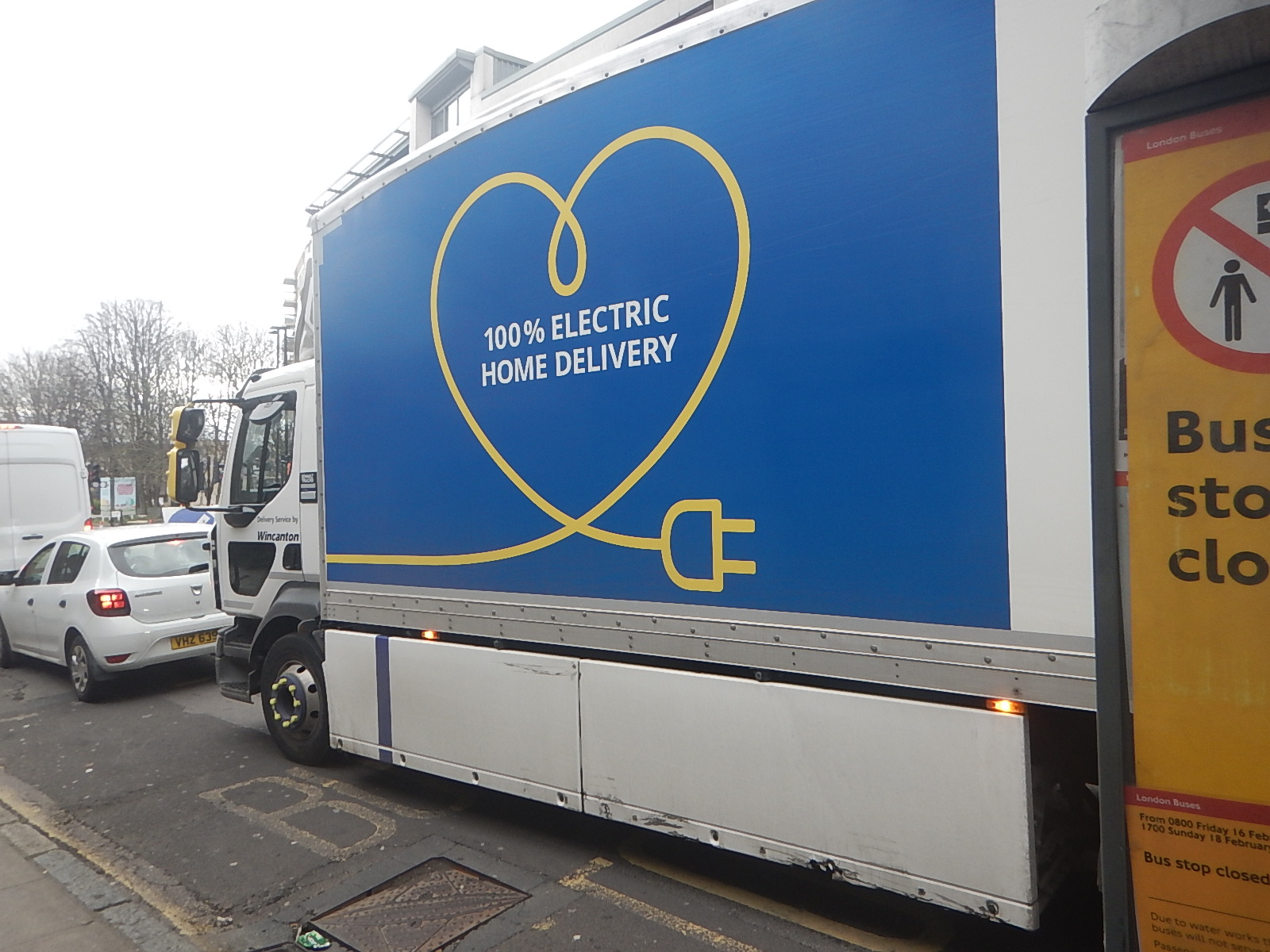
Sadly, because I was trying to catch a bus, in the roadworks I described in How Not To Organise A Piss-Up In A Brewery, I was unable to take any more pictures.
This press release from Wincanton is entitled Wincanton Announces Multimillion-Pound Investment In Electric Vehicles For IKEA.
These three paragraphs give the full story.
Wincanton, a leading supply chain partner for UK business, today announces that it has made a multimillion-pound investment in electric vehicle technology to provide home delivery services for IKEA.
The investment has seen Wincanton purchase 30 electric home delivery vehicles, comprising of 10 16-tonne trucks and 20 vans, to support IKEA’s goal of reaching 100% zero emission last mile deliveries by 2025.
The new fleet is expected to save Wincanton 1,000 tonnes of carbon emissions each year, across just over 10,000 journeys per annum. The vehicles, supplied by Renault Trucks and Ford, will carry deliveries to the homes of IKEA customers across Greater London and the Southeast of England from Spring 2023.
I do feel though, that we’d see more zero-carbon trucks, if London could get its act together with hydrogen.
Tevva And ZF Develop A 4x More Efficient Regen Braking System
The title of this post, is the same as that of this article on Electric & Hybrid Vehicle Technology International.
This is the first paragraph.
British electric vehicle manufacturer Tevva has successfully completed development of the regenerative braking system on its 7.5t battery-electric truck. Part of this involved working with global Tier 1 supplier ZF to integrate its electronic brake system (EBS) for use in zero-emission Tevva electric trucks.
I like what I read about Tevva and I suspect, if I still had horses, one of their trucks would make an ideal chassis for a non-HGV horse box.
Further Thoughts On BP’s Successful INTOG Bid
I have been searching the web and I feel BP’s successful INTOG bid may be different.
In 13 Offshore Wind Projects Selected In World’s First Innovation And Targeted Oil & Gas Leasing Round, I decided that BP’s bid, which only was for 50 MW of offshore wind would generate hydrogen and send it to shore through the Forties Pipeline System, which is owned by INEOS.
My reasons for feeling that it would generate hydrogen were as follows.
- In the wider picture of wind in the North Sea, BP’s proposed 50 MW wind farm is a miniscule one. SSE Renewables’s Dogger Bank wind farm is over a hundred times as large.
- A cable to the shore and substation for just one 50 MW wind farm would surely be expensive.
- BP Alternative Energy Investments are also developing a 2.9 GW wind farm some sixty miles to the South.
- It would probably be bad financial planning to put large and small wind farms so close together.
I still believe for these and other reasons, that there is no reason to believe that the proposed 50 MW wind farm is a traditional wind farm and most likely it will be paired with an appropriately-sized electrolyser producing around twenty tonnes of hydrogen per day.
But instead of being sent ashore by using the Forties Pipeline System, could this hydrogen be sent directly to the coast near Aberdeen, in its own personal hydrogen pipeline?
- Using a variety of maps, I have estimated the distance at only around twenty miles.
- With all the experience from BP and their suppliers, there must be a solution for a relatively short hydrogen pipeline.
I also found this scientific paper on ScienceDirect, which is entitled Dedicated Large-Scale Floating Offshore Wind To Hydrogen: Assessing Design Variables In Proposed Typologies, which talks about three different layouts.
- Centralised Onshore Electrolysis
- Decentralised Offshore Electrolysis
- Centralised Offshore Electrolysis
All would appear to be feasible.
There is a lot of information in the scientific paper and it leads me to the conclusion, that hydrogen could be generated offshore and transferred by pipeline to storage on the shore.
The paper shows a design for a submarine hydrogen pipeline and schematics of how to design a system.
I believe that BP’s proposed system could deliver around twenty tonnes of hydrogen per day to the shore.
The system could be as simple as this.
- A few large floating wind turbines would be positioned offshore, perhaps twenty miles from shore.
- Perhaps 5 x 10 MW, 4 x 12 MW turbines or 3 x 16 MW could be used. Deciding would be one of those calculations, that combines accountancy, data, engineering and finance, which are great fun.
- The offshore distance would be carefully chosen, so that complaints about seeing them from the shore would be minimised.
- The generated electricity would be collected at a floating electrolyser, where hydrogen would be created.
- The hydrogen would be pumped to the shore.
- The floating electrolyser could also contain hydrogen storage.
I think there is large scope for innovation.
- I can imagine drones and helicopters delivering equipment and personnel to service the electrolyser.
- Underwater hydrogen storage could be developed.
- A standard system could be developed for rolling out anywhere.
- It could be placed in the sea, by a steelworks or other large hydrogen user.
In its own right the concept would develop new markets, which is one of the wind farm’s aims.
Could This Be The Route To Create Affordable Hydrogen For All?
BP would be failing their customers, employees and shareholders, if they weren’t developing a zero-carbon alternative to diesel and petrol.
Offshore hydrogen electrolysers strategically placed along the coastline, could provide a reliable hydrogen supply to a that sizeable proportion of the world’s population, who live near to the coast.
Could The Technology Be Adapted To Motorway And Large Service Stations?
This document on the UK Government web site, gives the mileage statistics of lorries (HGVs) and has this sub-heading.
In 2019 lorries travelled 17.4 billion vehicle miles, remaining broadly stable (increasing slightly by 0.3%) compared with 2018.
It breaks this figure down, by the class of road.
- Motorways – 8.0 – 46 %
- A Roads – 6.3 – 36 %
- Rural Minor Roads – 0.9 – 5 %
- Urban A Roads – 1.5 – 9 %
- Urban Minor Roads – 0.7 – 4 %
Note that 82 % of HGV mileage is on Motorways or A roads. Anybody, who has ever driven a truck bigger than a Ford Transit over a distance of upwards of fifty miles, knows that trucks and vans regularly need to be fuelled up on the road. And that applies to the drivers too, who also by law must take a break, away from the cab.
Charging an electric truck could be a lengthy business and would require service stations to be connected directly to the nation grid and be fitted with a substantial number of heavy duty chargers.
One thing, that would be difficult with an electric truck, would be a Splash-and-Dash, if a truck was nearing the destination and needed a small amount of charging to meet delivery schedules.
Because of the distances involved, the driving rules, the often tight schedules and the fast filling, I am convinced that there will be a large proportion of hydrogen-powered trucks and vans on the road and these will need a network of service stations where hydrogen is available.
Look at these overhead view of South Mimms Services, where the M25 and the A1(M) cross to the North of London.
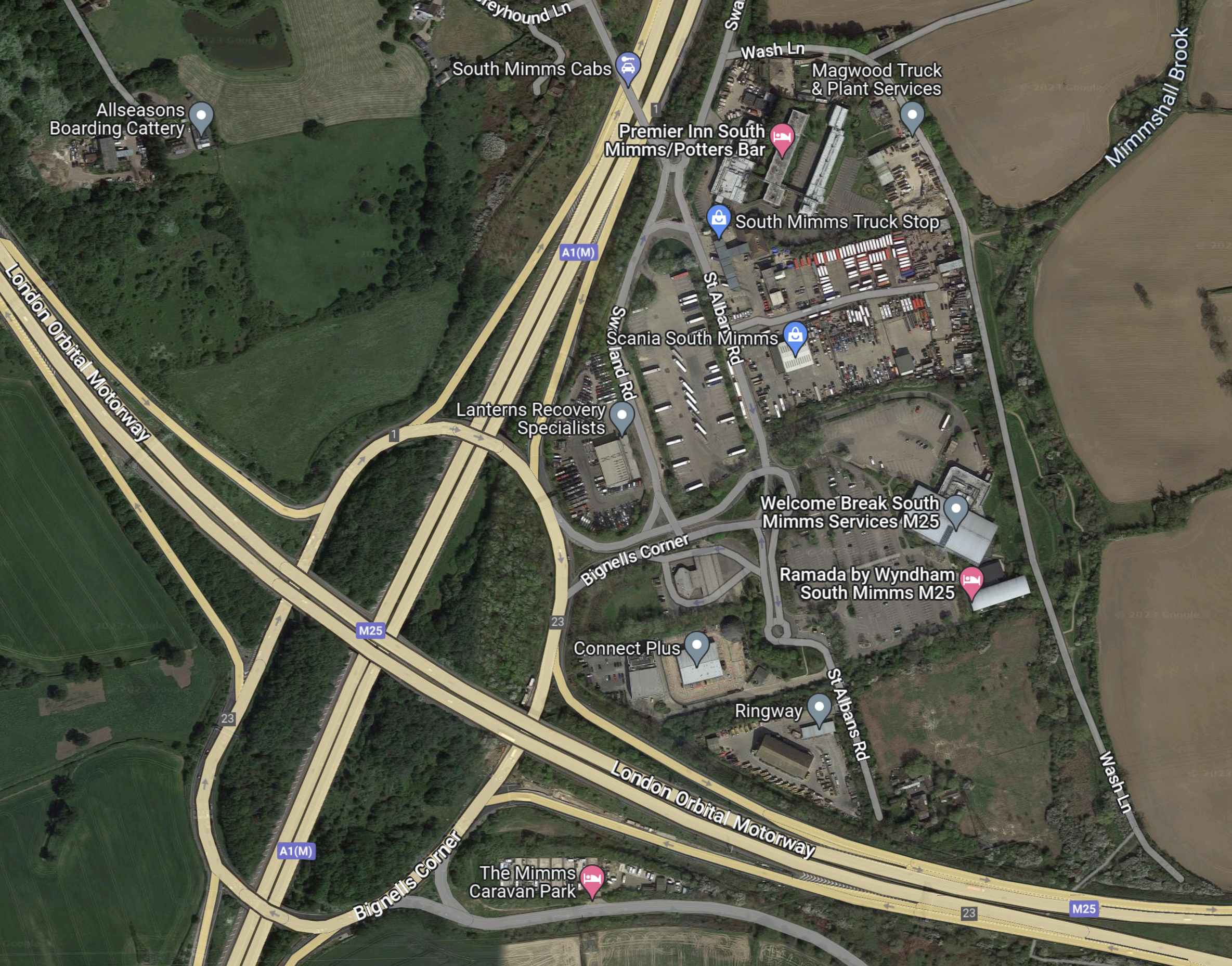
I would envisage that at least four 10 MW wind turbines, which have a rotor diameter of around 160-190 metres could be dotted around and inside the site including inside the roundabout.
- The electrolyser would be slightly smaller than that which would be used at Aberdeen.
- Perhaps fifteen tons per day of hydrogen could be generated.
- No hydrogen needed on the site would ever be brought in by truck.
- Wind-generated electricity could also power the hotels, restaurants and the service station.
- As the percentage of vehicles running on fossil fuels decreased, the air quality in the area of the service station, should increase.
- How many people, who lived locally would switch to a hydrogen-powered runabout and fill it up perhaps once a week, when they passed?
Much of the technology needed to add a hydrogen option to a typical large service station has already been developed and some would also be needed to build BP’s 50 MW offshore wind farm with an electrolyser.
Tevva Starts First Mass Production Of Electric Lorries In UK
The title of this post, is the same as that of this article on Professional Engineering.
These are the first three paragraphs.
Tevva is building its 7.5 tonne vehicles at Tilbury in Essex after it received European Community Whole Vehicle Type Approval (ECWVTA), meaning it can start producing and selling in volume across the UK and Europe.
The start-up has already started delivering its first mass-produced lorries to customers including Travis Perkins and Royal Mail. It expects to sell up to 1,000 in 2023.
Described as “ideal” for last mile and urban delivery fleets, the electric truck offers up to 227km range from its 105kWh battery on a single charge. It will be followed later in 2023 by a 7.5 tonne hydrogen-electric alternative. The hydrogen range extender will reportedly increase the range up to 570km.
That seems like a good start to me; certification, orders for a thousand and generous ranges with or without a hydrogen extender.
In Equipmake Hybrid To Battery Powered LT11, I described Equipmake’s battery-electric New Routemaster bus.
Both the battery-electric Routemaster and the Tevva truck seem to have generous ranges, so has better battery technology been developed.
Tevva Lands $57m For Electric And Hydrogen Trucks
The title of this post, is the same as that of this article on The Engineer.
This is the sub-title.
Tevva has secured $57m for its new London-based production facility to scale up manufacturing of its electric and hydrogen trucks.
It certainly looks like this well-connected company of Israeli origin, could be going places.
UK’s Tevva Uses Submarine Tech To Power Electric Trucks
The title of this post, is the same as that of this article on The Times of Israel.
The article is from April 2017 and starts with this paragraph.
Startup founded by Asher Bennett, brother of Israel’s education minister, aims to provide digital, emission-free vehicles.
This paragraph gives details of the man behind the company and their first sales.
Meanwhile, one UK company — Tevva Motors — has already got its first orders for repowering the trucks of delivery giants UPS, DHL and Switzerland’s Kuehne+Nagel with its components, including the batteries and motor, according to Tevva’s 48-year-old Israeli founder Asher Bennett. Bennett is the older brother of former entrepreneur turned right-wing politician Naftali Bennett, who is Israel’s education minister.
Since the article was written, Naftali Bennett has become Israel’s Prime Minister.
This paragraph explains how the trucks work.
The trucks Tevva repowers as well as those the company is planning to build from scratch next year at its new facility in Chelmsford are fully digital. “Every piece of information on our trucks is on the cloud,” Bennett said. The software and algorithms developed by the company automatically calculate the most efficient use of the battery and instruct the range extender when to kick in, without any input from the driver.
We’re already starting to see trains using similar techniques.
But as a time-expired Control Engineer, I would go a similar route.
It is a fascinating article, that deserves a full read.
Tevva Presents 7.5 Tonne Truck With Range Extender
The title of this post, is the same as that of this article on Electrive.
This is the first paragraph.
The English company Tevva has presented a 7.5-tonne truck that is supposed to have a range of up to 250 kilometres in electric drive mode and a range of up to 500 kilometres with the FC range extender activated. Production of the Tevva truck is scheduled to start in July 2022.
I like the concept, as it appears to give a reasonable range.
- The design team behind the truck have a good pedigree.
- The trucks are of a size to handle a useful load.
- Larger trucks will be produced later.
- The trucks will be built in a factory in the London Freeport.
I think we’ll see a lot more larger battery-electric vehicles with hydrogen range extenders.
Walking From Finsbury Square To Liverpool Street Station
In Finsbury Square Car Park Becomes British Land Hub For Delivery Drivers, I wondered if
.
So today, I walked the route from Finsbury Square To Liverpool Street Station.




































Note.
- The roads around Finsbury Square are probably the narrowest on the route between Finsbury Square and Liverpool Street station.
- Sun Street, Appold Street and Primrose Street are wide roads and didn’t strike me as too busy for eleven in the morning.
- The Old Cab Road is a high capacity route into Liverpool Street station between Platforms 10 and 11.
If Finsbury Square Car Park is be used to distribute parcels and light freight that is to be handled in Liverpool Street station, the roads between the car park and the station are more than adequate for an electric shuttle truck designed for the task.
But
- I suspect that Finsbury Square Car Park would need remodelled access ramps.
- There might be a need for a second entrance or exit on the East side of the site.
- The gardens on top probably need a makeover.
I wouldn’t be surprised if British Land dug another floor or two beneath the car park.
 The Anonymous Widower