Pension Power Backing For New Battery Energy Storage Plant
The title of this post, is the same as that of this article on Nation.Cymru.
These paragraphs outline the project,
A new battery energy storage plant at the site of a decommissioned power station will be funded by Welsh pensioners.
The plan for the facility at the former Uskmouth B Power Station at the Gwent Wetlands on the edge of Newport, was approved by the city council’s planning committee this January.
The batteries will store excess power during times of “excess supply” and then put that electricity back into the grid when demand is higher.
The Greater Gwent Pension Fund, which manages the retirement savings of more than 65,000 members from Blaenau Gwent, Caerphilly, Monmouthshire Newport and Torfaen councils as well as 52 other active employers in the Gwent region, has revealed it is investing in the project.
According to their Wikipedia entry, the Uskmouth power stations have had rather a chequered history and both appear to be currently non-productive.
- The original coal-fired Uskmouth A has been demolished and the site is now occupied by an 832 MW gas-fired CCGT power station. Currently, it is in a ‘dormant’ state, after its owner entered administration.
- The original coal-fired Uskmouth B has been converted and now can generate 363 MW on a mixture of biomass and waste plastic. Uskmouth B is currently being demolished.
This press release from Quinbrook Infrastructure Partners is entitled Quinbrook To Build Large-Scale Battery Storage Project At Uskmouth, South Wales.
This is the sub-heading.
Uskmouth will be one of the largest storage projects in the UK and will directly support the UK’s energy transition.
These first two paragraphs outline the project.
Quinbrook Infrastructure Partners (“Quinbrook”), a specialist investment manager focused on renewables, storage and grid support infrastructure has acquired the exclusive development rights for one of the UK’s largest battery storage projects to date.
The planned 230MW / 460MWh Battery Energy Storage System (“BESS”), will be located at the site of the former Uskmouth coal fired power station in south Wales (“Project Uskmouth”) and will seek to utilise existing power transmission infrastructure and provide a new lease of life to the area. Uskmouth was acquired from Simec Atlantis Energy Limited (“SAE”). Quinbrook has partnered with Energy Optimisation Solutions Limited (“EOS”) in the origination and development of Project Uskmouth, which represents a major anchoring project in the planned re-development and regeneration of the Uskmouth site into a Sustainable Energy Park that will support innovative future industry. Quinbrook considers these types of regeneration projects as key to making meaningful contributions to delivery of the Government’s Levelling Up ambitions.
Note.
- The battery can supply 230 MW for two hours.
- It looks like the battery will replace the older of the two power stations and work with the relatively-modern 832 MW gas-fired CCGT power station.
- Will they act as backup to renewables?
As there are very few renewables in the area, will this work with the wind farms being developed in the Celtic Sea or are Quinbrook anticipating wind farms South of Newport in the Bristol Channel?
I have a few thoughts.
Will Uskmouth Work With Hinckley Point C?
This Google Map shows the relative locations of Uskmouth and Hinckley Point C.

Note.
- Uskmouth is just South of Newport, in the North-East corner of the map.
- I estimate that Uskmouth and Hinckley Point C are 24.7 miles apart.
A cable across the Bristol Channel would surely increase the energy security of South Wales.
Will There Be Wind Farms In The Bristol Channel?
I feel that this is inevitable.
This document on the Welsh Government web site is entitled Future Potential For Offshore Wind In Wales, was written by The Carbon Trust.
This paragraph is the document’s assessment of wind farms in the Bristol Channel.
Despite high energy demand and good infrastructure, environmental conditions in the Bristol Channel
makes this area challenging for offshore wind development. In addition to lower average wind speeds,
the Bristol Channel has complex seabed, including areas of hard rock, and is exposed to strong tidal
currents from the Severn Estuary. Seabed conditions and tidal currents were the main drivers behind
cancellation of the Atlantic Array project and it is considered unlikely that a developer would look to
revive this site in the near-term, particularly given competition with other more favourable UK sites.
That doesn’t seem very promising.
But this is the document’s assessment of wind farms in the Pembrokeshire Atlantic area.
Exposure to the prevailing south-westerly Atlantic wind and swells means that the waters off
Pembrokeshire have excellent wind speeds, often exceeding 10 m/s, but also a harsher wave
environment than elsewhere in Wales. Significantly, water depths quickly increase to over 50m,
suggesting that floating foundations are likely to be required, particularly if projects are located
further from shore, which is likely given constraints from environmental impact and seascape near to
the Pembrokeshire Coast National Park.Grid infrastructure is constrained for thermal generation but should not be a barrier to new
renewables. The Greenlink interconnector could also support the addition of new capacity. The region
has good port infrastructure at Milford Haven and Pembroke Dock, which is already actively pursuing
upgrades to future proof the port for potential offshore wind deployment.
That is a lot more promising.
- Some demonstration wind farms are under development.
- Hopefully, the steel would be available at Port Talbot.
- I can see this area, having almost 50 GW of floating wind.
I do feel though, that once the sea off Pembrokeshire is full of wind farms, that developers will turn their attention to the more difficult waters of the Bristol Channel.
Is The Uskmouth BESS A Good Investment?
The Nation.Cymru article discusses this and what they say is well worth reading.
My feelings are that the BESS will be very busy balancing electricity on the South Wales Coast and to and from Ireland using the 500 MW Greenlink Interconnector, which opens this year.
These electrical systems are relatively easy to model and I suspect Quinbrook wouldn’t be investing, if the BESS was not going to generate a substantial income.
Mortenson Announces Completion Of Edwards & Sanborn Solar + Storage Project
The title of this post, is the same as that of this press release from Mortenson.
These two paragraphs describe the project,
Terra-Gen and Mortenson have announced the full substantial completion of the Edwards & Sanborn Solar + Energy Storage project, the largest solar plus energy storage project in the United States. Mortenson was the full Engineering, Procurement, and Construction (EPC) contractor on both the solar and energy storage scopes for this vanguard project in the energy industry.
This project stretches over 4,600 acres and includes more than 1.9 million First Solar modules. In total, the project generates 875 MWdc of solar energy and has 3,287 megawatt-hours of energy storage with a total interconnection capacity of 1,300 megawatts. The project supplies power to the city of San Jose, Southern California Edison, Pacific Gas & Electric Co. and the Clean Power Alliance, and Starbucks, among others. A portion of the project is situated on the Edwards Air Force Base and was the largest public-private collaboration in U.S. Department of Defense history. The project uses LG Chem, Samsung, and BYD batteries.
Note.
- 4,600 acres is just over seven square miles.
- There’s more about this massive project on this web page.
- Judging by the fact, they use three different makes of batteries, did Mortenson have a problem sourcing the number needed from a single manufacturer or are the contractors seeing, which perform best in the hot desert?
California and other places can build these projects, if there is masses of sun and flat desert.
Shotwick Solar Park is the largest solar farm in the UK. It has a capacity of 72.2 MW.
BESS Projects Represent ‘Encouraging Progress’ in New York Efforts To Replace Dirty And Polluting Peakers
The title of this post, is the same as that of this article on Energy Storage News.
These are the first three paragraphs.
Battery storage is playing an active role in helping New York City retire its fleet of peaker power plants, with around 700MW of its most polluting power generation assets already fully retired.
According to a new report, 4,019MW – about two-thirds of a 6,093MW fleet – has either retired or put in place plans to replace turbines with cleaner technologies since New York adopted its climate goals and environment protection policies in 2019.
In addition to 700MW already retired, around the same amount again is actively being moved towards end of life.
Note.
- Just over 6,000 MW seems a lot of extra peaker power, even for a city as large as New York.
- But at least over 4 GW has been retired or the plans to replace it with cleaner technologies are in place.
- The New Yorkers certainly seem to be getting on with the conversion, with about a GW/per year either retired or planned to do so.
The article says this about batteries.
Battery storage is one of a number of different technologies that can be used to replace peaking capacity. While lithium-ion batteries with 4-hour duration might be the most directly analogous in terms of technical capability to peakers, effectively retiring the power plants could be facilitated with a combination of other resources including rooftop solar, offshore wind and energy efficiency measures.
I find the 4-hour duration interesting, but I suspect the Yanks know what they’re doing.
So if you were going to replace the 240 MW Glanford Brigg power station, which Centrica describe as a peaker station, with energy storage, you’d use a 240 MW/960 MWh battery, if you were working to New York rules.
Batteries in the UK, that I’ve talked about lately include.
Amp Hunterston – 400 MW/800 MWh – 2 hours
Amp Kincardine – 400 MW/800 MWh – 2 hours
- Carlton Energy Park – 1040 MW/2080 MWh – 2 hours – Close to an 884 MW gas-fired power station.
- Coalburn – 500 MW/1000 MWh – 2 hours- Close to a 946 MW collection of wind farms.
- Gateway Energy Centre – 450 MW/900 MWh – 2 hours – Close to an 732 MW gas-fired power station.
- Normanton Energy Reserve – 500 MW/1000 MWh – 2 hours
- Richborough Energy Park – 100 MW/100 MWh – 1 hour
- Spalding Energy Centre – 550 MW/1100 MWh – 2 hours – Close to an 860 MW gas-fired power station.
Note.
- The first field is Output/Storage Capacity.
- The second field is the duration.
- I have assumed Spalding Energy Centre is another two hour duration system, like Gateway Energy Centre, which is also being developed by Intergen.
- Two hours seems to be the most common duration for a UK battery.
Adding the batteries up gives a virtual 3940MW/7780MWh battery.
It amazing how they add up to quite large values. But then every little helps!
And these are only the ones I’ve talked about.
Q4 2023 Sees Largest Quarterly Increase In Battery Energy Storage
The title of this post, is the same as that of this article on Solar Power Portal.
These three paragraphs outline the story.
Energy research consultancy Modo Energy has confirmed that Q4 2023 saw 420MW of new battery energy storage capacity become commercially operational.
This new capacity represents a 13% increase on the previous quarter and, in doing so, becomes the largest ever quarterly increase in operating battery capacity in GB. The previous record was set in Q2 2023 when 413MW was added.
It is worth noting that the additional capacity now means that GB’s operational grid-scale battery energy storage capacity has now reached 4.6GWh. Modo also confirmed that 1.5GW of battery storage was added across 2023 – a record for a one-year period.
Note.
- Modo Energy has a web site.
- Hinckley Point C has a nameplate capacity 3.26 GW.
- The article also says that the average duration of battery storage in GB is now 1.3 hours.
Strangely, this gives a BESS total storage capacity of 4.55 GWh, which is half the capacity of Electric Mountain.
Exagen Given Green light for new 500MW / 1GWh Battery Storage Project In Leicestershire
The title of this post is the same as that of this article on PV Magazine.
This is the outline of the project, which will be called the Normanton Energy Reserve.
The new 500MW / 1GWh battery site will be capable of powering 235,000 homes for two hours, equivalent to 80% of the homes in Leicestershire.
Approximately 45% of the 19-acre site will be set aside to improve biodiversity by extending Normanton Millennium Wood and creating wildflower meadows. The project will deliver more than 25% biodiversity net gain.
Exagen will establish a circa £4M community fund to spend on improvements in the local area, with residents consulted on how the fund is used.
Note.
- A 500MW / 1GWh battery is not small.
- The size probably makes it a good backup for Leicestershire.
- Nineteen acres is a 277 metre square.
- Any biodiversity net gain is worthwhile.
- A £4M community fund is not to be sneezed at.
It all sounds very good.
Normanton Wood has a web site, where this is said on the home page.
Normanton Wood is one of The Woodland Trust’s ‘Woods on Your Doorstep’ woodlands created to commemorate the Millennium. It lies near Earl Shilton Leicestershire and was planted by members of the local community.
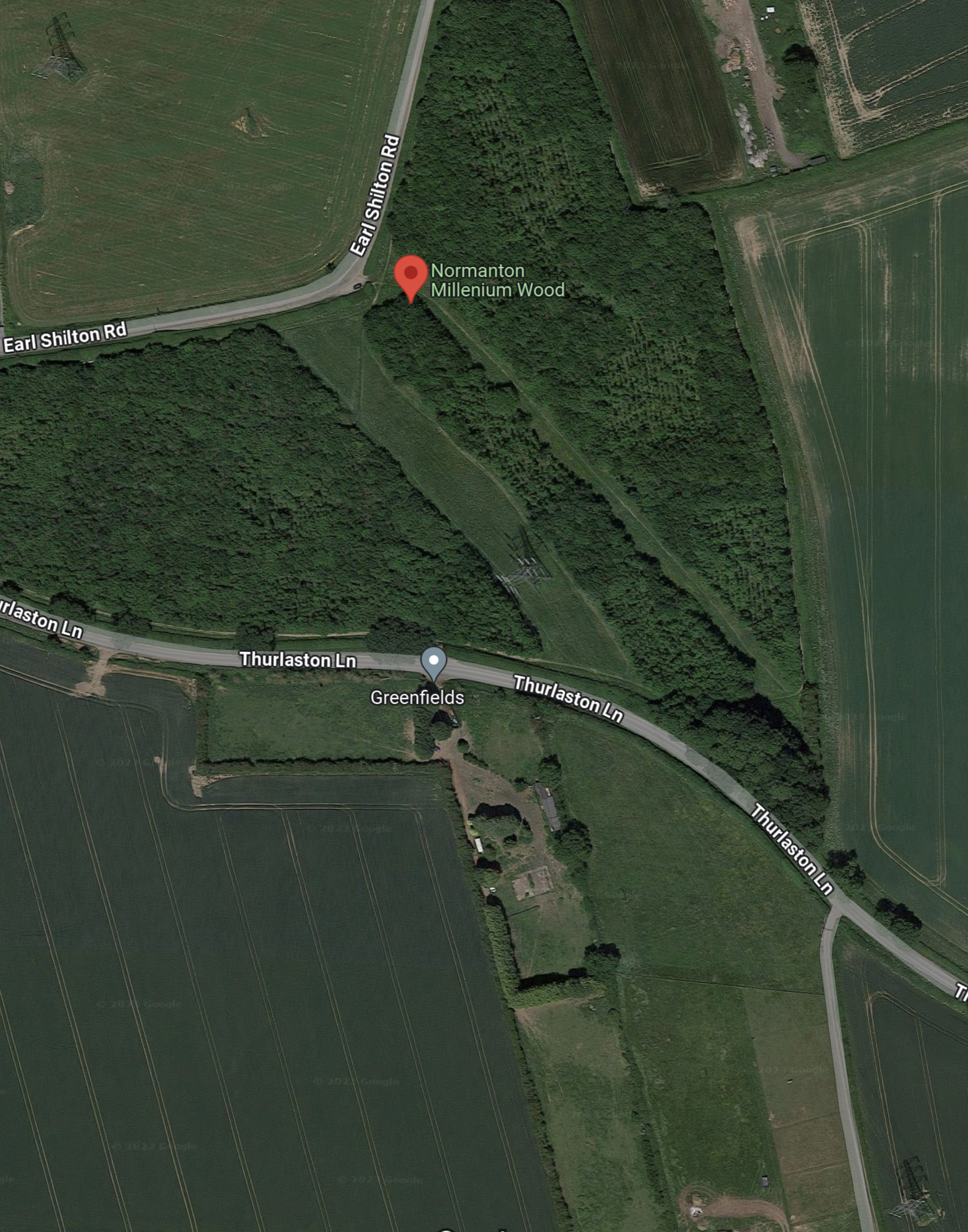
This Google map shows the wood.
Note.
- The red arrow indicates Normanton Millennium Wood.
- I suspect that cleared space in the woodland leading South-East from the red arrow is about 300 metres long and 15 metres wide, which is about 1.1 acres
- As Normanton Millennium Wood is 16.75 acres, I suspect it includes all the woodland to the East of the red arrow, up to the cultivated farmland.
- If you look carefully, you can see a large electricity pylon in the wider cleared area, to the South of the red arrow.
- When I created this map, I clipped it so that the next pylons to the North-West and South-East were in the respective corners of the map.
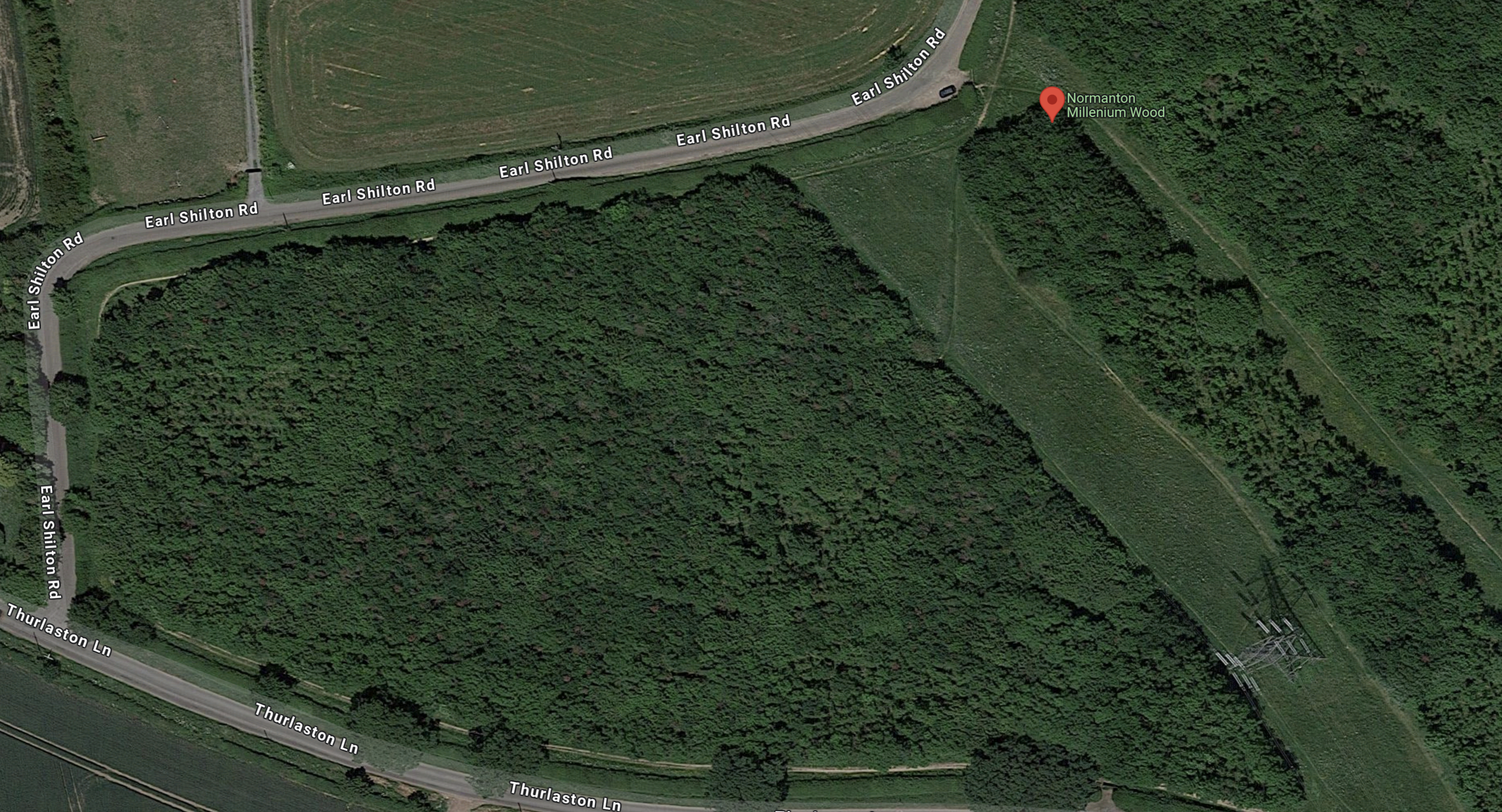
This second map shows the land to the West of the red arrow, which is enclosed by the roads.
Note.
- As before the red arrow indicates Normanton Millennium Wood.
- The electricity pylon is clearly visible on the cleared strip.
- The land to the East of the cleared strip looks like its been planted with trees in the last decade or so.
- The land to the West of the cleared strip looks more like scrub, that has grown up after years of neglect.
- I estimate that the area of the cleared strip and the scrub, is around nineteen acres.
- This news story from Exagen, is entitled Woodland Planting At Normanton Energy Reserve – Becca Leake is a must-read as it outlines how woodland will be planted at the site.
As there is no local substation, it looks to me, that a new substation will be built close to the electricity pylon, with the battery to its West.
Conclusion
It seems a good design for a large battery site, which will be shielded from neighbours by a large area of woodland.
I am also sure, that this battery and the one talked about in New Octopus Energy Makes First Investment To Develop UK’s Largest Battery, are the same battery.
All the numbers in both articles are identical.
UK Transmission-Connected 100MW BESS Online At Former Coal Plant Site
The title of this post, is the same as that of this article on Energy Storage News.
These are the first three paragraphs.
A 100MW battery storage project in the UK connected to National Grid’s transmission network has gone online, developed by Pacific Green on the former site of a coal plant.
UK transmission system operator (TSO) National Grid has plugged in the 100MW/100MWh battery energy storage system (BESS) project to its 400kV Richborough substation.
The project, dubbed the Richborough Energy Park battery, is owned by asset manager Sosteneo Infrastructure Partners which acquired it from developer Pacific Green in July 2023.
A Transmission-Connected Battery
Thye Energy Storage News article says this about transmission-connected batteries.
Most BESS projects in the UK connect into the lower-voltage networks run by distribution network operators (DNOs) rather than National Grid’s high-voltage network. Benefits of the latter include a more reliable connection and better visibility in National Grid control rooms.
This would look to be a better way to connect a battery to the grid, but the battery must be able to supply electricity at 400 kV.
This Google Map shows the location of Richborough Energy Park.

Note.
- Richborough Energy Park is marked by the red arrow.
- The coast is the East Coast of Kent.
- The Prince’s Golf Club lies between the Energy Park and the sea.
This second Google Map shows the energy park in more detail.

Note.
- Richborough Energy Park is marked by the red arrow.
- The 336 MW coal-fired Richborough power station used to occupy the site.
- To its West is Richborough 400kV substation.
- There is a large solar park to the North.
- The 1 GW Nemo Link connects to the grid at the energy park.
- The 300 MW Thanet Wind Farm connects to the grid here.
It looks like an ideal place to put a 100MW/100MWh battery energy storage system, so that it can balance the wind and solar farms.
Sheaf Energy Park
This page on the Pacific Green web site is entitled Delivering Grid-Scale Energy Storage With A Global Reach.
Four battery projects are shown.
- Richborough Energy Park – In Operation
- Sheaf Energy Park – In Construction
- Limestone Coast Energy Park – In Origination
- Portland Energy Park – In Origination
The first two projects are in Kent and the others are in Australia. That is certainly global reach by Pacific Green.
I then found this page on the Pacific Green web site, that is entitled Pacific Green Acquires Sheaf Energy Limited – 249 MW / 373.5 MWh Battery Energy Storage Development In The UK.
These two paragraphs describe the acquisition and development of Sheaf Energy Park.
Pacific Green Battery Energy Parks 2 Limited, a wholly-owned subsidiary of Pacific Green Technologies, Inc. has acquired 100% of the shares in Sheaf Energy Limited (“Sheaf Energy Park”) for £7.5 million (US$9.1 million) from UK-based energy originator, Tupa Energy (Holdings) Limited.
Sheaf Energy Park will be a 249 MW / 373.5 MWh battery energy storage system (“BESS”) located next to the Richborough Energy Park in Kent, England. Design and construction will begin in the first half of 2023, with the energy park commencing its 35-year operating life in April 2025.
It looks to me that Pacific Green have found the figures for the construction and operation to their liking at Richborough Energy Park and have decided that to more than triple their investment in energy storage at the site will be very much to their advantage.
Conclusion
I suspect we’ll see other locations in the UK and around the world, with wind, solar, interconnectors and batteries working in harmony to make the most of the electricity available.
Carlton Power Secures Planning Consent For World’s Largest Battery Energy Storage Scheme
The title of this post, is the same as that of this news story from Carlton Power.
This is the sub-heading.
£750m 1GW Battery Project To Be Built At Carlton Power’s Trafford Low Carbon Energy Park In Greater Manchester
These three paragraphs outline the project.
Carlton Power, the UK independent energy infrastructure development company, has secured planning permission for the world’s largest battery energy storage scheme (BESS), a 1GW (1040MW / 2080MWh) project located at the Trafford Low Carbon Energy Park in Greater Manchester. The £750m BESS scheme will strengthen the security and resilience of the energy system in the North West of England, and support the energy transition and the growth of renewable power generation in the region.
Planning permission for the BESS was granted by Trafford Council, the local planning authority.
Subject to a final investment decision, construction of the battery storage scheme is expected to begin in the first quarter of next year (2024) with it entering commercial operation in the final quarter of 2025. Carlton Power is in advanced talks with companies to finance, build and operate the Trafford BESS.
I have a few thoughts.
It’s A Monster
This Wikipedia entry, lists the World’s Largest Grid Batteries.
- The current largest is Vistra Moss Landing battery in the United States, which has a capacity of 1600 MWh and an output of 400 MW.
- The Trafford BESS will have a capacity of 2080 MWh and an output of 1040 MW.
By both measures the Trafford BESS is larger.
Where Will It Get The Energy?
Consider.
- In Liverpool and Morecambe Bays there is over 5 GW of offshore wind farms either operational, under construction or planned.
- Carrington gas-fired power station has a capacity of 884 MW.
- The Western HVDC Link is a 2250 MW link between Scotland and Connah’s Quay in North Wales.
- I wrote about the proposed Mersey Barrage in Mersey Tidal Project And Where It Is Up To Now.
I can see enough renewable energy being generated to replace Carrington gas-fired power station.
Who Will Finance, Build And Operate The Trafford BESS?
There are two major Energy Storage Funds in the UK.
- Gore Street with 27 projects totalling 1.17 GW.
- Gresham House with 17 projects totalling 425 MW.
Note.
- There are other smaller funds.
- The figures given are cumulative outputs for the portfolios.
- Sourcing the large number of batteries might be a problem.
- As the maths of these batteries are now well-known, I would expect that finance shouldn’t be too much of a problem.
- Local companies like Liverpool Victoria or Peel Holdings could even take a position.
A large American contractor backed by US money could swallow the whole project.
That happened with North Sea oil and gas in the last century.
Is Highview Power’s CRYOBattery Still Planned?
Carlton Power’s news story says this about Highview Power’s plans.
In addition to Carlton Power’s two projects, Highview Power Storage Inc. is planning to build and operate the world’s first commercial liquid air storage system – a £250m 250MWh long duration, cryogenic energy storage system – on the Trafford Low Carbon Energy Park, which was until 1991 the site of the Carrington coal-fired power station. The Low Carbon Energy Park is located close to Manchester Ship Canal and the £750m Carrington flexible gas-fired power station which entered operation in 2016.
It seems that the CRYOBattery is still planned.
Conclusion
Manchester is getting a powerful zero-carbon hub.
SSE Renewables Announces Construction Of Second Utility-Scale Battery Storage System
The title of this post, is the same as that of this news item from SSE Renewables.
These three paragraphs outline the project and its current status.
SSE Renewables has taken a Final Investment Decision to proceed with, and entered into contracts to deliver, its second battery energy storage system (BESS). The 150MW project is located at the site of SSE’s former Ferrybridge coal-fired power station in West Yorkshire, England.
The investment is part of SSE’s £12.5bn Net Zero Acceleration Programme and means construction will now commence later this month at the iconic site.
For decades the Ferrybridge coal-fired power station was a prominent feature of the West Yorkshire landscape, before being decommissioned by SSE in 2016. Now SSE Renewables’ plans to build a new 150MW battery storage project at Ferrybridge will provide flexible generation for Britain’s national grid and a new era for the site.
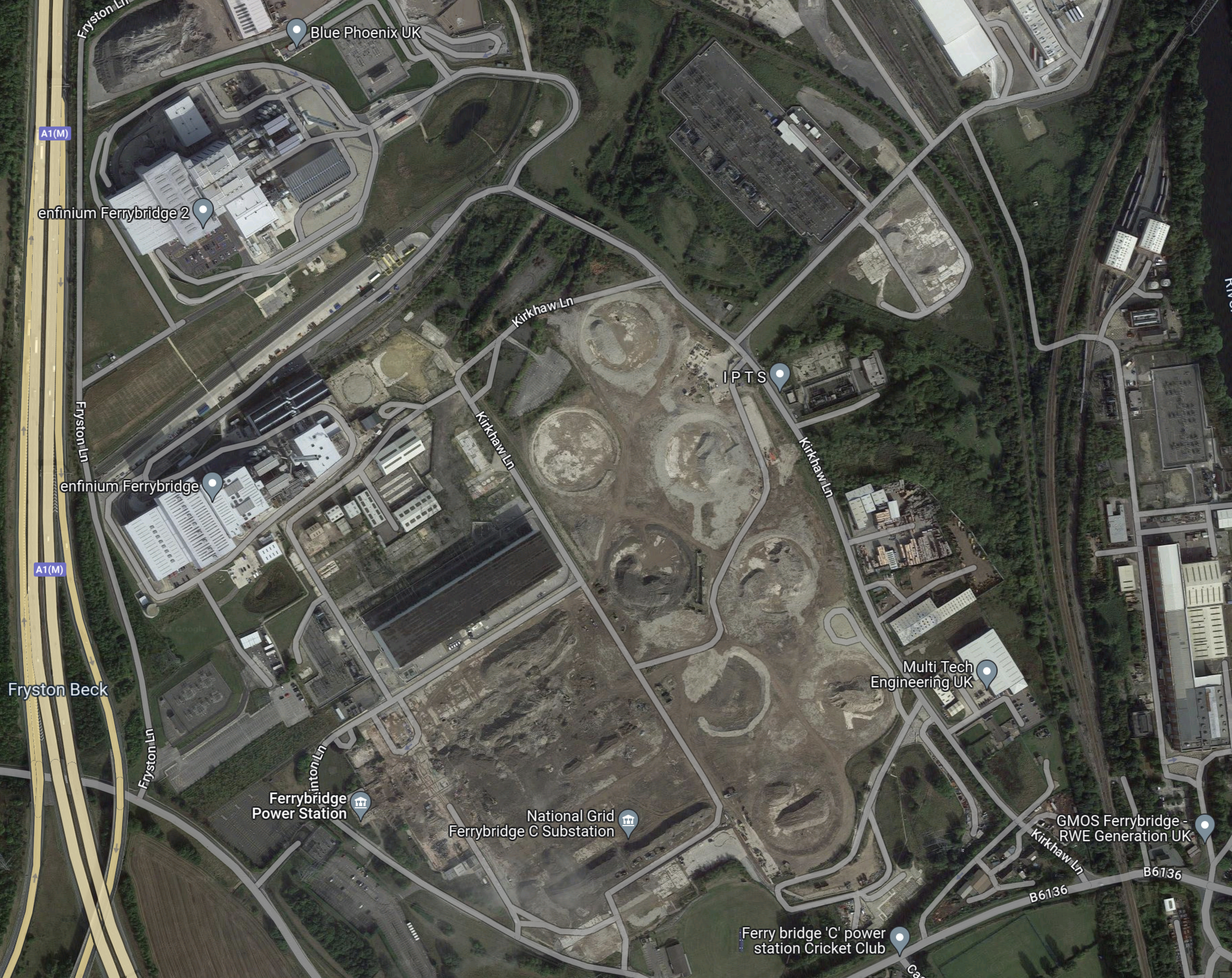
This Google Map shows the site.
Note.
- The A1(M) runs up the West side of the map, with the East Coast Main Line going up the East.
- The circular structures in the middle of the map appear to be the bases and remains of the eight cooling towers.
- There are a lot of labels saying Ferrybridge power station.
- One existing and one demolished sub-stations can be located.
- The last Ferrybridge power station; C had a capacity of just over 2 GW.
The Wikipedia entry for Ferrybridge C, is worth a read, as it details the struggles of various owners and their engineers to generate electricity efficiently and with regard to the regulations.
The site’s use since 2016 seems to have been varied with two multi-fuel power stations, that were designed to burn mixed fuel including biomass, general waste and waste wood, a carbon capture experiment for Chris Huhne and now the 150 MW battery, which other sources give as having a storage capacity of 300 MWh.
It looks to me that SSE still own the large site and I wonder what their plans envisage for the site.
- A large electrolyser to produce hydrogen could be invaluable for decarbonising the heavy industry in the area.
- According to Wikipedia, there was a plan to build the gas-fired Ferrybridge D and a gas pipeline to connect it to the gas transmission system, but neither were built.
- So could the gas pipeline be built to distribute the hydrogen?
- Or could a large hydrogen store and a small hydrogen-powered power-station be built at Ferrybridge to back up the renewables
- Alternatively, more batteries could be added to the site.
The size of the site, gives lots of possibilities.
Boralex Commissions BESS At Wind Farm In France In EU-Supported Demonstration Project
The title of this post, is the same as that of this article on Energy Storage News.
These two paragraphs outline the project.
Canada-based renewable energy firm Boralex has turned on a 3.3MWh battery storage unit attached to a wind farm in France.
The battery storage project has been installed at the site of the Plouguin wind farm, an 8MW generating facility in the Finistere department of Brittany, northwest France.
Note.
- The project was co-financed by the European Union through its European Regional Development Fund (ERDF).
- The project was launched to demonstrate the technical feasibility of a hybrid wind-plus-storage project.
- Boralex added in its announcement that the project will contribute to the stability of the French electricity grid.
There will be a lot of projects like this in the future.
This paragraph makes an interesting point about using batteries with solar and wind power.
Wind farms are less frequently hybridised with energy storage than solar PV because of the larger minimum project size and less predictable variability, with sharper peaks meaning heavier battery cycling and potentially faster degradation.
My control engineering knowledge and experience says that larger power sources and those that are highly variable will need batteries with more capacity for the same stability and quality of power output.
This sounds to me like a very good reason for developing larger and more affordable batteries, like those of Cheesecake Energy, Energy Dome, Gravitricity and Highview Power.
It also probably means that to stabilise several gigawatts of wind power, you need a very large amount of storage, that can only be provided by pumped storage hydroelectricity.
Conclusion
A very large amount energy storage is going to be needed.
Projects like these are essential to make sure we use them to their full possibilities.

