East-West Rail: Electrification
The first paragraph of the Wikipedia entry for the East West Railway, says this about electrification.
As of March 2020, electrification of the line is not planned, but the 2019 decision (to rule it out) is under review.
But I don’t think it’s a simple decision of electrify or not!
These observations are guiding my thoughts.
Milton Keynes Central Station
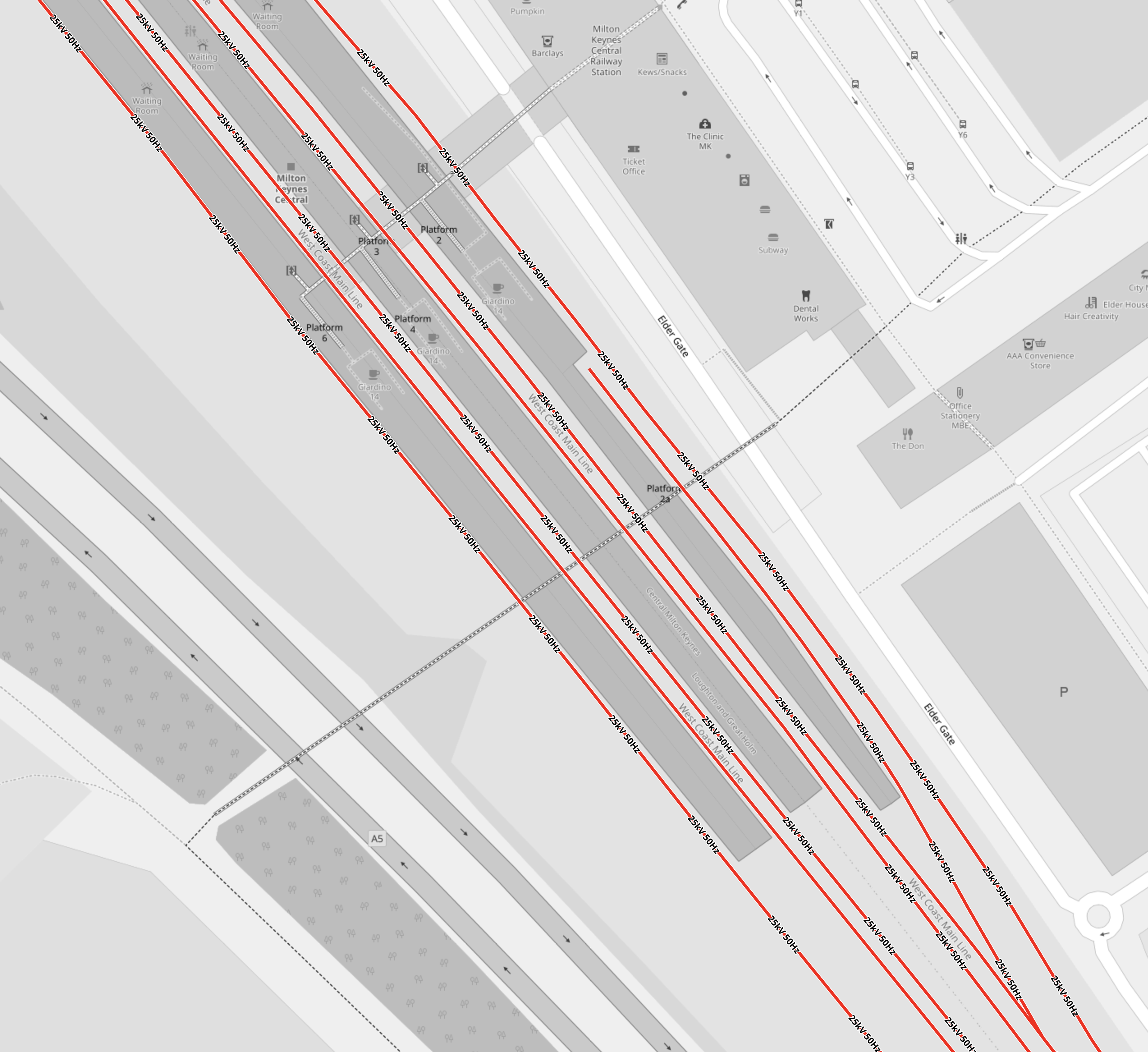
This OpenRailwayMap shows the platforms and whether they are electrified in Milton Keynes Central station.
Note.
- Lines shown in red are electrified with 25 KVAC overhead wires.
- The short platform is Platform 2A, which can take a five-car train and was built recently to terminate the Marston Vale Line service.
- Could Platform 2A be ideal for handling and charging, battery-electric trains, that terminate in Milton Keynes station?
The Wikipedia entry for Milton KeynesCentral station, has a section called Platforms and Layout, which gives full details.
Bletchley Station
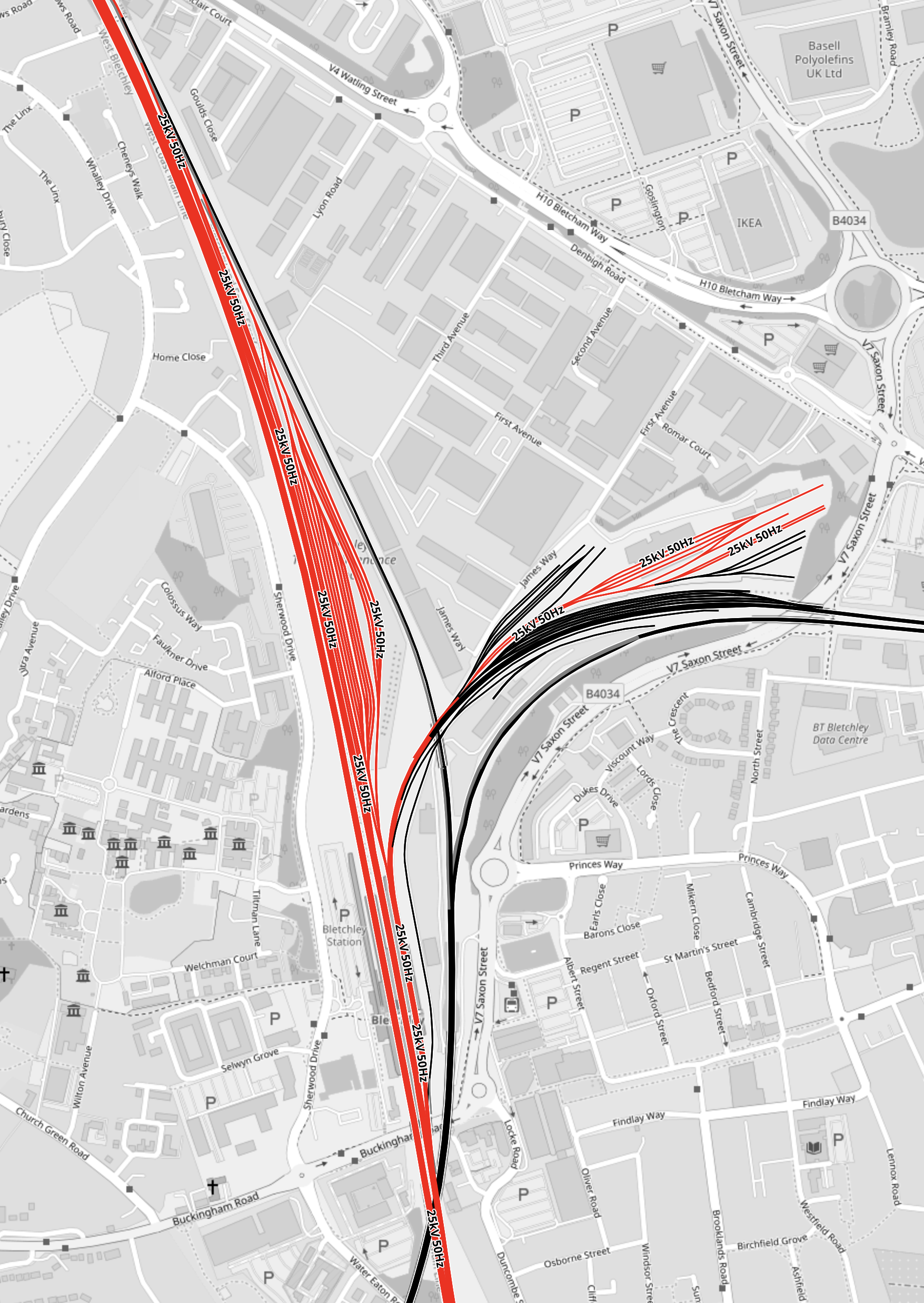
This OpenRailwayMap shows the platforms and whether they are electrified in Bletchley station.
Note.
- Lines shown in red are electrified with 25 KVAC overhead wires.
- The wide swath of red going North is the West Coast Main Line.
- The smaller patch of red to the East of the West Coast Main Line are electrified sidings.
- All low-level platforms at Bletchley station are electrified.
- The viaduct platforms, are shown in black as they are not electrified.
- A non-electrified line leads North-West from the viaduct towards Milton Keynes Central.
- The Milton Keynes end of the line between Milton Keynes Central station and the viaduct is electrified.
- A non-electrified line leads North-East from the viaduct towards Fenny Stratford and Bedford.
The Google Map shows a 3D visualisation of Bletchley station.
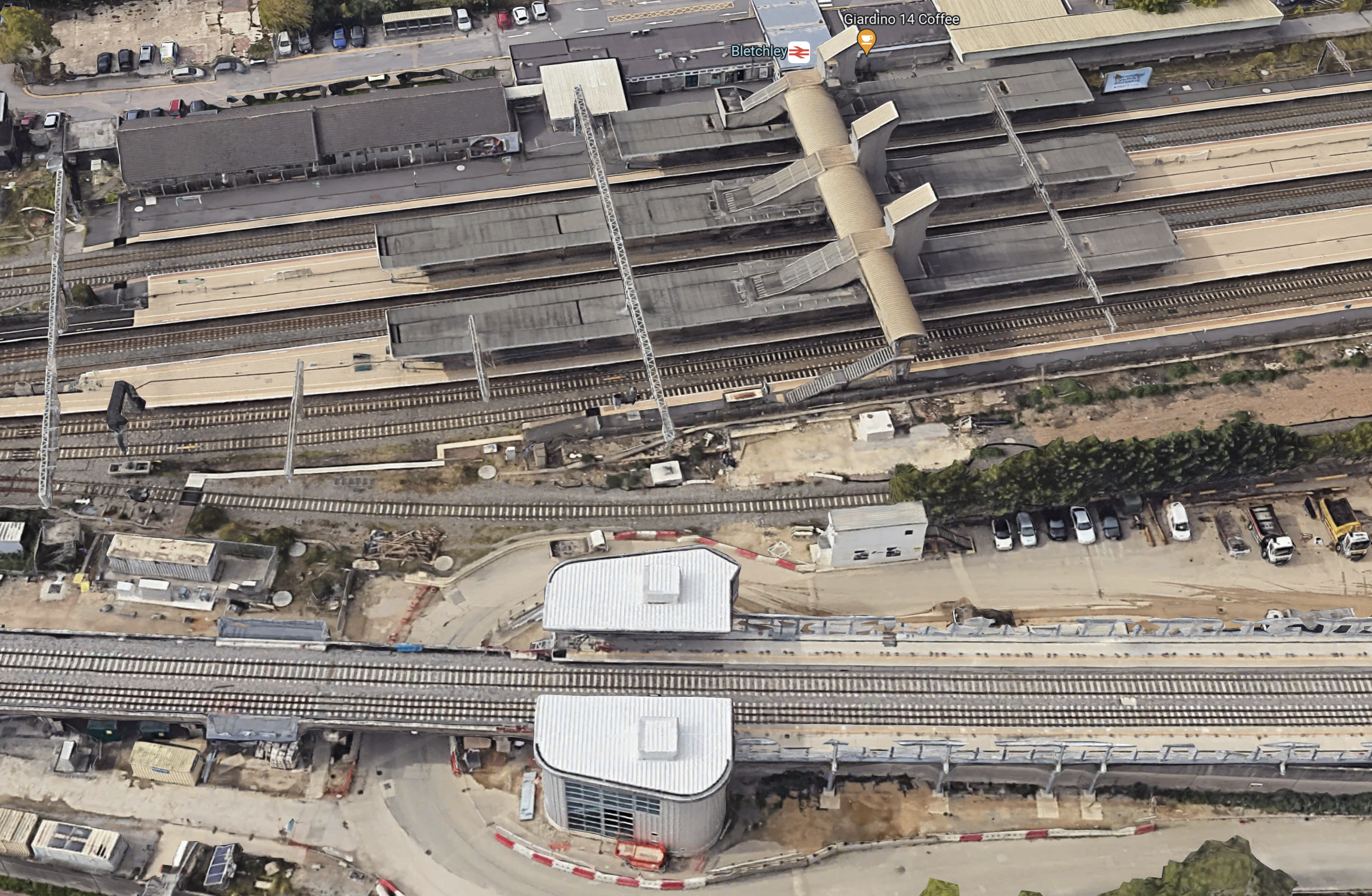
I can’t see much sign of any electrification.
Bedford Station
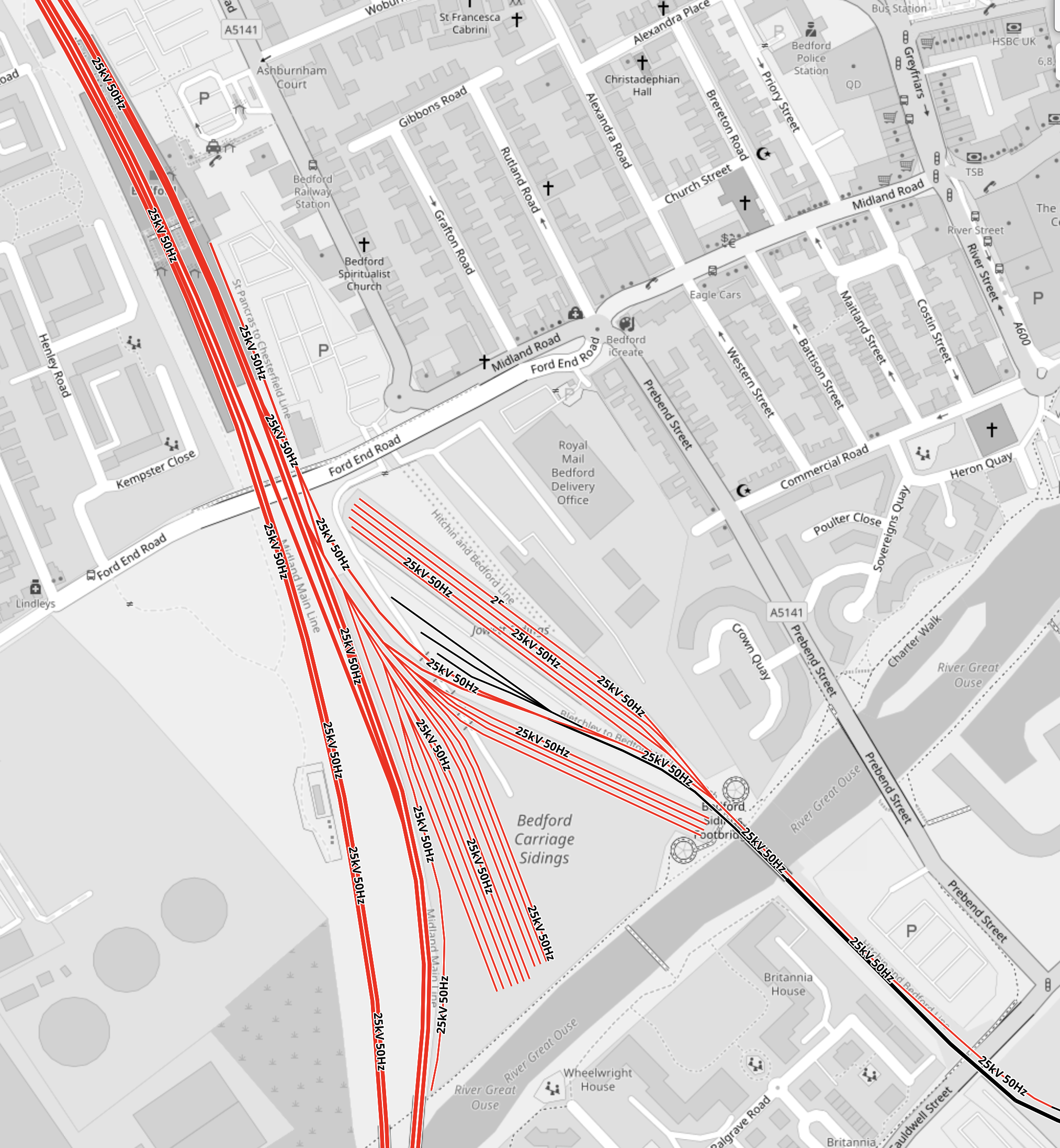
This OpenRailwayMap shows the platforms and the electrification around Bedford station.
Note.
- All platforms at Bedford station are electrified.
- The lines to the West of the station are the electrified Midland Main Line.
- The Marston Vale Line services terminate in the short Platform 1A, which is the South-East corner of the station.
- The track into Platform 1A is electrified for about two hundred metres, through the sidings South of the station.
This picture shows the electrified track as it crosses over the river.
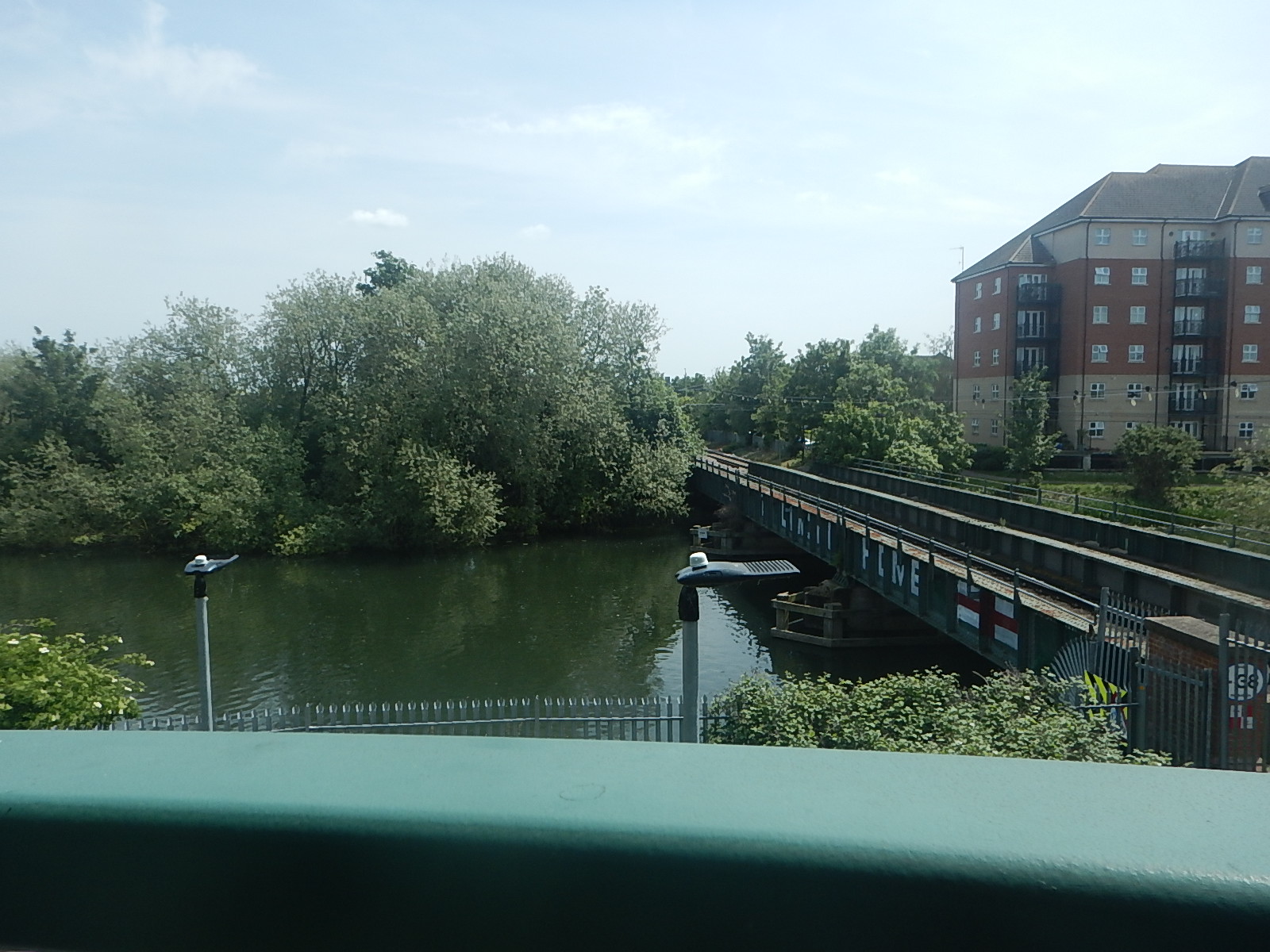
Could Platform 1A be ideal for handling and charging, battery-electric trains, that terminate in Bedford station?
It’s odd that there is the same platform layout at both ends of the Marston Vale Line.
Is it just a coincidence or does Engineer Baldrick have a cunning Plan?
Oxford Station
This OpenRailwayMap shows the platforms and the electrification around Oxford station.
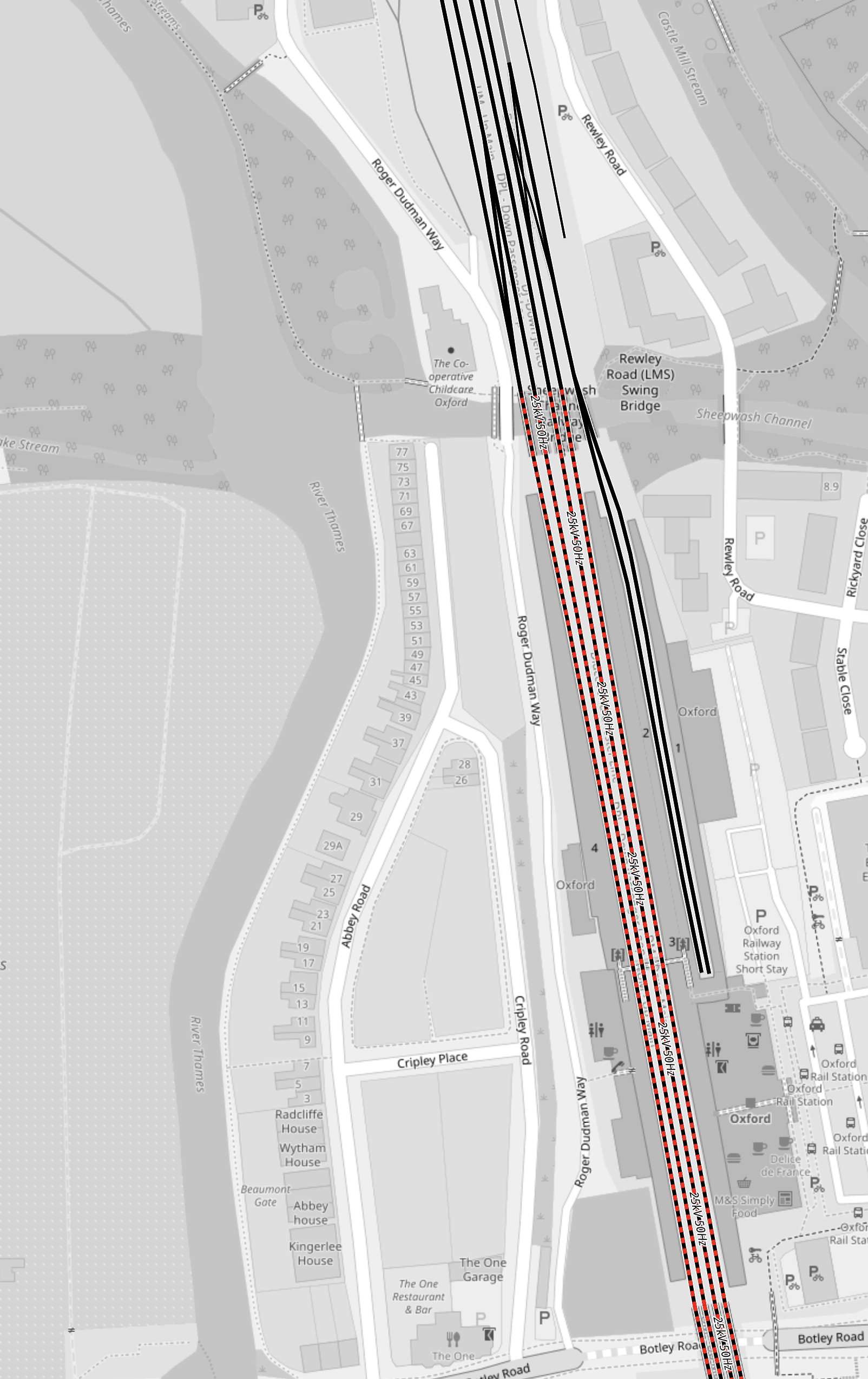
Note.
- The dotted red and black tracks, indicate electrification is planned.
- The planned electrification will connect Oxford station to Didcot Junction station.
- The two bay platforms at the North of the station are not electrified and Platform 2 is now used by Chiltern’s London services.
- Platform 1 could be used by trains on the East West Railway that terminate at Oxford.
When Oxford station is electrified, it wouldn’t be the largest project to add 25 KVAC overhead electrification to the two bay platforms.
Aylesbury Station
This OpenRailwayMap shows the platforms and the lack of electrification around Aylesbury station.
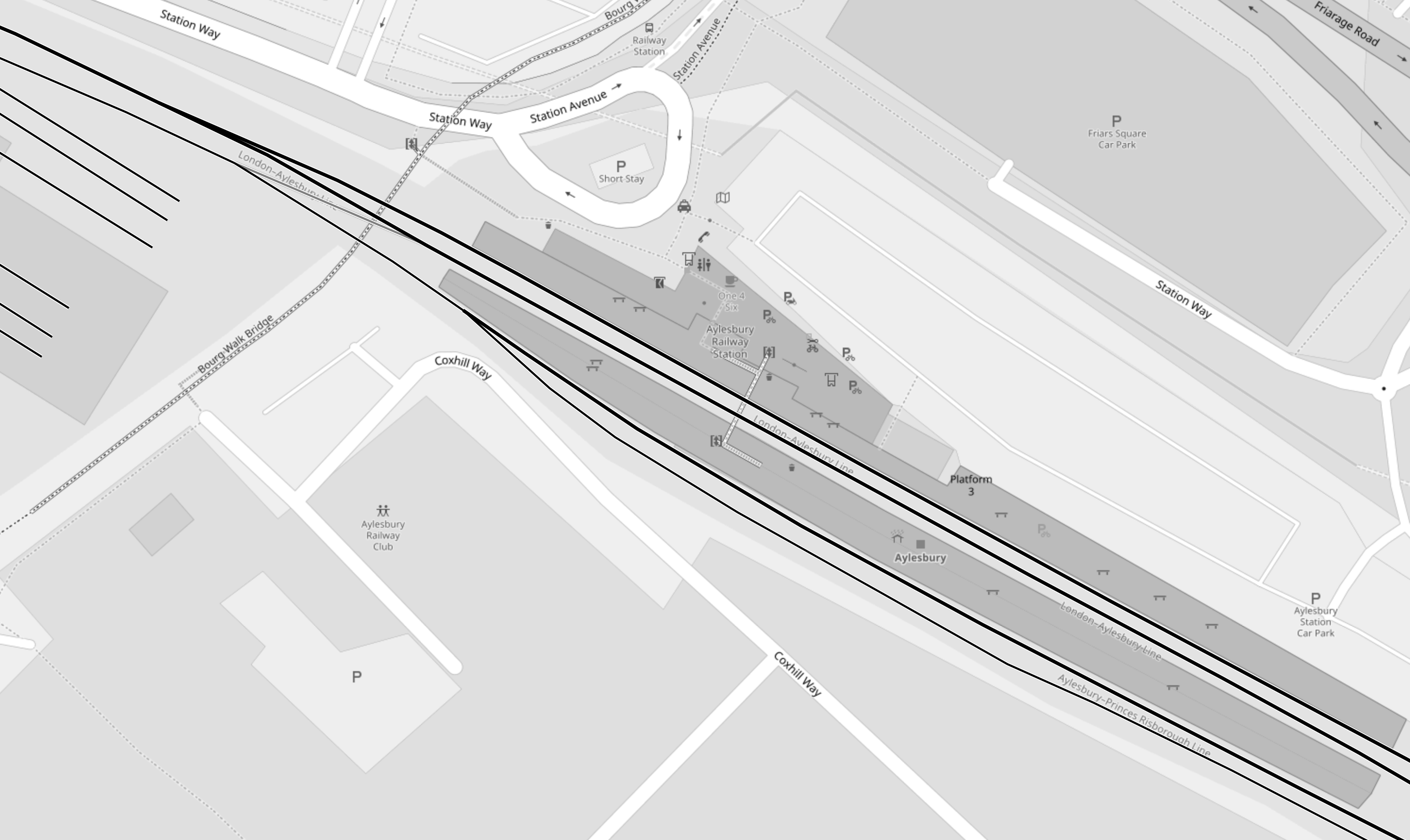
Note.
- No tracks are electrified.
- Platforms are numbered 3, 2, 1 from the top, so 2 and 3 are paired in the middle.
- All freight trains go through Platform 2 and most seem to go via Princes Risborough and High Wycombe.
- Chiltern services use Platforms 1 and 3.
Putting a charging system in Aylesbury station could be tricky.
I wonder if the simplest system for East West Railway would be to electrify between Aylesbury and Aylesbury Vale Parkway stations.
Chiltern Railway’s time between the two stations is as much as seven minutes.
Some trains to Aylesbury take over twenty minutes to do the short journey to Aylesbury Vale Parkway and return, which is more than enough to fully-charge a battery-electric train.
You can even have Chiltern’s hourly Aylesbury Parkway service, sharing the same stretch of electrification with East West Railway’s Aylesbury service, as there is a loop, which creates double-track for some of the way.
It should be noted that between Marylebone and Aylesbury Vale Parkway stations is only 41.1 miles, so some battery-electric trains could do that with a full charge at one end.
East West Railway Distances
In Trains Needed For The East West Railway, I calculated some of these distances.
- Oxford and Bedford – 46.8 miles
- Oxford and Milton Keynes – 33.4 miles
- Aylesbury and Milton Keynes – 25.9 miles
With charging at both ends, all of these routes are possible using modern battery-electric trains, where even a Class 777 IPEMU, designed for extending Merseyrail’s suburban network has done 84 miles on one charge.
On To Cambridge
In this document on the East-West Rail Consortium web site, these services are suggested, for when the East West Railway is complete.
- An hourly train via Norwich terminating at Great Yarmouth.
- An hourly train via Ipswich terminating at Manningtree.
These are distances on these routes that are not electrified, that are to the East of Cambridge.
- Ely and Norwich – 53.7 miles
- Norwich and Great Yarmouth – 18.3 miles
- Cambridge and Haughley Junction – 40.3 miles
Note.
- The Manningtree service would be able to charge its batteries after passing Haughley junction going East and it would be nearly an hour before it needed to use the battery for traction.
- If the Yarmouth service could handle the full route on batteries, then it could return to Cambridge with an efficient charger at Great Yarmouth, which for 25 KVAC overhead electrification trains is an off the shelf item.
- But it does look to me that the trains must leave Cambridge with full batteries, so they can reach electrification at Bedford, Haughley or Norwich.
This map shows the route of the East West Railway between Bedford and Cambridge.
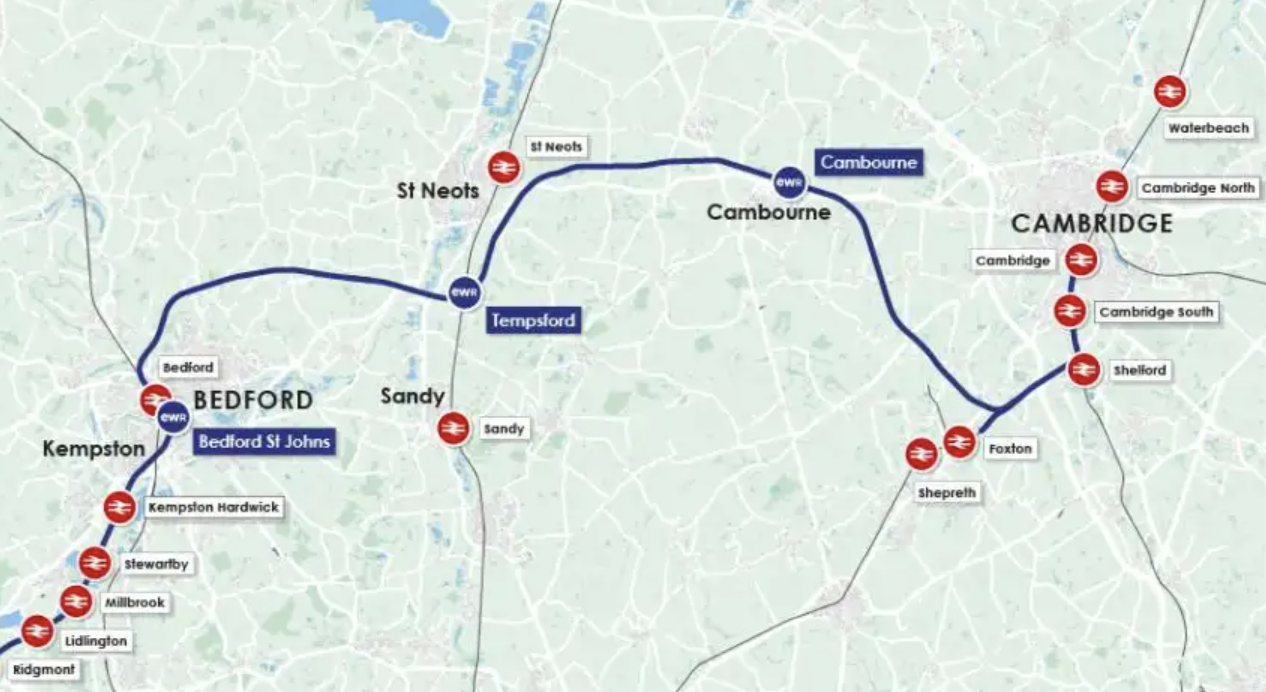
Note.
- Bedford is on the electrified Midland Main Line to London.
- Tempsford is on the electrified East Coast Main Line to London.
- Cambridge has two electrified main lines to London.
- These connections should ensure a good power supply to the East of Bedford for electrification.
I suspect the easiest option will be to add some more electrification at one or more of these places.
- At the Eastern end of the Bedford and Cambridge section.
- To the West of Haughley junction, when it is rebuilt.
- To the North of Ely, when the railways in that area are improved.
Although, as it will be a new route, it might be best to build Bedford and Cambridge as an electrified railway.
East-West Rail: Along The Marston Vale Line
For the initial phase of the East West Railway, it doesn’t appear that the Marston Vale Line will be improved.
As I write this, I have not heard of any improvements between Bedford and Bletchley.
Perhaps, with all the arguments about the section of the East West Railway between Bedford and Cambridge, the Government, Network Rail and the East West Railway feel that the best approach, is to do what they can with the existing track layout and the rebuilt viaduct at Bletchley.
These are my thoughts.
The Capacity Of The Marston Vale Line
In the Wikipedia entry for the Marston Vale Line, this is said about the infrastructure of the line.
Apart from a short length of single track at both ends, the line is double track, and is not electrified. It has a loading gauge of W8 and a line speed of 60 miles per hour (97 km/h). The line’s signalling centre is at Ridgmont.
The line has a length of only 16.5 miles.
I believe with modern signalling and well-trained drivers, that the line could accommodate at least two trains per hour (tph) in both directions.
At its simplest every half hour, a train would leave both end stations and the two trains would pass each other on the long double-track section in the middle.
Proposed Train Services
Train services on the East West Railway will be as follows, when it opens between Oxford and Milton Keynes and Bedford, are proposed to be as follows.
- 2 tph – East West Railway – Oxford and Milton Keynes Central via Oxford Parkway, Bicester Village, Winslow and Bletchley
- 1 tph – East West Railway – Oxford and Bedford via Oxford Parkway, Bicester Village, Winslow, Bletchley, Woburn Sands and Ridgmont
- 1 tph – West Midlands Trains – Bletchley and Bedford via Fenny Stratford, Bow Brickhill, Woburn Sands, Aspley Guise, Ridgmont, Lidlington, Millbrook, Stewartby, Kempston Hardwick and Bedford St Johns
If the East West Railway uses the Marston Vale Line between Bletchley and Bedford, then there will be two tph along the Marston Vale Line.
I believe that if the Marston Vale Line is not improved until later, then the proposed initial train service pattern can be achieved.
The New Bletchley Viaduct
The tracks appear to have been laid on the Bletchley Viaduct.
This Google Map shows the tracks on the viaduct.
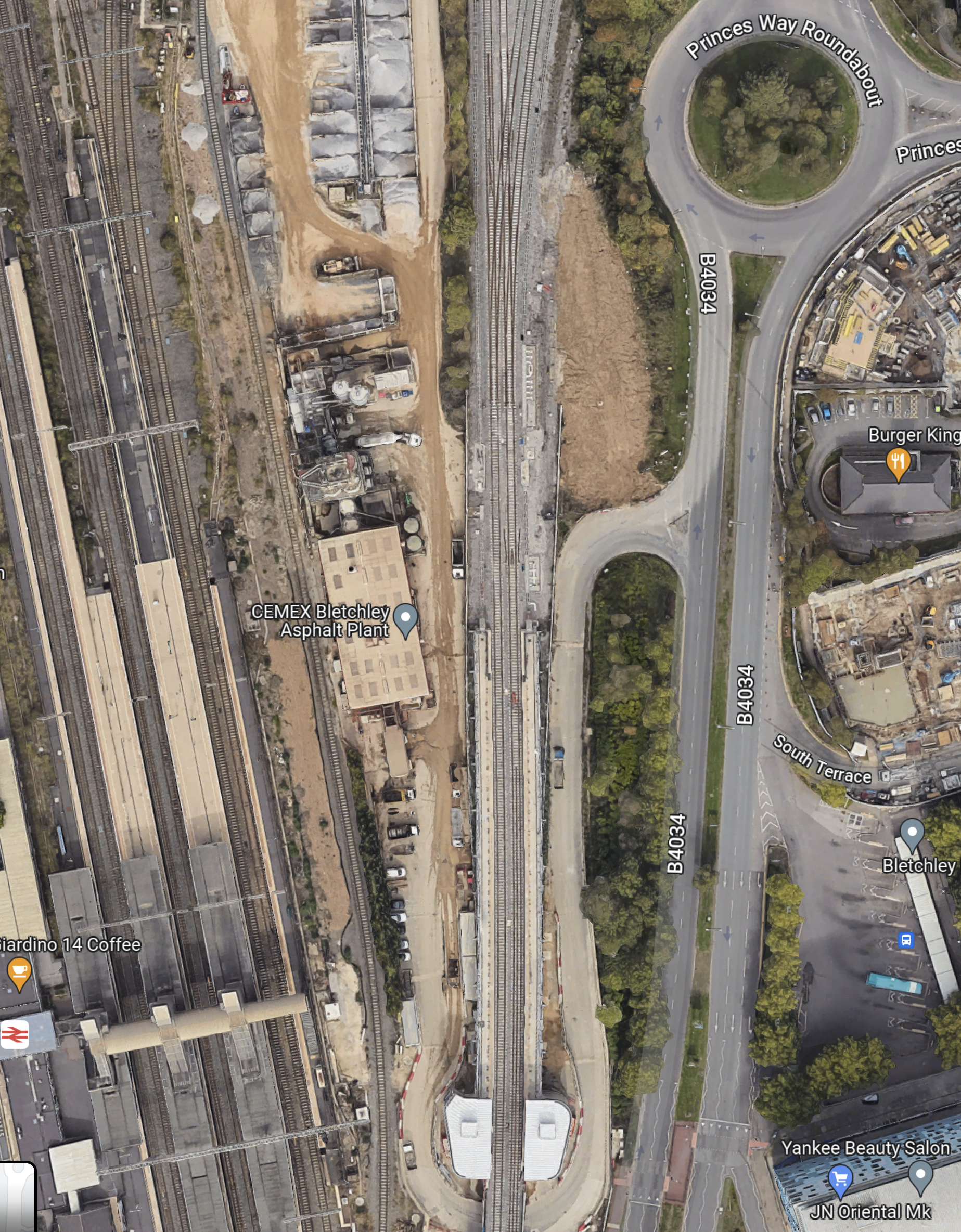
Note.
- The double-track viaduct runs North-South in the middle of the map.
- The two platforms appear to be substantially complete.
- The two lift and stair towers are at the Southern end of the platforms.
This second Google Map shows the section of the viaduct by the roundabout.
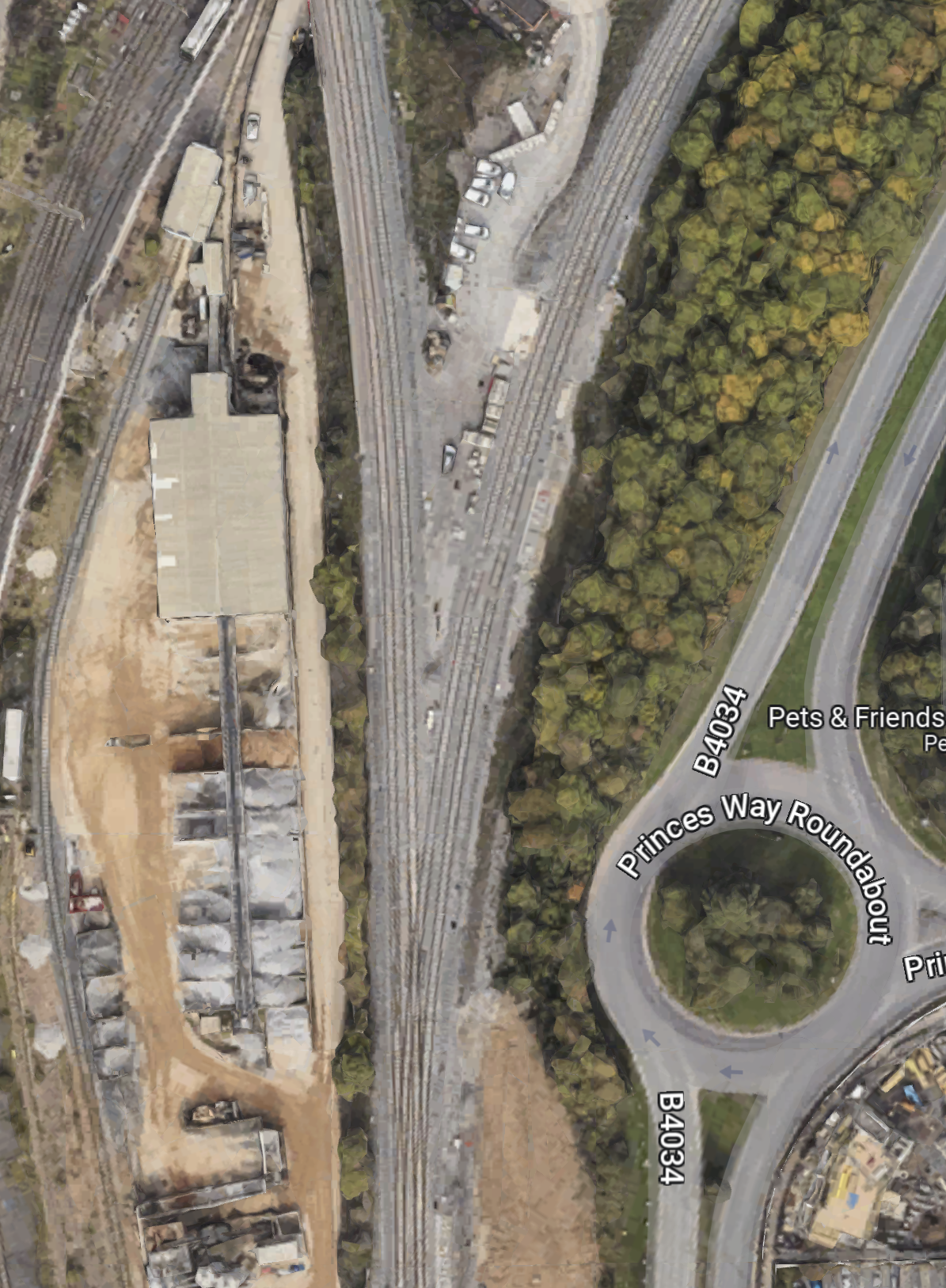
Note.
- The viaduct splits with two tracks going North-West to Milton Keynes Central and two tracks going North-East to Bedford.
- There is a complicated junction, which appears to allow a lot of flexibility for train operations.
I have followed the Milton Keynes tracks and there are cross-overs, so that trains can go between Platform 2A at Milton Keynes Central station and either of the viaduct platforms at Bletchley station, which they will need to do to run services between Oxford and Aylesbury, and Milton Keynes Central.
This Google Map shows the tracks between the viaduct and Fenny Stratford, which is the first station towards Bedford.
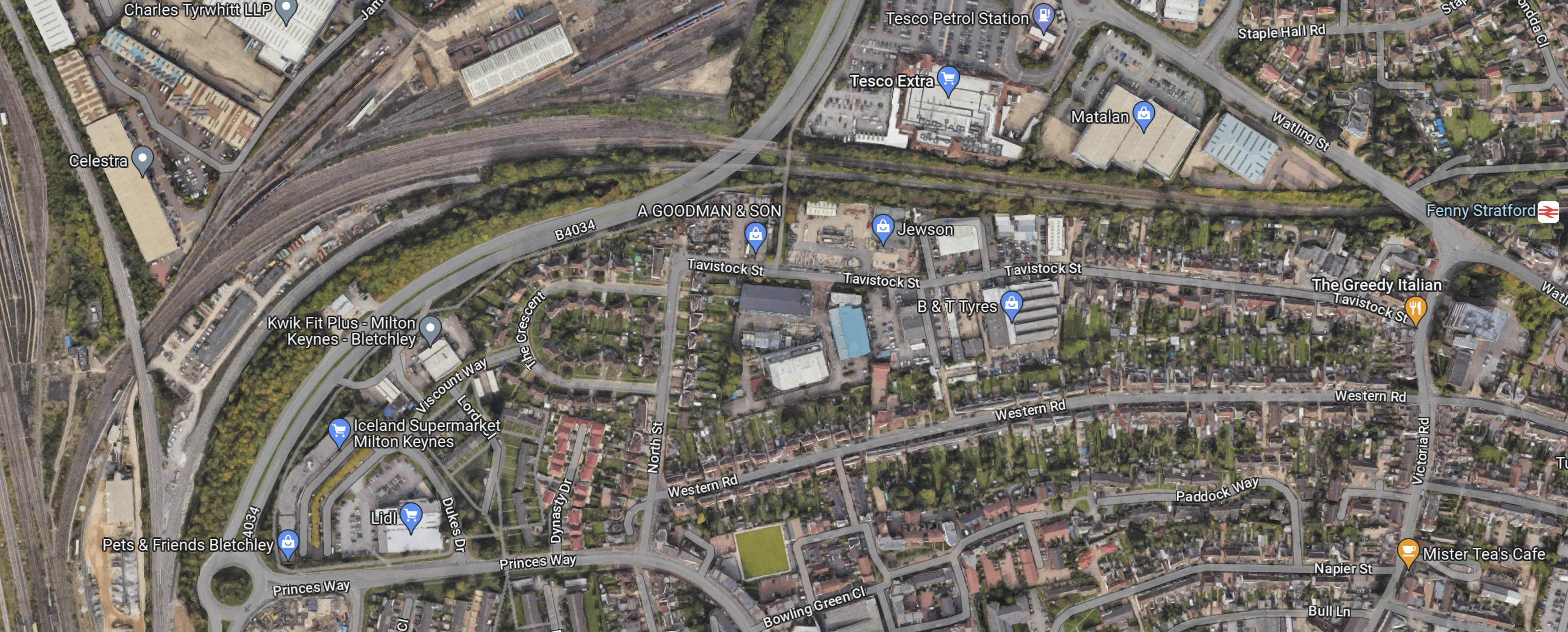
Note.
- The Princes Way roundabout in the West of the map.
- The Milton Keynes and Bedford tracks divide close to the roundabout.
- Fenny Stratford station in the East of the map.
- The tracks gradually combine from West to East, so there is only one track for the single platform at Fenny Stratford station.
This Google Map shows the Western section of the tracks between the viaduct and Fenny Stratford.
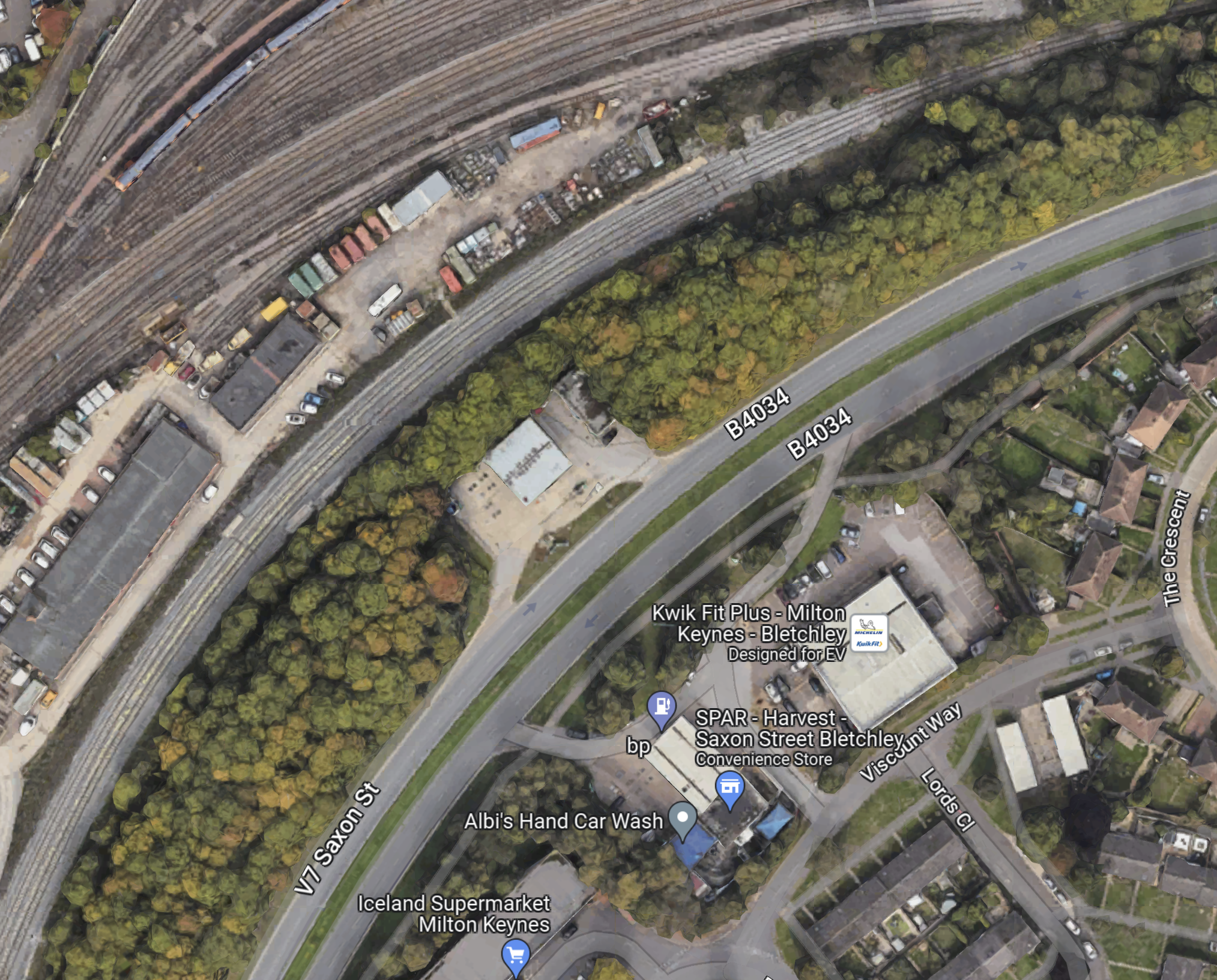
Note, how the two tracks on the viaduct join into one for going towards Fenny Stratford in the North-East corner of the map..
I’m certain, that this track layout, allows a train to go between the single platform at Fenny Stratford station and either of the viaduct platforms at Bletchley station.
A Milton Keynes Central And Bedford Service
In the Wikipedia entry for the Marston Vale Line, there is a section, which is entitled Extension to Milton Keynes Central, where this is said.
In June 2005, the then franchisee, Silverlink Trains announced an intention to extend the Marston Vale service via the West Coast Main Line to Milton Keynes Central, where a new platform and track would be built alongside the up slow track. Work began on 4 December 2006 at the station to prepare for a service connection. The platform was ready for use in January 2009 but the service did not materialise and there are no longer any published plans for it to do so. A firm service pattern on East West Rail remains to be announced but the illustrative pattern has no Bedford–Milton Keynes Central service; passengers will continue to have to change at Bletchley. There is no east-to-north chord between this line and the WCML: As of December 2020, the route the chord might take is occupied by trade outlets and a warehouse.
But.
Supposing a Milton Keynes to Bedford train did this.
- It ran from Platform 2A at Milton Keynes Central to the Northbound platform on the Bletchley viaduct.
- It would then reverse and run to Bedford along the Marston Vale Line.
- It would terminate in Platform 1A at Bedford station.
And supposing a Bedford to Milton Keynes train did this.
- It ran from Platform 1A at Bedford to the Northbound platform on the Bletchley viaduct.
- It would then reverse and run to Milton Keynes Central along the tracks alongside the West Coast Main Line.
- It would terminate in Platform 2A at Milton Keynes Central station.
Note.
- There would be some bi-directional running.
- Trains would only reverse on the Northbound platform on the Bletchley viaduct.
- Platform 2A at Milton Keynes Central would handle 4 tph.
- Platform 1A at Bedford station would handle 2 tph.
As the only reversing happens on the Northbound platform on the Bletchley viaduct, would it be sensible for a new driver to step-up, so that the reverse was fast?
I believe that with some innovative running, that a Milton Keynes and Bedford service is possible, because of the comprehensive track layout that has been installed.
East-West Rail: Through Bedford
This Google Map shows the route of East West Rail through Bedford.
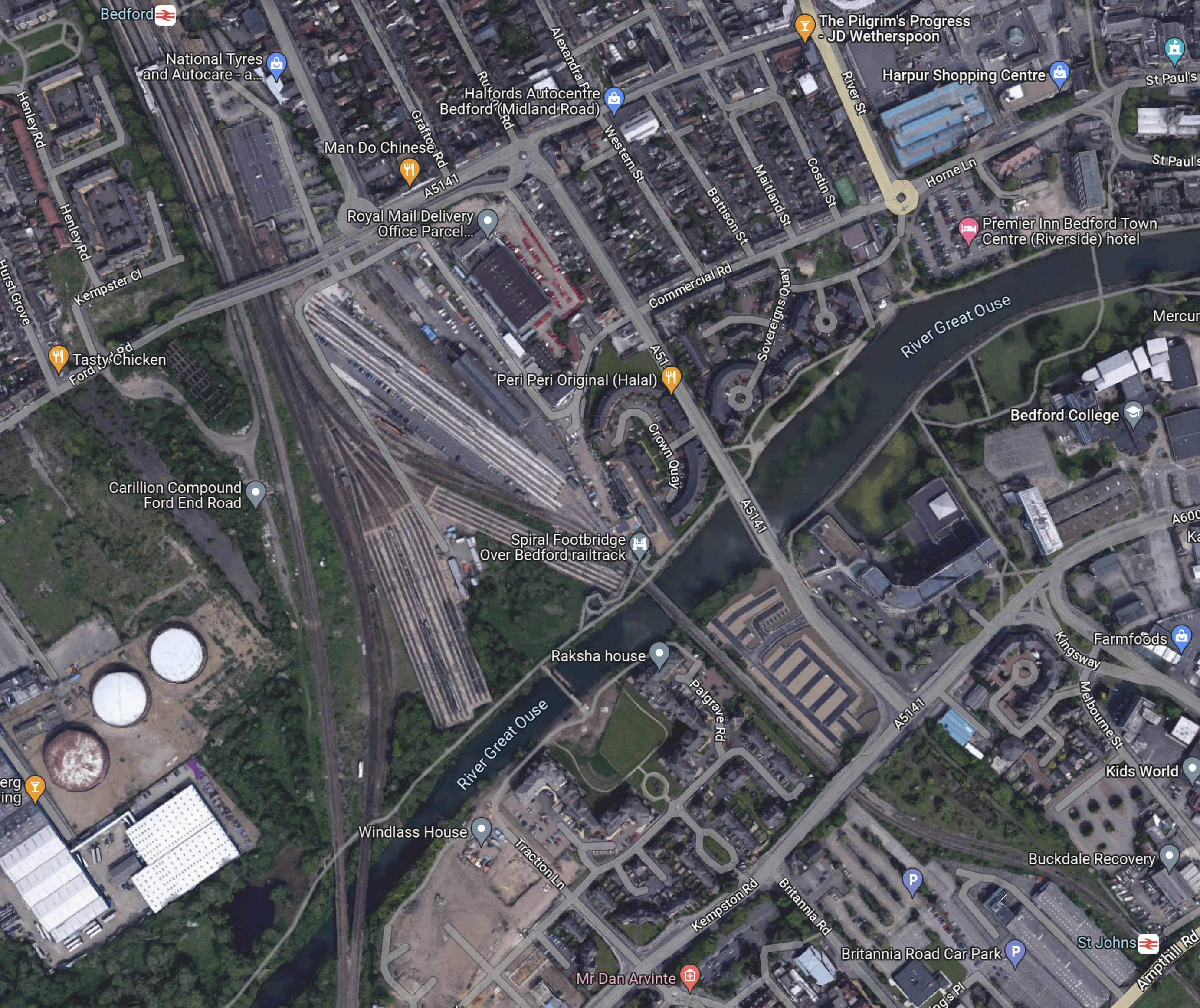
Note.
- Bedford St. Johns station in the South-East corner of the map.
- Bedford station is in the North-West corner of the map.
- Tracks run between the two stations to allow Marston Vale Line trains to terminate in Platform 1A at Bedford station.
- There are a lot of sidings for Thameslink trains South of Bedford station.
- The Great Ouse divides the town into two.
I’ll now explore further.
Bedford St. Johns Station
This Google Map shows Bedford St. Johns station.
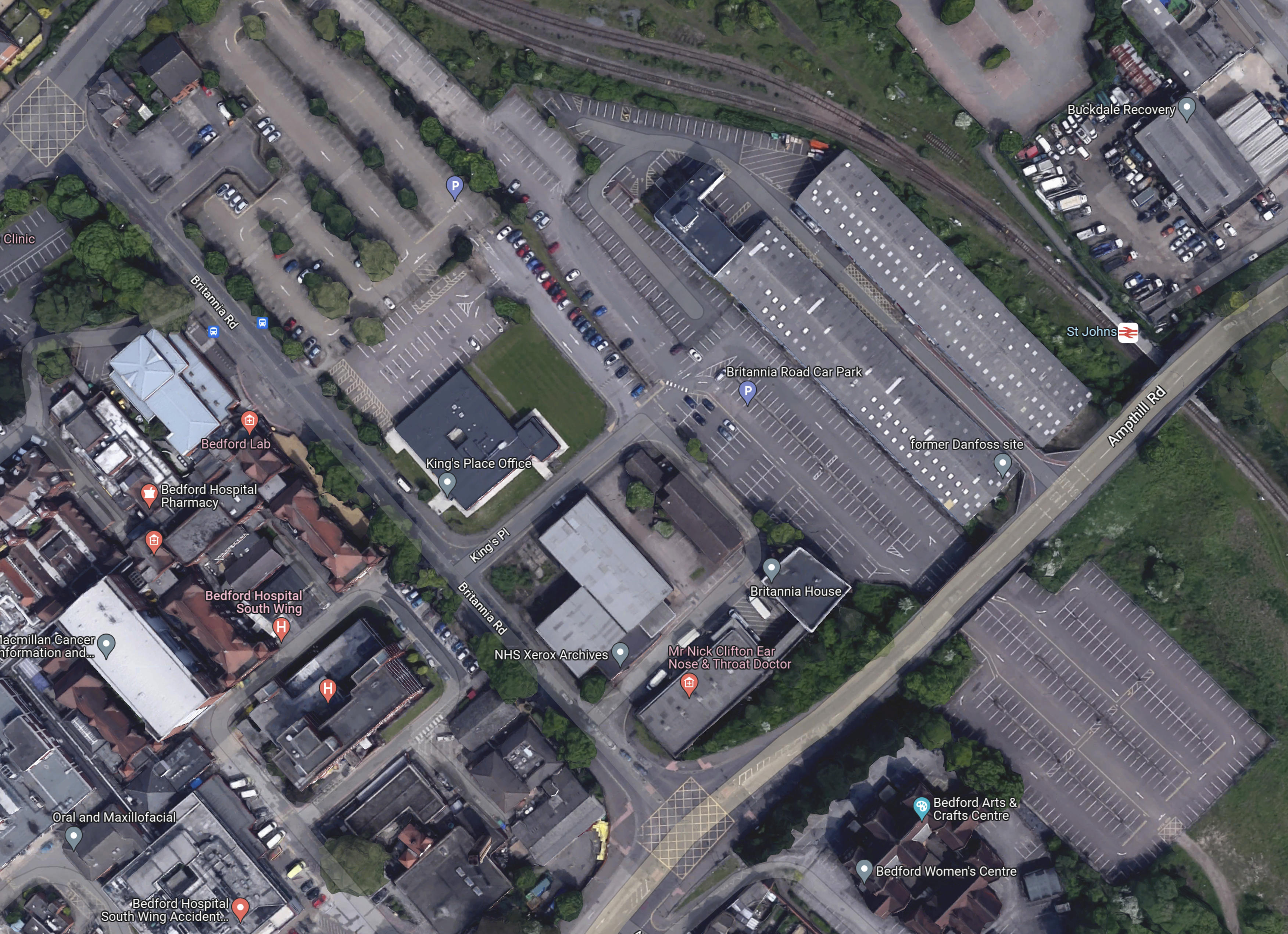
Note.
- Bedford St. Johns station towards the North-East corner of the map.
- The single-track Marston Vale Line passing through the station.
- The track becomes double track to the North of the station.
- Although not shown on the map, the Marston Vale Line becomes double track to the South of the station.
- If it was all double-track, this would surely make operation of the Marston Vale Line easier for two trains per hour (tph).
- In the South-West of the map is Bedford hospital.
The Wikipedia entry for Bedford St. Johns station, says this about the future of the station.
In March 2021, plans were unveiled which, if taken forward, would see Bedford St Johns railway station relocated as the track through the station will be realigned. In May 2023, EWRL announced that it proposes to relocate the station further north (to Kempston Road) to better serve Bedford Hospital.
That sounds sensible, as it would allow either a full two-platform step-free station or a smaller single-sided one-platform station to be built.
Over The Great Ouse
This Google Map shows the railway crossing the Great Ouse.
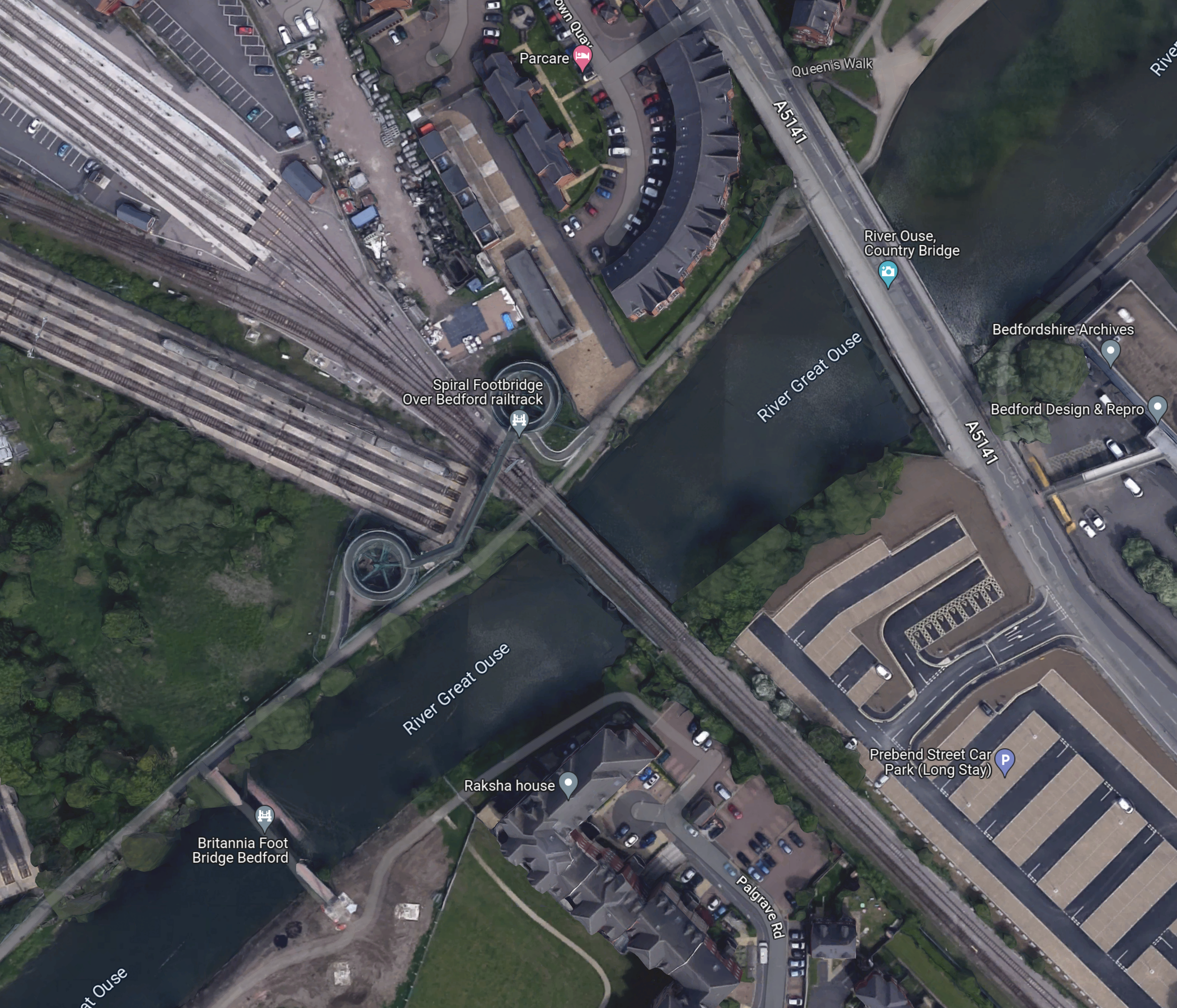
Note.
- The Marston Vale Line runs to the South -West of the long-stay car park in the South-East corner of the map.
- The Western bridge takes the line over the Great Ouse.
- It then runs between the sidings to Bedford station.
This picture, which was taken from the Spiral Footbridge on the North bank of the Ouse, shows the double-track rail bridge.
There are two tracks all the way from where the single-track divides to the North of Bedford St. Johns station.
The Southern Approaches To Bedford Station
This Google Map shows the Southern approaches to Bedford station.
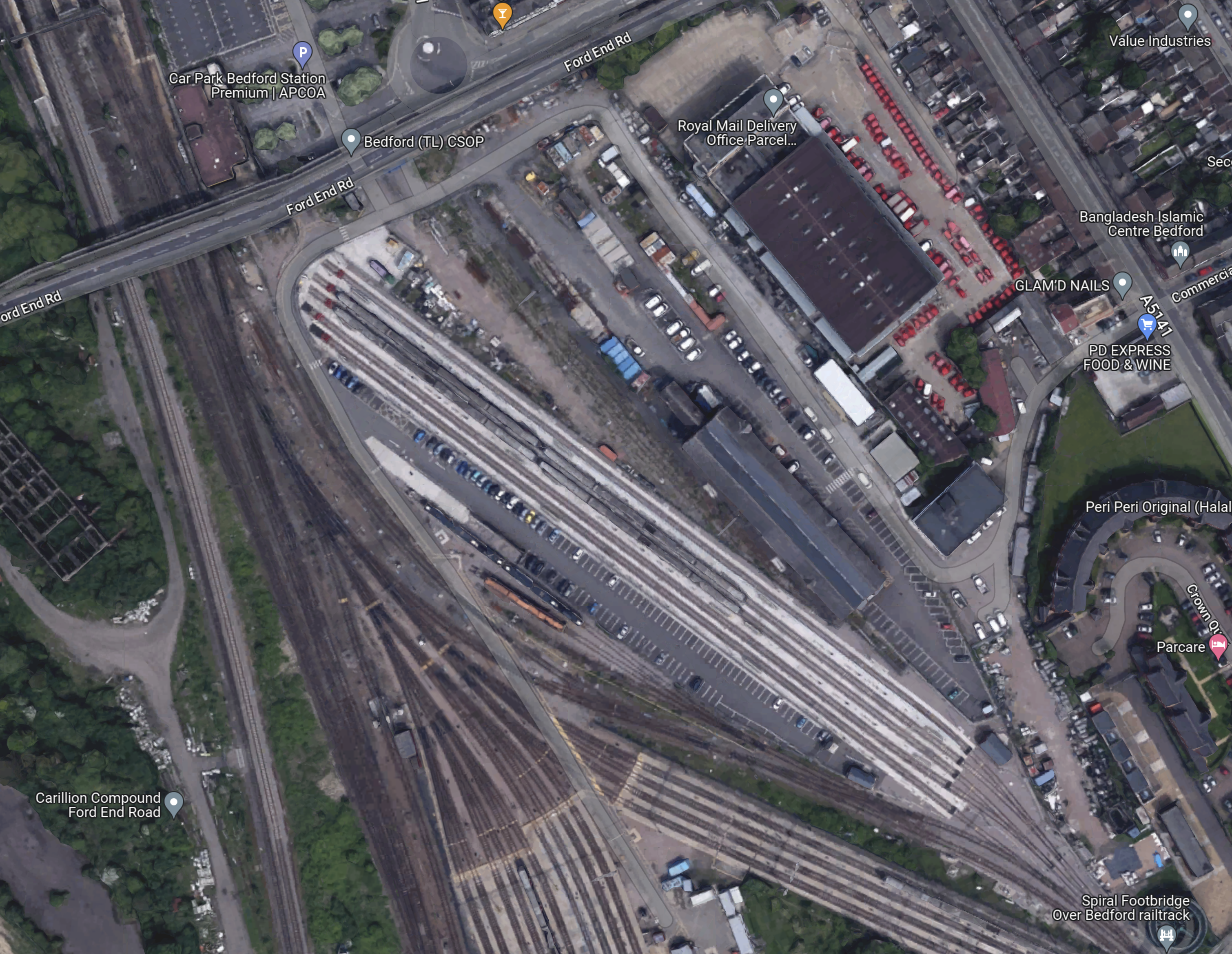
I have looked at the track layout and I’m fairly sure of the following.
- Current Marston Vale trains can go directly into Platform 1A without crossing any other tracks.
- Marston Vale trains can use Platform 1 if required.
- Thameslink trains can terminate in Platforms 1, 2 or 3.
- Southbound Corby trains can call in Platforms 1, 2 or 3.
- If they stop in Platforms 1 or 2, they appear to cross over South of Bedford station to the Midland Main Line.
If 2 tph were running on the Marston Vale Line; one fast and one stopping, a single platform should be able to handle the trains, if it was long enough.
Bedford Station
These pictures show Bedford station.

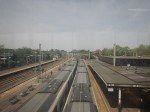
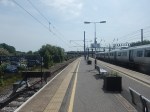
Note.
- The first two pictures were taken from the footbridge.
- The fast line between Platforms 3 and 4, is clearly visible in the second picture.
- Platform 1A is electrified.
This Google Map shows Platform 1A, where Marston Valley Line trains currently terminate.

Note.
- Platforms from the right are 1A and 1, 2 and 3 on the islands, with 4 to the left.
- Judging it against the three cars of the train in Platform 2, I reckon that Platform 1A could be updated to hold a six-car train.
Would a six-car train be long enough?
Initial East West Rail Services To Bedford
According to the Wikipedia entry for the East West Railway, these services will run on the railway between Oxford and Bedford.
- East West Railway – Oxford and Milton Keynes Central via Oxford Parkway, Bicester Village, Winslow and Bletchley – 2 tph
- East West Railway – Oxford and Bedford via Oxford Parkway, Bicester Village, Winslow, Bletchley, Woburn Sands and Ridgmont – 1 tph
- East West Railway – Aylesbury and Milton Keynes Central via Aylesbury Vale Parkway, Winslow and Bletchley – 1 tph
- West Midlands Trains – Bletchley and Bedford via Fenny Stratford, Bow Brickhill, Woburn Sands, Aspley Guise, Ridgmont, Lidlington, Millbrook, Stewartby, Kempston Hardwick and Bedford St Johns – 1 tph
Note.
- tph is trains per hour.
- There a fast train and a stopping train between Bletchley and Bedford.
- It appears that both these trains could terminate in Platform 1A at Bedford station.
I believe this will be possible with the current track layout, as the Marston Vale Line is almost all double-track.
East West Rail Services To Cambridge And Beyond
In this document on the East-West Rail Consortium web site, these services are suggested, for when the East West Rail is complete.
- An hourly train via Norwich terminating at Great Yarmouth.
- An hourly train via Ipswich terminating at Manningtree.
Would this mean three of four passenger tph on the Marston Vale Line?
If Cambridge and Oxford services, were running under digital signalling, I suspect trains could cross between the Thameslink and Marston Vale Lines, so that they could call in the through platforms at Bedford station.
How Would Trains Connect To The East At Bedford Station?
This Google Map shows the Midland Main Line through Bedform.
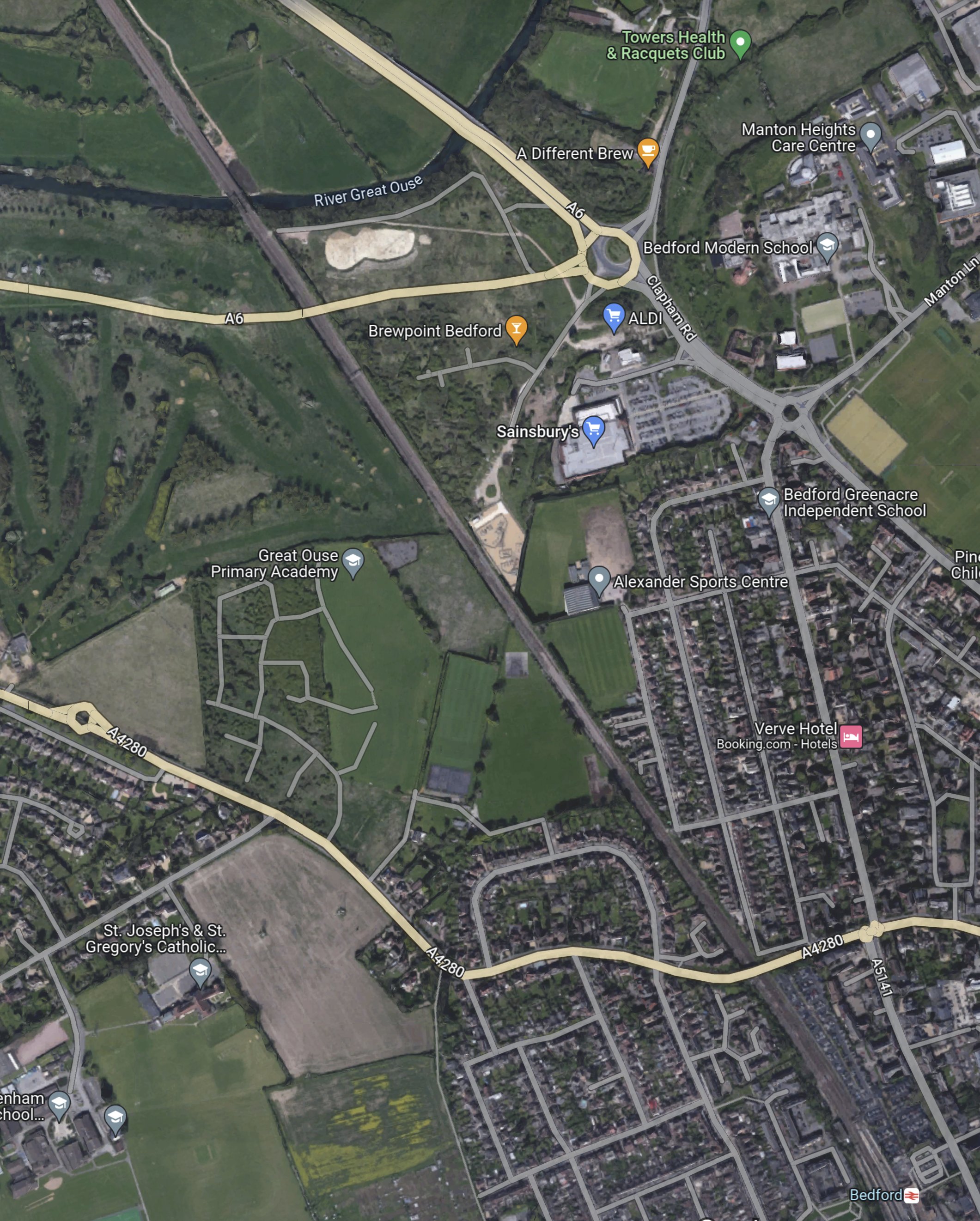
Note.
- Bedford station in the South-East corner of the map.
- The Midland Main Line runs diagonally from Bedford station across the map.
- The A6 seems to take a curious route in the North-West corner of the map, where it connects to a roundabout with an Aldi and a Sainsbury’s
This Google Map shows the countryside to the North-East of the roundabout.
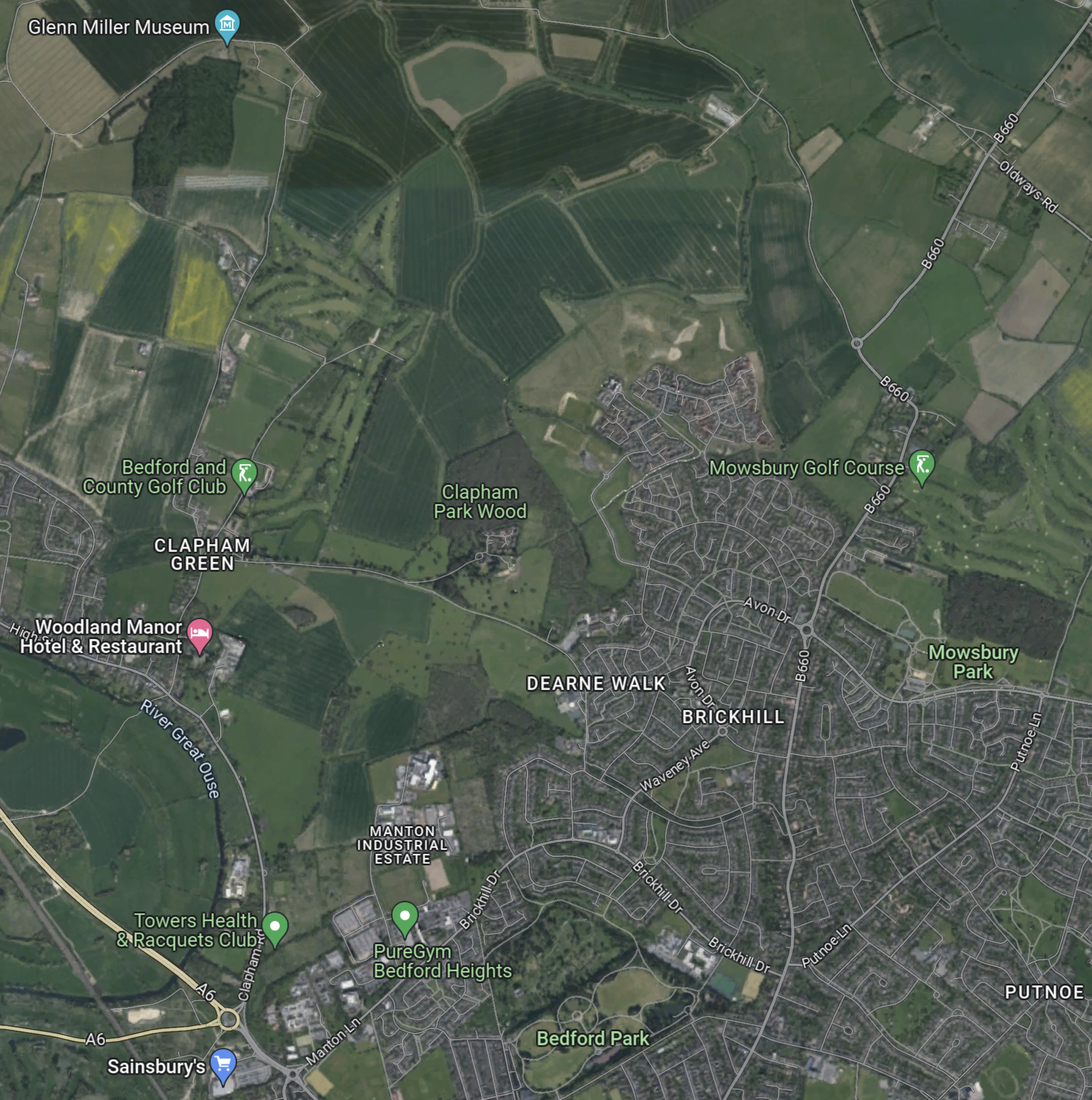
Judging by the colours of the fields to the North-East of the roundabout, I suspect, that a high proportion of the land is in one ownership.
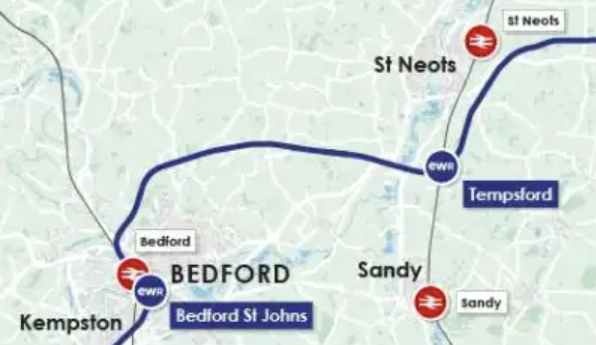
This map clipped from the East West Rail route map, shows the route between Bedford and the East Coast Main Line between St. Neots and Sandy stations.
This Google Map shows the area of the junction, that would connect the East West Rail tracks to the slow lines through Bedford station.
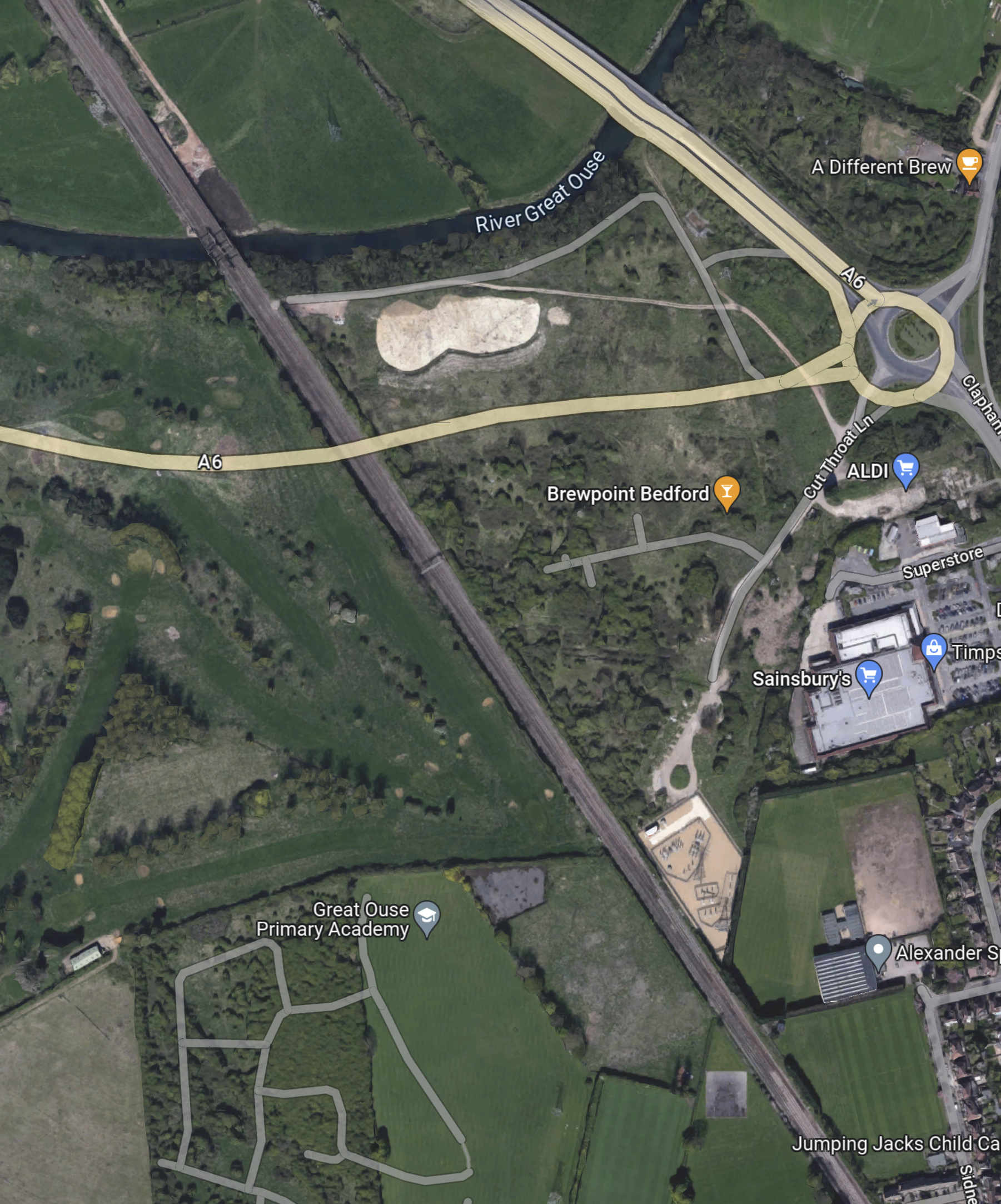
Note.
- The four-track Midland Main Line runs diagonally across the map.
- The beige-coloured diamond-shaped area by the railway is an electrical substation.
- There doesn’t appear to be many properties that would need to be demolished.
- There would need to be a viaduct over the A6.
- Once over the A6, the land seems to be in one ownership, which should ease building the railway across.
I feel it would be feasible, possibly with the use of a dive-under or flyover to connect the East West Rail tracks to the slow lines through Bedford station.
East-West Rail: Oxford And Bedford
This map from East West Rail shows the route between Oxford and Bedford.
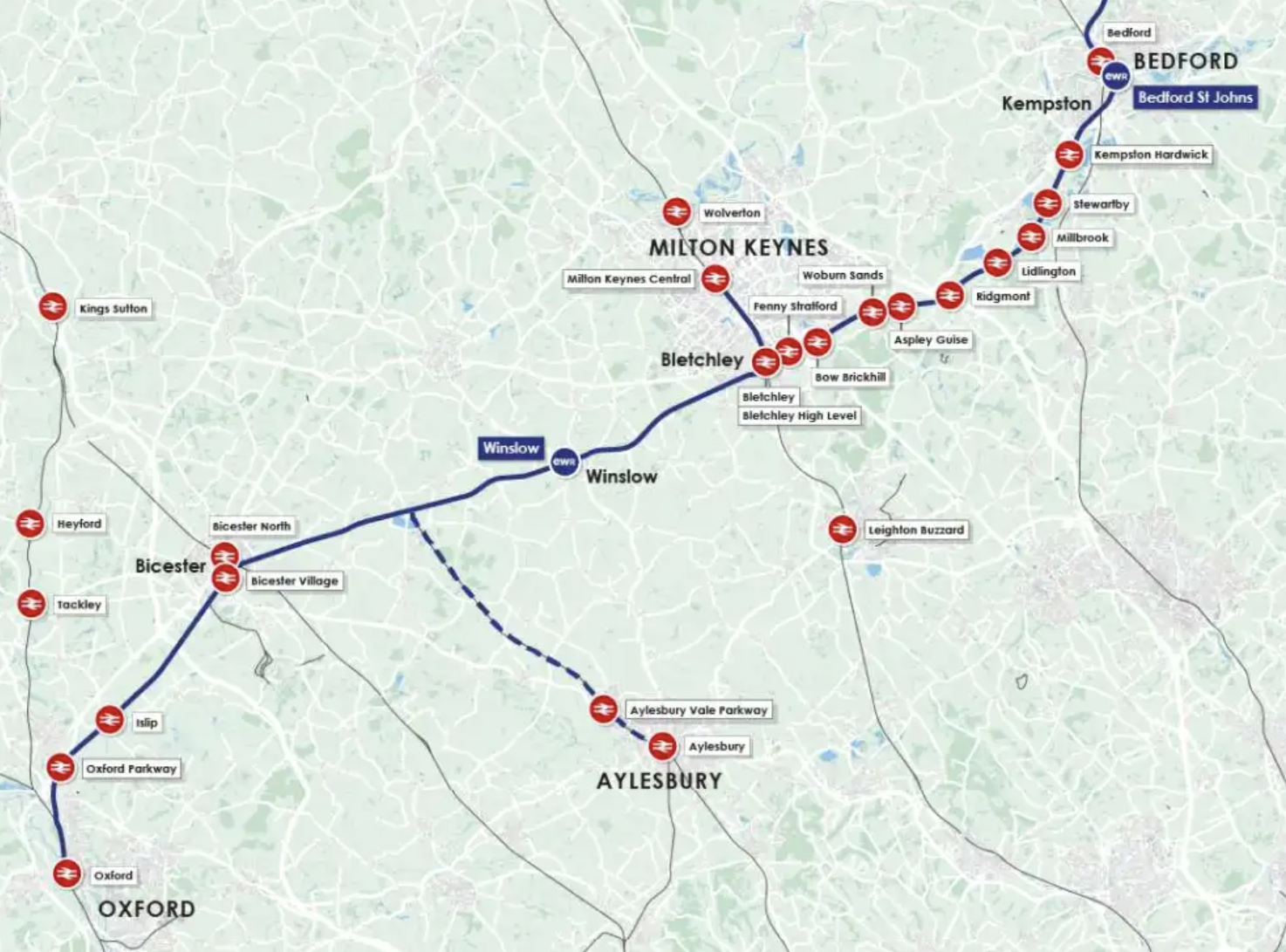
Note.
- The proposed route is shown in blue.
- The possible Southern extension to Aylesbury is shown dotted.
- The route between Bicester and Bletchley is rebuilt track along a former alignment.
- The route between Bletchley and Bedford will surely be rebuilt track along the Marston Vale Line.
- The Bicester and Bedford sections of track will be joined by the Bletchley Flyover, which is well on the way to completion.
This Google Map shows Bletchley station.

Note.
- Bletchley Station has six platforms.
- The double-track Bletchley Flyover runs North-South at the Eastern side of the station.
- There are the beginnings of two platforms on the flyover, which will increase the number of platforms at Bletchley station to eight.
- There is a junction at the Northern end of the flyover, where one pair of tracks go North to Milton Keynes Central and the other takes the Marston Vale Line to Bedford.
The track-layout at Bletchley station allows trains between Oxford and Bedford and Oxford and Milton Keynes Central to call at Bletchley station.
Proposed Passenger Trains Between Oxford and Bedford
According to the Wikipedia entry for the East West Railway, these service will run on the railway between Oxford and Bedford.
- East West Railway – Oxford and Milton Keynes Central via Oxford Parkway, Bicester Village, Winslow and Bletchley – 2 tph
- East West Railway – Oxford and Bedford via Oxford Parkway, Bicester Village, Winslow, Bletchley, Woburn Sands and Ridgmont – 1 tph
- East West Railway – Aylesbury and Milton Keynes Central via Aylesbury Vale Parkway, Winslow and Bletchley – 1 tph
- West Midlands Trains – Bletchley and Bedford via Fenny Stratford, Bow Brickhill, Woburn Sands, Aspley Guise, Ridgmont, Lidlington, Millbrook, Stewartby, Kempston Hardwick and Bedford St Johns – 1 tph
Note.
- tph is trains per hour.
- All larger stations get at least a half-hourly service.
- There are three tph between Oxford and Bletchley via Oxford Parkway, Bicester Village and Winslow.
- There a fast train and a stopping train between Bletchley and Bedford.
- It is still undecided, whether provision will be made for the Aylesbury service.
I think that this service pattern is achievable, with or without the Aylesbury service.
East-West Rail: Route For £5bn Bedford To Cambridge Link Announced
The title of this post, is the same as that of this article on the BBC.
This is the sub-heading.
The preferred route of part of £5bn railway line connecting Oxford and Cambridge has been announced.
The first two paragraphs summarise the route.
The East-West Rail (EWR) project confirmed details of the section between Bedford and Cambridge.
It will include new stations at Tempsford and Cambourne, and enter Cambridge via the south of the city.
This map from East West Rail shows the route.

Note.
- The proposed route is shown in blue.
- The possible Southern extension to Aylesbury is shown dotted.
- The Wikipedia entry for East West Rail has conflicting information, as to when trains can run between Bicester and Bedford.
These related posts describe and discuss various parts and issues of the route.
East-West Rail: Along The Marston Vale Line
East-West Rail: Aylesbury Spur
East-West Rail: Electrification
East-West Rail: Oxford And Bedford
East-West Rail: Through Bedford
East-West Rail: Bedford’s Mayoral Candidates Split On Rail Project
The title of this post, is the same as that of this article on the BBC.
This is the first sentence.
Part of the route of the controversial East-West Rail project will not be decided before we know the winner of Bedford’s mayoral elections.
Unfortunately, the four candidates for Mayor all seem to have different ideas for East-West Railway through the town.
I have a few thoughts and observations.
Thameslink
Thameslink has the following connections to the East West Railway.
- Four tph at Bedford.
- Three tph at Cambridge.
Note.
- tph is trains per hour.
- All Bedford trains terminate at Bedford.
- The half-hourly Luton Airport Express between London St. Pancras and Corby stops at Luton Airport Parkway, Luton, Bedford, Wellingborough and Kettering.
- Cambridge trains may extend to Cambridge North station.
- Cambridge has additional through services between London King’s Cross and Ely and/or King’s Lynn.
Both Bedford and Cambridge will be busy stations.
Extra Tracks At Bedford
Bedford station has four tracks; two which are generally used by Thameslink services and two main lines used by through trains.
- The fast lines must accommodate the following trains.
- East Midlands Railway – 6 tph in both directions. Two tph stop in Bedford station.
- Freight Trains – 2 tph in both directions.
- East West Railway – 2 tph in both directions. All trains will stop in Bedford station.
It strikes me, that the station may need at least one and possibly two extra tracks.
If there are extra tracks, there will need to be some demolition of houses.
Freight Trains
In Roaming Around East Anglia – Newmarket Station, I wrote this about the plans of the East West Rail Consortium in the area.
In this document on the East-West Rail Consortium web site, this is said.
Note that doubling of Warren Hill Tunnel at Newmarket and
redoubling between Coldham Lane Junction and Chippenham Junction is included
in the infrastructure requirements. It is assumed that most freight would operate
via Newmarket, with a new north chord at Coldham Lane Junction, rather than
pursuing further doubling of the route via Soham.
So would it be possible to create a double-track railway through Newmarket station?
In the related post, I came to this conclusion.
Newmarket can benefit from East West Rail, but the two parties must agree objectives that don’t cause problems for the other.
But I do think, that Newmarket will not welcome the building of a double-track railway through the town.
I do wonder, if the East West Rail Consortium plan to run freight trains between Felixstowe and South Wales and the West of England through Bedford and Oxford.
Four freight tph, through Bedford would certainly need extra tracks and the demolition of houses in the centre of Bedford.
Electrification
Two of the candidates for Bedford’s mayor, think that the line needs to be electrified.
As the route is full or partially-electrified at Didcot, Bletchley, Bedford and Cambridge, I believe that battery-electric trains could handle the route.
But then there are no plans to purchase any passenger trains of this type.
Freight trains would still need to be diesel hauled, unless more progress is made fairly quickly in the development of hydrogen-powered freight locomotives.
The Cambridge Effect
Cambridge is one of the most important cities in the world, because of its strength in innovation in high technology industries.
But Cambridge is bursting at the seams and needs more space for laboratories, advanced manufacturing and housing.
A fully-developed double-track and electrified East West Railway would open up Bletchley, Milton Keynes, Bedford, Newmarket, Bury St. Edmunds and Ipswich to act as satellites to help Cambridge build a shared and successful future.
The Felixstowe Effect
If Cambridge will stimulate the growth of passenger traffic, then Felixstowe will promote the growth of East-West freight traffic.
Conclusion
It may not be initially built that way, but probably by 2040, the East West Railway will be a fully-electrified double-track railway between Didcot and Felixstowe.
Extra tracks will also be needed through Bedford. This will mean demolition of houses.
Could An Oxford And Cambridge Service Be Run Via The Lizzie Line?
This article on the BBC is entitled East-West Rail: Part Of £5bn Scheme ‘Appears To Be Unachievable’.
These are the first four paragraphs.
A £5bn rail project “appears to be unachievable” in parts, a government report said.
The East-West Rail scheme will create a link from Oxford to Cambridge, with services being introduced in stages.
Stage two, between Oxford and Bedford, and stage three, between Bedford and Cambridge, have “major issues”, the Infrastructure and Projects Authority said.
A spokesman for East-West Rail said the delivery programme was “under review”.
As someone, who used to live near Cambridge, I have seen the transport routes improve in East Anglia, but not the area’s connections to the rest of the country.
The article describes Stage 2 and 3 of the East West Railway like this.
Stage two involves predominantly upgrading existing infrastructure, between Bletchley and Bedford, to allow services between Oxford and Bedford.
Stage three involves building a new line, between Bedford and Cambridge, to extend the railway and facilitate services from Oxford to Cambridge.
So if the Government feel that the major issues and opposition should lead to cancellation of the scheme to the East of Bedford or even Bletchley, what are the problems and alternatives?
Freight
The Port of Felixstowe is the UK’s busiest container port and it handles 48% of Britain’s containerised trade.
Having lived as a teenager in Felixstowe and in Suffolk for probably half my life, there is only one certainty about the port in my mind. It will get bigger and will generate more rail and road traffic in East Anglia.
- The roads have improved greatly, since the 1960s, when I used to cycle between Ipswich and Felixstowe, along a two-lane single carriageway road.
- The renamed A14 has replaced the A45 and now connects the port to the M1 and the M6.
- Tens of long freight trains every day now connect Felixstowe with the rest of the country.
- The East West Railway will be a very useful link between Felixstowe and South Wales and the West of England.
- Global warming will mean the decarbonisation of heavy freight, with more traffic on an electrified railway.
Felixstowe’s connections to the North and Midlands may have improved greatly, but they will need to be improved a lot more.
The Port of Southampton is the UK’s second busiest container port.
- Most freight trains from Southampton go North via Basingstoke, Reading and Oxford.
- A plan some years ago was for an Electric Spine, that would have connected the Port of Southampton to the Northern cities.
- The Electric Spine would have envisaged electrification of the East West Railway to the West of Bedford and electrified connections with the West Coast Main Line and the Midland Main Line.
- The Midland Main Line is now planned to be fully electrified, under the the Integrated Rail Plan for the North and Midlands.
Southampton, like Felixstowe will be in need of improved transport connections.
In an ideal world, an electrified East West Railway, would improve freight connections between the UK’s two busiest container ports and major cities in the UK.
Problems With Freight
Could this be the major problem East of Bletchley, where the residents living along the route, don’t want to see large numbers of freight trains running close by?
In this document on the East-West Rail Consortium web site, this is said.
Note that doubling of Warren Hill Tunnel at Newmarket and
redoubling between Coldham Lane Junction and Chippenham Junction is included
in the infrastructure requirements. It is assumed that most freight would operate
via Newmarket, with a new north chord at Coldham Lane Junction, rather than
pursuing further doubling of the route via Soham.
Will the residents of Newmarket object to a double-track freight railway through the town? Freight trains and horses are not a good mix.
I do wonder, if freight trains hauled by noisy and unfriendly diesel locomotives are one of the reasons a full Oxford and Cambridge railway is losing its appeal and becoming a vote loser for the Government.
Cambridge Has An Accommodation And Commuting Problem
There is a shortage of accommodation in Cambridge for offices, laboratories, workshop and above all workers.
So it looks to the surrounding towns and cities to provide help.
London and Ely have good links, but the city needs better links to Bedford, Bury St. Edmunds, Haverhill, Ipswich, Norwich, Kings Lynn, Peterborough, Soham, Stansted Airport, Stevenage, Sudbury and Thetford.
Cambridge may be the place in the South East with the largest numbers of commuters from London.
Cambridge Needs A Decent Rail Network
In my view Cambridge needs at least the following services in trains per hour (tph)
- Colchester via Haverhill, Sudbury and Marks Tey – 2 tph
- Ipswich via Newmarket, A14 Parkway, Bury St. Edmunds, Stowmarket and Needham Market – 2 tph
- King’s Lynn via Cambridge North, Ely and Downham Market – 2 tph
- Oxford via Bedford, Milton Keynes/Bletchley and Bicester – 2 tph
- London King’s Cross via Cambridge South – 2 tph
- Norwich via Cambridge North, Ely, Thetford, Attleborough and Wymondham – 2 tph
- Peterborough via Cambridge North, Ely and March – 2 tph
- Stansted Airport via Cambridge South and Audley End – 2 tph
- Stevenage via Royston and Hitchin – 2 tph
- Wisbech via Cambridge North, Ely and March – 2 tph
Note.
- Some services already exist.
- Some of these services duplicate each other to give 4 tph or even 6 tph on certain routes.
- Some services could be back-to-back through Cambridge.
- A 14 Parkway station is a new station proposed by the East West Railway. I wrote about it in detail in Soham Station – 14th December 2021.
- Haverhill would be served by a rebuilt Stour Valley Railway.
- Wisbech would be served by restoring the railway to March.
To complete the network there would be a two tph service between Peterborough and Ipswich, which would go via March, Ely, Soham, A 14 Parkway, Bury St. Edmunds, Stowmarket and Needham Market.
Oxford Could Probably Argue that It Needs A Decent Rail Network Like Cambridge
Oxford would argue this and they have a point.
The East West Railway Is The Odd Line Out
Looking at the rail networks at Cambridge and Oxford, it appears, that with the exception of Cotswold services at Oxford and a few CrossCountry services, it appears that the East West Railway is a bit of an odd line out, as everything else is a local service.
The Effects Of Not Building The Bedford And Cambridge Section Of The East-West Railway
What will it mean, if the Bedford and Cambridge Section of The East-West Railway is not built?
- Cambourne will not get the promised station.
- Bedford and Cambridge journeys will be by bus, train via London or private car.
- Commuting into Cambridge from the West will be difficult.
- Milton Keynes and Cambridge journeys will be by bus, train via London or private car.
- Oxford and Cambridge journeys will be by bus, train via London or private car.
- Train journeys between Cambridge and much of the rest of the UK, will need to go via London.
It would appear that by not building the third section of the East West Railway, a lot of potential passengers will be denied a rail service.
Could Services Be Run Using Existing Infrastructure Through London?
The Elizabeth Line will eventually be able to handle a lot more services than it does at present.
Would Extending The Elizabeth Line To Oxford Be A Good Start?
Consider.
- Oxford has two services to London; Chiltern to Marylebone and Great Western Railway (GWR) to Paddington.
- The GWR service to Paddington stops only at Reading and Slough, has a frequency of two tph and takes under an hour.
- The fastest journey between Oxford and Liverpool Street using a fast GWR train and the Elizabeth Line takes one hour and 20 minutes.
- Only 10.6 miles of the route between Oxford and Paddington is without electrification.
- There is also a two tph stopping shuttle train between Oxford and Didcot Parkway stations and a two tph stopping train between Paddington and Didcot Parkway.
I feel that combining the two Didcot Parkway services and moving them to the Elizabeth Line would be an experiment worth trying.
This would give 2 tph direct to the following stations.
- Bond Street for the West End
- Canary Wharf for finance.
- Farringdon for Cambridge, Gatwick and Brighton.
- Hayes & Harlington for Heathrow.
- Liverpool Street for the City of London, Cambridge and Stansted
- Reading for Wales and the West.
Note.
- No-one would have a worse service than currently, but many passengers would avoid a change on their journey.
- Services could terminate at either Abbey Wood or Shenfield stations.
- Services could be an extension of the two tph to Reading or additional services.
- Between Didcot Parkway and Oxford is shown on OpenRailwayMap, as proposed for electrification.
- There may need to be some new platforms at Didcot Parkway station.
- I estimate that between Oxford and Liverpool Street would take one hour and fifty minutes.
It certainly looks, that it would be possible to replace the current GWR service between Oxford and Paddington, with an all-electric Elizabeth Line service.
The direct stopping service between Oxford and Liverpool Street would be thirty minutes slower, than the current fastest train.
The current fastest train between Liverpool Street and Cambridge takes 71 minutes, so with a change at Liverpool Street Oxford and Cambridge would probably be just over three hours.
Google Maps estimate a driving time of two hours between the two University Cities.
Could The Elizabeth Line Be Extended To Cambridge?
There is no train connection between the Elizabeth Line and the West Anglia Main Line at Liverpool Street station, although the walk for passengers is not that long.
In Extending The Elizabeth Line – Connecting West Anglia Main Line Services To The Central Tunnel, I describe how it could be possible to connect the West Anglia Main Line to the Elizabeth Line at Stratford station.
This connection would allow services from Cambridge, Harlow and Stansted to anywhere on the Elizabeth Line to the West of Stratford.
Oxford and Cambridge and Heathrow and Stansted would be distinct possibilities.
Could A High Speed Limited Stop Service Run Between Oxford And Cambridge?
In Extending The Elizabeth Line – High Speed Trains On The Elizabeth Line, I proposed running faster long-distance trains through the Central Tunnel of the Elizabeth Line.
- They would have to be dimensionally identical to the Class 345 trains to fit the platform edge doors.
- They would have a long-distance interiors.
- In the Central Tunnel, they would behave like 345 trains. with Paddington to Stratford taking 19 minutes.
- But on main lines like the Great Western Main Line, they could rattle along at 125 mph.
If the trains could keep up with Class 802 train performance between Oxford and Paddington and enter the Central Tunnel quickly, these times could be possible.
- Oxford and Paddington – 55 minutes
- Paddington and Stratford – 19 minutes
- Stratford and Tottenham Hale – 14 minutes
- Tottenham Hale and Cambridge – 65 minutes
Just over two-and-a-half hours, without a change of train, sounds fine to me.
What About The Trains From Great Malvern?
The fast services between Paddington and Oxford, run twice an hour, with the service formed of one hourly Paddington and Oxford service and another hourly Paddington and Great Malvern service.
- If Oxford gets electrified soon, this will mean that the Oxford and Paddington service would be all-electric.
- But the Great Malvern service would need to be able to handle 65.5 miles of line without electrification each way.
- The speed limits between Oxford and Great Malvern vary between 70 and 100 mph.
I’m certain that Stadler could design and build a train, with the following characteristics.
- Class 345 dimensions.
- 125 mph performance.
- Ninety miles range on battery power.
The trains would be charged between Paddington and Oxford and by a charger at Great Malvern.
Conclusion
Would an Oxford and Cambridge service through Central London be an alternative to the East-West Railway?
Perhaps not an alternative, but an addition?
The New Winslow Station Site
This Google Map shows the site of the new Winslow station, on the East West Railway.
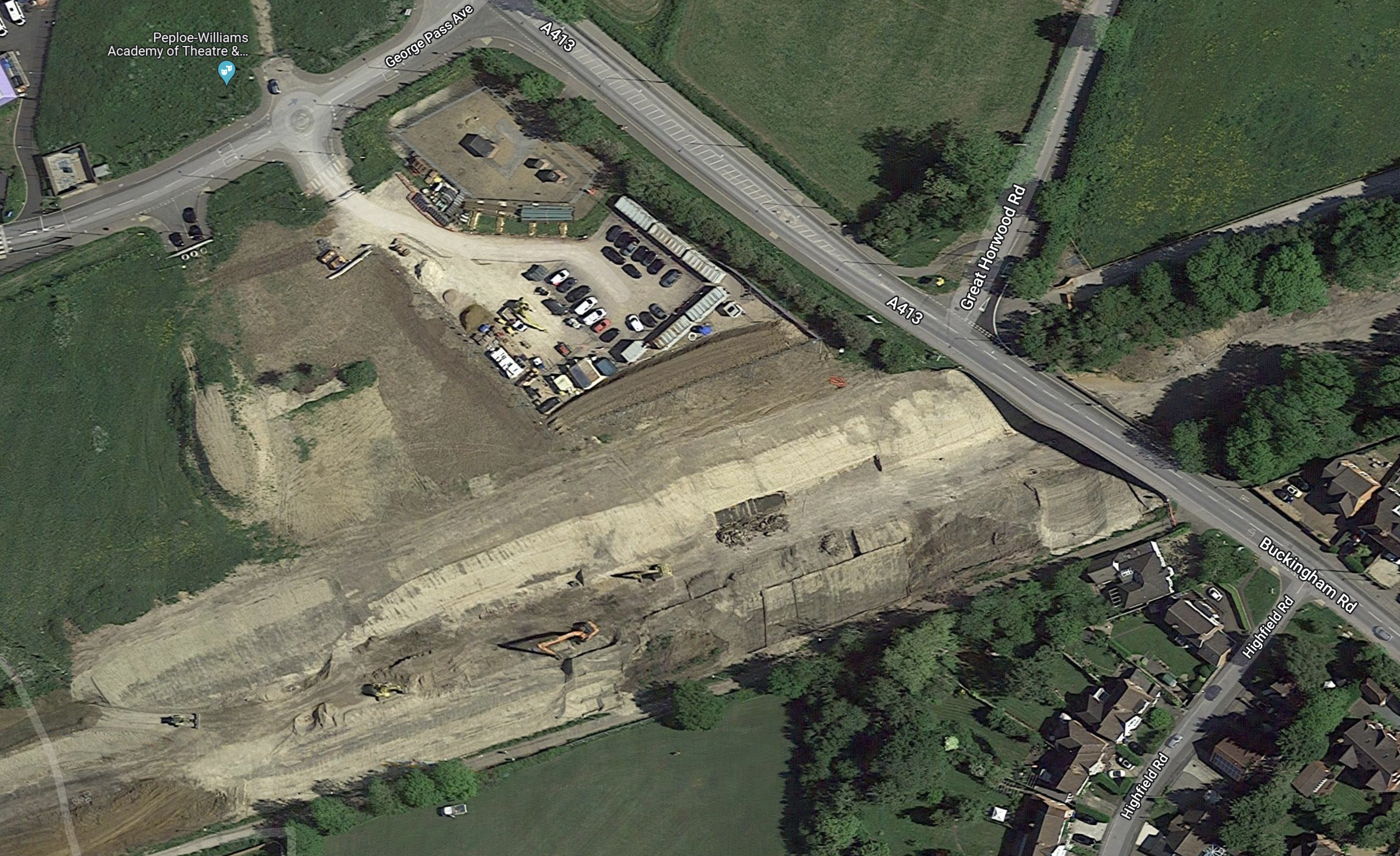
Note.
- The line from north of Wolvercote Tunnel (just north of Oxford) through Bicester to Bletchley would be enabled for 100 mph (160 km/h) double-track running.
- There will be two platforms at Winslow station.
- The station is planned to open in 2024.
Services at the station are likely to be.
- Two tph – Oxford and Milton Keynes via Oxford Parkway, Bicester Village, Winslow and Bletchley
- One tph – Oxford and Bedford via Oxford Parkway, Bicester Village, Winslow, Bletchley, Woburn Sands and Ridgmont
Note.
- tph is trains per hour.
- It appears the current Bedford and Bletchley service will continue.
It looks like the one tph service between Aylesbury and Milton Keynes via Aylesbury Vale Parkway, Winslow, Bletchley has been deferred indefinitely.
Consider.
- Building a single track railway between Aylesbury Vale Parkway station and Claydon Junction on the East West Railway can’t be that challenging or expensive.
- A single track railway should be able to handle the required train service of up to two tph at Aylesbury Vale Parkway station and occasional freight trains.
It doesn’t look too difficult or costly. So why? The only valid reason I can think of is that High Speed Two doesn’t want it for some reason.
Thoughts On Faster Trains On Thameslink
The Class 700 trains used by Thameslink only have an operating speed of 100 mph.
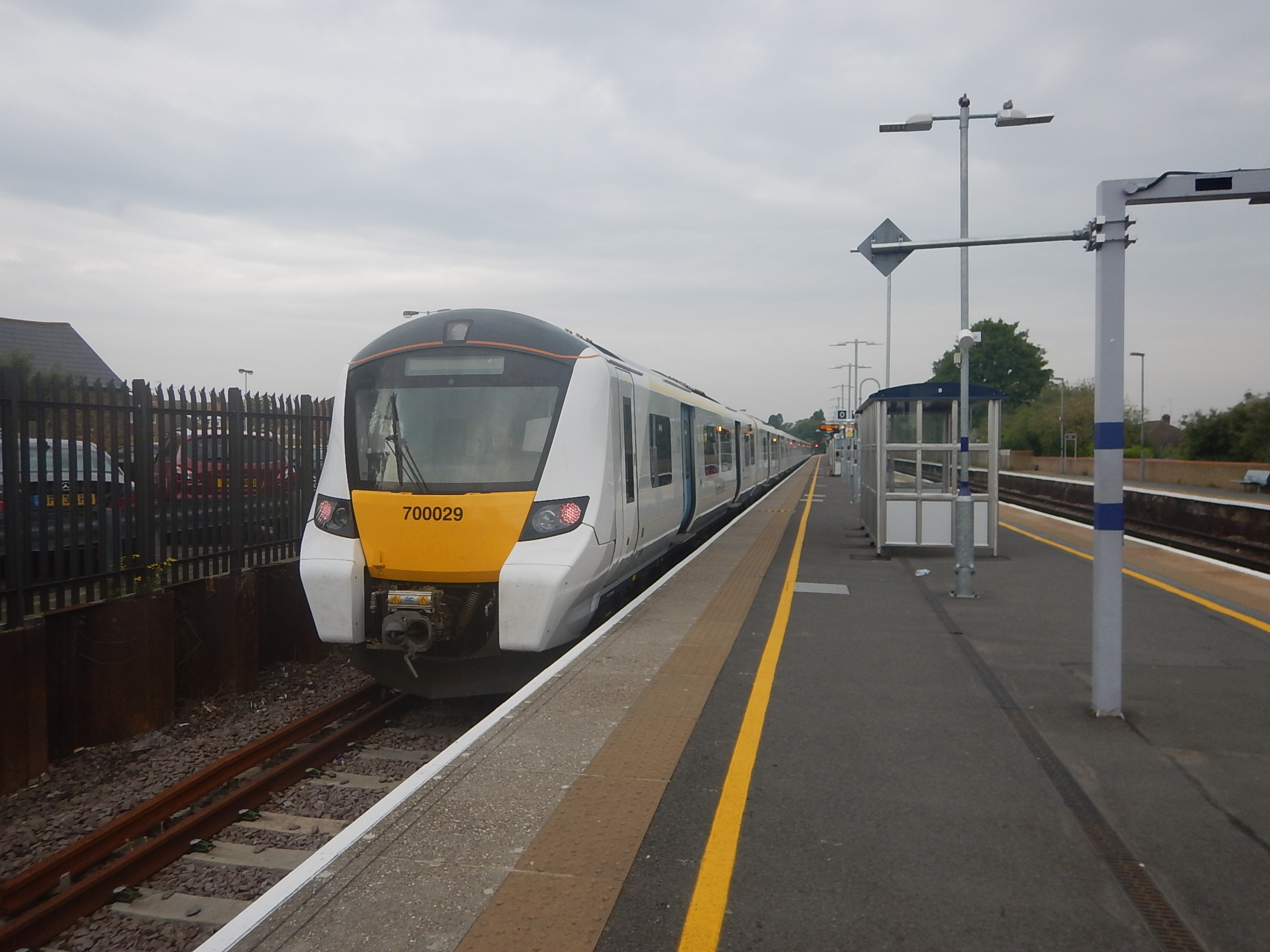
I do wonder, if that is a fast enough operating speed for all Thameslink routes.
Sharing The Midland Main Line With 125 mph Trains
A couple of years ago, I travelled back into St. Pancras with a group of East Midlands drivers in a Class 222 train.
They told me several things about the route including that the bridge at the South of Leicester station would be difficult to electrify, as it was low and the track couldn’t be lowered as one of Leicester’s main sewers was under the tracks at the bridge. Perhaps, this is one place, where discontinuous electrification could be used on the Midland Main Line.
They also told me, that sometimes the Thameslink trains were a nuisance, as because of their 100 mph operating speed, the 125 mph Class 222 trains had to slow to 100 mph.
Upgrading Of The Midland Main Line South Of Bedford
The electrification of the Midland Main Line South of Bedford is being updated, so that it is suitable for 125 mph running.
An Analysis Of Services On The Midland Main Line South Of Bedford
The current Class 222 trains are capable of 125 mph and will be replaced by Class 810 trains capable of the same speed on both diesel and electricity.
Currently, a Class 222 train is capable of doing the following on a typical non-stop run between St. Pancras and Leicester.
- Covering the 30 miles between St. Albans and Bedford in 17 minutes at an average speed of 106 mph.
- Covering the 50.3 miles between Bedford and Leicester in 30 minutes at an average speed of 100.6 mph.
- Maintaining 125 mph for long stretches of the route, once the trains is North of London commuter traffic at St. Albans
I can estimate the timings on the 79.2 miles between Leicester and St. Albans, by assuming the train runs at a constant speed.
- 100 mph – 47.5 minutes
- 110 mph – 43.2 minutes
- 125 mph – 38 minutes
- 140 mph – 34 minutes
Note.
- I have done the calculation for 140 mph, as that is the maximum operating speed of the Class 810 train with full in-cab digital signalling.
- Trains have been running at 125 mph for a couple of decades on the Midland Main Line.
- To get a St. Pancras and Leicester time add another 14 minutes, which is the current time between St. Pancras and St. Albans of a Class 222 train.
- Some Off Peak trains are timed at 62-63 minutes between St. Pancras and Leicester.
- A time of under an hour between St. Pancras and Leicester might be possible and the Marketing Department would like it.
- As Thameslink trains between Bedford and St. Albans stop regularly, they are on the slow lines of the four-track railway, to the North of St. Albans.
- South of St. Albans, Thameslink trains often run on the fast lines.
I can expect that East Midlands Railway will want to be running their new Class 810 trains as far as far South as they can at 125 mph, to speed up their services. When the signalling allows it, they’ll want to run at 140 mph.
So they won’t want to see Thameslink’s slow trains on the fast lines.
- But if you look at the Thameslink trains that do run on the fast lines between St. Albans and St. Pancras, they appear to be the four trains per hour (tph) that run to and from Bedford.
- Of these trains, two tph terminate at Brighton and two tph terminate at Gatwick Airport.
- The average speed of a Class 222 train between St. Albans and St. Pancras assuming 14 minutes for the 19.7 miles is 84.4 mph.
So it looks to me that a 100 mph Thameslink train could be able to get away without slowing the East Midland Railway expresses.
But then that is not surprising, as for many years, the Class 222 trains worked happily with 100 mph Class 319 trains.
Is There Scope For Extra And Faster Services Into St. Pancras?
I have only done a simple calculation, but I do wonder if there is scope for the following.
- Increasing the frequency of trains for both Thameslink and East Midlands Railway.
- Saving a few minutes on East Midlands Railway services.
Consider.
- The new Class 810 electric trains will probably have better acceleration and deceleration than the current Class 222 diesel trains, when working using electric power.
- East Midlands Railway is introducing Class 360 trains that were built as 100 mph trains by Siemens, who are now upgrading them to 110 mph trains.
- Can Siemens do the same for the Class 700 trains and create a sub-fleet capable of 110 mph running?
- All trains will be running under full in-cab digital signalling with a large degree of automatic train control.
I feel that if the Class 700 trains had the extra speed, they would make the planning of services South of St. Albans easier and allow the Class 810 trains to both run faster and provide more services.
Sharing The East Coast Main Line With 125 mph Trains
The following Thameslink services run up the East Coast Main Line past Stevenage.
- Cambridge And Brighton – Two tph – Stops at Royston, Ashwell and Morden (1 tph), Baldock, Letchworth Garden City, Hitchin, Stevenage, Finsbury Park, London St Pancras International, Farringdon, City Thameslink, London Blackfriars, London Bridge, East Croydon, Gatwick Airport, Three Bridges, Balcombe, Haywards Heath and Burgess Hill
- Cambridge and Kings Cross – Two tph – Stops at Foxton, Shepreth, Meldreth, Royston, Ashwell and Morden, Baldock, Letchworth Garden City, Hitchin, Stevenage, Knebworth, Welwyn North, Welwyn Garden City, Hatfield, Potters Bar and Finsbury Park
- Peterborough and Horsham – Two tph – Stops at Huntingdon, St Neots, Sandy, Biggleswade, Arlesey, Hitchin, Stevenage, Finsbury Park, London St Pancras International, Farringdon, City Thameslink, London Blackfriars, London Bridge, East Croydon, Coulsdon South, Merstham, Redhill, Horley, Gatwick Airport, Three Bridges, Crawley, Ifield, Faygate (limited) and Littlehaven
Note.
- Services are generally run by Class 700 trains, although lately the Kings Cross service seems to use Class 387 trains, which have a maximum speed of 110 mph and a more comfortable interior with tables.
- It is intended that the Cambridge and Kings Cross service will be extended to Maidstone East by 2021.
In addition there are two Cambridge Express and Fen Line services.
- Kings Cross and Ely – One tph – Stops at Cambridge and Cambridge North.
- Kings Cross and King’s Lynn – One tph – Stops at Cambridge, Cambridge North, Waterbeach, Ely, Littleport, Downham Market and Watlington
Note.
- These services are generally run by Class 387 trains.
- Cambridge and King’s Cross is timetabled at around fifty minutes.
Adding all of this together means that slower services on the East Coast Main Line are comprised of the following in both directions.
- Three tph – 110 mph – Class 387 trains
- Four tph – 100 mph – Class 700 trains
These seven trains will have to be fitted in with the 125 mph trains running services on the East Coast Main Line, for LNER, Grand Central, Hull Trains and East Coast Trains.
There are also the following problems.
- All trains must navigate the double-track section of the East Coast Main Line over the Digswell Viaduct and through Welwyn North station.
- The King’s Cross and Cambridge service stops in Welwyn North station.
- Full in-cab digital signalling is being installed on the East Coast Main Line, which could increase the speed of the expresses through the double-track section.
Could the introduction of the Class 387 trains on the Cambridge and King’s Cross service have been made, as it easier to fit in all the services if this one is run by a 110 mph train?
However, the full in-cab digital signalling with a degree of automatic train control could be the solution to this bottleneck on the East Coast Main Line.
- Trains could be controlled automatically and with great precision between perhaps Hatfield and Stevenage.
- Some expresses might be slowed to create gaps for the Cambridge and Peterborough services.
- The Hertford Loop Line is also getting full in-cab digital signalling, so will some services be sent that way?
In Call For ETCS On King’s Lynn Route, I talked about a proposal to improve services on the Fen Line. This was my first three paragraphs.
The title of this post, is the same as that on an article in Edition 849 of Rail Magazine.
The article is based on this document on the Fen Line Users Aoociation web site, which is entitled Joint Response To Draft East Coast Main Line Route Study.
In addition to ETCS, which could improve capacity on the East Coast Main Line, they would also like to see journey time reductions using trains capable of running at 125 mph or faster on the King’s Lynn to Kings Cross route.
My scheduling experience tells me that a better solution will be found, if all resources are similar.
Hence the proposal to run 125 mph trains between King’s Cross and King’s Lynn and probably Ely as well, could be a very good and logical idea.
If the Class 700 trains were increased in speed to 110 mph, the trains through the double-track section of the East Coast Main Line would be.
- One tph – 110 mph – Class 387 trains
- Four tph – 110 mph – Class 700 trains
- Two tph – 125 mph – New trains
Note.
- This would probably be an easier mix of trains to digest with the high speed services, through the double-track section.
- I like the idea of extending the Ely service to Norwich to give Thetford, Attleborough and Wymondham an improved service to London, Cambridge and Norwich.
The new trains would probably be a version of Hitachi’s Regional Battery Train.
- It would need to be capable of 125 mph on the East Coast Main Line.
- If the Ely service were to be extended to Norwich, this section would be on battery power.
There are certainly a lot of possibilities.
But as with on the Midland Main Line, it looks like for efficient operation, the operating speed of the Class 700 trains on the route needs to be increased to at least 110 mph.
Could Faster Class 700 trains Improve Services To Brighton?
These are the Thameslink services that serve Bedford, Cambridge and Peterborough, that I believe could be run more efficiently with trains capable of at running at speeds of at least 110 mph.
- Bedford and Brighton – Two tph
- Bedford and Gatwick Airport – Two tph
- Cambridge and Brighton – Two tph
- Cambridge and Maidstone East – Two tph
- Peterborough and Horsham – Two tph
Note.
- I have assumed that the Cambridge and King’s Cross service has been extended to Maidstone East as planned.
- Eight tph serve Gatwick Airport.
- Four tph serve Brighton.
The Gatwick Express services have a frequency of two tph between London Victoria and Brighton calling at Gatwick Airport is already run by 110 mph Class 387 trains.
It would appear that if the Bedford, Cambridge and Peterborough were run by uprated 110 mph Class 700 trains, then this would mean that more 110 mph trains would be running to Gatwick and Brighton and this must surely improve the service to the South Coast.
But it’s not quite as simple as that, as the Cambridge and Maidstone East services will be run by eight-car trains and all the other services by twelve-car trains.
Conclusion
There would appear to be advantages in uprating some or possibly all of the Class 700 trains, so that they can run at 110 mph, as it will increase capacity on the Brighton Main Line, East Coast Main Line and Midland Main Line.
East West Railway Company To Start Second Phase Of Rolling Stock Procurement
The title of this post, is the same as that of this press release from East West Rail.
These are the three introductory paragraphs.
East West Railway Company (EWR Co) is to restart market engagement with potential train suppliers, as its rolling stock procurement process enters a new phase.
The move follows an initial phase of procurement activity, which EWR Co concluded earlier in the year. A new PIN Notice has been published today to restart engagement with potential suppliers, which includes a set of technical specifications taking account of feedback from the market gained during the initial procurement phase.
This procurement aims to secure a short-term, interim solution to leasing a small fleet of self-powered trains for the Western Section of East West Rail.
The press release has a link to the Prior Information Notice or PIN Notice on the EU database.
along with all the usual contact and other details, this is said about the specification.
The East West Railway Company (EWR Co.) is looking to leasing a fleet of 12 or 14 x 3 car self-powered units with modifications including European Train Control System (‘ETCS’) Level 2 and Driver Controlled Operation (‘DCO’) capability, supported by a full maintenance package (under a ‘wet’ lease). These units will ensure timely operation of EWR’s Western Section Phase 2 between Oxford, Milton Keynes, Bedford and Aylesbury. The lease duration would be 4 years, with an option to extend for 2 years.
The date of the notice is the 10th of November 2020, so it has been recently updated.
I commented on these trains in March 2020, when I wrote EWR Targets Short-Term Fleet Ahead Of Possible Electrification.
In the intervening eight months, a lot have things have happened.
Awareness Of Green Issues
The Covid-19 pandemic has arrived, with all its ferocity and seems to be moving people in the direction of thinking about green issues and zero-carbon transport.
Type “build back greener UK” into Google and you get lots of articles. Some feature Boris Johnson, like this article on Business Green, which is entitled Boris Johnson To Pledge To ‘Build Back Greener’.
I don’t think the public, myriad engineers and scientists and a good selection of politicians will find it appropriate for the East West Railway to use any rolling stock, that is not zero-carbon and powered by renewable energy.
Hitachi Have Launched The Regional Battery Train In Conjunction With Hyperdrive Innovation
In July 2020, I wrote Hyperdrive Innovation And Hitachi Rail To Develop Battery Tech For Trains.
Hitachi had been talking for some time, that they were developing battery electric trains for the UK, but this was the first news of a route to their design, manufacture and into service.
Hitachi also published this YouTube video and this infographic of the train’s specification.

They have also called the train, the Hitachi Regional Battery Train.
- It has a range of 90 kilometres or 56 miles.
- It is fitted with a pantograph for running on 25 KVAC overhead electrification.
- It can run at up to 100 mph on batteries.
- Three-car Class 385 trains can be fitted with batteries, as I wrote about in Hitachi Plans To Run ScotRail Class 385 EMUs Beyond The Wires, which was written in April 2019.
My estimate is that Oxford and Bedford are under fifty miles apart, so if Hitachi’s train could be charged at both ends of the route, one of their trains could provide a self-powered service between Oxford and Bedford.
It seems that Hitachi have an off-the-shelf train, that fits the specification for the trains required by East West Railway.
Vivarail Have Launched A Fast Charge System
Battery electric trains, like electric vehicles are not much use, if you can’t charge them when it is needed.
The initial Service Pattern of the East West Railway is given in the Wikipedia entry of the East West Railway.
- Two trains per hour (tph) – Oxford and Milton Keynes Central via Oxford Parkway, Bicester Village, Winslow and Bletchley.
- One tph – Oxford and Milton Keynes via Oxford Parkway, Bicester Village, Winslow, Bletchley, Woburn Sands and Ridgemont.
- One tph – Aylesbury and Milton Keynes Central via Aylesbury Vale Parkway, Winslow and Bletchley.
There are four terminal stations.
- Aylesbury – No electrification
- Bedford – Full Electrification
- Milton Keynes Central – Full Electrification
- Oxford – No electrification
The existing electrification could be used at Bedford and Milton Keynes Central, whereas some type of charging system, would be needed at Aylesbury and Oxford.
It appears that Adrian Shooter of Vivarail has just announced a One-Size-Fits-All Fast Charge system, that has been given interim approval by Network Rail.
I discuss this charger in Vivarail’s Plans For Zero-Emission Trains, which is based on a video on the Modern Railways web site.
There is more about Vivarail’s plans in the November 2020 Print Edition of the magazine, where this is said on page 69.
‘Network Rail has granted interim approval for the fast charge system and wants it to be the UK’s standard battery charging system’ says Mr. Shooter. ‘We believe it could have worldwide implications.’
Vivarail’s Fast Charge system would surely be a front-runner for installation at Aylesbury and Oxford, if battery electric trains were to be run on the East West Railway.
Choosing A Train
East West Rail have said the following about the train specification.
- Three cars
- Self-powered
- European Train Control System (‘ETCS’) Level 2 and Driver Controlled Operation (‘DCO’) capability
- Available on a wet lease, that includes a full maintenance package
The press release from East West Rail and other documents mentions between twelve and fourteen trains will be leased.
In Trains Needed For The East West Railway, I calculated that the proposed services could need around eight or nine trains.
This must mean one of three things.
- There are plans for extra services.
- There are plans for the proposed services to be extended.
- Trains will run some services in pairs.
Because, of the last reason, the trains must have the ability to run in pairs.
As sections of the East West Railway are being built for 100 mph operation, the trains must also have a 100 mph capability.
When I talked briefly about green issues earlier, I said that I felt the trains should be zero-carbon, which would rule out diesel.
That leaves two options for self-powered operation; battery electric or hydrogen.
So what trains fit the specification?
British Rail Era Trains
A large number of British Rail era trains could be suitable for updating for interim use on the East West Railway.
I even suspect, some fantasist will suggest using shortened versions of InterCity 125 trains, as are used in South-West England and Scotland.
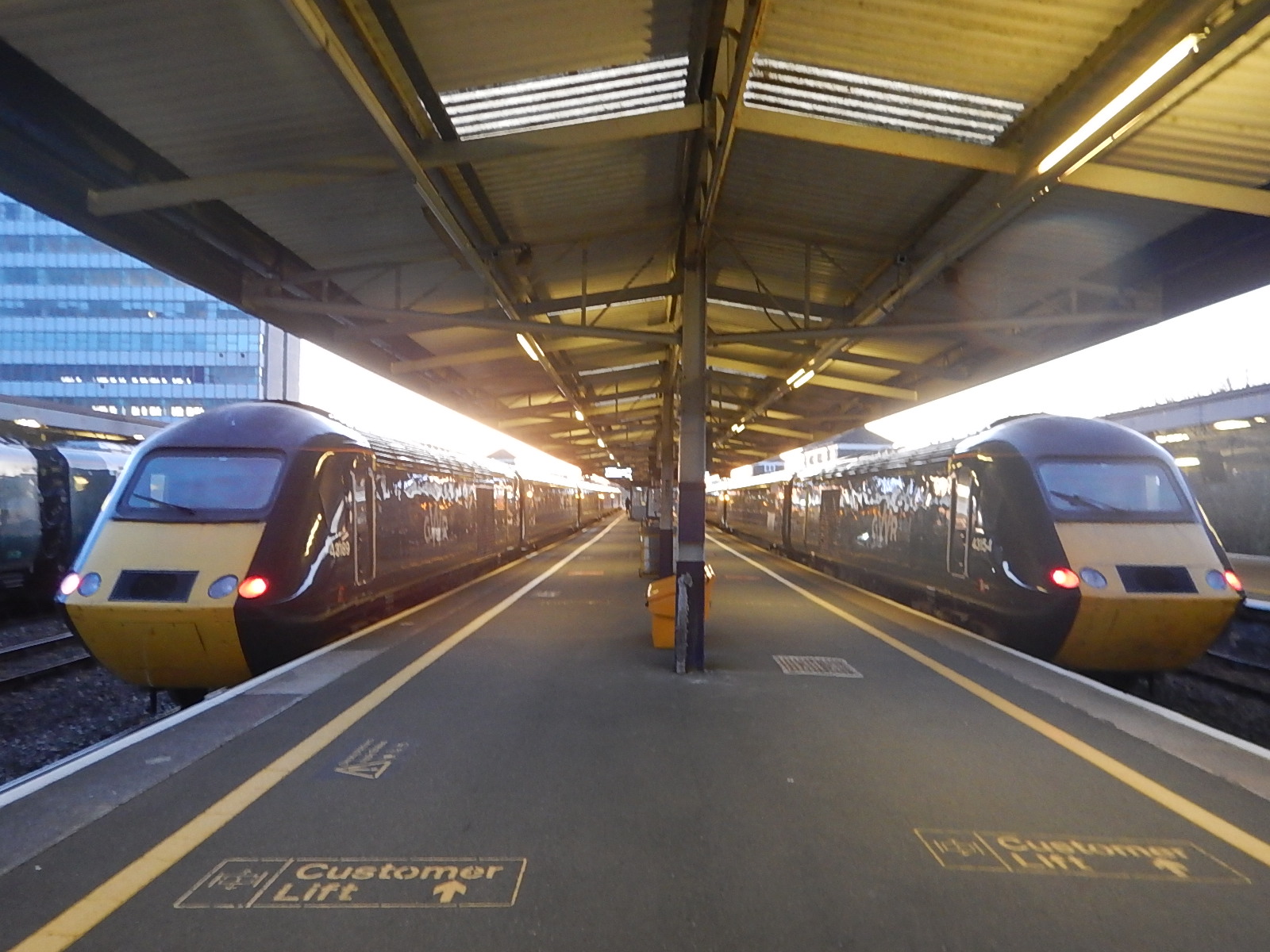
But let’s be serious and not insult the intelligence of the three world-leading universities on the final route of the East West Railway.
A lot of money is also being spent on this railway and tarted-up forty-year-old trains would not encourage people to use the new railway.
Class 170 Trains
There are eighty-seven three-car Class 170 trains with various operators, some of which will be surplus to requirements, as they are being replaced with new trains.
But they are diesel, so surely they don’t fit my perceived need for zero-carbon trains.
That would have been true until a couple of weeks ago, when as I wrote in Vivarail’s Plans For Zero-Emission Trains, Adrian Shooter of Vivarail disclosed an audacious plan to convert, diesel trains into zero-carbon battery electric trains.
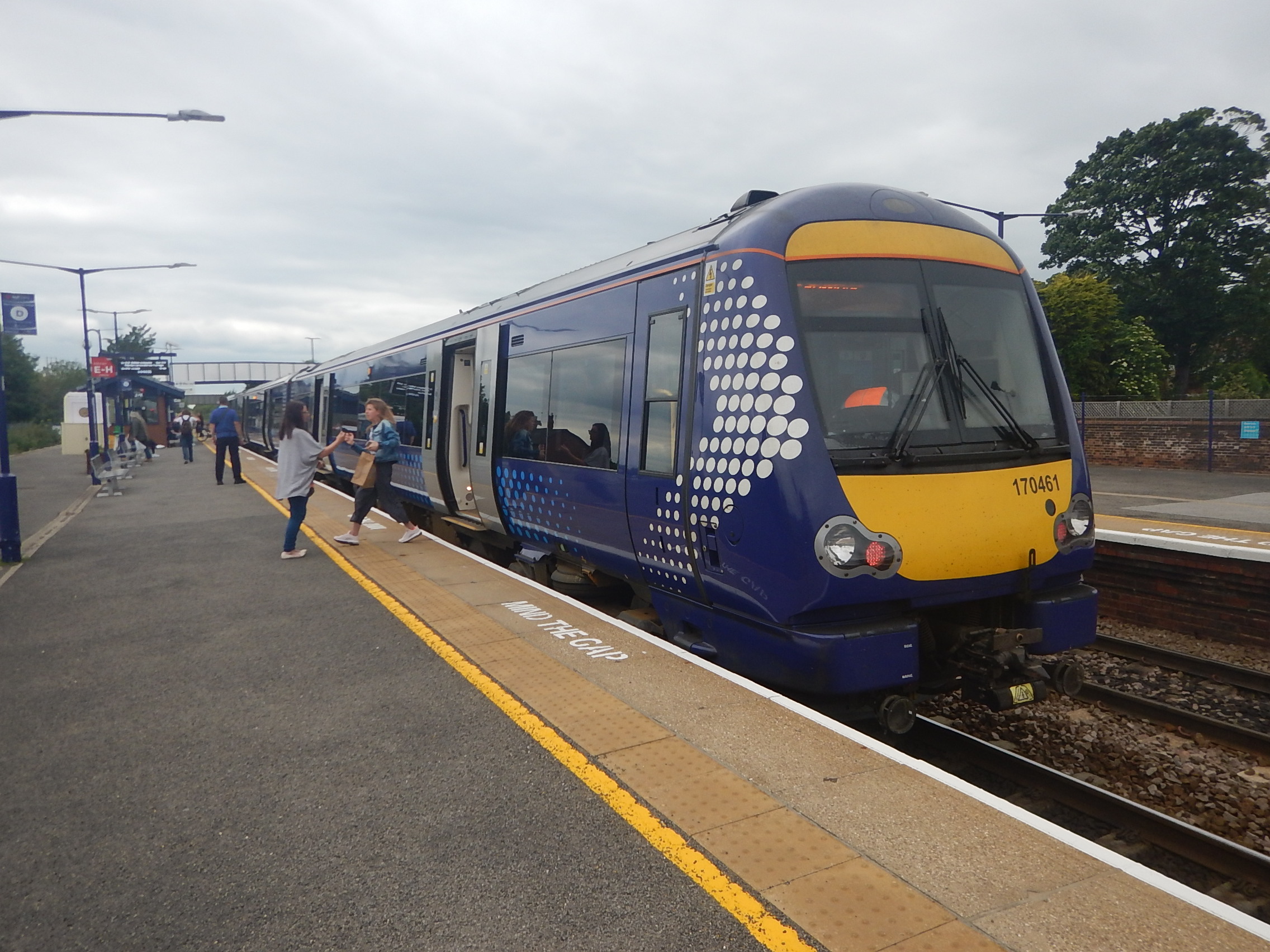
Class 170 trains like this were on the list of possible conversions.
- They 100 mph trains.
- Some are three-cars.
- They meet all the disability regulations.
- They have been used for services much longer than Oxford and Bedford.
They could also start the service as diesel trains and gradually converted to battery electric, if this would be better for operation.
Class 175 Trains
The three-car 100 mph Class 175 trains could be a possibility as there are fifteen trains, but they have two problems.
- They are powered by diesel.
- They probably won’t be available until 2023.
So I think they can be ruled out.
Class 185 Trains
All the fifty-one Class 185 trains are currently in service with TransPennine Express. They are due to release fifteen trains in 2021 and it was thought that these trains were in prime position for becoming the interim trains for East West Railway.
- They 100 mph trains.
- Some are three-cars.
- They meet all the disability regulations.
- They have been used for services much longer than Oxford and Bedford.
- The fleet is the right size.
But then the Department of Transport decided to change their plans for the Liverpool and Norwich service.
I wrote about one journey on the overcrowded section of this service in Mule Trains Between Liverpool And Norwich.
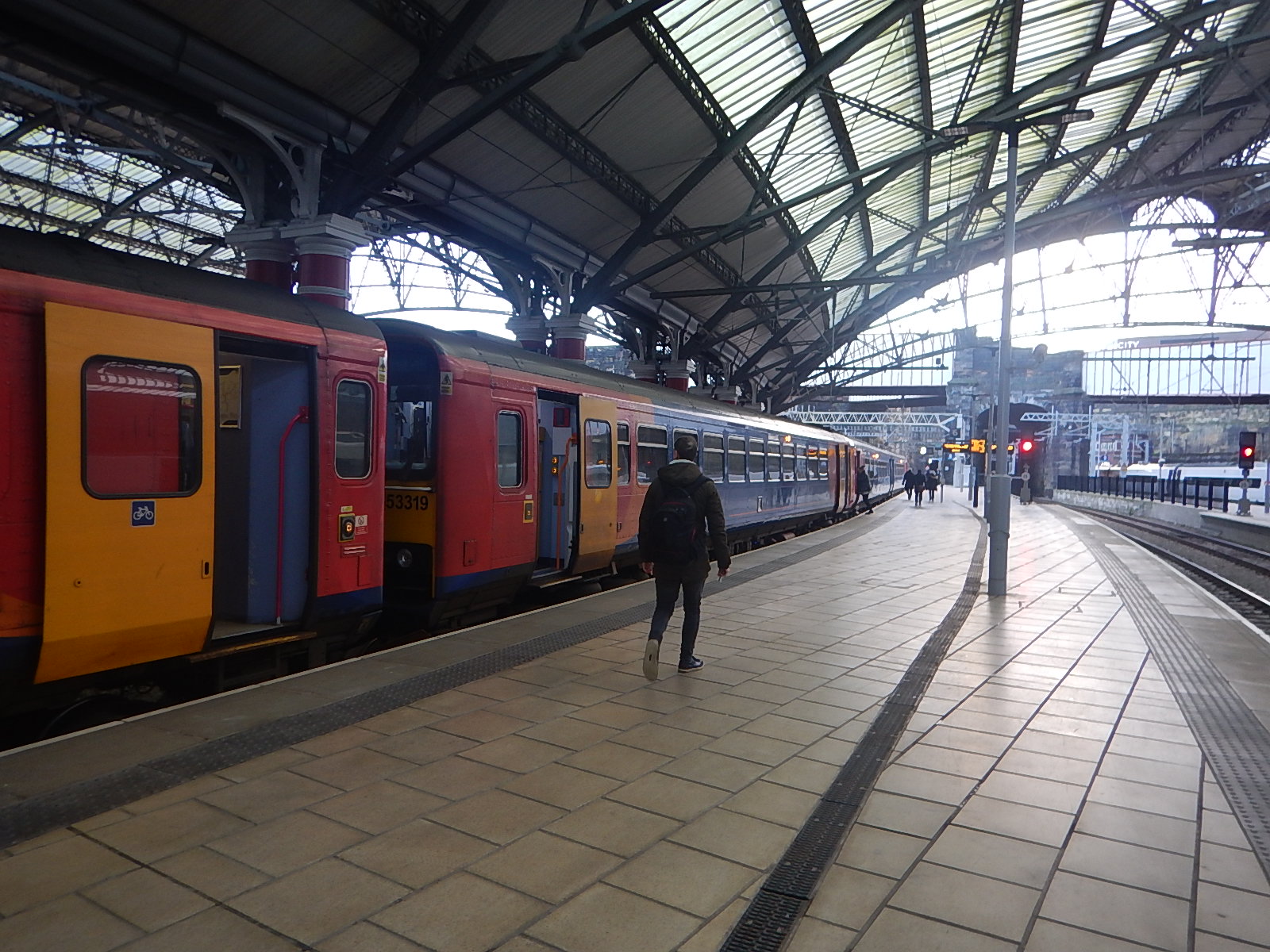
The picture shows the inadequate train formed of an assorted collection of Class 153 trains, I took from Liverpool to Sheffield.
The service is now being split at Nottingham and East Midlands Railway will receive the released Class 185 trains for the Liverpool and Nottingham portion of the service.
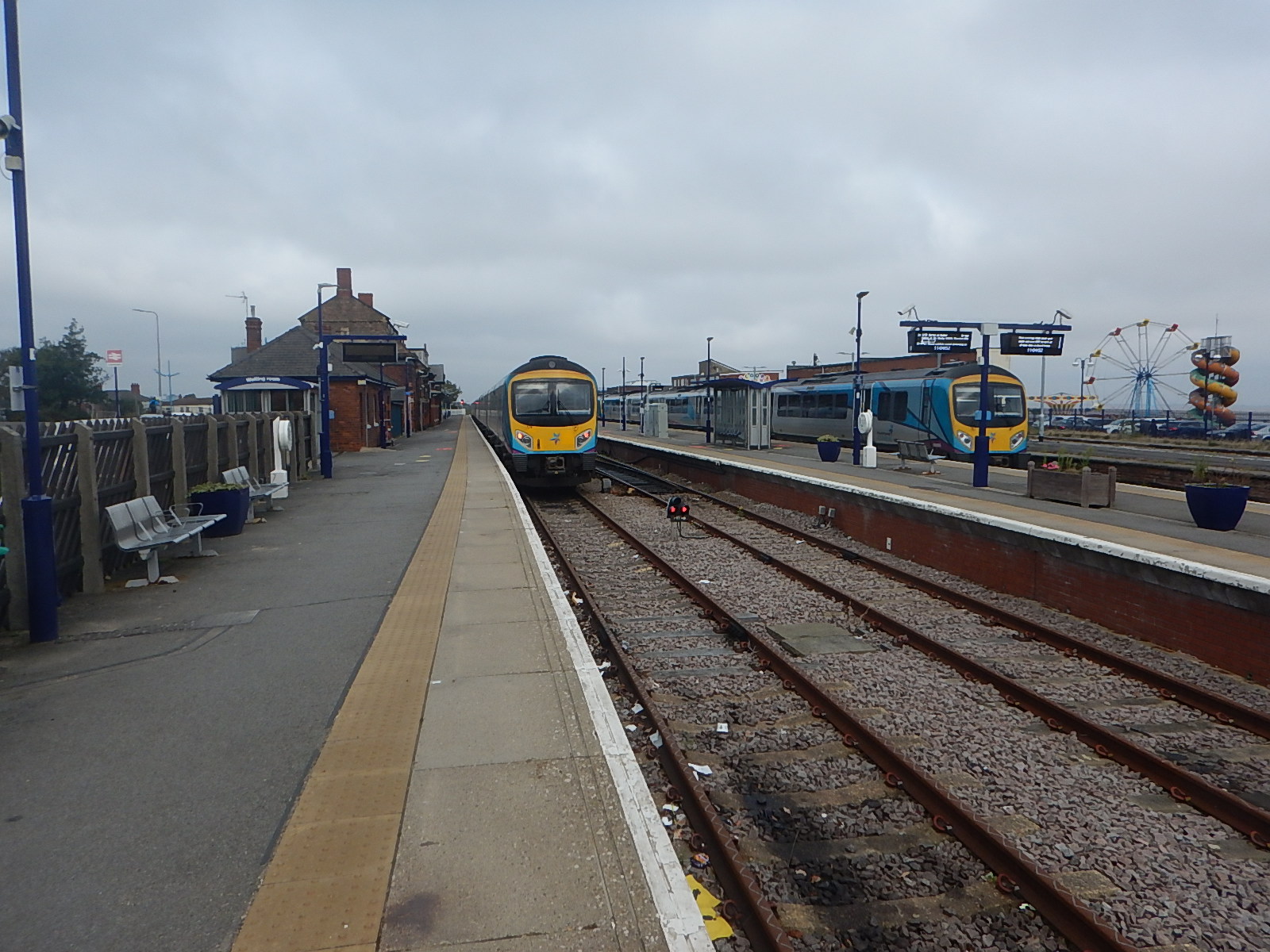
A fleet of these Class 185 trains will surely offer more comfort on a very busy service.
So it is looking unlikely that Class 185 trains will be used on the East West Railway.
Class 220, 221 and 222 Trains
These three fleets of Voyager trains could be a possibility, as they can be shortened to three-car trains.
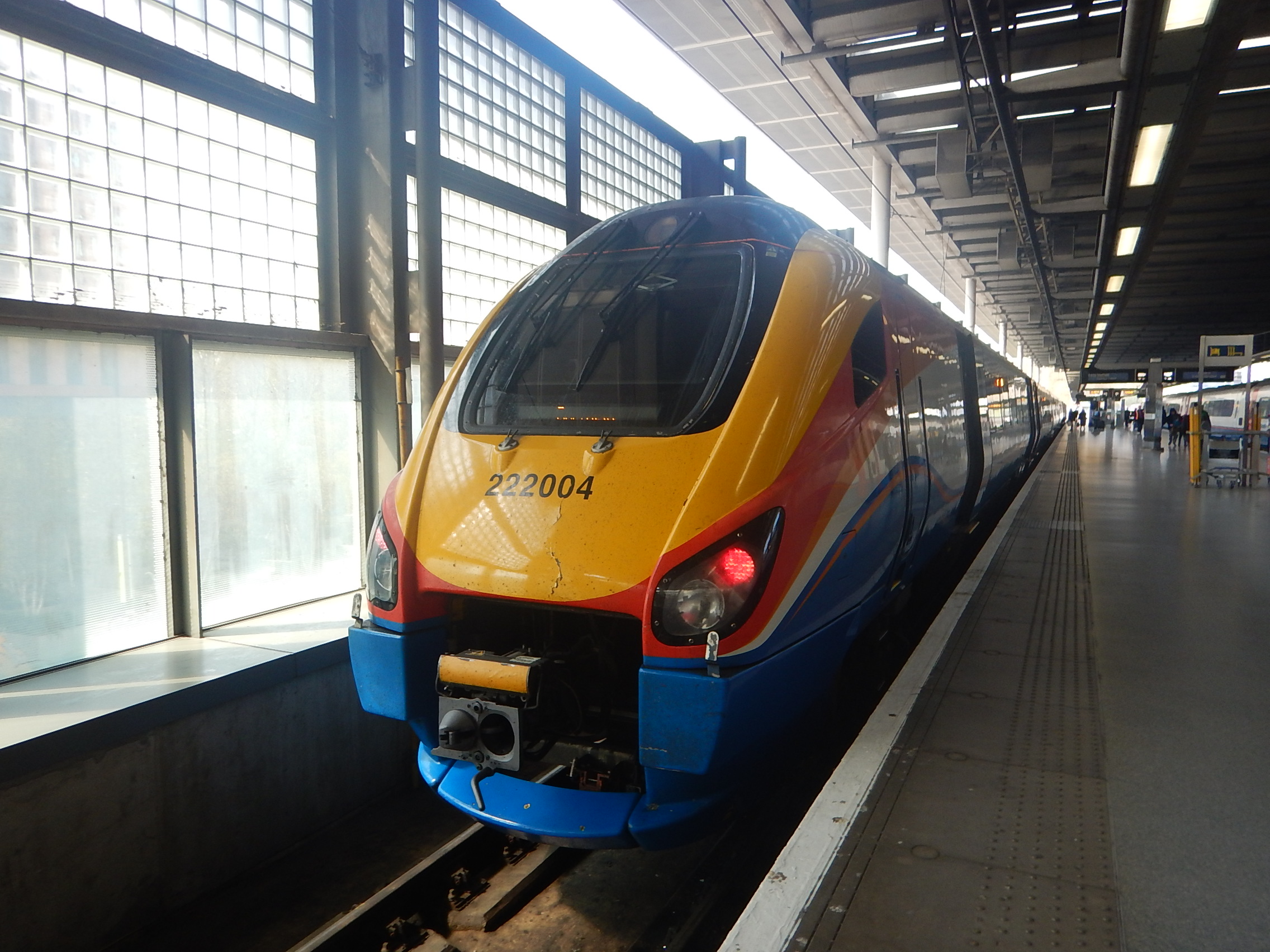
But they have disadvantages.
- They are diesel-powered.
- The diesel engines make a lot of noise for passengers.
- CrossCountry may have an alternative plan for these trains as I wrote about in DfT and Arriva CrossCountry Sign Agreement.
I think it is unlikely, that these trains will be used on the East West Railway.
Class 350 Trains
There are thirty-seven Class 350 trains, that were built only twelve years ago, that have been retired. The owner; Porterbrook are planning to convert them into battery electric versions, which they have called BatteryFLEX trains.
Unfortunately, they are four-cars and unlike other trains, it doesn’t appear that they can be shortened to three cars.
Class 375, 377, 379 and 387 Trains
These four fleets of Electrostar trains could be a possibility for running as battery electric trains.
- Some are three-car trains and four-car trains can be converted to three-car trains, by simply removing a car.
- They are 100 mph trains.
- Bombardier converted a Class 379 train for battery operation and I have heard or seen no adverse reports from either passengers, rail staff or journalists.
- They can work in multiple formations.
- They are all wired for dual-voltage operation.
- Pantographs wells have already been fitted to trains that normally work using 750 VDC third-rail electrification.
The picture shows the Class 379 train, that was converted to battery electric operation.

The Class 379 trains, also have the advantage, that there is a fleet of thirty trains, that are being replaced by Greater Anglia, who are homeless.
If I were the owner of the Class 379 trains, I’d do the following.
- Convert them all into battery electric trains.
- Shuffle cars around to get a mix of three-, four- and five-car trains to match market opportunities.
- Make them compatible with Vivarail’s Fast Charge system.
- Do a licensing deal with Vivarail, so I could supply the chargers.
This plan has some big advantages.
- Battery electric operation of the Class 379 trains has been successfully proven.
- Some Class 379 trains are already available for conversion, as they have been replaced by Greater Anglia.
- The trains could easily be delivered in time for the opening of the East West Railway.
- The trains would not need to be replaced, if the East West Railway was to be fully electrified in the future.
- If I leased out all the Class 379 trains, I’m fairly sure that I could acquire some other Electrostars to convert.
The trains would surely be ideal for the Uckfield Branch and Ashford and Hastings, which are to be run by battery electric trains.
- The order for these services is still to be announced.
- This use would be a trial application of the highest quality.
- I suspect that five-car trains would be ideal for these Southern routes.
- In Battery Electrostars And The Uckfield Branch, I estimated that Southern would need twelve five-car trains for the Uckfield Branch and four trains for the Ashford and Hastings service.
It looks to me, the thirty four-car Class 379 trains could be converted into the following battery electric trains.
- Twelve five-car trains for the Uckfield Branch.
- Four four-car trains for Ashford and Hastings.
- Fourteen three-car trains for the East West Railway.
Using battery electric Class 379 trains for the East West Railway, the Uckfield Branch and Ashford and Hastings. looks from the engineering, numbers and financial points of view to be a very efficient proposition.
Class 385 Trains
As I indicated earlier, Hitachi have the technology to create a Class 385 train with a battery capability.
- They appear to be talking to ScotRail.
- Are they talking to Vivarail about using their Fast Charge system?
- As the trains would be new, East West Railway would get trains to their specification.
Battery electric Class 385 trains must be a serious proposition.
Class 600 Trains
The Class 600 train could be an interesting possibility.
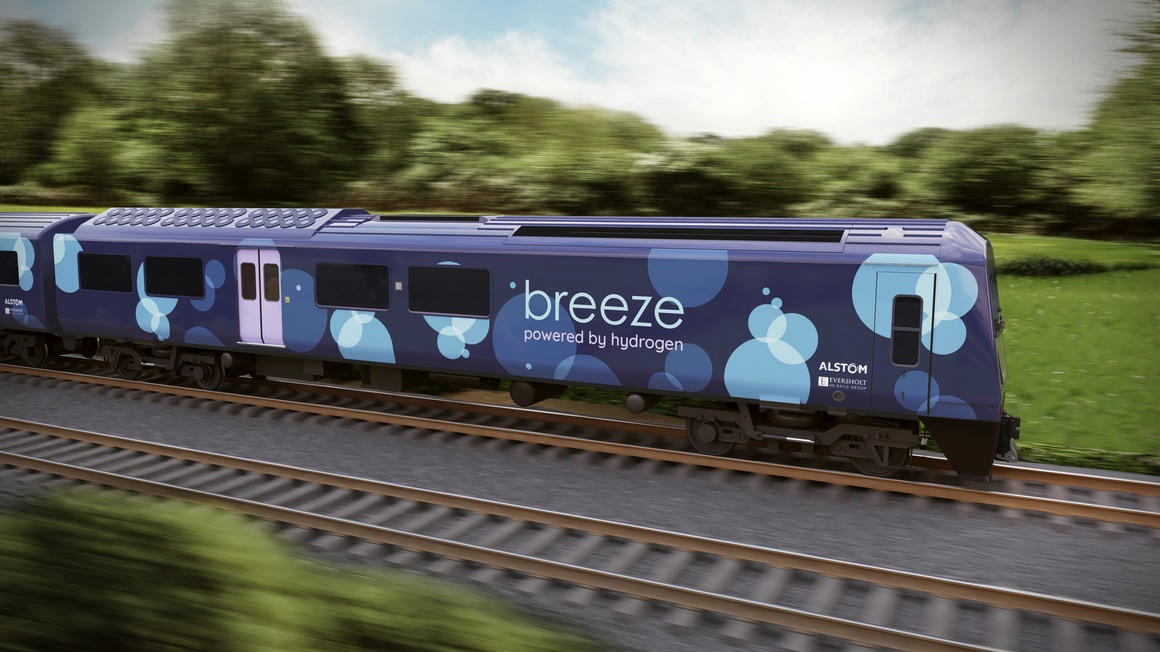
The trains can be powered by both hydrogen and overhead or third-rail electrification.
- The trains are three-cars long.
- They are 100 mph trains.
- First in-service dates are scheduled for 2024, which could be convenient.
- The trains will have a state-of-the-art Renatus interior.
- They will not need charging and could probably be refuelled as infrequently as only once per day.
I am not worried, by the train being powered by hydrogen, but because of the large tanks in the train, the passenger capacity will be lower, than a diesel, electric or battery electric train of a similar length.
I suspect though, that Alstom will be pitching for the order.
Aventras
In this article in Global Rail News from 2011, which is entitled Bombardier’s AVENTRA – A new era in train performance, gives some details of the Aventra’s electrical systems. This is said.
AVENTRA can run on both 25kV AC and 750V DC power – the high-efficiency transformers being another area where a heavier component was chosen because, in the long term, it’s cheaper to run. Pairs of cars will run off a common power bus with a converter on one car powering both. The other car can be fitted with power storage devices such as super-capacitors or Lithium-ion batteries if required. The intention is that every car will be powered although trailer cars will be available.
Unlike today’s commuter trains, AVENTRA will also shut down fully at night. It will be ‘woken up’ by remote control before the driver arrives for the first shift
This was published over nine years ago, so I suspect Bombardier have refined the concept.
Bombardier have not announced that any of their trains have energy storage, but I have my suspicions, that both the Class 345 and Class 710 trains use super-capacitors or Lithium-ion batteries, as part of their traction system design.
I believe that Bombardier, have the ability to build an Aventra to this specification.
- Three-cars
- 100 mph running
- Sixty mile range on battery power.
- Dual voltage.
- Ability to work in pairs.
Like the Hitachi trains, they would be new build.
CAF
CAF have proposed a battery electric train based on the Class 331 train, which I wrote about in Northern’s Battery Plans.
It is a four-car development of the three-car Class 331 trains.
Can it be built as a three-car train to fit the specification?
Conclusion
There are some good candidates sir supplying an interim fleet of trains for the East West Railway.
My money’s on one of the following.
- New Hitachi Class 385 trains
- Converted Class 379 trains.
- New Aventras
All would be battery electric trains.
But there is a change that Alstom’s Class 600 hydrogen trains could be used.
 The Anonymous Widower