Is Carbon Black Used To Make Offshore Electrical Cable?
I asked Google AI, the answer to this question and received this answer.
Yes, carbon black is extensively used to make offshore electrical cables. It serves two primary functions: providing electrical conductivity to specific components and offering UV protection to outer jacketing materials.
That seems a positive answer.
It also could be a very complementary one.
HiiROC have a process that splits any hydrocarbon gas including natural gas, chemical plant off gas and biomethane, into turquoise hydrogen and carbon black.
Two methods of bringing energy to the shore from an offshore wind farm are electricity and hydrogen, through a cable or pipe respectively.
This looks to me, that there could be a possibility to use one of Baldrick’s cunning hybrid plans to bring energy onshore using both hydrogen and electricity.
Effectively, the transmission and use of the system, would use both the hydrogen and carbon black produced by HiiROC.
Centrica Secures Investment Stake In Gasrec Helping Boost UK Bio-LNG Ambitions
The title of this post, is the same as that of this press release from Centrica.
This is the sub-heading.
Centrica has secured a minority stake in Gasrec, the UK’s largest dual provider of bio-LNG (bio-Liquified Natural Gas) and bio-CNG (bio-Compressed Natural Gas) to the road transport sector,
These first two paragraphs give more details.
Gasrec says the investment will drive the next phase of its infrastructure ambitions, with plans to open a UK wide network of open-access refuelling stations supplying renewable bio-LNG for the decarbonisation of heavy goods vehicles.
Centrica is taking a 16% stake and becomes one of three major shareholders in Gasrec, alongside global integrated energy company bp and private family office 44 North.
I have some thoughts.
Does Running A Truck On bio-LNG or bio-CNG. Reduce Carbon Emissions?
This paragraph from the press release, gives the thoughts of Chris O’Shea, who is Group Chief Executive, Centrica.
Chris O’Shea, Group Chief Executive, Centrica plc, said: “Demand for bio-LNG for transport is growing fast as more HGV operators make the switch – drawn by a clean, ready-to-use fuel which slashes CO2 emissions by up to 85 per cent in comparison to diesel*. This investment in Gasrec enhances our collaboration with the leading company in the sector, and puts us in a strong position to energise a vital sector of the industry on its journey to net zero.”
As Centrica is a public company, with shareholders, who would take a dim view of Mr. O’Shea telling porkies, I suspect we can assume that the following is true.
Drawn by a clean, ready-to-use fuel which slashes CO2 emissions by up to 85 per cent in comparison to diesel.
The asterisk in the full quote, refers to this note.
Low Carbon Vehicle Partnership, Innovate UK and Office for Low Emission Vehicles, Low Emission Freight & Logistics Trial (LEFT), Key Findings, November 2020. Using specific feedstocks CO2 reductions of 200% are achievable.
Centrica could be being conservative with their claims.
Decarbonising Buses, Locomotives And Trucks
Despite what Elon Musk, would have us believe, electric trucks will not dominate the future of freight transport.
An electric truck would be the vehicle equivalent of asking Usain Bolt to run a hundred metres with a large refrigerator on his back.
Trucks are going to need a fuel without a weight penalty and with a long range.
I asked Google for information about Cummins diesel, natural gas and hydrogen engines and received this AI Overview.
Cummins offers engines powered by diesel, natural gas, and hydrogen. While diesel engines are well-established, Cummins is also developing both natural gas and hydrogen engines, particularly focusing on hydrogen as a pathway to zero-carbon solutions for various applications. Cummins utilizes a fuel-agnostic platform, meaning a common base engine can be adapted for different fuel types, including diesel, natural gas, and hydrogen.
Recently, GB Railfreight purchased thirty Class 99 locomotives from Stadler.
- They can use electrification, where it exists.
- Where electrification doesn’t exist, they can use an onboard Cummins diesel engine, which is built in Darlington.
- In electric-mode, they have 6.2 MW of power, and are the most powerful locomotives ever to run on UK railways.
- In diesel-mode, they have 1.8 MW of power, which is more than enough to haul a large container train in and out of Felixstowe.
I had thought that at some future date, Cummins would convert these locomotives to electro-hydrogen.
But now that Gasrec is providing bio-LNG and bio-CNG, GB Railfreight, have the option of converting both hydrogen and biomethane.
Similar logic can be applied to Wrightbus’s Streetdeck Ultroliner, one version of which is fitted with a Cummins engine, that can be converted to electric, hydrogen or natural gas, which of course includes biomethane. This page on the Wrightbus web site describes the bus.
Wrightbus are also going back into coach manufacture, as I wrote about in Wrightbus Goes Back To The Future As It Relaunches The Contour Coach. As with the Streetdeck Ultroliner, Cummins seem to be providing one of the power units.
It seems to me, that the zero- and low-carbon revolution in transport will generate a need for the availability of biomethane, hydrogen and natural gas fuel for transport all over the country.
Gasrec with around twenty biomethane fuelling points around the country, seem well-placed to supply the biomethane in bio-LNG or bio-CNG form.
Could Gasrec Deliver Hydrogen?
Various bus companies in the UK, have had difficulty getting the fuel for their hydrogen buses.
I believe that delivering hydrogen would be very similar to delivering LNG and if Gasrec can deliver LNG successfully and safely, they probably have the technology to do the same for hydrogen.
Centrica Seem To Be Assembling An Interesting Consortium
These are some deals, that I have reported on this blog, that involve Centrica.
- Centrica, along with Hyundai, Kia, Siemens and others have backed Hull-based hydrogen start-up; HiiROC, who can produce affordable hydrogen from any hydrocarbon gas including natural gas, where it is needed.
- Centrica have invested in Sizewell C. Will they be using their share of the electricity to make affordable pink hydrogen using HiiROC?
- In Centrica And Ryze Agree To Develop Hydrogen Pathway, I talked about how Centrica and Ryse were aiming to bring hydrogen to the masses.
- In Recurrent Energy’s Middle Road Project Sold To Centrica, I talked about a Centrica investment in solar power.
- In Aberdeen’s Exceed Secures Centrica Rough Contract, I talked about how Centrica were redeveloping the Rough gas storage site for hydrogen.
- In Lhyfe And Centrica To Develop Offshore Renewable Green Hydrogen In The UK, I talked about developing offshore hydrogen.
- In Centrica Announces Hydrogen Ready Combined Heat And Power Partnership With 2G, the title says it all.
- In Centrica Signs UK Biomethane Agreement With Yorkshire Water And SGN Commercial Services, Centrica appear to be sourcing biomethane from Yorkshire Water.
- In Centrica Invests In Renewable Energy Storage Capabilities To Boost UK’s Energy Security And Accelerate Transition To Net Zero, I talk about Centrica, Goldman Sachs and others, investment in liquid-air energy storage company; Highview Power.
- In British Gas Owner Mulls Mini-Nuke Challenge To Rolls-Royce, I talk about rumours that Centrica might invest in SMRs.
Note.
- A lot of these deals are are about hydrogen production.
- Some of these deals are about biomethane production.
- None of these deals talk about getting hydrogen and biomethane to customers.
It appears to me, that Gasrec have a model that works to get hydrogen, methane and biomethane from production and storage to the end customers.
Developing A Rural Hydrogen Network
In Developing A Rural Hydrogen Network, I talked about supplying all those millions of off-gas grid properties with hydrogen for heating, agricultural and industrial purposes, in the countryside of the UK.
Gasrec have the technology to decarbonise the countryside.
Conclusion
Gasrec would appear to be a very useful partner for Centrica.
Poo power To Heat Homes In West London As Thames Water Continues To Reduce Its Carbon Footprint
The title of this post, is the same as that of this press release from Thames Water.
These are the three bullet points.
- Thames Water unveils its second successful gas-to-grid project.
- Around 4000 homes in West London will be heated using converted sewage sludge from Mogden sewage treatment works starting early this year.
- This initiative is part of Thames Water’s commitment to reduce its carbon emissions across its operations thereby reducing its contribution to the causes of climate change.
These three paragraphs outline the project.
Thames Water has announced sewage sludge will be used to heat homes in West London early this year, after successfully delivering its second gas-to-grid (G2G) project, at its Mogden Sewage Treatment Works (STW).
The success of the gas-to-grid model established at Deephams STW in North London in 2021, where biogas is converted into biomethane to heat homes in Enfield, served as the blueprint for the project at Mogden.
Currently serving over 2 million customers, Mogden is the third largest STW in the UK, and has the potential to reach and supply gas to 4000 homes in West London. This comes as part of the company’s commitment on energy transition, by transforming the way it creates and uses power to reach net zero carbon emissions.
The press release then gives a paragraph of explanation as to how the system works.
A byproduct of the sewage treatment process is sewage sludge, which is then digested to produce BioGas. Mogden STW then generates electricity with this BioGas via Combined Heat and Power (CHP) engines. The Gas-to-Grid plant, which will be managed by gas supplier SGN, intends to take a proportion of this BioGas and to ‘uprate’ it to export quality which is achieved by filtering, scrubbing and then compressing gas so it can be used as fuel for cooking and heating.
This Thames Water graphic illustrates the process.
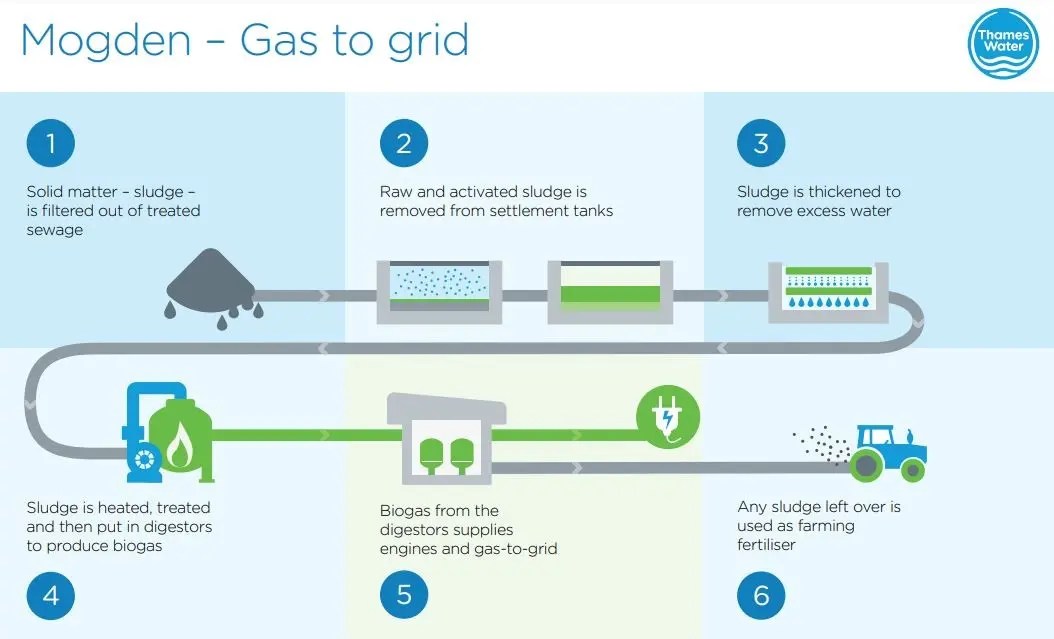
This press release is not Thames Water’s image from many of its customers.
Firm Develops Jet Fuel Made Entirely From Human Poo
The title of this post, is the same as that of this article on the BBC.
This is the sub-heading.
A new aviation company has developed a type of jet fuel made entirely from human sewage.
These are the first three paragraphs.
Chemists at a lab in Gloucestershire have turned the waste into kerosene.
James Hygate, Firefly Green Fuels CEO, said: “We wanted to find a really low-value feedstock that was highly abundant. And of course poo is abundant.”
Independent tests by international aviation regulators found it was nearly identical to standard fossil jet fuel.
It certainly seems to have a lot going for it.
I have some other thoughts.
What About Disposable Nappies?
I wrote Are Disposable Nappies A Wasted Resource?, about making hydrocarbon fuels from disposable nappies.
Should Disposable Nappies Be Collected Separately?
My food waste is collected separately in a special bin. Hackney Council say this is what happens to food waste.
Food waste from households in Hackney is sent to an anaerobic digestion facility in south east England, where it’s turned into renewable energy to power homes and biofertiliser to be spread on local farmland to grow crops.
Surely, a similar or appropriate process could be used for disposable nappies.
Biomethane From Sewage Works
In Centrica Signs UK Biomethane Agreement With Yorkshire Water And SGN Commercial Services, I wrote about how Centrica have found a way to distribute biomethane from sewage works using the UK’s gas grid.
Could Firefly take the solids and Centrica the biomethane?
Given that water companies are regularly blamed for spilling sewage could there be an opportunity for a large sewage works to be a major producer of green fuels for agriculture, aviation, industry and road transport.
Centrica Signs UK Biomethane Agreement With Yorkshire Water And SGN Commercial Services
The title of this post, is the same as that of this news item from Centrica.
These three paragraphs outline the story.
Yorkshire Water, an essential water and wastewater services provider for the Yorkshire Region, and Centrica Energy Trading, have today announced signing a 15-year agreement to offtake biomethane production and manage shipping, trading, and balancing of production from two plants developed by SGN Commercial Services.
SGN, a leading manager of natural gas and green gas distribution networks in Scotland and the south of England will design, develop and operate the biomethane gas-to-grid sites, which once operational, will produce approximately 125GWh of biomethane annually — enough to heat more than 10,000 UK households.
Biogas will be produced as a by-product of Yorkshire Water’s sewage wastewater treatment processes, where Centrica will offtake production from the site and subsequently manage shipping, trading, and balancing of the green gas. Biomethane will be injected into the UK grid to displace natural gas, providing cleaner and more resilient gas supplies that reduces dependency on outside energy imports.
SGN Commercial Services are a wholly-owned subsidiary of SGN.
This mission statement is on the home page of their web site.
Our safety-first culture provides bespoke commercial solutions and green gas services to our clients, allowing them to better meet their business needs today and in the future.
In an energy market which is prioritising de-carbonisation and net-zero solutions, we can help navigate a clear pathway for your business to achieve its goals both responsibly and cost-effectively.
It looks to me, that SGN Commercial Services will design, develop and operate the biomethane gas-to-grid sites, so that the biomethane from the sewage works can be fed into Centrica’s main UK gas grid.
You could argue, that every sewage works and landfill producing large amounts of methane, should have one of these connections.
What would be the repercussions if SGN Commercial Services were asked to connect all these sites to the gas grid?
- How much gas would be collected?
- How many houses could be heated?
- How much of the greenhouse gas; methane would not be released into the atmosphere?
This is a cunning plan, that is worthy of Baldrick at his best.
Over a period of time, domestic gas consumption will fall as houses are fitted with heat pumps and other green methods for heating.
Could this mean, that as time goes on, more and more of our domestic consumption of gas is satisfied by net-zero gas from waste sources?
Does HiiROC Fit In Anywhere?
This article on UKTN is entitled Meet HiiROC, The Startup Making Low-Cost Hydrogen Free From Emissions.
There is a section, which is called How Does HiiROC Work?, where this is said.
The company’s hydrogen generation units use feedstock gases such as methane, flare gas or biomethane at high pressure and with a very high electrical field between an anode and cathode.
This dissembles the tightly bound molecules into hydrogen and carbon atoms, with both coming out as a plasma (like a gas). The carbon is instantly cooled and solidified as pure carbon, which means no carbon dioxide is formed, in a quenching process to stop it from reforming back into the input gas.
The end product is hydrogen and carbon black, a material used in rubber tires, inks and paint.
It’s a material that has wide industrial use, but current production methods create large amounts of CO2 and other environmentally harmful biproducts.
“Our process is emission-free,” says HiiROC co-founder and CEO Tim Davies. “Because all you’ve got is hydrogen and solid carbon – they are the two products.”
For every kilogram of hydrogen produced using HiiROC units, you’re left with three kilograms of carbon black. This, however, is a potentially valuable, clean solid by-product and does not contribute to global warming unlike processes that create carbon dioxide gas.
Read the full article on UKTN, as it is full of very interesting information.
It says this about distributing hydrogen to a number of industries.
Lots of industries need hydrogen, which means HiiROC has a broad range of potential customers.
Their smallest machine can produce up to 100 kilograms of hydrogen per day. But due to their modular design and small size, they can easily be stacked up to increase output, making them scalable for businesses requiring large-scale industrial hydrogen production.
So at one end of the scale, it could support a hydrogen filling station, or a farmer wanting to use hydrogen to go carbon-free and at the other, it could support an energy intensive process like hydrogen steelmaking. All that is needed is a suitable hydrocarbon gas feed.
Last night on the BBC, a program called What They Really Mean For You, was about electric cars.
The program flagged up a shortage of graphite for making the batteries for electric cars.
So seeing that HiiROC hydrogen systems, could be producing tonnes of carbon black could this be converted into battery-grade graphite?
Google says yes!
This article on Sciencing is entitled How To Turn Carbon Into Graphite.
Conclusion
As Centrica own a substantial portion of HiiROC and are lending the company a gas-fired power station for full scale trials, I believe that Centrica is up to something, that will have three strong benefits for the British public.
- They will be able to keep their gas boilers for longer.
- Hydrogen supplied by HiiROC’s devices will provide hydrogen in the required quantities to where it is needed.
- The carbon black produced by HiiROC’s devices, when turned into graphite will be a valuable feedstock for giga-factories making batteries.
Engineering is the science of the possible, whereas politics is dreams of the impossible.
Dual-Fuel Class 37 And 66 Locomotive Concepts Unveiled
The title of this post, is the same as that of this article on Railway Gazette.
This is the first paragraph.
G-volution and SBL-Rail have produced design concepts for dual-fuel versions of Class 37 and 66 locomotives, which would be able to run on diesel with biomethane, biopropane or hydrogen.
Note.
- There are about sixty Class 37 locomotives in service or stored.
- 480 Class 66 locomotives were originally produced and over 300 must still be in service.
- Both locomotives have electric transmissions.
- G-volution are developing a dual-fuel Class 180 train, that I wrote about in Grand Central DMU To Be Used For Dual-Fuel Trial.
- Two of the design concepts involve replacing the current diesel engines with modern Cummins engines, that meet current emission regulations.
- Fuel savings of ten percent are mentioned for one engine conversion.
This is said about the dual-fuel conversions.
Biomethane and biopropane dual fuel engines would offer significant carbon and cost savings verses diesel. Hydrogen has the potential to do so if produced from renewable sources, but would need to be ‘much cheaper’ than it is today.
The article then gives a table, which shows the various savings.
The article comes to these conclusions.
- Biomethane and biopropane prices are expected to fall, as production increases.
- Green hydrogen is too expensive, but costs will come down.
- More rises in the price of diesel, will tilt costs towards alternative fuels.
I feel that to get the emissions and costs down, there would need to be a bit of cheating.
Look at this picture of a Class 66 locomotive under 25 KVAC electrification.

I wonder, if a pantograph and all the electrical gubbins could be fitted to a Class 66 locomotive to create a genuine electro-diesel locomotive.
- It would use electrification, where it exists.
- It would use the existing electric transmission.
- I do suspect though that the Class 37 locomotive may be more difficult to convert because of its age.
It should be noted that in GB Railfreight Plans Order For Future-Proofed Bi-Mode Locomotives, I talk about how GB Railfreight are proposing to purchase a fleet of new electro-diesel freight locomotives, that appears will have Class 66 locomotive performance on both electrification and diesel.
The Involvement Of Cummins
Cummins, who are one of the world’s largest manufacturers of diesel engines, could have a lot to lose from the move to zero-carbon.
- But they have adopted an if-you-can’t-them-join-them philosophy to hydrogen.
- They have bought up hydrogen companies like Hydrogenics.
- They are developing internal combustion engines that can run on hydrogen.
- Cummins have claimed to me, that they will try to fill any niche market with their engines, so it would be likely, they would apply that philosohy to hydrogen.
I believe that Cummins will not give up their market share without a fight.
I would expect, Cummins will actively support G-volution’s plans, if it would sell upwards of fifty large engines.
Conclusion
I have four main conclusions.
- I believe that this study could lead to a very significant and worthwhile updating of a Class 66 locomotive.
- The locomotive would need to be modified so it could use electrification.
- But I am more dubious, that this could be done with the Class 37 locomotive.
- I also believe that Cummins will be part of the solution.
In the wider world, I also believe that to retain their turnover and market share, Cummins and the other big diesel engine manufacturers will come up with increasingly innovative solutions.
Caterpillar, Cummins, Deutz, JCB, MTU and others will not give up multi-billion businesses without a fight.
Foresight Partners With CNG Fuels To Deliver Carbon-Neutral UK Transport Network As Demand For Clean Fuels Grows
The title of this post is the same as that of this press release from the Foresight Group.
These four bullet points introduce the document.
- Two Foresight investment funds have partnered with CNG Fuels to acquire and grow a strategic network of biomethane HGV refuelling stations across the UK
- CNG Fuels is the UK’s dominant supplier of renewable biomethane compressed natural gas for the UK’s truck sector
- Transport sector emissions accounted for 34% of UK emissions in 2019
- Biomethane-refuelling technologies reduce carbon emissions by 80+% and lower operating costs and improve air quality.
This web page is the home page of the CNG Fuels web site.
Judging by the picture on the CNG Fuels have Waitrose as a customer.
It looks to me, that Foresight Group and CNG Fuels are companies to watch, as biomethane or renewable natural gas, produced from food waste could be a valuable alternative fuel to decarbonise trucks.
 The Anonymous Widower