Seratech’s Technology Explained
I first wrote about Seratech in Carbon-Neutral Concrete Prototype Wins €100k Architecture Prize For UK Scientists, after reading about this carbon-neutral concrete in the Architect’s Journal.
I have just received Seratech’s October 2023 Newsletter, which contains two must-read articles.
Olivine In The Age Of Climate Crisis
I’d never heard of olivine until I read about the architecture prize, that was won by Seratech.
This is the Wikipedia entry for olivine.
These are the first three paragraphs of Seratech’s article.
On the west coast of Norway, a few kilometres from the village of Åheim, is an open excavation pit – home to the largest commercial olivine deposit in the world.
This seaside quarry, run by Belgian industrial minerals company, Sibelco, works to extract olivine from the earth’s crust by drilling, blasting and crushing. A single blast (used to break up the rocks) removes up to 40,000 tonnes of olivine.
The site is predominantly powered by hydroelectricity and boasts a 4km conveyor system for transport which limits the need for heavy vehicle or double-handling of materials in a bid to reduce emissions.
This is Sibelco’s video of their impressive mining process.
Note.
The mining operation is fully-integrated with its own ort.
- The video does the mining operation justice.
- Sibelco aim to make the mining of olivine carbon-neutral.
Olivine has this Wikipedia entry, which gives more information.
This Google Map shows the port complex at Åheim.
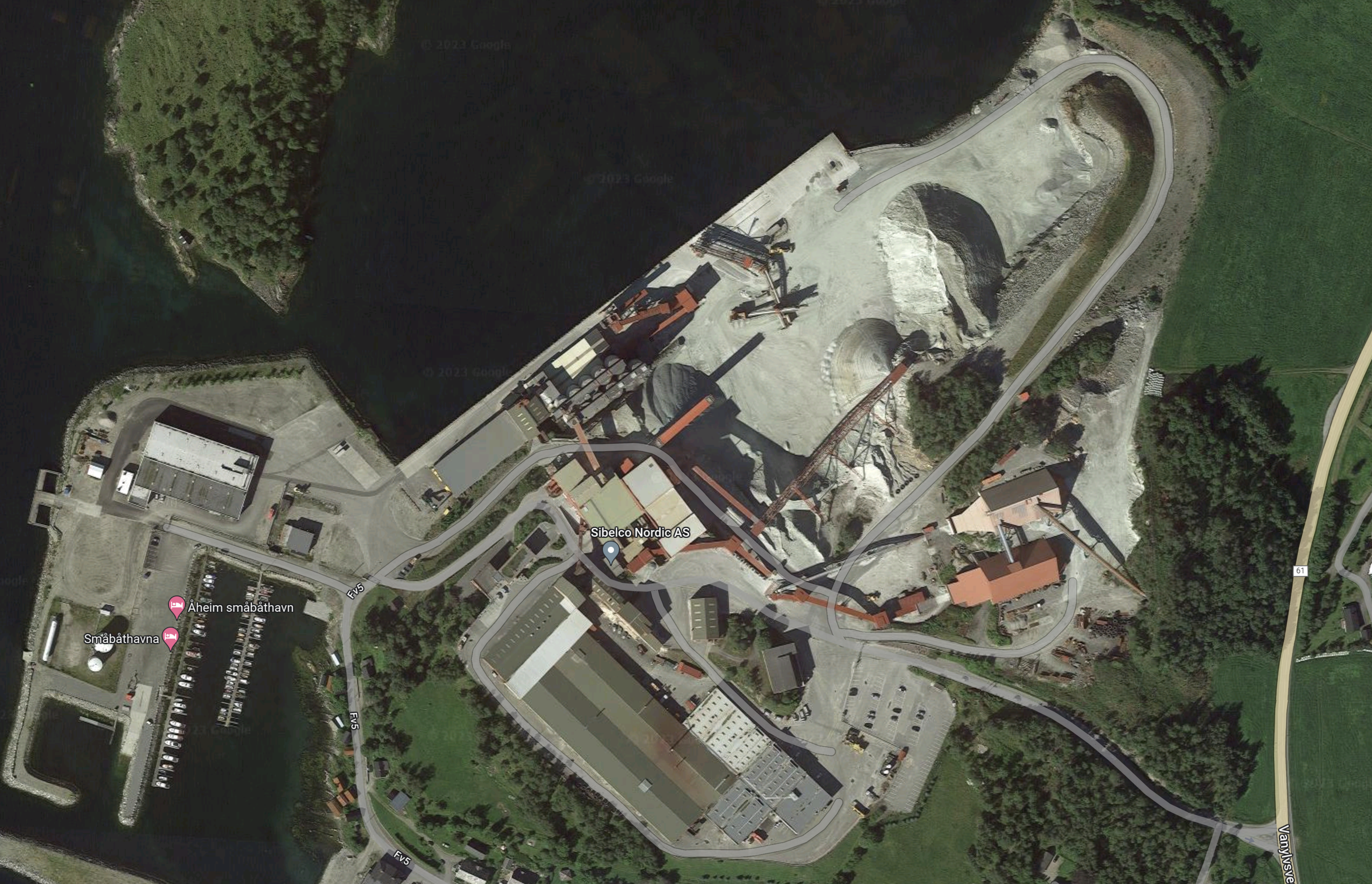
It looks like mine, processing and port all on one site.
The Big Interview With Mike Eberlin
This is the sub-heading.
Former Managing Director of Tarmac Cement & Lime and chair of MPA Cement, Mike Eberlin, became Seratech’s business advisor in June this year. He was intrigued by the novel technology Sam Draper and Barney Shanks had uncovered
These paragraphs are a summary of what Mike Eberlin said.
As we begin to talk, Mike is quick to point out there are two big advantages to Seratech: “They are using magnesium silicate as a starting material which produces silica as a cement replacement and magnesium oxide which can then absorb CO2”.
The CO2 absorption is what fascinates Mike as the type of magnesium carbonate Seratech produces is a “slightly unstable” version which when cured, becomes stable and reverts to the rock-like substance you would find in nature. “This came as a surprise because the chemistry wouldn’t indicate that was possible,” he explains.
Following this discovery, and as Seratech’s research progressed, it soon became apparent that the magnesium carbonate lends itself well as a binder and can be used in applications like building blocks and plasterboard: “It’s effectively carbon capture and use, not carbon capture and storage because you are mineralising the CO2 into a product.
“We end up in this clever situation whereby it’s not that we don’t emit the CO2, it’s better than that, we absorb CO2 and create two binders that replace cement”.
That’s what I call an endorsement.
Conclusion
I have this feeling that Seratech will be a very significant company in a couple of years.
H&M Move Partners With Lanzatech To Launch Capsule Collection Using Captured Carbon Emissions
The title of this post, is the same as that of this press release from H & M.
This is the sub-heading.
This is the stuff of science fiction: LanzaTech diverts carbon emissions heading for the atmosphere, traps them, and turns them into thread. In a leap towards innovating sportswear, H&M Move partners with the breakthrough material science company for a drop arriving at hm.com/move on April 6.
And this is an H & M image of some of the clothes on a young lady.

Not bad considering that the polyester thread was made using carbon emissions from a steelworks.
Lanzatech’s Process
This paragraph from the H & M press release outlines the process.
Using three simple steps, LanzaTech captures carbon emissions from steel mills, traps them in bioreactors and converts them into the same building blocks that conventional polyester is made of. This revolutionary solution helps reduce pollution and limits the use of virgin fossil resources needed to make new products.
So does this mean that lots of products made from polyester can use the polyester made by Lanzatech?
As I worked for ICI Plastics Division, who had a polyester plant, that was used to make Melinex film, I suspect the answer is yes from the knowledge I picked up at the time.
Out of curiosity, I typed “polyester underwear men’s” into Google and there’s quite a lot of it about. Including some from Marks and Spencer that I own. Marks and Spencer also do a similar product for the ladies. Both products have a high proportion of polyester and could best be described as everyday.
I must find mine comfortable, as I have been buying them for some years now!
So it looks like it might be possible to replace a proportion of the fossil fuel-based polyester with one made from captured carbon dioxide.
And this can this be used in the same way as the fossil fuel-based polyester.
The Wikipedia entry for polyester is full of useful information and is very much a must-read.
This table gives world PET (polyethylene terephthalate) production for 2008 in millions tonnes/year
- Textile – 39
- Resin, bottle – 16
- Film – 1.5
- Special – 2.5
Note.
- Bottle includes, the bottles used for soft drinks, washing up liquid etc.
- Film is high quality and was used as recording tape, but now it’s mainly for packaging.
- Special includes engineering plastics.
Wikipedia has this section on recycling, where this is said.
Recycling of polymers has become very important as the production and use of plastic is continuously rising. Global plastic waste may almost triple by 2060 if this continues. Plastics can be recycled by various means like mechanical recycling, chemical recycling, etc. Among the recyclable polymers, polyester PET is one of the most recycled plastic. The ester bond present in polyesters is susceptible to hydrolysis (acidic or basic conditions), methanolysis and glycolysis which makes this class of polymers suitable for chemical recycling. Enzymatic/biological recycling of PET can be carried out using different enzymes like PETase, cutinase, esterase, lipase, etc. PETase has been also reported for enzymatic degradation of other synthetic polyesters (PBT, PHT, Akestra™, etc) which contains similar aromatic ester bond as that of PET.
Note that PET is one of the most recycled plastics.
So it looks like the LanzaTech process can not only use carbon dioxide, it can also create a product that can be recycled.
UK’s Largest Carbon Capture Project Will Turn 40,000 Tonnes Of CO2 Into Sodium Bicarbonate For Dialysis Machines, Pharmaceutical Tablets And Baking Soda Every Year
The title of this post, is the same as that of this article in the Daily Mail.
These bullet points summarise the article.
- A facility that turns carbon dioxide into sodium bicarbonate was opened today
- Tata Chemicals Europe will remove up to 40,000 tonnes of CO2 each year
- The resulting sodium bicarbonate will be used as baking soda and in tablets
- Much of it will be used in haemodialysis to treat people with kidney disease
When I worked at ICI in Runcorn, the company had a facility at Winnington.
- In the 1960s, when I was there the main product was soda ash, which was produced by the Solvay process.
- The plant is now owned by Tata Chemicals Europe, and I suspect the new process is a replacement for the Solvay process.
- The carbon dioxide probably comes from a local 94 MW gas-fired power station on the site.
This ia a good example of Carbon Capture and Use, where a modern process is much better for the environment.
How much better could we protect the environment and the health of everyone, by improving or changing industrial processes?
Memories of the Solvay Process
I went over one of the Solvay processes a couple of times, when I worked at Runcorn.
- I can’t remember why now, but it was probably just to give the newest engineer in the department some experience.
- ICI trained me well at that time, especially in Health and Safety.
- One of the Victorian plants, I went over was built using a framework of oak beams, rather than the steel, we’d use today.
- The thing, that I remember most was the white sodium bicarbonate powder everywhere at the finishing end.
All the grades had uses from baking down to clearing up acid spills. Wikipedia details these uses.
Solvay Process Repurposed
Searching the Internet for more information on Tata Chemicals Europe’s process, I found this article on Scientific American, which is entitled Desalination Breakthrough: Saving The Sea From Salt.
The first paragraph outlines the problem.
Farid Benyahia wants to solve two environmental problems at once: excess carbon dioxide in the atmosphere and excess salt in the Persian Gulf (aka the Arabian Gulf). Oil and natural gas drive the region’s booming economies—hence the excess CO2—and desalination supplies the vast majority of drinking water, a process that creates concentrated brine waste that is usually dumped back into the gulf.
Benyahia, who is a chemical engineer at Qatar University appears to have solved the problem, by repurposing and simplifying the Solvay process.
I suggest that if you’ve got this far, that you read the Scientific American article all the way through, as it paints a horrific vision of the dangers of water desalination.
Hopefully, though Benyahia has the solution, which turns the problem into baking soda and calcium chloride.
We Can Suck CO2 From The Air And Store It In The Ocean As Baking Soda
The title of this section is the same as that of this article on New Scientist.
I first heard about this process on Radio 5.
It concerns some work by Arup Sen Gupta at LeHigh University in Bethlehem, Pennsylvania.
He seems the sort of researcher, who does it properly and his research on capturing carbon dioxide and turning it into baking soda, that is stored in the ocean may well be an idea in the right direction.
It further supports my view that research will find new and better ways of reducing carbon dioxide levels in the atmosphere.
SSE Thermal Outlines Its Vision For The UK’s Net Zero Transition
The title of this post is the same as that of this news item from SSE Thermal.
This is the opening statement.
SSE Thermal, part of SSE plc, is calling on government to turbocharge the delivery of low-carbon technologies to help deliver a net zero power system by 2035.
Two paragraphs then outline what the company is doing.
The low-carbon developer is bringing forward multiple low-carbon projects across the UK. This includes Keadby 3 Carbon Capture Power Station in the Humber – which is being developed in collaboration with Equinor and recently became the first power CCS project in the country to receive planning permission – and Aldbrough Hydrogen Pathfinder, which would unite hydrogen production, storage and power generation in one location by the middle of this decade.
These projects would form part of SSE’s £24bn investment programme in the UK, and in addition to supporting the decarbonisation of industrial heartlands and powering a low-carbon future, they would also help to secure a just transition for workers and communities.
The news item then talks about the future.
Now, SSE Thermal has published ‘A vision for the UK’s net zero transition’ which outlines the need for these low-carbon technologies and the potential of carbon capture and hydrogen in providing flexible back-up to renewables.
It also outlines the steps Government should take to facilitate this:
- Progress the deployment of carbon capture and storage (CCS) and hydrogen infrastructure in a minimum of four industrial areas by 2030.
- Support first-of-a-kind carbon capture and storage and hydrogen projects to investment decisions before the end of next year.
- Increase its ambition for power CCS to 7-9GW by 2030, with regular auctions for Dispatchable Power Agreements.
- Set out a policy ambition for hydrogen in the power sector and a strategy for delivering at least 8GW of hydrogen-capable power stations by 2030.
- Accelerate the delivery of business models for hydrogen transport and storage infrastructure, to kickstart the hydrogen economy.
These are my thoughts.
Carbon Capture And Use
There is no mention of Carbon Capture And Use, which in my view, should go hand in hand with Carbon Capture And Storage.
- Sensible uses for carbon dioxide include.
- Feeding it to plants like tomatoes, flowers, salad vegetables, soft fruit and herbs in greenhouses.
- Mineral Carbonation International can convert a dirty carbon dioxide stream into building products like blocks and plasterboard.
- Deep Branch, which is a spin-out from Nottingham University, can use the carbon dioxide to make animal feed.
- Companies like CarbonCure add controlled amounts of carbon dioxide to ready-mixed concrete to make better concrete and bury carbon dioxide for ever.
Surely, the more carbon dioxide that can be used, the less that needs to be moved to expensive storage.
Note.
- There is a lot of carbon dioxide produced in Lincolnshire, where there are a lot of greenhouses.
- At least three of these ideas have been developed by quality research in Universities, in the UK, Australia and Canada.
- I believe that in the future more uses for carbon dioxide will be developed.
The Government should do the following.
- Support research on carbon capture.
- Support Research on finding more uses for carbon dioxide.
Should there be a disposal premium or tax credit paid to companies, for every tonne of carbon dioxide used in their processes? It might accelerate some innovative ideas!
Can We Increase Power CCS to 7-9GW by 2030?
That figure of 7-9 GW, means that around a GW of CCS must be added to power stations every year.
Consider.
- It is probably easier to add CCS to a new-build power station, than one that is a couple of decades old.
- Better and more affordable methods of CCS would probably help.
- In Drax To Pilot More Pioneering New Carbon Capture Technology, I wrote about a promising spin-out from Nottingham University
- In Drax Secures £500,000 For Innovative Fuel Cell Carbon Capture Study, I wrote about another system at Drax, that captures carbon dioxide from the flue gases at Drax.
If we develop more ways of using the carbon dioxide, this will at least cut the cost of storage.
Can We Deliver At Least 8GW Of Hydrogen-Capable Power Stations By 2030?
Do SSE Thermal mean that these power stations will always run on hydrogen, or that they are gas-fired power stations, that can run on either natural gas of hydrogen?
In ‘A vision for the UK’s net zero transition’, this is said about the hydrogen power stations.
Using low-carbon hydrogen with zero carbon emissions at point of combustion, or blending hydrogen into existing stations.
So if these power stations were fitted with carbon capture and could run on any blend of fuel composed of hydrogen and/or natural gas, they would satisfy our needs for baseload gas-fired power generation.
Hydrogen Production And Storage
SSE’s vision document says this about Hydrogen Production.
Using excess renewables to create carbon-free hydrogen, alongside other forms of low-carbon hydrogen, which can then be stored and used to provide energy when needed.
SSE’s vision document also says this about Hydrogen Storage.
Converting existing underground salt caverns or creating new purpose-built caverns to store hydrogen and underpin the hydrogen economy.
This page on the SSE Thermal web site is entitled Aldbrough Has Storage, where this is said about storing hydrogen at Aldbrough.
In July 2021, SSE Thermal and Equinor announced plans to develop one of the world’s largest hydrogen storage facilities at the Aldbrough site. The facility could be storing low-carbon hydrogen as early as 2028.
With an initial expected capacity of at least 320GWh, Aldbrough Hydrogen Storage would be significantly larger than any hydrogen storage facility in operation in the world today. The Aldbrough site is ideally located to store the low-carbon hydrogen set to be produced and used in the Humber region.
From my own experience, I know there is a similar salt structure in Cheshire, which has also been used to store gas.
Earlier, I said, that one of the things, that SSE would like the Government to do is.
Progress the deployment of carbon capture and storage (CCS) and hydrogen infrastructure in a minimum of four industrial areas by 2030.
If Cheshire and Humberside are two sites, where are the other two?
Deciding What Fuel To Use
If you take the Humberside site, it can provide electricity to the grid in three ways.
- Direct from the offshore and onshore wind farms.
- Using natural gas in the gas-fired power stations.
- Using hydrogen in the gas-fired power stations.
SSE might even add a battery to give them a fourth source of power.
In the 1970s, I used dynamic programming with Allied Mills to get the flour mix right in their bread, with respect to quality, cost and what flour was available.
Finance For SSE Thermal Plans
The news item says this.
These projects would form part of SSE’s £24bn investment programme in the UK.
£24bn is not the sort of money you can realise solely from profits or in sock drawers or down sofas, but provided the numbers add up, these sorts of sums can be raised from City institutions.
Conclusion
I like SSE Thermal’s plans.
Raven SR And Chart Industries To Work Together On Hydrogen And CO2 Capture
The title of this post, is the same as that of this article on the Carbon Herald.
These are the first two paragraphs.
Renewable fuels company Raven SR and Chart Industries announced they have signed a Memorandum of Understanding to work together on the liquefaction, storage, and transportation of hydrogen as well as pure CO2 produced from Raven SR’s non-combustion Steam/CO2 Reformation process that converts waste to renewable fuel.
Raven SR uses local waste as feedstock to produce transportation-grade H2 and synthetic fuels, including sustainable aviation fuel (SAF). The carbon dioxide, which is a byproduct of the process, when liquefied is used for food and beverage production, fertilizer production, and other consumer needs and as a feedstock for concrete or alternative fuels.
Note.
- It appears like I do, that the companies feel it is better to use carbon dioxide, rather than store it.
- It also looks like they have improved the steam reforming process for making hydrogen.
- An advantage of the process is that it doesn’t need pure water.
There is a video in the article, which I suggest you watch.
It may be one of those processes that dies a premature and messy death, but my knowledge of catalysts and strange ways to produce gases like hydrogen and acetylene from working at ICI in the early 1970s, tells me that someone will develop a viable route to create hydrogen, that is better than the methods used today,
Green Groups Furious As New Coalmine In Cumbria Is Approved
The title of this post, is the same as that of this article on The Times.
These two paragraphs outline the story.
Michael Gove has approved the first deep coalmine in 30 years, despite calls from environmental activists and Labour to turn down the project.
The levelling-up secretary’s planning approval for the mine in Cumbria comes after two years of opposition. Critics said that it would increase emissions and 85 per cent of the coking coal would be exported to produce steel.cumbria
In March 2019, I wrote Whitehaven Deep Coal Mine Plan Moves Step Closer, when local councillors unanimously backed the plan.
In that post, I speculated about the possibility of using the coal from Cumbria with the HIsarna ironmaking process and wrote this.
In Wikipedia, there is an entry for the HIsarna ironmaking process.
This process is being developed by the Ultra-Low Carbon Dioxide Steelmaking (ULCOS) consortium, which includes Tata Steel and the Rio Tinto Group. Reduction in carbon-dioxide produced by the process compared to traditional steel-making are claimed to be as high as fifty percent.
This figure does not include carbon-capture to reduce the carbon-dioxide still further.
However, looking at descriptions of the process, I feel that applying carbon-capture to the HIsarna steelmaking process might be a lot easier, than with traditional steelmaking.
If you are producing high quality steel by a process like HIsarna, you want to make sure that you don’t add any impurities from the coal, so you have a premium product.
So is Cumbrian metallurgical coal important to the HIsarna process?
I originally heard that the coal from Whitehaven was very pure carbon and I felt as the HIsarna process uses powdered coal, there might be a connection between the two projects. Reading today in The Times article, it seems that the Cumbrian coal has some sulphur. So either the HIsarna project is dead or the Dutch have found a way to deal with the sulphur.
The HIsarna process is a continuous rather than a batch process and because of that, it should be easier to capture the carbon dioxide for use elsewhere or storage in a depleted gas field.
There’s more to come out on the reason for the approval of the project.
I shall be digging hard to see what I can find. But I do believe a steel-making process, that uses a much smaller amount of coal, not coke, could lead to a more economic way of making zero-carbon steel than using hydrogen created by electrolysis.
Carbon capture would need to be used to deal with carbon dioxide produced, but progress is being made with this technology.
Increased CCS Can Decarbonise GB Electricity Faster On Route To Net Zero
The title of this post, is the same as that of this news item on the SSE web site.
This is the first paragraph.
Building more power carbon capture and storage plants (Power CCS) could significantly accelerate the UK’s plans to decarbonise the GB electricity system on route to net zero, according to new analysis commissioned by SSE.
I am not surprised, as in my time, I have built several production, storage and distribution mathematical models for products and sometimes bringing things forward has beneficial effects.
These three paragraphs summarise the findings.
The UK Government’s proposed emissions reductions from electricity for 2035 could be accelerated to 2030 by combining its 50GW offshore wind ambition with a significant step up in deployment of Power CCS. This would require 7-9GW (equivalent to 10-12 plants) of Power CCS compared to the current commitment of at least one Power CCS plant mid-decade, according to experts at LCP Delta.
Replacing unabated gas with abated Power CCS generation will deliver significant reductions in greenhouse gas emissions. The analysis suggests that adding 7-9GW Power CCS to the UK’s 2030 offshore wind ambition will save an additional 18 million tonnes of CO2 by 2040, by preventing carbon emissions during periods when the sun isn’t shining, and the wind isn’t blowing.
Gas consumption for electricity generation would not significantly increase, given the 7-9GW Power CCS would displace older and less efficient unabated gas power stations already operating and reduce importing unabated gas generation from abroad via the interconnectors. Importantly, Power CCS can provide a safety net to capture emissions from any gas required to keep the lights on in the event of delays to the roll out of renewables or nuclear.
The report is by LCP Delta, who are consultants based in Edinburgh.
The report says this about the transition to hydrogen.
Power CCS also presents significant opportunities to kickstart, then transition to, a hydrogen economy, benefitting from the synergies between CCS and hydrogen, including proximity to large-scale renewable generation and gas storage facilities which can support the production of both electrolytic and CCS-enabled hydrogen.
And this about the reduction in carbon emissions.
The existing renewables ambition and the accelerated Power CCS ambition are expected to save a total of 72 million tonnes of CO2 by 2040 compared to commitments in the UK’s Net Zero Strategy from October 2021.
I don’t think there’s much wrong with this analysis.
But of course the greens will trash it, as it was paid for by SSE.
I have a few thoughts.
Carbon Capture And Use
I believe we will see a great increase in carbon capture and use.
- Carbon dioxide is already an ingredient to make Quorn.
- Carbon dioxide is needed for fizzy drinks.
- Carbon dioxide can be fed to tomatoes, salad plants, herbs and flowers in giant greenhouses.
- Carbon dioxide can be used to make animal and pet food.
- Carbon dioxide can be used to make building products like plasterboard and blocks.
- Carbon dioxide can be added to concrete.
- Carbon dioxide can be used as a refrigerant and in air-conditioning. There are one or two old Victorian systems still working.
Other uses will be developed.
Carbon Capture Will Get More Efficient
Carbon capture from power stations and boilers, that use natural gas is a relatively new process and its capture will surely get better and more efficient in the next few years.
Gas From INTOG
I explain INTOG in What Is INTOG?.
One of INTOG’s aims, is to supply electricity to the oil and gas rigs and platforms in the sea around the UK.
Currently, these rigs and platforms, use some of the gas they produce, in gas turbines to create the electricity they need.
- I have seen reports that ten percent of the gas that comes out of the ground is used in this way.
- Using the gas as fuel creates more carbon dioxide.
Decarbonisation of our oil and gas rigs and platforms, will obviously be a good thing because of a reduction of the carbon dioxide emitted. but it will also mean that the gas that would have been used to power the platform can be brought ashore to power industry and domestic heating, or be exported to countries who need it.
Gas may not be carbon-neutral, but some gas is more carbon-neutral than others.
SSE’s Plans For New Thermal Power Stations
I have taken this from SSE’s news item.
SSE has deliberately chosen to remain invested in the transition of flexible thermal electricity generation due to the key role it plays in a renewables-led, net zero, electricity system and is committed to decarbonising the generation.
Together with Equinor, SSE Thermal is developing two power stations equipped with carbon capture technology. Keadby 3 Carbon Capture Power Station is based in the Humber, the UK’s most carbon-intensive industrial region, while Peterhead Carbon Capture Power Station is located in the North East of Scotland. Combined, the two stations could capture around three million tonnes of CO2 a year.
Studies have shown that Keadby and Peterhead Carbon Capture Power Stations could make a lifetime contribution of £1.2bn each to the UK economy, creating significant economic opportunity in their respective regions. Both will be vital in supporting the huge amount of renewables which will be coming on the system.
SSE Thermal and Equinor are also collaborating on Keadby Hydrogen Power Station, which could be one of the world’s first 100% hydrogen-fuelled power stations, and Aldbrough Hydrogen Storage, which could be one of the world’s largest hydrogen storage facilities.
Note.
- SSE appear to think that gas-fired power stations with carbon capture are an ideal backup to renewables.
- If gas is available and it can be used to generate electricity without emitting any carbon dioxide, then why not?
- Hydrogen is coming.
Things will get better.
Is A Virtuous Circle Developing?
Consider.
- Spare wind electricity is turned into hydrogen using an electrolyser or perhaps some world-changing electro-chemical process.
- The hydrogen is stored in Aldbrough Hydrogen Storage.
- When the wind isn’t blowing, hydrogen is used to backup the wind in Keadby Hydrogen power station.
- The other Keadby power stations can also kick in using natural gas. The carbon dioxide that they produce, would be captured for storage or use.
- Other users, who need to decarbonise, can be supplied with hydrogen from Aldbrough.
Note.
- Gas turbines are throttleable, so if National Grid wants 600 MW to balance the grid, they can supply it.
- As time progresses, some of the gas-fired power stations at Keadby could be converted to hydrogen.
- Rough gas storage is not far away and could either store natural gas or hydrogen.
- Hydrogen might be imported by tanker from places like Africa and Australia, depending on price.
Humberside will be levelling up and leading the decarbonisation of the UK.
If you have an energy-hungry business, you should seriously look at moving to Humberside.
Carbon-Neutral Concrete Prototype Wins €100k Architecture Prize For UK Scientists
The title of this post, is the same as that of this article on the Architect’s Journal.
Under a picture of two white-coated scientists with their protective boots on concrete samples, the story and their invention is outlined.
A pair of PhD students at Imperial College London have won a global architecture prize for devising a groundbreaking method of creating carbon-neutral concrete
Material scientists Sam Draper and Barney Shanks landed the €100,000 2022 Obel Award with their ‘simple way’ to capture carbon from industrial production processes and create an end product that can eliminate the CO₂ footprint of concrete.
The prototype technology, dubbed Seratech, takes industrial CO₂ emissions directly from flues and produces a carbon-negative cement replacement material (silica). According to the scientists, when this is used in combination with Portland cement, the carbon capture associated with producing the silica means the concrete products can be zero carbon.
One of the products, we will need in the world is concrete and if we can make it in a carbon-neutral manner, then that will surely reduce worldwide carbon emissions.
The Technology Explained
This page on the Seratech website is entitled Our Technology.
It gives this description of the technology.
Seratech has developed a process that consumes olivine and waste CO₂ from flue gases and produces two products which both have significant value in construction.
Silica is produced which can be used as a supplementary cementitious material (SCM) in concrete meaning the amount of Portland cement in the concrete can be reduced by up to 40%. As the silica comes from a process that captures CO₂ it is “carbon negative” and the concrete can become carbon neutral.
Magnesium carbonate is produced that can be used to make a range of zero carbon construction materials and consumer products, including alternatives to building blocks and plasterboard.
The aim is for humanity to be able to continue building robust cities and infrastructure, but without the climate cost of traditional cement mixes and with the Seratech technology this goal is achievable!
Note that olivine in Europe is generally mined in Norway.
Replacement Of Steel By Concrete
Could we also replace steel in some applications with concrete?
In UK Cleantech Consortium Awarded Funding For Energy Storage Technology Integrated With Floating Wind, I talked about some of ground-breaking methods used by a company called RCAM Technologies to create infrastructure using 3D printing of concrete.
If Imperial’s concrete, which is called Seratech can be 3D printed, I can see lots of applications for the technology.
So you could kill two sources of large carbon emissions with one technology.
Conclusion
I have said on this blog before, that we will have to keep or even build more gas-fired power stations, as they can be an efficient source of pure carbon dioxide, that will be needed as a feedstock to create an increasing number of agricultural and building products.
Is Twelve The Answer To Carbon Emissions?
Everybody knows that The Answer to the Ultimate Question of Life, the Universe, and Everything is 42.
I’ve just been digging around the Internet, where I started in the Wikipedia entry for the Electrochemical Reduction Of Carbon Dioxide, which says this about the process.
The electrochemical reduction of carbon dioxide, also known as electrolysis of carbon dioxide, is the conversion of carbon dioxide (CO2) to more reduced chemical species using electrical energy. It is one possible step in the broad scheme of carbon capture and utilization, nevertheless it is deemed to be one of the most promising approaches.
This led me to the Wikipedia entry for a company called Twelve.
I then looked at the Twelve web site.
The Mission Statement
Most companies have them and their’s is.
We Are The Carbon Transformation Company
Which is backed up by the following.
We make the world’s most critical chemicals, materials and fuels from air, not oil with our revolutionary carbon transformation technology.
We’re reinventing what it means to be a chemical company in the climate era, on a mission to eliminate global emissions and build a fossil-free future.
I have explored the web site and it looks good for me.
See what you think!
Significant Step Forward For Keadby 3 Carbon Capture Power Station
The title of this post, is the same as that of this press release from SSE.
These three paragraphs outline the project.
A landmark project in the Humber which could become the UK’s first power station equipped with carbon capture technology has taken a major leap forward following an announcement by the UK Government today.
Keadby 3 Carbon Capture Power Station, which is being jointly developed by SSE Thermal and Equinor, has been selected to be taken forward to the due diligence stage by the Department for Business, Energy and Industry Strategy (BEIS) as part of its Cluster Sequencing Process.
This process will give the project the opportunity to receive government support, allowing it to deploy cutting edge carbon capture technology, and to connect to the shared CO2 pipelines being developed through the East Coast Cluster, with its emissions safely stored under the Southern North Sea. The common infrastructure will also supply low-carbon hydrogen to potential users across the region.
The press release also says this about the power station.
- Keadby 3 power station could have a generating capacity of up to 910MW.
- It could be operational by 2027.
- It would capture up to one and a half million tonnes of CO2 a year.
It would provide low-carbon, flexible power to back-up renewable generation.
The H2H Saltend Project
The press release also says this about the H2H Saltend project.
Equinor’s H2H Saltend project, the ‘kick-starter’ for the wider Zero Carbon Humber ambition, has also been taken to the next stage of the process by BEIS. The planned hydrogen production facility could provide a hydrogen supply to Triton Power’s Saltend Power Station as well as other local industrial users. In June, SSE Thermal and Equinor entered into an agreement to acquire the Triton Power portfolio.
I wrote about H2H Saltend and the acquisition of Triton Power in SSE Thermal And Equinor To Acquire Triton Power In Acceleration Of Low-Carbon Ambitions.
In the related post, I added up all the power stations and wind farms, that are owned by SSE Thermal and it came to a massive 9.1 GW, which should all be available by 2027.
Collaboration Between SSE Thermal And Equinor
The press release also says this about collaboration between SSE Thermal and Equinor.
The two companies are also collaborating on major hydrogen projects in the Humber. Keadby Hydrogen Power Station could be one of the world’s first 100% hydrogen-fuelled power stations, while Aldbrough Hydrogen Storage could be one of the world’s largest hydrogen storage facilities. In addition, they are developing Peterhead Carbon Capture Power Station in Aberdeenshire, which would be a major contributor to decarbonising the Scottish Cluster.
This collaboration doesn’t lack ambition.
I also think, that there will expansion of their ambitions.
Horticulture
Lincolnshire is about horticulture and it is a generally flat county, which makes it ideal for greenhouses.
I wouldn’t be surprised to see a large acreage of greenhouses built close to the Humber carbon dioxide system, so that flowers, salad vegetables, soft fruit, tomatoes and other plants can be grown to absorb the carbon dioxide.
It should also be noted that one of the ingredients of Quorn is carbon dioxide from a fertiliser plant, that also feeds a large tomato greenhouse.
We would have our carbon dioxide and eat it.
Other Uses Of Carbon Dioxide
Storing carbon dioxide in depleted gas fields in the North Sea will probably work, but it’s a bit like putting your rubbish in the shed.
Eventually, you run out of space.
The idea I like comes from an Australian company called Mineral Carbonation International.
- I wrote about their success at COP26 in Mineral Carbonation International Win COP26 Clean Energy Pitch Battle.
- The company has developed the technology to convert carbon dioxide into building products like blocks and plasterboard.
- Their mission is to remove a billion tonnes of CO2 by 2040 safely and permanently.
We would have our carbon dioxide and live in it.
I also think other major uses will be developed.
A Large Battery
There is the hydrogen storage at Aldbrough, but that is indirect energy storage.
There needs to be a large battery to smooth everything out.
In Highview Power’s Second Commercial System In Yorkshire, I talk about Highview Power’s proposal for a 200MW/2.5GWh CRYOBattery.
This technology would be ideal, as would several other technologies.
Conclusion
Humberside will get a giant zero-carbon power station.
 The Anonymous Widower