The Ultimate Bi-Mode
This picture shows, what could be an experiment by Freightliner at Shenfield.
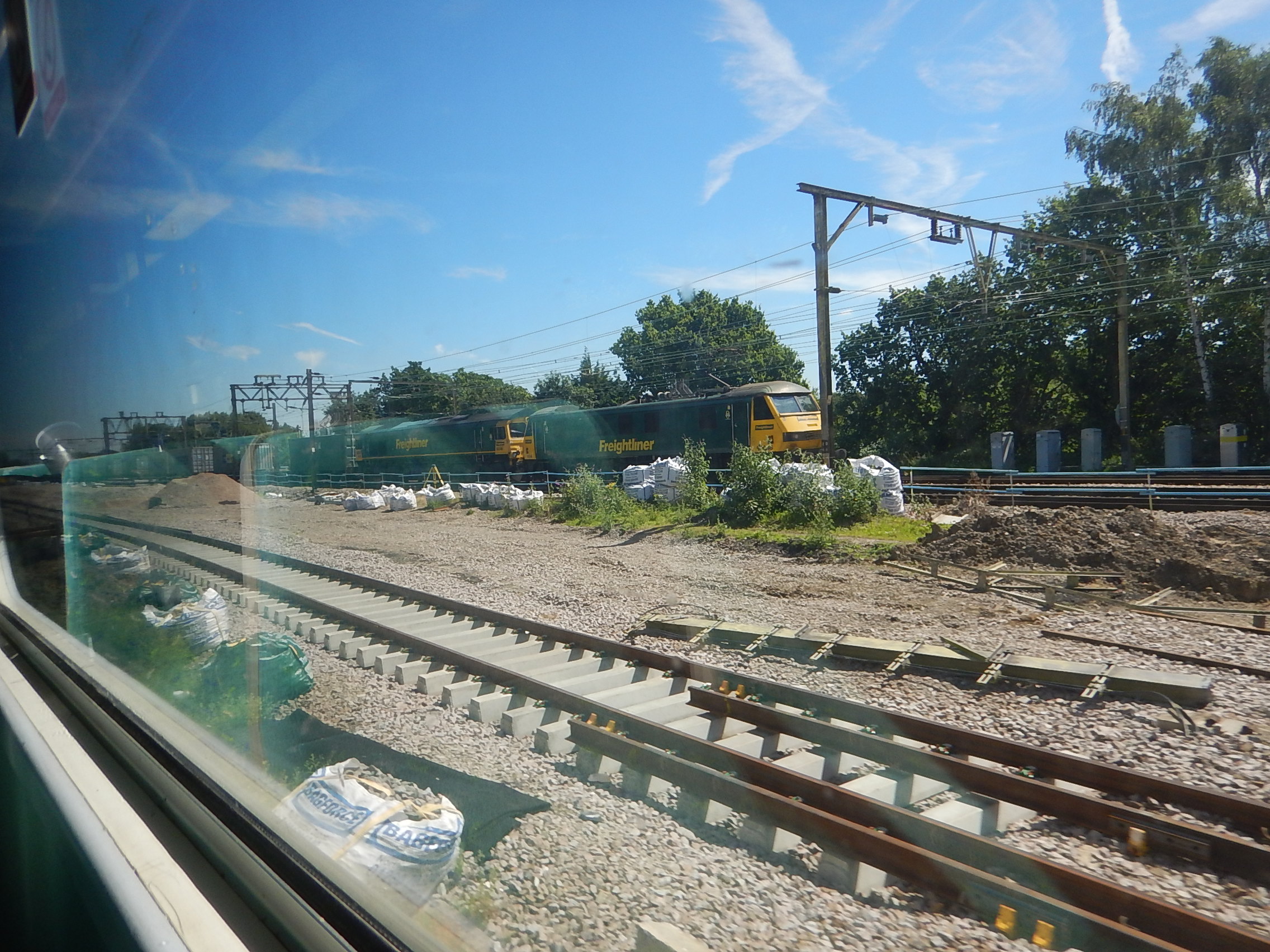
Unfortunately, I didn’t have a chance to ask the driver, if the Class 66 locomotive was running dead-in-train or helping the Class 90 locomotive with a very heavy load.
The picture shows, that the electric and diesel locomotives can work together, at the front of a train.
Note.
- The Class 66 locomotive has a power of 1,850 kW and the Class 90 locomotive has 3,730 kW.
- Did the Class 66 locomotive pull the train out of Felixstowe?
Since I took this picture, I’ve never seen a similar pairing again.
Universal Hydrogen And Railway Locomotives
On the product page of the Universal Hydrogen web site, there is a section, which is entitled Other Transportation Applications, where this is said.
Our lightweight, aviation-grade modular hydrogen capsules can be used in a wide range of transportation applications where weight, safety, and speed of refueling are important. We are working with partners in automotive, heavy equipment, maritime, and railroad domains. If you have an application that can benefit from our global modular green hydrogen distribution network, please get in touch!
I believe that the railway locomotive of the future will be hydrogen-electric. And so do some of the UK’s rail freight companies, judging, by some of their press releases.
- It would have an electric transmission. like most locomotives today, such as the UK’s Class 66, Class 68, Class 70, Class 88, Class 93 and the upcoming Class 99 locomotives.
- It will be able to use 25 KVAC overhead electrification, where it exists.
- Hydrogen-power will be used, where there is no electrification.
The lowest-carbon of the locomotives, that I listed, will probably be the Class 99 locomotive.
- Thirty have been ordered by GB Railfreight, from Swiss company; Stadler.
- The locomotives will be built at Valencia in Spain.
- It will have up to 6 MW, when running using electrification.
- It will have up to 1.6 MW, when running using a Cummins diesel, with a rating of 2,150 hp.
- Because a proportion of UK freight routes are electrified, it is likely that these locomotives will substantially reduce carbon emissions for many locomotive-hauled operations.
It should be noted that Cummins are heavily into hydrogen and their philosophy seems to embrace families of engines, which are identical below the cylinder head gasket, but with appropriate cylinder heads and fuel systems, they can run on diesel, natural gas or hydrogen.
I wouldn’t be surprised to find out that the Class 99 locomotive will have a diesel engine, that has a hydrogen-powered sibling under development at Cummins.
With perhaps a power on hydrogen of about 2.5 MW, these zero-carbon locomotives would be able to handle upwards of ninety percent of all heavy freight trains in the UK.
These are further thoughts.
Alternatives To Cummins Hydrogen Internal Combustion Engines
There are two main alternatives, in addition to similar engines from companies like Caterpillar, JCB, Rolls-Royce mtu and others.
- Fuel cells
- Gas-turbine engines.
Note.
- Universal Hydrogen and others have fuel cells, that can probably deliver 2.5 MW.
- Universal Hydrogen use Plug Power fuel cells.
- Rolls-Royce have developed a 2.5 MW electrical generator, based on the engine in a Super Hercules, that is about the size of a typical beer-keg. I wrote about this generator in What Does 2.5 MW Look Like?.
Cummins may be in the pole position with Stadler, but there are interesting ideas out there!
Cummins have also indicated, they will build hydrogen internal combustion engines at Darlington in the UK.
Would One Of Universal Hydrogen’s Hydrogen Capsules Fit In A Railway Locomotive?
These are various widths.
- Class 66 locomotive – 2.63 metres.
- ATR72 airliner – 2.57 metres.
- DHC Dash-8 airliner – 2.52 metres
- Class 43 power car – 2.74 metres
I suspect that even if it was a bit smaller a hydrogen capsule could be made for a UK locomotive.
How Big Is The Market?
The UK has around five hundred diesel railway locomotives.
Clean Air Power Adds Hydrogen To Class 66 Fuel Mix
The title of this post, is the same as that of this article on the International Rail Journal.
This is the first two paragraphs.
Fuel injection technology developed by Clean Air Power that enables a class 66 locomotive to run on a combination of diesel, biogas and hydrogen has successfully completed nine months of trials with British freight operator Freightliner.
This is the first time that the injection technology has been tested by the rail freight sector and, according to Clean Air Power, paves the way for reducing the emissions of other class 66 locomotives.
Note.
- There are 450 Class 66 locomotives in service in the UK, with more in service in Europe.
- Freightliner was Clean Air Power’s main project partner.
- Nothing was disclosed about carbon savings.
- The trial was backed by £400,000 of Government money.
- The locomotive has completed a nine month trial.
This would appear to be a good professional start to decarbonisation of rail freight.
It’s also rather ironic, that this successful trial of a diesel-saving locomotive was announced on the day of Vlad the Mad’s big parade.
GB Railfreight Names Locomotive For Ukraine
The title of this post is the same as that of this article on Railnews.
This is the first paragraph.
GB Railfreight has unveiled a Class 66 locomotive bearing the nameplates ‘Glory to Ukraine’, and painted in a special livery using the Ukrainan colours. GBRf said it ‘stands with Ukraine, and this newly painted locomotive honours the people affected by the conflict as they continue to courageously defend their homeland’.
Perhaps not in the same class as this article from the Guardian, which is entitled Lithuania Names Road Leading To Russian Embassy ‘Ukrainian Heroes’ Street’.
But every little bit helps!
Dual-Fuel Class 37 And 66 Locomotive Concepts Unveiled
The title of this post, is the same as that of this article on Railway Gazette.
This is the first paragraph.
G-volution and SBL-Rail have produced design concepts for dual-fuel versions of Class 37 and 66 locomotives, which would be able to run on diesel with biomethane, biopropane or hydrogen.
Note.
- There are about sixty Class 37 locomotives in service or stored.
- 480 Class 66 locomotives were originally produced and over 300 must still be in service.
- Both locomotives have electric transmissions.
- G-volution are developing a dual-fuel Class 180 train, that I wrote about in Grand Central DMU To Be Used For Dual-Fuel Trial.
- Two of the design concepts involve replacing the current diesel engines with modern Cummins engines, that meet current emission regulations.
- Fuel savings of ten percent are mentioned for one engine conversion.
This is said about the dual-fuel conversions.
Biomethane and biopropane dual fuel engines would offer significant carbon and cost savings verses diesel. Hydrogen has the potential to do so if produced from renewable sources, but would need to be ‘much cheaper’ than it is today.
The article then gives a table, which shows the various savings.
The article comes to these conclusions.
- Biomethane and biopropane prices are expected to fall, as production increases.
- Green hydrogen is too expensive, but costs will come down.
- More rises in the price of diesel, will tilt costs towards alternative fuels.
I feel that to get the emissions and costs down, there would need to be a bit of cheating.
Look at this picture of a Class 66 locomotive under 25 KVAC electrification.

I wonder, if a pantograph and all the electrical gubbins could be fitted to a Class 66 locomotive to create a genuine electro-diesel locomotive.
- It would use electrification, where it exists.
- It would use the existing electric transmission.
- I do suspect though that the Class 37 locomotive may be more difficult to convert because of its age.
It should be noted that in GB Railfreight Plans Order For Future-Proofed Bi-Mode Locomotives, I talk about how GB Railfreight are proposing to purchase a fleet of new electro-diesel freight locomotives, that appears will have Class 66 locomotive performance on both electrification and diesel.
The Involvement Of Cummins
Cummins, who are one of the world’s largest manufacturers of diesel engines, could have a lot to lose from the move to zero-carbon.
- But they have adopted an if-you-can’t-them-join-them philosophy to hydrogen.
- They have bought up hydrogen companies like Hydrogenics.
- They are developing internal combustion engines that can run on hydrogen.
- Cummins have claimed to me, that they will try to fill any niche market with their engines, so it would be likely, they would apply that philosohy to hydrogen.
I believe that Cummins will not give up their market share without a fight.
I would expect, Cummins will actively support G-volution’s plans, if it would sell upwards of fifty large engines.
Conclusion
I have four main conclusions.
- I believe that this study could lead to a very significant and worthwhile updating of a Class 66 locomotive.
- The locomotive would need to be modified so it could use electrification.
- But I am more dubious, that this could be done with the Class 37 locomotive.
- I also believe that Cummins will be part of the solution.
In the wider world, I also believe that to retain their turnover and market share, Cummins and the other big diesel engine manufacturers will come up with increasingly innovative solutions.
Caterpillar, Cummins, Deutz, JCB, MTU and others will not give up multi-billion businesses without a fight.
Movable Overhead Electrification To Decarbonise Freight
The title of this post is the same as that as this article on Railway Gazette.
This is the first paragraph.
The use of a moveable overhead conductor rail to eliminate the need to use diesel locomotives at freight terminals where traditional fixed electrification equipment would obstruct loading and unloading is being demonstrated in the UK, and a trial in India is planned.
The Railway Gazette article also has two pictures, which show the overhead conductor rail in two positions.
Ipswich And Wentloog
In A Class 93 Locomotive Hauling A Train Between The Port Of Felixstowe And Wentloog, I wrote about running freight trains between Felixstowe and Wentloog using a Class 93 locomotive.
Currently, there appear to be three services a day each way between Felixstowe and Wentloog.
- They are diesel hauled.
- The Class 66 locomotive can’t travel faster than 75 mph.
- The route between Ipswich and Wentloog is fully-electrified.
- Other services that go from Felixstowe to the rest of the UK via London, are sometimes hauled by a Class 90 locomotive from Ipswich.
- Class 90 electric locomotives can haul trains at up to 110 mph.
This Google Map shows the layout of Wentloog freight terminal.
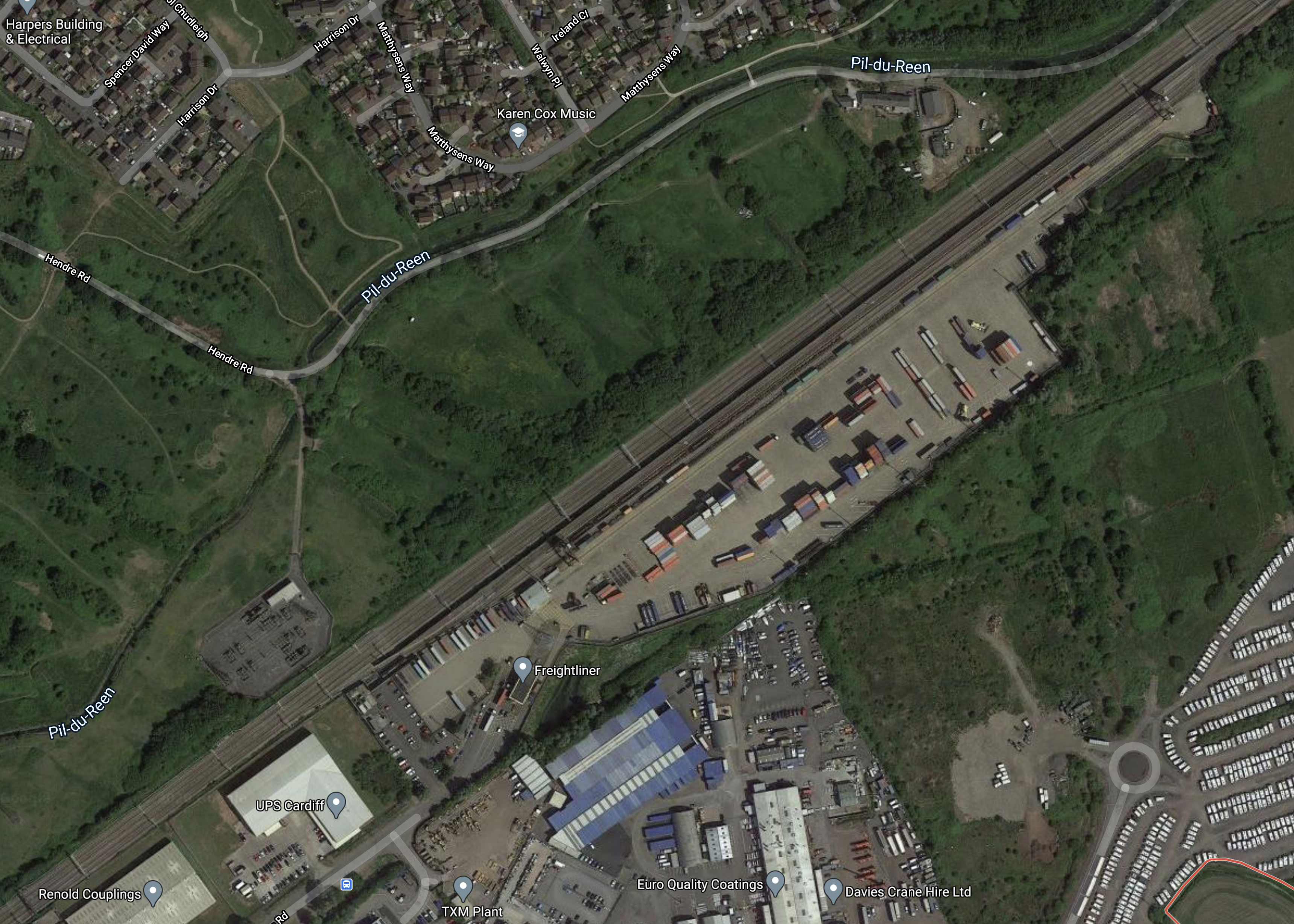
Fitting a moveable overhead conductor rail at Wentloog would surely allow carbon-cutting Class 90 locomotives to haul a train, between Ipswich and Wentloog.
How many other freight terminals can be electrified by installing a moveable overhead conductor rail?
DB Cargo UK Successfully Trials The Use Of ‘Combi-Consists’
The title of this post, is the same as that of this press release on DB Cargo UK.
This is the first paragraph.
DB Cargo UK is trialling the use of ‘combi-consists’ to increase capacity, improve customer service and improve its efficiency.
The next four paragraphs describe the trial.
This month the UK’s largest rail freight operator ran a unique jumbo train from Belmont Yard in Doncaster to Barking, East London, carrying a mix of wagons for two altogether different types of customers.
The train consisted of two sets of empty wagons – 21 x MBA wagons for Ward Recycling and 18 x JNA wagons for FCC Environment – with an isolated DIT (dead-in-train) locomotive – in the middle.
The MBA wagons had previously been discharged at Immingham in North Lincolnshire and the JNA wagons discharged at FCC Environment’s new waste transfer facility at Tinsley in South Yorkshire.
Both sets of wagons were then taken to DB Cargo UK’s Belmont Yard depot in Doncaster where the jumbo train was assembled. The train travelled from Belmont Yard to Barking via Lincoln Central, Spalding, The East Coast Mainline, Hertford North and Canonbury Tunnel.
There is also a video embedded in the press release, which shows the formation of the train in detail.
This train is certainly efficient, as it uses less train paths, crew and fuel.
DB Cargo UK now intend to trial the concept on a greater portion of the East Coast Main Line and the Midland Main Line.
I have a few thoughts.
Could The Concept Work With Loaded Trains?
This trial was with empty trains, but would it be possible to use the concept with two shorter loaded trains?
Would there be advantages in terms of efficiency, if the following were done?
- Two container trains leave Felixstowe as a pair, with one going to Plymouth and the other going to Cardiff.
- They split at say Swindon and then proceed independently.
Obviously, all the weights would have to be in order and the locomotive would need to be able to pull the combined train.
Other possibilities might be.
- Stone trains running from the Mendips and the Peak District to London.
- Biomass trains running from import terminals to power stations in the Midlands.
- Trains delivering new cars.
- Trains delivering goods for supermarkets. Tesco are certainly increasing their use of trains.
I would suspect that DB Cargo UK have several ideas.
Could An Electric Locomotive Go In The Middle?
A Class 90 locomotive weighs 84.5 tonnes, as against the 129.6 tonnes of the Class 66 locomotive used in the trial.
So if the electric locomotive can be run dead-in-train, the weight would be slightly less.
But this might give a big advantage, if they ever wanted to run a pair of trains from Felixstowe to Plymouth and Cardiff, as per my earlier example.
- The trains would split anywhere on the electrified section of the Great Western Main Line.
- The lead train would go to Plymouth.
- The second train would go to Cardiff, which is now fully electrified.
There would appear to be possibilities to save carbon emissions.
Could An Electric Locomotive Go On The Front?
Some routes out of Felixstowe are fully-electrified from the Great Eastern Main Line.
It could be possible for the following.
- Two diesel-hauled trains to leave Felixstowe with ubiquitous Class 66 locomotives and form up as a combi-consist train in Ipswich yard.
- The Class 66 locomotive on the front is replaced by an electric locomotive.
- Both Class 90 and Class 92 electric locomotives have twice the power of a Class 66 locomotive, so both should be able to haul the combi-consist train.
The trains would split en-route with the electric locomotive hauling a train to an electrified destination.
This picture shows, what could be an experiment by Freightliner at Shenfield.
Unfortunately, I didn’t have a chance to ask the driver, if the Class 66 locomotive was running dead-in-train or helping the Class 90 locomotive with a very heavy load.
The picture shows, that the electric and diesel locomotives can work together, at the front of a train.
Since I took this picture, I’ve never seen a similar consist again.
Could A Bi-Mode Locomotive Go On The Front?
In GB Railfreight Plans Order For Future-Proofed Bi-Mode Locomotives, I talked about how GB Railfreight had started negotiations to purchase a fleet of powerful bi-mode locomotives from Stadler.
- Provisionally, they have been called Class 99 locomotives.
- The locomotives will be Co-Co bi-modes.
- The diesel engine will be for heavy main line freight and not just last-mile operations.
- I suspect that on diesel the power will be at least 2.5 MW to match a Class 66 locomotive.
These locomotives could be ideal for hauling combi-consist trains.
Would Combi-Consist Trains Save Energy?
This could be a big driver of the use of combi-consist trains and may push DB Cargo UK to acquire some powerful bi-mode locomotives.
Conclusion
Combi-consist trains seem to be an excellent idea.
GB Railfreight Plans Order For Future-Proofed Bi-Mode Locomotives
The title of this post, is the same as that of this article on Railway Gazette.
This is the introductory paragraph.
GB Railfreight is planning to order a fleet of main line electro-diesel locomotives with a modular design which would facilitate future replacement of the diesel engine with a battery or hydrogen fuel cell module.
The rest of the article gives clues to the deal and the specification of the locomotives.
- Negotiations appear to have started with Stadler for locomotives to be built at their Valencia plant.
- Twenty locomotives could be ordered initially, with options for thirty.
- The locomotive will be Co-Co bi-modes.
- The diesel engine will be for heavy main line freight and not just last-mile operations.
- They would be capable of hauling freight trains between Ipswich and Felixstowe, within two minutes of the times of a Class 66 locomotive.
- They will be of a modular design, so that in the future, the diesel engine might be replaced by a battery or fuel cells as required and possible.
They have provisionally been called Class 99 locomotives.
These are my thoughts.
EuroDual or UKLight?
Stadler make two types of bi-mode locomotives.
But the two types are closely related and open up other possibilities.
This paragraph from the Eurolight wikipedia entry, explains the various versions.
The type has been intentionally developed to support use on secondary lines without limiting power or speed performances, making it suitable for mixed traffic operations. Specific versions of the Eurolight have been developed for the United Kingdom market, and a 6-axle Co’Co’ machine for narrow gauge Asian markets, named UKLight and AsiaLight respectively. Furthermore, an electro-diesel locomotive derivative of the UKLight that shares much of its design, referred to as the Stadler Euro Dual, has also been developed and introduced during the late 2010s.
It looks like the customer can get the locomotive they want.
GB Railfreight would probably need locomotives to this specification.
- Slightly narrower than a EuroDual, to fit the UK loading gauge.
- Three-axle bogies to handle the weight of the larger locomotive.
- A body bigger than the UK Light to be large enough for the diesel engine.
- It would probably help if the locomotive could go anywhere that a Class 92 locomotive could go, so it could handle their duties if required.
This leads me to the conclusion that GB Railfreight will get a slightly narrower EuroDual.
Weight Issues
The weights of various locomotives are as follows.
- Class 66 Locomotive – 129.6 tonnes
- Euro Dual – 126 tonnes
- Class 90 Locomotive – 84.5 tonnes
- Class 92 Locomotive – 126 tonnes
All locomotives have six axles, except for the Class 90 Locomotive which has four.
I don’t think there will be any weight issues.
Power On Electricity
These are the power of the locomotives on electricity.
- Class 66 Locomotive – Not Applicable
- Euro Dual – Up to 7 MW
- Class 90 Locomotive – 3.7 MW
- Class 92 Locomotive – 5 MW
GB Railfreight can probably have what power is best for their routes.
Operating Speed On Electricity
These are the power of the locomotives on electricity.
- Class 66 Locomotive – Not Applicable
- Euro Dual – 100 mph
- Class 90 Locomotive – 110 mph
- Class 92 Locomotive – 87 mph
GB Railfreight can probably have what power is best for their routes, but I suspect they’d want it to be as fast as a Class 90 locomotive.
Power On Diesel
These are the power of the locomotives on diesel.
- Class 66 Locomotive – 2.5 MW
- Euro Dual – Up to 2.8 MW
- Class 90 Locomotive – Not Applicable
- Class 92 Locomotive – Not Applicable
To be able to handle trains, that a Class 66 locomotive is able to, 2.5 MW would probably suffice.
Could The Locomotives Use The Channel Tunnel?
I suspect that diesel locomotives are not liked in the Channel Tunnel because of all that flammable diesel.
But in the future, when there is a battery-electric variant, I would suspect that would be allowed.
In UK To France Automotive Train Service Launched, I talked about Toyota’s new service between Toton in England and Valenciennes in France via the Channel Tunnel. A locomotive with sufficient battery range might be ideal for this service, if it could handle the Market Harborough and Toton section, which is likely to be without electrification for some years.
Will The Locomotives Have Third Rail Shoes?
If their power on electricity is such that they can stand in for Class 92 locomotives, then there may be a need to fit all or some of the locomotives with third rail shoes.
As an example, they might be useful in taking freight trains to and from Southampton or the Channel Tunnel.
Conclusion
I feel that, as the locomotive must fit current routes and schedules, so I wouldn’t be surprised to see the following specification.
- UK loading gauge.
- Co-Co
- Class 90 locomotive power and operating speed on electricity of 3.7 MW and 110 mph.
- Class 66 locomotive power and operating speed on diesel of 2.5 MW and 75 mph.
- Ability to change between electric and diesel power at speed.
- Ability to haul a heavy freight train out of Felixstowe.
- Ability to haul passenger trains.
Stadler will have one eye on the fact, that if they get this design right, this order for up to fifty locomotives could be just the start.
It certainly seems a locomotive designed for the UK’s railway system.
Fortescue Unveils World-First Electric Train Using Gravity To Recharge
The title of this post, is the same as that of this article on InnovateAus.
These two paragraphs summarise the project.
Fortescue has announced the development of an electric train that recharges itself using gravity, as the Australian resources giant finalises its acquisition of UK-based Williams Advanced Engineering.
Fortescue is dedicating $50 million, in partnership with Williams Advanced Engineering (WAE), for research and development on the Infinity Train, which fully recharges its battery using gravitational energy when it descends.
Note.
- Most of Australia’s iron ore is mined in the Pilbara region of Western Australia.
- There are at least four railways in Pilbara leading to the coast.
- As the mines are higher than the coast, the heavily loaded trains will be going downhill, whereas the empties will be going uphill.
- There would certainly appear to be scope for charging going to the coast and coming back on a full battery with the empties.
- 94 % of Australia’s iron ore exports are transported by train from Pilbara to the coast.
There are hundreds of locomotives used for transportation of Iron ore from Pilbara to the coast.
Will Williams Convert Existing Locomotives?
I suspect they will as this is route that Wabtec is taking with their FLXdrive locomotives.
Will Williams Convert Locomotives For Other Pilbara Companies?
I suspect what Andrew Twiggy Forest wants he gets.
Could Williams Convert Other Diesel Electric Locomotives
I suspect they could and I wouldn’t rule out seeing a battery-electric Class 66 locomotive.
I laid out my thoughts in Could Class 66 Locomotives Be Converted Into Battery-Electric Locomotives?.
Rolls-Royce And Porterbrook Agreement Will Drive Rail Decarbonisation
The title of this post, is the same as that of this press release from Porterbrook.
This is the important part of the press release.
Rolls-Royce is teaming up with Porterbrook to identify and develop technological innovations to reduce carbon emissions and improve air quality across the rail network. The two companies, who have signed a memorandum of understanding, will investigate the potential for the use of synthetic and net zero fuels, including hydrogen, both in fuel cells and internal combustion engines. Building on their recent success of jointly introducing hybrid battery-diesel railcars into passenger service, the two companies will also explore the potential for advanced hybridisation.
The relationship also includes considering the role of the wider rail ecosystem in decarbonisation, including fuel chain supply, infrastructure and operational models that can aid innovation and the transition to net zero.
The UK’s railway accounts for approximately 1% of all domestic greenhouse gas (GHG) emissions* and the Government’s ambition is to remove all diesel-only trains – both passenger and freight – from the network by 2040 and achieve a net zero rail network by 2050. The UK Government has identified a number of different routes to this target including alternative forms of power such as hydrogen, fuel cells, batteries, hybrid-electric and sustainable fuels.
Rolls-Royce have issued a similar press release.
I believe this agreement could result in significant benefits to the UK rail industry, in respect to reduction in diesel consumption, noise and carbon emissions.
Examples could include.
- Conversion of Bombardier Turbostars to hybrid operation. I covered this in UK’s First 100mph Battery-Diesel Hybrid Train Enters Passenger Service.
- Conversion of Class 66 locomotives to hydrogen power.
- Conversion of Class 43 power-cars to hydrogen power.
Unfortunately, I can’t add more examples as there is no Porterbrook fleet list on their web site.
 The Anonymous Widower