Will The Railway Between Buxton And Matlock Be Reopened?
In Issue 901 of Rail Magazine in an article about reopening the Northern route between Exeter and Plymouth, this is said, about possible rail re-opening of Beeching cuts.
Although not yet confirmed, they are believed by RAIL to include bids to reinstate the former Midland Railway route from Matlock-Buxton, and the line between Lostwithiel and Fowey.
I have found this news story on the Matlock Mercury, which is entitled Quarry Firms And Heritage Operator Consider Peak District Railway Line.
This is the introductory paragraph.
Proposals to revive a disused rail line through the Peak District have moved a step forward, but not the passenger service some have called for.
The reasons for the reinstatement are given in the story.
- There is an enormous demand for stone from projects like Crossrail 2, High Speed Two and Heathrow Expansion and Derbyshire is a major source.
- Currently, stone trains between Derbyshire and the South-East take a roundabout route via the congested and unsuitable Hope Valley Line and Sheffield.
- A route via Matlock would join the Midland Main Line nearly thirty miles further South.
It should be noted that the original track-bed still exists and part is used for the double-track Peak Rail, with much of the rest being used for the cycling and walking route; the Monsal Trail.
Thoughts About The Design Of The Railway
In the June 2017 Edition of Modern Railways, there is an excellent article, which is entitled Connecting The Powerhouses, that was written by Colin Boocock.
I wrote a post with the same name, based on his article, from which a lot of the following thoughts are taken.
Colin Boocock’s Thoughts On The Design
I said this in my previous post.
The track bed of the Peak Main Line is still intact and the author of the article suggests that there could be two ways of rebuilding the railway.
- As a 75 mph single-track railway sharing the track-bed with the Monsal Trail.
- As a 90 mph double-track railway, after moving the Monsal Trail to a more picturesque route.
Four or five, reopened or new stations could be built with passing loops to enable the minimum service frequency to be achieved, which the author suggests should be the following in both directions in every hour.
- One fast passenger train
- One stopping passenger train.
- One freight train; full or empty.
But there are possible problems.
- The A6 has to be crossed.
- One local landowner didn’t allow consultants access to the line for an inspection.
- Severn Trent Water are digging a large pipe into the track-bed.
- Peak Rail have plans to extend their heritage line to Bakewell. Could both groups co-exist?
It sounds to me that everybody should find a good hostelry and thrash out a comprehensive co-operation agreement on the backs of engineering envelopes, fuelled by some excellent real ale.
But various improvements to the route and railway technology in general, in the last few years have probably made the reinstatement less challenging.
Ambergate Station And Junction
Ambergate station and the associated junction is where trains for Matlock station, leave the Midland Main Line and take the Derwent Valley Line.
This article on the BBC is entitled Major Rail Works To Affect Derbyshire Train Services and it describes work done to improve Ambergate Junction.
It is to be hoped, that the updating of the junction is at least well-documented, so that it can be updated easily to accept stone trains to and from the Derwent Valley Line.
Improved Handling Of Freight Trains At Buxton
In £14m Peak District Rail Freight Extension Unveiled, I indicated that the improvements at Buxton had been completed.
- There are now two long sidings, that can each take a 26 wagon stone train and allow them to reverse.
- Capacity has increased by 44 %
- No more trains will be running.
According to this document on the Network Rail web site, the sidings operate on a 24 hour basis and on average, accommodate 6-10 freight trains every 24 hour period.
I’m not sure, but it looks like the sidings also allow all stone trains to access the following.
- All quarries in the area with a rail connection.
- The Great Rocks Freight Line to access the Hope Valley Line and Sheffield
- The proposed reopened rail line to Matlock, Derby and the South.
The track layout at Buxton station would appear to allow trains to go between Manchester and Derby, once the Matlock and Buxton railway is reinstated.
Ambergate Station And Junction
Ambergate station and the associated junction is where trains for Matlock station, leave the Midland Main Line and take the Derwent Valley Line.
This article on the BBC is entitled Major Rail Works To Affect Derbyshire Train Services and it describes work done to improve Ambergate Junction.
It is to be hoped, that the updating of the junction is at least well-documented, so that it can be updated easily to accept stone trains to and from the Derwent Valley Line.
Signalling Improvements
One of Colin Boocock’s options for the route, is a 75 mph single-track railway sharing the track-bed with the Monsal Trail.
Single-track railways running an intense schedule could be a challenging signalling problem in the past, but with in-cab digital signalling, as used on Thameslink and the London Underground, it is much less onerous.
It should be possible to handle Colin Boocock’s desired minimum frequency of three trains per hour (tph) in both directions.
Colin Boocock’s second option of a 90 mph double-track railway, after moving the Monsal Trail to a more picturesque route, would be very much easier to signal to a very high degree of safety.
Electrification
Electrification would surely, be the best way to get heavy freight trains in and out of the area.
But I suspect the line could not be electrified in a traditional manner, as heavy gantries in the Peak District would not go down well!
But what about a design something like this?
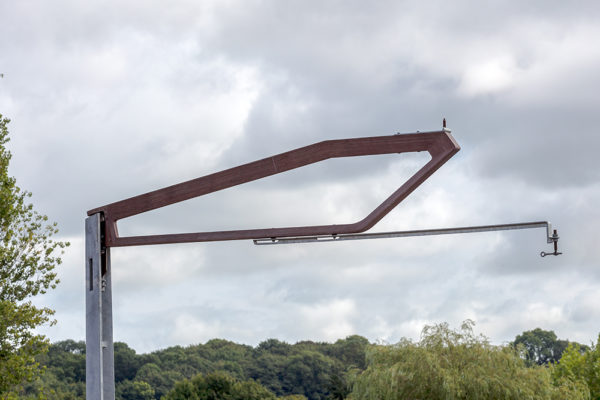
I talk about this design in Prototype Overhead Line Structure Revealed.
It does seem to be a good attempt to reduce the clutter of girders, gantries and wires!
Freight Locomotives
If electrification is not possible, which is probably the case, as the locomotives will need access to large amounts of freight sidings, then diesel power will be needed,
The current Class 66 locomotives are not the most environmentally-friendly locomotives, but hopefully in a sensitive area like the Peak District, some more advanced locomotives could be used.
Passenger Trains
Quiet battery-electric or hydrogen-powered trains would be ideal for the route.
How Many Stone Trains Will Use The Route?
With the current lockdown because of COVID-19, it’s a bit difficult to ascertain how many stone trains are currently going into and out of the quarries in an hour.
But from the Network Rail figures, I have found and Colin Boocock’s minimum figure, it looks like one tph would be a frequency for which to aim.
Could this frequency be handled between Matlock And Buxton?
Even if the route was single-track with passing loops, Colin Boocock’s minimum timetable could be achieved.
Note that the Great Rocks Freight Line will still be capable of handling trains via the Hope Valley Line and Sheffield.
Conclusion
I think that this scheme could be feasible, if engineers used modern signalling and other designs to blend in with the scenery.
Switching From Lorries To Freight Trains Could Cut Air Pollution By 10%
The title of this post is the same as this article on Rail Technology Magazine. This is the first paragraph.
Making the switch from HGVs to trains for freight travel could lead to 10% less air pollution from NOx across the country, says new research from the Campaign for Better Transport (CBT).
The major problem will be to get freight operators to switch from road to rail.
However, I do feel that this may be hastened by external factors and innovative methods and technology.
Shortages Of Train And Truck Drivers
There are regular news items about shortages of train and truck drivers.
I would think, that both careers will attract the same type of person.
Both careers will have their good and bad points.
But after a search of the Internet, it does appear that the train driver will earn more than the truck driver.
So will a shortage of truck drivers, nudge more freight operators to use rail?
Track Improvements For Rail Freight
Over the last decade or so, there have been several improvements in track layouts, that have been driven by the need to increase the amount of freigt carried by rail.
- The development of the Great Northern and Great Eastern Joint Line through Lincolnshire as a freight by-pass for the East Coast Main Line.
- The building of the Bacon Factory Chord to increase capacity to and from the Port of Felixstowe.
- Electrification of the Gospel Oak to Barking Line will create a second electrified freight route across London.
- Several passing loops have been lengthened to allow longer freight trains.
- The Ordsall Chord will help freight through Manchester.
Obviously any general improvements will help freight trains as well as passenger trains.
Air-Pollution Activitists And Politicians
Most long-distance rail-freight is diesel-hauled and increasingly it goes through areas of large cities, where there is electrification. These electrified lines all see diesel-hauled freight trains.
- The North London Line
- The West London Line
- The Gospel Oak to Barking Line
- The Ordsall Chord
- The Great Eastern Main Line
- The West Coast Main Line
- The East Coast Main Line
- The Great Western Main Line
It will not be long before air-quality activists set their sites on removing diesel haulage from lines like these.
Will a local politician in North London say, be more likely to get elected, if they say, they will push for a ban on noisy and polluting diesel-powered locomotives running through their constituency.
The Replacement Of Diesel Locomotives With Electro-Diesel Locomotives
If you take a freight route like say Felixstowe to Trafford Park in Manchester via the Great Eastern Main Line, the North London Line and the West Coast Main Line, all of the route except for the two ends is electrified.
Normally, freight on this route would be hauled by a Class 66 diesel-locomotive, which would probably score 2/10 as a friend of the environment.
A modern electro-diesel locomotive, like a Class 88 locomotive may be able to this and similar routes using electricity in the middle and its onboard diesel engine at both ends of the route.
The various locomotives, used on UK freight trains compare as follows.
- Class 66 – 65/75 mph – 2.4 MW on diesel
- Class 68 – Modern diesel to Stage II A emission standards – 100 mph – 2.8 MW on diesel
- Class 70 – 75 mph – 2.7 MW on diesel
- Class 86 – 75 mph – 0.7 MW on electricity
- Class 88 – 100 mph – 4 MW on electricity – 0.7 MW on diesel
- Class 90 – Electric locomotive – 100 mph – 0.9 MW on electricity
- Class 92 – Electric locomotive – 87 mph – 5 MW on electricity
As the table shows the Class 66 locomotives are slow and less powerful than both the more modern Class 68 or Class 88 locomotives.
Cynically, I would say that the only reason that Class 66 and Class 70 locomotives are still in service is that they are good for the bottom line.
Despite this, I feel we’ll see an increasing number of electro-diesel locomotives like the Class 88 arriving in the UK.
New Electric Locomotives
Judging by some of the strange combinations, I’ve seen on some freight trains, we are short of electric locomotives.
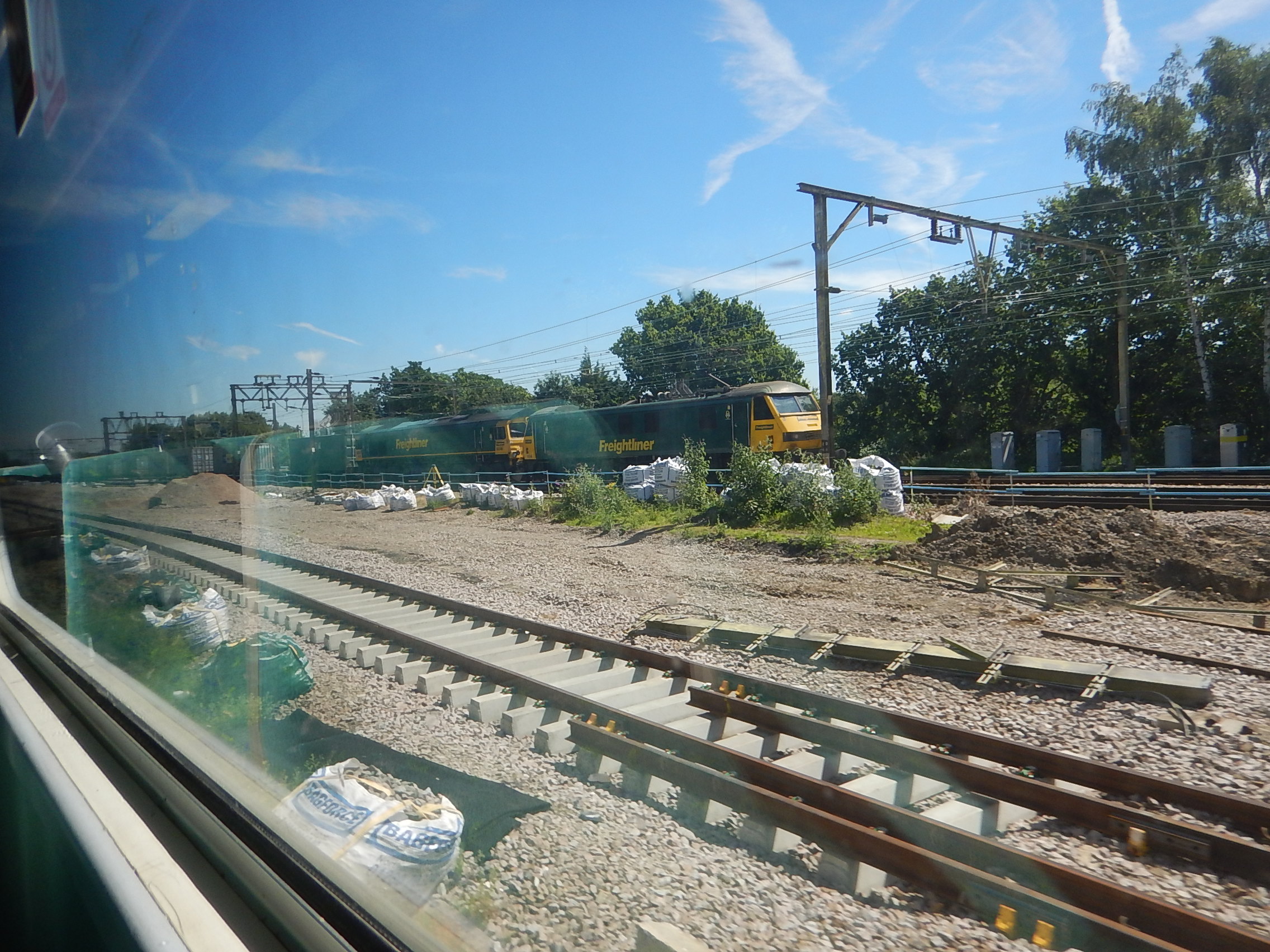
This double-headed train has a Class 90 electric locomotive and a Class 66 diesel locomotive at the front of a long freight train.
Even electric locomotives from the 1960s are being called up for service.
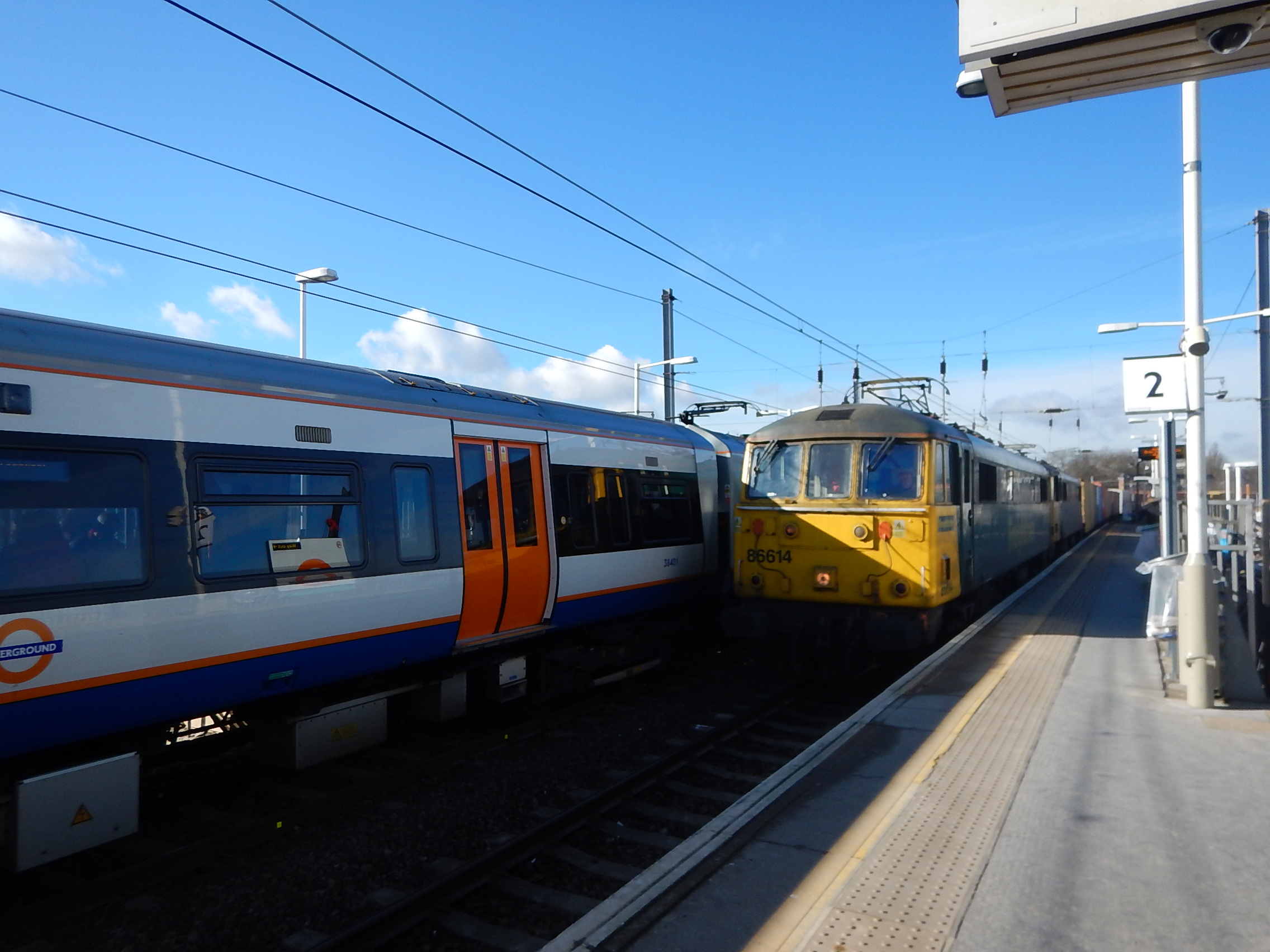
These two Class 86 locomotives were hauling a freight train through Hackney Wick station.
I think we’ll see small numbers of new electric locomotives arriving in the UK.
I suspect too, that freight operators are preparing their bids for the fifteen Class 90 locomotives, that will be released in the next few years by Greater Anglia.
More Electrification
In a couple of years, there will be full electrification from London to Bristol and Cardiff.
Although the Government has put a hold on a lot of electrification, current schemes like electrification of the Great Western Main Line will increase the use of electric or electro-diesel haulage.
Other smaller schemes might be added to increase the use of electric haulage for freight.
As an example, the lines into the important freight ports of London Gateway and Liverpool Two are not electrified. Electrifying both would probably increase the proportion of electrically-hauled freight.
An Unnecessary Diesel-Hauled Train
I took these picture at Blackhorse Road station this morning.
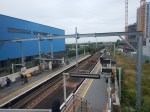


This train from Moss End to Dagenham Dock is pathed to be electric-hauled. So why was it hauled by a noisy and polluting Class 66 locomotive?
Could A Modular Family Of Freight Locomotives Be Created?
In Thoughts On A Battery/Electric Replacement For A Class 66 Locomotive, I looked at the possibility of creating a battery/electric locomotive with the performance of a Class 66 locomotive.
- I felt that the locomotive would need to be able to provide 2,500 kW for two hours on battery, to bridge the gaps in the UK electrification.
- This would need a 5,000 kWh battery which would weigh about fifty tonnes.
- It would be able to use both 25 KVAC overhead and 750 VDC third-rail electrification.
- It would have a power of 4,000 kW, when working on electrification.
- Ideally, the locomotive would have a 110 mph operating speed.
It would be a tough ask to design a battery/electric locomotive with this specification.
The Stadler Class 88 Locomotive
Suppose I start with a Stadler Class 88 locomotive.
- It is a Bo-Bo locomotive with a weight of 86.1 tonnes and an axle loading of 21.5 tonnes.
- It has a rating on electricity of 4,000 kW.
- It is a genuine 100 mph locomotive when working from 25 KVAC overhead electrification.
- The locomotive has regenerative braking, when working using electrification.
- It would appear the weight of the diesel engine is around seven tonnes
- The closely-related Class 68 locomotive has a 5,600 litre fuel tank and full of diesel would weight nearly five tonnes.
In Thoughts On A Battery Electric Class 88 Locomotive On TransPennine Routes, I said this about replacing the diesel-engine with a battery.
Supposing the seven tonne diesel engine of the Class 88 locomotive were to be replaced by a battery of a similar total weight.
Traction batteries seem to have an energy/weight ratio of about 0.1kWh/Kg, which is increasing with time, as battery technology improves.
A crude estimate based on this energy/weight ratio would mean that at least a 700 kWh battery could be fitted into a Class 88 train and not make the locomotive any heavier. Given that lots of equipment like the alternator and the fuel tank would not be needed, I suspect that a 1,000 kWh battery could be fitted into a Class 88 locomotive, provided it just wasn’t too big.
This would be a 4,000 kWh electric locomotive with perhaps a twenty minute running time at a Class 66 rating on battery power.
The Stadler Class 68 Locomotive
The Stadler Class 68 locomotive shares a lot of components with the Class 88 locomotive.
- It is a Bo-Bo locomotive with a weight of 85 tonnes and an axle loading of 21.2 tonnes.
- It has a rating on diesel of 2,800 kW.
- It is a genuine 100 mph locomotive.
- The locomotive has regenerative braking to a rheostat.
- It has a 5,600 litre fuel tank and full of diesel would weight nearly five tonnes.
They are a locomotive with a growing reputation.
A Double Bo-Bo Locomotive
My devious engineering mind, thinks about what sort of locomotive would be created if a Class 68 and a Class-88-based battery/electric locomotive were integrated together.
- It would be a double Bo-Bo locomotive with an axle loading of 21.5 tonnes.
- It has a rating on electricity of 4,000 kW.
- It has a rating on diesel of 2,800 kW.
- Battery power can be used to boost the power on diesel as in the Stadler Class 93 locomotive.
- It would be nice to see regenerative braking to the batteries.
Effectively, it would be a diesel and a battery/electric locomotive working together.
This picture shows a Class 90 electric locomotive and a Class 66 diesel locomotive pulling a heavy freight train at Shenfield.
If this can be done with a diesel and an electric locomotive, surely a company like Stadler have the expertise to create a double locomotive, where one half is a diesel locomotive and the other is a battery/electric locomotive.
A Control Engineer’s Dream
I am a life-expired Control Engineer, but I can still see the possibilities of creating an sdvanced control system to use the optimal power strategy, that blends electric, battery and diesel power, depending on what is available.
I feel that at most times, the locomotive could have a power of up to 4,000 kW.
The Ultimate Family Of Locomotives
I have used a diesel Class 68 and a Class 88-based battery/electric locomotive,, to create this example locomotive.
In the ultimate family, each half would be able to work independently.
In time, other members of the family would be created.
A hydrogen-powered locomotive is surely a possibility.
The Control System on the master locomotive, would determine what locomotives were coupled together and allocate power accordingly.
Conclusion
I have used Stadler’s locomotives to create this example locomotive.
I suspect they are working on concepts to create more powerful environmentally-friendly locomotives.
As are probably, all the other locomotive manufacturers.
Someone will revolutionise haulage of heavy freight trains and we’ll all benefit.
Freight Diesel Traction Realities
The title of this post is the same as that of a comprehensive article by Roger Ford in an article in the April 2019 Edition of Modern Railways.
In the article Roger talks about the problems of decarbonising the freight sector on the UK’s railways.
Future Traction
This section in the article begins with this paragraph
Since the laws of physics and chemistry rule out pure battery or hydrogen fuel cell 3 MegaWatt (4,000 hp) freight locomotives from around 2035 we are going to need to start replacing the diesel locomotives for routes yet to be electrified.
The following actions are suggested.
- More electrification, through a rolling program.
- Research into and production of low-CO2 locomotives.
- 4000 hp locomotives to run faster, longer and heavier freight trains.
These actions will apply to many countries in Europe and the wider world.
Hybrid
This section in the article begins with these two paragraphs.
Extension of electrification will reduce the length of the last miles beyond the end of the wires, making increased use of electric traction viable. Here the challenge will be to provide sufficient diesel traction power and range. Stadler’s Class 93 ‘tri-mode’ locotive provides an interesting preview.
It builds on the Class 88, which adds a 700kW diesel engine to a 4MW Bo-Bo electric locomotive.
The Class 93 locomotive has a larger 900 kW diesel engine and a lithium titanate oxide battery.
I estimated the battery size at 126 kWH in Stadler’s New Tri-Mode Class 93 Locomotive.
Roger reckons that the battery gives 6-7 ,minutes of power to boost output to 1,740 hp or 1300 kW.
- The boost from the battery would appear to be 400 kW
- For 6.5 minutes this would need 43.3 kWH
Either Roger’s 6-7 minutes or my deduced battery size of 126 kWH is wrong. So I will assume both figures are wrong.
Suppose though, you wanted to boost the power of a Class 93 locomotive to the 2,500 kW of a Class 66 locomotive for an hour, which would get a freight train into or out of the Port of Felixstowe.
- 1600 kW will be needed to boost the diesel engine.
- 1600 kWH will need to be stored in the battery.
- I will assume 75 Wh/Kg for the LTO batteries.
- I have made no allowance for the use of regenerative braking.
This gives a weight of 21.3 tonnes for the batteries.
Roger says this in the article.
If you need to fit diesel engines and batteries into an electric locomotive for freight the a Co-Co configuration gives you another 20 tonnes on a 17.5 tonne axle load.
This leads me to believe that a hybrid locomotive with the power of a Class 66 locomotive and a range of one hour is possible.
Roaming Around East Anglia – Freight Trains Through Newmarket
The East West Rail Consortium plan to change the route of freight trains to and from Haven Ports; Felixstowe, Harwich and Ipswich to the West of Kennett station.
In this document on the East-West Rail Consortium web site, this is said.
Note that doubling of Warren Hill Tunnel at Newmarket and
redoubling between Coldham Lane Junction and Chippenham Junction is included
in the infrastructure requirements. It is assumed that most freight would operate
via Newmarket, with a new north chord at Coldham Lane Junction, rather than
pursuing further doubling of the route via Soham.
How would these changes affect Newmarket and the horse-racing industry in the town?
How Many Freight Trains Are We Talking About?
This table shows the number of freight trains going through Kennett station on the 1st of March 2019.
- 00 1 1
- 01 1 0
- 02 0 1
- 03 2 1
- 04 1 1
- 05 1 1
- 06 1 2
- 07 1 1
- 08 1 0
- 09 1 0
- 10 1 0
- 11 0 0
- 12 0 0
- 13 2 2
- 14 0 2
- 15 1 1
- 16 0 1
- 17 1 1
- 18 0 1
- 19 1 1
- 20 1 0
- 21 1 2
- 22 0 2
- 23 0 0
In the table the first figure is the hour, the second figure is the number of freight trains going West and the third figure is the number of freight trains going East.
This gives a daily total of eighteen trains going West and twenty-one trains going twenty-one trains going East.
But these figures will increase!
At present, Network Rail are adding a passing loop on the Felixstowe Branch Line. This article on Rail Magazine is entitled £60.4m Felixstowe Branch Upgrade Under Way and says this about the upgrade.
Installing the new line will create capacity for up to ten additional freight trains, each the equivalent of 76 lorries.
Not all will come via Kennett, as some will go via London.
The Port of Felixstowe will get larger and other improvements on the route across Suffolk will increase the number of freight trains passing through Kennett station.
I estimate that it is very likely that in a few years there will be two trains per hour (tph) in both directions for every hour of the day.
Rerouting The Trains Through Newmarket
Currently, these freight trains go via Ely, but the plan of the East West Rail Consortium would be to reroute all these freight trains through the Warren Hill tunnel and Newmarket station.
I suspect the reasons for the change of route could include the following.
Accessing The East West Rail Link From Newmarket Is Easy And Quick
If as expected the East West Rail Link joins the London-Cambridge Line just South of Cambridge South station, then the trains would run through Dullingham, Cambridge and Cambridge South stations, when running between the East West Rail Link and Newmarket station.
The East West Rail Link Will Be An Efficient Railway
Drive on a new motorway and the curves are smooth with relaxed gradients.
A new railway will be like that too and less energy will be used to power trains along its length.
Increasing the Capacity Through Ely Is Difficult
There is a very complicated track layout at Ely and increasing the number of trains might be difficult or very expensive.
Freight Trains Will Use The East West Rail Link To Avoid London
Take going between the Haven Ports and Bristol or South Wales.
Currently, these trains tend to go via London and in a couple of years will have to share tracks with London’s intensive Crossrail network between Acton Main Line and Reading stations.
Using the East West Rail Link, the trains would join the Great Western Main Line at Didcot, a few miles West of Reading.
How many services will use the East West Rail Link to by-pass London?
Freight Trains Will Use The East West Rail Link To Get To The West Coast Main Line
Currently, these trains either go via London or take the slow cross-country route via Peterborough to Nuneaton for the West Coast Main Line.
If they use the East-West Rail Link, they can join the West Coast Main Line at Bletchley.
The East-West Rail Link Will Be An Important Freight Link
I think that as the years pass and more freight terminals are created, we will see more freight trains using the East-West-Rail-Link and many of these trains will go through Newmarket.
What Problems Would The Rerouting Create In Newmarket?
I can see these problems.
Noise And Vibration
Four freight trains per hour will create a lot of noise and vibration as they pass through.
Frightening The Horses
This Google Map shows a corner of the gallops at Newmarket.
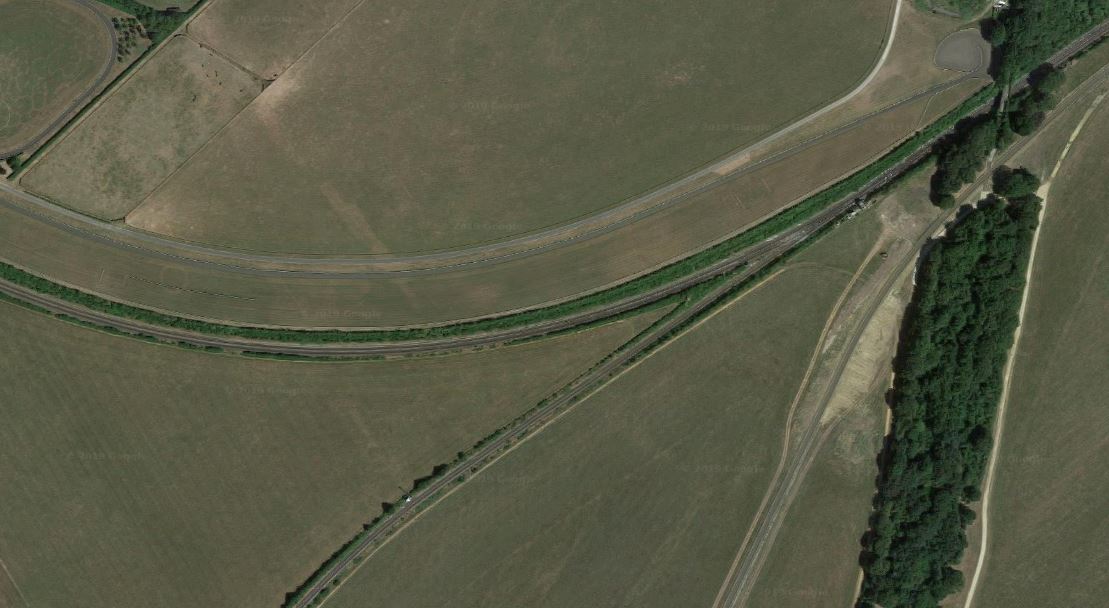
Note how the railway from the East splits into two, to the West of the band of trees running down the map.
- The top branch curves away to the North and goes through Soham to Ely.
- The bottom branch curves away to the South and goes through Warren Hill Tunnel to Newmarket station and then on to Cambridge.
Alongside, the Southern route is the Al Bahatri all-weather gallop, which is an important facility for training racehorses. It can just be picked out as a sand-coloured line.
Currently, nearly all the freight trains take the Northern route to Ely, keeping them away from the Al Bahatri.
But, if the main freight route was through the town, as planned by the East West Rail Consortium, then at least four freight trains per hour would run alongside the gallop. There could also be four passenger trains per hour.
Railway Electrification
It is unlikely, that the railway through Newmarket will be electrified, but under a different government, this could happen.
It might add another dimension to disturbance through the town, as you get pantograph noise and occasional sparks and flashes. I don’t know how horses will react, but from my own experience years ago, they do react to electrical fields.
The Rail Freight Industry
Look at most freight trains on the UK’s railways and the locomotive on the front, is a noisy, smelly and polluting Class 66 or Class 70 locomotive.
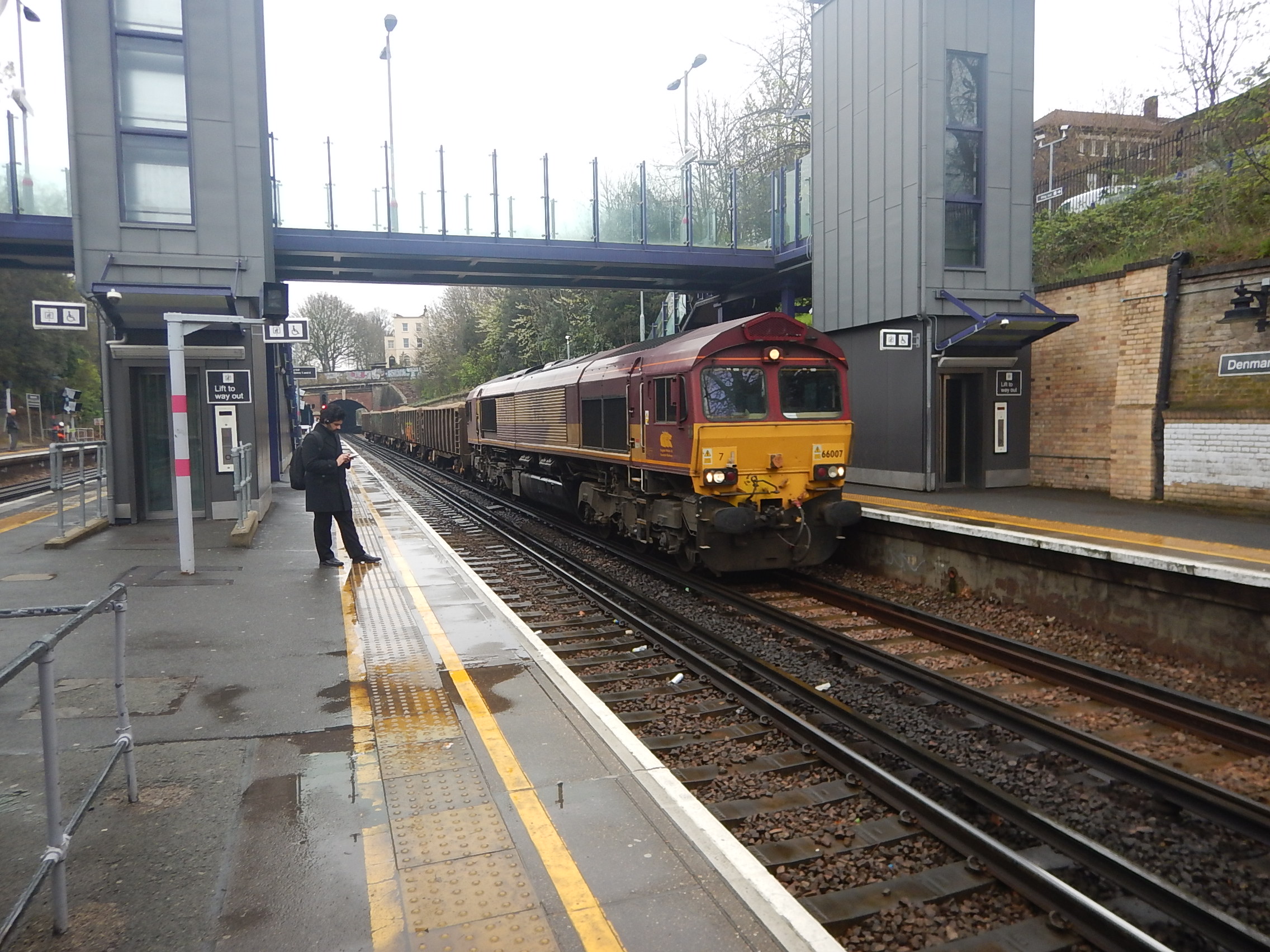
You’ll see these American imports, which don’t meet the latest emission regulations, hauling freight trains, even when there are overhead wires for electric haulage.
Why?
Because rail freight companies are so driven by accountants, that they can’t be bothered to obtain more modern diesel locomotives, that are quieter, more powerful and less polluting.
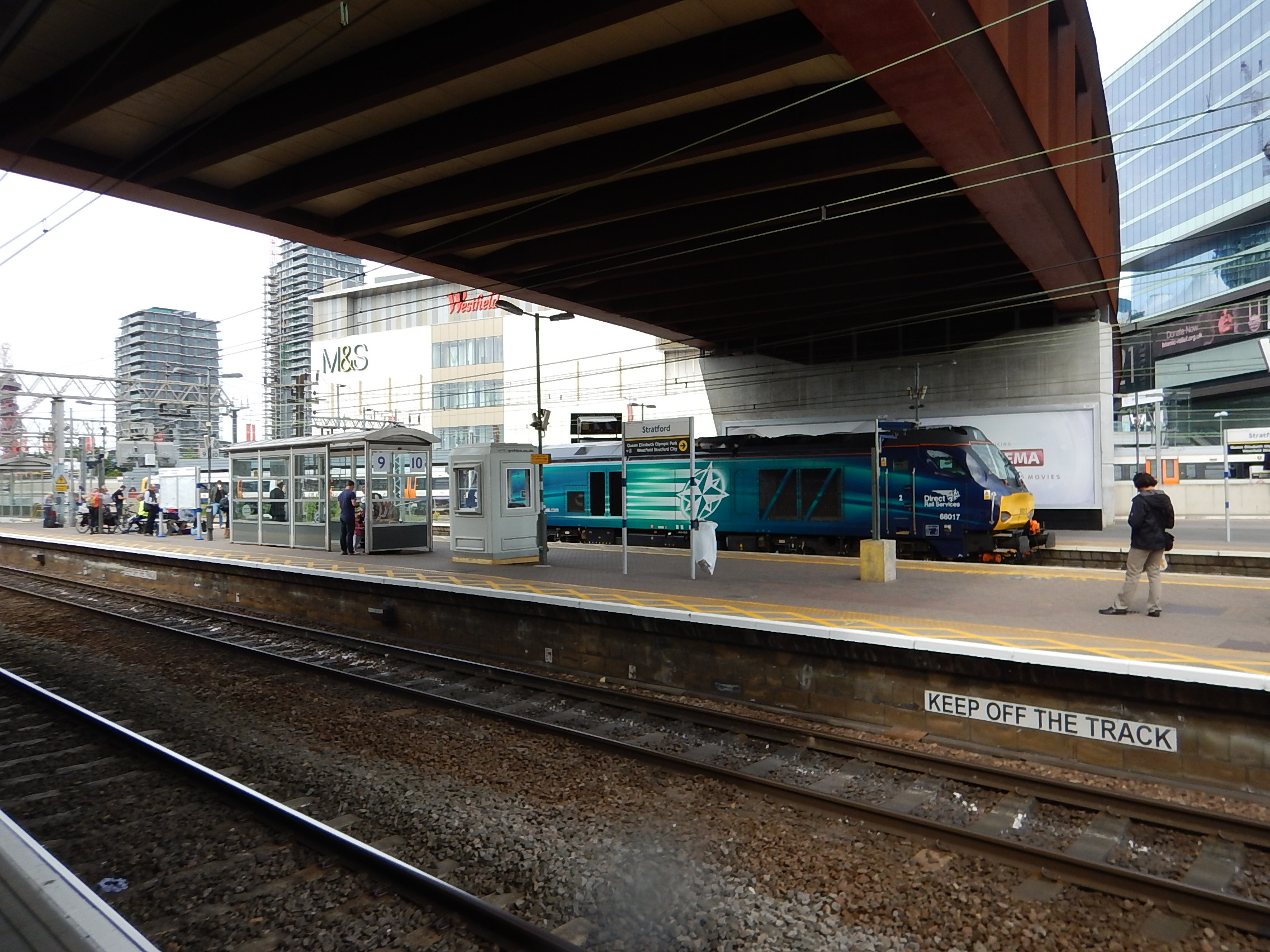
The picture shows a modern Class 68 locomotive at Stratford. These are quieter and meet most of the noise and emission regulations.
Mitigating The Problems
I’ll deal with various methods, that could be used, starting with the easiest.
A Level Railway Through The Town
It looks like the Victorian engineers, who built the railway through the town, built it as level as possible, so that steam locomotives didn’t have to work so hard in the Warren Hill Tunnel, which I don’t think has a chimney for smoke.
Modern engineers will ensure that the railway is as level as possible, with gentle gradients and curves all the way between Kennett and Dullingham stations.
Passenger Trains With Batteries
Greater Anglia’s new Class 755 trains are powered by both overhead electrification and onboard diesel engines. The latter sit in a power pack in the middle of the train.
Not having seen or heard one of these Swiss-built trains in the metal, I can make no comment as to the noise and vibration of these trains, but they should be quieter than the current three-car Class 170 trains.
It does appear that passenger trains built in the last years are much quieter, as they are much more aerodynamically correct and slippery, so they generate less noise.
The new trains have also been ordered for the South Wales Metro. But the Welsh trains will additionally be fitted with batteries to avoid some difficult electrification in the Valleys.
So if the passenger trains prove to be noisy through the town, which I doubt they will be, there will be the option of adding batteries to avoid the use of diesel power.
It is my belief, that technology will ensure that passenger trains will not be a problem.
More Environmentally-Friendly Freight Locomotives
As I said earlier, smelly, noisy and polluting freight locomotives are a big problem.
This is not just a problem for places like Newmarket with special circumstances, but on railways like the London Overground and those in Central Birmingham, Leeds and Manchester,, where suburban electric railways have to accommodate heavy rail freight.
The railway locomotive manufacturers have designed solutions for the problem in recent years.
Stadler, who are an innovative Swiss company have started to manufacture a Class 93 locomotive, which can run on diesel, electric and/or battery power. I’m fairly sure, that one of the design goals of this locomotive is to be able to haul a heavy freight train between Felixstowe and Peterborough, using electric power where it is available and a mix of diesel and battery at other times.
At Newmarket if the new double-track was well-designed and almost level, I suspect that a Class 93 locomotive could haul a train between Kennett and Dullingham stations on battery power.
Locomotives of this type should be compulsory on all freight routes through sensitive areas.
The government must legislate, as left to themselves the rail freight companies will sit on their hands and wallets.
One of the conditions of a double-track railway through Newmarket, should be that only locomotives that meet the latest noise, vibration and pollution standards, like the Class 93 locomotive should be allowed.
Quieter 100 mph Freight Trains
Karl Watts, who is a disruptive innovator and CEO of the Rail Operations Group, has bought the first ten Class 93 locomotives and intends to use them to haul 100 mph freight trains, where the routes allow.
On the electrified Great Eastern Main Line between Ipswich and London, the operating speed is 100 mph. But freight trains trundle up and down at 75 mph, thus slowing all of the passenger services.
Watts plans to use the Class 93 locomotives with new 100 mph container wagons to run freight trains at 100 mph on this and other routes, which would increase the freight and passenger capacity of the line.
New 100 mph freight wagons will be smoother, quieter and used through Newmarket at an appropriate speed would remove a large proportion of the noise and vibration.
Again, it would need investment from the freight companies.
However, modern freight trains hauled by modern hybrid locomotives like the Class 93 could significantly remove noise and vibration.
Lengthen Warren Hill Tunnel
A second bore will be dug to double-track the kilometre long Warren Hill Tunnel.
Some rail tunnels have been extended with covers and this technique might be possible at the Newmarket station end of the tunnel. The techniques exist, so that housing or other developments can be built on top of the railway.
Techniques like this not only suppress noise and vibration, but create much needed housing.
Acoustic Barriers
You see these a lot in Germany to reduce noise and vibration from railway lines in sensitive area, but rarely in the UK.
Conclusion
It will be difficult to put a double-track railway through Newmarket, but I believe that using modern rolling stock and some advanced construction, that a solution can be found.
Newmarket should dig in its heels and only accept the best to force rail freight companies to get their act together.
Government too, should enforce the current regulations on diesel locomotives, which most of the current locomotives do not meet.
Grants To Support Low-Carbon Technology Demonstrators
The title of this post is the same as that of this article on Railway Gazette.
This is the two introductory paragraphs.
The Department for Transport has awarded grants of around £350 000 to each of five projects which aim to develop technology to reduce the rail network’s carbon footprint.
The projects were selected under the second round of the DfT’s First of a Kind competition, run by Innovate UK as part of the DfT’s wider Accelerating Innovation in Rail programme.
These are the winners.
Project 1 Riding Sunbeams
I wrote about this technology in Solar Power Could Make Up “Significant Share” Of Railway’s Energy Demand.
Project 2 Diesel Freight Carbon Reduction Technology
We all hate Class 66 locomotives, with their noise, vibration and pollution.
But an Essex company called Vortex Exhaust Technology has been awarded a grant to see if their free-flowing exhausts can tame, these most unfriendly of beasts.
They make this claim on their web site.
Vortex is the ONLY exhaust technology available that effectively eliminates back pressure, improving engine efficiency, boosting power and cutting emissions.
A Class 66 locomotive will be a tough challenge.
To see what the company can do for road vehicles, there is a case study at the bottom of this page.
But then they are Essex Boys! Performance is in the genes!
Project 3 CODD-P Hydraulic Pump
This is said in the Railway Gazette article.
Unipart Rail will undertake in-service testing of a commercial version of a digital displacement pump and electronic controller in place of a traditional hydraulic pump with swashplate design. This is expected to provide a significant reduction in fuel consumption.
It sounds like an idea from Artemis Intelligent Power in Edinburgh.
Project 4 Green Rail Exhaust After Treatment
This is said in the Railway Gazette article.
Leasing company Porterbrook will collaborate with Eminox to transfer an on-road exhaust after-treatment system widely fitted to heavy-duty vehicles to the railway environment, equipping a South Western Railway Class 158 DMU for in-service trials. This will enable the technical and commercial viability to be established, so it can be offered for widespread fitment.
There are currently 170 Class 158 trains and 30 of the closely-related Class 159 trains in service, so if this is successful, there won’t be a shortage of installations.
The picture shows one of East Midlands Trains, Class 158 trains.

It should also be said, that most Class 158 trains are in excellent condition, despite being nearly thirty years old.
Note that Porterbrook are involved. Train leasing companies seem to be getting increasingly involved with innovation.
Project 5 W2W Zero Emissions Power System
This is said in the Railway Gazette article.
Steamology’s Water 2 Water concept will use compressed hydrogen and oxygen gas in a ‘compact energy-dense steam generator’ to produce high pressure superheated steam to drive a turbine, which will generate electricity to charge the batteries as a ‘range extender’ for a Vivarail Class 230 multiple-unit produced from former London Underground vehicles.
It sounds to me, that the tabloids will say that this is the return of the steam train.
Conclusion
They are a broad spread of technology and I have this feeling, that the Department for Transport will get a sensible return for an outlay of around two million pounds.
But I suspect that the best and most profitable idea, will come, after a meeting between two or more of the award winners and their backers.
Rail Operations Group Gets Serious About Thunderbirds Etc.
The February 2019 Edition of Modern Railways has an article entitled Class 93 Tri-Oomph!, which has been written by Ian Walmsley.
This is the first paragraph.
Rail Operations Group has become known for the efficient haulage of EMUs around the country using very clever tranlation devices built into Europhenix converted Class 37 kicos. As I described in the March 2016 issue (“Lost in translation”) it looked at tens of millions of pounds worth of EMUs being dragged around unbraked, thought ‘this can’t be right’, and proceeded to make 50-year-old locomotives operate with state-of-the-art computer kit.
Rail Operations Group (ROG) had employed classicdisruptive innovation to create a new market, that was to everybody’s benefit.
As Ian reports, the company has grown a lot in the last few years and now does a lot more than just move new trains around.
- Old trains are also moved.
- Old trains are also stored safely.
- Operations are all planned as a consultancy.
The company is already planning their next operational niche.
A Move Into Logistics
ROG is moving into logistics.
Ian talks about the inefficiency and polluting distribution system using trucks, that add to traffic congestion.
He talks about rail being a better way and then says this.
The difference with ROG is that the company is going to invest in two Class 769 (bi-mode 319s’) converted for parcel use, and while these are not my favourite trains, parcels are a lot less fussy than me about how long they take to get to top speed.
Using 769s’ means that your hubs can be almost anywhere; not necessarily on a 25 KVAC electrified siding, just close to a road system interchange area.
So what happens, if they don’t get a customer? The Class 769 trains will be delivered with seats, so they could be sub-leased for passenger use.
I wrote The Go-Anywhere Express Parcel And Pallet Carrier (HSPT) in May 2017, where I discussed the uses for this type of parcel carrier. This was my conclusion.
There is definitely a market for a HSPT.
If it does come about, it will be yet another tribute to the magnificent Mark 3 design!
As to the secondary use of these trains as passenger trains, there is nothing wrong with that. After all, we’ve all had our fill of the dreaded Rail Replacement Buses.
In Gospel Oak-Barking Fleet Plan Remains Unclear, I talked about the problems caused by late delivery of the new Class 710 trains.
The problem would have been eased, if two Class 769 trains in good condition could have been called up at a couple of days notice.
Surely, there are other applications.
- I suspect that given the number of level-crossing accidents in the UK, they will find a lot of use.
- I don’t think Porterbrook will mind, if ROG effectively offered a try-before-buy service to train operators.
- There must also be a market for pop-up rail services to large sporting and cultural events.
Again, it appears ROG have found a niche and have invested in it.
Before leaving the subject of Class 769 trains, I must mention Brexit.
Could the trains find a use in a no-deal Brexit-world moving high-value freight from ports and airports to inland distribution centres?
Thoughts On The Class 93 Locomotive
These are some thoughts from the article.
Available Power
Ian starts by saying this about the operation of the Class 93 locomotive.
Apart from the obvious electric (4,000kW) and diesel (900kW), the third mode is a Lithium Titanate Oxide (LTO) battery (400kW), which can be used in conjunction with the diesel to give a power boost up to 1,300kW or 1,743hp in old money.
The extra oomph from the battery takes you from a Class 33 to a Class 37 in old locos but with minimal losses, and you don’t need full power for very long on most non-electrified routes.
I suspect there’s a clever control system, that optimises the use of the battery.
The Ultimate Thunderbird
The locomotive appears to have a unique feature of a variable height coupler, which enables it to haul rolling stock with all the five standard heights of coupler, that exist on UK railways.
How did this madness occur?
But as the locomotive can deal with them all, Ian argues that the Class 93 locomotive could be the ultimate Thunderbird or rescue locomotive.
Moving Trains In The Future
Ian argues that ROC’s collection of locomotives used for moving new and replaced trains is getting older and will soon be difficult to service.
The Class 93 locomotives would be ideal for this role.
But Ian sees this very much as a fallback position, if the locomotives do not find innovative new uses.
Ian finishes with this paragraph.
When we first saw Dr. Beeching’s new Freightliners(now ‘intermodal’) in the 1960s, they did 75 mph. They still do, but there are some really smart looking 100 mph flats available. Remember the path-ology. There are plenty of cross-country runs where a Class 37 equivalent is fine for the diesel bits, then pan up and 4,000kW is yours. Come on. Not excited by this? You must be in the wrong job.
As an example some freight trains go between Felixstowe and Birmingham, Liverpool or Manchester using the North London Line.
They are hauled all the way by a Class 66 diesel.
Put the containers on the smart looking 100 mph flats with a Class 93 locomotive on the front and the following happens.
- The locomotive uses diesel between Felixstowe and Ipswich, with possibly some battery boost.
- The locomotive uses electric power for most of the journey.
- The locomotive might use diesel power at the destination for a short distance.
- On the double-track 100 mph Great Eastern Main Line, the operating speed will not be far off the new Class 745 and Class 720 trains.
- On the North London Line, the train will pass through some of the smartest parts of North London with lower levels of noise, vibration and pollution.
- On the West Coast Main Line, the train will be able to mix it with the new Class 730 trains on the slow lines.
Greater Anglia have the trains to run more services between London and Ipswich.
How many more could they squeeze in, if all freight trains had a similar performance to their express services?
Consider now, freight trains taking the cross-country route from Felixstowe to the North and Midlands via Peterborough.
- With track improvements at Haughley and doubling of the line between Kennett and Ely, I suspect that timings on the flat lands of East Anglia using hybrid power would be approaching those of Class 66 locomotive-hauled stock.
- With a faster cruise on the East Coast Main Line, would the trains take the direct route on the slow lines, rather than the diversion through Lincoln?
The Class 93 locomotive could be the ultimate Felixstowe Flyer.
Could it also be the freight locomotive that passenger train operators want reight operators to use, as it keeps freight trains out of the way of passenger ones?
Stadler’s New Tri-Mode Class 93 Locomotive
In Thoughts On A Battery/Electric Replacement For A Class 66 Locomotive, I looked at an electro-diesel freight locomotive with batteries instead of a diesel engine, as a freight locomotive. It would have the size and weight of a Class 70 locomotive and perhaps use similar technology to Stadler’s Class 88 locomotive.
I concluded the article like this.
It would be a heavyweight locomotive with a performance to match.
I believe that such a locomotive would be a very useful addition to the UK’s fleet of freight locomotives.
Stadler have not produced a battery/electric replacement for a Class 66 locomotive, but they have added a diesel/electric/battery Class 93 locomotive with a heavyweight performance to their Class 68/88 or UKLIGHT family of locomotives built at Valencia in Spain.
Details of the locomotive are given in this article in Rail Magazine, which is entitled Rail Operations Fuels Its Ambitions With Tri-Mode Class 93s. There is also a longerand more detailed article in the print edition of the magazine, which I purchased today.
Reading both copies of the article, I can say the following.
A More Powerful Class 88 Locomotive
At a first glance, the Class 93 locomotive appears to be a more powerful version of the Class 88 locomotive.
- The power on electric mode is the same in both locomotives at four megawatt. It would probably use the same electrical systems.
- Some reports give the diesel power of the Class 93 locomotive as 1.34 MW as opposed to 0.7 MW of the Class 88 locomotive.
- The Class 93 locomotive has a top speed of 110 mph, as opposed to the 100 mph of the Class 88 locomotive.
- The article says, “It’s an ’88’ design with the biggest engine we could fit.”
It would also appear that much of the design of the two locomotives is identical, which must make design, building and certification easier.
The Class 93 Locomotive Is Described As A Hybrid Locomotive
Much of the article is an interview with Karl Watts, who is Chief Executive Officer of Rail Operations (UK) Ltd, who have ordered ten Class 93 locomotives. He says this.
However, the Swiss manufacturer offered a solution involving involving an uprated diesel alternator set plus Lithium Titanate Oxide (LTO) batteries.
Other information on the batteries includes.
- The batteries are used in regenerative braking.
- Batteries can be charged by the alternator or the pantoraph.
- Each locomotive has two batteries slightly bigger than a large suitcase.
Nothing is said about the capacity of the batteries, but each could be say 200 litres in size.
I have looked up manufacturers of lithium-titanate batteries and there is a Swiss manufacturer of the batteries called Leclanche, which has this data sheet, that describes a LT30 Power cell 30Ah.
- This small cell is 285 mm x 178.5 mm x 12 mm.
- It has a storage capacity of 65 Wh
- It has an expedited lifetime of greater than 15,000 cycles.
- It has an energy density of 60 Wh/Kg or 135 Wh/litre
These cells can be built up into much larger batteries.
- A large suitcase is 150 litres and this volume would hold 20 kWh and weigh 333 Kg.
- A battery of 300 litres would hold 40 kWh. Is this a large Swiss suitcase?
- A box 2.5 metres x 1 metre x 0.3 metres underneath a train would hold 100 kWh and weigh 1.7 tonnes
These batteries with their fast charge and discharge are almost like supercapacitors.
, It would appear that, if the large suitcase batteries are used the Class 93 locomotive will have an energy storage capacity of 80 kWh.
But this is said about Class 93 locomotive performance..
LTO batteries were chosen because they offer a rapid recharge and can maintain line speed while climbing a gradient, and will recharge when running downhill.
Looking at the batteries, they could provide up to around 40 kW of extra power for perhaps half an hour to help the train climb a gradient and then recharge using regenerative braking or the diesel alternator.
This is a hybrid vehicle, with all the efficiency advantages.
The article does say, that with a light load, the locomotives can do 110 mph on hybrid. Nothing is said about what is a light load.
Could it be a rake of five modern Mark 5A coaches?
In Thoughts On A Battery Electric Class 88 Locomotive On TransPennine Routes, I said this.
It is worth looking at the kinetic energy of a Class 88 locomotive hauling five forty-three tonne CAF Mark 5A coaches containing a full load of 340 passengers, who each weigh 90 Kg with baggage, bikes and buggies. This gives a total weight would be 331.7 tonnes.
The kinetic energy of the train would be as follows for various speeds.
90 mph – 75 kWh
100 mph – 92 kWh
110 mph – 111 kWh
125 mph – 144 kWhThe increase in energy is because kinetic energy is proportional to the square of the speed.
There would be little difference in this calculation, using a Class 93 locomotive, which is only a tonne heavier. The kinetic energy at 100 mph, would be 93 kWh.
This could be very convenient, as it looks like the battery capacity could be almost as large as the kinetic energy of a fully-loaded train.
A train stopping in a station without electrification, would cut diesel running drammatically in the station and when accelerating away.
Similar Weight And Axle Load To A Class 88 Locomotive
The article states that the locomotive will weight 87 tonnes, as opposed to the 86 tonnes of a Class 88 locomotive.
As both locomotives have four axles, this would mean that their axle loading is almost the same.
So anywhere the Class 88 locomotive can go, is most likely to be territory suitable for the Class 93 locomotive.
Again, this must make certification easier.
A Modular Design
In a rail forum, members were saying that the Class 93 locomotive has a modular design.
So will we see other specifications with different sized diesel engines and batteries?
The TransPennine routes, for example, might need a locomotive with a smaller diesel engine, more battery capacity and a 125 mph-capability for the East Coast Main Line.
Stadler have said they specialise in niche markets. Have they developed the tailor-made locomotive?
Power Of Various Locomotives
These are various UK locomotives and their power levels in megawatts.
- Class 43 – Diesel – 1.7
- Class 66 – Diesel – 2.4
- Class 67 – Diesel – 2.4
- Class 68 – Diesel – 2.8
- Class 88 – Electric – 4
- Class 88 – Diesel – 0.7
- Class 90 – Electric – 3.9
- Class 91 – Electric – 4.8
- Class 93 – Electric – 4
- Class 93 – Diesel – 0.9
- Class 93 – Hybrid – 1.3
The interesting figure, is that the Class 93 locomotive has 53 % of the diesel power of a Class 43 locomotive from an InterCity 125. The difference could probably be made up at times using battery power, where needed. The batteries could be partly recharged using regenerative braking.
Could The Locomotive Be Uprated To 125 mph?
Consider.
- The UK has successfully run 125 mph Class 43 and 91 locomotives for many years.
- Stadler has built trains that run at that speed.
- Mark 3, Mark 4 and Mark 5A coaches are all certified for 125 mph.
- There are hundreds of miles of track in the UK, where 125 mph running is possible.
I would think it very unlikely, that the engineers designing the Class 93 locomotive, ruled out the possibility of 125 mph running in the future!
Only Stadler will know!
Could A Battery/Electric Version Of The Locomotive Be Created?
I don’t see why not!
The diesel engine, fuel, exhaust and cooling systems and some ancilliary systems could all be removed and be replaced with an equivalent weight of batteries.
As the C27 diesel engine in a Class 88 locomotive weighs almost seven tonnes, I suspect a ten tonne battery would be possible.
Given the current typical energy density and using the Leclanche figures, this would mean that the batteries would have a total capacity of around 700-700 kWh.
Possible Uses Of The Class 93 Locomotive
The Rail Magazine article goes on to detail some of the uses of a Class 93 locomotive.
Express Freight
Karl Watts says this.
They can operate express freight. In Europe, there are vehicles capable of 100 mph running, and these are perfect for high-speed domestic freight. We have been running intermodals at 75 mph since the 1960s – It’s time to change that.
The locomotive would certainly be able to haul express freight at 100 mph on an electrified main line.
Note the following.
- This would greatly help with freight between Felixstowe and London on the 100 mph Great Eastern Main Line.
- Running freight trains at 100 mph on the major electrified lines would increase capacity, of the lines.
- Ports and freight terminals wouldn’t need to be electrified.
Overall, the proportion of freight mileage, where electric power was used, would grow significantly.
Electrification Gap Jumping
In Thoughts On A Battery/Electric Replacement For A Class 66 Locomotive, I gave a list of typical gaps in the electrification in the UK.
- Didcot and Birmingham – Around two-and-a-half hours
- Didcot and Coventry – Just under two hours
- Felixstowe and Ipswich – Around an hour
- Haughley Junction and Peterborough – Around two hours
- Southampton and Reading – Around one-and-a-half hours
- Werrington Junction and Doncaster via Lincoln – Around two hours
- Werrington Junction and Nuneaton – Just under two hours
How many of these gaps could be bridged by a Class 93 locomotive working in a diesel hybrid mode?
It should be noted, that many of the busiest gaps are in the flatter Eastern areas of England.
I’m sure Stadler and Rail Operations Group have done extensive simulation of possible routes and know where the locomotives are best suited.
Class 66 Locomotive Replacement
I suspect that several of these locomotives will end up replacing duties currently done by Class 66 locomotives.
It could haul an intermodal freight from Felixstowe to Manchester, Liverpool, Glasgow or Doncaster, using electrification where it exists.
And do it at a speed of 100 mph, where speed limits allow!
No other locomotive on the UK network could do that!
Use On Electrified Urban Freight Routes
Near to where I live there are two electrified lines passing through North London; the North London Line and the Gospel Oak To Barking Line.
Both lines have several freight trains a day passing through, that are still hauled by diesel locomotives.
There are other urban freight routes around the UK, where despite electrification, polluting diesel locomotives are still used.
Class 93 locomotives would be an ideal environmentally-friendly replacement locomotive on these routes.
Thunderbird Duties
Karl Watts says this.
They can be used for network recovery as a more comprehensive Thunderbird. Currently, stand-by locomotives are hired or used by an operator to rescue its own trains, but these would be available for anything or anyone. I have sopken to Network Rail about this and they need convincing. But as the network gets busier, so it will be that one failure causes chaos.
Perhaps, a better method for recovering failed trains could be developed.
Passenger Trains
Karl Watts says this.
I can say that the 93s’ feature n two franchise bids, although I cannot say which, due to non-disclosure agreements.
We can only speculate!
Class 93 locomotives could replace the Class 68 locomotives on TransPennine Express services between Liverpool and Scarborough, where Mark 5A coaches will be used.
- Electric mode could be used between Liverpool and Stalybridge and on the East Coast Main Line.
- Diesel or hybrid mode would be used where needed.
- If the locomotives could be uprated to 125 mph, that would help on the East Coast Main Line.
There are certainly, redundant Mark 4 coaches or new Mark 5A coaches that could be used to provide services.
An InterCity 125 For the Twenty-First Century
The InterCity 125 is a masterpiece of engineering, that passengers love.
One of the reasons for the success, is the superb dynamics of the train, which gives them a very comfortable ride.
Could it be that by putting two Class 93 locomotives at each end of a rake of suitable coaches could create a 125 mph train, with the same faultless dynamics?
The answer is probably yes, but in many cases either half-length trains or bi-mode multiple units may be a more affordable or capable train.
The locomotive certainly gives a lot of flexibility.
Conclusion
This is going to be a very useful locomotive.
This was the last paragraph of the printed article, as spoken by Karl Watts.
I don’t think I will be ordering only ten or 20 – there will be more.
I have registered 93001 to 93050.
The word hybrid opens the door.
I think this might be the third member of a very large and widespread family.
Thoughts On A Battery/Electric Replacement For A Class 66 Locomotive
Many of the long freight routes from Felixstowe and Southampton are hauled by diesel locomotives like the environmentally-unfriendly Class 66 locomotive.
Electric haulage can’t be used because of significant gaps in the 25 KVAC overhead electrification. Gaps and a typical transit time of a Class 66-hauled heavy freight train include.
- Didcot and Birmingham – Around two-and-a-half hours
- Didcot and Coventry – Just under two hours
- Felixstowe and Ipswich – Around an hour
- Haughley Junction and Peterborough – Around two hours
- Southampton and Reading – Around one-and-a-half hours
- Werrington Junction and Doncaster via Lincoln – Around two hours
- Werrington Junction and Nuneaton – Just under two hours
Would it be possible to design a battery/electric hravy locomotive, that could bridge these gaps?
Consider the following.
- A Class 66 locomotive has a power output of around 2500 kW.
- To run for two hours on battery would require a battery of 5000 kWh.
- A 5000 kWh battery would weigh around fifty tonnes. But battery energy densities are getting higher, which would reduce the weight.
- A Class 70 locomotive is a heavy freight diesel Co-Co locomotive with a weight of 134 tonnes with a full tank of diesel.
- A Class 88 locomotive is an electro-diesel locomotive, that without the diesel engine weighs about 80 tonnes.
- A Class 88 locomotive has a power output of 4,000 kW on 25 KVAC overhead electrification
Putting this information together and I think it would be possible to design a battery/electric locomotive with the following specification.
- 4000 kW on 25 KVAC overhead electrification
- Ability to use 750 VDC third-rail electrification
- Ability to change between running on electrification and battery in under a minute and at line speed.
- A 5000 kWh battery.
- Ability to charge the battery, when connected to electrification.
- Ability to use a rapid charging system.
- Two hour range with 2500 kW on battery power.
- Regenerative braking to the battery.
- Co-Co configuration
- Dimensions, weight and axle loading similar to a Class 70 locomotive.
These are a few other thoughts.
Passing Loops With Charging Stations
Passing loops are often provided for freight trains, so that passenger trains can pass a slow freight train. So why not fit these loops with a charging station, so that trains can stop for say twenty minutes to charge or top up the batteries?
Electrification Islands
There are places, where it would be easy to create, what is best described as an electrification island.
I describe electrification islands in The Concept Of Electrification Islands.
Last Mile Applications
Ports and Container Terminals are often without electrification.
The proposed locomotive would be able to work in these environments.
A couple of yeas ago, I had a long talk with a crane operator at the Port of Felixstowe, who I met on a train going to football. He was of the opinion, that Health and Safety is paramount and he would not like 25 KVAC overhead electrification all over the place. Containers do get dropped!
So if freight locomotives used battery power inside the port, most would be pleased.
The only cost for ports and freight terminals would be installing some form of charging.
Maximum Power On Batteries
I suspect that the maximum power on battery would also be the same as the 4,000 kW using 25 KVAC overhead electrification, as the locomotive may have applications, where very heavy trains are moved on partially electrified lines.
Diesel-Free Operation
The proposed locomotive will not use any diesel and will essentially be an electric locomotive, with the ability to use stored onboard power.
Environmentally-Friendly Operation
Freight routes often pass through areas, where heavy diesel locomotives are not appreciated.
- The proposed locomotive will not be emitting any exhaust or noxious gases.
- Noise would be similar to an electric locomotive.
- They would be quieter using battery-power on lines without overhead electrification, as there would be no pantograph noise.
I think on balance, those living by freight routes will welcome the proposed locomotive.
Would Services Be Faster?
This would depend on the route, but consider a heavy freight train going from Felixstowe to Leeds.
- On the electrified East Coast Main Line, the proposed battery-electric locomotive would have a power of 4,000 kW, as opposed to the 2,500 kW of the Class 66 locomotive.
- On sections without electrification, the locomotive would have more power if required, although it would probably be used sparingly.
- The locomotive would have a Driver Assistance System to optimise power use to the train weight and other conditions.
I feel on balance, that services could be faster, as more power could be applied without lots of pollution and noise.
Creeping With Very Heavy Loads
I suspect they would be able to creep with very heavy loads, as does the Class 59 locomotive.
Class 59 Locomotive Replacement
The proposed locomotive may well be able to replace Class 59 locomotives in some applications.
Any Extra Electrification Will Be Greatly Appreciated
Some gaps in electrification are quite long.
For example, Didcot and Birmingham takes about two and a half hours.
- Didcot is on the electrified Great Western Main Line.
- Birmingham has a lot of electrified lines.
So perhaps there could be some extra electrification at both ends of busy freight routes.
Electrification between Didcot and Wolvercote Junction would be a possibility.
- It would be about twelve miles
- It is very busy with heavy freight trains.
- The natives complain about the railway.
- It would allow Great Western Railway to run electric trains to and from London.
- If Chiltern Railways were to run battery-electric trains to Oxford, it would provide electrification for charging at Oxford.
- Electrification could be extended to Oxford Parkway station to make sure battery-electric trains would get a good send-off to Cambridge
This simple example shows, why bi-mode and battery/electric trains don’t mean the end of electrification.
All vehicles; rail or road and especially electric ones, need to take on fuel!
I also think, that there is scope to electrify some passing loops, so that locomotives can top-up en route.
Conclusion
It would be a heavyweight locomotive with a performance to match.
I believe that such a locomotive would be a very useful addition to the UK’s fleet of freight locomotives.
 The Anonymous Widower