Ocean Winds Enters Lease Agreement With Crown Estate For 1.5 GW Celtic Sea Floating Wind Project
The title of this post, is the same as that of this article on offshoreWIND.biz.
This is the sub-heading.
Ocean Winds has entered into an agreement for lease with the Crown Estate for a 1.5 GW floating offshore wind project, for which the developer secured a site in the Round 5 seabed auction last year.
These two paragraphs add detail to the story.
Offshore Wind Leasing Round 5, the UK’s first dedicated floating wind seabed leasing round, was launched in February 2024, offering three areas. In June 2025, the Crown Estate announced Equinor and Gwynt Glas, a joint venture between EDF and ESB, as preferred developers for two project sites and said it was working to ensure the delivery of the full potential capacity of Round 5, which is up to 4.5 GW.
Equinor and Gwynt Glas entered into lease agreements for their floating wind projects in October 2025 and, the following month, the Crown Estate said Ocean Winds had secured the third floating offshore wind site in the Celtic Sea.
This map shows the three wind farms, that make up the Glynt Glas wind farm.
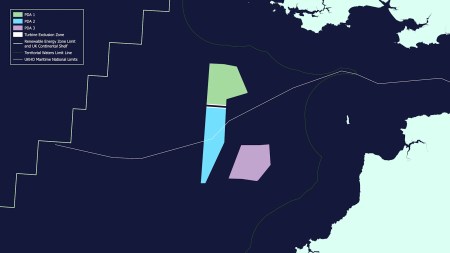
Note.
- It is expected to be built from and connect to the grid at Port Talbot in South Wales.
- The three sites are expected to be commissioned by the early-to-mid 2030s.
- The elongated white dot to the East of the wind farms would appear to be Lundy Island.
- The large bay to the North of Lundy is Carmarthen Bay with Caldey Island at its West end and Llanelli on its East.
- The Gower separates Swansea Bay from Carmarthen Bay.
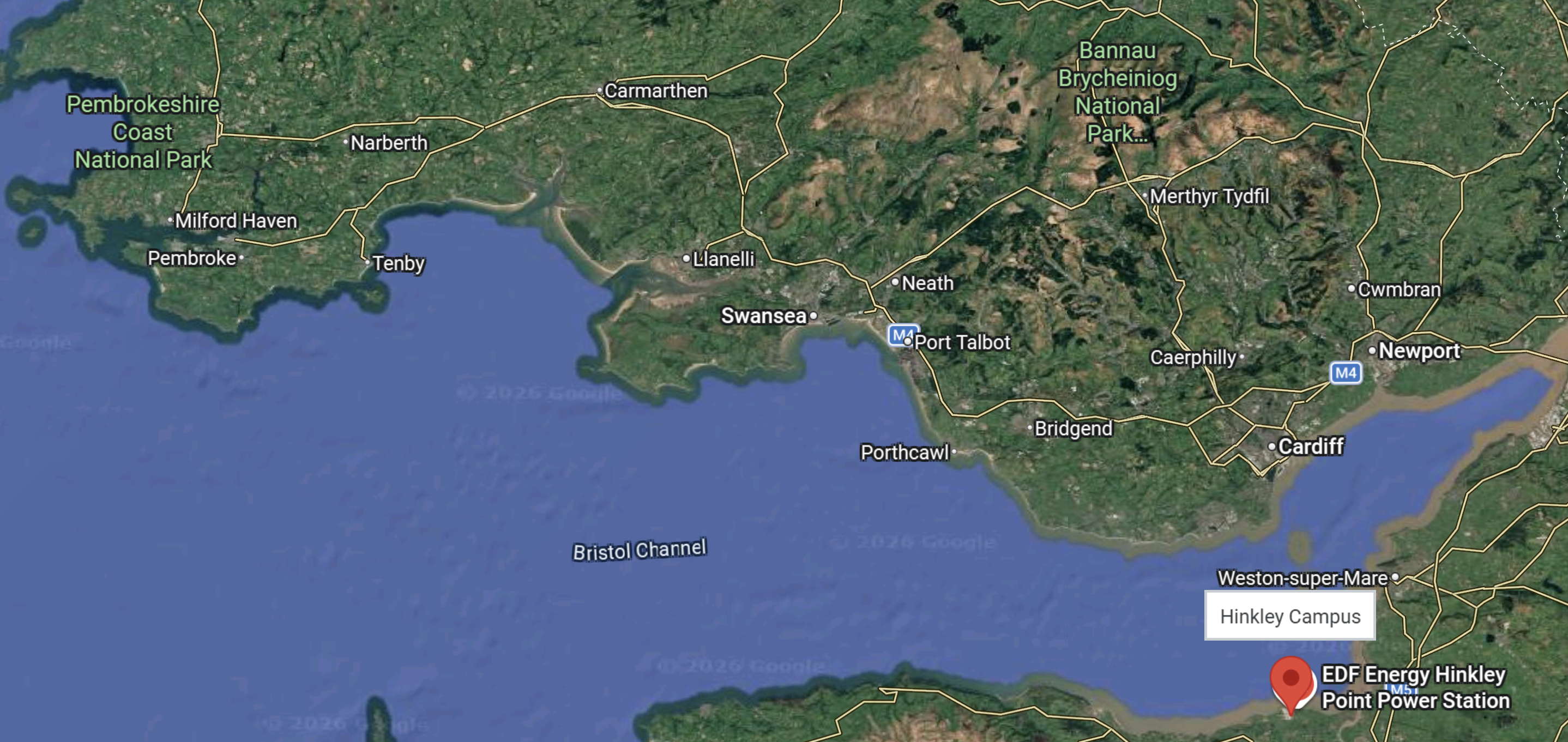
This Google Map shows the Bristol Channel from the wind farms in the West to Cardiff and Hinkley Point.
Note.
- Along the North coast of the Bristol Channel, working from West to East, my 78-year-old eyes can pick out Milford Haven, Pembroke, Caldey Island, Tenby, Llanelli, Swansea, Port Talbot, Porthcawl, BridgendCaerphilly, Cardiff and Newport.
- Coming back along the South Coast, I can see Weston-super-Mare, Hinkley Point C and the tip of Lundy Island in line with Tenby.
- The three sections of Glynt Glas will each generate 1.5 GW, making a total of 4.5 GW.
- Hinkley Point C when completed, will be a 3.26 GW nuclear power station.
- There is also a 2.2 GW gas-fired power station at Pembroke.
Nearly 8 GW of renewable electricity should be enough to convert Port Talbot steelworks to the manufacture of green steel.
How Much Wind Power Is Planned For The Western Approaches?
I asked Google AI, the title of this section and received this answer.
The UK has a target of 50 GW of offshore wind by 2030, with significant projects planned for the Celtic Sea (part of the Western Approaches), which is a key area for 5 GW of floating wind. Total UK offshore wind pipeline capacity exceeds 93 GW, with major developments in this region focusing on floating technology.
Key details regarding wind power in the Western Approaches (specifically the Celtic Sea) include:
Celtic Sea Developments: The area is a primary focus for floating wind projects, designed to capitalize on deep-water potential, with 5 GW of floating wind expected to be deployed across the UK by 2030.
Pipeline and Capacity: The total UK pipeline for offshore wind, which includes the Western Approaches, is 93 GW, and the government is aiming for 43-50 GW of installed offshore capacity by 2030.
Project Status: The region is expected to benefit from the Crown Estate’s leasing rounds aimed at accelerating floating wind, with 15.4 GW of new projects submitted across the UK in 2024.
Wales/South West England Context: Wales has 1.4 GW of projects in the pre-application stage, with some potential for developments off the South West coast.
For more detailed information on specific projects and their development status, you can visit the RenewableUK website and RenewableUK website.
It looks like about 20 GW of offshore wind could be installed in the Western Approaches.
Bid To Create UK’s First Regional Hydrogen Network
The title of this post is the same as this article on the BBC.
This is the sub-heading
Four energy companies are working together to bid for government funding to develop the UK’s first regional hydrogen transport and storage network.
This two paragraphs add more details to the article.
National Gas, Centrica, Equinor and SSE Thermal aim to secure about £500m of funding to develop the network, which will connect sites across the Humber region.
“This is a competitive process that will determine where the UK’s first integrated hydrogen network is built,” a spokesperson for the four companies said.
Note.
- There are already several hydrogen projects in the area including Aldbrough Hydrogen Storage, H2H Saltend, and Ferrybridge and Keadby Next Generation Power Stations.
- The local MPs seem in favour.
- In Could Doncaster Sheffield Airport Become A Hydrogen Airport?, I laid out my reasons, why Doncaster Sheffield Airport could become a hydrogen airport.
I can see this hydrogen cluster having a big future.
US Government Sends Stop Work Order To All Offshore Wind Projects Under Construction
The title of this post, is the same as that of this article on offshoreWIND.biz.
This is the sub-heading.
The US Department of Interior has paused the leases and suspended construction at all large-scale offshore wind projects currently under construction in the United States, citing ”national security risks identified by the Department of War in recently completed classified reports.”
The wind farms named are.
- Coastal Virginia Offshore Wind-Commercial – 2,600 GW
- Empire Wind 1 – 810 MW
- Revolution Wind – 704 MW
- Sunrise Wind – 924 MW
- Vineyard Wind 1 – 806 MW
Note.
- These five wind farms total 5,844 MW or 5.8 GW.
- The Empire Wind development is being led by Equinor, who are Norwegian.
- The Revolution Wind and Sunrise Wind developments are being led by Ørsted, who are Danish.
- The Vineyard Wind development is being led by Iberdrola, who are Spanish and Copenhagen Infrastructure Partners, who are Danish.
- Coastal Virginia Offshore Wind project uses 176 Siemens Gamesa SG 14-222 DD (Direct Drive) offshore wind turbines.
- Empire 1 Wind is using Vestas V236-15MW offshore wind turbines.
- Revolution Wind is using 65 Siemens Gamesa SG 11.0-200 DD offshore wind turbines.
- Sunrise Wind is using Siemens Gamesa wind turbines, specifically their 8.0 MW models (SG 8.0-167).
- Vineyard 1 Wind is using General Electric (GE) Haliade-X 13 MW offshore wind turbines.
- Some of the components for the Siemens wind turbines will be manufactured in Virginia.
- Coastal Virginia Offshore Wind has a budget of $11.2-3 billion.
- Empire 1 Wind has a budget of $5 billion.
- Resolution Wind has a budget of $4 billion.
- Sunrise Wind has a budget of $5.3 billion.
- Vineyard 1 Wind has a budget of $4 billion.
There will only be one winner in this new round of the ongoing spat between Trump and the wind industry, that he hates so much – the 1.3 million active lawyers in the United States,which is a figure from according to Google AI.
Ocean Winds Secures Third Celtic Sea Floating Wind Site
The title of this post, is the same as that of this article on offshoreWIND.biz.
This is the sub-heading.
Ocean Winds has secured the third floating offshore wind site in the Celtic Sea, offered through the Crown Estate’s Round 5 auction earlier this year. The developer is joining Equinor and the Gwynt Glas joint venture, which were awarded rights for two of the three sites offered in Round 5 in June.
This paragraph outlines Ocean Winds’s deal.
On 19 November, the Crown Estate said that Ocean Winds was set to be awarded the rights for a third floating offshore wind site in the Celtic Sea.
There would now appear to be three Celtic Winds deals for wind farms.
- Gwynt Glas – 1.5 GW
- Ocean Winds – 1.5 GW
- Equinor – 1.5 GW
Note.
- 4.5 GW will be able to power a good proportion of South Wales and the South-West peninsular.
- In Gwynt Glas And South Wales Ports Combine Strength In Preparation For Multi-Billion Floating Wind Industry, I talk about partnerships between the wind farms and the ports.
- If you sign up for a large wind farm from the Crown Estate, do you get to have afternoon tea with Charles and Camilla in the garden at Highgrove or even Buckingham Palace?
This map of the wind farms is available from download from this page on the Crown Estate web site.
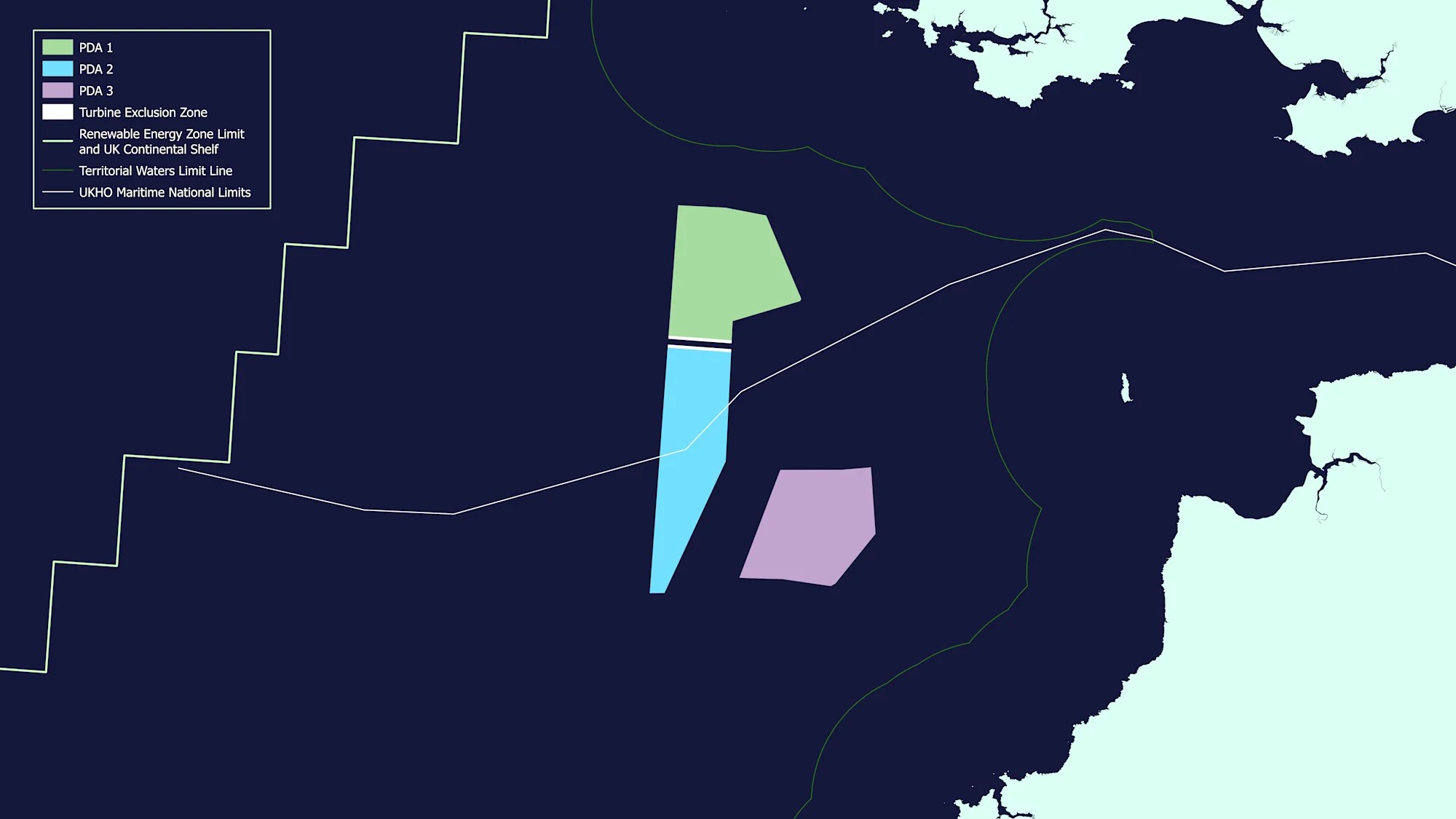
Note.
- Gwynt Glas is in green.
- Ocean Winds is in blue.
- Equinor is in mauve.
- The white dot to the East of the wind farms is Lundy Island.
This triple wind farm is certainly well-placed to supply power to Cornwall, Devon and South Wales.
UK Economy To Reap GBP 6.1 Billion From 3.6 GW Dogger Bank Offshore Wind Farm
The title of this post, is the same as that of this article on offshoreWIND.biz.
This is the sub-heading.
The 3.6 GW Dogger Bank Wind Farm, which will become the world’s largest offshore wind farm once fully operational, will boost the UK economy by GBP 6.1 billion (approximately EUR 6.9 billion) during its lifetime and support thousands of UK jobs over the next decade, according to a report written by BVG Associates.
The first three phases of the Dogger Bank wind farm are scheduled to be delivered as follows.
- Dogger Bank A – 1235 MW – 2025
- Dogger Bank B – 1235 MW – 2026
- Dogger Bank C – 1218 MW – 2027
The planned dates in the North Sea are generally kept, because we’ve been building structures there since the days of World War Two.
These two paragraphs from the article add more detail.
The economic impact report was commissioned by Dogger Bank Wind Farm’s equity partners SSE, Equinor and Vårgrønn, who are currently constructing the offshore wind farm in three 1.2 GW phases at adjoining sites in the North Sea, more than 130 kilometres from the Yorkshire Coast.
Direct spend with companies in the Northeast of England and in the counties of North Yorkshire and the East Riding of Yorkshire is expected to total over GBP 3 billion, with hundreds of jobs supported in these regions.
But these three wind farms are just the hors d’oeuvre.
This article on offshoreWIND.biz is entitled SSE, Equinor Move Forward with 1.5 GW Dogger Bank D Project and it has this sub-heading.
SSE and Equinor have finalised a seabed lease with the Crown Estate to progress Dogger Bank D, the proposed fourth phase of the world’s largest offshore wind farm, the 3.6 GW Dogger Bank Wind Farm, currently under construction off the coast of England in the North Sea.
These two paragraphs from the article add more detail.
The lease allows Dogger Bank D shareholders to maximise renewable generation from the eastern part of the Dogger Bank C seabed area, located around 210 kilometres off the Yorkshire coast, with future potential to unlock an additional 1.5 GW.
SSE Renewables and Equinor previously established terms for the wind farm with the Crown Estate in July 2024. Implementation of these commercial terms was subject to the conclusion earlier this year of the plan-level Habitats Regulation Assessment (HRA) associated with the Crown Estate’s wider Capacity Increase Programme.
Note.
- The total capacity for the first four phases of the Dogger Bank Wind Farm are 5,188 MW.
- But if the Crown Estate’s wider Capacity Increase Programme is carried out, the total capacity will be 6,688 MW.
- Hinckley Point C is planned to be only 3,260 MW and is likely to be fully delivered between 2029 and 2031.
So if the Crown Estate, Equinor and SSE go for the full Dogger Bank D, I believe it is likely that we’ll get a wind farm with a capacity of two Hinckley Point Cs delivered before the nuclear power station.
.
Visiting The Consultation For Ferrybridge Next Generation Power Station At Knottingley
Yesterday, I visited the first meeting for the consultation on Ferrybridge Next Generation Power Station, which was held in the old town hall at Knottingley.
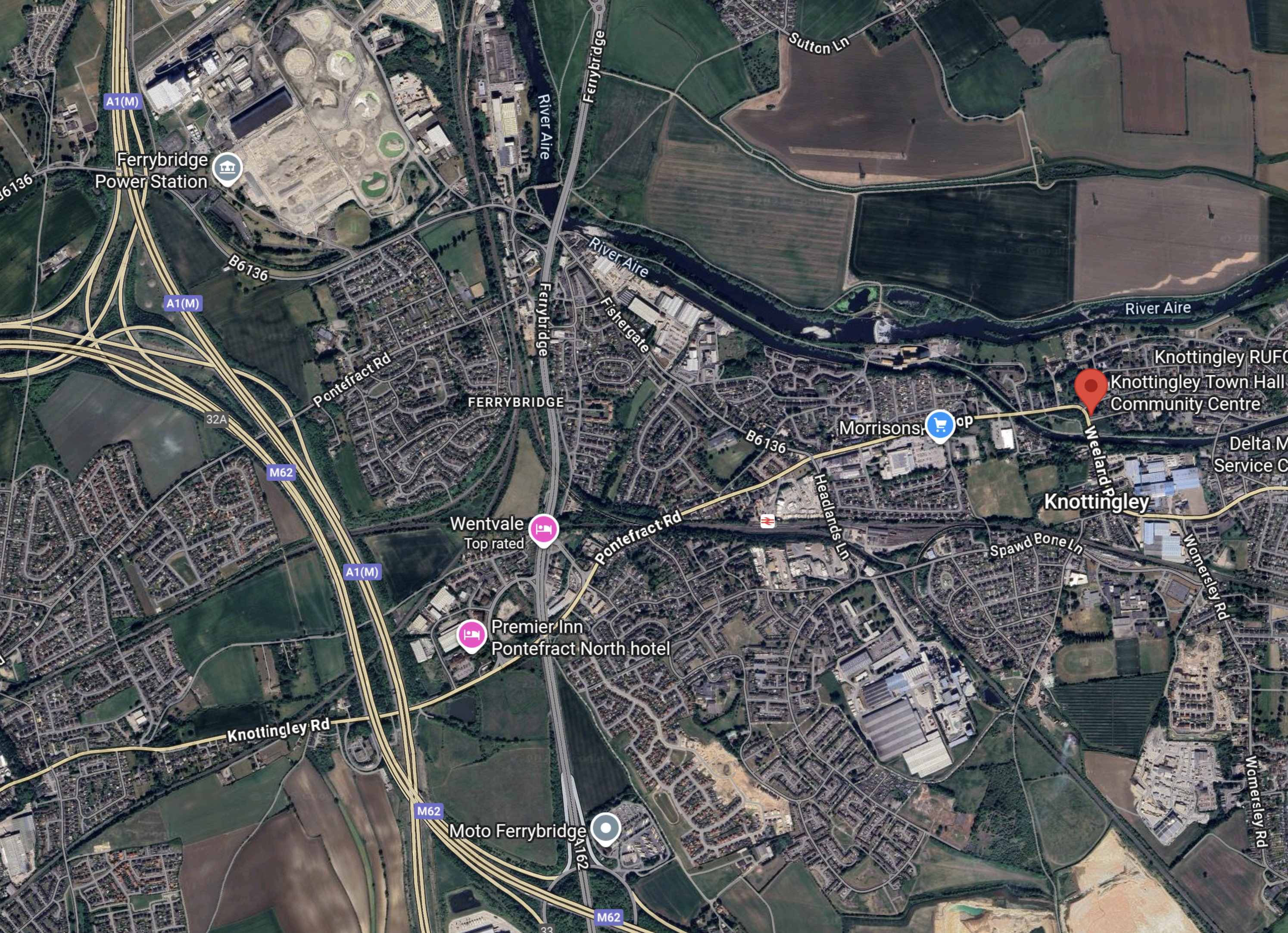
This Google Map shows the power station in relation to Knottingley.
Note.
- The meeting was held in the Knottingley Town Tall Community Centre, which is marked by the red arrow.
- I had arrived by train from Wakefield at Knottingley station and I was lucky enough to be able to get a taxi to the Town Hall.
- Knottingley station is marked on the map about a twenty-minute walk to the West of the Town Hall.
- The Ferrybridge power station site is in the North-West corner of the map and appears to be bordered by the B6136 road.
- The A1 (M) and the M 62 motorways run North-South past the power station site.
- The A (M) motorway continues North-South to Newcastle and Scotland, and London respectively.
- The M62 motorway continues West-East to Liverpool and Manchester, and Hull respectively.
- The well-appointed Moto Ferrybridge services is accessible from both motorways.
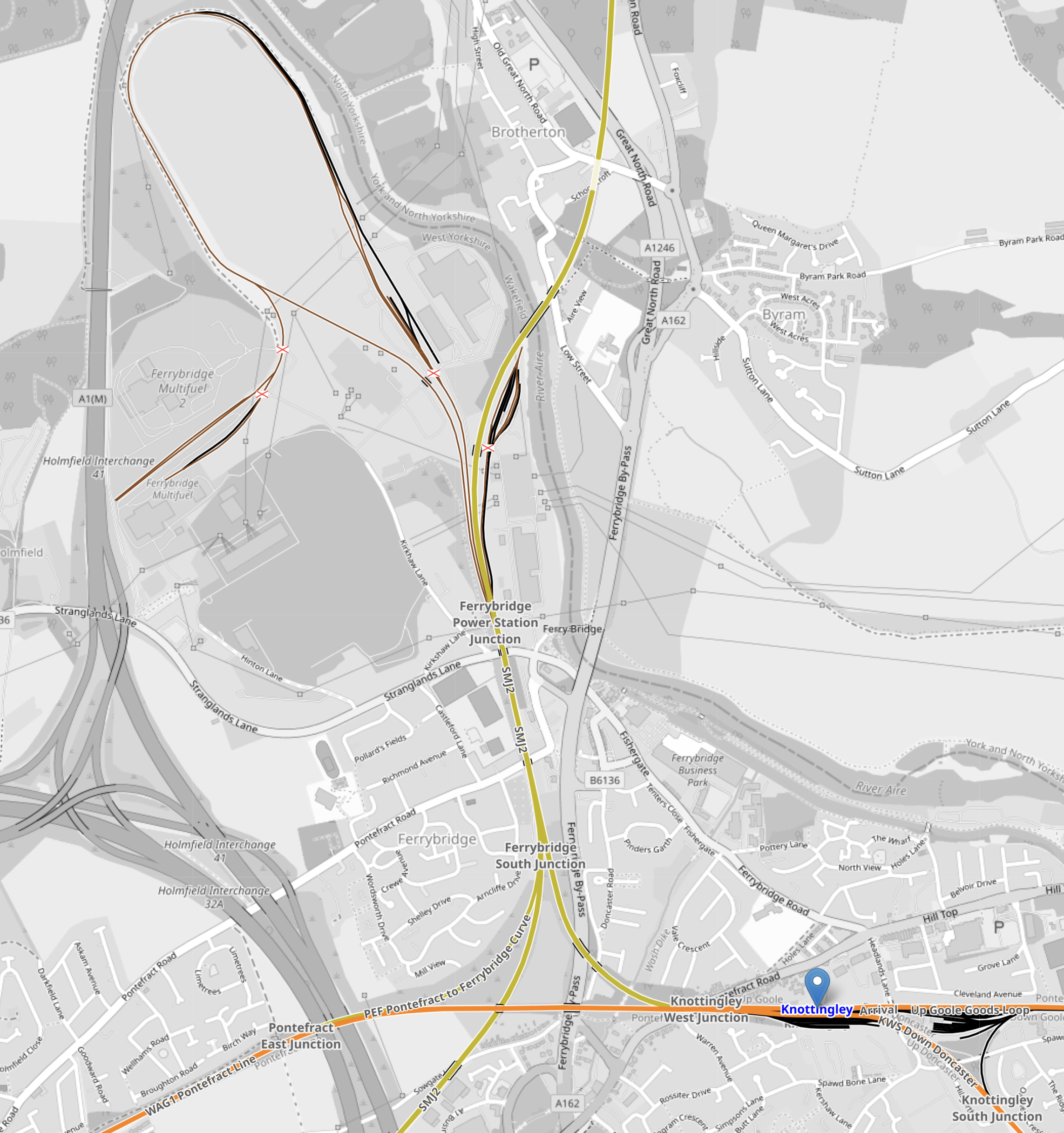
This OpenRailwayMap shows the rail lines in the area.
Note.
- The A 62 and A 1(M) motorways running down the West side of the map.
- Knottingley station is on the Pontefract Line, and is marked by a blue arrow.
- The Pontefract Line could have connections from both East and West to the Ferrybridge power station site via Ferrybridge Power Station junction.
- The loop, where the merry-go-round coal trains turned, appears to be still intact at the North of the power station site.
Will these rail lines be any use in the building and operation of the new power station?
These are my thoughts.
Fuel For The Power Station
The brochure for the consultation says this about the fuel for the Ferrybridge Next Generation Power Station.
Ferrybridge Next Generation Power Station will be designed to run on 100% hydrogen, natural gas or a
blend of natural gas and hydrogen.
The brochure has an informative section, which is entitled Natural Gas Pipeline Corridors.
Additionally, I should say, that I lived within a couple of hundred metres of a major gas pipeline in Suffolk, for over twenty years and it was the most unobtrusive of neighbours.
The brochure also says this about hydrogen safety.
As with all of our sites, appropriate measures will be
in place to ensure safe operation. Hydrogen is not
inherently more dangerous than other fuel sources.Hydrogen is flammable and must be handled with care,
just like other flammable fuels. To ignite, hydrogen
must be combined with an additional oxidising agent,
such as air or pure oxygen, in a specific concentration
and with an ignition source (a spark).
It is nearly sixty years ago now, since I worked as an Instrument Engineer, in ICI’s Castner-Kellner works at Runcorn, where hydrogen, chlorine and caustic soda were produced by the electrolysis of brine.
The plant was an unhealthy one, as it used a lot of mercury and my main task, was to design instruments to detect mercury in air and operators’ urine.
The Wikipedia entry for the Castner-Kellner process is a fascinating read and explains why it is being replaced by much better modern mercury-free processes.
I asked Google AI, if the Castner-Kellner process is still used and received this reply.
No, the Castner-Kellner process, a type of mercury cell for producing chlorine and caustic soda, is now largely obsolete due to occupational health and mercury pollution concerns, though a few plants may still operate globally. Modern chlor-alkali processes primarily use safer diaphragm cell and membrane cell technologies to produce chlorine and other chemicals from brine electrolysis.
I suspect that countries, where life is cheap, still use this process, which is very dangerous to those that work on the plant.
INEOS now own ICI in Cheshire and they still produce a large proportion of the hydrogen, chlorine and caustic soda, that the UK needs, but in a much safer way.
The question has to be asked about how hydrogen will be delivered to the Ferrybridge site.
Consider.
- SSE are developing a large hydrogen store at Aldbrough.
- Centrica are developing a large hydrogen store at Brough.
- Both of these stores could be connected to the German AquaVentus system, as the Germans are short of hydrogen storage.
- There is an East Coast Hydrogen Delivery Plan, which could probably have an extension pipeline to the Ferrybridge site.
- The East Coast Hydrogen Delivery Plan, talks of a hydrogen capacity of 4.4 GW.
I don’t feel, that this is the sort of project, that will be delivered until the mid-2030s, at the earliest.
There is also one other important development, that will require hydrogen at Ferrybridge.
I asked Google AI, if there will be hydrogen-powered coaches by 2030 and received this reply.
Yes, there will be hydrogen-powered coaches and buses by 2030, particularly in the UK and EU, with government strategies and funding promoting their deployment, especially for routes requiring high range and quick refueling where battery-electric models may be less suitable. For example, the EU’s CoacHyfied project is developing fuel cell coaches, and the UK government envisions hydrogen playing a role in its transport decarbonization by 2030, with potential to accelerate its zero-emission bus goals.
The nearest you can get to a hydrogen-powered coach in England, is to take an upmarket Wrightbus upmarket hydrogen-powered bus between Sutton station and Gatwick Airport.
- It is mouse quiet and vibration-free.
- It handles the hills with alacrity.
- I wrote about my journey in Sutton Station To Gatwick Airport By Hydrogen-Powered Bus.
That journey convinced me of the superiority in many ways of a hydrogen bus or coach over its diesel cousins.
I believe that this superiority will see large growth in hydrogen-powered long-distance coaches in the next few years.
But I also feel that some specialist transport, like horse transport, will go the hydrogen route.
As there are services at Ferrybridge, where two important motorways cross, I can envisage that the services will need to be able to refuel passing hydrogen buses, coaches trucks and other heavy vehicles, as well as the occasional car.
So would it be possible to supply hydrogen for the motorway services, by the same route as the power station?
I believe that the hydrogen could come from Saltend to the East of Hull, so I gave Google AI the phrase “Saltend zero-carbon hydrogen” and received this reply.
Saltend is home to several initiatives for producing and utilizing zero-carbon hydrogen, most notably the H2H Saltend project by Equinor, which aims to build the world’s largest hydrogen production plant with carbon capture capabilities by 2026 to supply industrial users at the Saltend Chemicals Park. Additionally, a new green hydrogen facility is planned for the park by Meld Energy with a target operation in early 2027, and a separate low-carbon hydrogen plant by ABP, HiiROC, and px Group is also being developed to meet local industrial demand. These projects collectively contribute to the broader Zero Carbon Humber initiative, which seeks to significantly reduce industrial emissions in the region.
Note.
- Saltend will certainly have enough zero-carbon hydrogen for everybody who wants it.
- Delivery dates in a couple of years are being talked about.
- Local industrial demand could be satisfield using specialised trucks, just as ICI used in the 1960s.
- As the Germans want to connect their AquaVentus system to Humberside, any excess hydrogen, could always be sold across the North Sea.
- OpenRailwayMap shows that Saltend is rail-connected.
But how do you get hydrogen between Saltend and Ferrybridge?
I am sure, that hydrogen could be delivered by truck from Saltend to Ferrybridge, but would the locals allow a stream of hydrogen trucks on the roads.
On the other hand, both Saltend and Ferrybridge are both rail-connected, so would it be possible to deliver the hydrogen by rail?
Google AI says this about railway wagons for hydrogen.
Railway wagons for hydrogen transport include liquid hydrogen tank cars (tankers) for transporting cryogenic liquid hydrogen and compressed gas tank cars for carrying hydrogen in its gaseous state or bound within carrier mediums like ammonia or methanol. Hydrogen fuel cell technology is also being developed for use on trains themselves, with a hydrogen fuel cell generator wagon providing power for main-line, non-electrified freight routes.
I believe that it will be possible to develop trains of an appropriate length to shuttle hydrogen between where it is produced and where it is used.
Such a specially-designed shuttle train would be ideal for moving hydrogen between Saltend and Ferrybridge.
- Once at Ferrybridge, the train would be connected to the local hydrogen system feeding the power station, the motorway services and any local businesses that needed hydrogen.
- The trains could be hydrogen fuel cell powered, so they could use any convenient route.
- Like hydrogen powered buses, I suspect they could be mouse quiet.
- The trains would be sized to perhaps deliver a day’s hydrogen at a time.
- There could only be minor changes needed to the rail system.
- If required, the trains could could deliver their cargo in the dead of night.
It could even be based on the contept of the TruckTrain, which I wrote about in The TruckTrain.
Reform Declares War On County’s Net-Zero Projects
The title of this post, is the same as that of this article on the BBC.
This is the sub-heading.
Reform UK leaders in Lincolnshire say they have “declared war” on green energy projects.
These three paragraphs outline their policies.
Boston and Skegness MP Richard Tice, Greater Lincolnshire’s mayor Dame Andrea Jenkyns and Councillor Sean Matthews, who leads the county council, launched a campaign at a press conference held in Boston earlier.
They said they opposed wind and solar farms and battery storage facilities, with Tice adding: “It is an absolute outrage what the madness of net stupid zero is doing to our county, as well as to our country.”
The government said green energy was vital in delivering energy security, while Labour MP Melanie Onn argued Reform’s stance posed a risk to thousands of jobs.
It should be noted that Lincolnshire has a lot of projects, that will be concerned with renewable energy.
Lincolnshire is one of the UK counties, with the highest level of wind power.
- There are over 7 GW of wind farms, that already do or will land their electricity in the county including 5.5 GW from the world’s largest offshore wind farm; Hornsea.
- There is approaching 300 MW of onshore wind in the county, which includes England’s largest onshore wind farm at Keadby, which is 68 MW.
I asked Google how much solar there was in the county and I got this AI Overview.
Lincolnshire has a significant amount of solar power capacity, with several large solar farms and numerous smaller installations. The county is a major location for solar energy development, with some projects aiming to power tens or even hundreds of thousands of homes.
In the real world of wind and solar energy, all of this renewable energy will need backup and the county has it in hundreds of megawatts.
- Keadby One is a 732 MW gas-fired power station owned by SSE Thermal.
- Keadby Two is a 849 MW gas-fired power station owned by SSE Thermal.
- Keadby Three will be a 910 gas-fired power station, fitted with carbon capture, that is being developed by SSE Thermal.
- Keadby Next Generation Power Station is a 1800 MW hydrogen-powered power station, that is being developed by Equinor and SSE Thermal. I wrote about it in Consultation On Plans For Keadby Hydrogen Power Station To Begin and it will generate 900 MW of zero-carbon electricity.
Now that it what I call backup.
Conclusion
Lincolnshire generates a lot of renewable energy and Reform UK want to throw it all away.
As I showed in US Gov’t Withdraws All Offshore Wind Energy Areas, Trump’s policies against renewable energy and wind in particular are not good for investment and employment.
We don’t want Trump’s policies in the UK.
And especially in Lincolnshire, where all this energy can attract jobs.
Equinor, EDF-ESB Joint Venture Secure 1.5 GW Sites In UK Floating Wind Leasing Round
The title of this post, is the same as that of this article on offshoreWIND.biz.
This is the sub-heading.
The Crown Estate has selected Equinor and Gwynt Glas, a joint venture between EDF Renewables UK and ESB, as preferred bidders in the seabed leasing round for floating wind projects in the Celtic Sea.
These two paragraphs give more details.
Selected on 12 June, each of the two developers was awarded 1.5 GW of capacity in their respective project development area (PDA) for an annual option fee of GBP 350/MW (approximately EUR 410/MW).
The Crown Estate launched the floating wind leasing round (Offshore Wind Leasing Round 5) in February 2024, offering three areas off the coasts of Wales and South West England for a total of up to 4.5 GW of installed capacity.
Note.
- It looks like the Crown Estate are working to get a contract for the third site.
- The ports of Bristol and Port Talbot could be handling the assembly of the floating turbines.
- The Crown Estate has also established a new strategic approach with the National Energy System Operator (NESO).
Given the problems some wind and solar farms have had to get connected, the Crown Estate’s link up with NESO could be attractive to developers?
Conclusion
This looks a good bit of business by the Crown Estate in the Celtic Sea.
Did they get NESO to be helpful, by asking senior people for tea with Charles and Camilla at Highgrove?
Centrica And Equinor Agree Major New Deal To Bolster UK Energy Security
The title of this post, is the same as that as this news item from Centrica.
This is the sub-heading.
Centrica and Equinor have today announced a £20 billion plus agreement to deliver gas to the UK. The new deal will see Centrica take delivery of five billion cubic meters (bcm) of gas per year to 2035.
These three paragraphs add more detail to the deal.
The expansive ten-year deal continues a long-term relationship with Equinor that dates back to 2005 bringing gas from Norway to the UK.
In 2024, the UK imported almost two-thirds (66.2%) of its gas demand, with 50.2% of the total imports coming from Norway1. This is an increase from the UK importing around a third of its gas requirements from Norway in 20222 and underlines the strategic importance of the Norwegian relationship to UK energy and price security.
The contract also allows for natural gas sales to be replaced with hydrogen in the future, providing further support to the UK’s hydrogen economy.
I believe there is more to this deal than, is stated in the news item.
These are my thoughts.
Where Does AquaVentus Fit In?
The AquaVentus web site has a sub heading of Hydrogen Production In The North Sea.
This video on the web site shows the structure of the project.
I clipped this map from the video.

Note.
- The thick white line running North-West/South-East is the spine of AquaVentus, that will deliver hydrogen to Germany.
- There is a link to Esbjerg in Denmark, that is marked DK.
- There appears to be an undeveloped link to Norway, which goes North,
- There appears to be an undeveloped link to Peterhead in Scotland, that is marked UK.
- There appears to be a link to just North of the Humber in England, that is marked UK.
- There appears to be an extra link, that would create a hydrogen link between Norway and Humberside.
- Just North of the Humber are the two massive gas storage sites of Aldbrough owned by SSE and Brough owned by Centrica.
- Aldbrough and Rough gas storage sites are being converted into two of the largest hydrogen storage sites in the world!
- There appear to be small ships sailing up and down the East Coast of the UK. Are these small coastal tankers, that are distributing the hydrogen to where it is needed?
When it is completed, AquaVentus will be a very comprehensive hydrogen network.
RWE
I should add that AquaVentus is a project of German energy company; RWE.
It should be noted that RWE are the largest generator of electricity in the UK.
They will soon be even larger as they are developing these offshore wind farms in British waters.
- Dogger Bank South – 3 GW
- Norfolk Boreas – 1.4 GW
- Norfolk Vanguard East – 1.4 GW
- Norfolk Vanguard West – 1.4 GW
Note.
- This is 7.2 GW of electricity.
- The three Norfolk wind farms wwere possibly acquired at a bargain price from Vattenfall.
- None of these wind farms have Contracts for Difference.
- RWE are developing large offshore electrolysers.
- East Anglia is in revolt over pylons marching across the landscape.
I wonder, if RWE will convert the electricity to hydrogen and bring it ashore using AquaVentus, coastal tankers or pipelines to existing gas terminals like Bacton.
The revenue from all this hydrogen going to Germany could explain the rise in Government spending, as it could be a Magic Money Tree like no other.
HiiROC
HiiROC is a Hull-based start-up company backed by Centrica, that can turn any hydrocarbon gas, like chemical plant waste gas, biomethane or natural gas into turquoise hydrogen and carbon black.
I asked Google about the size of Norway’s chemical industry and got this reply.
Norway’s chemical industry, including oil refining and pharmaceuticals, is a significant part of the country’s economy. In 2023, this sector generated sales of NOK 175 billion (approximately €15.2 billion), with 83% of those sales being exports. The industry employed 13,800 full-time equivalents and added NOK 454 billion (approximately €3.9 billion) in value.
Isn’t AI wonderful!
So will Norway use HiiROC or something similar to convert their natural gas and chemical off-gas into valuable hydrogen?
If AquaVentus were to be extended to Norway, then the hydrogen could be sold to both the UK and Germany.
A scenario like this would explain the option to switch to hydrogen in the contract.
Aldbrough And Brough
Earlier, I said that just North of the Humber are the two massive gas storage sites of Aldbrough owned by SSE and Brough owned by Centrica.
I have read somewhere, that Germany is short of hydrogen storage, but I’m sure Centrica and SSE will help them out for a suitable fee. Centrica are also thought to be experts at buying energy at one price and selling it later at a profit.
Conclusion
I have felt for some time, that selling hydrogen to the Germans was going to be the Conservative government’s Magic Money Tree.
Has this Labour government decided to bring it back to life?
Equinor May Ditch Empire Wind 1 ‘In Coming Days’ Unless Stop-Work Order Lifted – Reports
The title of this post, is the same as that of this article on offshoreWIND.biz.
This is the sub-heading.
Equinor could abandon the Empire Wind 1 offshore wind project “in the coming days” if the stop-work order, issued by the US government soon after the project started offshore construction work, is not lifted, president of Equinor Renewables Americas, Molly Morris, recently shared in an interview.
These are the first three paragraphs.
Morris told Politico that the standstill was costing the company millions each day and USD 50 million (around EUR 45 million) per week but that a lawsuit would take too long as the work offshore needs to get off the ground again soon.
Last month, Anders Opedal, CEO and President of Equinor, called the US government’s order to stop construction activities on Empire Wind 1 “unlawful” and said the company was seeking to engage directly with the US administration to clarify the matter and was considering its legal options.
AP reports that Morris said the project was now at risk of missing the summer construction window as it began this month and would be set back a year if that happens. This is why the company is pushing for the order to be lifted by the government as that would allow for the work to be resumed while legal action could get the project tied up in courts, according to AP’s report.
When this project is late and inevitably loses money, it will be Trump’s fault.
I’ve seen it all before with housing and railway projects in the UK and other countries.
But Trump is bringing pointless political interference for a whole new stupid level.
How
 The Anonymous Widower