Extending The Elizabeth Line – Adding Ladbroke Grove Station To The Elizabeth Line
There is a Wikipedia entry for Ladbroke Grove railway station, which starts with this paragraph.
Ladbroke Grove is a proposed railway station in London, England on the Crossrail Route between Old Oak Common and Paddington. This is not part of the internal route and would be added at a later stage. Locals want the station to be called Portobello Central to serve the nearby Portobello Market. It was originally called Kensal.
The Wikipedia entry also gives these details of two proposals for a Ladbroke Grove station on the Elizabeth Line.
Kensington and Chelsea Council has been pushing for a station at North Kensington / Kensal, just to the east of the Old Oak Common railway station site, off Ladbroke Grove and Canal Way, as a turn-back facility will have to be built in the area anyway. Siting it at Kensal Rise, rather than next to Paddington itself, would provide a new station to regenerate the area. Amongst the general public there is a huge amount of support for the project and then-mayor of London Boris Johnson stated that a station would be added if it did not increase Crossrail’s overall cost; in response, Kensington and Chelsea Council agreed to underwrite the projected £33 million cost of a Crossrail station, which was received very well by the residents of the borough. Transport for London (TfL) is conducting a feasibility study on the station and the project is backed by National Grid, retailers Sainsbury’s and Cath Kidston, and Jenny Jones (Green Party member of the London Assembly).
The plans were resurrected by Boris Johnson in 2016.
In March 2017, it was announced that TfL was considering a Crossrail station in Kensal Green, on the site of a former gasworks, and it would be between Old Oak Common and Paddington.
This map from cartometro.com shows the railway lines to the West of Paddington.
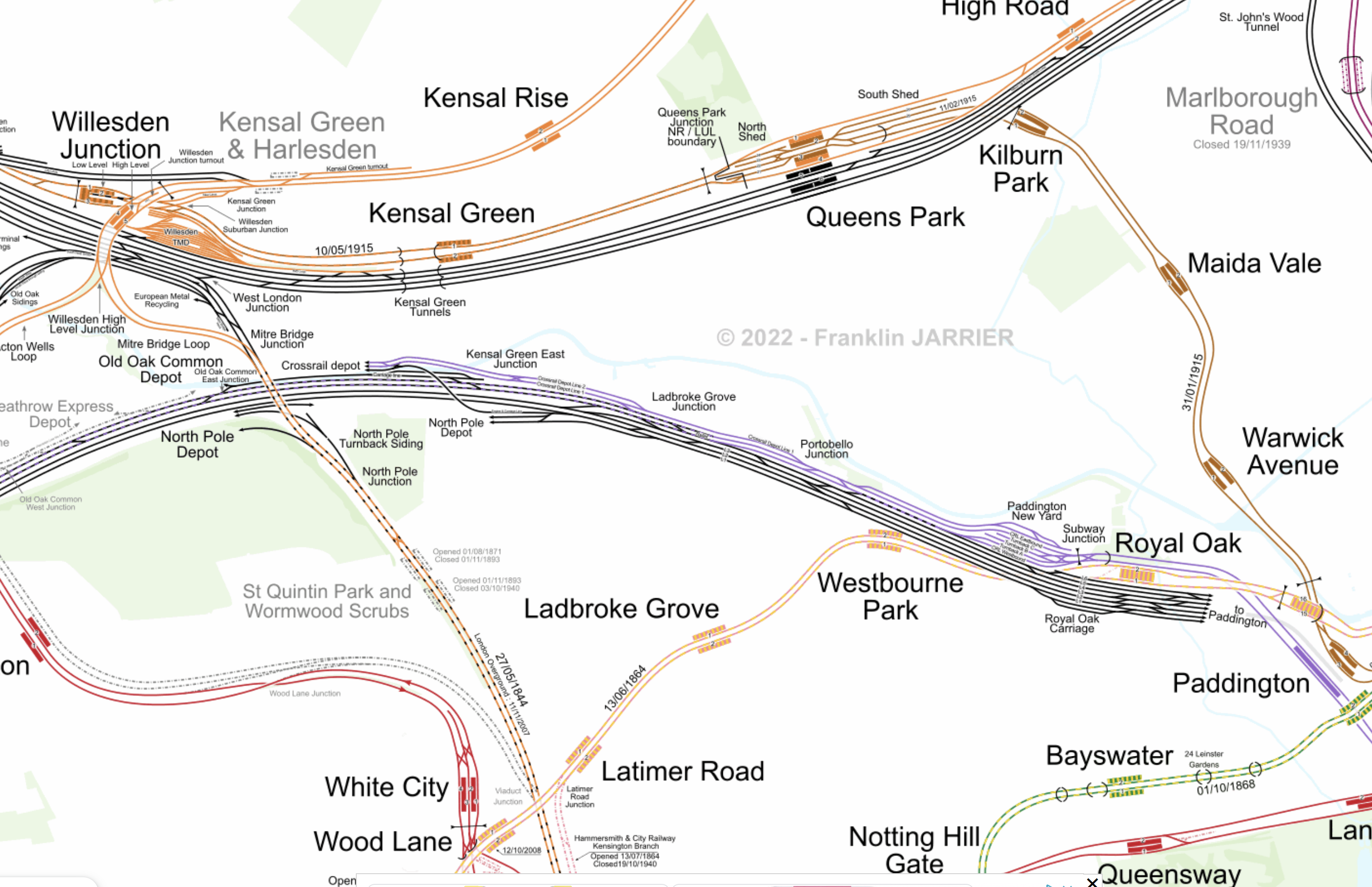
Note.
- The Elizabeth Line is shown in purple.
- Ladbroke Grove rube station is not close to the Elizabeth Line.
- Kensal Green tube station is not close to the Elizabeth Line.
But we do know this about the future Old Oak Common station.
- It will be served by Elizabeth Line services between Central London and Heathrow Airport.
- It will be served by High Speed Two services between London Euston and the North of England and Scotland.
- It will be served by Great Western services between London Paddington and the West of England and Wales.
- It will be served by North London Line services betweeen Stratford and Richmond.
- It will be served by Heathrow Express services between London Paddington and Heathrow Airport.
From the map, it looks unlikely that the Hammersmith & City Line will be able to serve Old Oak Common station.
However, it might be possible that Euston and Old Oak Common could be served by Watford DC Line services, which called at either Old Oak Common or Kensal Greeen.
A link between Euston and Old Oak Common, would give all stations on the line access to High Speed Two and Heathrow with a change at Old Oak Common.
Some Euston suburban services could stop at Old Oak Common for access to High Speed Two and Heathrow.
The Watford DC Line which is very self-contained could become a comprehensive feeder line for High Speed Two and Heathrow.
Kensal Green Station
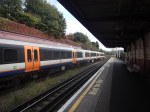
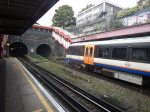
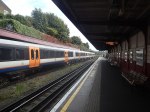
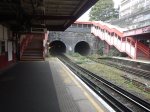
I took a trip to Kensal Green station and took these pictures.
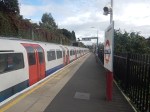
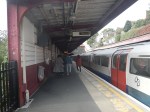

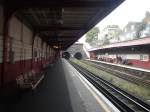
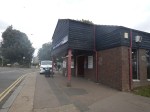
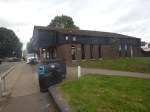


Note.
The station handles two heights of trains on single-height platforms.
Some of the stairs are not the best.
There is no step-free access.
There are six lines through the station and there may be scope for more platforms.
If ever there was a station that needed a makeover it is Kensal Green.
Conclusion
I doubt that the Hammersmith & City Line could be connected to the Elizabeth Line to the West of Paddingt9n.
But I do feel that the Watford DC Line could be developed into a comprehensive link between Euston and Old Oak Common satiations.
Extending The Elizabeth Line – Could Open Access Services Use The Elizabeth Line?
In the February 2024 Edition of Modern Railways, there is an article which is entitled First Bid For Sheffield To King’s Cross Paths.
The article is mainly about FirstGroup’s proposal for a new Sheffield and London service, running under the Hull Trains brand.
But, this is the last paragraph.
Modern Railways understands First is working on a number of proposals for additional open access services, and this is an early statement of intent. Other existing open access proposals include Grand Union Trains’ plans for London to Stirling and Cardiff to Edinburgh services, along with an already approved London to Carmarthen service, and the recently submitted Wrexham, Shropshire and Midland Railway application for a London to Wrexham service. It is understood other organisations, including MTR and Virgin, are also working up plans for new open access services.
The respected Modern Railways magazine seem to think, that we’ll be seeing more open access services on UK railways.
These are my thoughts.
A Simple Example – London Crosslink
In Extending The Elizabeth Line – London Crosslink, I said this.
In the Wikipedia entry for the London Crosslink, this is the introduction.
London Crosslink was a passenger train service operated by Anglia Railways between Norwich and Basingstoke, using the North London Line to bypass central London. Class 170 Turbostar diesel multiple units were used, and the service operated between 22 May 2000 and 28 September 2002, supported by funding from the Strategic Rail Authority through its Rail Passenger Partnership fund.
As it was discontinued and it doesn’t seem to be sadly missed, I’m not advocating its reinstatement, but just looking how it might be run after the full opening of the Elizabeth Line.
But surely, there were good reasons, why the service was run in the first place and there might be a need in the future.
These are some characteristics of the service.
- There were about half-a-dozen services in both directions every day.
- At its full length it ran between Norwich and Basingstoke.
- Stops included Diss, Stowmarket, Ipswich, Colchester, Witham, Chelmsford, Ingatestone, Romford, Stratford, Highbury & Islington, Camden Road, West Hampstead, Brentford, Feltham, Staines, Woking and Farnborough (Main).
- Each service seemed to have a different stopping pattern.
- The timetable wasn’t very regular.
- The route wasn’t fully electrified.
It appears that it may have been a difficult service to timetable.
I lived North of Ipswich for some years.
I never used the London CrossLink service, as I had moved away before the service started in 2000.
- I would have found the change to the Central Line at Stratford station useful.
- I would have found the change to the Victoria Line at Highbury & Islington station useful.
- I would have found the change to Thameslink at West Hampstead station useful.
- Basingstoke would have given access to Greater South-West England.
- I could have got a bus to Heathrow from Feltham.
But getting to Marylebone, Paddington and Waterloo would have still been tedious.
Could a replacement for the London CrossLink be routed via the Elizabeth Line?
- The service would use the Elizabeth Line between Stratford and Reading.
- The service would use the Reading and Basingstoke Line between Reading and Basingstoke.
The route has some advantages over the original route.
- Except for the 13.6 miles between Southcote Junction and Basingstoke, the route is fully-electrified.
- Whitechapel will give access to London Overground services.
- Farringdon will give access to Thameslink services.
- There will be a lot of connections at Tottenham Court Road and Bond Street.
- Paddington and Reading will give access to Heathrow, Oxford and West of England services.
- Basingstoke will give access to Greater South-West England.
It is certainly an as-useful route as the original, if not more so.
The Trains
In Extending The Elizabeth Line – Will There Be A Need For Long Distance Class 345 Train?, I set out how a standard Class 345 train could be updated with faster running and a more appropriate interior.
As the Elizabeth Line is likely to need some more trains if High Speed Two is delayed, perhaps some extra trains should be ordered fairly soon.
The Routes
Consider.
- A terminal station would probably need to be electrified to the Elizabeth Line route.
- It would need the infrastructure to turn the trains.
These stations could probably be used as terminal stations.
- Basingstoke
- Bristol
- Cardiff
- Colchester
- Faversham
- Hoo – See Extending The Elizabeth Line – A Branch To The Isle Of Grain.
- Ipswich
- Northfleet – For European services at Ebbsfleet International.
- Norwich
- Oxford
- Rochester
- Southampton
- Southend Victoria
There will certainly be others.
Why Use Open Access?
Suppose an operator wants to run a service between Bristol Parkway and Northfleet to give the West Country access to European services.
- The operator takes all the risk and Network Rail get track access charges.
- Do Transport for London get track access charges for the Elizabeth Line tunnels?
- If they get their predictions and sums wrong, they lose the money.
But if they get it right, they probably sell it to an infrastructure company at a profit.
Conclusion
I think open access operation might work through the Elizabeth Line Tunnels.
Extending The Elizabeth Line
It is generally accepted that the Elizabeth Line has been a success and suggestions are being put forward for the line’s improvement and extension.
This is an index of the various ideas.
- A Branch To The Isle Of Grain
- A Service Between Heathrow And Southend Airports
- An Extension To Southend Airport
- Connecting Great Eastern Main Line Services To The Central Tunnel
- Connecting Great Western Main Line Services To The Central Tunnel
- Connecting North Kent Line Services To The Central Tunnel At Abbey Wood
- Connecting West Anglia Main Line Services To The Central Tunnel
- Connection To Southeastern High Speed One Services
- Could Open Access Services Use The Elizabeth Line?
- High Speed Trains On The Elizabeth Line
- Improving The Northern City Line
- Improving The Route To Windsor & Eton Central Station
- Linking To The Chatham Main Line
- London Crosslink
- Piccadilly Line To Ealing Broadway
- Rebuilding Shenfield Station
- Serving South-East London
- Stratford To Walthamstow and Chingford
- Thoughts On The Maximum Frequency In The Central Tunnel
- Will There Be A Need For Long Distance Class 345 Train?
Was Baldrick An Essex Man?
I have been looking at Network Rail’s page for Beaulieu Park station.
This is the heading.
Network Rail and Essex County Council are working together to develop proposals for the first railway station to be built on the Great Eastern main line for over 100 years.
These two paragraphs outline the project and where the finance is being obtained.
The new station is part of a wider regeneration of the Beaulieu Park estate in Chelmsford with new road infrastructure and up to 14,000 homes.
Essex County Council, in partnership with Chelmsford City Council, successfully secured £218m of funding from the Government’s Housing and Infrastructure (HIF) fund together with £34m contributions from the South East Local Enterprise Partnership and the developers of Beaulieu, Countryside and L&Q.
These features of Beaulieu Park station are listed on the page.
- Three platforms with a central loop line and new tracks to enable stopping services to call at the station while allowing fast trains to pass through unimpeded
- Step free access to all platforms via 2 lifts
- Accessible toilets, baby change facilities, waiting area and space for retail/catering
- Ticketing facilities, with ticket vending machines and a gate line
- Pedestrian and cycle access routes to the station
- 500 spaces for cycle parking and storage
- A bus interchange including bus stands for local services
- Pick up and drop off area with dedicated taxi bays
- Parking for over 700 cars, 5% of which to be designated Blue Badge bays, and motorcycle spaces, as well as dedicated parking for station staff, emergency services, and a dedicated space for service access.
Note.
- How many other parkway stations, other than Ebbsfleet International station have 700 parking spaces?
- The parking at Whittlesford Parkway can only hold 377 vehicles.
- How many other parkway stations have an overtaking loop for faster trains?
Beaulieu Park is not your average parkway station!
I have a few thoughts.
Which Of The Current Services Will Call?
The Network Rail page says this about services.
It will provide additional access to the railway with regular connections to the capital (only 40 minutes from London Liverpool Street station) and other destinations in the east of England. New tracks will enable stopping services to call at the station while allowing fast trains to pass through unimpeded.
Note.
- Trains between London and Hatfield Peverel station typically take under forty minutes.
- Two fast trains per hour (tph) between Liverpool Street and Norwich via Colchester, Ipswich and Stowmarket pass through.
- Only one of the fast trains stops at Chelmsford.
- Four stopping tph, one to each of Braintree, Clacton-on-Sea, Colchester Town and Ipswich pass through.
If all the stopping trains stopped, Beaulieu Park would have the following services.
- Braintree – 1 tph
- Chelmsford – 4 tph
- Clacton-on-Sea – 1 tph
- Colchester – 3 tph
- Colchester Town – 1 tph
- Hatfield Peverel – 1 tph
- Ingatestone – 2 tph
- Ipswich – 1 tph
- Kelvedon – 2 tph
- London Liverpool Street – 4 tph
- Marks Tey – 2 tph
- Romford – 1 tph
- Shenfield – 3 tph
- Stratford – 4 tph
- Witham – 4 tph
All trains are new Class 720 electric trains.
I also feel, that Network Rail could be being cunning.
Suppose, the Liverpool Street and Norwich express, that doesn’t stop at Chelmsford, stopped instead at Beaulieu Park.
- This would give an hourly express service between Beaulieu Park and Norwich, which stopped at Colchester, Manningtree, Ipswich, Stowmarket and Diss.
- It would also enable two tph between Beaulieu Park and Ipswich.
The 700 parking spaces at Beaulieu Park now start to make sense.
- Both Ipswich and Norwich stations are within walking distance of the town centres and the football grounds.
- Ipswich station has a shuttle bus service to the town centre and the hospital.
- Both stations have several local train services.
Beaulieu Park station appears to have been designed as a Park-and-Ride station for the Great Eastern Main Line and all its branches.
Services To And From Lowestoft
In Making Sense Of The New East Anglia Franchise, I looked in detail at Greater Anglia’s promises.
In a section, which is entitled London – Lowestoft – Yarmouth Services, I said this.
There are going to be four direct services between London and Lowestoft each day. This probably initially means two trains to London in the morning peak and two trains back in the evening one.
When, I first moved back to Suffolk in the 1970s, I regularly caught a diesel-hauled train from Wickham Market to London for the day.
This is all motherhood and apple pie for those in Lowestoft wanting to go to London, but I suspect it isn’t the easiest service for a train operator to schedule efficiently and make money.
Would a train operator really want to start a full train at Lowestoft at say six in the morning and then have it wait around all day in London before returning in the evening?
The service hasn’t started.
Services To And From Cambridge Or Peterborough
At some time in the last decade, one of the predecessors of Greater Anglia, used to run a service to Peterborough via Colchester and Ipswich, so that travellers in Essex could catch trains to the North.
Given too that Cambridge has an employment problem, if a service was run, it might attract passengers.
The Class 755 trains Could Serve Bury St. Edmunds, Cambridge, Lowestoft, Newmarket, Peterborough And Yarmouth
Consider.
- A pair of Class 755 trains would leave Liverpool Street.
- They would use electric power to run to Ipswich.
- The trains would run in one of the paths of the current hourly Ipswich service.
- Like their all electric siblings; the Class 745 trains, they would probably run most of the journey at near 100 mph.
- At Ipswich the trains would split.
- One train would go to on to Lowestoft and Yarmouth and the other would go to Cambridge and Peterborough.
If passenger numbers felt it was a good idea, I’m certain, it could be timetabled.
The Chelmsford Avoiding Line
In Will The Chelmsford Avoiding Line Be Rebuilt?, I described the avoiding line, that used to be between the two tracks at Chelmsford station.
It probably saved a few minutes, by allowing fast expresses to pass stopping trains.
Effectively, a new avoiding line is being built at Beaulieu Park, a few miles from the original position at Chelmsford.
So will the fast expresses save a few minutes?
Could The Elizabeth Line Run To Beaulieu Park?
Consider
- The end sections of the Elizabeth Line seem to be busy, as I wrote in Very Busy Lizzie.
- The City of Chelmsford is between Shenfield and Beaulieu Park.
- Paddington and Reading is 35.9 miles.
- Liverpool Street and Hatfield Peverel is 35.9 miles.
So Beaulieu Park is actually closer to London than Reading.
Perhaps, at some time in a few years, passenger traffic between Beaulieu Park and Shenfield will be such, that the Elizabeth Line will be extended to Beaulieu Park.
The ideal service from Beaulieu Park would surely be two tph to Heathrow, as getting to Heathrow from East Anglia by train needs a change at Liverpool Street.
The only drawback is that to work effectively on the Great Eastern Main Line, a sub-variant of the Class 345 trains will be needed with a 100 mph operating speed. I wrote about these trains in Extending The Elizabeth Line – High Speed Trains On The Elizabeth Line.
But they may have the advantage of being able to take the fast lines between Shenfield and Stratford.
Conclusion
Beaulieu Park may just look like any other station to serve a housing development.
But it’s a lot more than that!
- It’s a Park-and-Ride for the whole Great Eastern Main Line and London.
- It should speed up expresses between London and Colchester, Ipswich or Norwich.
- It should improve local connectivity.
- It could take a lot of traffic off the nearby A12.
- It could give the City of Chelmsford its own local metro.
- It could give Heathrow a direct link to much of Essex.
- How much carbon will be saved by passengers?
We need many more well thought out Park-and-Ride stations.
Extending The Elizabeth Line – A Branch To The Isle Of Grain
In Elizabeth Line To Ebbsfleet Extension Could Cost £3.2 Billion, I talked about extending the Elizabeth Line to Ebbsfleet International and Gravesend stations.
In Gibb Report – Hoo Junction Depot, I talked about how Chris Gibb proposed using the former Hoo branch to create a depot for Thameslink trains.
I am a great believer in the idea, that modern railways are a great way of levelling up an area.
I have watched as Dalston and Hackney have risen as the London Overground has developed more and more frequent services through the area.
So when I wrote about the Ebbsfleet Extension to the Elizabeth Line, I asked this question.
Could The Elizabeth Line Be Extended To The Proposed Hoo Station?
The Hundred of Hoo Railway, leaves the North Kent Line about three miles to the East of Gravesend and runs across the Isle of Grain.
I wrote about the proposed reopening of the Hundred of Hoo Railway or the Hoo Branch as it is commonly known in Effort To Contain Costs For Hoo Reopening.
I then put various proposals and facts together.
It is proposed that the Elizabeth Line runs a four trains per hour (tph) service to Gravesend station.
- Gravesend station is a not very suitable station to turn nine-car Class 345 trains, that are over two hundred metres long, as it is on a cramped site.
- Government money has been pledged to build a station on the Isle of Grain to support the new housing on the island.
- According to Chris Gibb, there is space to build a depot.
So why not build a terminal station for the Elizabeth Line on the Isle of Grain?
I had these thoughts on the proposed Hoo station.
- It would be under ten kilometres from Hoo Junction, where the North Kent Line is electrified.
- A single platform could handle 4 tph, but provision for two platforms would be prudent.
- A couple of sidings could provide stabling.
- Services would join the North Kent Line at Hoo Junction.
- Services would use battery power between Hoo Junction and Hoo station.
- If charging were needed at Hoo station a short length of 25 KVAC overhead electrification would be needed.
- There is plenty of power available locally to power any electrification.
The only problem is that there would be a need for battery-electric Class 345 trains, but as Aventra trains were designed and built with battery operation in mind, this shouldn’t be too challenging.
I have a few other thoughts.
Housing By An Elizabeth Line Station
Woolwich station was built to serve a housing development and the developers even built the station box, which I wrote about in Exploring The Woolwich Station Box.
So I don’t think the developers of the housing on the Isle of Grain will be against the Elizabeth Line station.
What Would Be The Frequency To Hoo Station?
As I said, the proposed Hoo branch, could easily have a capacity of four tph.
But services to Heathrow Terminal 4, Heathrow Terminal 5, Maidenhead and Reading are all two tph. Only Abbey Wood, Paddington and Shenfield have a higher frequency.
I suspect that two tph maximises the number of passengers, as they are prepared to wait thirty minutes.
Conclusion
I can see the branch to Hoo station on the Isle of Grain, being one of these options.
- A branch to turn trains running to Gravesend.
- A short branch to level-up the Isle of Grain.
- A short branch to provide transport for new housing.
Or perhaps a mixture of some or all options.
Could we see other branches like Hoo?
Extending The Elizabeth Line – Connecting West Anglia Main Line Services To The Central Tunnel
If say it was ever needed to run a train between Cambridge or Stansted stations and the Central Tunnel of the Elizabeth Line, three things must be possible.
Trains Would Have To Be Compatible With The Central Tunnel Of The Elizabeth Line
As any train would have to be compatible with the platform-edge doors in the central tunnel of the Elizabeth Line, the trains would have to be dimensionally identical to the current Class 345 trains.
- Nine cars
- Possibility of lengthening to ten cars.
- 204.73 metres long.
- 6 sets of doors per carriage
- Ability to run under full digital signalling.
I covered this in detail in Extending The Elizabeth Line – High Speed Trains On The Elizabeth Line.
Trains Would Need A 100 mph Capability To Travel On The Fast Lines Of The West Anglia Main Line
They would be designed for a higher speed of at least 100 mph, to enable running on the fast lines.
The faster running would ease scheduling of the trains.
Effectively, the train would be a Class 345 train with more features and considerably more grunt.
Trains Must Be Able To Connect Between The West Anglia Main Line And The Central Tunnel Of The Elizabeth Line At Stratford
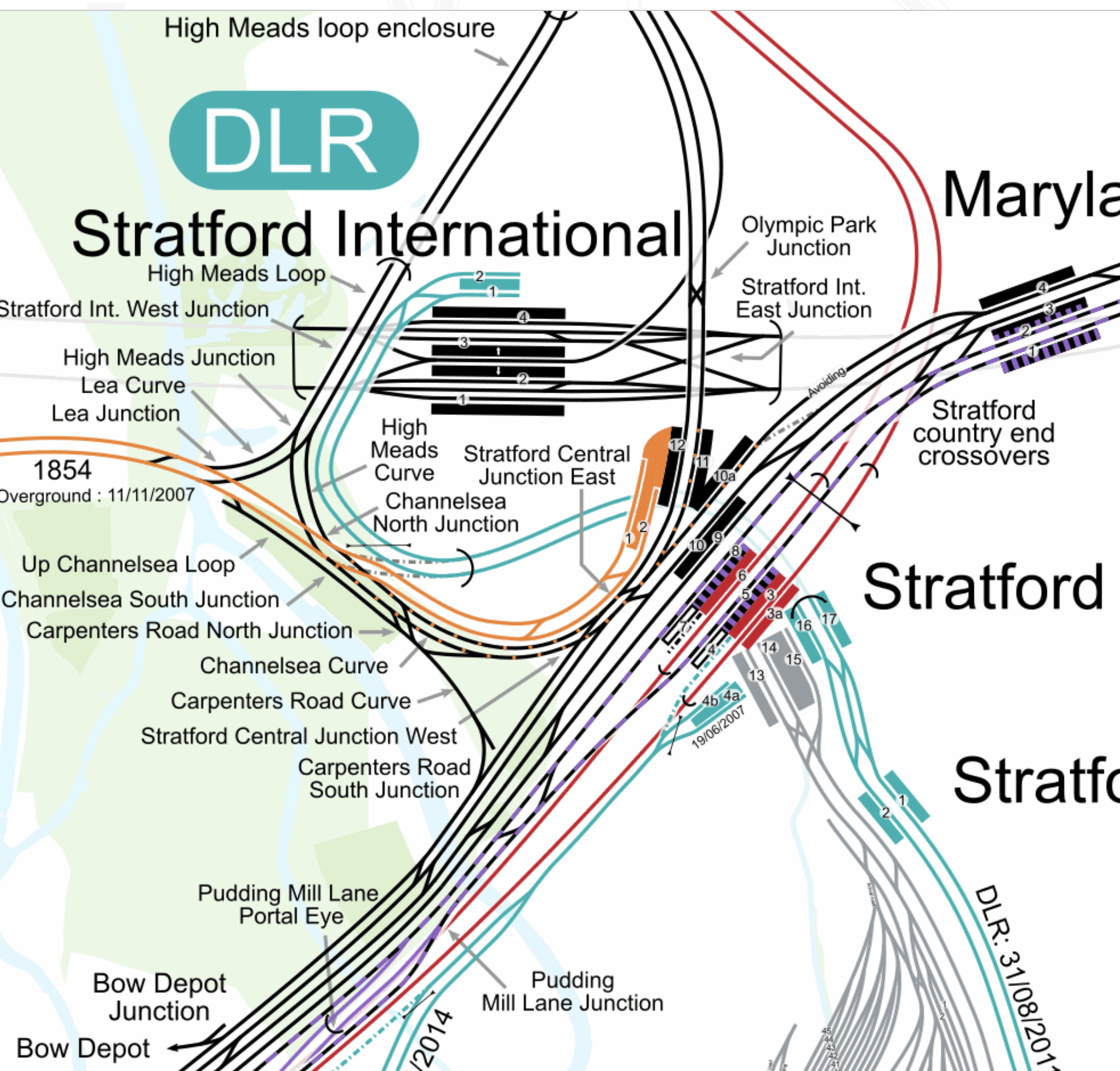
This map from cartometro.com shows the track layout at Stratford.
Note.
- The Elizabeth Line is shown in black and purple.
- The Elizabeth Line enters and leaves the Central Tunnel at the Pudding Mill Lane Portal Eye.
- The West Anglia Main Line to and from Stansted and Cambridge goes through Platforms 11 and 12 at Stratford station, before crossing over Stratford International station and going through Olympic Park Junction.
I am fairly sure that the track layout at Stratford does not allow trains to go both ways between West Anglia Main Line and the Elizabeth Line Central Tunnel.
But I suspect with the addition of a couple of extra crossovers, that this could be arranged.
Extending The Elizabeth Line – Connection To Southeastern High Speed One Services
The Two Stratford Stations
In this post, Stratford station is the station handling Greater Anglia and London Overground, Underground and Docklands Light Railway services, with Stratford International station handles High Speed services.
The Elizabeth Line And The Great Western Railway Services
One of the most important stations on the Elizabeth Line is Paddington, where it connects to the London terminus of the Great Western Railway.
I would expect that quite a few passengers going to the West and Wales on the Great Western Railway, will be transported to Paddington by the Elizabeth Line.
The Elizabeth Line And Greater Anglia Services
Another of the important stations on the Elizabeth Line is Liverpool Street, where the station is the London terminus of the Greater Anglia.
I would expect that quite a few passengers going to East Anglia on the Greater Anglia, will be transported to Liverpool Street by the Elizabeth Line.
Southeastern High Speed One Services
Southeastern runs some High Speed services on High Speed One to provide Kent with an improved service to London.
Current services are
- London St Pancras International to Ramsgate via Faversham.
- London St Pancras International to Ramsgate via Dover Priory.
- London St Pancras International to Margate via Canterbury West.
Note
- All trains are one train per hour (tph).
- All trains stop at Stratford International and Ebbsfleet International.
- All trains are run by 140 mph Class 395 trains.
There has also been talk of running a fourth service to Hastings and Eastbourne via Stratford International, Ebbsfleet International and Ashford International.
St. Pancras Station
All of these trains terminate in three platforms; 11 to 13 at St. Pancras International station.
St. Pancras is not the ideal terminal for the Southeastern High Speed services.
- St. Pancras is not on the Elizabeth Line.
- St.Pancras doesn’t have good connections to Heathrow.
- All connections to the Underground are a long walk.
- Eurostar services are a longer walk.
- East Midland services are also a longer route, with stairs and escalators for good measure.
St. Pancras station was designed by a committee, as a museum to Victorian architecture, rather than as a working station.
Ebbsfleet International Station Must Be The Largest Parkway Station In The UK
It holds nearly five thousand cars and it is served by Southeastern High Speed Services.
Thanet Parkway Station Will Open This Year
Thanet Parkway station is under construction.
- It will have nearly three hundred parking spaces.
- It will be served by Southeastern High Speed Services.
- It should open in May 2023.
This station will need a good connection to London.
Could An Interchange Between The Elizabeth Line And Southeastern High Speed Services Be Provided At Stratford?
Such an alternative interchange would be popular with passengers.
- The Elizabeth Line from Stratford currently serves the West End, the Northern section of the City of London, East London, Liverpool Street, Paddington and the West End directly.
- The Elizabeth Line from Stratford currently serves Canary Wharf, Cannon Street, Charing Cross, Euston, Heathrow, King’s Cross. Reading, St. Pancras and Victoria with a change at Whitechapel.
- The Central Line, which shares platforms with the Elizabeth Line serves Bank and the West End directly.
- The Overground is easily accessed for travel across North London to Richmond.
- The Jubilee Line is easily accessed for travel to London Bridge, Waterloo and Westminster.
It would be connected to two large parkway stations and lots of parking all over Kent.
I believe that Stratford must be promoted as an alternative terminus for Southeastern High Speed Services.
Today, I walked both ways between two Stratford stations.
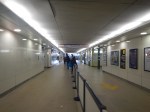
These pictures show the route I took between Stratford and Stratford International stations, through the Eastfield Shopping Centre.
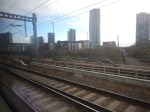
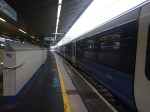
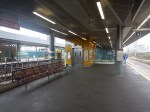
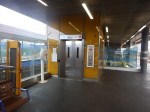
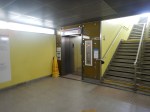
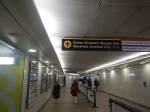
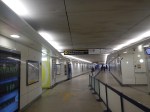

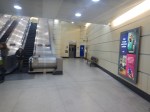



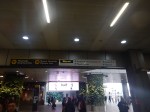




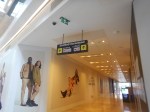



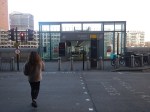
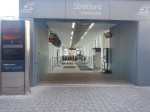
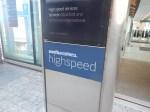
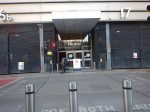
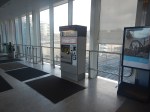
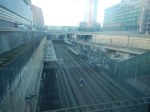
Note.
- I went through the Shopping Centre.
- I passed Marks & Spencer’s large food hall, excellent toilets and a Food Court.
- By the Food Court is an exit that leads to an entrance to Stratford International station.
- The walk took about 10 minutes.
- It was vaguely level.
- Lifts by-passed the escalators.
- One thing that makes the journey to London easier, is to travel in the Eastern end of the train, as the lifts and escalators at Stratford International station, are at that end.
It does need some better signage, but they were doing a bit of refurbishment, so that may already be underway.
It could be a very high quality interchange and it is already better than St. Pancras.
Coming back I took the longer route outside the Shopping Centre.


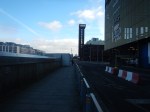

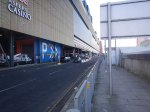
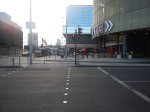
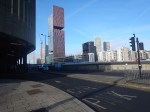
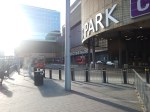
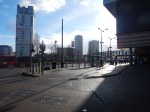
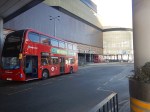


Note.
- I just turned left out of the entrance, walked along the road and turned right past the bus station.
- If the weather had been colder or wetter, I’d have gone back via the Shopping Centre.
- The walk took about 12 minutes.
I think normally, I’d go back through the Shopping Centre, as there’s a Marks and Spencer Food Hall on the route and it’s slightly quicker and often warmer.
Could Stratford Station Be A London Superhub Station?
When you consider the stations connected to Stratford in London, East Anglia and Kent, it has an excellent collection.
- Airports – Gatwick, Heathrow, Luton, Southend and Stansted
- Cities – Cambridge, Canterbury, Chelmsford, Colchester, Ipswich, Norwich and Southend-on-Sea
- London Main and Terminal Stations – Cannon Street, Charing Cross, Clapham Junction, Euston, Farringdon, King’s Cross, London Bridge, Liverpool Street, Marylebone, Moorgate, Paddington, Victoria and Waterloo
- Major Areas – Canary Wharf, City of London, Hampstead, Olympic Park and West End
- Ports – Dover, Felixstowe, Folkestone and Harwich
You can even get a train to Slough, with a change at Whitechapel.
I would think it already is a London Superhub Station.
Extending The Elizabeth Line – Serving South-East London
The Inadequacies Of Abbey Wood Station
Abbey Wood station is the Elizabeth Line’s main terminus in South-East London.
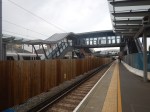

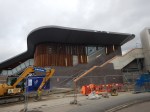
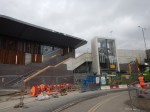
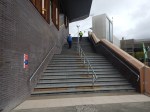
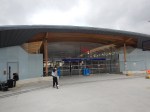
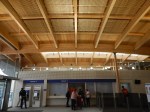
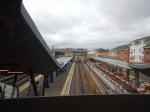
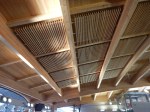
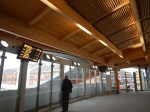
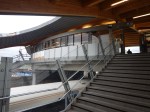
The architecture is impressive, as the pictures taken before the station was finished show.
But other things are less than impressive.
- There is no station parking.
- Central London rail terminals served by Elizabeth Line services are only Liverpool Street/Moorgate and Paddington.
- Central London rail terminals served by National Rail services are Cannon Street, London Bridge, King’s Cross and St. Pancras.
In my view, Abbey Wood is a lost cause, as a commuter station, unless substantial parking is built at the station.
Parking At Stations In West Kent
This list shows the number of car parking spaces at stations in West Kent and South East London.
- Barnehurst – 162 *
- Belvedere – None *
- Bexleyheath – 83 *
- Chatham – 276 *
- Dartford – 186 *
- Ebbsfleet International – 4945 #
- Erith – None *
- Eynsford – 15
- Farningham Road – None
- Gillingham – 152 *
- Gravesend – 94 *
- Greenhithe – 8 *
- Longfield – 88
- Meopham – 167
- Northfleet – None *
- Plumstead – None *
- Rochester – None *
- St. Mary Cray – 31
- Slade Green – 25
- Sole Street – 61
- Stone Crossing – None *
- Strood – 112 *
- Swanley – 106
- Swanscombe – None *
- Welling – 117
Note.
- An asterisk (*) indicates direct trains to and from Abbey Wood station for the Elizabeth Line.
- An hash(#) indicates direct trains to and from Stratford International for the Elizabeth Line.
These figures are according to the National Rail web site.
It looks like unless you can walk to your nearest station and that has an easy connection to Abbey Wood, you’re probably better off going to Ebbsfleet and parking there.
Travelling Between Ebbsfleet International And The Elizabeth Line At Stratford International
Consider.
- Southeastern’s Highspeed service between Ebbsfleet International and Stratford International has a frequency of three trains per hour (tph)
- It takes less than twelve minutes between the two stations.
- It takes ten minutes to walk between Stratford International and Stratford Station for the Elizabeth Line and Greater Anglia services.
- There are eight Elizabeth Line tph to Paddington, calling at all stations. For Heathrow change at Whitechapel station.
Note.
- From these points, it should be possible to estimate the time you should park at Ebbsfleet to get to an event in London or East Anglia, if you live in Kent and are parking at Ebbsfleet International.
- I think four tph between Ebbsfleet International and Stratford International would make the route more attractive.
- If you’re going to Norwich or Ipswich be careful, as only one of the two tph stop at Stratford.
I catch the 12:30 from Liverpool Street for matches at Ipswich on Saturdays. This is the 12:38 from Stratford, so I suspect if you parked at parked at Ebbsfleet before 12:00, you’d make it.
Who’d have thought, that when they built the massive car parks at Ebbsfleet international, that they would be a Park-and-Ride for football at Ipswich. And Norwich too!
Changing Trains At Stratford
This map from Cartometro shows the two Stratford stations.
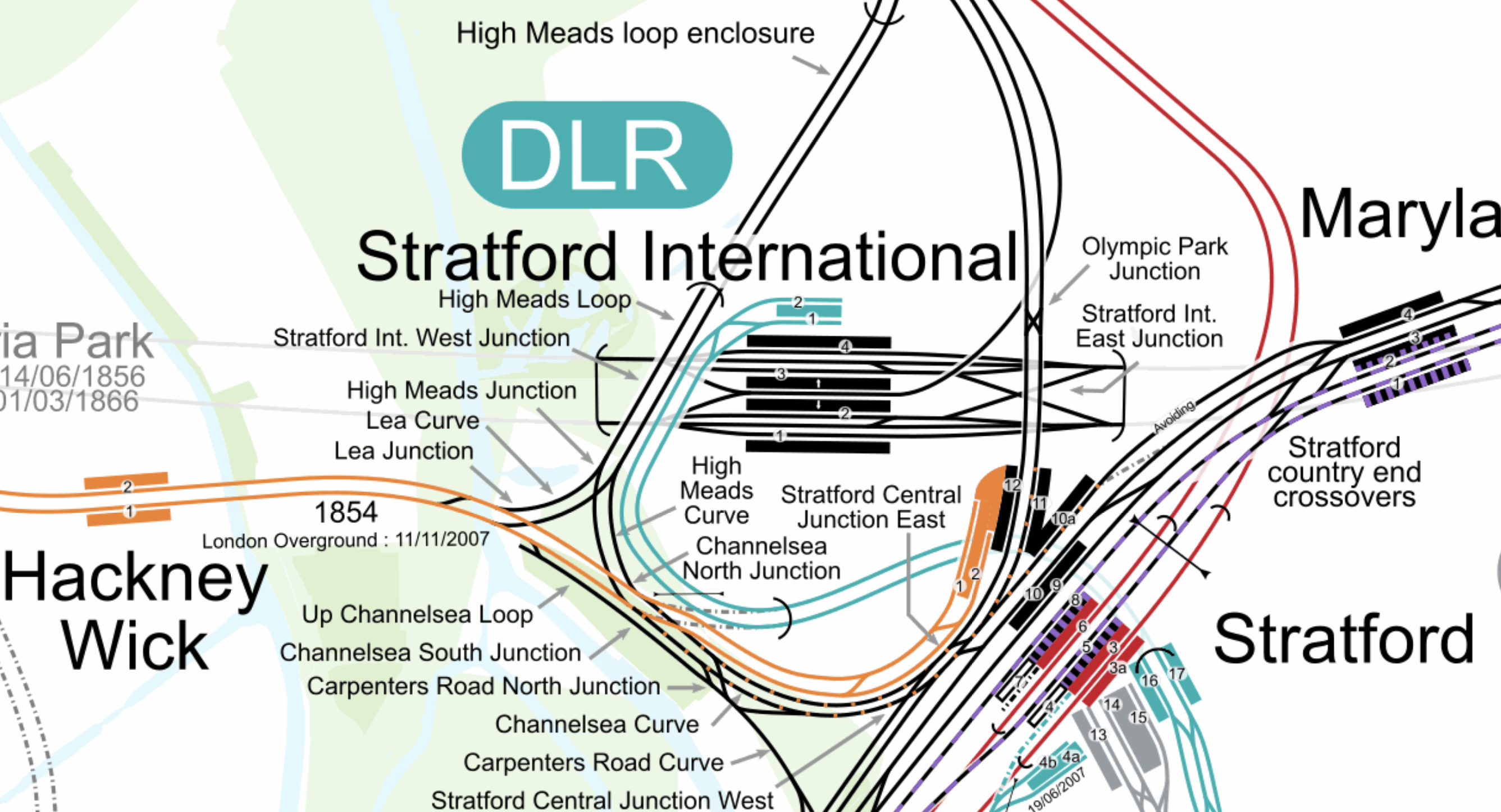
Note.
- The Elizabeth Line is shown in purple.
- The Central Line is shown in red.
- The Jubilee Line is shown in silver.
- The Overground is shown in orange.
- Lifts and escalators take passengers to and from the surface from between platforms 2 and 3 at Stratford International station.
Two pedestrian tunnels connect all the platforms in Stratford station.
- Elizabeth Line trains use platforms 5 and 8.
- Central Line trains use platforms 3, 3a and 6.
- Great Eastern Main Line trains use platforms 9, 9a and 10.
- Overground trains use platforms 1 and 2.
All platforms have lifts.
I suspect, that when you get to know the Stratford complex well, it’s easier than it looks.
But it does need better signage.
Full Step-Free Route Between Ebbsfleet And Heathrow Central
I have just used Transport for London’s Journey Planner, as if I was in a wheelchair and need full step-free access to go from Ebbsfleet to Heathrow Central.
This was the route.
- Southeastern to Stratford International station – 10 mins
- Walk to Stratford station – 21 mins
- Jubilee Line to Bond Street – 24 mins
- Bond Street to Heathrow Central – 32 mins
Note.
- The times are slower than say myself.
- I think it is possible to pick up the Elizabeth Line at Stratford.
But the route is certainly possible in a wheel-chair.
The Penge Interchange
This map from Cartometro shows where the East London Line of the London Overground and the Chatham Main Line between Victoria and Chatham cross in Penge.
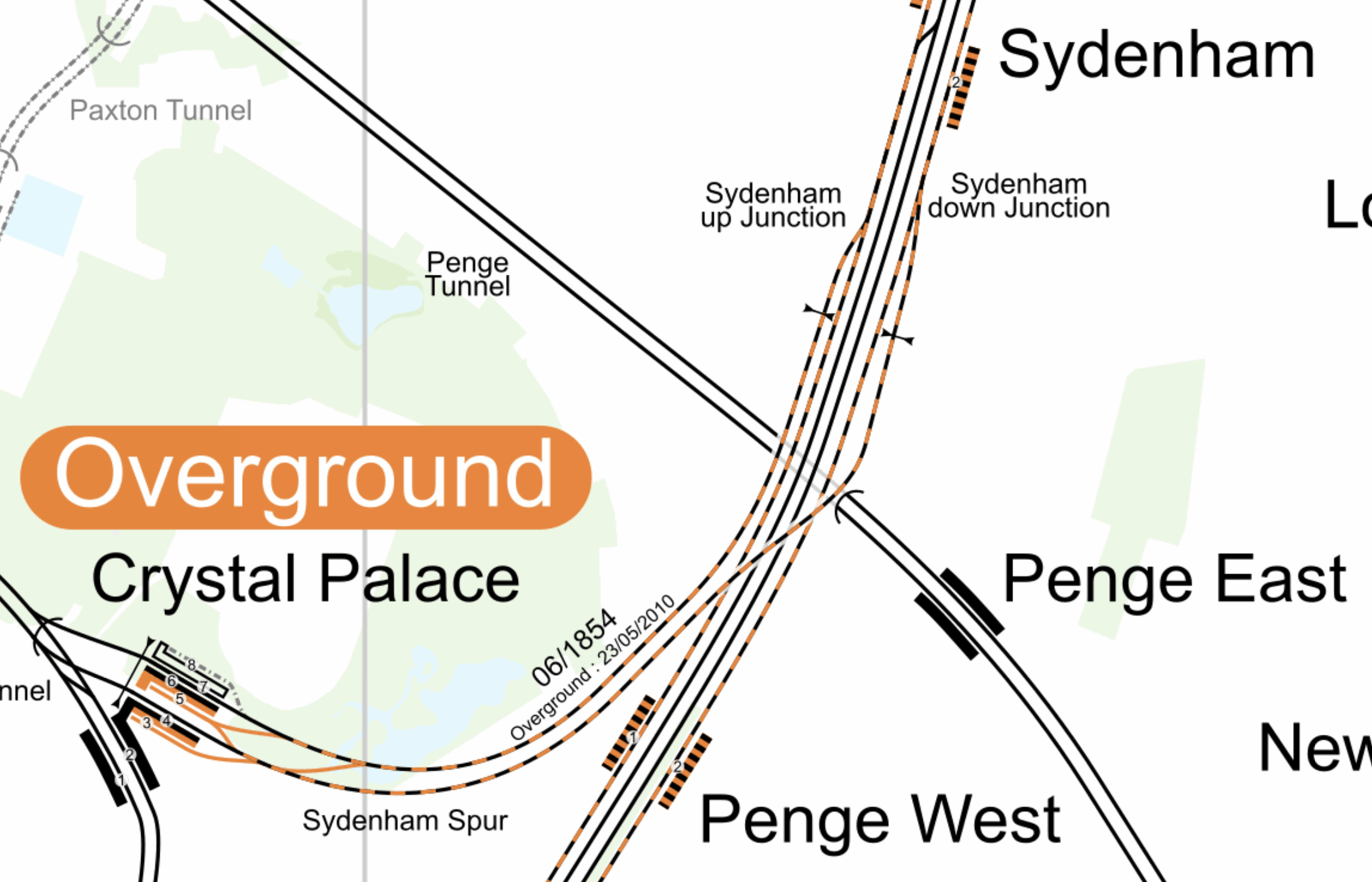
Note.
- The East London Line runs North-South through Sydenham and Penge West stations.
- The Chatham Main Line runs through Penge East station.
There is a plan by Transport for London to create a Penge Interchange station on railway land, where the two lines cross.
- The station could replace Penge West and Penge East stations.
- It would be fully step-free.
- Interchange would be allowed between the East London Line and the Chatham Main Line.
This would increase connectivity for those travelling to and from South-East London and West Kent.
I brlieve that this one interchange could help level-up a large area of South-East London.
Extending The Elizabeth Line – Linking To The Chatham Main Line
Preamble
I believe that everybody in the South East of England needs the best access possible to the Elizabeth Line, by train from where they live.
- The Elizabeth Line serves the important places like Brick Lane, Canary Wharf, the City of London, Heathrow Airport, Liverpool Street station, the Olympic Park, Oxford Street and Paddington station directly.
- Because of its connection to Thameslink, the Elizabeth Line also serves important places like Bedford, Brighton, Cambridge, Gatwick Airport, Luton Airport and Tate Modern with a single change at Farringdon station.
- Using the Elizabeth Line, Thameslink and perhaps a bus, it is possible to get to most important places in Central London.
- The more passengers that use the Elizabeth Line and Thameslink, the more London’s businesses will thrive creating employment and tax revenues.
- It should also be remembered, that using a train to visit central London, probably cuts your carbon footprint.
- The Elizabeth Line also cost a fortune, so perhaps by using it, you will be getting some of your portion of what it cost you back.
This post is one of several, where I discuss how to bring more passengers into the Elizabeth Line network.
The Chatham Main Line
This is the introduction to the Wikipedia entry for the Chatham Main Line.
The Chatham Main Line is a railway line in England that links London Victoria and Dover Priory / Ramsgate, travelling via Medway (of which the town of Chatham is part, hence the name).
Services to Cannon Street follow the route as far as St Mary Cray Junction where they diverge onto the South Eastern Main Line near Chislehurst.
Thameslink services to Luton run in parallel from Rainham to Rochester, diverging once across the River Medway at Rochester Bridge Junction onto the North Kent Line via Gravesend and Dartford.
A shuttle service operates on the Sheerness Line which starts at Sittingbourne.
Note.
- The main London terminals for trains to London on the Chatham Main Line are Cannon Street (Peak only), St. Pancras and Victoria.
- Services stop at Rainham station, so passengers can change to the two trains per hour (tph) Thameslink service to Luton.
- St. Pancras has one tph from Strood, Rochester, Chatham, Gillingham, Rainham, Sittingbourne and Faversham stations.
- Victoria has two tph from Strood, Rochester, Chatham, Gillingham, Rainham, Sittingbourne and Faversham stations.
- Rochester, Gillingham, Rainham and Faversham can turnback trains to London.
The only connections to the Elizabeth Line are.
- The HighSpeed service to St. Pancras calls at Stratford International, where the connection is tortuous.
- The Thameslink service calls at Farringdon, where the connection is easy.
As an example say you were going from Chatham to Heathrow Terminal 4.
The National Rail timetable suggests this route.
- Southeastern HighSpeed – Chatham to St. Pancras
- Thameslink – St. Pancras to Farringdon
- Elizabeth Line – Farringdon to Heathrow
Note that the change at St. Pancras is not the easiest.
Extending The Elizabeth Line To The Chatham Main Line
In Elizabeth Line To Ebbsfleet Extension Could Cost £3.2 Billion, I talk about this proposal as described in this article on Ian Visits.
One of the key features of Crossrail To Ebbsfleet (C2E) project is that instead of all trains terminating at Abbey Wood, trains will terminate as follows.
- Abbey Wood – 4 tph
- Northfleet – 4 tph
- Gravesend – 4 tph
This will mean that 8 tph would pass through Abbey Wood station.
Gravesend is not the best place to turn trains, so why not turn two tph at somewhere like Rochester, Gillingham, Rainham or Faversham?
If two tph to Rainham is good enough for Thameslink, surely two tph to Faversham could be good enough?
Extending The Elizabeth Line To A New Hoo Station
In Effort To Contain Costs For Hoo Reopening, I discussed opening the new Hoo station.
Consider.
- Hoo junction to Hoo station is no more than five or six miles.
- Aventras have been designed to run on battery power, so I suspect Lizzie’s Class 345 trains could be so fitted.
- Range would be sufficient for one return trip from Hoo junction to Hoo station
- Two tph at Hoo station could be handled by a single platform.
It looks to me, that of the four tph to Gravesend if C2E is built, two tph could go to both of Hoo and Faversham.
This assumes of course that digital signalling can fit all the trains on the North Kent Line between Abbey Wood and Faversham.
Chatham And London Main Line Stations
In these routes, I am assuming that there are two tph on the Lizzie Line between Faversham and Heathrow.
- Chatham and Cannon Street – Lizzie Line to Whitechapel and then District Line
- Chatham and Charing Cross – Lizzie Line to Whitechapel and then District Line
- Chatham and Euston – Lizzie Line to Whitechapel and then Hammersmith & City Line
- Chatham and Farringdon – Lizzie Line direct – Thameslink direct
- Chatham and Fenchurch Street – Lizzie Line to Whitechapel and then District Line
- Chatham and Liverpool Street – Lizzie Line direct
- Chatham and Marylebone – Lizzie Line to Paddington and then Bakerloo Line
- Chatham and Paddington – Lizzie Line direct
- Chatham and Kings Cross – Thameslink direct – Lizzie Line to Whitechapel and then Hammersmith & City Line
- Chatham and St. Pancras – Thameslink direct – Southeastern HighSpeed direct
- Chatham and Victoria – Southeastern direct – Lizzie Line to Whitechapel and then District Line
- Chatham and Waterloo – Lizzie Line to Paddington and then Bakerloo Line
Note how Whitechapel is an important interchange, as I said in Whitechapel Station Is The Preferred Interchange.
Conclusion
I do believe that the Elizabeth Line could be successfully extended to Kent.
Extending the Elizabeth Line – Stratford To Walthamstow and Chingford
A lot of people in Walthamstow and Chingford would like a direct rail connection to Stratford with its shopping, sporting, entertainment and employment opportunities.
The Hall Farm Curve used to provide this connection, but it was removed in 1968, despite having been electrified in 1960.
This map from cartometro.com shows the curve.

Note.
- The Chingford branch line is shown in orange.
- The triple-track Stratford branch of the West Anglia Main Line crosses the Chingford branch line at right angles.
- Lea Bridge station reopened in 2016.
It has been stated that the Hall Farm Curve would be reinstated as an electrified single track.
There would probably be a need for a crossover to the North of the former Hall Farm junction to enable trains from Lea Bridge to get to the Chingford-bound track.
The Hall Farm Curve would also give access to Elizabeth Line and Greater Anglia services at Stratford. But it may be that when the Elizabeth Line opens fully in November, travellers get used to going into Liverpool Street and changing there.
Services Between Stratford and Chingford Via Walthamstow
Providing this service might be difficult, but not impossible.
- Trains could use the High Meads Loop at Stratford.
- Digital signalling may allow more trains to be squeezed in.
- Chingford could certainly handle eight trains per hour (tph)
But there is always the problem of the level crossing at Highams Park station.
Changing Between The Elizabeth And Chingford Branch Lines At Liverpool Street Station
Consider.
- At present Liverpool Street station on the Lizzie Line has sixteen trains per hour (tph).
- Eight tph go to both Eastern termini at Abbey Wood and Shenfield.
- In the West two tph go to each of Heathrow Terminal 4, Heathrow Terminal 5, Maidenhead and Reading, with the other eight tph reversing at Paddington.
- If you travel in the Eastern end of a Lizzie Line train, you should enter Liverpool Street station opposite to where all London Overground services including those to and from Chingford terminate in the station.
- The walking route between the Elizabeth And Chingford Branch Lines At Liverpool Street is step-free.
Some passengers will use this route to places like Walthamstow Central, but others moan, that there is no direct connection between the Victoria and Lizzie Lines.
Stations Without Step-Free Access On The Chingford Branch Line
These stations on the Chingford Branch Line do not have full step-free access between train and street.
- Bethnal Green
- Cambridge Heath
- London Fields
- Hackney Downs
- Clapton
- St. James Street
- Walthamstow Central
- Wood Street
Only Hackney Downs and Walthamstow Central have been mentioned with respect to installing some form of step-free access.
Increasing Capacity Between Liverpool Street And Chingford
The Chingford Branch Line can handle pairs of four-car trains and running these all day, would surely be the best way to increase capacity.
Conclusion
If money was no object, the Chingford Branch Line could be improved to make it a much better feeder line for the Elizabeth Line.
I also have a feeling, that a lot of people living in North-East London will switch their travelling from the Victoria Line to the Chingford Branch Line and the Lizzie Line.
 The Anonymous Widower