Will It Be Third-Time Lucky For Grand Union Trains In Wales?
It is three years since I wrote Grand Union Seeks ’91s’ To Cardiff and their proposal has not been accepted and the third iteration has been announced.
This article on Wales Online is entitled Independent Rail Firm Bids To Launch As Rival To Great Western On The Mainline From South Wales To London.
These are the introductory paragraphs.
An independent rail firm is hoping to launch a rival train service in Wales which they say will slash journey times between Carmarthen and London. Grand Union Trains is making a fresh bid to introduce an initial service in both directions between Cardiff and London on the existing Great Western line.
The company believes the move will “create passenger choice” and increase the number of trains available, with the hope that the service can be extended west in South Wales towards Carmarthen.
Other points in the article include.
- Swansea will be by-passed, which will speed up services to and from Llanelli and Carmarthen.
- A new Park-and-Ride station will be built by Grand Union at Felindre, which is to the North of Swansea.
- Services will stop at Llanelli, Cardiff Central, Newport, Severn Tunnel Junction and Bristol Parkway.
- When Cardiff Parkway opens, this will be an extra stop.
An article in the June 2022 Edition of Modern Railways, which is entitled Grand Union Bids For London To Carmarthen, gives extra details.
- Three classes.
- 2023 start for the service.
- Five return trains per day.
- Cycle provision.
- Vanload freight will be carried.
- Electric trains could start between London and Cardiff by 2023.
- In 2025, trains could be nine-car bi-modes.
- South Wales-based operation and maintenance.
- 125 full-time jobs created.
It certainly seems to be a comprehensive and well-thought out plan.
These are my thoughts and observations.
Felindre Station
Felindre station is named in Wikipedia as the West Wales Parkway station, where it is introduced like this.
West Wales Parkway is a proposed railway station north of Swansea, near to the boundaries of the neighbouring principal area of Carmarthenshire, and the villages of Felindre and Llangyfelach. The station is proposed to be situated at the former Felindre steelworks, near Junction 46 of the M4 and A48, and near Felindre Business Park and Penllergaer Business Park. The project is in the planning stages, as part of a wider Department for Transport proposal to re-open the Swansea District line to passenger traffic.
This Google Map shows where, it appears the Felindre station will be built.
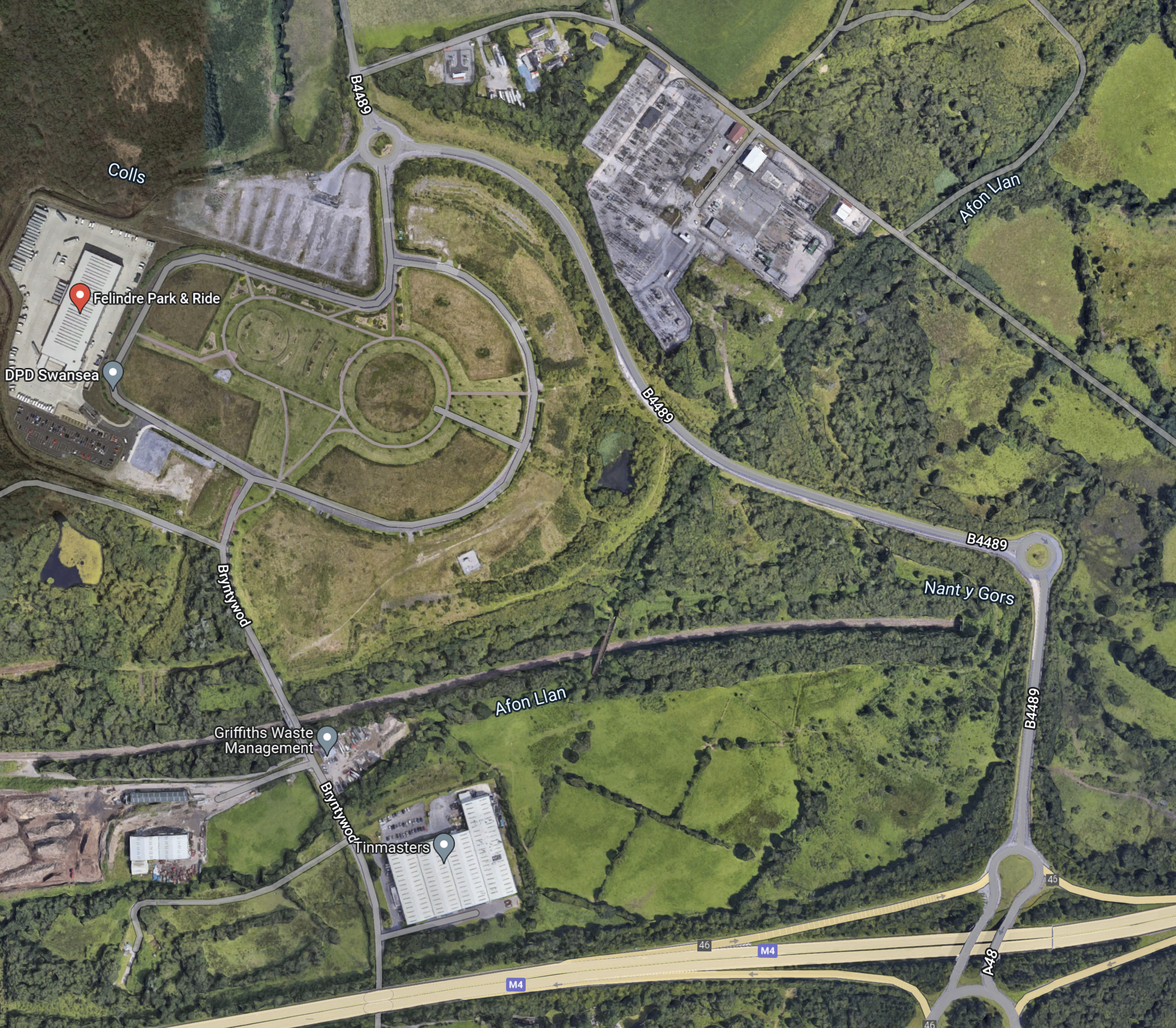
Note.
- The Felindre Business Park in the North-West corner of the map, with a Park-and-Ride.
- The M4 running across the bottom of the map.
- The Swansea District Line runs East-West between the motorway and the Business Park.
It looks that the new station could be located on the South side of the Business Park.
According to Wikipedia, the station would cost £20 million to build.
- It would need a comprehensive rethinking of transport improvements in the Swansea area.
- But it could result in time savings on services between Carmarthen and Cardiff.
The Modern Railways article says this.
GU proposes to build the Felindre station near Swansea and invest in Severn Tunnel Junction station, where it says it will increase parking, provide direct access from the M4 motorway and improve passenger and staff facilities, backing up plans being evaluated by the Welsh Government for the station.
Grand Union is not a charity and does this indicate that a bank or infrastructure company is prepared to fund parking and the extra passengers pay the charges.
Rolling Stock
Wikipedia says that the rolling stock could be nine-car InterCity 225s hauled by Class 91 or Class 93 locomotives.
As the Class 93 locomotives are bi-modes, these would handle the Carmarthen and Cardiff leg.
The Modern Railways article says this.
Trains could start between Cardiff and London Paddington as early as May 2023 if electric only, with services extended west around two years later with new bi-mode trains in up to nine-car formations.
Would a new Class 93 locomotive count as a new bi-mode train?
I suspect the new locomotive would be more affordable, than a new bi-mode train.
Vanload Freight
This is an interesting idea and it follows similar thinking to Royal Mail’s latest ideas, that I wrote about in Royal Mail Rolling Back The Years To Put More Post On Trains.
One coach could be a nice little earner, if it were modified to carry roller cages, that were loaded and unloaded at the end of the route.
One advantage of the InterCity 225s is that they are 125 mph trains, so that this will be high speed freight.
Timings
Consider.
- A GWR Carmarthen and London service takes three hours and 47 minutes.
- This includes a nine-minute reverse at Swansea.
- GWR makes seven more stops than Grand Union will.
- GWR does seven diesel stops, whereas Grand Union will only do two.
I would estimate that Grand Union will be under three hours and thirty minutes.
Carmarthen Station
This Google Map shows Carmarthen station.
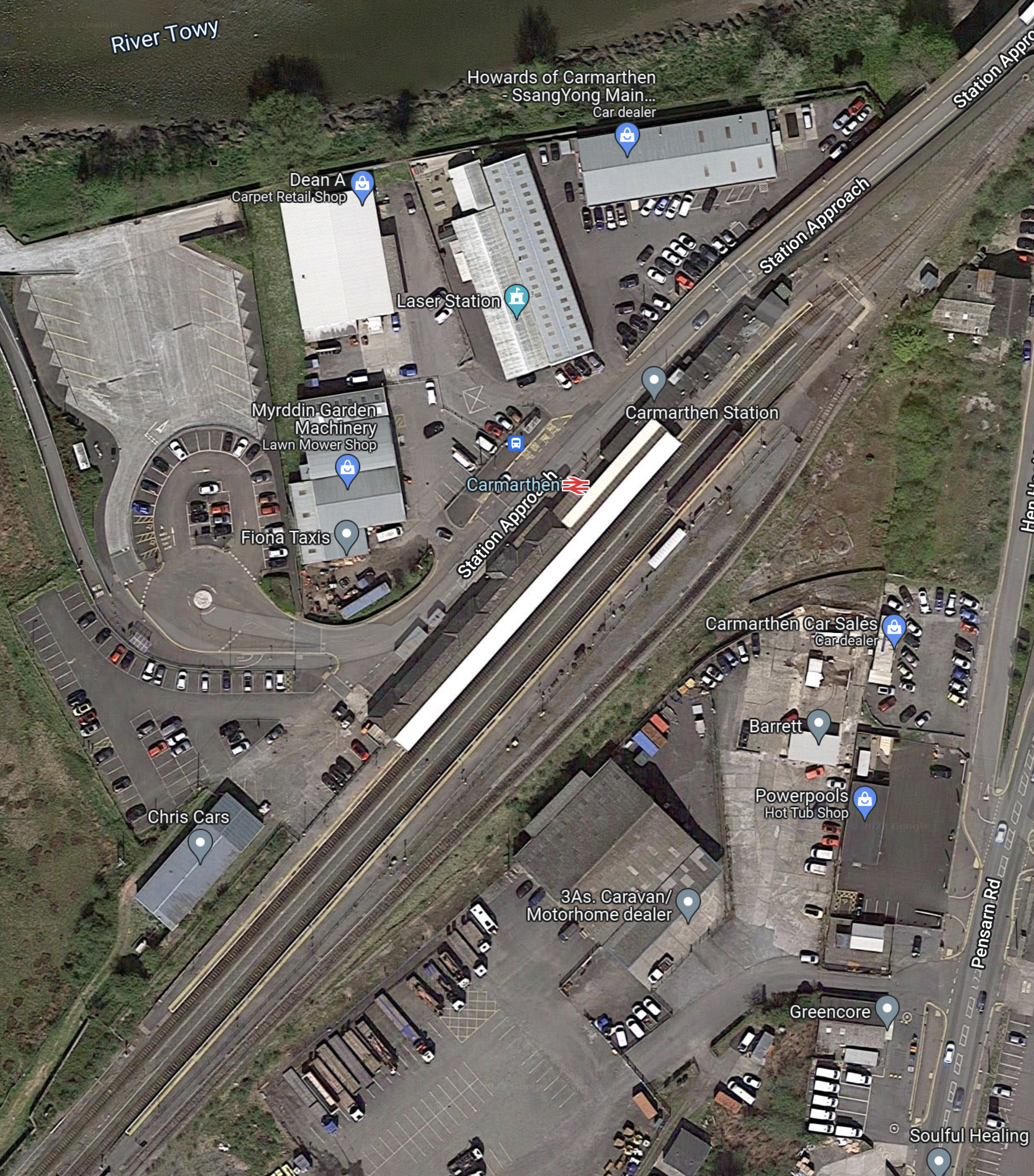
Note.
- The station has two platforms.
- There are certainly pictures of the station with an InterCity 125 in the station.
These pictures show the station.






I suspect that the station will be upgraded to accommodate Grand Union.
Rrenewable Energy Developments In South West Wales
In Enter The Dragon, I talked about renewable energy developments in South West Wales.
I used information from this article on the Engineer, which is entitled Unlocking The Renewables Potential Of The Celtic Sea.
The article on the Engineer finishes with this conclusion.
For now, Wales may be lagging slightly behind its Celtic cousin to the north, but if the true potential of the Celtic Sea can be unleashed – FLOW, tidal stream, lagoon and wave – it looks set to play an even more prominent role in the net zero pursuit.
The Red Dragon is entering the battle to replace Vlad the Mad’s tainted energy.
South West Wales could see a massive renewable energy boom.
The Railways To The West Of Carmarthen
This map from OpenRailwayMap shows the rail lines to the West of Carmarthen.
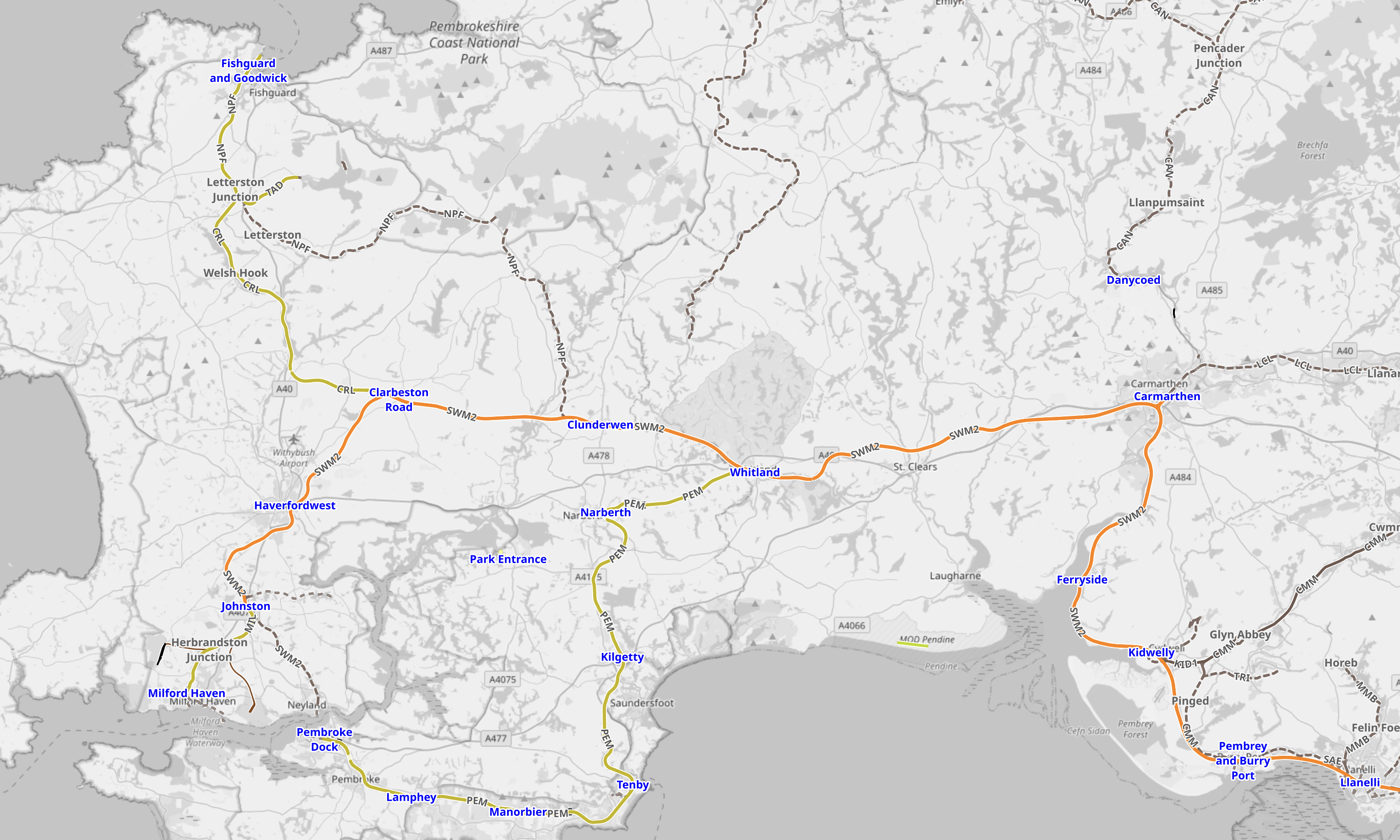
There are three main branches to Fishguard, Milford Haven and Pembroke Dock.
I can see the railways becoming increasingly important in supporting the growing renewable energy in the area.
- There would be more frequent services.
- Services would tie in with London and Cardiff trains at Carmarthen.
- Closed stations could be reopened and new ones built.
It may also be possible to bring in large components needed by the renewable energy industry.
Conclusion
I feel that Grand Union have seen the opportunities presented to a frequent Carmarthen and London service and have grabbed them with both hands.
Offshore Wind Champion Appointed As £160m Floating Offshore Wind Fund Opens For Expressions Of Interest
The title of this post, is the same as that of this press release from Kwasi Kwarteng.
These three paragraphs describe the policy.
Ambitious plans to expand offshore wind around the United Kingdom to power homes and businesses with cheap, homegrown energy received a further boost today with the appointment of a new government champion and a multimillion-pound manufacturing fund opening for expressions of interest.
The appointment of Tim Pick as the first UK Offshore Wind Champion was confirmed by Prime Minister Boris Johnson and Business and Energy Secretary Kwasi Kwarteng today.
The Floating Offshore Wind Manufacturing Investment Scheme (FLOWMIS) will provide £160 million in government funding to boost floating offshore wind capability around the UK at sites in Scotland, Wales and elsewhere by supporting manufacturers and giving private investors the confidence to back this emerging sector which is expected to rapidly expand in the years ahead.
Floating offshore wind needs the following components.
- Wind turbines, which are the same as those used onshore.
- Floats, which are generally made from steel, but concrete can also be used. There are a few proven designs, like the Windfloat from Principle Power.
- Mooring systems for the turbines.
- Electrical substations and cables.
There is also a need for deep water docks, with large cranes to assemble the systems, prior to towing the turbines into position.
Floating offshore wind is a new industry and there will be new ideas coming through from innovators.
I feel that the strategy could help bring new ideas through.
Wind And Solar Boom Will Bring Energy Surplus
The title of this post, is the same as that of this article on The Times.
Under the picture, is this sub-title.
The government has set a target of 50 gigawatts of offshore wind farms by 2030, up from about 10 gigawatts at present.
According to this Wikipedia list of offshore wind farms, the UK currently has 2180 offshore turbines with a capacity of 8113 MW.
These wind farms appear to be planned.
Hornsea
The Hornsea wind farm is currently supplying 1.2 GW to the grid, but it is planned to be expanded to 6 GW, which is another 4.8 GW.
East Anglia Array
The East Anglia Array is currently supplying 0.7 GW to the grid, but it is planned to be expanded to 7.2 GW, which is another 6.5 GW.
Sofia
The Sofia wind farm will supply 1.4 GW from 2026.
Moray East
The Moray East wind farm will supply 0.95 GW from 2022.
Neart Na Gaoithe
The Neart Na Gaoithe wind farm will supply 0.45 GW from 2023.
Triton Knoll
The Triton Knoll wind farm will supply 0.86 GW from 2022.
Seagreen
The Seagreen wind farm will supply 1.1 GW from 2023.
Dogger Bank
The Dogger Bank wind farm will supply 3.6 GW from 2025.
Moray West
The Moray West wind farm will supply 1.2 GW from 2025.
Rampion 2
The Rampion 2 wind farm will supply 1.2 GW before 2030.
Norfolk Boreas
The Norfolk Boreas wind farm will supply 1.8 GW before 2030
Norfolk Vanguard
The Norfolk Vanguard wind farm will supply 1.8 GW before 2030
These wind farms total up to 31.1 GW
Morgan And Mona
The Morgan and Mona wind farms will supply 3 GW from 2028.
ScotWind
This map shows the wind farms in the latest round of leasing in Scotland.

These wind farms should be providing 24.8 GW by 2030.
Celtic Sea
In Two More Floating Wind Projects In The Celtic Sea, I give details of six wind farms to be developed in the Celtic Sea, that will produce a total of 1.2 GW.
All should be delivered by 2030.
Northern Horizons
In Is This The World’s Most Ambitious Green Energy Solution?, I talk about Northern Horizons, which will produce 10 GW of wind energy from 2030.
An Armada Of Wind Farms
As many of these wind farms will be floating and wind-powered, the collective noun must surely be an armada.
These are some figures.
- The size is certainly spectacular at 70.1 GW.
- As the UK electricity consumption in 2020-2021 was 265.4 TWh, the average hourly production throughout the year is 30.3 GW.
- As I write this post, the UK is generating 30.1 GW.
As the best offshore wind farms have a capacity factor of around fifty percent, we should be able to power the UK with wind power alone.
So when The Times says this in the first two paragraphs of the article.
Britain will have excess electricity supplies for more than half of the year by 2030 as a huge expansion of wind and solar power transforms the energy system, a new analysis suggests.
Energy storage technologies, including batteries and electrolysers to make hydrogen, will need to be deployed at massive scale to prevent this surplus electricity going to waste, according to LCP, a consultancy.
The article would appear to correct.
The Need For Energy Storage
If we look at energy production at the current time, energy production is as follows.
- Biomass – 0.5 GW
- Gas – 17 GW
- Nuclear – 5 GW
- Onshore Wind – 12 GW with 20 % capacity factor – 2.4 GW
- Offshore Wind – 8.1 GW with 30 % capacity factor – 2.4 GW
- Interconnects – 0.4 GW
- Others – 0.5 GW
This totals up to 28.2 GW.
In 2030, energy production could be as follows.
- Biomass – 0.5 GW
- Nuclear – 5 GW
- Onshore Wind – 12 GW with 20 % capacity factor – 2.4 GW
- Offshore Wind – 30 GW with 30 % capacity factor – 9 GW
- Floating Offshore Wind – 40 GW with 50 % capacity factor – 20 GW
- Others – 0.5 GW
This totals up to 37.4 GW.
So if you take a typical day, where on average throughout the day we are producing around 7 GW more of electricity than we need, we will actually produce around 7 * 24 GWh = 168 GWh of excess electricity
Whichever was you look at it, we have got to do something concrete with a large amount of electricity.
- Store it in batteries of various types from lithium ion, through new types of batteries like those being developed by Highview Power and Gravitricity to pumped hydro storage.
- Store the energy in the batteries of electric cars, vans, buses, trucks, trains and ships.
- Store the energy in Norwegian pumped hydro storage.
- Convert it to hydrogen using an electrolyser and blend the hydrogen with the natural gas supply.
- Convert it to hydrogen using an electrolyser and use the hydrogen to make zero-carbon steel, concrete and chemicals.
- Convert it to hydrogen using an electrolyser and develop new zero-carbon industries.
- Convert it to hydrogen using an electrolyser and store the hydrogen in a depleted gas field.
- Sell it to Europe, either as electricity or hydrogen.
Note.
- We are going to have to build a lot of batteries and I suspect they will be distributed all round the country.
- We are going to have to build a lot of hydrogen electrolysers.
- We have world class battery and electrolyser companies.
We should also fund the following.
- Developments of technology, that makes better batteries, electrolysers, boilers and heat pumps.
- I would also do a lot of work to increase the capacity factor of wind farms.
I also believe that if we have masses of electricity and hydrogen, we might find as a country, it’s very beneficial in terms of jobs, exports and a healthier economy to invest in certain industries.
Conclusion
The future is rosy.
DP Energy And Offshore Wind Farms In Ireland
DP Energy are a company that are developing these offshore wind farms in Ireland.
Located off the West Coast of Ireland, the Clarus Offshore Wind Farm project will utilise Floating Offshore Wind (FOW) technology and upon completion, will have the potential capacity of up to 1 GW.
Located off the South Coast of Ireland, the Inis Ealga Marine Energy Park project will utilise Floating Offshore Wind (FOW) technology and upon completion, will have the potential capacity of up to 1 GW.
Latitude 52 Offshore Wind Farm
DP Energy has given the name Latitude 52 to the area it is exploring for a potential future offshore wind farm off the coast of Counties Wicklow and Wexford.
It appears to be another 1 GW project.
Located off the East Coast of Ireland, the Shelmalere Offshore Windfarm project will utilise fixed bottom wind turbines and upon completion, will have the potential capacity of up to 1 GW.
Note.
- These wind farms are being developed in a partnership with Spanish Energy company; Iberdrola.
- Each is a one GW offshore wind farm.
They are also developing the Gwynt Glas offshore wind farm in the UK sector of the Celtic Sea.
- In January 2022, EDF Renewables and DP Energy announced a Joint Venture partnership to combine their knowledge and
expertise, in order to participate in the leasing round to secure seabed rights to develop up to 1GW of FLOW in the Celtic Sea. - The wind farm is located between Pembroke and Cornwall.
The addition of Gwynt Glas will increase the total of floating offshore wind in the UK section of the Celtic Sea.
- Blue Gem Wind – Erebus – 100 MW Demonstration project – 27 miles offshore
- Blue Gem Wind – Valorus – 300 MW Early-Commercial project – 31 miles offshore
- Falck Renewables and BlueFloat Energy – Petroc – 300 MW project – 37 miles offshore
- Falck Renewables and BlueFloat Energy – Llywelyn – 300 MW project – 40 miles offshore
- Llŷr Wind – 100 MW Project – 25 miles offshore
- Llŷr Wind – 100 MW Project – 25 miles offshore
- Gwynt Glas – 1000 MW Project – 50 miles offshore
This makes a total of 2.2 GW, with investors from several countries.
It does seem that the Celtic Sea is becoming the next area of offshore wind around the British Isles to be developed.
Interconnectors
Interconnectors are to be built to connect Ireland, UK and France.
The Celtic Interconnector is being built between County Cork in Ireland and the North West Coast of France.
Greenlink is being built between County Wexford in Ireland and Pembroke in Wales.
Conclusion
Are the British, Irish and French governments, planning to build a large wind power resource in the Celtic Sea?
A Massive Task For Ukraine?
After the Russians are thrown out of Ukraine, it will be a massive task to rebuild Ukraine.
But one of Ukraine’s traditional industries can also be used to transform the world.
The Transformation Of Energy Production To Floating Offshore Wind
I believe that over the next few years, we will see an enormous transformation of zero-carbon energy to floating offshore wind.
- The floating offshore wind industry is planning to use the next-generation of larger wind turbines of up to 20 MW.
- These turbines are too large and intrusive to install onshore.
- Floating wind turbines generally have a higher capacity factor of over 50 %, than onshore turbines.
- Each wind turbine will be mounted on a substantial semi-submersible float, which is built out of large-diameter steel tubes
- The wind turbines are of the same design, as those installed onshore.
- There are several designs for the floats and they are usually based on designs that have worked in the oil and gas industry.
The world will need millions of floating turbines and an equivalent number of floats to fully decarbonise.
Could The Ukrainians Build The Floats?
Consider.
- The Russians have destroyed Mariupol, whilst the Ukrainians have defended the city in the steelworks.
- Mariupol used to have a large shipbuilding industry.
- Ukraine is in the world’s top ten of iron ore producers.
- There is a lot of scrap steel available in the Ukraine, that the Russians have left behind.
- The Ukrainians probably have a lot of workers, who have the skills to build the floats.
I’m sure something could be arranged for the benefit of everybody.
Two More Floating Wind Projects In The Celtic Sea
In Two Celtic Sea Floating Wind Projects Could Be Delivered By 2028, I said this.
There now appears to be four floating wind farms under development in the Celtic Sea between the South-West corner of Wales and the Devon and Cornwall Peninsular.
- Blue Gem Wind – Erebus – 100 MW Demonstration project – 27 miles offshore
- Blue Gem Wind – Valorus – 300 MW Early-Commercial project – 31 miles offshore
- Falck Renewables and BlueFloat Energy – Petroc – 300 MW project – 37 miles offshore
- Falck Renewables and BlueFloat Energy Llywelyn – 300 MW project – 40 miles offshore
But they do create a starter for a GW.
Last night, I found two other projects being developed in the Celtic Sea, under the collective name of the Llŷr Project.
The sponsoring company, which appears to be called Llŷr Wind has a web site, with a title of Harnessing Welsh Energy, which has this outline description underneath.
Situated off the Pembrokeshire coast, in southwest Wales, is a flagship project that could transform the world’s ability to generate renewable electricity from wind. The Llŷr projects are exploring the potential of two innovative floating offshore wind technologies.
The next statement is key.
Combined, the two 100MW projects will generate enough renewable electricity to power around 250,000 homes. If successful, we will be able to offer highly cost-effective, floating offshore wind farms to the rest of the world by 2030.
The Llŷr Project would appear to be a research project to find the best way to generate electricity using floating wind turbines in deep water.
- It appears that the two wind farms will use different floats for the turbines.
- The Llŷr projects are located in the approaches to the Bristol Channel in the Celtic Sea approximately 40 kilometres offshore at depths averaging 60-70 metres.
- These offshore sites enjoy high average windspeeds which are, typically, in excess of 10 metres per second. That is over twenty miles per hour.
- Each 100MW project will comprise 6 to 8 next-generation turbines which are too large to be deployed on land.
- 6 x 20 MW turbines will be 120 MW.
- 8 x 12 MW turbines will be 96 MW.
- Each project will have an offshore substation.
- There will be up to two connections for each substation.
- Will the Llŷr Projects test manufacturers’ new turbine designs?
- It is hoped that installation of the turbines will start in 2025/26, with power being delivered in 2026/7.
- The project is being developed by Floventis Energy, which is a joint venture of SBM Offshore and Cierco.
It does look to me that SBM Offshore, who are a Dutch company, are using their extensive oil and gas experience to develop floating offshore wind.
This appears to be a very well-thought out research project in a location, where there is everything needed.
- Lots of wind, which can be boosted by dragons if needed.
- Deep water.
- Ports for assembly of turbines onto floats.
- Steelworks and fabrication.
- Good electrical connections to the National Grid.
- Excellent universities.
- Good transport connections.
- An experienced engineering workforce.
There is also the ultimate potential of 50 GW of floating offshore wind in the Celtic Sea.
Conclusion
The Llŷr Project could have a very positive input into the worldwide development of floating offshore wind.
I have read the web sites of Floventis, SBM Offshore and Cierco and these companies appear to be aiming to dominate the floating offshore wind industry.
Their strategy is stated on the Floventis web site.
Our strategy is simple. We plan to maximize the local benefits of our projects and minimize their impact. Our technologies are far more benign than conventional offshore wind and more suited for deployment in remote and sensitive environments.
Already driving demonstration projects in California and the UK, Floventis is building a portfolio of projects to take floating offshore wind, through a stepwise process – increasing project size, to full scale commercial development proposals by 2030.
We believe that the floating offshore wind industry is a model for a “just transition” to clean energy, at scale, which will reward communities, in the broadest sense, with skilled jobs and enhanced social equity.
I can certainly live with that! And I’m certain the world can too!
Highview Chief Rupert Pearce On The Cold Batteries That Could Save The Planet
The title of this post, is the same as that of this article on The Sunday Times.
It is an article very much worth a read, as it talks about former Inmarsat boss; Rupert Pearce and his new position as boss at Highview Power.
I have followed Highview Power for a few years.
I first wrote about the company in British Start-Up Beats World To Holy Grail Of Cheap Energy Storage For Wind And Solar, after reading about the company in the Daily Telegraph in August 2019.
They seem to have had good press in the last three years and have generated a steady stream of orders from Spain, Chile and Scotland.
But progress seems to have been slow to get the first full-size system at Carrington completed.
It does seem , that Rupert Pearce could be the professional boss they need?
Highview Power ‘s CRYOBatteries certainly have potential.
Highview Power CRYOBatteries Compared To Lithium-Ion Batteries
Highview Power ‘s CRYOBatteries do not use any exotic metals or materials, that are not readily available, whereas lithium-ion batteries use lots of rare metals and electricity in their manufacture.
CRYOBatteries can also be expanded in capacity by just adding more liquid-air tanks.
Highview Power CRYOBatteries Typically Cost £500 Million
This figure is disclosed in the Sunday Times article.
For that you probably get a power station, with these characteristics.
- 50 MW Output.
- Five to eight hour storage.
- No emissions.
- Well-understood maintenance.
- An environmentally-friendly plant.
- Long battery life.
But my experience tells me, that like large lithium-ion batteries used for grid storage, that CRYOBatteries could be an asset that will appeal to large financial companies.
- At present, Highview Power have not run a 50 MW CRYOBattery, but once they show high reliability, I can envisage the energy storage funds taking a good look.
- At £500 million a throw, they are a good size with probably a decent return for insurance companies and pension funds.
See World’s Largest Wind Farm Attracts Huge Backing From Insurance Giant for Aviva’s view on investing in massive green infrastructure.
I very much feel, that with his City connections and experience, that Rupert Pearce might be the right person to arrange financing for CRYOBatteries.
I will add a story from the financing of Artemis, which was the project management system, that I wrote in the 1970s.
Normally we leased or rented the systems, but some companies wanted to buy them outright, so we came up with a price of something like £125,000. Our bank were happy to fund these systems, when the purchaser was someone like BP, Shell, Bechtel, Brown & Root or British Aerospace. Later on, the bank would package together several systems and get us a better deal.
Intriguingly, £125,000 in the late 1970s is about half a billion now. I suspect, I’m being naive to suggest that Highview’s problem of funding multiple sales is similar to the one we had fifty years ago.
Highview Power CRYOBatteries And Wind And Solar Farms
I discussed the use of CRYOBatteries with solar power in The Power Of Solar With A Large Battery.
As the Highview Power press release, on which I based the article has now been deleted, I would assume that that project has fallen through. But the principles still apply!
But surely, a wind farm paired with an appropriately-sized CRYOBattery would ensure a steady supply of power?
Could CRYOBatteries Be Used With Floating Offshore Wind Farms?
In ScotWind N3 Offshore Wind Farm, I described an unusual wind farm proposed by Magnora ASA.
- This page on their web site outlines their project.
- It will be technology agnostic, with 15MW turbines and a total capacity of 500MW
- It will use floating offshore wind with a concrete floater
- It is estimated, that it will have a capacity factor of 56 %.
- The water depth will be an astonishing 106-125m
- The construction and operation will use local facilities at Stornoway and Kishorn Ports.
- The floater will have local and Scottish content.
The floater will be key to the whole wind farm.
- It will certainly have an offshore substation to connect the wind turbines to the cable to the shore.
- Magnora may be proposing to add a hydrogen electrolyser.
- Tanks within the concrete floater can be used to store gases.
I wonder if CRYOBatteries could be installed on the concrete floaters, that would be used to smooth the electrical output of the wind farm?
Note that in the past, concrete semi-submersible concrete structures have been used to host all kinds of gas and oil processing equipment.
Conclusion
I feel that Highview Power have made a good choice of Chief Executive and I have high hopes he can awaken a company with masses of potential.
Two Celtic Sea Floating Wind Projects Could Be Delivered By 2028
The title of this post, is the same as that of this article on offshoreWIND.biz.
This is the first paragraph.
Falck Renewables and BlueFloat Energy have said that they are looking at early delivery of their two floating wind projects in the Celtic Sea, called Llywelyn and Petroc, which have grid connections secured and almost a year’s worth of bird surveys already completed.
These would add two extra 300 MW wind farms to the Celtic Sea.
In Enter The Dragon, I indicated the potential of renewable energy around Wales based on this article on the Engineer is entitled Unlocking The Renewables Potential Of The Celtic Sea. This sentence from the article talks about the possibilities of offshore wind in the Celtic Sea.
The Celtic Sea – which extends south off Wales and Ireland down past Cornwall and Brittany to the edge of the continental shelf – is estimated to have around 50GW of wind generating capacity alone.
The article also talks about Blue Gem Wind and their Erebus and Valorous wind farm projects in the Celtic Sea, that I wrote about in Blue Gem Wind.
There now appears to be four floating wind farms under development in the Celtic Sea between the South-West corner of Wales and the Devon and Cornwall Peninsular.
- Blue Gem Wind – Erebus – 100 MW Demonstration project – 27 miles offshore
- Blue Gem Wind – Valorus – 300 MW Early-Commercial project – 31 miles offshore
- Falck Renewables and BlueFloat Energy – Petroc – 300 MW project – 37 miles offshore
- Falck Renewables and BlueFloat Energy Llywelyn – 300 MW project – 40 miles offshore
But they do create a starter for a GW.
Both consortia seem to have similar objectives.
- To use a stepping-stone approach, gradually building in size.
- To involve the local community in creating a supply chain.
- Create long-term benefits for the region.
If these and other consortia fill the Celtic Sea with 50 GW of floating wind turbines, then we’ll all benefit.
How Britannia With Help From Her Friends Can Rule The Waves And The Wind
The Government doesn’t seem to have published its future energy plans yet, but that hasn’t stopped the BBC speculating in this article on their web site, which is entitled Energy Strategy: UK Plans Eight New Nuclear Reactors To Boost Production.
These are the first two paragraphs.
Up to eight more nuclear reactors could be delivered on existing sites as part of the UK’s new energy strategy.
The plan, which aims to boost UK energy independence and tackle rising prices, also includes plans to increase wind, hydrogen and solar production.
Other points include.
- Up to 95% of the UK’s electricity could come from low-carbon sources by 2030.
- 50 gigawatts (GW) of energy through offshore wind farms, which would be more than enough to power every home in the UK.
- One of the big points of contention is thought to have been the construction of onshore wind turbines.
- Targets for hydrogen production are being doubled to help provide cleaner energy for industry as well as for power, transport and potentially heating.
- A new licensing round for North Sea oil and gas projects.
- A heat pump accelerator program.
In this post I shall only be looking at one technology – offshore wind and in particular offshore floating wind.
Who Are Our Friends?
I will start with explaining, who I see as our friends, in the title of this post.
The Seas Around Us
If we are talking about offshore winds around the the UK, then the seas around the UK are surely our biggest and most-needed friend.
The Island Of Ireland
The seas are shared with the island of Ireland and the UK and the Republic must work together to maximise our joint opportunities.
As some of the largest offshore wind farm proposals, between Wales and Ireland involve a Welsh company called Blue Gem Wind, who are a partnership between Irish company; Simply Blue Energy, and French company; TotalEnergies, we already seem to be working with the Irish and the French.
The City Of London
Large insurance and pension companies, based in the City of London like, abrdn, Aviva, L & G and others are always looking for investments with which to provide income to back their insurance business and our pensions.
In World’s Largest Wind Farm Attracts Huge Backing From Insurance Giant, I describe why and how, Aviva back wind farms.
Germany
Germany are certainly on our side, despite being in a mess of Mutti Merkel’s making, because she got the country too deeply dependant on Vlad the Mad’s tainted gas.
- German utilities are providing finance to build wind farms in British waters.
- German company; Siemens is manufacturing turbine blades in Hull.
- Germany wouldn’t mind buying any electricity and hydrogen we have spare. Especially, as we haven’t invaded them since 1944.
I suspect a mutually-beneficial relationship can be negotiated.
Norway
I have customised software for a number of countries, including Iran, Saudi Arabia, South Korea and the United States and despite selling large numbers of systems to Norway, the Norwegians never requested any modifications.
They are generally easy-going people and they are great friends of the UK. They were certainly a fertile country for the sale of Artemis systems.
Just as the UK worked together with the Norwegians to deliver North Sea Oil, we are now starting to work together to develop renewable energy in the North Sea.
In UK To Norway Sub-Sea Green Power Cable Operational, I describe how we have built the North Sea Link with the Norwegians, which will link the British and Norwegian energy networks to our mutual benefit.
In Is This The World’s Most Ambitious Green Energy Solution?, I describe an ambitious plan called Northern Horizons, proposed by Norwegian company; Aker Solutions to build a 10 GW floating wind farm, which will be 120 km to the North-East of the Shetlands.
Floating Wind Turbines
This is the introduction of the Wikipedia entry for floating wind turbines.
A floating wind turbine is an offshore wind turbine mounted on a floating structure that allows the turbine to generate electricity in water depths where fixed-foundation turbines are not feasible. Floating wind farms have the potential to significantly increase the sea area available for offshore wind farms, especially in countries with limited shallow waters, such as Japan, France and US West coast. Locating wind farms further offshore can also reduce visual pollution, provide better accommodation for fishing and shipping lanes, and reach stronger and more consistent winds.
At its simplest a floating wind farm consists of a semi-submersible platform, which is securely anchored to the sea-bed to provide a firm platform on which to erect a standard wind turbine.
There are currently two operational floating wind farms off the East Coast of Scotland and one in the Atlantic off the Portuguese coast.
- These wind farms are fairly small and use between three and five turbines to generate between 25-50 MW.
- The largest current floating turbines are the 9.5 MW turbines in the Kincardine Wind Farm in Scotland, but already engineers are talking of 14 MW and 20 MW floating turbines.
- Experience of the operation of floating wind turbines, indicates that they can have capacity factors in excess of 50 %.
- Floating wind turbines can be erected on their floats in the safety of a port using a dockside crane and then towed into position.
- Floating wind turbines can be towed into a suitable port for servicing and upgrading.
Many serious engineers and economists, think that floating wind farms are the future.
The Energy Density of Fixed Foundation And Floating Wind Farms
In ScotWind Offshore Wind Leasing Delivers Major Boost To Scotland’s Net Zero Aspirations, I summarised the latest round of Scotwind offshore wind leases.
- Six new fixed foundation wind farms will give a capacity of 9.7 GW in 3042 km² or about 3.2 MW per km².
- Ten new floating wind farms will give a capacity of 14.6 GW in 4193 km² or about 3.5 MW per km².
Note.
- Floating wind farms have a small advantage in terms of energy density over those with fixed foundations.
- Suppose these energy densities are achieved using 14 MW turbines.
- Engineers are talking of 20 MW turbines.
- Using large turbines could increase the energy density by 20/14 or 43 %
We could see in a few years with 20 MW turbines, fixed foundation turbines having an energy density of 4.6 MW per km², with floating turbines having 5 MW per km².
The Potential Of A Ten-Mile Square In The Seas Around Us
I will assume.
- It is at least 100 km from land.
- The water would be at least 100 metres deep.
- There are no structures in the area.
And calculate.
- The area will be a hundred square miles, which is smaller than the county of Rutland.
- This will be 259 square kilometres.
If it were to be filled with floating wind turbines at a density of 5 MW per km², the capacity would be 1300 MW or 1.3 GW.
There must be hundreds of empty ten-mile squares in the seas around us.
Offshore Hydrogen Production And Storage
I believe in the near future, that a lot of offshore wind energy will be converted to hydrogen offshore.
- Electrolysers could be combined with wind turbines.
- Larger electrolysers could be combined with sub-stations collecting the electricity.
- In Torvex Energy, I discuss a method to create hydrogen from seawater, without having to desalinate the water. Surely, this technology would be ideal for offshore electrolysis.
Hydrogen would be brought to shore using pipelines, some of which could be repurposed from existing gas pipelines, that are now redundant, as the gas-fields they served have no gas left.
I also suspect that hydrogen could be stored in a handy depleted gas field or perhaps some form of specialist storage infrastructure.
Combining Wind And Wave Power In A Single Device
Marine Power Systems are a Welsh company, that has developed a semi-submersible structure, that can support a large wind turbine and/or a wave-power generator.
This is the mission statement on their home page.
Marine Power Systems is revolutionising the way in which we harvest energy from the world’s oceans.
Our flexible technology is the only solution of its type that can be configured to harness wind and wave energy, either as a combined solution or on their own, in deep water. Built on common platform our devices deliver both cost efficiency and performance throughout the entire product lifecycle.
Our structurally efficient floating platform, PelaFlex, brings excellent stability and straightforward deployment and maintenance. The PelaGen wave energy converter represents market-leading technology and generates energy at an extremely competitive cost of energy.
Through optimised farm layout and the combination of wind and wave energy, project developers can best exploit the energy resource for any given area of seabed.
We are unlocking the power of oceans.
There is a link on the page to more pages, that explain the technology.
It looks to me, that it is well-designed technology, that has a high-chance of being successful.
It should also be noted that according to this news page on the Marine Power Systems web site, which is entitled MPS Lands £3.5M Of Funding From UK Government, the UK government feel the technology is worth backing.
I certainly believe that if Marine Power Systems are not successful, then someone else will build on their original work.
If wind and wave power can successfully be paired in a single float, then this must surely increase the energy production at each float/turbine in the floating wind farm.
Energy Storage In Wind Turbines
The output of wind farms can be very variable, as the wind huffs and puffs, but I believe we will see energy storage in wind turbines to moderate the electricity and deliver a steadier output.
Using lithium-ion or other batteries may be possible, but with floating offshore turbines, there might be scope to use the deep sea beneath the float and the turbine.
Hybrid Wind Farms
In the latest round of Scotwind offshore wind leases, one wind farm stands out as different. Magnora ASA’s ScotWind N3 Offshore Wind Farm is described as a floating offshore wind farm with a concrete floater.
I can see more wind farms built using this model, where there is another fixed or floating platform acts as control centre, sub-station, energy store or hydrogen electrolyser.
How Much Electricity Could Be Produced In UK And Irish Waters?
I will use the following assumptions.
- Much of the new capacity will be floating wind turbines in deep water.
- The floating wind turbines are at a density of around 5 MW per km²
This Google Map shows the British Isles.
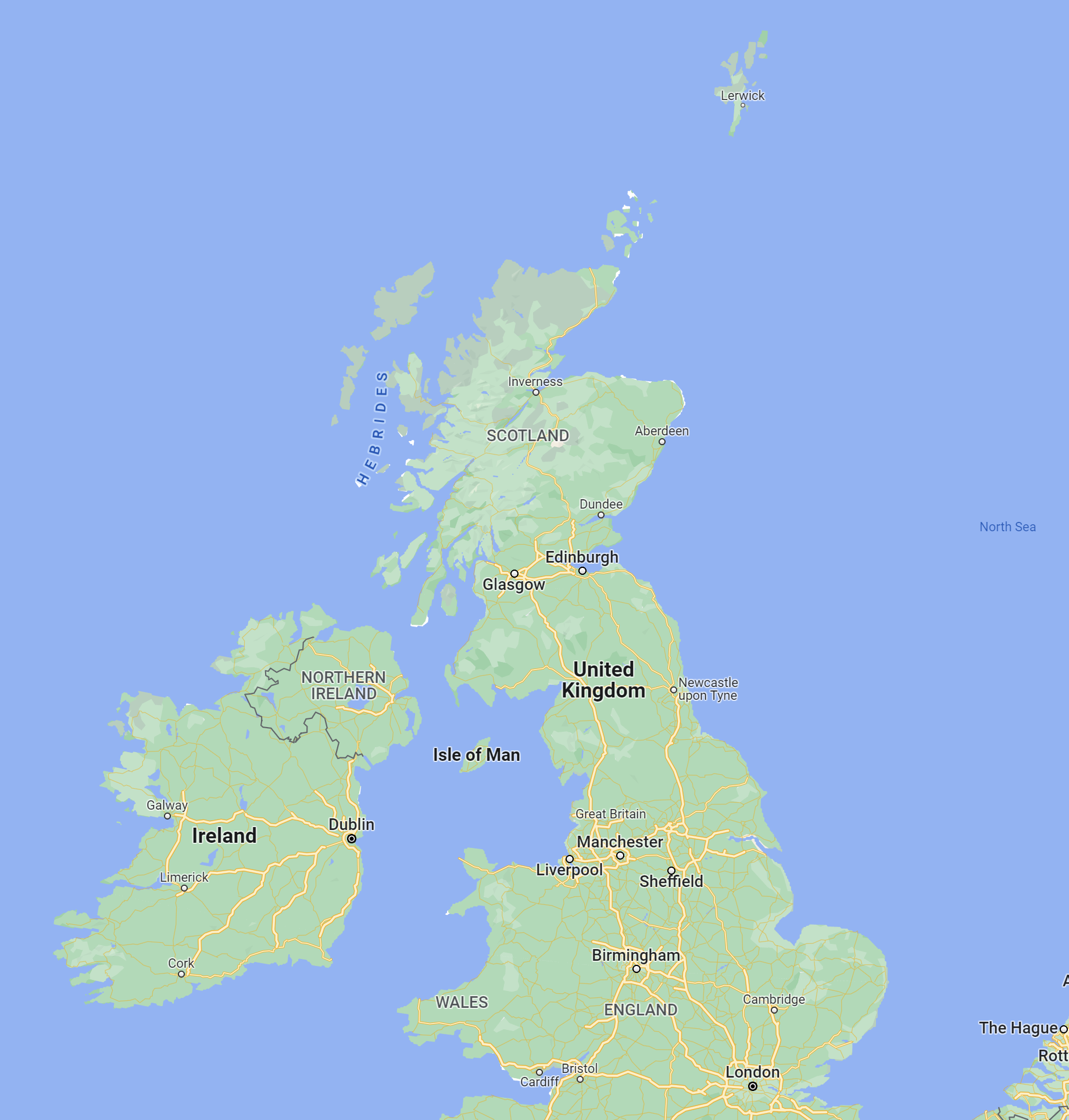
I will look at various seas.
The Celtic Sea
The Celtic Sea is to the South-West of Wales and the South of Ireland.
In Blue Gem Wind, I posted this extract from the The Our Projects page of the Blue Gem Wind web site.
Floating wind is set to become a key technology in the fight against climate change with over 80% of the worlds wind resource in water deeper than 60 metres. Independent studies have suggested there could be as much as 50GW of electricity capacity available in the Celtic Sea waters of the UK and Ireland. This renewable energy resource could play a key role in the UK meeting the 2050 Net-Zero target required to mitigate climate change. Floating wind will provide new low carbon supply chain opportunities, support coastal communities and create long-term benefits for the region.
Consider.
- The key figure would appear 50 GW of electricity capacity available in the Celtic Sea waters of the UK and Ireland.
- Earlier I said that floating turbines can have a wind turbine density of 5 MW per km².
- According to Wikipedia, the surface area of the Celtic Sea is 300,000 km².
To accommodate enough floating turbines to generate 50 GW would need 10000 km², which is a 100 km. square, or 3.33 % of the area of the Celtic Sea.
This wind generation capacity of 50 GW would appear to be feasible in the Celtic Sea and still leave plenty of space for the shipping.
The Irish Sea
According to Wikipedia, the surface area of the Irish Sea is 46,000 km².
Currently, there are ten wind farms in the Irish Sea.
- Six are in English waters, three are in Welsh and one is in Irish.
- None are more than sixteen kilometres from the coast.
The total power is 2.7 GW.
I feel that the maximum number of wind farms in the Irish Sea would not cover more than the 3.33 % proposed for the Celtic Sea.
3.33 % of the Irish Sea would be 1532 km², which could support 7.6 GW of wind-generated electricity.
I can’t leave the Irish Sea without talking about two wind farms Mona and Morgan, that are being developed by an enBW and BP joint venture, which I discussed in Mona, Morgan And Morven. This infographic from the joint venture describes Mona and Morgan.

That would appear to be a 3 GW development underway in the Irish Sea.
Off The Coast Of South-East England, East Anglia, Lincolnshire And Yorkshire
These wind farms are proposed in these areas.
- Hornsea – 6 GW
- Triton Knoll – 900 MW
- Dogger Bank – 3.6 GW
- Norfolk Boreas – 1.8 GW
- Norfolk Vanguard – 1.8 GW
- East Anglia Array – 7.2 GW
- Rampion Extension – 1.2 GW
Note.
All wind farms have comprehensive web sites or Wikipedia entries.
The total capacity of these wind farms is 22.5 GW
The North Sea
According to Wikipedia, the surface area of the North Sea is 570,000 km².
Would it is reasonable to assume, that perhaps a tenth of this area would be available for new wind farms in UK waters?
3.33 % of the available North Sea would be 1898 km², which could support 9.5 GW of wind-generated electricity.
On The East Coast Of Scotland
In Wind Farms On The East Coast Of Scotland, I summarised the wind farms off the East coast of Scotland, that are being built in a cluster in the First of Forth.
This map shows the proposed wind farms in this area.
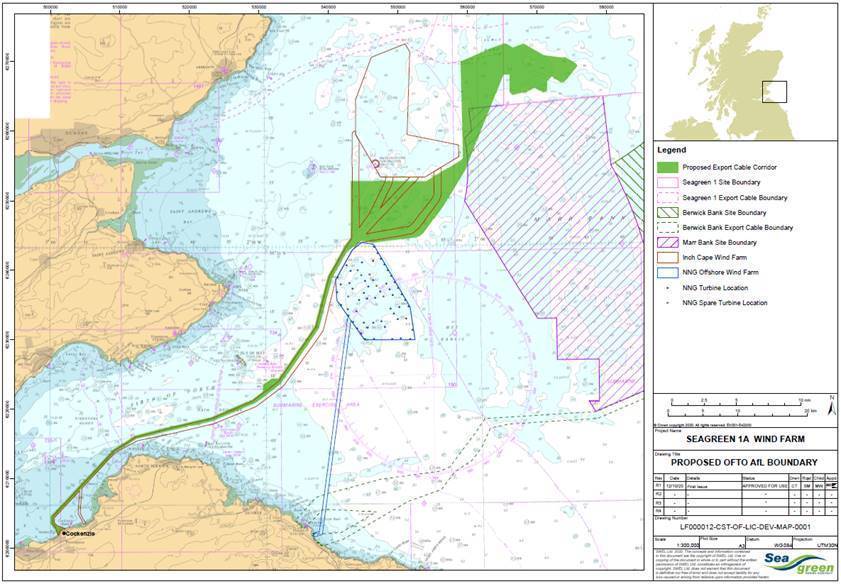
There are five wind farms in the map.
- The green area is the cable corridor for Seagreen 1a
- Inch Cape is the odd-shaped wind farm to the North and West of the green area
- Seagreen at the top of the map, to the North of Inch Cape.
- Marr Bank with the pink NE-SW hatching
- Berwick Bank with the green NW-SE hatching
- Neart Na Gaoithe is edged in blue to the South of the green area.
Berwick Bank and Marr Bank are both owned by SSE and appear to have been combined.
The capacity of the wind farms can be summarised as follows.
- Seagreen – 1075 MW
- Neart Na Gaoithe – 450 MW
- Inch Cape – 1000 MW
- Berwick Bank and Marr Bank – 4100 MW
This gives a total of 6625 MW or just over 6.6 GW.
Around The North Of Scotland
This map shows the latest successful ScotWind leases.
Note.
- Several of these proposed wind farms have detailed web sites.
These seventeen leases total up to 24.3 GW.
An Interim Total
I believe these figures are realisable.
- Celtic Sea – 50 GW
- Irish Sea – 7.6 GW – 3 GW already underway
- South East England, East Anglia, Lincolnshire And Yorkshire – 22.5 GW
- North Sea – 9.5 GW
- On The East Coast Of Scotland – 6.6 GW
- Around The North Of Scotland – 24.3 GW
Note.
- I have tried to be as pessimistic as possible.
- Irish and North Sea estimates are based on Blue Gem Wind’s professional estimate for the Celtic Sea.
- I have used published figures where possible.
My estimates total up to 120.1 GW of extra wind-power capacity. As I write this, current UK electricity production is around 33 GW.
Vikings Will Invade
This Google Map shows the Faroe Islands, the North of Scotland, Norway and Denmark.
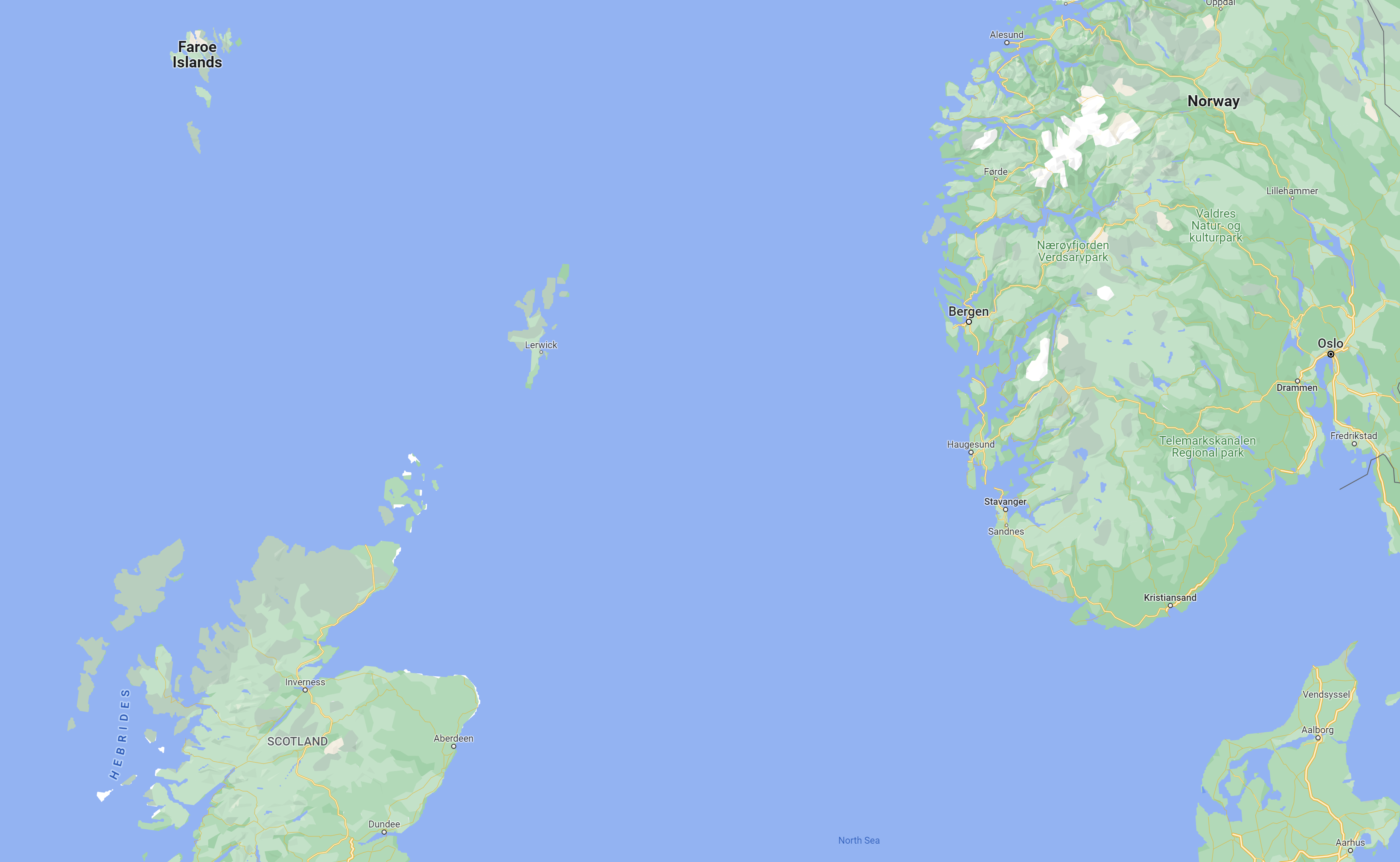
To get an idea of scale, the Shetland Isles are around 70 miles or 113 km. from North to South.
In Is This The World’s Most Ambitious Green Energy Solution?, I talked about Norwegian company; Aker Solutions’s plan for Northern Horizons.
- It would be a 10 GW offshore floating wind farm 136 km to the North-East of the Shetlands.
- This position would probably place it about halfway between the Faroes and the Norwegian coast.
- The project is best described in this article on the Engineer, which is entitled Northern Horizons Plans Clean Energy Exports For Scotland.
- In the article, there is a good graphic and a video.
This will be offshore engineering of the highest class, but then I first came across Norwegian offshore engineering like this in the 1970s, where nothing was too difficult for Norwegian engineers.
There are two major points to remember about the Norwegians.
- They have the Sovereign Wealth Fund to pay for the massive investment in Northern Horizons.
- They need to replace their oil and gas income, with a zero-carbon investment stream.
I feel that Northern Horizons will not be a one-off and the virgin sea in the map above will be liberally carpeted with more floating wind farms.
- On Shetland, electricity can be fed into the UK grid.
- On Norway, electricity can be fed into the Norwegian grid or stored in Norwegian pumped storage systems.
- On Scotland, more pumped storage systems can be built to store energy.
- Hydrogen can be piped to where it is needed to decarbonise heavy industry and transport.
- Norwegian fjords, Shetland harbours, Scottish lochs and possibly Scapa Flow would be ideal places to assemble and service the giant floating turbines and build the other needed floating infrastructure.
- I can also see Denmark getting in on the act, as they will probably want to decarbonise the Faroe Islands.
I estimate that between the Faroes, Scotland and Norway, there are 510,000 km² of virgin sea.
With a potential of 5 MW per km², that area has the potential to create an amazing amount of both electricity and hydrogen.
Exporting Power To Europe
There will need to be more interconnectors from the UK to Europe.
These are already working.
- BritNed – 1 GW – Isle of Grain and Rotterdam
- ElecLink – 1 GW – Through the Channel Tunnel
- HVDC Cross-Channel – 2 GW – England and France
- IFA-2 – 1 GW – England and France
- NemoLink – 1 GW – Kent and Belgium
- North Sea Link – 1.4 GW – Blyth and Norway
- Viking Link – 1.4 GW – Lincolnshire and Denmark
These are proposed.
- GridLink – 1.4 GW – Kent and Dunkirk
- NeuConnect – 1.4 GW – Isle of Grain and Germany
- North Connect – 1.4 GW – Scotland and Norway
There are also gas interconnectors, that could be converted to hydrogen.
This press release from National Grid, which is entitled Undersea Electricity Superhighways That Will Help Deliver Net Zero Move A Step Closer, has these bullet points.
- Positive progress on plans for £3.4bn electricity super-highway projects – Scotland to England Green Links.
- Ofgem opens consultation that recognises the “clear case” and “consumer benefit” of two subsea high voltage cables to transport clean between Scotland and England.
- The cables form part of a planned 16 project £10 billion investment from National Grid to deliver on the government’s target of 40GW of offshore wind generation by 2030.
This paragraph expands on the work by National Grid to meet the third point.
These projects are part of National Grid’s work upgrading the electricity transmission system to deliver the UK government’s target of 40GW of offshore wind generation by 2030. In addition to the Eastern Links, it is developing 14 major projects across its network to facilitate the target representing a £10 billion investment. This includes two further Scotland to England high voltage links (also in partnership with the Scottish transmission network owners) and proposals in the Humber, Lincolnshire, East Midlands, North of England, Yorkshire, North Kent, as well as four in East Anglia (one of which is a proposed offshore link between Suffolk and Kent).
I think we can assume, that National Grid will do their part to allow the UK government’s target of 40GW of offshore wind generation by 2030 to be met.
Will The UK Have 40 GW Of Offshore Wind Generation By 2030?
In the Wikipedia entry for Windpower In The UK, this is the opening sentence.
The United Kingdom is one of the best locations for wind power in the world and is considered to be the best in Europe. By the beginning of March 2022, the UK had 11,091 wind turbines with a total installed capacity of over 24.6 gigawatts (GW): 14.1 GW of onshore capacity and 10.4 GW of offshore capacity.
It would appear an extra 30 GW of wind power is needed.
In An Interim Total earlier, I gave these figures.
- Celtic Sea – 50 GW
- Irish Sea – 7.6 GW – 3 GW already underway
- South East England, East Anglia, Lincolnshire And Yorkshire – 22.5 GW
- North Sea – 9.5 GW
- On The East Coast Of Scotland – 6.6 GW
- ScotWind – 24.3 GW
The wind farms in South East England, East Anglia, Lincolnshire And Yorkshire and ScotWind and Mona and Morgan are either being planned or under construction, and in many cases leases to construct wind farms are being paid.
I would feel, that at least 30 GW of these 56.4 GW of wind farms will be completed by 2030.
Conclusion
Boris’s vision of the UK becoming a Saudi Arabia of wind is no fantasy of a man with massive dreams.
Standard floating wind turbines, with the possibility of also harvesting wave power could be assembled in ports along the coasts, towed into position and then connected up.
Several GW of wind-power capacity could probably be added each year to what would become the largest zero-carbon power station in the world.
By harvesting the power of the winds and waves in the seas around the British Isles it is an engineering and mathematical possibility, that could have been developed by any of those great visionary Victorian engineers like Armstrong, Bazalgette, Brunel and Reynolds, if they had had access to our modern technology.
Up Yours! Putin!
Enter The Dragon
Look at this map of UK offshore wind farms. clipped from Wikipedia.
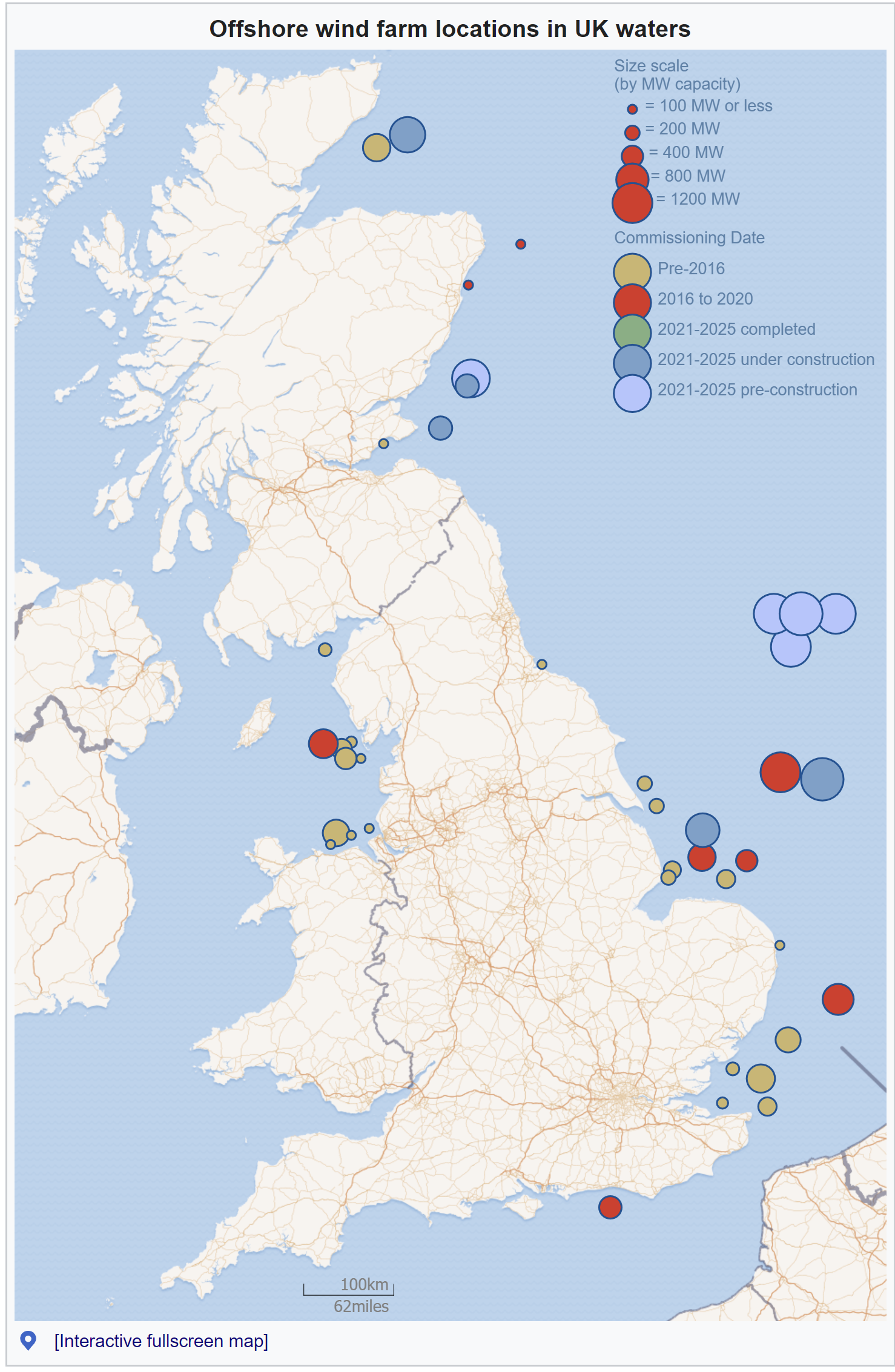
It is only a crude map, but it does show the lack of offshore wind farms around the coasts of Wales and South-West England.
This article on the Engineer is entitled Unlocking The Renewables Potential Of The Celtic Sea.
The article starts with these two paragraphs.
Over the last decade, the UK has become a global leader in renewable marine energy, tapping into the vast resources its coastal geography offers. Offshore wind, in particular, has flourished, with gigawatt-scale projects being deployed off the east coast of England and Scotland, at Hornsea, Dogger Bank and Moray.
However, looking at a map of existing and proposed wind farms, what’s perhaps most striking is the complete absence of projects in the southwest of Britain, off the rugged shores of Wales, Devon and Cornwall, shaped by the fierce North Atlantic. The Celtic Sea – which extends south off Wales and Ireland down past Cornwall and Brittany to the edge of the continental shelf – is estimated to have around 50GW of wind generating capacity alone. What’s more, it also delivers some of the highest tidal ranges in the world, alongside some of the best waters in Europe for generating wave energy. In a country blessed with renewable resources, the Celtic Sea may well be its biggest prize.
The article then discusses how the challenge of developing renewable energy around Wales is being met.
- It describes the relevance of Floating Offshore Wind (FLOW).
- It quotes someone who says. “Eighty per cent of the world’s wind resources are in waters deeper than you would traditionally go with fixed offshore wind.”
- It talks about Blue Gem Wind and their Erebus and Valorous wind farm projects, that I wrote about in Blue Gem Wind.
- It talks of how expertise from offshore oil and gas is being used to develop floating offshore wind.
The article then goes on to talk about tidal power.
The Welsh Government Tidal Lagoon Challenge is mentioned.
- The article notes “The IP for the Swansea Bay Tidal Lagoon has been purchased by a consortium led by Bridgend’s DST Innovations and has been reborn as Blue Eden.”
- Blue Eden is described on this page of the DST Innovations web site. The project is not in the least bit timid or small.
- The article also introduces to the Morlais Tidal Energy Scheme, which has its own web site.
The article then finishes with a few paragraphs about how wind, wave and tidal power can be combined in a single scheme.
Conclusion
The article finishes with this paragraph.
For now, Wales may be lagging slightly behind its Celtic cousin to the north, but if the true potential of the Celtic Sea can be unleashed – FLOW, tidal stream, lagoon and wave – it looks set to play an even more prominent role in the net zero pursuit.
The Red Dragon is entering the battle to replace Vlad the Mad’s tainted energy.
 The Anonymous Widower