Aurizon Secures Funding To Develop Next-Generation Freight Trains Using Renewable Energy
The title of this post, is the same as that of this press release from Aurizon.
These five paragraphs outline the project.
Australia’s largest rail freight company Aurizon, today received a major boost to its program to develop the next generation of Australian freight trains, aiming to replace diesel fuel with renewable energy sources on its locomotive fleet.
Aurizon has secured a $9.4 million grant from the Australian Renewable Energy Agency (ARENA) to develop, test and trial a battery electric tender (BET) to be used in conjunction with a modified locomotive. (refer graphic below).
The tender – essentially a big battery-pack on wheels – will couple with the modified locomotive to operate as a hybrid unit using both diesel and battery-electric power sources. The tender’s battery will also harness re-generative energy captured as the train travels down grades and brakes as part of normal operation.
The ARENA grant represents half of the required funding for the ‘Battery Powered Tender for Heavy Haul Fleet Decarbonisation’ project, with the balance of the investment to be funded by Aurizon. The battery-electric tender and modified locomotive project will be built by Aurizon and technology project partner, Alta Battery Technology (Alta) at a facility in Australia, with design and technology inputs from Alta.
Aurizon appreciates the Federal Government making funding available to support the development of a range of new zero emissions technologies in the transport sector, including technologies that can be developed for application in rail-based freight supply chains that are integral to Australia’s export and domestic industries that rely on transport services.
At a first glance it appears to be suited to Aurizon and its long routes with heavy freight trains across Australia.
These are some more specific thoughts.
Alstom Have Built A Train With a Hydrogen Tender
In From 2025, Nestlé Waters France Will Use The First Hydrogen-Powered Freight Train Through An Innovative Solution Developed by Alstom and ENGIE, I describe a train powered by an electric locomotive with an attached hydrogen power unit.
The Future Of The Class 68 Locomotives
Could these be given a reduced-carbon second life, by developing a specialised tender?
I wrote about this in The Future Of The Class 68 Locomotives.
I suspect Stadler, who seem to be excellent innovators will be watching.
There Seems To Be A Lot Going On In Australia
I have written several posts about decarbonisation of freight trains in Australia.
- BHP To Trial Battery Locos On Pilbara Iron Ore Network
- Battery-Electric Power Rides The Rails
- Wabtec And Roy Hill Unveil The First FLXdrive Battery Locomotive
- Fortescue Unveils World-First Electric Train Using Gravity To Recharge
- BHP Joins The Party On Electric Rail
- Rio Tinto Orders Wabtec FLXdrive Battery Locomotives To Reduce Emissions
The big mining companies certainly seem keen to decarbonise.
I See My First Modern 100 % Electric Truck
Where I live in Hackney, you see a lot of electric vans. Even the local deli has one.
But until yesterday, I don’t think I’ve seen a 100 % full-size electric truck, other than the famous Harrods delivery vans, which I can remember from the 1960s.
This was a sideview of the truck I saw.
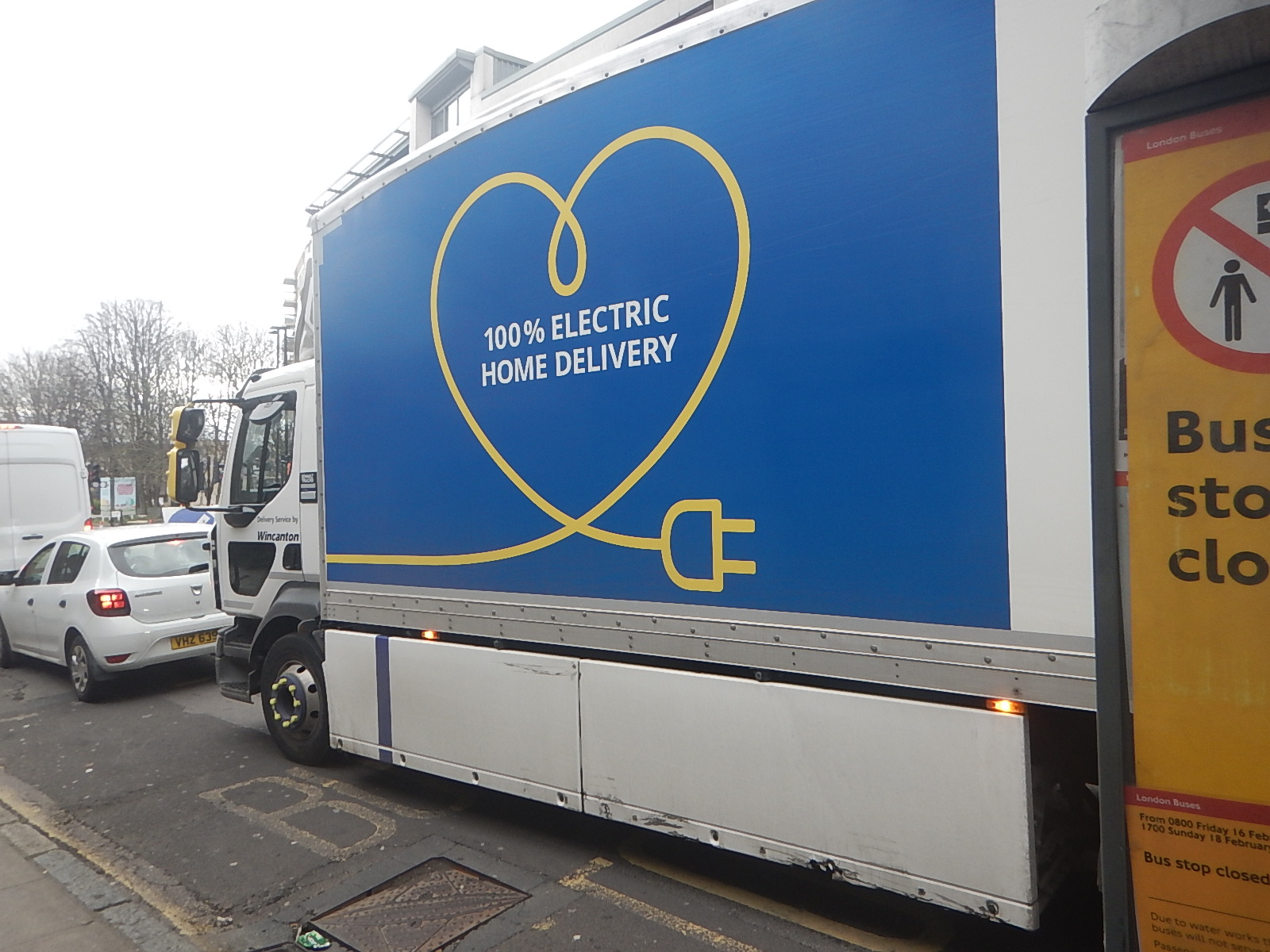
Sadly, because I was trying to catch a bus, in the roadworks I described in How Not To Organise A Piss-Up In A Brewery, I was unable to take any more pictures.
This press release from Wincanton is entitled Wincanton Announces Multimillion-Pound Investment In Electric Vehicles For IKEA.
These three paragraphs give the full story.
Wincanton, a leading supply chain partner for UK business, today announces that it has made a multimillion-pound investment in electric vehicle technology to provide home delivery services for IKEA.
The investment has seen Wincanton purchase 30 electric home delivery vehicles, comprising of 10 16-tonne trucks and 20 vans, to support IKEA’s goal of reaching 100% zero emission last mile deliveries by 2025.
The new fleet is expected to save Wincanton 1,000 tonnes of carbon emissions each year, across just over 10,000 journeys per annum. The vehicles, supplied by Renault Trucks and Ford, will carry deliveries to the homes of IKEA customers across Greater London and the Southeast of England from Spring 2023.
I do feel though, that we’d see more zero-carbon trucks, if London could get its act together with hydrogen.
Battery-Electric Power Rides The Rails
The title of this post, is the same as that of this article on Power Progress.
These two introductory paragraphs, outline the project.
In late October 2023, transportation solution provider Wabtec and its launch customer Roy Hill, an Australia-based iron ore mining company, celebrated the debut of the FLXdrive locomotive – a production model unit that Wabtec described as the “world’s first 100% battery-powered, heavy-haul locomotive for mainline service.”
The debut was the culmination of more than a decade of R&D that started at a time when battery technology and density were far more limited. Rogerio Mendonca, president, Freight Equipment, Wabtec, labeled the company’s earliest project as “more of a science pilot than anything else.”
I feel that this conversion of a diesel locomotive to a 7MWh battery-electric locomotive will be a significant milestone in freight haulage.
In the UK, we have 480 Class 66 locomotives.
Not all are used for heavy freight and you regularly see a single locomotive hauling a load that a lowered-powered battery electric locomotive could handle.
I suspect that if Roy Hill find this a capable locomotive, that we’ll see some Class 66 locomotives converted to battery-electric operation.
The article is well worth a full read.
Siemens Gamesa And Vestas Collaborate To Standardise Equipment For Transportation Of Wind Turbine Towers
The title of this post, is the same as that of this article on offshoreWIND.biz.
This is the sub-heading.
Building on a previous collaboration focused on tower foundations and lifting guidelines, Siemens Gamesa and Vestas, facilitated by Energy Cluster Denmark, have signed a new partnership agreement to increase standardisation within the wind industry.
Surely standard sizes and similar designs will help any industry. Look at how containerisation has helped freight transportation.
These four paragraphs illustrate the problem and detail the solution.
Initially, the partners will standardise equipment for the transportation of wind turbine towers.
“Currently, whenever a wind turbine tower is shipped out for offshore installation, the manufacturer welds a box onto the installation vessel to which the tower is then clamped. The process is costly in terms of tons of iron and labour on the quayside. Once installation offshore is completed, all the equipment is removed from the vessel, which is again costly in terms of hours, money and the green transition,” said Jesper Møller, Chief Engineer in Offshore Execution at Siemens Gamesa.
The new partnership agreement comprises a series of projects involving equipment for and the storage of huge components produced by wind turbine manufacturers.
The first project focuses on sea fastening, involving securing towers, blades, and nacelles to installation vessels.
The article finished with statements about why standardisation is important.
Wabtec And Roy Hill Unveil The First FLXdrive Battery Locomotive
The title of this post, is the same as that of this press release from Wabtec.
This is the sub-heading.
World’s first 100% battery-powered, heavy-haul freight locomotive for mainline service
This is the first three paragraphs.
Wabtec and its launch customer, Roy Hill, a leading iron ore miner majority owned by Australia’s most successful private company, Hancock Prospecting, have celebrated the debut of the FLXdrive battery locomotive, the world’s first 100% battery-powered, heavy-haul locomotive for mainline service. The ceremony unveiled the unique, striking pink-colored locomotive at Wabtec’s design and development center in Pennsylvania in front of employees, customer executives, and government and community officials.
“This FLXdrive locomotive represents a major step in the journey to a low-to-zero-emission future in the rail industry,” said Rafael Santana, President & CEO of Wabtec. “The FLXdrive is driven from within by our battery technology and the innovative spirit of our employees. Roy Hill is an ideal customer to partner with given their leadership and excellent operational record.”
Roy Hill’s FLXdrive battery-electric locomotive will feature an energy capacity of 7 megawatt hours (MWh). Based on the route and company’s rail operations, the FLXdrive is anticipated to provide a double-digit percentage reduction in fuel costs and emissions per train. Once Wabtec completes the final battery installations and track testing, the locomotive will begin its 17,000-kilometer (10,500-mile) journey in 2024 for delivery to its new home in the Pilbara region of Western Australia, one of the world’s premier mining precincts.
These further two paragraphs outline the operation of the locomotive.
The FLXdrive locomotive represents not only a first for the Pilbara, but a first for the mining industry. The technological smarts that have gone into the development of the loco makes it well suited for our rail network. By using regenerative braking, it will charge its battery on the 344 kilometer (214 mile) downhill run from our mine to port facility and use that stored energy to return to the mine, starting the cycle all over again. This will not only enable us to realise energy efficiencies but also lower operating costs.”
Today, Roy Hill uses four Wabtec ES44ACi “Evolution Series” diesel-electric locomotives in a consist to pull trains that are typically 2,700 meters (1.6 miles) in length carrying more than 33,000 tonnes of iron ore. The addition of the FLXdrive will form a hybrid locomotive consist with Wabtec diesel-electric locomotives, and recharge during the trip through regenerative braking. The FLXdrive manages the overall train energy flow and distribution through its state-of-the-art energy management software. It is also designed with a unique battery thermal management system using liquid cooling to withstand the Pilbara heat, where temperatures can reach 55°C (130°F).
I have some thoughts.
Could Class 66 Locomotives Be Converted Into Battery-Electric Locomotives?
I answered this question fully in Could Class 66 Locomotives Be Converted Into Battery-Electric Locomotives? a couple of years ago and came to this conclusion.
I am not a lover of the smelly, noisy and polluting diesel Class 66 locomotives, but it does look it could be possible to convert some into battery-electric locomotives.
I wouldn’t be surprised to see Wabtec convert some Class 66 locomotives into battery-electric locomotives.
I also believe, that conversion of Class 66 locomotives to battery-electric operation could be the most affordable way to help decarbonise rail freight.
Note.
- Class 68 locomotives could probably also be converted.
- The battery-electric locomotives would either be used singly or in conjunction with diesel-electric locomotives as Roy Hill propose to do.
After the launch of Wabtec’s first production locomotive, I wouldn’t be surprised to find that some of the UK’s freight operators are talking to Wabtec.
Could A Battery-Electric Class 66 locomotive Work With An Electric Locomotive?
This picture shows, what could be an experiment by Freightliner at Shenfield.
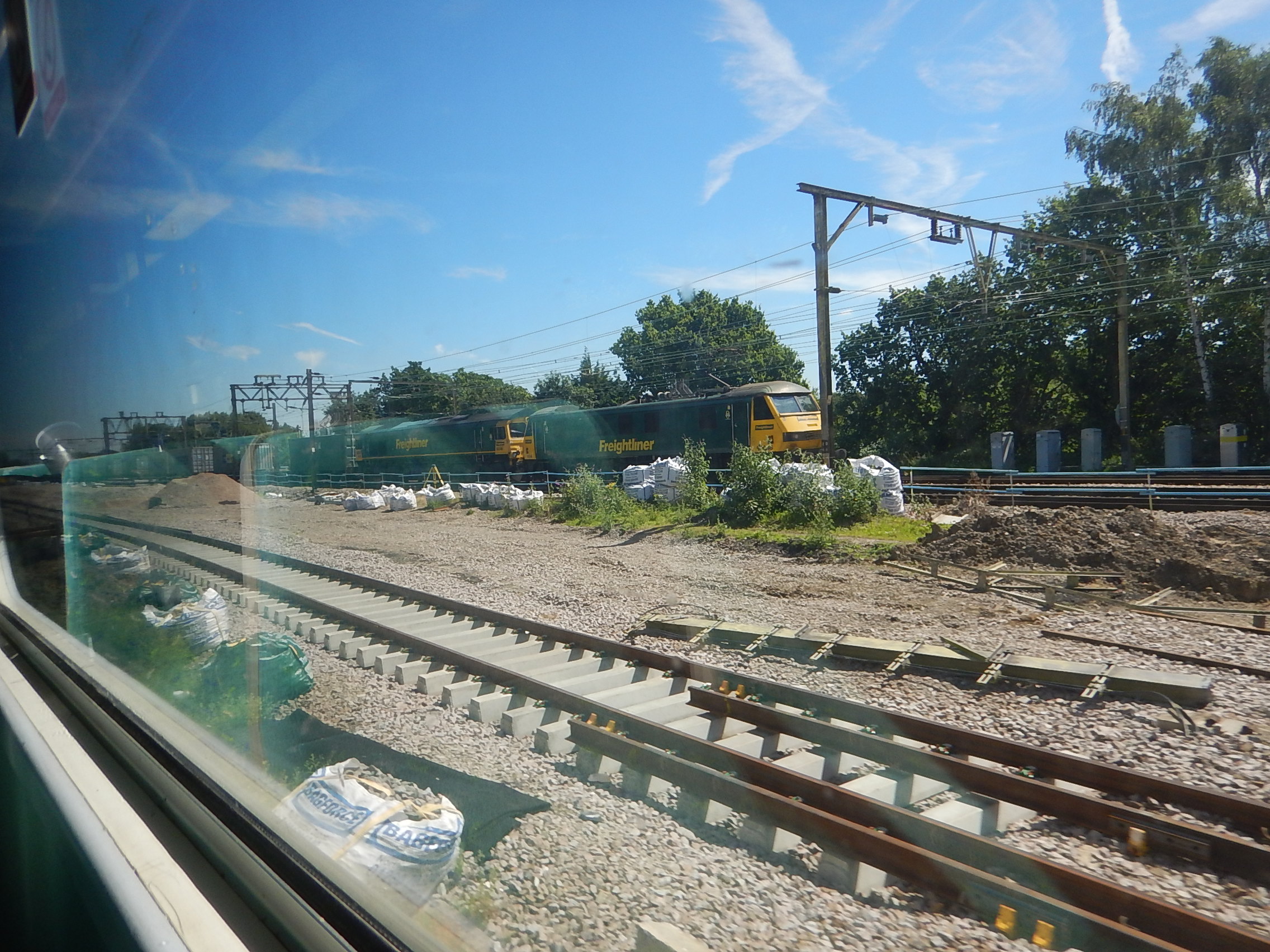
Unfortunately, I didn’t have a chance to ask the driver, if the Class 66 locomotive was running dead-in-train or helping the Class 90 locomotive with a very heavy load.
The picture shows, that the electric and diesel locomotives can work together, at the front of a train.
Consider.
- The battery-electric locomotive would be used, where there is no electrification.
- The battery-electric locomotive could be charged by the electric locomotive or regenerative braking.
It could be an interesting way to handle some freight routes in the UK.
Global First For Formula 1: CEVA Logistics Transports Ferrari Equipment By Rail
The title of this post is the same as that of this article on Container News.
This is the sub-heading.
CEVA Logistics, CMA CGM-owned third-party logistics provider, recently designed an innovative rail transport solution for Scuderia Ferrari’s F1 racing team in North America
These paragraphs outline the transport.
In a global first for Formula 1, Ferrari equipment is being transported by rail between three North American F1 grand prix races as part of the two companies’ efforts to cut carbon emissions.
Since the start of their cooperation in 2022, CEVA has been altering the Scuderia Ferrari logistics programme. As CEVA guarantees that the equipment reaches each of the 23 Grand Prix racing venues on schedule, the flow of the six different 45-ton equipment kits that travel the world has shifted away from air freight and toward a primary combination of ocean and road freight.
Carbon savings were 90 % compared to flying and 32 % compared to an all-road route.
But as the containers appeared to have travelled 4,000 miles between Montreal to Las Vegas via Austin, probably hauled by a diesel locomotive, how much extra carbon savings could have been achieved if a hydrogen-powered locomotive had been used?
UK Rail Operations Group Gets The Keys To Their Tri-Mode Locomotive
The title of this post, is the same as that of this article on RailFreight.com.
This is the sub-heading.
A Green Milestone, in every sense. Delivered in an eye-catching livery reminiscent of British Racing Green, Rail Operations Group may well have called the delivery of their first Class 93 tri-mode locomotive, a leap forward in reshaping the future of operations. It is certainly an environmental first strike on behalf of the rail industry in the race to a net-zero carbon economy.
Note.
- There are thirty on order.
- It can haul both freight and passenger trains.
- It has a maximum speed of 110 mph.
- The development history in the Wikipedia entry is a good read.
It certainly looks an impressive locomotive and the livery will get it noticed. But then you don’t hide your best light under a bushel!
Operations
This section in the Wiki9pedia entry is entitled Proposed Use, where this is said.
ROG intends to pair the locomotive with a new generation of freight wagons that would run at a maximum speed of 100 mph (160 km/h), comparable to that of contemporary passenger trains. Trains formed of such wagons would be easier to insert into timetables around and between existing passenger trains, increasing flexibility and potentially creating capacity for more freight trains on the national network.
In addition to freight, the Class 93 has also been designed to accommodate the haulage of passenger stock, including a variable-height Dellner coupling and a three-step Westcode brake in addition to its conventional two-pipe air brake.
The Class 93 locomotives will surely be very impressive hauling freight heavy trains to and from Felixstowe, on the electrified Great Eastern Main Line sandwiched between the 100 mph express passenger trains.
- What weight and length of train, these locomotives can haul in and out of Felixstowe?
- What destinations will they be able to reach using the electrification from Ipswich?
- Will they be able to take shorter trains to the Midlands via Ely and Leicester?
It will be interesting to see where these locomotives operate.
Electrification Of The Hope Valley Line
This news story from the Department of Transport is entitled Yorkshire And The Humber To Benefit From £19.8 billion Transport Investment.
This is said about the Hope Valley Line.
The Hope Valley Line between Manchester and Sheffield will also be electrified and upgraded, with the aim of cutting journey times from 51 to 42 minutes and increasing the number of fast trains on the route from 2 to 3 per hour, doubling capacity.
The fast trains are currently TransPennine’s service between Liverpool Lime Street and Cleethorpes.
- Between Platform 13 at Manchester Piccadilly station and Sheffield station is 42.6 miles.
- At the Manchester end, there will be electrification between Manchester Piccadilly and Hazel Grove stations, which is 8.7 miles and takes typically 17 minutes.
- After the electrification of the Midland Main Line to Sheffield, there will be electrification between Dore & Totley and Sheffield stations, which is 4.2 miles and takes typically 8 minutes.
The gap in the electrification between Dore & Totley and Hazel Grove stations will be 29.7 miles.
But it will not be an easy route to electrify.
- At the Western end, there is the Disley Tunnel, which is 3535 metres long.
- In the middle, there is the Cowburn Tunnel which is 3385 metres long, that is also the deepest tunnel in England.
- At the Eastern end, there is the Totley Tunnel, which is 5700 metres long.
Yorkshire doesn’t have an Underground railway, but the combined length of these three tunnels is 7.84 miles, which means that over 26 % of the electrification needed between Manchester Piccadilly and Sheffield will have to be installed in tunnels.
Could The Route Be Run Using Battery-Electric Trains?
Consider.
- The gap in the electrification between Dore & Totley and Hazel Grove stations will be 29.7 miles.
- There is electrified sections at Dore & Totley and Hazel Grove stations, which will be able to charge the trains.
- Merseyrail’s Class 777 trains have demonstrated a battery range of 84 miles.
- A Stadler Akku train has demonstrated a battery range of 139 miles.
- Hitachi are developing a battery-electric version of TransPennine’s Class 802 train.
- If all trains can run on batteries or be self-powered, there would be no need to electrify the long and possibly difficult tunnels.
I believe that it would be possible to electrify all passenger services between Manchester and Sheffield using appropriate battery-electric trains.
Freight would be a problem and I suspect that hydrogen-hybrid and other self-powered locomotives could handle the route.
Could The Complete TransPennine Liverpool Lime Street and Cleethorpes Service Be Run By Battery-Electric Class 802 trains?
These are the various electrified and unelectrified sections.
- Liverpool Lime Street and Liverpool South Parkway – Electrified – 5.7 miles – 10 minutes
- Liverpool South Parkway and Trafford Park – Not Electrified – 25.2 miles – 30 minutes
- Trafford Park and Hazel Grove – Electrified – 12.6 miles – 28 minutes
- Hazel Grove and Dore & Totley – Not Electrified – 29.7 miles – 35 minutes
- Dore & Totley and Sheffield – Electrified – 4.2 miles – 6 minutes
- Sheffield and Doncaster – Not Electrified – 18.6 miles – 25 minutes
- Doncaster and Cleethorpes – Not Electrified – 52.1 miles – 78 minutes
Note.
- This is a total of 125.6 miles without electrification.
- The Manchester Piccadilly and Sheffield time is 56 minutes.
- The distance is 37.8 miles.
- That is an average speed on 40.5 mph.
- Most of the line between Manchester Piccadilly and Sheffield has an maximum speed of 70 mph, but there is a short length of track with a 50 mph speed and another longer one with 90 mph.
To achieve 40 minutes between Manchester Piccadilly and Sheffield would need an average speed of 60.7 mph. Given the improvements being carried out by Network Rail at the current time, I believe that forty minutes between Manchester Piccadilly and Sheffield should be possible.
I’ll look at a train going East.
- The train will leave Liverpool Lime Street with a reasonably full battery after charging using the current electrification in the station.
- The train will leave Liverpool South Parkway with a full battery after charging using the current electrification from Liverpool Lime Street.
- The train will arrive at Trafford Park with a battery perhaps two-thirds full, but it will be fully charged on the current electrification to Hazel Grove.
- The train will arrive at Dore & Totley with a battery perhaps two-thirds full, but it will be fully charged on the Midland Main Line electrification to Sheffield.
- The train will arrive at Doncaster with a battery perhaps two-thirds full and the train would wait until it had enough charge to reach Cleethorpes.
I’ll look at a train going West.
- The train will leave Cleethorpes with a full battery after charging using the new electrification in the station.
- The train will arrive at Doncaster with a battery perhaps two-thirds full and the train would wait until it had enough charge to reach Sheffield.
- The train will arrive at Sheffield with a battery perhaps two-thirds full, but it will be fully charged on the Midland Main Line electrification to Dore & Totley.
- The train will arrive at Hazel Grove with a battery perhaps two-thirds full, but it will be fully charged on the current electrification to Trafford Park.
- The train will arrive at Liverpool South Parkway with a battery perhaps two-thirds full, but the route is electrified to Liverpool Lime Street.
Note.
- If the battery range on a full battery was over 90 miles, the two most easterly sections could be run without any charging at Doncaster.
- If the battery range was over 125.6 miles, the journey could be done by starting with a full battery.
- If every time the train decelerated, regenerative braking would recover energy, which could be reused.
- The only new electrification needed will be a short length at Cleethorpes station, that would charge the trains.
I certainly believe that Liverpool Lime Street and Cleethorpes services could be run by battery-electric trains.
Could The Complete TransPennine Liverpool Lime Street and Cleethorpes Service Be Run By Battery-Electric Class 802 trains Without The Midland Main Line Electrification?
In this section, I’m assuming, that there is no electrification at Sheffield.
These would be the various electrified and unelectrified sections.
- Liverpool Lime Street and Liverpool South Parkway – Electrified – 5.7 miles – 10 minutes
- Liverpool South Parkway and Trafford Park – Not Electrified – 25.2 miles – 30 minutes
- Trafford Park and Hazel Grove – Electrified – 12.6 miles – 28 minutes
- Hazel Grove and Cleethorpes – Not Electrified – 104.6 miles – 143 minutes
Note.
- This is a total of 129.6 miles without electrification.
- The battery range of the train, should probably be around 120 miles to make sure the train could run between Hazel Grove and Cleethorpes.
- One diesel power-pack could be installed for emergency use.
I’ll look at a train going East.
- The train will leave Liverpool Lime Street with a reasonably full battery after charging using the current electrification in the station.
- The train will leave Liverpool South Parkway with a full battery after charging using the current electrification from Liverpool Lime Street.
- The train will arrive at Trafford Park with a battery perhaps 80 % full, but it will be fully charged on the current electrification to Hazel Grove.
- The train would then eek out what power it had left to reach Cleethorpes.
If necessary, the train could stop in the electrified Doncaster station to top up the batteries from the East Coast Main Line electrification for the run to Cleethorpes.
I’ll look at a train going West.
- The train will leave Cleethorpes with a full battery after charging using new electrification in the station.
- The train will arrive at Doncaster with a battery perhaps 57 % full and the train would wait if needed, until it had enough charge to reach Hazel Grove.
- The train will arrive at Hazel Grove with a battery perhaps one-thirds full, but it will be fully charged on the current electrification to Trafford Park.
- The train will arrive at Liverpool South Parkway with a battery perhaps one-thirds full, but the route is electrified to Liverpool Lime Street.
Note.
- If the battery range on a full battery was over 105 miles, the Eastern section could be run without any charging at Doncaster.
- If the battery range was over 129.6 miles, the journey could be done by starting with a full battery.
- If every time the train decelerated, regenerative braking would recover energy, which could be reused.
- The only new electrification needed will be a short length at Cleethorpes station, that would charge the trains.
However, it might be prudent to electrify the through platforms at Sheffield, so that they could be used for emergency charging if required.
Northern Train’s Service Between Sheffield And Manchester Piccadilly Via The Hope Valley Line
There is a one train per hour (tph) Northern service between Sheffield and Manchester Piccadilly.
- The Class 195 diesel train takes 78 minutes.
- The distance is 42 miles.
- The first mile or so at the Manchester end is electrified.
- Trains seem to take about sixteen minutes to turn round at Manchester Piccadilly.
- Trains seem to take about nine minutes to turn round at Sheffield.
- The service runs via Reddish North, Brinnington, Bredbury, Romiley, Marple, New Mills Central, Chinley, Edale, Hope, Bamford, Hathersage, Grindleford and Dore & Totley.
- The max speed is generally 60 mph to the West of New Mills Central and 70 mph to the East, with short lower speed sections.
There would appear to be two ways to run this route withy battery-electric trains.
- As Manchester Piccadilly station is fully-electrified and trains could be connected to the electrification for upwards of twenty minutes, trains will certainly be able to be fully-charged at Manchester. As the round trip is only 84 miles, could trains run the service without a charge at Sheffield.
- Alternatively, there could be a dedicated electrified platform at Sheffield. But the problem with this, is that currently this service uses a random platform at Sheffield.
It looks like, if the train has the required range, that charging at the Manchester end would be the better solution.
Liverpool And Norwich Via The Hope Valley Line
This service uses a similar route between Liverpool Lime Street and Sheffield, as the Liverpool and Hull service and then it meanders, through the East Midlands.
- Liverpool Lime Street and Liverpool South Parkway – Electrified – 5.7 miles – 11 minutes
- Liverpool South Parkway and Trafford Park – Not Electrified – 25.2 miles – 33 minutes
- Trafford Park and Hazel Grove – Electrified – 12.6 miles – 26 minutes
- Hazel Grove and Dore & Totley – Not Electrified – 29.7 miles – 28 minutes
- Dore & Totley and Sheffield – Electrified – 4.2 miles – 6 minutes
- Sheffield and Nottingham – Being Electrified – 40.6 miles – 52 minutes
- Nottingham and Grantham – Not Electrified – 22.7 miles – 30 minutes
- Grantham and Peterborough – Electrified – 29.1 miles – 29 minutes
- Peterborough And Ely – Not Electrified – 30 miles – 31 minutes
- Ely and Norwich – Not Electrified – 53.7 miles – 56 minutes
This is a total of 161.3 miles without electrification.
But as Sheffield and Nottingham and Grantham and Peterborough will be fully electrified, this route will be possible using a battery-electric train.
Electrifying Sheffield Station
I said earlier in this post, that electrifying Sheffield station would be an option for electrifying the Sheffield and Manchester Piccadilly service.
If this were to be done, it would have collateral benefits for other services that terminate at Sheffield, which could be charged whilst they turned around.
I wrote about Sheffield station as a battery-electric train hub in Could Sheffield Station Become A Battery-Electric Train Hub?
Conclusion
I believe that full electrification of the Hope Valley Line is not needed, if battery-electric trains are used.
I also believe that battery-electric trains and the current improvements being carried out on the Hope Valley Line will enable a forty minute time between Manchester Piccadilly and Sheffield.
Iarnród Éireann And Latvia’s DIGAS To Trial Europe’s First Retrofitted Hydrogen Freight Locomotive
The title of this post, is the same as that of this press release from Irish Rail.
This is the sub-heading.
Cleaner, cheaper and practical initiative towards decarbonisation goals
These are the first three sections.
Cleaner
Iarnród Éireann Irish Rail is providing a locomotive and will test a retrofitted hydrogen locomotive using a cleaner burning renewable fuel.
Cheaper
DIGAS will provide a cost-effective way how to introduce a hydrogen in the fleet of existing diesel locomotives by retrofitting diesel locomotives with a specialised internal combustion engine (ICE) hydrogen system.
Practical
The collaboration will demonstrate a practical path towards complete decarbonisation of the diesel locomotive fleet.
Note.
- The eighteen 071 Class locomotives were built in Canada by General Motors.
- Some date from as early as 1976.
- In the UK, there is a similar project to convert Class 66 locomotives to dual fuel, which I wrote about in Clean Air Power Adds Hydrogen To Class 66 Fuel Mix.
It does look that the technology is being developed to convert freight locomotives to hydrogen.
New Freight Interchange Connects To West Coast Main Line
The title of this post, is the same as that of this article on Rail Technology Magazine.
This is the sub-heading.
Rail passengers have been thanked after major work to connect a new rail to road freight interchange with the West Coast main line was completed.
These two paragraphs outline the project.
The work, which took nine days, saw new track, points and signalling systems installed to connect the existing railway to the new sidings at the under-construction freight facility at SEGRO logistics park in Northampton.
Once complete, the facility will provide 5 million square ft of warehouse space and employ up to 7,000 people.
This OpenRailwayMap shows the location of SEGRO logistics park in Northampton (SLPN).

Note.
- SEGRO logistics park in Northampton is in the middle of the map.
- The M1 motorway runs along the North-East side of the logistics park
- The complex junction of the M1 at the Eastern side of the logistics park is Junction 15.
- The orange line down the West side of SLPN is the Northampton Loop Line.
- A loop from the Northampton Loop Line is used to create a Rail Freight Interchange on the West side of the logistics park.
- The red line running across the South-West corner of the map is the West Coast Main Line.
The SEGRO logistics park has a comprehensive web site, which shows seven plots.
These are my thoughts.
Freight Trains
Initial plans talk of four freight trains per day, with more to come in the future.
This picture from Network Rail shows the Northern end of the Rail Freight Interchange.

Note.
- There is a freight train, which looks like it’s going North on the Northampton Loop Line.
- There are tunnels at the Northern end of the site.
- This page on the Network Rail web site has another picture and a video.
- It looks like there will be a lot of concrete.
It will be interesting to see the final layout in a year or so.
There Is No Mention Of A Rail Station
In everything I’ve read about the SLPN, there is no mention of a railway station, so this must mean that all the seven thousand or more workers on the site, will get there by road.
The only thing I can see about transport for workers to and from the site is this sentence.
A sustainable bus route will connect SLPN to the town centre and local neighbourhoods to the south.
Well-designed and implemented, it would properly suffice.
Nothing though is said about cycling or walking!
There Is No Mention Of Hydrogen
It is likely, that in the life of SLPN, there will be a significant move to hydrogen-powered heavy trucks.
Has SLPN been designed with hydrogen in mind.
Solar Thermal Heating
The buildings are noted as having solar thermal heating. That is a new one on me, but it seems possible.
I took these pictures as I passed the site on my return from Birmingham on September 21st 2023


One concrete tunnel is clearly visible.
 The Anonymous Widower