Germany Rakes In EUR 12.6 Billion Through ‘Dynamic Bidding’ Offshore Wind Auction
The title of this post, is the same as that of this article on offshoreWIND.biz.
This is the sub-heading.
Germany’s first dynamic bidding process, covering four offshore wind zones with a combined capacity of 7 GW, has generated EUR 12.6 billion in proceeds, according to the Federal Network Agency.
This dynamic bidding process seems to have brought in the euros.
I hope the Crown Estate is going to look at this bidding, to see if it would be good for the UK.
Hydrogen Trains Are To Roll Between Stade And Bremervörde
The title of this post is the same as part of the title of this article on Hydrogen Central.
The original title mentions Switzerland, but Bremervörde is in Germany to the North-West of Hamburg.
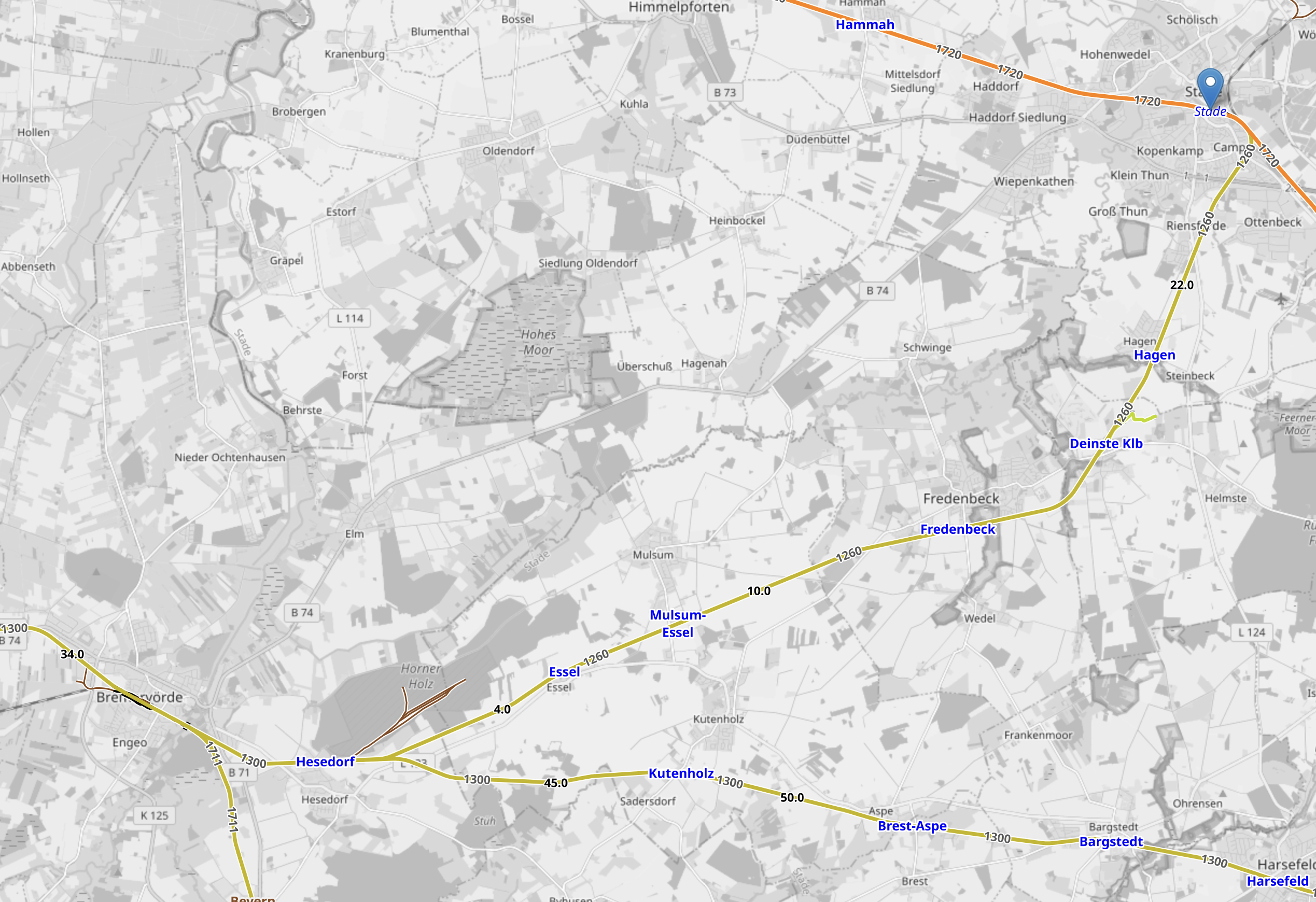
This map from OpenRailwayMap shows the route.
Note.
- Stade is in the North-East corner of the map and marked with a blue arrow.
- Stade station is on the Hamburg S-Bahn and has an hourly fast train between Hamburg and Cuxhaven.
- Bremervörde is in the South-West corner of the map, where the various routes converge.
- Bremervörde station is on the Buxtehude-Cuxhaven Line which is run by the hydrogen-powered Alstom Coradia iLint trains.
- Bremervörde appears to be, where the hydrogen-powered trains are serviced and refuelled.
- Currently, there are no passenger trains between Stade and Bremervörde, except at the weekends, when a heritage service called the Moor Express runs between Bremen Hauptbahnhof and Stade via Bremervörde.
- Freight trains also operate between Stade and Bremervörde.
At first sight it looks like the Stade and Bremervörde route, could be an ideal one to run with hydrogen-powered iLint trains.
- Servicing and refuelling of the trains could be shared with the existing Buxtehude-Cuxhaven service.
- The new service would probably need a few extra identical trains.
- The track is already in use, so probably wouldn’t need too much work.
- As some of the stations are in use by the Moor Express, there may not need to be too much work to bring them up to the required standard.
This re-opening, illustrates the advantage of having a fully-certified, independently-powered train, that can be deployed on non-electrified lines.
Denmark And Germany Sign Bornholm Energy Island Agreement, First Legally Binding Cooperation On Joint Offshore Renewable Energy Project In EU
The title of this post, is the same as that of this article on offshoreWIND.biz.
This is the sub-heading.
German Federal Minister for Economic Affairs and Climate Action, Robert Habeck, and Danish Minister for Climate, Energy and Utilities, Lars Aagaard, have signed an agreement for the Bornholm Energy Island in the Baltic Sea. This is the first legally binding cooperation agreement in Europe on a joint offshore energy project under the EU Renewable Energy Directive.
Bornholm is a Danish island between Denmark, Germany and Sweden, as this map shows.

Note.
- Malmo is in Sweden.
- Copenhagen is in Denmark.
- Germany is in the South-West corner of the map.
Bornholm is the island in the North-East corner of the map.
This paragraph gives the bare details of the generation and transmission capacities.
Bornholm Energy Island, located in the Danish sector of the Baltic Sea, will facilitate connecting at least 3 GW of offshore wind generation capacity to the grid by the early 2030s. The electricity will then be transported via new grid connections to Germany (2 GW ) and to the Danish mainland (1.2 GW).
The great advantage of an energy island, is that the electricity can be sent both ways according to where it is needed.
Some of the energy islands that have been proposed also include energy storage and/or hydrogen production.
This web site gives more details of the Bornholm Energy Island.
Under a heading of Why Build Energy Islands?, these reasons are given.
- Environment and climate
- Energy security in Europe
- Inspiration for the world
Under a heading of What is an Energy Island?, this is said.
An energy island makes it possible to establish large wind farms at sea far from the coast. The energy produced by the wind turbines is sent via cables to the energy island, from where it is sent out to consumers. On Bornholm, a high-voltage facility must therefore be established on the island which can receive and distribute the electricity. After that, green power can be sent from Bornholm to millions of consumers in Denmark and Germany. Bornholm’s Regional Municipality is working hard to seize the energy island’s potential for job creation and local business growth, and in turning Bornholm into the green business beacon and transport hub for green fuels in the Baltic Sea.
I suppose it could be argued that in the UK, Orkney and Shetland are already energy islands and will become more so in years to come.
Energy islands, whether real or man paid certainly seems to be a concept that is growing in populatity, with several being developed.
Industry Calls For 10 GW Of Offshore Hydrogen In German National H2 Strategy
The title of this post, is the same as that of this article on offshoreWIND.biz.
This is the sub-heading.
Offshore wind and hydrogen developers and organisations in Germany have called on the federal government to set clear targets for offshore hydrogen in the update of the country’s National Hydrogen Strategy, with an additional 10 GW of offshore electrolysis capacity to be added by 2035.
These two paragraphs add detail the story and name those who are behind it.
On 26 May, several companies and industry organisations signed an appeal sent to the German Federal Government that highlights offshore hydrogen’s advantage of adding large-scale capacities and asks that a target of an additional 10 GW of offshore hydrogen by 2035 be added to both the country’s hydrogen strategy and the area development plan.
The parties that signed the appeal include the German offshore wind-to-hydrogen initiative AquaVentus, offshore wind and hydrogen players BP, Siemens Gamesa, Gasunie, Copenhagen Infrastructure Partners (CIP), EnBW, Equinor, and Lhyfe, as well as industry organisations WAB and the Federal Association of Offshore Wind Farm Operators (BWO), among others.
These two paragraphs describe an area to be developed for the first offshore hydrogen production.
As reported in January, in the country’s new area development plan for offshore wind, Germany’s Federal Maritime and Hydrographic Agency (BSH) also outlined the first offshore hydrogen area in the North Sea.
The area, SEN-1, spans over 100 square kilometres in the North Sea and will allow for an electrolysis capacity of up to 1 GW to be tested and connected with a hydrogen pipeline.
Note.
- 1 GW if electricity should create about 435 tonnes of hydrogen per day.
- That amount of hydrogen could be stored as liquid in a sphere with a radius of 11.35 metres.
Ed Sheeran Wins Thinking Out Loud Copyright Case
The title of this post, is the same as that pf this article on the BBC.
This was the sub-heading
Ed Sheeran did not copy Marvin Gaye’s Let’s Get It On when composing Thinking Out Loud, a US court has ruled.
It certainly looks like justice has been done, after a court case urged on, by unscrupulous lawyers, who would probably have got millions of dollars in fees, if they’d won.
It was an example of the American legal system at its worst.
I was probably about fourteen, when I went to a Scout camp on the Verulam Estate near St. Albans. I can remember we walked from East Barnet to St. Albans with the trek cart.
One evening at the camp around a wood fire, a Scoutmaster from another troop, entertained up on his guitar, playing various songs of the day. He showed us how most songs were created using the same chords and rhythm. He also gave us a few pieces of his own.
It was fascinating. But it seems to me that Sheeran has used a similar line and argument in his defence.
I don’t have much respect for American lawyers.
One of the companies, that I helped create was taken over by an American corporation. I can remember at dinner one night with one of their senior managers, some of the best legal jokes and advice being offered.
On the other hand, I would defend one of my ideas in the US Courts, if I had an idea, that someone had stolen. But in that case, I would make sure, I’d got my case correct.
I suspect, it could be a good way to protect an idea.
I have sold two companies and ideas to Americans and one to the Germans. Only one American deal ended up in the Courts and that was one of these opportunistic cases, dreamed up by sharp lawyers, that was thrown out.
The German deal was for several millions and it was interesting, as the Germans were happy to do all the negotiating in the UK, with the contract being wholly written in English law.
World’s Largest-Of-Its-Kind Power Line To Deliver Clean Power To 1.8m UK Homes And Boost Energy Security
The title of this post, is the same as that as this press release from the UK Government.
These are the three bullet points of the press release.
- LionLink power line between UK and Netherlands will deliver enough electricity to power more homes than Manchester and Birmingham combined.
- Agreement made as Grant Shapps leads delegation of leading businesses to key North Sea Summit.
- Part of renewed Government drive to work with business to help grow the economy.
These three paragraphs outline the project.
The world’s largest multi-use electricity power line will be built under the North Sea, boosting UK energy supplies with enough to power 1.8 million homes – more than Birmingham and Manchester combined.
The new LionLink will connect the UK and the Netherlands with offshore wind farms, providing clean affordable and secure energy to Britain which will help cut household bills and drive Putin’s Russia further out of the energy market.
The cross-border electricity line will be only the second of its kind in the world, with the first having been built by Germany and Denmark. However, it will be able to carry more than four times the amount of electricity as its predecessor – making it the largest of its kind in terms of capacity anywhere in the world.
Note.
- I suspect the LionLink will go via the Dogger Bank, where Danish, Dutch, German and UK territorial waters meet an we are already building 8 GW of fixed foundation offshore wind. The other countries are also active in the area.
- The press release doesn’t mention, where the LionLink will make landfall in the UK.
- Much of the connection will probably use the cables being laid for the Dogger Bank wind farms.
- There is also no mention of the North Sea Wind Power Hub, which could be an artificial island on the Dogger Bank.
There is also a press release on the National Grid web site, which is entitled National Grid And TenneT Collaborate On Proposed First-Of-A-Kind Anglo-Dutch Electricity Link, which gives more details.
- The capacity is stated to be 2 GW.
- Like the current BritNed interconnector, the project will be a cooperation between National Grid And TenneT.
- TenneT is a limited liability company owned by the Dutch government, that is a transmission system operator in the Netherlands and in a large part of Germany.
There is also a diagram, showing how the LionLink will work, which includes these components.
- On the Dutch side, there is an offshore AC>DC Converter Station, which is connected to the Dutch electricity grid and one or more offshore wind farms.
- Across the border between the Dutch and UK Exclusive Economic Zones, there will be a HVDC cable.
- The HVDC cable will terminate in an onshore DC>AC Converter Station in the UK, which will be connected to the UK electricity grid.
No details of the two landfalls have been given.
More information is given in this article on offshoreWIND.biz, which is entitled UK And Netherlands Unveil Multi-Purpose Interconnector Plans.
- This shows a map of the North Sea with an interconnector running in a straight line between possibly Rotterdam and Bacton in Norfolk.
- A wind farm is shown connected to this interconnector.
This paragraph describes the windfarm and the interconnector.
LionLink, a multi-purpose interconnector that was announced today at the North Sea summit, could connect a Dutch offshore wind farm with a capacity of 2 GW to both countries via subsea interconnectors.
If the wind farm has a capacity of 2 GW, I would assume it can supply up to 2 GW to the UK and The Netherlands.
This is a classic system, that can be optimised by the application of sound principles.
All electricity generated by the wind farm must be used, stored or converted into green hydrogen.
Electricity will be distributed as to need.
Energy storage or electrolysers could be sited at either end or even in the wind farm.
I would suspect that more wind farms could be connected to the interconnector.
The team, that write the control system for the grid will have a lot of fun!
BritNed
I have a feeling that National Grid and TenneT have taken a long hard commercial look at the electrical and financial performance of BritNed over the last year and decided, that a second connection would be to the mutual benefit of both companies, their customers and the UK and The Netherlands in general.
It would also be twice as difficult for terrorists sponsored by Putin to cut two cables.
Conclusion
This is a great leap forward for wind power in the North Sea and Europe.
Lifting The Barriers To Refueling
The title of this post, is the same as that of this article on Railway Age.
It is a good summing up of Alstom’s problems of getting hydrogen for the iLint in Germany.
This paragraph from the article is puzzling.
Alstom’s task now is to clear external hurdles out of the way. Sprotte explains this using the Bremervörde project as an example: “The location is geographically favorable, almost in the middle of the regional transport network. If they were allowed to, Alstom and Linde could jointly supply several surrounding communities with ready-made hydrogen, for example for municipal commercial vehicles. But they can’t, and that’s because public funding for the project was only granted on the express condition that the filling station be used exclusively for rail transport.” This was met with incomprehension by the partners involved.
The Bremervörde project is to provide hydrogen for the Cuxhaven route that I wrote about in My First Ride In An Alstom Coradia iLint.
It strikes me that a certain amount of bureaucracy, is stopping the full deployment of the trains.
But then the London Mayor has a hydrogen policy of ignore it and it might go away.
N-Sea To Connect German Offshore Wind Farm To Dutch Gas Platform
The title of this post, is the same as that of this article on offshoreWIND.biz.
This is the sub-heading.
Dutch upstream oil and gas company, ONE-Dyas, has awarded N-Sea with a contract to install a subsea power cable between the Riffgat offshore wind farm in the German North Sea and the new, to-be-built N05-A gas production platform.
At a first look it appears that wind power is being used to power the gas production platform.
Other points from the article include.
- The distance of the connecting cable is ten kilometres.
- The Dutch government approved the scheme in June 2022.
- A final investment decision was made in September 2022.
I have some thoughts and further information.
Borkum, Rottumerplaat and Schiermonnikoog
The article says this about the position of the gas platform.
The N05-A platform will be installed some 20 kilometres north of the islands of Borkum, Rottumerplaat and Schiermonnikoog, and approximately one and a half kilometres from German waters.
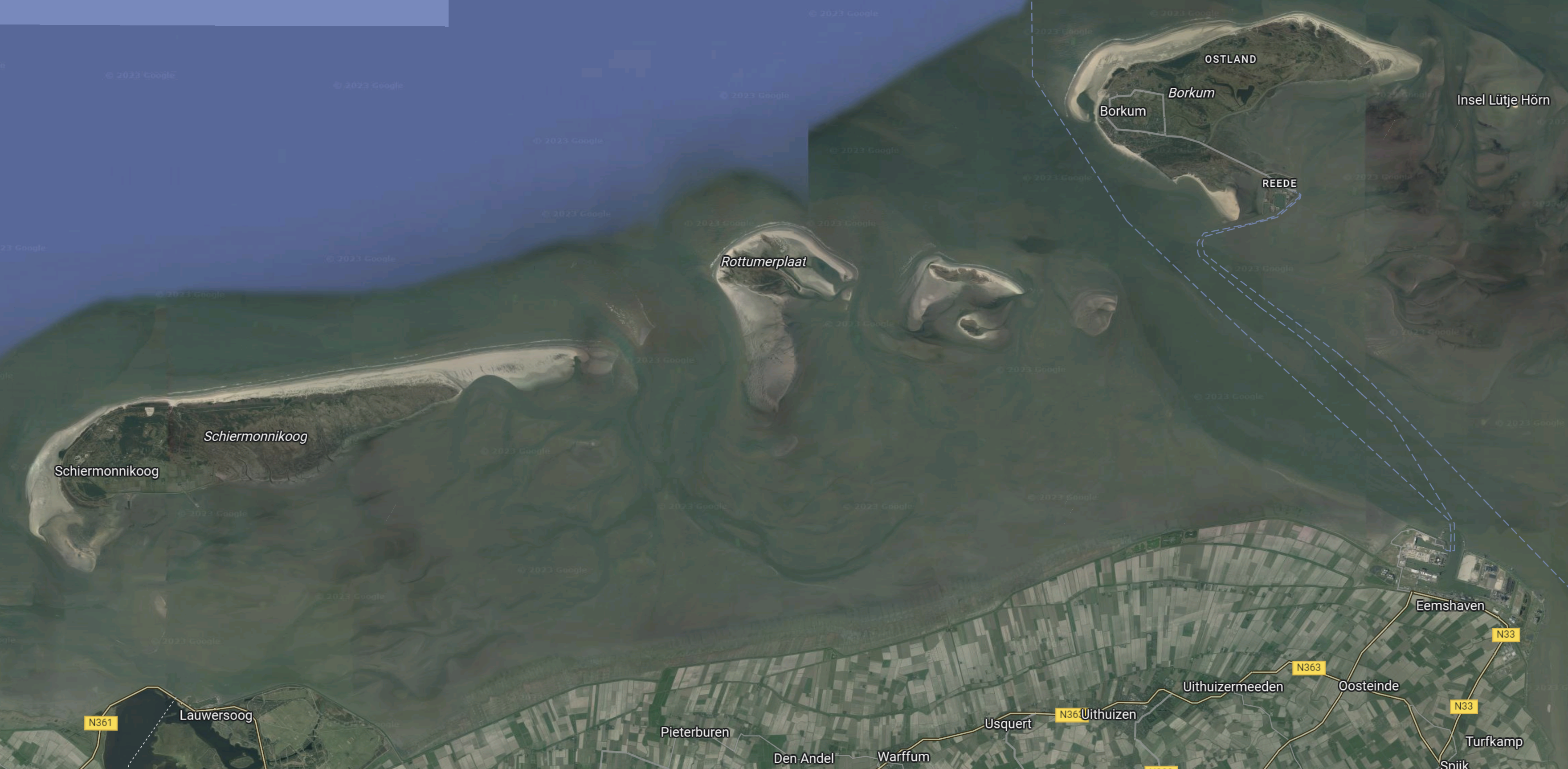
This Google Map shows the three islands.
Note.
- Borkum is the horseshoe-shaped German island in the North-East corner of the map.
- Schiermonnikoog is the long and thin island in the West.
- Rottumerplaat is the larger of the two Dutch islands in middle map.
- Eemhaven, which I wrote about in The Train Station At The Northern End Of The Netherlands, is in the South-East corner of the map.
Shipping routes run up the River Ems and German-Dutch border in the East of the map
Riffgat Wind Farm
This web page on the EWE web site, gives this description of the wind farm.
EWE has built the first commercial wind farm in the German North Sea in summer 2013 with Riffgat. The modern wind farm has a total capacity of 108 megawatts of power and can supply around 120,000 households with environmentally friendly electricity. In just 14 months of construction, the 30 wind turbines of the 3.6 megawatt class have been installed 15 kilometers off the north seas of Borkum. The rotor diameter of the units is 120 meters, while the hub height is 90 meters, which corresponds to the height of the Bremen dome. Overall, the plants are 150 meters high from the water surface to the top rotor blade tip. They are founded on 70 meter long steel foundations (monopiles), 40 meters deep in the sea bottom. The water depth in the wind farm is between 18 and 23 meters. In addition to the wind power plants, Riffgat also consists of a substation which transports the generated electricity to a better transportable voltage level.
It looks a pretty standard 100 MW wind farm with fixed foundations.
The N05-A Platform
The article says this about the N05-A project.
The N05-A project is part of the so-called GEMS area, an area approximately 20 to 80 kilometres north of the Ems estuary. ONE-Dyas, together with partners Hansa Hydrocarbons and EBN, aims to extract natural gas from the N05-A field as well as surrounding fields in the German and Dutch North Sea.
The GEMS area has a web site with a URL with a .co.uk extension.
It has an informative video, which I don’t think would go down with Dutch chapter of Just Stop Oil.
The North Sea’s First Gas Platform To Run Entirely On Wind Power
The article says this about the N05-A project.
While the N05-A platform will not be the first in the North Sea to run on wind energy, it will be the first to do so entirely.
Hywind Tampen floating wind farm will be the first.
Conclusion
This looks like a good pragmatic solution to me.
I can see more connections between offshore wind farms and oil and gas facilities all over the world.
Mercedes-Benz, Amazon, Frankfurt Airport, Lidl & Kaufland, Vodafone – Giants In Germany Lining Up To Buy Offshore Wind Power
The title of this post, is the same as that of this article on offshoreWIND.biz.
This is the sub-heading.
With the latest news about Lidl and Kaufland entering a long-term offshore wind power offtake contract, and Mercedes-Benz announcing the same shortly prior to that, the list of big names signing up to buy offshore wind-generated electricity in Germany keeps growing. What lies behind this are both the companies’ ambitious decarbonisation strategies and the country’s approach to tendering.
Rhe whole article can be read after signing up for a free trial.
Green Hydrogen to Flow From Denmark To Germany From 2028
The title of this post, is the same as that of this article on Hydrogen Central.
These are the two introductory paragraphs.
Green hydrogen to flow from Denmark to Germany from 2028.
The climate minister, Lars Aagaard, and the German economy and climate minister, Vice Chancellor Robert Habeck, signed an agreement in Copenhagen to build a land-based hydrogen pipeline from Denmark to Germany, which will commence operations in 2028.
The article also says this about the hydrogen infrastructure to Germany.
An underground hydrogen pipeline from western Jutland will probably be used to transfer the hydrogen to northern Germany. The capacity of the new pipeline was not confirmed.
I can see the UK having the means to export hydrogen to Europe.
 The Anonymous Widower