UK Energy Exports To Europe At Record High
The title of this post, is the same as that of this article on The Times.
This is the first two paragraphs.
Britain has exported record amounts of gas to Europe so far this year as its liquefied natural gas terminals receive shipments destined for the Continent.
Electricity exports also have surged to unprecedented highs in recent weeks after an unexpected glut of gas pushed down short-term gas prices and resulted in gas-fired power plants generating more for export.
Who’d have thought it, that all those gas pipelines and electricity interconnectors between the UK and the Continent of Europe would be part of the replacementliqui for Russian gas.
According to Wikipedia, we have three liquified natural gas terminals; two at Milford Haven; South Hook and Dragon, and Grain on the Isle of Grain.
Note.
- South Hook is Europe’s largest liquified natural gas terminal and is owned by a partnership of the Qataris, ExxonMobil and Elf.
- South Hook and Dragon together can provide 25 % of the UK’s natural gas needs.
- Grain is owned by National Grid and according to Wikipedia, is in terms of storage capacity it is the largest LNG facility in Europe and the eighth largest in the world.
- Grain can supply 20 % of the UK’s natural gas needs.
- Grain has a reloading facility, so that gas can be exported.
- Grain seems to be continually expanding.
- Both Milford Haven and the Isle of Grain have large gas-fired power-stations.
Politicians say we don’t have enough gas storage, but we do seem to have world-class LNG terminals.
I have a couple of extra thoughts.
Blending Natural Gas With Hydrogen
HyDeploy is a project investigated blending hydrogen natural gas to cut carbon emissions. The project is described in this post called HyDeploy.
Surely, these terminals could be places, where hydrogen is blended with our natural gas supply.
- The terminals are connected to the UK gas network.
- Both Milford Haven and the Isle of Grain should have access to large amounts of offshore wind energy in the next few years, which could be used to generate green hydrogen.
- The terminals would need electrolysers to generate the hydrogen.
The Isle of Grain already has a blending capability.
NeuConnect
NeuConnect is an under-development interconnector between the Isle of Grain in Kent and Wilhelmshaven in Germany.
- It will have a capacity 1.4 GW.
- All the planning permissions seem to be in place.
- Prysmian have won a € 1.2 million contract to deliver the interconnector.
- Arup and German engineering firm Fichtner have formed a joint venture to provide project services for the interconnector.
- Construction could start this year.
It looks like the Germans will be replacing some of Putin’s bloodstained gas with clean zero-carbon energy from the UK.
Should We Develop More Gas Fields?
There are some gas fields in the seas around the UK, like Jackdaw, that could be developed.
Suppose, we extracted the gas and sent it to the reloading terminal on the Isle of Grain through the gas transmission network, where it could be exported by ship, to the Continent.
The UK would not be increasing its carbon emissions, as that would surely be the responsibility of the end-user.
Should We Develop More Gas Fired Power-Stations?
I believe it is possible to develop carbon-capture technology for gas-fired power stations.
The carbon dioxide would be either used in a beneficial way or stored in perhaps a worked-out gas field under the North Sea.
So long as no carbon dioxide is released into the atmosphere, I don’t see why more gas-fired power stations shouldn’t be developed.
What is happening at Keadby near Scunthorpe would appear to be one model for zero-carbon power generation.
Keadby Power Station
This is an existing
Conclusion
We will be exporting more energy to the Continent.
Could Fortescue Future Industries’ Green Hydrogen Help Europe Ditch Russian Energy?
The title of this post, is the same as that of this article on Motley Fool Australia.
This is the first paragraph.
Green hydrogen may help interrupt the Kremlin’s ability to conduct “war games”, says Fortescue chief Andrew Forrest.
I very much think that Andrew ‘Twiggy’ Forrest is right.
My last three hydrogen articles were.
- Poland May Become A Green Hydrogen Tycoon.
- Will The Orkney Become A Major Green Hydrogen Production Centre?
- Wind And Solar Boom Will Bring Energy Surplus.
If the projects in these articles don’t blow the bottom out of the market for Russia’s bloodstained gas, with a little bit of help from Twiggy’s hydrogen kanganaut, then I’ll be very surprised. Especially, as countries like Argentina, Australia, Brazil, Canada, Chile, Denmark, Iceland, Ireland, Jordan, Japan, Kenya, Namibia, Morocco, Norway, Papua New Guinea, Portugal, South Korea, Spain, Sweden and the United States are all planning to produce green hydrogen in large quantities.
Poland May Become A Green Hydrogen Tycoon
The title of this post, is the same as that of this article on Hydrogen Central.
This is the first two paragraphs.
In 2050, Poland may become one of the most competitive producers of green hydrogen in the European Union. In addition, we could export it to other countries, using the already existing infrastructure – e.g. the Yamal gas pipeline.
According to analysts of the Polish Economic Institute (PIE), in the next three decades Poland could become a very competitive producer of green hydrogen. Particularly economically beneficial in Polish conditions would be the production of hydrogen based on energy from onshore wind energy.
Note.
- The Yamal pipeline comes all the way from Siberia.
- The Baltic pipeline will connect Norway and Poland.
- Poland currently has over 7 GW of wind power.
- Wikipedia says this “In 2019, wind was the second most important source of electricity produced in Poland, after coal, and accounted for about 10% of the electricity production.”
- I have been to quite a few parts of Poland and it seems that it can be flat and windy.
- 1.2 GW of offshore wind is under development near Slupsk.
I very much feel that the conclusion of the article could be right.
Will Orkney Become A Major Green Hydrogen Production Centre?
Two projects seem to be coming together to the West of and on Orkney.
The West Of Orkney Wind Farm
This map shows the awarded leases in the latest ScotWind round, which I analysed in ScotWind Offshore Wind Leasing Delivers Major Boost To Scotland’s Net Zero Aspirations.

Note the wind farm numbered 13 to the West of Orkney.
- It is now called the West of Orkney wind farm.
- It has its own web site.
This page on the web site describes the project.
The West of Orkney Windfarm is being developed around 30km off the west coast of Orkney and around 25km from the north Caithness coast. With an expected capacity of 2GW, and first power scheduled for 2029, the project will be capable of powering the equivalent of more than two million homes.
The West of Orkney Windfarm lies wholly within the “N1” Plan Option, which is one of 15 areas around Scotland which the Scottish Government considered suitable for the development of commercial scale offshore windfarms. The Scottish Government published the Sectoral Marine Plan for Offshore Wind Energy in October 2020 following over two years of extensive analysis, consideration and engagement with a wide range of stakeholders.
In January 2022 OWPL were successful in securing an Option Agreement from Crown Estate Scotland for the project in the ScotWind leasing process.
The West of Orkney Windfarm has a grid connection agreement with National Grid for a connection in Caithness. Additionally, the project partners are exploring an option to power the Flotta Hydrogen Hub. There is the potential for both power export options to be utilised.
The project is currently considering both fixed-bottom foundations and floating substructures for the wind turbines.
The West of Orkney wind farm will be one of the largest offshore wind farms in Scotland.
The Flotta Hydrogen Hub
The Flotta Hydrogen Hub is described on its web site.
This section describes the low carbon ambition of the Flotta Hydrogen Hub.
This potential £multi-billion project would utilise a repurposed area of the existing Flotta Terminal to create a green hydrogen hub powered by offshore wind projects in the seas to the west of Orkney.
If successful, this ambitious plan – which could be realised in the later years of this decade – would deliver a new wave of renewable employment alongside significant quantities of green hydrogen.
This hydrogen could be exported to Europe or other destinations, blended into the gas grid at St Fergus and drive forward an international maritime green hydrogen refueling hub.
If realised, the Flotta Hydrogen Hub would contribute significantly to the UK’s low carbon ambitions, sustain and create long-term skilled jobs and place Scotland at the front of the global hydrogen revolution.
The proposal is supported locally by EMEC Hydrogen which has spearheaded Orkney’s leading position in green hydrogen production.
It is certainly a comprehensive vision.
I have my thoughts.
Will The West Of Orkney Wind Farm Have Fixed Foundations Or Floating Substructures?
If you look on the map earlier in this post, you will notice a cluster of wind farms at the North of Scotland.
- 7 – DEME Concessions Wind – 200 km² – 1.0 GW – Floating
- 8 – Falck Renewables Wind – 256 km² – 1.0 GW – Floating
- 9 – Ocean Winds – 429 km² – 1.0 GW – Fixed
- 13 – Offshore Wind Power – 657 km² – 2.0 GW – Fixed or Floating
- 14 – Northland Power – 390 km² – 1.5 GW – Floating
- 15 – Magnora – 103 km² – 0.5 GW – Floating
Given that floating wind farms outnumber those on fixed foundations, I wouldn’t be surprised to see the West of Orkney wind farm, built as a floating wind farm.
Where Is Flotta?
This Google Map shows the North of Scotland and the Southern part of Orkney.
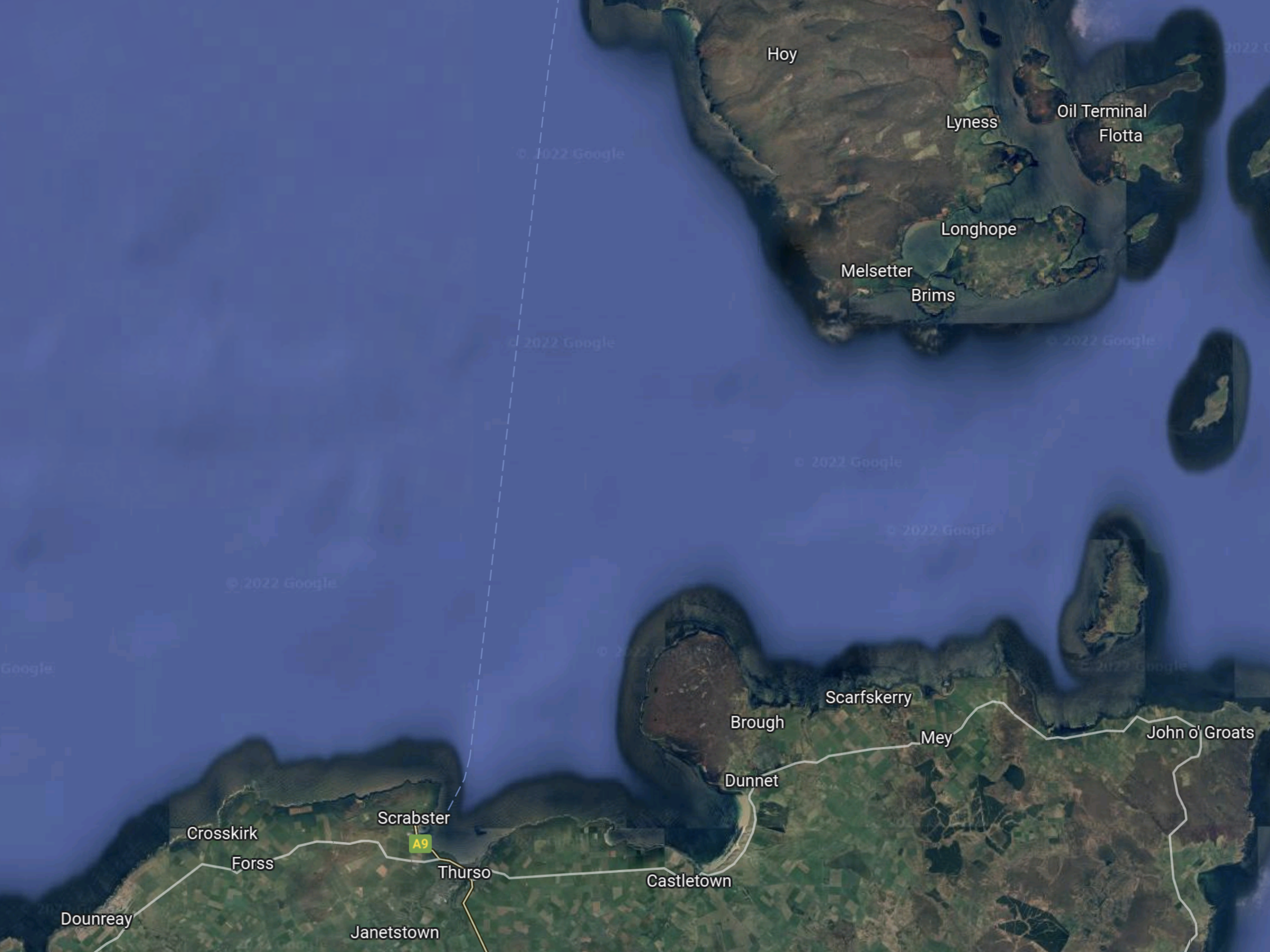
Note.
- Flotta and its Oil Terminal in the North-East corner of the map.
- John o’Groats in the South-East corner of the map.
- The ferry between Scrabster and Orkney.
- Dounreay in the South-West corner of the map.
The West of Orkney Windfarm web site says that the wind farm is being developed around 30km off the west coast of Orkney and around 25km from the north Caithness coast.
This Google Map shows the island of Flotta.

Note.
- The oil terminal is clearly visible.
- Will it get tight for space on the island of Flotta, if they need a tank farm for all the hydrogen?
- I suspect that a pipeline to deliver hydrogen elsewhere, would have a high priority!
This Google Map shows the Caithness coast in more detail.
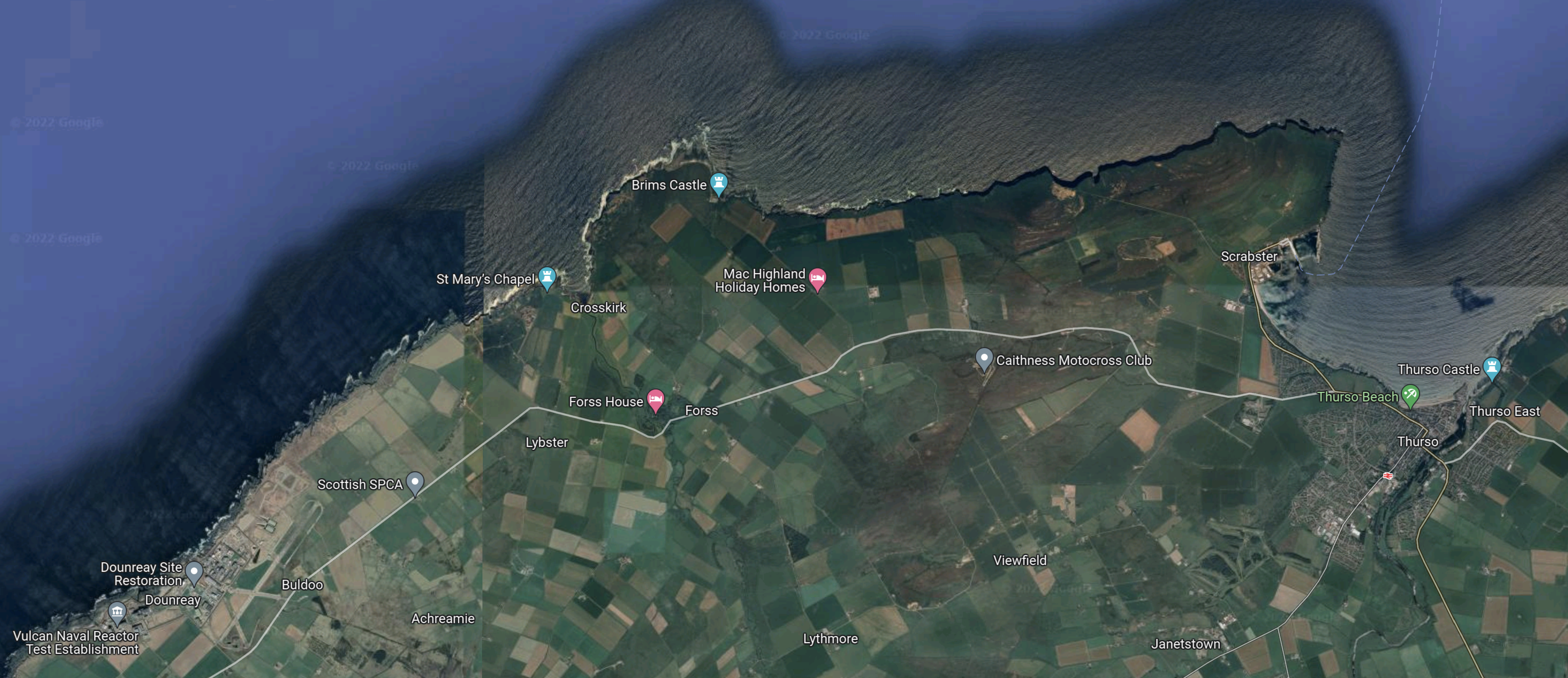
Note.
- Thurso and Scrabster are at the East of the map.
- The former nuclear research at Dounreay, is in the South-West corner of the map.
This article on the Stornaway Gazette is entitled SSE Plan To Bypass Isles Condemned and has this sub-title.
The Western Isles could be massively disadvantaged for decades to come if Scottish and Southern Energy are allowed to take power from offshore windfarms direct to a hub at Dounreay in Caithness.
This appears to indicate that West of Orkney wind farm and others in the area could be connected to the National Grid using a sub-station at Dounreay.
What Will Be The Capacity Of The Flotta Hydrogen Hub?
As I said previously, if the Flotta Hydrogen Hub is well-designed, possibly with a pipeline to take hydrogen out, that the Flotta Hydrogen Hub will have limitations on how much hydrogen it can produce due to the site size.
So the limitation of the capacity of the Flotta Hydrogen Hub will depend on the size of the electrolyser and how much electricity can be fed from the West of Orkney wind farm and possibly other wind farms to the site.
The West of Orkney wind farm has a capacity of 2 GW.
The other site that could possibly be connected would be Northland’s 1.5 GW wind farm in ScotWind N2.
Note that the combined area of these two wind-farms would be a 33 km square.
This Google Map shows the North of Scotland, Orkney, Shetland and the Faroe Islands.
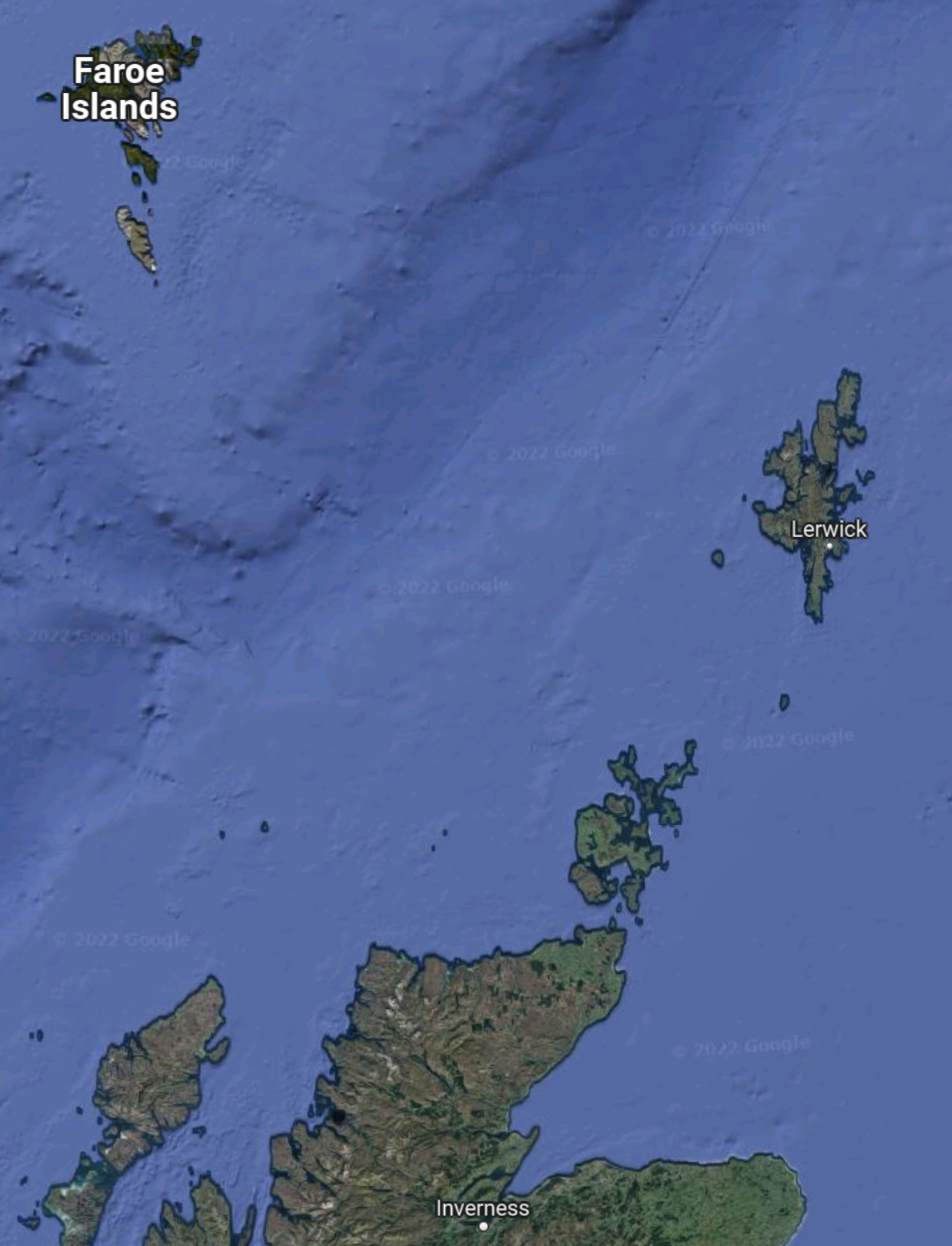
Note.
- The distance between Cape Wrath and John o’Groats is just over 100 km.
- There is nothing to the West of Orkney, except a few rocky stacks, sea, fish and sea-birds.
- I could see the West of Orkney wind farm and the one Northland are building in the ScotWind N2 being extended further out.
A 100 km square would hold about 13.5 GW of floating turbines, so lets say that a round 10 GW could be cabled to Orkney.
Could The West of Orkney Wind Farm And ScotWind N2 Use Identical Technology?
I wouldn’t be surprised if this happened and a massive floating wind farm expanded to the North and West.
The capacity of the wind farm could be upwards of 10 GW.
How Much Hydrogen Could Be Produced In The Flotta Hydrogen Hub?
In Can The UK Have A Capacity To Create Five GW Of Green Hydrogen?, I said the following.
Ryze Hydrogen are building the Herne Bay electrolyser.
- It will consume 23 MW of solar and wind power.
- It will produce ten tonnes of hydrogen per day.
The electrolyser will consume 552 MWh to produce ten tonnes of hydrogen, so creating one tonne of hydrogen needs 55.2 MWh of electricity.
A GW of electricity for a year is 8760 GWh, which would produce over 150,000 tonnes of hydrogen.
Conclusion
This plan could generate huge amounts of green hydrogen on Orkney.
Study Suggests Solar Energy Can Be Cleanly’ Converted Into Storable Hydrogen Fuel
The title of this post, is the same as that, as this news item from Strathclyde University.
This section entitled Green Hydrogen, describes the research.
Most hydrogen is still made from natural gas, producing greenhouse gasses, and green hydrogen production is urgently needed. Green hydrogen is produced from water using a photocatalyst – a material which drives the decomposition of water into hydrogen and oxygen using sunlight.
The study, ‘Photocatalytic overall water splitting under visible light enabled by a particulate conjugated polymer loaded with iridium’ is published in Angewandte Chemie, a journal of the German Chemical Society. It suggests that using a photocatalyst under simulated sun light facilitates the decomposition of water when loaded with an appropriate metal catalyst – in this case iridium.
When used in a fuel cell, hydrogen does not emit any greenhouse gasses at the point of use and can help decarbonise sectors such as shipping and transportation, where it can be used as a fuel, as well as in manufacturing industries.
Using this photocatalyst may not be the final solution, but I do believe from my mathematical modelling of catalysts in an unrelated application in the 1970s, that this research could lead to an affordable way to create green hydrogen.
Torvex Energy
Hydrogen And Chlorine Production At ICI Mond Division in The 1960s.
In my time in the late 1960s, when I worked For ICI Mond Division, I spent time in the Castner-Kellner works trying fairly unsuccessfully to develop an analyser to detect mercury-in-air in the Castner-Kellner process, that created chlorine and hydrogen from brine.
The process is not a nice one as it uses a mercury cathode and Wikipedia says this about safety.
The mercury cell process continues in use to this day. Current-day mercury cell plant operations are criticized for environmental release of mercury leading in some cases to severe mercury poisoning (as occurred in Japan). Due to these concerns, mercury cell plants are being phased out, and a sustained effort is being made to reduce mercury emissions from existing plants.
ICI felt that a mercury-in-air analyser would help to make the plant safer.
But ICI did have an alternative way to produce the chlorine they needed for selling as a gas or liquid or using as a base chemical for products like disinfectants, bleaches and dry cleaning fluids, without the use of mercury.
It was only a small plant and I was taken there once.
As with the Castner-Kellner process, it used a series of electrolyser cells.
- These were smaller and had a tub, with a concrete lid.
- The anode and cathode and the pipes collecting the hydrogen and the chlorine went through the lid.
- They were rebuilt regularly.
- As with the Castner-Kellner process, brine is electrolysed.
- The process was old and probably dated from before the Castner-Kellner process.
But of course as there was no mercury, the hydrogen and chlorine were pure and could be used for certain types of manufacture like pharmaceuticals.
Torvex Energy
This article on Hydrogen Fuel News is entitled Stockton R&D Firm Unveils New Hydrogen From Seawater Production Process.
These are some points from the article.
- Torvex Energy, a Stockton research and development company, recently unveiled a new technique for producing hydrogen from seawater.
- This unique method of producing hydrogen from seawater does not result in oxygen gas emissions.
- As such, it is clearly quite different from more traditional water electrolysis methods used for producing green H2.
- The team behind the production method call it an environmentally friendly technique.
- There is no desalination process.
- The firm has patents pending on this unique form of electrochemical process.
- It worked with the Material Processing Institute to establish proof of concept for this purpose.
I originally felt that Torvex Energy may have updated the ancient ICI process, that I saw over forty years ago, but when I asked the company, they said it was different.
It now appears that they haven’t, which means they must have found a totally new process.
There is certainly an ongoing patent application with a number of gb1900680.8.
How Efficient Is The Torvex Energy Process?
This will be key and there is nothing on their web site or on the Internet to indicate, if the Torvex Energy process is more or less efficient than traditional electrolysis.
Offshore Hydrogen Production
The main application for the Torvex Energy process must surely be in the production of hydrogen offshore.
- A fleet of floating wind turbines could surround a mother platform with a Torvex Energy process.
- The hydrogen could then be sent ashore in a pipeline.
- If there to be a handy depleted gas field, this possibly could be used to store the gas.
Depending on the efficiency of the Torvex Energy process, this could be a more cost-effective way to bring energy ashore, as gas pipelines can be more affordable, than HVDC electrical links. Especially, if the pipeline already exists.
Conclusion
Torvex Energy would have appeared to have made a major breakthrough in the production of hydrogen.
Shell To Develop Blue Hydrogen Plant
The title of this post, is the same as that of this article in The Times.
The article is based on this press release from Shell, which is entitled Shell And Uniper To Work Together On Blue Hydrogen Production Facility In The UK.
These are the three bullet points of the press release.
- Shell and Uniper sign co-operation agreement to progress plans for low-carbon hydrogen production at Uniper’s Killingholme site in North Lincolnshire
- Hydrogen produced could be used to decarbonise heavy industry, transport, heating and power across Humber and beyond.
- Project recently passed eligibility phase for UK Government’s Phase-2 carbon capture, usage and storage Cluster Sequencing Process.
Note.
- The Killingholme site is currently occupied by the 900 MW gas-fired Killingholme power station.
- Heavy industry on Humberside includes chemicals and oil refineries and the Scunthorpe steelworks.
This Google Map shows the location of Killingholme power station.
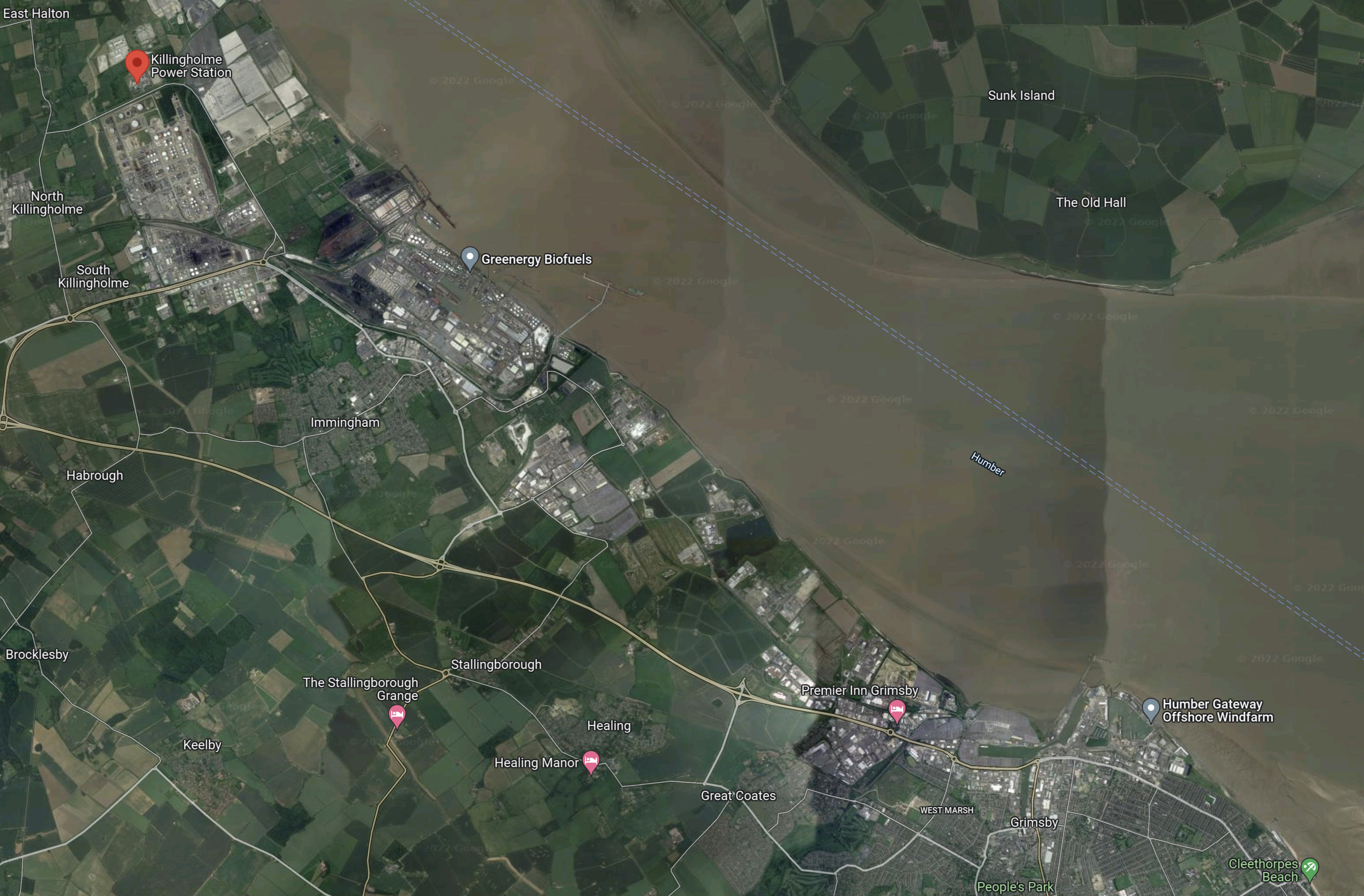
Note.
- Killingholme power station is marked by the red arrow.
- The river is the Humber.
- The Port of Immingham is on the power station side of the river.
- Cleethorpes Beach is marked by the green dot in the bottom-right hand corner.
- Grimsby is to the North of Cleethorpes.
- Between Grimsby and Killingworth power station is a mass of chemical works.
This second Google Map shows the area to the South-East of the power station.
Note.
- Killingholme power station is marked by the red arrow.
- The Hornsea 02 substation to the North of the power station.
- The large Uniper site to the South of the power station.
- The large number of tanks inland from the port and the chemical works.
I have some thoughts.
A Full Description Of The Project
This paragraph from the press release described the project.
Uniper has signed an agreement with Shell to progress plans to produce blue hydrogen at Uniper’s Killingholme power station site in the East of England. The hydrogen produced could be used to decarbonise industry, transport and power throughout the Humber region.
The Humber Hub Blue project includes plans for a blue hydrogen production facility with a capacity of up to 720 megawatts, using gas reformation technology with carbon capture and storage (CCS).
The captured carbon would be fed through the proposed Zero Carbon Humber onshore pipeline, part of the East Coast Cluster, recently selected as one of two CCS clusters to receive initial government support under the government’s cluster sequencing process.
I suspect that a lot of the plant from the existing Killingholme power station will be repurposed.
This is the specification of the power station.
The Uniper (Formerly E.ON UK) plant consists of two 450 MW Siemens V94.2 gas turbine modules each connected to a heat recovery steam generator using only a single steam turbine in a 2 into 1 configuration. Gas is supplied from a 26-mile pipeline from Theddlethorpe.
When it was built by Powergen (now called Uniper) and opened in April 1993 it was only the second gas-fired power station built in the UK. It was taken out of service in 2002 due to the lower price of electricity and was then restored to full service in August 2005, with one of the 450 MW units returning to service in April 2005.
It was announced that the power station will be closed in 2015.
Will The Project Use The Shell Blue Hydrogen Process?
Will the plant use the Shell Blue Hydrogen Process, that I described in Shell Process To Make Blue Hydrogen Production Affordable?
It appears the Shell Blue Hydrogen Process offers advantages.
- Shell are claiming, that with carbon dioxide costing $25-35/tonne, that their process is more economic than grey or green hydrogen.
- Steam reforming also needs steam, but this new process actually generates steam as a by-product, which further improves the economics, as integrated chemical plants use a lot of steam. Killingholme’s neighbours would probably welcome the steam.
- Shell are reporting capturing 99% of the carbon.
- It looks like savings of between 10 and 25 % are possible.
The most-fervent greens, may claim blue hydrogen is totally wrong.
But if it is more affordable than both grey and green hydrogen and all but one percent of the carbon dioxide is captured, I believe that this should be an option, that is fully investigated.
This appears to be a victory for top-class chemical engineering.
Northern Endurance Partnership
The Northern Endurance Partnership is described on this page of the Equinor web site, where this is said.
BP, Eni, Equinor, National Grid, Shell and Total today confirmed they have formed a new partnership, the Northern Endurance Partnership (NEP), to develop offshore carbon dioxide (CO2) transport and storage infrastructure in the UK North Sea, with bp as operator.
This infrastructure will serve the proposed Net Zero Teesside (NZT) and Zero Carbon Humber (ZCH) projects that aim to establish decarbonised industrial clusters in Teesside and Humberside.
There is also a map.
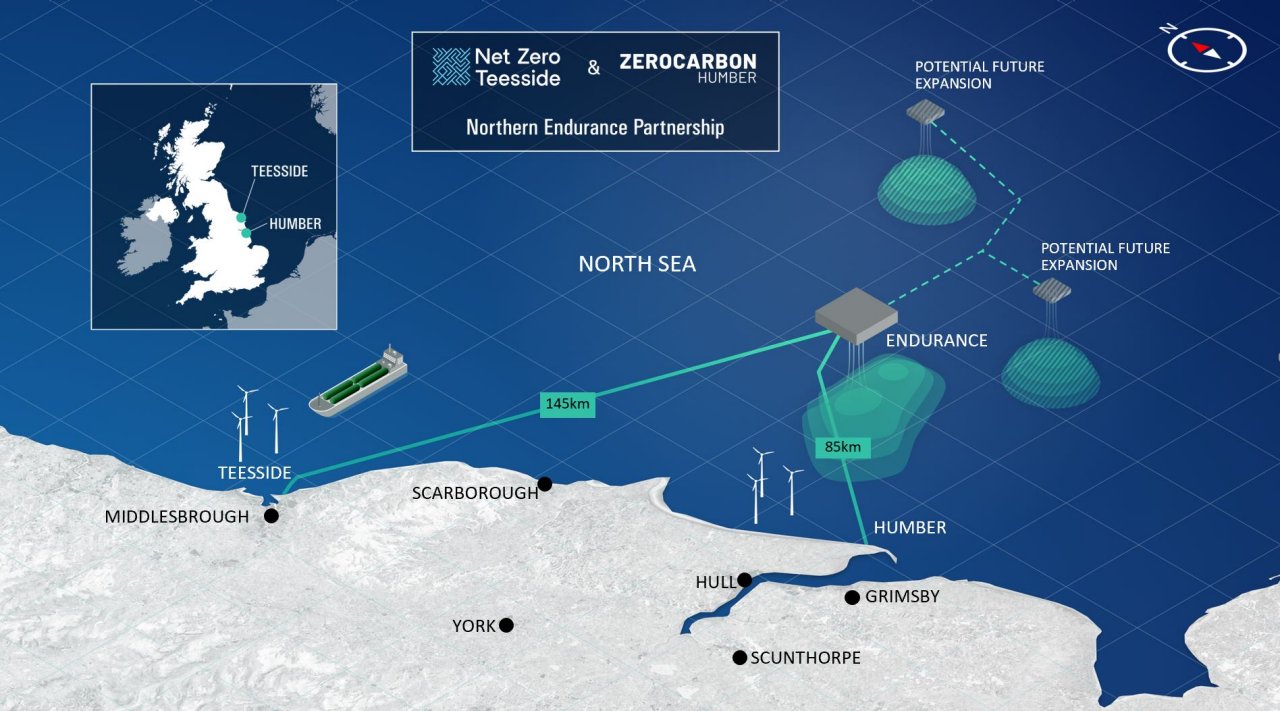
Note.
- One facility would appear to serve the Tees and the Humber.
It looks like the depleted gas fields could hold a lot of carbon dioxide.
Carbon Capture
Some points from the Equinor press release about carbon capture.
- Blue hydrogen production at Killingholme could see the capture of around 1.6 million metric tonnes (Mt) of carbon a year through CCS.
- The UK Government has set a target to capture 10 Mt of carbon a year by 2030.
- NEP has submitted a bid for funding through Phase 2 of the UK Government’s Industrial Decarbonisation Challenge, aiming to accelerate the development of an offshore pipeline network to transport captured CO2 emissions from both NZT and ZCH to offshore geological storage beneath the UK North Sea.
These projects could could decarbonise a lot of businesses on Teesside and the Humber.
Carbon Capture And Use
The Equinor press release says this about carbon capture and use.
The Northern Endurance Partnership will channel the extensive experience of its members to develop and deliver the offshore transport and storage infrastructure we need to unlock the enormous benefits of deploying CCUS across the Humber and Teesside. We’re delighted to start working together with five really world class energy companies to deliver a solution that will play a critical role in decarbonising the UK’s largest industrial heartland and protecting tens of thousands of jobs in the process.”
Uses include.
- Feeding to salad vegetables, tomatoes, soft fruit and flowers in giant greenhouses.
- Creating sustainable aviation fuel.
- Creating building products like blocks and plaster board.
- Making better concrete.
This is a list that will grow.
Making Hydrogen With An Electrolyser
The Shell press release says this.
Uniper continues to develop a separate green hydrogen project, using electrolytic hydrogen production technology, as part of the overall Humber Hub development at Uniper’s Killingholme site. Uniper, along with its project partners, will shortly complete the Project Mayflower feasibility study, part funded by the Department for Transport’s Clean Maritime Demonstration Competition, administered by InnovateUK, looking at the decarbonisation of port related activities at the Port of Immingham.
Note that the sub station for the 1.4 GW Hornsea 2 wind farm is close to both Killingholme power station and the Uniper web site.
What Will Happen To Shell’s Blue Hydrogen Plant?
I think there are two possible scenarios.
- It will be closed when Uniper’s electrolyser is fully on stream.
- It will become an emergency hydrogen source, when the wind is not blowing.
In both cases it will produce less carbon dioxide, thus leaving more space in the Northern Endurance Partnership.
Conclusion
It looks like there could be a comprehensive hydrogen production facility at Killingholme.
Andrew Forrest Snaps Up Pilbara And Gascoyne Cattle Stations For Green Energy Production
The title of this post, is the same as that of this article on the Australian Broadcasting Corporation.
This is the first paragraph.
Australian mining billionaire Andrew Forrest has continued his land acquisition in Western Australia, purchasing another three cattle stations in the state’s north-west to generate renewable energy.
These are some points for the article.
- Andrew Forrest’s Fortescue Future Industries has purchased three cattle stations in northern WA
- The stations will continue to run stock, and contribute to the production of green energy
- FFI says it is looking at other parts of WA to acquire land for similar projects
- The energy created will be used to decarbonise Andrew Forrest’s mining operations by 2030.
- A renewable hub of 340 wind turbines alongside solar panels will be created, which will generate 5 GW of energy.
- The possibility of offshore energy is mentioned.
- There is no mention of energy storage.
I have a few thoughts.
For A Reliable 5 GW Of Energy, Storage Is Surely Needed
I would think that this is probably understood by Fortescue Future Industries and given their ambitions for hydrogen, this must surely be part of an energy storage strategy.
Will Hydrogen Be Exported By Fortescue Future Industries From Australia?
I would expect this depends on three things.
- How much green energy is generated.
- The energy needs of Andrew Forrest’s mining companies.
- How much hydrogen can be sold in Australia.
Fortescue Future Industries will certainly have the market, if they have a surplus.
How Much Energy Will Fortescue Future Industries Generate Per Hectare?
This paragraph from the article gives useful information.
The hub would consist of 340 wind turbines alongside solar panels across Emu Creek and Uaroo Stations, in a development envelope of more than 65,000 hectares of land and a disturbance footprint of more than 10,000 hectares.
- If you look at the 65,000 hectares, as the area of the renewable energy hub, 0.77 MW is generated per hectare.
- If you look at the 10,000 hectares, as the area of the renewable energy hub, 0.5 MW is generated per hectare.
- If you look at Shell’s Scotwind E2 lease, that is 2 GW in 86,000 hectares, where 0.023 MW is generated per hectare.
So on a brief look Australia is a more efficient place for renewable energy, than the seas around the UK.
Conclusion
Andrew Forrest is developing a more detailed plan.
Is This The World’s Most Ambitious Green Energy Solution?
In the 1970s and 1980s, when I was developing Artemis, which was the first desk-sized project management system, we were heavily involved in North Sea Oil, with dozens of systems in Aberdeen. As Norway developed the oil business on the other side of the North Sea, the number of systems there grew to at least twenty.
Increasingly, I became aware of a Norwegian company called Kværner, which seemed to have large numbers of Artemis systems.
In 2002, Kværner merged with Aker Maritime and this eventually led to the formation of Aker Solutions in 2008, which is a company that is headquartered in Oslo and employs nearly 14,000.
According to Wikipedia, the Kværner name was dropped somewhere along the way, as non-Scandinavians have difficulty pronouncing Kværner.
Aker Solutions appears to be wholly Scandinavian-owned, with Aker ASA owning a third of the company.
They are a very respected company, when it comes to offshore engineering for oil and gas and wind projects.
Aker ASA also have a subsidiary called Aker Horizons, which has this web site, where they call themselves a planet-positive company.
This page on the Aker Horizons is entitled Northern Horizons: A Pathway for Scotland to Become a Clean Energy Exporter.
These first two paragraphs outline the project.
A vision to utilise Scottish offshore wind resources in the North Sea to make the country an exporter of clean energy has been unveiled at the COP 26 climate change conference in Glasgow.
The Northern Horizons Project has been unveiled by Aker Horizons’ portfolio companies Aker Offshore Wind and Aker Clean Hydrogen, who have the technical know-how and expertise to realise the project, and DNV, the independent energy expert and assurance provider.
Various targets and ambitions are listed.
- 10 GW of renewable energy in the North Sea.
- 5 GW of green hydrogen.
- Giant turbines nearly as tall as the London Shard on floating platforms more than 130km from Shetland.
- Enough liquid hydrogen will be produced to power 40 percent of the total mileage of local UK buses.
- Enough synthetic fuel to make 750 round trips from the UK to New York.
A completion date of 2030 for this project is mentioned.
This article on The Engineer is entitled Northern Horizons Plans Clean Energy Exports For Scotland.
The article is dated the 4th of November 2021 and starts with this sub-heading and an informative video.
Aker Horizons’ new initiative, Northern Horizons, aims to make Scotland a clean energy exporter by utilising offshore wind resources in the North Sea.
There is an explanatory graphic of the project which shows the following.
- Floating wind turbines.
- A floating DC substation.
- A floating hydrogen electrolyser.
- An onshore net-zero refinery to produce synthetic aviation fuel and diesel.
- A hydrogen pipeline to mainland Scotland.
- Zero-carbon energy for Shetland.
It is all very comprehensive.
These are some other thoughts.
Project Orion
Project Orion how has its own web site and the project that seems to have similar objectives to Northern Horizons.
The title on the home page is Building A World-Leading Clean Energy Island.
There is this statement on the home page.
Orion is a bold, ambitious project that aims to transform Shetland into the home of secure and affordable clean energy.
We will fuel a cleaner future and protect the environment by harnessing the islands’ renewables potential, using onshore and offshore wind, tidal and wave energy.
The graphic has similar features to that Northern Horizons in the article on The Engineer, with the addition of providing an oxygen feed to Skyrora for rocket fuel.
German Finance
I feel very much, that the Germans could be providing finance for developments around Shetland, as the area could be a major source of hydrogen to replace Vlad the Mad’s tainted gas.
In Do BP And The Germans Have A Cunning Plan For European Energy Domination?, I described how BP is working with German utilities and finance to give Germany the hydrogen it needs.
NorthConnect
The NorthConnect (also known as Scotland–Norway interconnector) is a proposed 650 km (400-mile) 1,400 MW HVDC interconnector over the floor of the North Sea.
- It will run between Peterhead in North-East Scotland and Norway.
This project appears to be stalled, but with the harvesting of more renewable energy on Shetland, I can see this link being progressed, so that surplus energy can be stored in Norway’s pumped storage hydro.
Icelink
Icelink is a proposed electricity interconnector between Iceland and Great Britain.
- It would be the longest undersea interconnector in the world, with a length of 620 to 750 miles.
- It would be a 800–1,200 MW high-voltage direct current (HVDC) link.
- National Grid is part of the consortium planning to build the link.
- Iceland has a surplus of renewable energy and the UK, is the only place close enough for a connection.
I believe that if Icelink were to be built in conjunction with energy developments on and around Shetland, a more powerful and efficient interconnector could emerge.
Conclusion
This ambitious project will transform the Shetlands and the energy industry in wider Scotland.
This project is to the North-East of Shetland, but the islands are surrounded by sea, so how many other Northern Horizons can be built in a ring around the islands?
EDF Renewables Eyes 50MW Solar Farm To Power Green Hydrogen Development In Teesside
The title of this post, is the same as that of this article on Solar Power Portal.
These are the first two paragraphs.
EDF Renewables is looking to develop a 49.9MW solar farm to power a new green hydrogen production facility in Teesside.
Working together with Hynamics, a subsidiary of the EDF Group specialising in hydrogen, the companies are planning to develop a 30-50MW electrolyser, which will subsequently be scaled to over 500MW in line with emerging demand.
They are working with PD Ports and British Steel.
Teesside is certainly getting the green hydrogen it needs, as there is also a 400 MW hydrogen project on Teesside, that I wrote about in BP Plans To Turn Teesside Into First Green Hydrogen Hub.
 The Anonymous Widower