ITM Power’s 24MW Electrolyser Sale to Yara
The title of this post, is the similar to that of this press release from ITM Power. I just added a few words.
These are the first three paragraphs.
ITM Power (AIM: ITM), the energy storage and clean fuel company, is pleased to provide details of the sale of a 24MW electrolyser to Linde Engineering contained in the Company’s Half Year Report issued yesterday. The electrolyser is to be installed at a site operated by Yara Norge AS (“Yara”) located at Herøya outside Porsgrunn, about 140 km southwest of Oslo. The site covers an area of approximately 1.5 square kilometres and is the largest industrial site in Norway. The Porsgrunn site produces 3 million tons of fertiliser per year.
The hydrogen required for ammonia production is currently produced from SMR. Yara intends to start replacing this grey hydrogen with green hydrogen produced from renewable energy and electrolysis. The 24MW system supplying 10,368 kg/day of hydrogen will account for approximately 5% of the plant’s consumption and serve as a feasibility study for future upscaling. Yara has received a grant of up to NOK 283m (£23.6m,pending ESA approval) from Enova SF, a Government funding body, to invest in green solutions for hydrogen used for industrial purposes in Norway.
The electrolyser equipment is due to be ready for shipment from ITM Power in Q4 2022 with revenue realised in the Company’s 2022/2023 financial year.
These are my thoughts.
The Size Of The Electrolyser
A 24 MW electrolyser, that produces 10,368 Kg of hydrogen/day may sound a large device.
This is an extract from the press release.
In January 2021, the Company received an order for the world’s then largest PEM electrolyser of 24MW from Linde. In October 2021, the Company, with Linde, announced the deployment of a 100MW electrolyser at Shell’s Rhineland refinery, following the start-up of an initial 10MW facility at the site.
It appears that ITM Power have built one before and one four times the size has been ordered.
What Size Of Electrolyser Would Yara Need To Fully Decarbonise Ammonia Production?
According to the press release, a 24 MW electrolyser will produce five percent of the plant’s consumption, which means that a 480 MW electrolyser will be needed, if Yara use an ITM electrolyser to produce all their hydrogen.
Will manufacture of an electrolyser of this size be a problem for ITM Power?
The press release says this about electrolyser production.
ITM Power operates from the world’s largest electrolyser factory in Sheffield with a capacity of 1GW (1,000MW) per annum, with the announced intention to build a second UK Gigafactory in Sheffield with a capacity of 1.5GW expected to be fully operational by the end of 2023. The Group’s first international facility, expected to have a capacity of 2.5GW per annum, is intended to be operational by the end of 2024, bringing total Group capacity to 5GW per annum.
It also says that the company has raised £250m to accelerate expansion.
The Delivery Date
The delivery date of the electrolyser is stated as Q4 2022.
I find this rather quick, which makes me believe that one of the reasons for the success of ITM Power is their production process.
How Much Ammonia Is Produced Worldwide?
This is an extract from this publication from the Royal Society, which is entitled Ammonia: Zero-Carbon Fertiliser, Fuel And Energy Store.
Current global ammonia production is about 176 million tonnes per year and is predominantly achieved through the steam reforming of methane to produce hydrogen to feed into ammonia synthesis via the Haber Bosch process.
Ammonia production is a highly energy intensive process consuming around 1.8% of global energy output each year (steam methane reforming accounts for over 80% of the energy required) and producing as a result about 500 million tonnes of carbon dioxide (about 1.8% of global carbon dioxide emissions)2,3,4. Ammonia synthesis is significantly the largest carbon dioxide emitting chemical industry process. Along with cement, steel and ethylene production, it is one of the ‘big four’ industrial processes where a decarbonisation plan must be developed and implemented to meet the netzero carbon emissions target by 2050.
It looks like Linde and ITM Power have a fairly simple plan to decarbonise world ammonia production. And they have started with one of the easier targets; Yara in the very environmentally-correct Norway.
I estimate that to produce 176 million tonnes of green ammonia will need over 28 GW of electrolyser capacity.
Conclusion
If Linde and ITM Power can persuade the world, that their technology is the way to go, then they’ve got it made.
Spanish Consortium Forms For $4.4 Billion Green Hydrogen Investment
The title of this post, is the same as that of this article on Hydrogen Fuel News.
This paragraph outlines the project.
A thirty-three company consortium, called the Spanish Hydrogen Network (Shyne) will be investing into a spectrum of green hydrogen technologies, including the installation of 500 megawatts of renewable H2 capacity by 2025. From there, the capacity will increase to 2 gigawatts by 2030. This represents half of the Spanish government’s goal for the entire country by that year, which is 4 gigawatts of capacity.
The article says this about the creation of hydrogen hubs.
The green hydrogen project’s goal is to “generate an ecosystem that connects” three H2 hubs.
The goal of the project is to develop an ecosystem in which three planned industrial H2 hubs in the Murcia, Catalonia and Basque regions will be connected. The project is also meant to support the development of two new innovation hubs in Castile-La Mancha and Madrid and will target the development of solid-oxide electrolyzers and photoelectrocatalysis.
Note that photoelectrocatalysis is the direct production of hydrogen from solar energy.
Australian Mining Giant Looks To Canada For Green Hydrogen Projects
The title of this post, is the same as that of this article on the Globe And Mail.
These are the first two paragraphs.
An Australian mining giant has signed agreements with three Canadian Indigenous nations to determine the viability of building green hydrogen projects as the company attempts to reinvent itself as a supplier of clean renewable energy.
Fortescue Future Industries (FFI) sees Canada as potentially one of the largest sources of renewable energy in the world and is hoping to develop multiple large-scale green energy projects here.
The article indicates quite a lot about the future direction of FFI.
I certainly think the company is going the right way.
Could Universal Hydrogen’s Concept Create A Hydrogen-Powered Single-Aisle Airliner?
Universal Hydrogen are making some of what I would consider the right moves.
Hydrogen Supply
Universal Hydrogen have signed a supply contract with Fortescue Future Industries for the supply of green hydrogen.
The deal is described in this press release on the FFI web site, which is entitled FFI And Universal Hydrogen Join Forces To Decarbonise Aviation.
Collaboration With Airbus
There is an article on BusinessWire, which is entitled Universal Hydrogen Announces New Engineering Development Center Located In Toulouse, France, The Heart of European Aviation.
Toulouse is the home of Airbus.
The Capsule Concept
The capsule concept could be universal.
These are widths of various planes and trains.
- De Havilland Canada Dash 8-400 – 2.52 metres – Internal
- Airbus ATR 72 – 2.57 metres- Internal
- Airbus A320neo – 3.7 metres – Internal
- Boeing 737 – 3.53 metres – Internal
- Class 800 train – 2.7 metres – External
- Class 66 locomotive – 2.65 metres – External
I suspect that if the design is correct, then one size of capsule can be made to fit a variety of applications.
Application To Regional Aviation
I discussed this in Flybe Appears To Be On The Way Back.
I believe that De Havilland Canada Dash 8s and Airbus ATR 72s could be converted to hydrogen.
Road Transport
Surely, the capsules would be too big for road transport in the UK and many other countries.
But they would probably be ideal to deliver hydrogen to bus and truck depots and filling stations for hydrogen vehicles. They would just be plugged in and then could start dispensing the fuel.
Decarbonation Of Diesel Locomotives
Consider.
- The cross-section of a diesel locomotive even in the UK, is larger than that of a regional airliner.
- Most of the space in the body of a diesel locomotive is taken up by a large diesel engine.
- Fuel ells or a small gas turbine could be small compared to the diesel engine.
- Most existing diesel locomotives have electric transmissions.
I believe that many diesel-electric locomotives could be converted to hydrogen power and some could use Universal Hydrogen’s capsules.
Zero-Carbon Backup Generators
Many pieces of important infrastructure, like data centres, hospitals and large railway stations have backup generators.
Universal Hydrogen’s capsules could provide hydrogen for zero-carbon backup generators.
Universal Hydrogen’s Ideas For Single-Aisle Airliners
In the Product page on the Universal Hydrogen web site, there is a section, which is entitled Single Aisle / Narrowbody, where this is the first two sentences.
The majority of aviation emissions are produced by the single aisle (also known as narrowbody) fleet, dominated by the Boeing 737 and Airbus A320 families of aircraft. Both Boeing and Airbus are likely to develop a replacement for these venerable models for entry into service in the mid 2030s.
Alongside the text is this graphic, which compares various airliners.
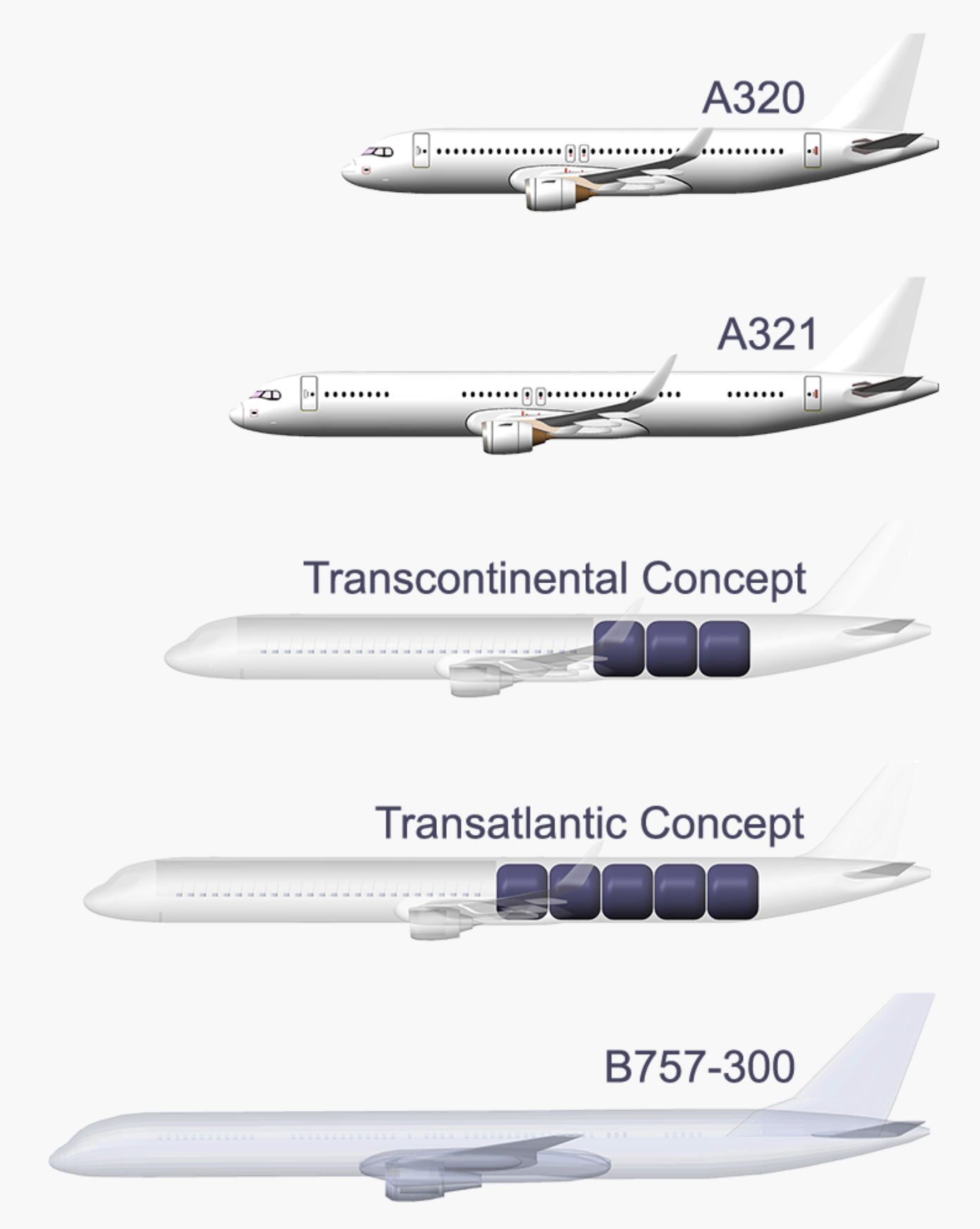
Universal Hydrogen are proposing that Airbus stretch the A321, so that hydrogen capsules can be fitted in the rear of the fuselage, so that the aircraft has similar proportions to the Boeing 757.
Read the full text on the Product page of the Universal Hydrogen web site.
I can see that if they could prove the concept with the Regional Airliner, they could develop the two concepts shown in the graphic.
Conclusion
This is a simple, but very exciting project.
Flybe Appears To Be On The Way Back
I was alerted to the relaunch of the Flybe airline being a serious proposition by this article on the Birmingham Mail, which is entitled Watch As First Of 32 New Flybe Planes Lands At Birmingham Airport.
These are the first two paragraphs.
The first of Flybe’s more eco-friendly planes has landed in Birmingham ready for the launch of the airline’s new city HQ.
Part of a planned 32-aircraft fleet, the De Havilland Canada Dash 8-400 turboprop touched down on the runway at Birmingham Airport on Friday.
The new Flybe will be based at Birmingham Airport and will have a fleet consisting of thirty-two De Havilland Canada Dash 8-400 aircraft.
The De Havilland Canada Dash 8-400
Note these facts about the aircraft.
- According to Wikipedia, 645 aircraft have been ordered, with 587 having been delivered.
- Different variants can handle between 40 and 80 passengers.
- All aircraft delivered since 1996 are dubbed Q-Series and have active noise and vibration suppression, which is designed to improve the cabin ambience.
- A Dash 8-400 is also called a Q400.
But the most interesting development of the Dash 8 aircraft, is that developments are underway, so that the aircraft will be able to be powered by hydrogen.
Universal Hydrogen And A Hydrogen-Powered Q400
This article on Future Flight is entitled Universal Assembles Hydrogen Aircraft Conversion Team In Washington State.
This is the first two paragraphs.
Universal Hydrogen and its hydrogen fuel cell partner Plug Power are joining forces with electric motor specialists MagniX and AeroTec to set up a Hydrogen Aviation Test and Service Center at Grant County International Airport in Moses Lake, Washington. The partners will use the new facility to convert a Dash 8 regional airliner to hydrogen propulsion in time to start commercial operations in 2025. Flight testing is due to begin in 2022.
The new hydrogen powertrain will consist of an electric propulsion unit (EPU) developed by MagniX and fuel cells provided by Plug Power, which has extensive experience converting trucks to hydrogen. Seattle-based AeroTec will take the lead on converting the Dash 8s to hydrogen propulsion, conducting flight tests, and arranging for certification under FAA supplemental type certificates. The system installation work will be conducted at the Moses Lake facility.
This paragraph gives details of the design.
The hydrogen-powered Dash 8 aircraft, which carry between 41 and 60 passengers, will be able to operate on routes of up to around 625 miles. Universal Hydrogen’s plan calls for the fuel to be delivered directly to aircraft in capsules that are installed in a compartment at the rear of the fuselage.
These are my thoughts on the design.
Power Required
Wikipedia says this about the engines of the Dash 8-400 (Q400).
The Series 400 uses Pratt & Whitney Canada PW150A engines rated at 4,850 shp (3,620 kW).
This means that the aircraft will need fuel cells capable of delivering over 7 MW.
This data sheet on the Plug Power web site, says that the company has fuel cells up to 125 KW, which weigh 350 Kg and need a cooling module, that weighs a further 103 Kg. Scaling up shows the power unit could weigh around 25.4 tonnes.
As the maximum take-off weight of a Q400 is around 30.5 tonnes, this wouldn’t leave much weight for the airframe, the two electric motors and propellers, the hydrogen and the passengers and their luggage.
It would appear that Plug Power must be using some form of lighter-weight fuel cell.
Or could they be using an appropriately-sized gas turbine generator from Pratt & Whitney Canada?
It should be noted that a Pratt & Whitney Canada PW150A engine, weighs under a tonne and generates over 3.5 MW.
Obviously, they wouldn’t be developing the plane, if they hadn’t figured out how to generate enough electricity to get it off the ground.
The Hydrogen Capsules
The Product page on the Universal Hydrogen web site is revealing.
This paragraph from the Product page describes how they would convert Regional Aircraft to Hydrogen.
Our first product is a conversion kit for existing regional aircraft, starting with the ATR72 and the De Havilland Canada Dash-8, to fly on hydrogen. This consists of a fuel cell electric powertrain that replaces the existing turboprop engines. It also accommodates, in the rear of the fuselage, our proprietary, lightweight, modular hydrogen capsules that are transported from green hydrogen production sites to the airport and loaded directly into the aircraft using the existing intermodal freight network and cargo handling equipment. By providing both an aircraft conversion solution for the existing fleet and a fuel services offering directly to regional airlines, we will be in passenger service with zero emissions by 2025 and in cargo service shortly thereafter.
Note.
- The cutaway on the Product page of a De Havilland Canada Dash-8, which has three capsules in the rear fuselage.
- The cutaway shows forty seats in the aircraft.
- If you scroll the pictures, you’ll see the design of the capsule.
- The product can be used to convert two regional airliners both of which are in production.
- Airports will need no new infrastructure to handle the hydrogen.
Universal Hydrogen has also signed a deal with Fortescue Future Industries to supply green hydrogen to fill the capsules.
Are A First Flight In 2022 And An in-Service Date Of 2025 Over Ambitious?
The article in Future Flight says this.
AeroTec will take the lead on converting the Dash 8s to hydrogen propulsion, conducting flight tests, and arranging for certification under FAA supplemental type certificates.
FAA Supplemental Type Certificates are outlined on this page on the FAA web site, where this introductory paragraph is given.
A supplemental type certificate (STC) is a type certificate (TC) issued when an applicant has received FAA approval to modify an aeronautical product from its original design. The STC, which incorporates by reference the related TC, approves not only the modification but also how that modification affects the original design.
They are a much-used and well-proven method to update aircraft for new purposes and new power units.
I suspect that going this route will enable Q400 and ATR 72 aircraft will be flying on hydrogen by 2025.
How Far Will A Range Of 625 Miles Take The Plane From Birmingham?
I have used the Air Miles Calculator to calculate distances in miles from Birmingham.
- Amsterdam Schiphol – 276
- Barcelona – 791
- Belfast City 225
- Berlin Schönefeld – 644
- Biarritz – 621
- Bilbao – 635
- Bordeaux – 529
- Cologne – 397
- Copenhagen – 624
- Cork – 290
- Dublin – 200
- Dusseldorf – 373
- Edinburgh – 251
- Frankfurt – 452
- Geneva – 556
- Glasgow – 260
- Hamburg – 495
- Inverness – 364
- Jersey – 225
- Kirkwall – 474
- Lerwick – 536
- Lyon – 558
- Munich – 660
- Newcastle – 179
- Newquay – 198
- Nice – 735
- Oslo – 726
- Paris-Charles de Gaulle – 303
- Paris-Orly – 315
- Rotterdam – 265
- Strasbourg – 494
Note.
- It might be possible to serve some routes without refuelling at the other end.
- Some routes could be paired for efficiency and still be well below 600 miles.
- The large intercontinental airports of Amsterdam Schiphol, Frankfurt and Paris-Charles de Gaulle should be reached easily.
- Amsterdam Schiphol Airport has a well-connected railway station.
- Paris-Charles de Gaulle Airport has a TGV station.
- Frankfurt Airport has a long distance railway station on the Cologne-Frankfurt high speed line.
- If you’re flying to the South of France or Switzerland, it looks like flying from London City Airport is about a hundred miles shorter.
It would appear that the range of 625 miles could be very useful, especially if you use a long distance train at both ends of the flight.
I can certainly understand why Flybe has chosen Birmingham as its main base.
Will Flybe Convert Their Aircraft To Hydrogen?
This is obviously up to the company, but if they don’t, someone else will and Flybe will lose their regional market in the UK.
Conclusion
I think those behind the new Flybe could be looking to create the UK’s first zero-carbon airline.
BP Plans To Turn Teesside Into First Green Hydrogen Hub
The title of this post, is the same as that of this article in The Times.
This is the first paragraph.
BP plans to build Britain’s biggest “green hydrogen” facility on Teesside to produce the clean fuel for use in new hydrogen-powered lorries and other transport.
Note.
The plans appear to be ambitious starting with a £100 million investment to build a 60 MW electrolyser by 2025, which would rise to as much as 500 MW by 2030.
The electrolyser will be paired with an upwards of a billion pound one gigawatt facility called H2Teesside, that will produce blue hydrogen.
I think there could be more to this than meets the eye.
Using The Carbon Dioxide Rather than Storing It!
I followed the carbon dioxide pipe from the CF fertiliser plant on Teesside using Google maps after seeing a film about it on the BBC. It goes to the Quorn factory and a massive greenhouse. I do wonder, if BP is talking to other companies, who also have a need for large quantities of good quality carbon dioxide.
One could be an Australian company, called Mineral Carbonation International, who have developed a process to convert carbon dioxide into building products like blocks and plasterboard. MCI won a prize at COP26, so could BP be looking at integrating one of these plants into their complex on Teesside?
The Electrolysers
Will BP be purchasing their electrolysers for green hydrogen from ITM Power in Sheffield?
This press release from ITM Power is entitled 12MW Electrolyser Sale.
The customer is not named, but could this be a starter kit for BP?
Alstom’s Hydrogen Aventras
In Alstom And Eversholt Rail Sign An Agreement For The UK’s First Ever Brand-New Hydrogen Train Fleet, I came to this conclusion.
This modern hydrogen train from Alstom is what is needed.
I also felt there could be three similar trains; electric, battery-electric and hydrogen, which would help operators hedge their bets on what type of traction to use.
Teesside must be one of the more likelier places where the Hydrogen Aventras will be carrying passengers.
I wrote about this possibility in Alstom Hydrogen Aventras And Teesside.
A deal between BP and Alstom would surely be in the interest of both companies.
- Alstom would get a local hydrogen supply.
- BP would get a first sale.
- BP would get excellent publicity and a local demonstration of the possibilities of hydrogen.
It might even be possible to supply the hydrogen by pipeline.
KEPSA Signs Large-Scale Green Energy Projects MoU In Kenya
The title of this post, is the same as that of this article on ESI Africa.
This is the first paragraph.
The Kenya Private Sector Alliance (KEPSA) has signed a Memorandum of Understanding (MoU) with green energy company Fortescue Future Industries (FFI) to help facilitate its members participation in new large scale green energy projects in Kenya.
FFI are planning a possible green hydrogen and green ammonia facility in the country, that will use renewable energy.
Andrew Forrest is building up the air miles again.
Fortescue Unveils Green Investment Framework
The title of this post, is the same as that of this article on Mining Weekly.
This is the first paragraph.
Iron-ore major Fortescue Metals this week launched its Sustainability Financing Framework, enabling the future issuance of green and social debt instruments that will support investments in eligible green and social projects.
I have to admit, that I thought something like this might happen, after seeing all the Fortescue Future Industries publicity on a bus, which I wrote about in Green Hydrogen Can Save Us. But Waiting For It Won’t.
I did say this in that post.
Andrew Forrest is intending to get his message across to the City.
But I didn’t take any action.
I can see other companies and investment trusts following Andrew Forrest’s lead.
Fortescue Future Industries Acquires Xergy Assets To Develop Hydrogen Tech Company
The title of this post, is the same as that of this article on Stockhead.
These are the first two paragraphs.
Andrew Forrest’s Fortescue Future Industries (FFI) has made yet another bold move in the ‘green-energy’ space with the acquisition of Xergy Inc and Xergy One Ltd’s commercial assets to form a new, wholly owned subsidiary called FFI Ionix Inc.
Poised to operate in the United States, FFI Ionix will function as a technology development company focused on the global commercialisation of hydrogen technologies such as ion exchange membranes for water electrolysis, electrochemical compression, water transmission and fuel cells.
It certainly appears that Andrew Forrest is building a company to handle all aspects of the production and use of green hydrogen.
He has signed deals with Argentina, JCB and Jordan.
He has been at COP26.
He is advertising on London’s taxis and at least one bus!
He has been interviewed by The Times.
I await Mr. Forrest’s next green hydrogen deal with interest.
Blue Hydrogen Is Not Clean Energy, Says Mining Tycoon
The title of this post, is the same as that of this article on The Times.
This is the first paragraph.
Producing “blue hydrogen” from natural gas is not a clean energy source and is being wrongly promoted as one by the oil and gas industry, a billionaire mining mogul has claimed.
The mining mogul is Andrew Forrest, who is the second richest person in Australia.
I feel he is only partly right, as there are processes coming through that use a catalyst to split the hydrogen from the carbon.
But like the taxi in the picture at the top of the article with Mr. Forrest, his words are all good publicity.
Incidentally, I do believe that in a few years, we’ll have the technology to use so much carbon dioxide efficiently, that we may see gas-fired power stations used to create both energy and carbon dioxide.
 The Anonymous Widower