The Ultimate Open Access Service
London and Windermere are 223 miles away by train with a single change at Oxenholme Lake District.
In a straight line the distance between Amsterdam and Hamburg is 227 miles.
I’ve done both journeys by train and the continental journey was a pain.
- In From Amsterdam To Hamburg The Hard Way, I describe a typical journey between the two cities.
- In From Hamburg To Osnabruck By Train, I describe how I only got halfway.
I’ve also tried splitting the route at Groningen.
- The first leg was a train to Groningen, where I spent the night.
- I spent the second day exploring and wrote about my experiences in The Train Station At The Northern End Of The Netherlands.
- On the third day, I started by going between Groningen and Leer in Germany.
- This section of the route at present is under repair after a ship destroyed the swing bridge over the River Ems.
- I describe its rebuilding in From Groningen To Leer By Train.
Once at Leer, you’re on the German main line and the route is electrified all the way to Bremen and Hamburg.
I believe that the route would be within the scope of a battery-electric high speed train, such as both Hitachi and Siemens are developing.
Some thoughts on the route.
The Competition
The trains need a change at Osnabruck to go between Amsterdam and Hamburg.
I suspect many travellers fly, as there are thirty-nine flights per week.
The service could be better.
Why Would I Run It As An Open Access Route?
Consider.
- If what I have experienced on the current Amsterdam and Hamburg via Osnabruckservice, then surely an experienced open access operator using trains designed for the route could do much better.
- This service could be run almost as a shuttle between two terminal stations. Several open access services like Hull Trains, Lumo and Grand Central are run this way.
- If a government service fails, governments get the blame, but if an open access service fails, the government gets no blame.
So would some governments, prefer open access operators to take the risk?
Would Any New Infrastructure Be Needed?
Very little if any!
Although, I do feel, that some of the level crossings and bridges could be improved or removed.
Where Is The Route Not Electrified?
The section without electrification is at the Dutch end.
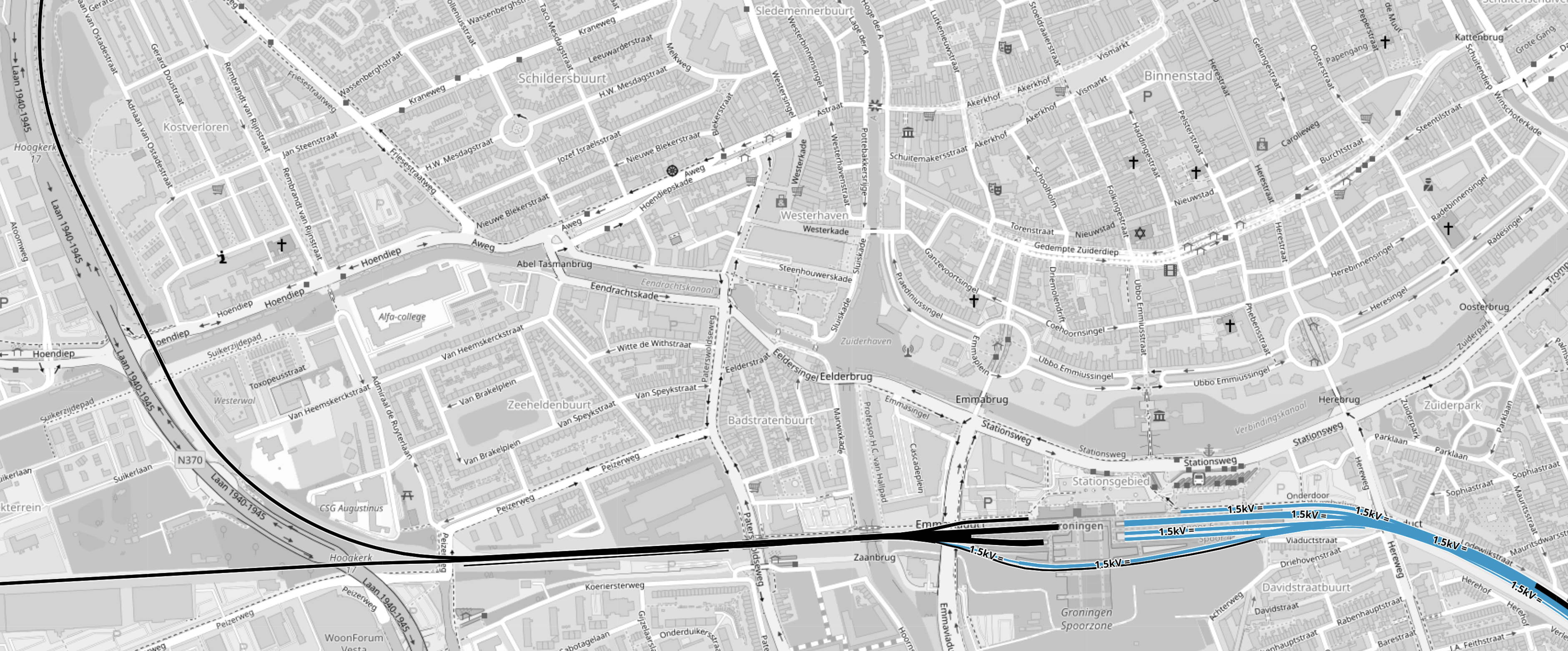
This OpenRailwayMap shows the lines around Groningen station.
Note.
- Lines in black are not electrified.
- Lines in blue are electrified at 1.5 KVDC overhead.
- The mass of blue lines is Groningen station.
- Hamburg is to the East.
- Eemshaven us to the North.
- Harbinger is to the West.
Amsterdam trains use the electrified lines to the East.
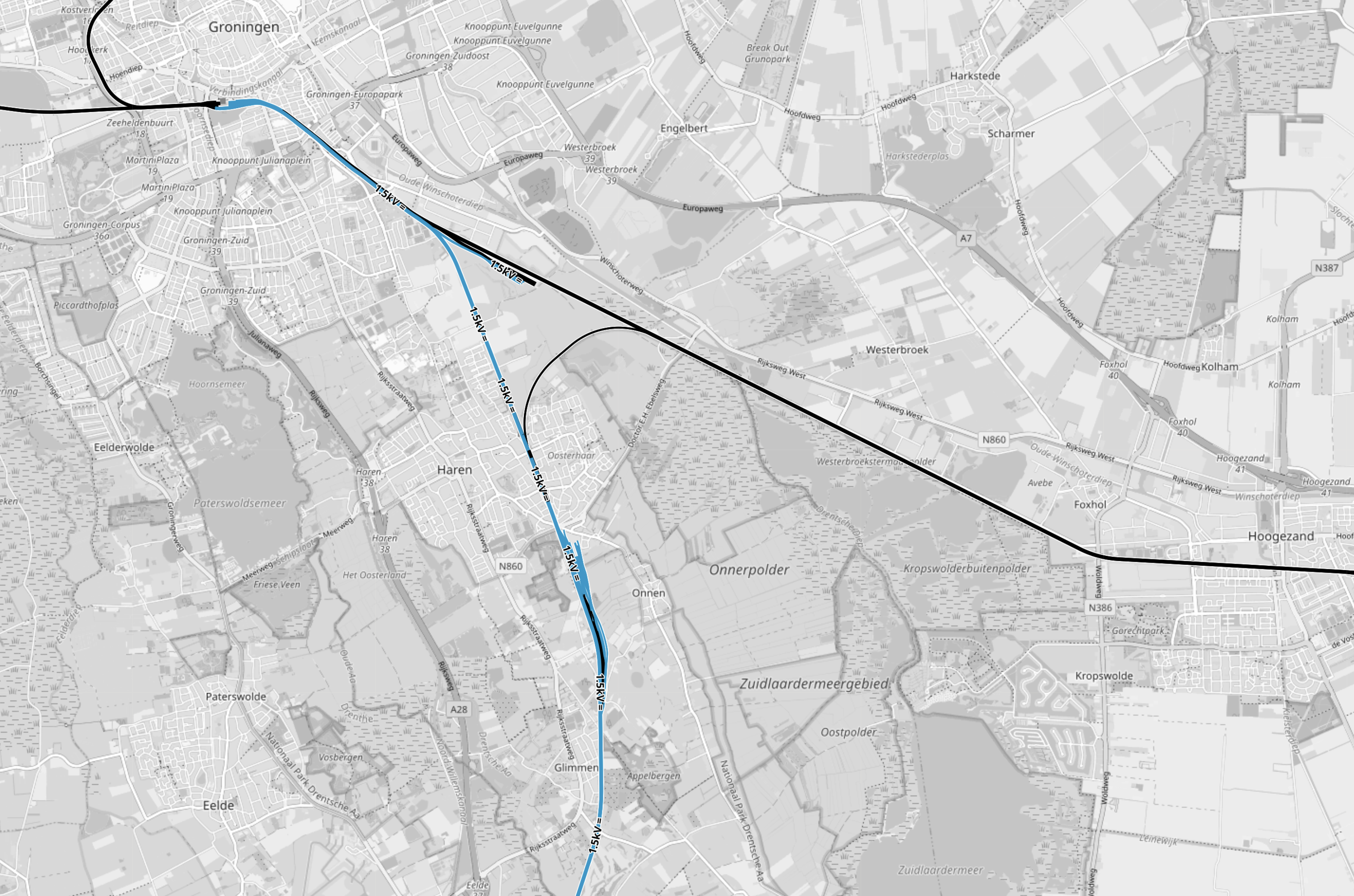
This second OpenRailwayMap shows a wider view of the lines around Groningen.
Note.
- Lines in black are not electrified.
- Lines in blue are electrified at 1.5 KVDC overhead.
- Groningen is in the North-West corner of the map.
- Trains between Groningen and Amsterdam use the electrified line to the South via Zwolle.
- Trains between Groningen and Bremen and Hamburg use the unelectrified line to the East.
- There is a single track chord, that would allow trains to go between Amsterdam and Germany.
I suspect that a battery-electric high speed train could be fully recharged before leaving Groningen for Germany.
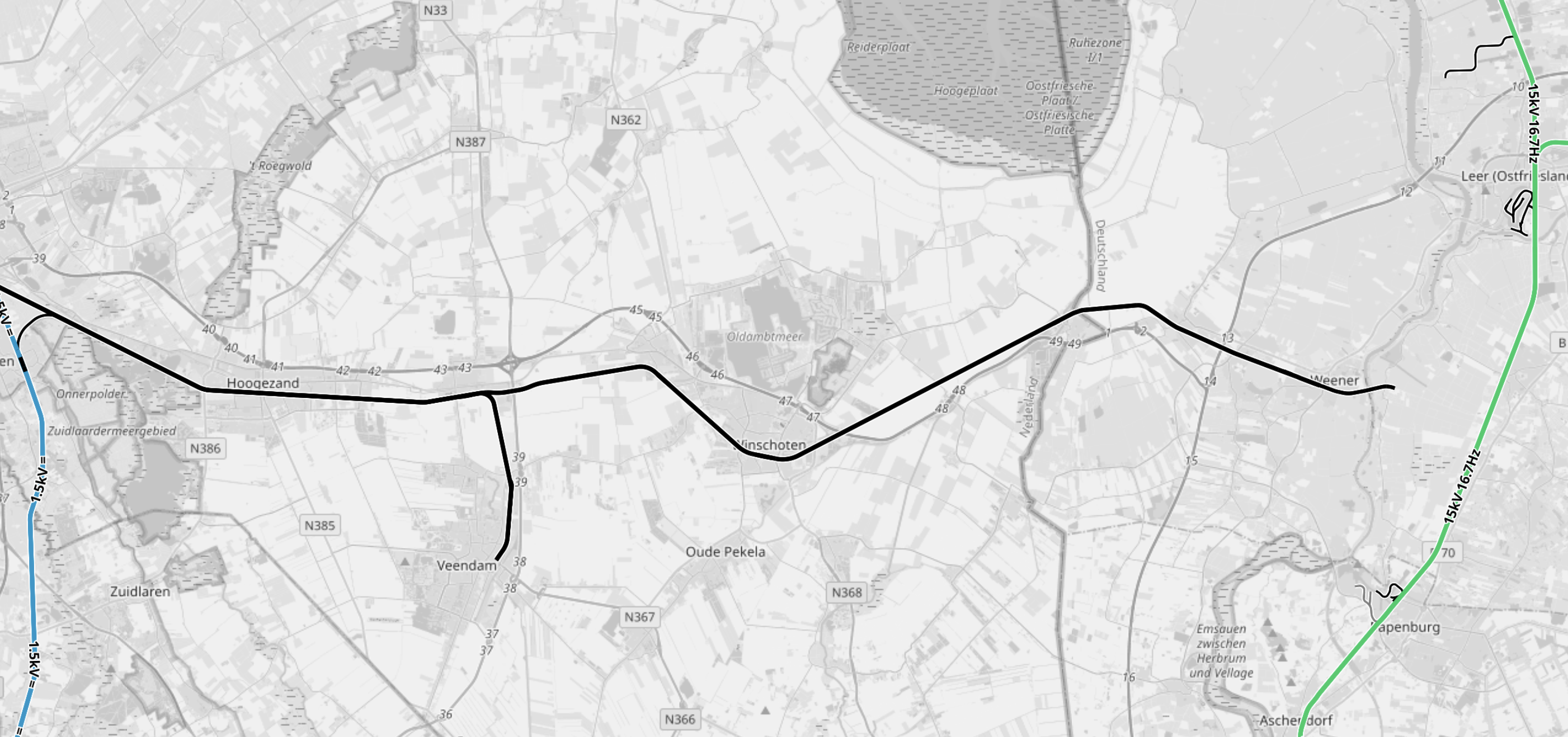
This third OpenRailwayMap shows between the chord to the East of Groningen and the German railway system at Leer.
Note.
- Lines in black are not electrified.
- Lines in blue are electrified at 1.5 KVDC overhead.
- Lines in green are electrified at 15 KVAC overhead.
- Groningen is off the Western side of the map.
- The chord connecting the Amsterdam and German lines from Groningen can be picked out.
- The unelectrified line East from Groningen seems to end in the middle of nowhere.
- The green lines in the East of the map are the electrified German railway system.
- Leer station, which is indicated by the tangle of lines in the North-East cornet of the map, has services to Bremen and Hamburg.
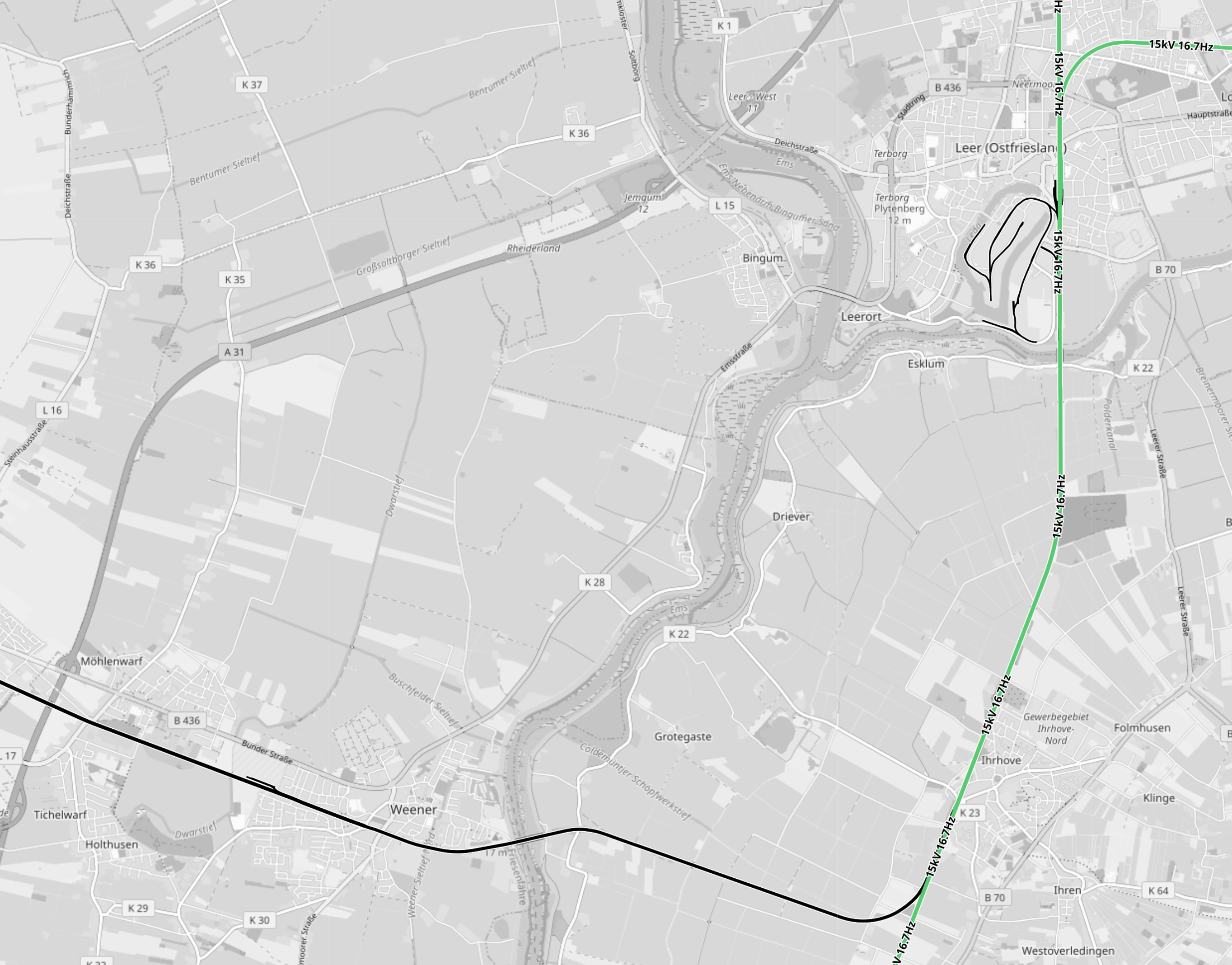
This forth OpenRailwayMap shows the Dutch and German railways at Leer.
Note.
- Lines in black are not electrified.
- Lines in green are electrified at 15 KVAC overhead.
- Leer station is in the North-East corner of the map.
- The green lines in the East of the map are the electrified German railway system.
- The River Ems runs down the middle of the map.
The unelectrified line East from Groningen seems to link up with the German railway system.
It used to link up until a German freighter called the Emsmoon demolished the Freisenbrücke over the River Ems.
In From Groningen To Leer By Train, I link to two videos and give the history of the accident.
The Freisenbrücke should be rebuilt in the next few months.
It looks like less than fifty miles of the route between Groningen and Leer is not electrified.
As all the other sections of Amsterdam and Hamburg are electrified, a battery-electric train with a range of less than fifty miles would be needed,
But the train would need to be compatible with both the Dutch and German electrification systems.
What Mode Of Trains Would Be Needed?
Trains would need three methods of operation.
- Using 15 KVAC overhead.
- Using 1.5 KVDC overhead.
- On battery power.
Batteries would be charged using regenerative braking or overhead wires, where they exist.
Lumo’s recently ordered Hitachi trains will probably work the same way.
Conclusion
This could be an open access service that could work.
Europe’s Next High-Speed Train Operator
I was alerted to Heuro Train, by this article in Railway Gazette International, which has this opening paragraph.
A proposal to launch high speed train services from Amsterdam to London and from Groningen to Paris has been announced by Dutch start-up Heuro, while Virgin founder Sir Richard Branson is also reported to be looking at competing with Eurostar on cross-Channel routes.
The Heuro Train web site was easily found and the title of this post, was part of their mission statement on the home page.
I have read the web site and have a few initial thoughts.
Technology-Driven Excellence
This is their first sub heading and this is the text.
In a world where technology defines possibilities, Heuro develops the latest innovations into every aspect of our service. From advanced train systems to intuitive in-seat features that cater to your needs, our technology is the driving force behind a seamless, state-of-the-art travel experience.
We’ve all written things like that in the past.
Meeting The Human Need
This is their second sub heading and this is the text.
Heuro emerged from human desires, informed by analyses from Marveltest.
There’s been a 32% annual increase in online interest for train travel over five years. High-Speed Trains are 98% full at peak times. Over half of Europeans prefer train travel under 2 hours as a greener option. Introducing High-Speed Operators in train monopolies boosts demand by 45%.
They appear to have done their research and those are interesting figures.
Lightning Speed Connectivity
This is their third sub heading and this is the text.
In our digital age, both work and leisure have found a substantial home on the internet for urban humans. Whether sealing a business deal, streaming a favorite show, or connecting with loved ones, online interactions have become integral to our daily lives. At Heuro, we don’t just commit—we guarantee the best internet experience.
This is actually irrelevant these days, as there will be a high standard of Internet experience on all modes of transport in a few years, although some will get it earlier than others.
Planned Routes
This is their sixth sub heading and this is the text.
We will connect Amsterdam with Brussels, Paris, and London with intermediate stops at Schiphol Airport, Rotterdam Central, Antwerp Central & complimentary services to Groningen, Assen, Zwolle and Almere (continuing to Paris, 2 times per day)
This route map is shown.
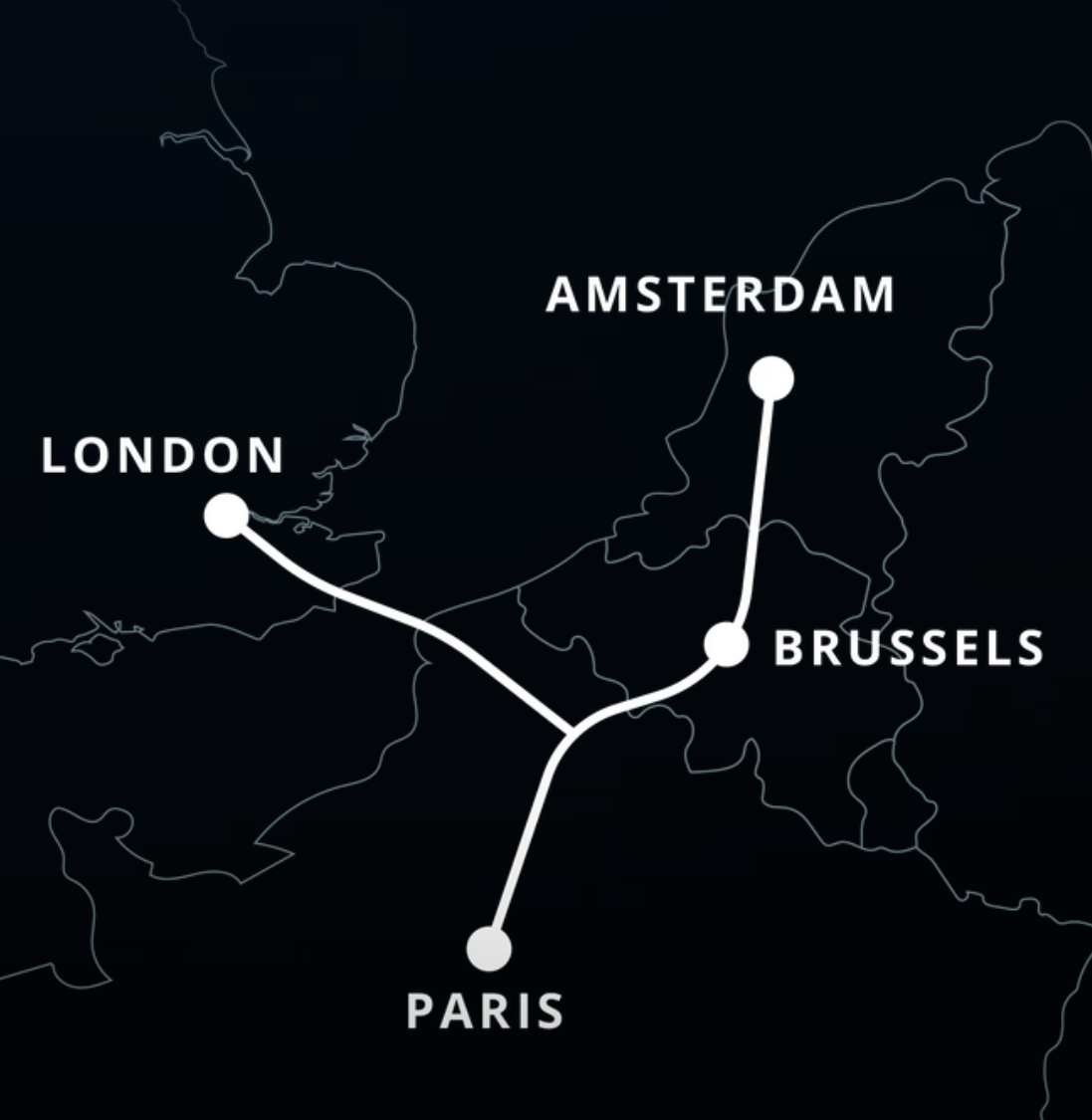
Note.
- It is not a large network.
- It makes a lot of use of the Dutch high speed line; HSL-Zuid, that runs between Amsterdam and the Belgian border.
- I suspect it has been designed to be extended.
The Railway Gazette Article has these two paragraphs, which give more information on services and Heuro’s thinking.
On November 15 Heuro told Railway Gazette International that it aims to launch in 2028, offering 16 Amsterdam – Paris and 15 Amsterdam – London trains each day with intermediate stops at Schiphol Airport, Rotterdam Centraal, Antwerpen Centraal and Brussels. Two of the Paris trains would run to and from Groningen via Assen, Zwolle and Almere.
The company said ‘every day, 55 planes fly from Amsterdam to London, while only four trains make this journey. Heuro intends to change that, aiming for more trains to depart from Amsterdam than flights’.
With other train companies wanting to serve London, will St. Pancras International be able to incorporate another fifteen trains per day from Amsterdam?
Web Site Language
Everything is in English! It also appears to be English English.
Les français ne seront pas amusés.
Extensions From London
Much of Central and Eastern England, and Eastern Scotland can be reached from St. Pancras International station, by a hundred metre walk to change platforms.
There is even a signed walking route between St. Pancras International and Euston stations, that isn’t the most arduous of walks.
The St. Pancras International and Euston stations connection could also be handled by a frequent electric shuttle bus.
Extensions From Amsterdam
Heuro are already indicating their intention to extend to Almere, Zwolle, Assen and Groningen.
I have taken that route and extended it via Leer, Oldenburg and Bremen to Hamburg.
Could this be in Heuro’s long term thinking?
Extensions From Paris
The French probably have ideas.
Conclusion
I like Heuro’s philosophy and starter kit.
German Police Probe ‘Political Motive’ In Railway Fires
The title of this post, is the same as that of this article on DW.com.
This is the sub-heading.
A series of fires hit rail infrastructure on the main line between Hamburg and Berlin overnight, leading to widespread train disruptions. Police say they suspect a politically motivated act of sabotage.
This is the first two paragraphs.
German police are investigating a suspected political motive behind an alleged act of sabotage targeting a major train route connecting the port city of Hamburg to the capital, Berlin.
Fire broke out overnight at three locations in the northern Hamburg region, affecting shafts holding railway cables.
This paragraph describes a claim for responsibility.
An anonymous letter published on the far-left website Indymedia claimed responsibility for the incident, describing it as an act of “sabotage.” The letter said it was a protest against “neo-colonial exploitation and earth destroying extraction of raw materials.”
I don’t think we want anything like this in the UK.
Hydrogen Trains Are To Roll Between Stade And Bremervörde
The title of this post is the same as part of the title of this article on Hydrogen Central.
The original title mentions Switzerland, but Bremervörde is in Germany to the North-West of Hamburg.
This map from OpenRailwayMap shows the route.
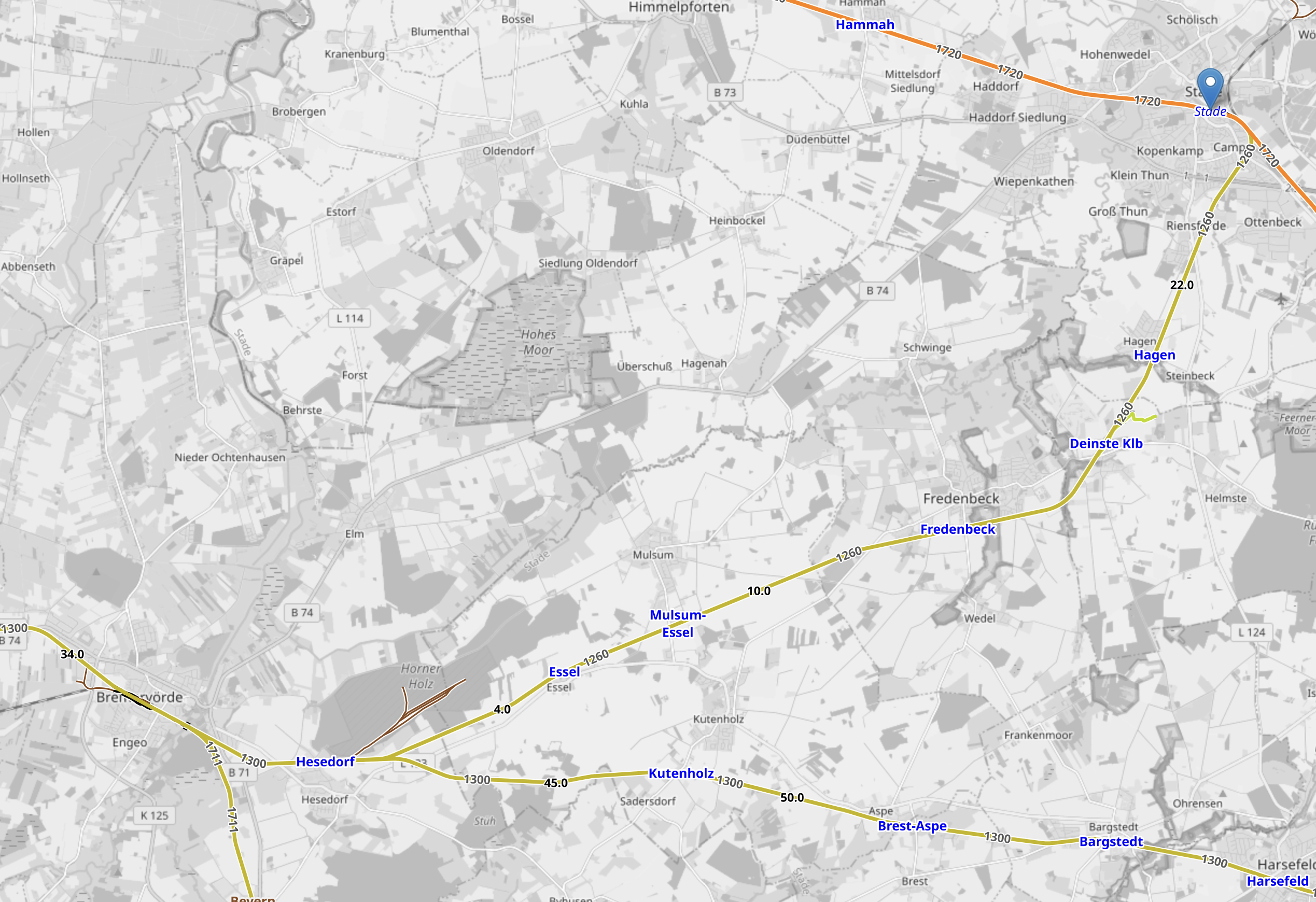
Note.
- Stade is in the North-East corner of the map and marked with a blue arrow.
- Stade station is on the Hamburg S-Bahn and has an hourly fast train between Hamburg and Cuxhaven.
- Bremervörde is in the South-West corner of the map, where the various routes converge.
- Bremervörde station is on the Buxtehude-Cuxhaven Line which is run by the hydrogen-powered Alstom Coradia iLint trains.
- Bremervörde appears to be, where the hydrogen-powered trains are serviced and refuelled.
- Currently, there are no passenger trains between Stade and Bremervörde, except at the weekends, when a heritage service called the Moor Express runs between Bremen Hauptbahnhof and Stade via Bremervörde.
- Freight trains also operate between Stade and Bremervörde.
At first sight it looks like the Stade and Bremervörde route, could be an ideal one to run with hydrogen-powered iLint trains.
- Servicing and refuelling of the trains could be shared with the existing Buxtehude-Cuxhaven service.
- The new service would probably need a few extra identical trains.
- The track is already in use, so probably wouldn’t need too much work.
- As some of the stations are in use by the Moor Express, there may not need to be too much work to bring them up to the required standard.
This re-opening, illustrates the advantage of having a fully-certified, independently-powered train, that can be deployed on non-electrified lines.
BP To Open Offshore Wind Office In Germany, Starts Recruitment Drive
The title of this post, is the same as that of this article on offshoreWIND.biz.
This is the first paragraph, which adds a bit more information.
Global energy major bp plans to open an office in Hamburg, Germany dedicated to the development of offshore wind projects and is in the process of seeking employees for the new office.
These are other points from the article.
- The topic of wind power is being promoted particularly in Hamburg.
- BP said that the company has already achieved a number of milestones in the field of wind energy.
- In cooperation with EnBW, bp is currently developing several wind farms in the Irish and Scottish Seas.
- Similar plans already exist for the Netherlands.
- The energy major would also like to supply charging stations for electric vehicles with green electricity.
- In Germany, wind and solar energy should account for 80 per cent of electricity generation by 2030, compared to today’s 42 per cent.
- Offshore wind energy is planned to grow seven times by 2045.
I believe that BP’s project expertise and management, backed by billions of German euros could be a complimentary dream team.
Alstom’s Coradia iLint Successfully Travels 1,175 km Without Refueling Its Hydrogen Tank
The title of this post, is the same as that of this press release from Alstom.
This paragraph describes the trip.
Alstom, global leader in smart and sustainable mobility, has demonstrated the effectiveness of its hydrogen powered solutions for long distance transportation. During a long-distance journey, an unmodified serially-produced Coradia iLint train covered 1,175 kilometres without refuelling the hydrogen tank, only emitting water and operating with very low levels of noise. The vehicle used for this journey comes from the fleet belonging to LNVG (Landesnahverkehrsgesellschaft Niedersachsen), the transport authority of Lower Saxony, and has been in regular passenger operation on the network of evb (Eisenbahnen und Verkehrsbetriebe Elbe-Weser GmbH) since mid-August. For the project, Alstom also partnered with the gas and engineering company Linde.
The distance is around 730 miles.
This paragraph describes the detailed route.
Starting in Bremervörde, the route took the Coradia iLint across Germany. From Lower Saxony, where the hydrogen train was built and developed by Alstom, it travelled through Hesse to Bavaria, all the way to Burghausen near the German-Austrian border before coming to a stop in Munich. Following this remarkable journey, the train will now head for the German capital. Several trips through Berlin are on the agenda as part of InnoTrans 2022, the premier International Trade Fair for Transport Technology, to be held from 20 to 23 September.
It looks to be a good test of a hydrogen-powered train.
It looks like Alstom believe that hydrogen trains can replace diesel ones, providing there is a source of hydrogen.
Exploring Germany Under The Latest Travel Rules
Because of the lack of travel brought about by the Covids, I’ve built up a list of places that I want to visit in Germany.
- Hamburg to see the Siemens Gamesa ETES energy storage and see how the Alstom Coradia iLint hydrogen train is getting on.
- Karlsruhe to see the newly-opened tram-tunnel in the city.
- Stuttgart to see how the construction work for Stuttgart 21 is faring and Alstom’s new battery trains.
- The Lake Constance Belt Railway.
The latest rules mean that travelling back to the UK is easy, so if I chose a route that allowed me to visit all the places I want from say a hotel in somewhere worth visiting like Stuttgart, would it be possible to book an appropriate stay there as a package?
Would this mean all the paperwork going to Germany would be handled by someone else, so if a mistake was made, it’s not my fault?
Bang Goes My Holiday!
There are various things I want to visit in Germany and I felt that the best thing to do would be go for a few days,
But the BBC are reporting these facts about travel to Germany.
- From Sunday, people travelling from the UK will not be allowed to enter Germany
- The decision is down to a rise in cases of the Indian variant in the UK
- German citizens and residents, plus people with an exceptional reason, can still enter – but face a two-week quarantine
So bang goes my holiday!
I particularly wanted to go to Hamburg to take a few pictures of the Siemens Gamesa ETES trial installation in the city.
However I’ve been able to locate the installation on Google Maps.
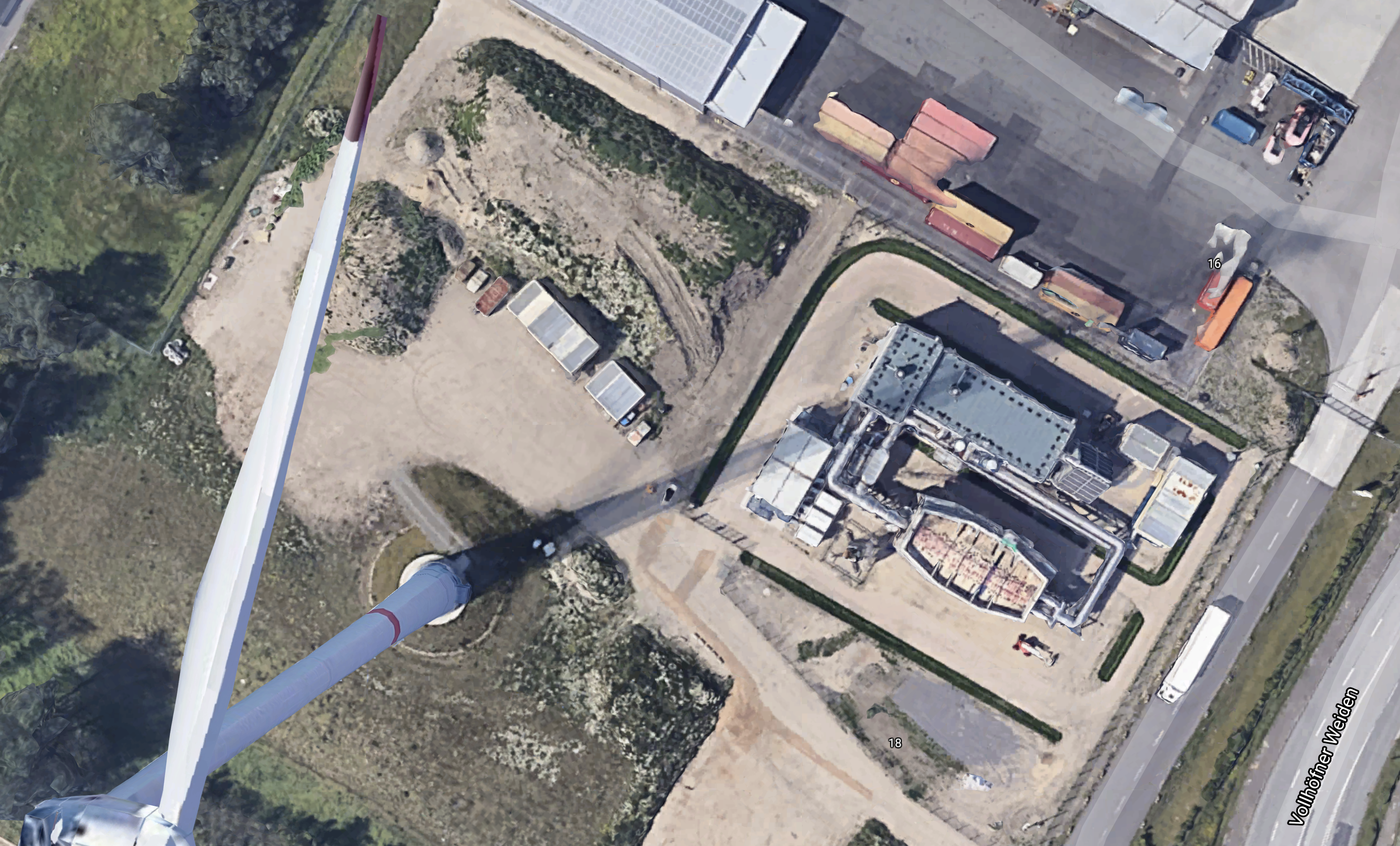
Note.
- The wind-turbine towards the South-West corner of the map.
- Siemens Gamesa ETES trial installation is the prominent odd shaped building towards the South-East corner of the map, just below the shadow of the turbine.
- The installation seems to have lots of pipes connected to it.
This second map shows the installation from an angle.
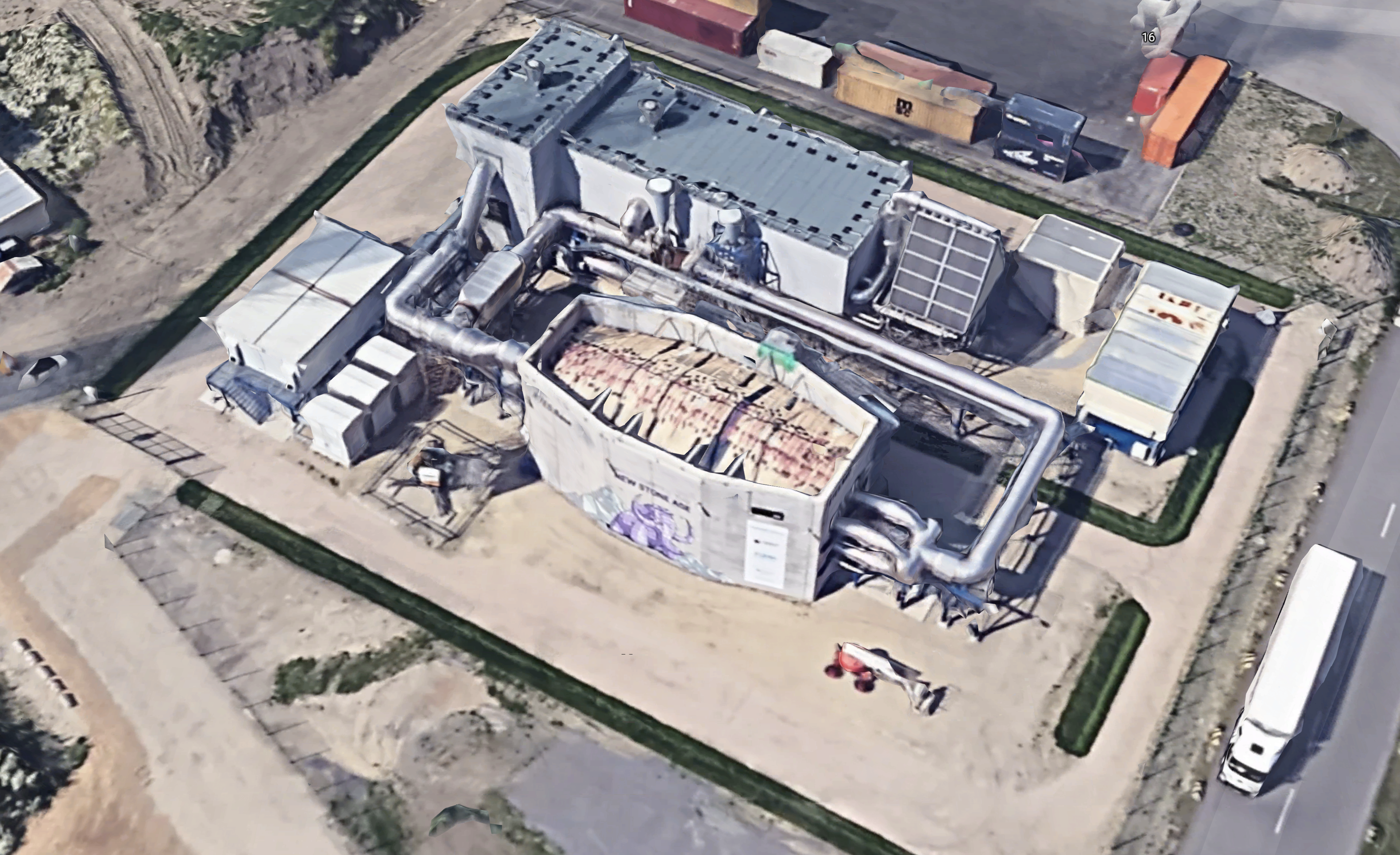
This document on the Siemens Gamesa web site describes the installation.
- The nominal power is 30 MW.
- The capacity is 130 MWh.
- 80 % of the technology is off the shelf.
The picture on the front says “Welcome To The New Stone Age”.
If anybody should find themselves in Hamburg with some time to waste, I’d be very grateful for a copyright-free image.
The installation appears to be just off the VollHöfner Weiden.
Hydrogen Ambitions For The Port Of Hamburg
The title of this post, is the same as that of this article on Seatrade Maritime News.
This is the introductory paragraph.
In January Hamburg announced that Vattenfall, Shell, Mitsubishi Heavy Industries (MHI) and municipal heat supplier Warme Hamburg had signed a Letter of Intent to develop a 100MW electrolyser to produce green hydrogen in the port area.
A few points from the article.
- Hamburg believes that ships will be running on green hydrogen.
- Buses and trucks will need the hydrogen.
- They may build a terminal to import green hydrogen, as the Japanese are doing at Kobe.
- The green hydrogen might be produced in places like Africa and Morocco.
100 MW strikes me as a large electrolyser.
 The Anonymous Widower