Could Norfolk And Suffolk Be Powered By Offshore Wind?
This week this article on the BBC was published, which had a title of Government Pledges £100m For Sizewell Nuclear Site.
These are the first three paragraphs.
The government is putting up £100m to support the planned Sizewell C nuclear plant in Suffolk, Business and Energy Secretary Kwasi Kwarteng has announced.
The investment marks the latest stage in efforts to build the £20bn reactor on the east coast of England.
However, it does not commit the government to approving the project, which is still subject to negotiations.
My view of the proposed Sizewell C nuclear plant is that of an engineer, who used to live within thirty minutes of the Sizewell site.
- Hinckley Point C power station, which is currently being constructed, will have a nameplate capacity of 3.26 GW.
- Sizewell C would probably be to a similar design and capacity to Hinckley Point C.
- Sizewell C would likely be completed between 2033-2036.
- Sizewell B is a 1250 MW station, which has a current closing date of 2035, that could be extended to 2055.
- East Anglia and particularly the mega Freeport East, that will develop to the South at the Ports of Felixstowe and Harwich will need more electricity.
- One of the needs of Freeport East will be a large supply of electricity to create hydrogen for the trains, trucks, ships and cargo handling equipment.
- Sizewell is a large site, with an excellent connection to the National Grid, that marches as a giant pair of overhead cables across the Suffolk countryside to Ipswich.
But.
- We still haven’t developed a comprehensive strategy for the management of nuclear waste in the UK. Like paying for the care of the elderly and road pricing, it is one of those problems, that successive governments have kept kicking down the road, as it is a big vote loser.
- I was involved writing project management software for forty years and the building of large nuclear power plants is littered with time and cost overruns.
- There wasn’t a labour problem with the building of Sizewell B, as engineers and workers were readily available. But with the development of Freeport East, I would be very surprised if Suffolk could provide enough labour for two mega-projects after Brexit.
- Nuclear power plants use a lot of steel and concrete. The production of these currently create a lot of carbon dioxide.
- There is also a large number of those objecting to the building of Sizewell C. It saddened me twenty-five years ago, that most of the most strident objectors, that I met, were second home owners, with no other connection to Suffolk.
The older I get, the more my experience says, that large nuclear power plants aren’t always a good idea.
Small Modular Nuclear Reactors
In Is Sizewell The Ideal Site For A Fleet Of Small Modular Nuclear Reactors?, I looked at building a fleet of small modular nuclear reactors at Sizewell, instead of Sizewell C.
I believe eight units would be needed in the fleet to produce the proposed 3.26 GW and advantages would include.
- Less land use.
- Less cost.
- Less need for scarce labour.
- Easier to finance.
- Manufacturing modules in a factory should improve quality.
- Electricity from the time of completion of unit 1.
But it would still be nuclear.
Wind In The Pipeline
Currently, these offshore wind farms around the East Anglian Coast are under construction, proposed or are in an exploratory phase.
- East Anglia One – 714 MW – 2021 – Finishing Construction
- East Anglia One North 800 MW – 2026 – Exploratory
- East Anglia Two – 900 MW – 2026 – Exploratory
- East Anglia Three – 1400 MW – 2026 – Exploratory
- Norfolk Vanguard – 1800 MW – Exploratory
- Norfolk Boreas – 1800 MW – Exploratory
- Sheringham Shoal/Dudgeon Extension – 719 MW – Exploratory
Note.
- The date is the possible final commissioning date.
- I have no commissioning dates for the last three wind farms.
- The East Anglia wind farms are all part of the East Anglia Array.
These total up to 8.13 GW, which is in excess of the combined capacity of Sizewell B and the proposed Sizewell C, which is only 4.51 GW.
As it is likely, that by 2033, which is the earliest date, that Sizewell C will be completed, that the East Anglia Array will be substantially completed, I suspect that East Anglia will not run out of electricity.
But I do feel that to be sure, EdF should try hard to get the twenty year extension to Sizewell B.
The East Anglia Hub
ScottishPower Renewables are developing the East Anglia Array and this page on their web site, describes the East Anglia Hub.
This is the opening paragraph.
ScottishPower Renewables is proposing to construct its future offshore windfarms, East Anglia THREE, East Anglia TWO and East Anglia ONE North, as a new ‘East Anglia Hub’.
Note.
- These three wind farms will have a total capacity of 3.1 GW.
- East Anglia ONE is already in operation.
- Power is brought ashore at Bawdsey between Felixstowe and Sizewell.
I would assume that East Anglia Hub and East Anglia ONE will use the same connection.
Norfolk Boreas and Norfolk Vanguard
These two wind farms will be to the East of Great Yarmouth.
This map from Vattenfall web site, shows the position of the two wind farms.
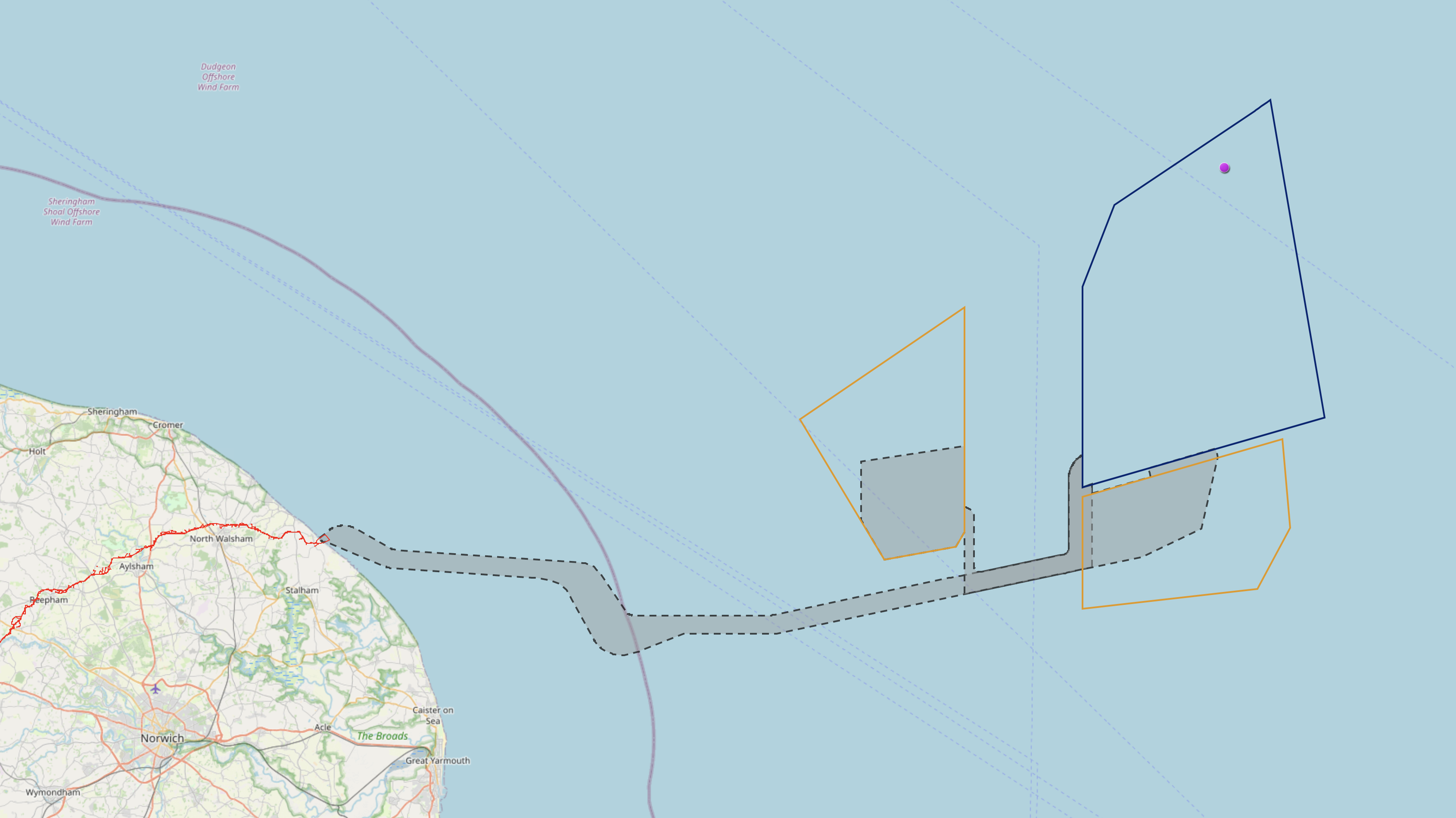
Note.
- Norfolk Boreas is outlined in blue.
- Norfolk Vanguard is outlined in orange.
- I assume the grey areas are where the cables will be laid.
- I estimate that the two farms are about fifty miles offshore.
This second map shows the landfall between Eccles-on-Sea and Happisburgh.
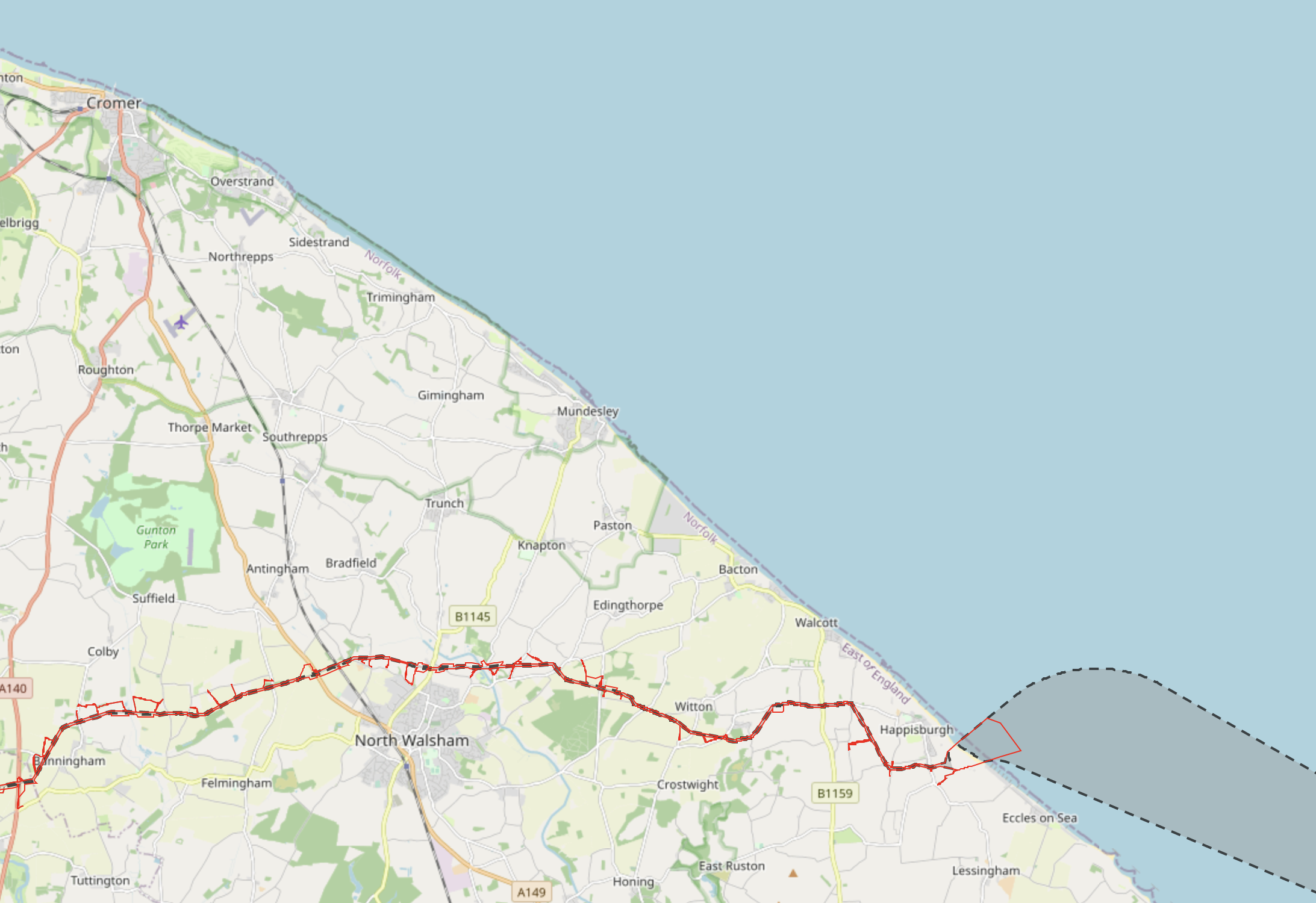
Note the underground cable goes half-way across Norfolk to Necton.
Electricity And Norfolk And Suffolk
This Google Map shows Norfolk and Suffolk.
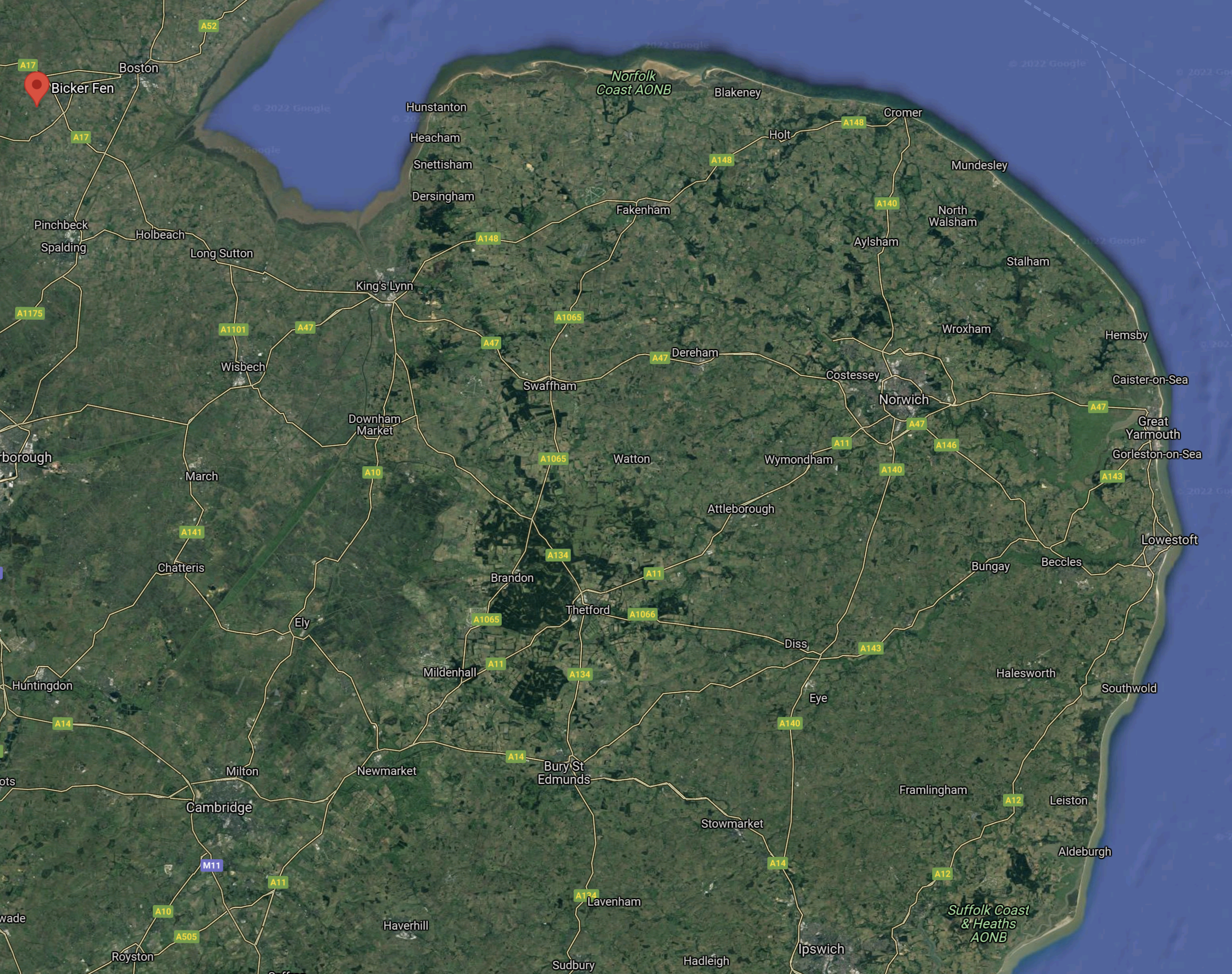
Note.
- The red arrow in the North-West corner marks the Bicker Fen substation that connects to the Viking Link to Denmark.
- The East Anglia Array connects to the grid at Bawdsey in the South-East corner of the map.
- Sizewell is South of Aldeburgh in the South-East corner of the map.
- The only ports are Lowestoft and Yarmouth in the East and Kings Lynn in the North-West.
There are few large towns or cities and little heavy industry.
- Electricity usage could be lower than the UK average.
- There are three small onshore wind farms in Norfolk and none in Suffolk.
- There is virtually no high ground suitable for pumped storage.
- There are lots of areas, where there are very few buildings to the square mile.
As I write this at around midday on a Saturday at the end of January, 49 % of electricity in Eastern England comes from wind, 20 % from nuclear and 8 % from solar. That last figure surprised me.
I believe that the wind developments I listed earlier could provide Norfolk and Suffolk with all the electricity they need.
The Use Of Batteries
Earlier, I talked of a maximum of over 7 GW of offshore wind around the cost of Norfolk and Suffolk, but there is still clear water in the sea to be filled between the existing and planned wind farms.
Batteries will become inevitable to smooth the gaps between the electricity produced and the electricity used.
Here are a few numbers.
- East Anglian Offshore Wind Capacity – 8 GW
- Off-Peak Hours – Midnight to 0700.
- Typical Capacity Factor Of A Windfarm – 20 % but improving.
- Overnight Electricity Produced at 20 % Capacity Factor – 11.2 GWh
- Sizewell B Output – 1.25 GW
- Proposed Sizewell C Output – 3.26 GW
- Largest Electrolyser – 24 MW
- World’s Largest Lithium-Ion Battery at Moss Landing – 3 GWh
- Storage at Electric Mountain – 9.1 GWh
- Storage at Cruachan Power Station – 7.1 GWh
Just putting these large numbers in a table tells me that some serious mathematical modelling will need to be performed to size the batteries that will probably be needed in East Anglia.
In the 1970s, I was involved in three calculations of a similar nature.
- In one, I sized the vessels for a proposed polypropylene plant for ICI.
- In another for ICI, I sized an effluent treatment system for a chemical plant, using an analogue computer.
- I also helped program an analysis of water resources in the South of England. So if you have a water shortage in your area caused by a wrong-sized reservoir, it could be my fault.
My rough estimate is that the East Anglian battery would need to be at least a few GWh and capable of supplying up to the output of Sizewell B.
It also doesn’t have to be a single battery. One solution would probably be to calculate what size battery is needed in the various towns and cities of East Anglia, to give everyone a stable and reliable power supply.
I could see a large battery built at Sizewell and smaller batteries all over Norfolk and Suffolk.
But why stop there? We probably need appropriately-sized batteries all over the UK, with very sophisticated control systems using artificial intelligent working out, where the electricity is best stored.
Note that in this post, by batteries, I’m using that in the loosest possible way. So the smaller ones could be lithium-ion and largest ones could be based on some of the more promising technologies that are under development.
- Highview Power have an order for a 50 MW/500 MWh battery for Chile, that I wrote about in The Power Of Solar With A Large Battery.
- East Anglia is an area, where digging deep holes is easy and some of Gravitricity’s ideas might suit.
- I also think that eventually someone will come up with a method of storing energy using sea cliffs.
All these developments don’t require large amounts of land.
East Anglia Needs More Heavy Consumers Of Electricity
I am certainly coming to this conclusion.
Probably, the biggest use of electricity in East Anglia is the Port of Felixstowe, which will be expanding as it becomes Freeport East in partnership with the Port of Harwich.
One other obvious use could be in large data centres.
But East Anglia has never been known for industries that use a lot of electricity, like aluminium smelting.
Conversion To Hydrogen
Although the largest current electrolyser is only 24 MW, the UK’s major electrolyser builder; ITM Power, is talking of a manufacturing capacity of 5 GW per year, so don’t rule out conversion of excess electricity into hydrogen.
Conclusion
Who needs Sizewell C?
Perhaps as a replacement for Sizewell B, but it would appear there is no pressing urgency.
Plans Announced For ‘Low Carbon’ Power Stations In Lincolnshire
The title of this post, is the same as that of this article on the BBC.
This is the introductory paragraph.
Hundreds of jobs could be created after plans were announced to build two “low carbon” power stations in North Lincolnshire.
Last year, I only had one night away from home and that was in Doncaster, from where I explored North East Lincolnshire and wrote Energy In North-East Lincolnshire, where I made a few predictions.
These are my thoughts on my predictions and other points made in the BBC article.
Keadby 1
Keadby 1 is a 734 MW gas-fired power station, that was commissioned in 1996.
Keadby 2
- Keadby 2 will be a 840 MW gas-fired power station.
- It will be possible to add Carbon Capture and Storage technology to Keadby 2 to make the plant net-zero carbon.
- Keadby 2 will be able to run on hydrogen.
Keadby 2 is under construction.
Keadby 3 And Keadby 4
I predicted that two new power stations would be added to the Keadby cluster.
- When I wrote the other post, SSE were still designing Keadby 3, but had said it would be a 910 MW station.
- This would mean that Keadby 1, Keadby 2 and Keadby 3 would have a combined capacity of 2484 MW of electricity.
- Adding a fourth station, which I called Keadby 4, which I proposed to be the same size as Keadby 3 would give a combined capacity of 3394 MW.
This will be more than the planned capacity of the under-construction Hinckley Point C nuclear power station will be able to generate 3200 MW.
The BBC article says this about the plans for Keadby.
One plant would burn natural gas and use carbon capture technology to remove the CO2 from its emissions. The CO2 would then be transported along pipelines before being securely stored in rocks under the North Sea.
The hydrogen power station would produce “zero emissions at the point of combustion”, its developers claimed.
It looks like Keadby will have the power of a Hinckley Point nuclear station, but running on gas.
Carbon Capture And Storage
From what I read on the sseThermal web site and published in Energy In North-East Lincolnshire, it looks like Keadby 2 and Keadby 3 will use carbon capture and storage and Keadby 4 will use hydrogen.
There are plenty of depleted gas fields connected to the Easington terminal that can be used for carbon-dioxide storage.
The Zero Carbon Humber Network
The Zero Carbon Humber is going to be a gas network along the Humber, that will distribute hydrogen to large industrial users and return carbon dioxide for storage under the North Sea.
This map shows the Zero Carbon Humber pipeline layout.

Note.
- The orange line is a proposed carbon dioxide pipeline
- The black line alongside it, is a proposed hydrogen pipeline.
- Drax, Keadby and Saltend are power stations.
- Easington gas terminal is connected to around twenty gas fields in the North Sea.
- The terminal imports natural gas from Norway using the Langeled pipeline.
- The Rough field has been converted to gas storage and can hold four days supply of natural gas for the UK.
I can see this network being extended, with some of the depleted gas fields being converted into storage for natural gas, hydrogen or carbon dioxide.
Enter The Vikings
This article on The Times is entitled SSE and Equinor’s ‘Blue Hydrogen’ Power Plant Set To Be World First.
This is the introductory paragraph.
The world’s first large-scale power station to burn pure hydrogen could be built in Britain this decade by SSE and Equinor to generate enough low-carbon energy to supply more than a million homes.
This second paragraph explains the working of the production of the blue hydrogen.
The proposed power station near Scunthorpe would burn “blue hydrogen”, produced by processing natural gas and capturing and disposing of waste CO2 in a process that has low but not zero emissions. Equinor is already working on plans for a blue hydrogen production facility at Saltend in the Humber.
This may seem to some to be a wasteful process in that you use energy to produce blue hydrogen from natural gas and then use the hydrogen to generate power, but I suspect there are good reasons for the indirect route.
I believe that green hydrogen will become available from the North Sea from combined wind-turbine electrolysers being developed by Orsted and ITM Power, before the end of the decade.
Green hydrogen because it is produced by electrolysis will have less impurities than blue hydrogen.
Both will be zero-carbon fuels.
According to this document on the TNO web site, green hydrogen will be used for fuel cell applications and blue hydrogen for industrial processes.
Blue hydrogen would be able to power Keadby 2, 3 and 4.
I can see a scenario where Equinor’s blue hydrogen will reduce the price of hydrogen steelmaking and other industrial processes. It will also allow the purer and more costly green hydrogen to be reserved for transport and other fuel cell applications.
Using The Carbon Instead Of Storing
The document on the TNO web site has this surprising paragraph.
Hydrogen produced from natural gas using the so-called molten metal pyrolysis technology is called ‘turquoise hydrogen’ or ‘low carbon hydrogen’. Natural gas is passed through a molten metal that releases hydrogen gas as well as solid carbon. The latter can find a useful application in, for example, car tyres. This technology is still in the laboratory phase and it will take at least ten years for the first pilot plant to be realised.
This technical paper is entitled Methane Pyrolysis In A Molten Gallium Bubble Column Reactor For Sustainable Hydrogen Production: Proof Of Concept & Techno-Economic Assessment.
This may be a few years away, but just imagine using the carbon dioxide from power stations and industrial processes to create a synthetic rubber.
But I believe there is a better use for the carbon dioxide in the interim to cut down the amount that goes into long-term storage, which in some ways is the energy equivalent of landfill except that it isn’t in the least way toxic, as carbon-dioxide is one of the most benign substances on the planet.
Lincolnshire used to be famous for flowers. On a BBC Countryfile program a couple of weeks ago, there was a feature on the automated growing and harvesting of tulips in greenhouses.
There are references on the Internet to of carbon dioxide being fed to flowers in greenhouses to make them better flowers.
So will be see extensive building of greenhouses on the flat lands of Lincolnshire growing not just flowers, but soft fruits and salad vegetables.
Conclusion
The plans of SSE and Equinor as laid out in The Times and the BBC could create a massive power station cluster.
- It would be powered by natural gas and hydrogen.
- Blue hydrogen will be produced by an efficient chemical process.
- Green hydrogen will be produced offshore in massive farms of wind-turbine/electrolysers.
- It would generate as much electricity as a big nuclear power station.
- All carbon-dioxide produced would be either stored or used to create useful industrial products and food or flowers in greenhouses.
Do power stations like this hasten the end of big nuclear power stations?
Probably, until someone finds a way to turn nuclear waste into something useful.
Batteries Could Save £195m Annually By Providing Reserve Finds National Grid ESO Trial
The title of this post, is the same as that of this article on Current News.
The title gives the findings of the Arenko-led trial.
What Is The National Grid Reserve Service?
It’s all about providing capacity for the National Grid Reserve Service, which is described in this Wikipedia entry. This is the introductory paragraph.
To balance the supply and demand of electricity on short timescales, the UK National Grid has contracts in place with generators and large energy users to provide temporary extra power, or reduction in demand. These reserve services are needed if a power station fails for example, or if forecast demand differs from actual demand. National Grid has several classes of reserve services, which in descending order of response time are: Balancing Mechanism (BM) Start-Up, Short-Term Operating Reserve, Demand Management and Fast Reserve.
The Wikipedia entry is very comprehensive.
A Collateral Benefit
This is a paragraph from the article.
Additionally, unlike CCGT plants, batteries do not need to be producing power in order to provide Reserve as they can charge when there is abundant renewable energy on the grid, and then wait to react when needed. As CCGT’s need to be producing power to provide this service, it can led to renewables switched off in favour of the more carbon intensive fossil fuel generation, to ensure Reserve is available if needed.
The article concludes that Reserve from Storage could help National Grid ESO’s reach their target of net-zero operation by 2025.
Could We Replace CCGT Plants With Batteries?
CCGT or combined cycle gas-turbine power plants are efficient ways to turn natural gas into electricity.
- Typical sizes are around 800 MW.
- They are reasonably quick and easy to build.
- As their fuel comes by a pipeline, they don’t need to be connected to the rail network, unlike biomass and coal power plants.
Because they burn methane, they still emit a certain amount of carbon dioxide, although levels much less than an equivalent coal-fired power station.
In Energy In North-East Lincolnshire, I described the three Keadby power stations.
- Keadby – In operation – 734 MW
- Keadby 2 – Under construction – 840 MW
- Keadby 3 – In planning – 910 MW
In total, these three power stations will have a capacity of 2484 MW.
By comparison, Hinckley Point C will have a capacity of 3200 MW.
Add Keadby 4 and the four CCGTs would provide more electricity, than Hinckley Point C.
I think it would be very difficult to replace a cluster of CCGT gas-fired power stations or a big nuclear power plant with the sort of batteries being deployed today. 2.5 to 3 GW is just so much electricity!
I do believe though, that instead of building a 3200 MW nuclear power plant, you could build a cluster of four 800 MW CCGTs.
But What About The Carbon Dioxide?
Using the Keadby cluster of CCGTs as an example.
- Keadby 2 and Keadby 3 are being built to be upgraded with carbon-capture technology.
- The HumberZero gas network will take the carbon dioxide away for storage in worked-out gas fields in the North Sea.
- Some carbon dioxide will be fed to salad vegetables and soft fruits in greenhouses, to promote growth.
- Keadby 2 and Keadby 3 are being built to be able to run on hydrogen.
- The HumberZero network will also be able to deliver hydrogen to fuel the power stations.
I’m certain we’ll see some of the next generation of wind turbines delivering their energy from hundreds of miles offshore, in the form of hydrogen by means of a pipe.
The technology is being developed by ITM Power and Ørsted, with the backing of the UK government.
- Redundant gas pipelines can be used, to bring the hydrogen to the shore
- The engineering of piping hydrogen to the shore is well-understood.
- Redundant gas pipelines can be used if they already exist.
- Gas networks can be designed, so that depleted gas fields can be used to store the gas offshore, in times when it is not needed.
But above all gas pipelines cost less than DC electricity links, normally used to connect turbines to the shore.
I can see very complicated, but extremely efficient networks of wind turbines, redundant gas fields and efficient CCGT power stations connected together by gas pipelines, which distribute natural gas, hydrogen and carbon dioxide as appropriate.
Could Offshore Hydrogen Storage And CCGTs Provide The Reserve Power
Consider.
- Using a CCGT power station to provide Reserve Power is well understood.
- Suppose there is a large worked out gasfield, near to the power station, which has been repurposed to be used for hydrogen storage.
- The hydrogen storage is filled using hydrogen created by offshore wind turbines, that have built in electrolysers, like those being developed by ITM Power and Ørsted.
- One of more CCGTs could run as needed using hydrogen from the storage as fuel.
- A CCGT power station running on hydrogen is a zero-carbon power station.
Effectively, there would be a giant battery, that stored offshore wind energy as hydrogen.
I can see why the UK government is helping to fund this development by ITM Power and Ørsted.
Could We See Cradle-To-Grave Design Of Gas Fields?
I suspect that when a gas field is found and the infrastructured is designed it is all about what is best in the short term.
Suppose a gas field is found reasonably close to the shore or in an area like the Humber, Mersey or Tees Estuaries, where a lot of carbon dioxide is produced by industries like steel, glass and chemicals!
Should these assessments be done before any decisions are made about how to bring the gas ashore?
- After being worked out could the gas field be used to store carbon dioxide?
- After being worked out could the gas field be used to store natural gas or hydrogen?
- Is the area round the gas field suitable for building a wind farm?
Only then could a long-term plan be devised for the gas-field and the infrastructure can be designed accordingly.
I suspect that the right design could save a lot of money, as infrastructure was converted for the next phase of its life.
Conclusion
It does appear that a lot of money can be saved.
But my rambling through the calculations shows the following.
Wind Turbines Generating Hydrogen Give Advantages
These are some of the advantages.
- Hydrogen can be transported at less cost.
- Hydrogen is easily stored if you have have a handy worked-out gas field.
- The technology is well-known.
Hydrogen can then be converted back to electricity in a CCGT power station
The CCGT Power Station Operates In A Net-Zero Carbon Manner
There are two ways, the CCGT station can be run.
- On natural gas, with the carbon-dioxide captured for use or storage.
- On hydrogen.
No carbon-dioxide is released to the atmosphere in either mode.
The Hydrogen Storage And The CCGT Power Station Or Stations Is Just A Giant Battery
This may be true, but it’s all proven technology, that can be used as the Power Reserve.
Power Networks Will Get More Complicated
This will be inevitable, but giant batteries from various technologies will make it more reliable.
Energy In North-East Lincolnshire
A few weeks ago, I took a train from Doncaster to Cleethorpes and back.

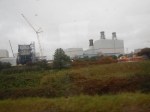
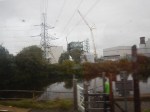
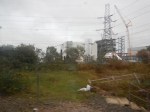
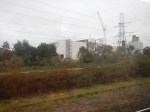
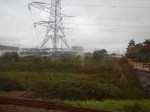
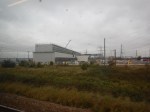
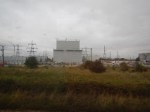

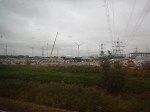
These pictures show the area is all about energy.
Keadby Power Station
Keadby power station is a 734 MW gas-fired power-station, that opened in 1996.
Keadby 2 Power Station
Keadby 2 is described on this page of the sseThermal web site.
These are the three opening paragraphs.
Keadby 2 is a new 840MW gas-fired power station in North Lincolnshire currently being constructed by our EPC contractor Siemens Energy. The project is adjacent to our operational Keadby 1 Power Station.
SSE Thermal has partnered with Siemens Energy to introduce first-of-a-kind, high-efficiency gas-fired generation technology to the UK. When completed, Keadby 2 is expected to become the cleanest and most-efficient gas-fired power station in Europe.
The station will also be capable of being upgraded to further decarbonise its generation through carbon capture or hydrogen technology, as routes to market develop.
Note.
- It will be possible to add Carbon Capture and Storage technology to Keadby 2 to make the plant net-zero carbon.
- Keadby 2 will be able to run on hydrogen.
- Keadby 2 is the under-construction power station in my pictures.
Could this be the prototype gas-fired power station of the future?
Keadby 3 Power Station
Keadby 3 is described on this page of the sseThermal web site.
These are the two opening paragraphs.
SSE Thermal is developing the option for a low-carbon combined cycle gas turbine (CCGT) at our Keadby site in North Lincolnshire, which will be known as Keadby 3.
As part of our commitment to a net zero emissions future, Keadby 3 will only be built with a clear route to decarbonisation, either using hydrogen as a low-carbon fuel, or equipping it with post-combustion carbon capture technology. The project is at the early stages of development and no final investment decision has been made.
Keadby 3 is still in the consultation and planning stage.
This newsletter on the sseThermal web site, gives some useful information about Keadby 3.
These are the first three paragraphs.
We are proposing to build a new gas fired power station at Keadby, North Lincolnshire. The project, known as Keadby 3, will have a generating capacity of up to 910 megawatts (MW) and will provide the essential back up to renewable generation and reliable and flexible energy during the country’s transition to Net Zero.
Keadby 3 will be a highly efficient gas fired power station. It will either use natural gas as the fuel and be fitted with a Carbon Capture Plant (CCP) to remove carbon dioxide (CO2) from the emissions to air from the plant, or it will be fired on primarily hydrogen, with no carbon dioxide emissions to air from its operation. Both options are currently being considered, and government is also currently considering the roles of carbon capture and hydrogen in the power sector nationally.
Keadby 3 will require connections for natural gas and possibly hydrogen fuel, water for use in the process
and for cooling and possibly for a pipeline to export the captured CO2 into a gathering network being provided by others and from there to a permanent geological storage site. An electricity connection to export the generated electricity to the UK transmission system will also be required. The plant would be capable of operating as a dispatchable low-carbon generating station to complement the increasing role of renewables in supplying the UK with electricity
Note.
- The three Keadby gas-fired power stations can generate 2484 MW of electricity in total.
- By comparison, the under-construction Hinckley Point C nuclear power station will be able to generate 3200 MW.
- The addition of a Keadby 4 power station, if it were the same size as Keadby 3, would mean the Keadby cluster of gas-fired power stations had a capacity of 3394 MW and they would be larger than the big nuclear station.
In terms of power output, it is an interesting alternative to a larger nuclear power station.
What About The Carbon?
If you’re burning natural gas, you will produce some carbon dioxide.
Power generation from natural gas creates 0.2 Kg of CO2 per kWh according to this web page.
So a 3000 MW station that produces 3000 MW, will produce 3000 MWh or 3000000 kWh in an hour.
This will create 600,000 Kg or 600 tonnes of carbon dioxide in an hour.
As there are roughly 9000 hours in a year, that is roughly 5.4 million tonnes of carbon dioxide.
This newsletter on the sseThermal web site, gives some information about sseThermal are going to do with the carbon dioxide.
As a low-carbon CCGT, Keadby 3 comprises one high efficiency gas turbine and associated steam turbine and either the infrastructure required to allow the CCGT to fire primarily on hydrogen gas, r inclusion of a post combustion Carbon Capture Plant (CCP) in a scenario where natural gas is used as the fuel. In the latter scenario, this is required in order that CO2 emissions are captured and directed to an offshore geological store through the Humber Low Carbon cluster pipeline network being developed by National Grid Ventures and partners.
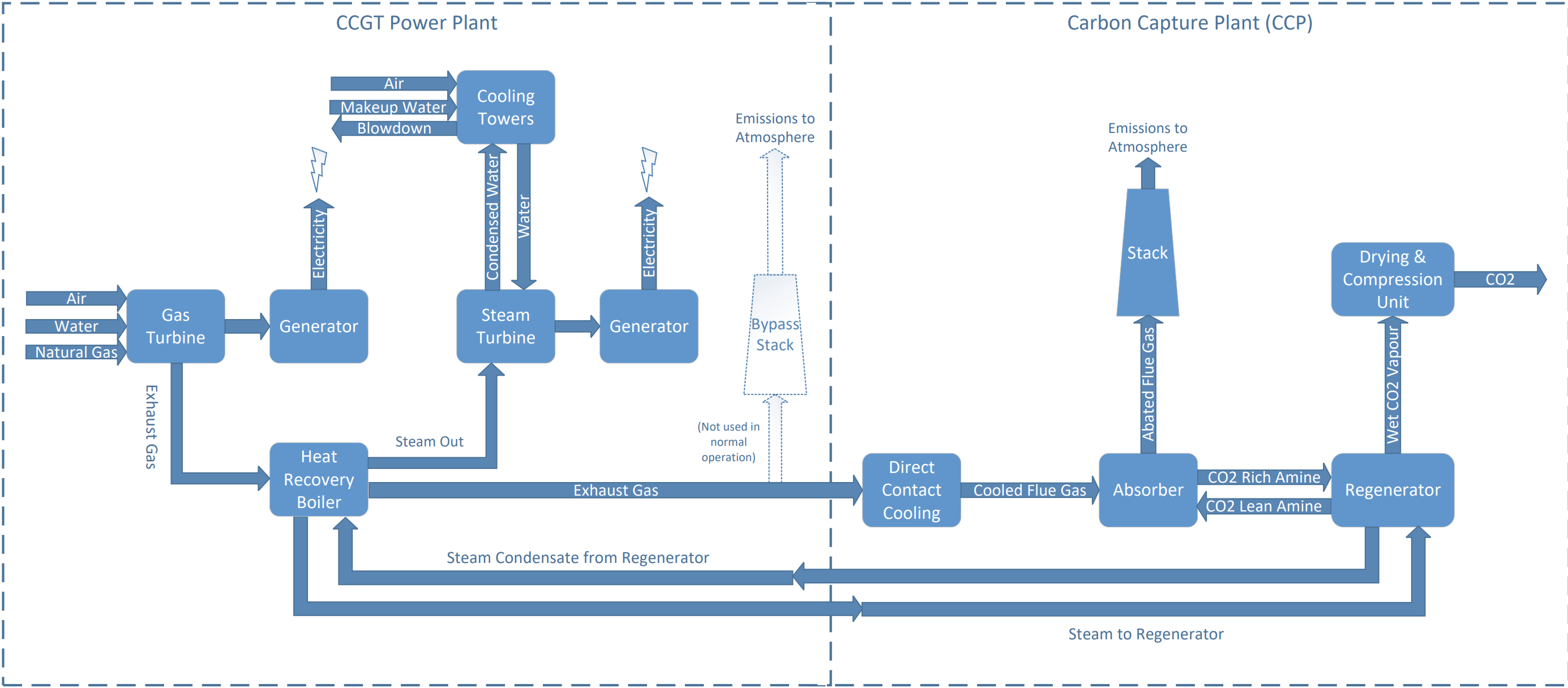
A diagram of these components, and optional components, is shown below.
Note.
- Click on the image to get a larger view.
- The CCGT Power Plant is on the left.
- Most of the power is generated by the gas-turbine.
- Heat is recovered to create steam, which drives a turbine to create more electricity
- The Carbon Capture Plant is on the right.
- Carbon dioxide is extracted from the exhaust.
There are two outputs from the plant; electricity and carbon dioxide.
As the carbon dioxide is in a pipe from the drying and compression unit, it is easy to handle.
The newsletter says this about what will happen to the carbon dioxide.
CO2 emissions are captured and directed to an offshore geological store through the Humber Low Carbon cluster pipeline network being developed by National Grid Ventures and partners.
As there are several worked out gas fields in the area, there are places to store the carbon dioxide.
Storing The Carbon Dioxide
This map shows the Zero Carbon Humber pipeline layout.
Note.
- The orange line is a proposed carbon dioxide pipeline
- The black line alongside it, is a proposed hydrogen pipeline.
- Drax, Keadby and Saltend are power stations.
- Easington gas terminal is connected to around twenty gas fields in the North Sea.
- The terminal imports natural gas from Norway using the Langeled pipeline.
- The Rough field has been converted to gas storage and can hold four days supply of natural gas for the UK.
I can see this network being extended, with some of the depleted gas fields being converted into storage for natural gas, hydrogen or carbon dioxide.
Using The Carbon Dioxide
But I would prefer , that the carbon dioxide were to be put to use. Under Carbon Capture and Utilisation on Wikipedia, a variety of uses are shown.
Surprisingly, they don’t talk about using the carbon dioxide to promote the growing of crops in green houses.
I do think, though, that some clever chemists will find ways to convert the carbon into some form of advanced engineering plastics to replace steel.
Hydrogen-Fuelled Power Stations
Note how on the map the hydrogen pipeline goes through the Keadby cluster of power stations.
- Hydrogen is a zero-carbon fuel.
- It will be produced offshore by wind turbines connected to electrolysers.
- The hydrogen will be brought ashore using the existing gas pipeline network.
- Excess hydrogen could be stored in the worked out gas fields.
I suspect there will be a massive increase in the number of wind turbines in the North Sea to the East of Hull.
Hydrogen Steelmaking
In ten years time, this will surely be the way steel will be made. British Steel at Scunthorpe would surely be an ideal site.
It would also be an ideal site for the HIsarna steelmaking process, which generates much less carbon dioxide and because it is a continuous process, what carbon dioxide is generated is easily captured.
Conclusion
Installations like this will mean that large nuclear power stations built with Chinese money are not needed.
 The Anonymous Widower