Repurposing The Affric/Beauly Hydro-Electric Scheme
The Affric/Beauly hydro-electric scheme was built in the 1950s and early 1960s, by the North of Scotland Hydroelectric Board.
- The scheme is now owned by SSE Renewables and has a page on their web site.
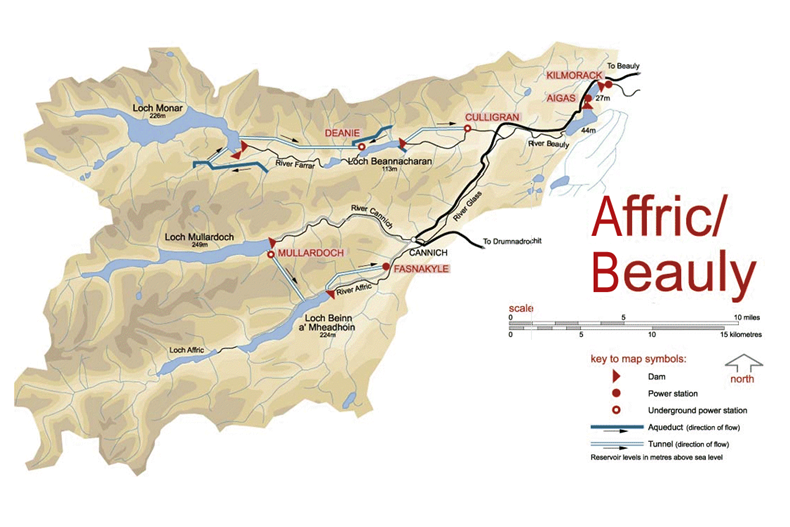
- There are six individual power stations; Mullardoch, Fasnakyle, Deanie, Culligran, Aigas and Kilmorack.
- There are seven dams; Mullardoch, Benevean, Monar, Loichel, Beannacharan, Aigas and Kilmorack.
This map from the SSE Renewables web site shows the layout of the dams and power stations.
This description of the scheme is from Wikipedia.
The Affric / Beauly hydro-electric power scheme for the generation of hydro-electric power is located in the western Highlands of Scotland. It is based around Glen Strathfarrar, Glen Cannich and Glen Affric, and Strathglass further downstream.
The scheme was developed by the North of Scotland Hydro-Electric Board, with plans being approved in 1947.
The largest dam of the scheme is at Loch Mullardoch, at the head of Glen Cannich. From there, a tunnel takes water to Loch Beinn a’ Mheadhoinn (Loch Benevean) in Glen Affric, via a small underground power station near Mullardoch dam. Loch Benevean is also dammed, with a tunnel taking water to the main power station of Fasnakyle, near Cannich.
To the north in Glen Strathfarrar, Loch Monar is dammed, and a 9 km tunnel carries water to an underground power station at Deanie. Further down the glen, the River Farrar is dammed just below Loch Beannacharan, with a tunnel to take water to Culligran power station (also underground).
The River Farrar joins with the River Glass near Struy to form the River Beauly. Downstream on the River Beauly, dams and power stations have been built in gorges at Aigas and Kilmorack.
As the rivers in this scheme are important for Atlantic salmon, flow in the rivers is kept above agreed levels. The dams at Kilmorack, Aigas and Beannacharn contain Borland fish lifts to allow salmon to pass.
Note
- Culligran, Deanie and Mullardoch power stations are underground.
- Loch Beannacharan is the English name for Loch Beinn a’ Mheadhoin.
- The salmon impose a constraint on water levels.
The sizes of the power stations in the scheme are as follows.
- Mullardoch – 2.4 MW
- Fasnakyle – 69 MW
- Deanie – 38 MW
- Culligran – 19 MW
- Aigas – 20 MW
- Kilmorack – 20 MW
This gives a total power of 168.4 MW.
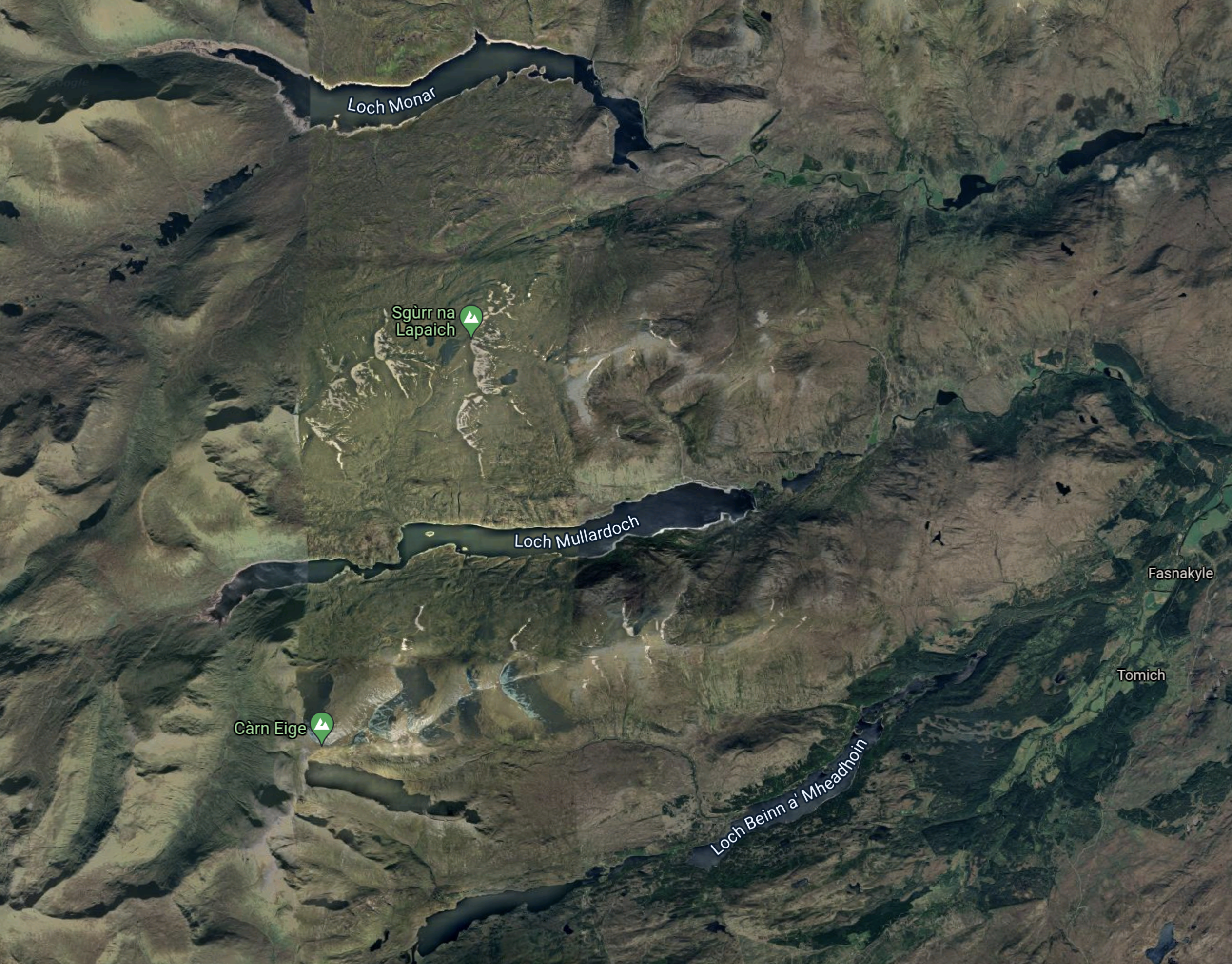
This Google Map shows the Western area of the SSE Renewables Map.
Note.
- The three lochs; Monar, Mullardoch and Beinn a’ Mheadhoin can be picked out on both maps.
- Fasnakyle, where the largest of the hydro-electric power stations in the Affric/Beauly scheme, is at the Eastern edge of the map about half-way up.
- The area doesn’t seem to have a large population.
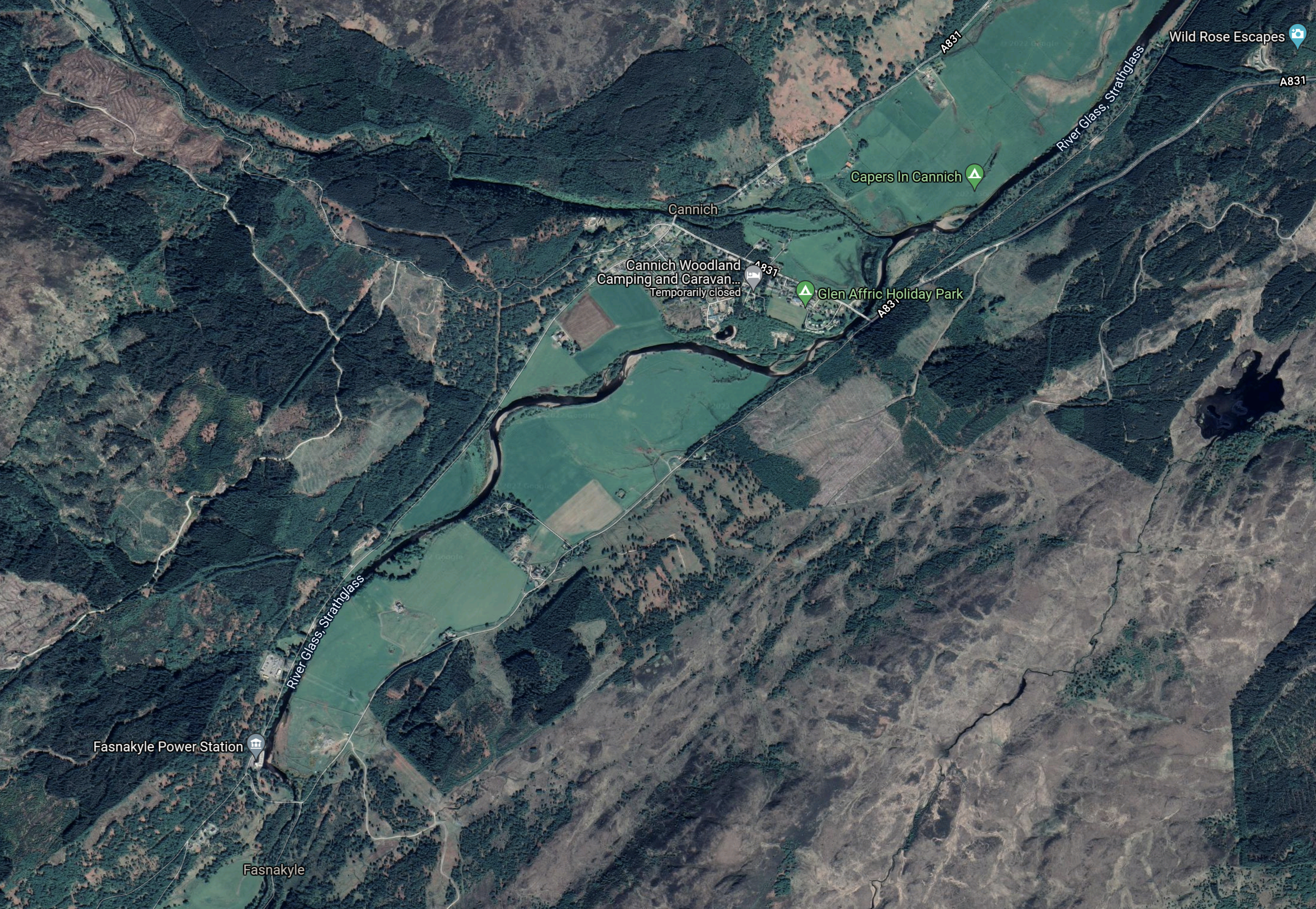
This Google Map shows the location of Fasnakyle power station in more detail.
Note.
- Fasnakyle power station is in the South-West corner of the map. marked by a grey flag.
- It appears that all of the water that goes through the power station flows into the River Glass, Strathglass, which meanders its way towards Inverness on the bottom of what appears to be a broad valley.
This Google Map shows the next section of the river.
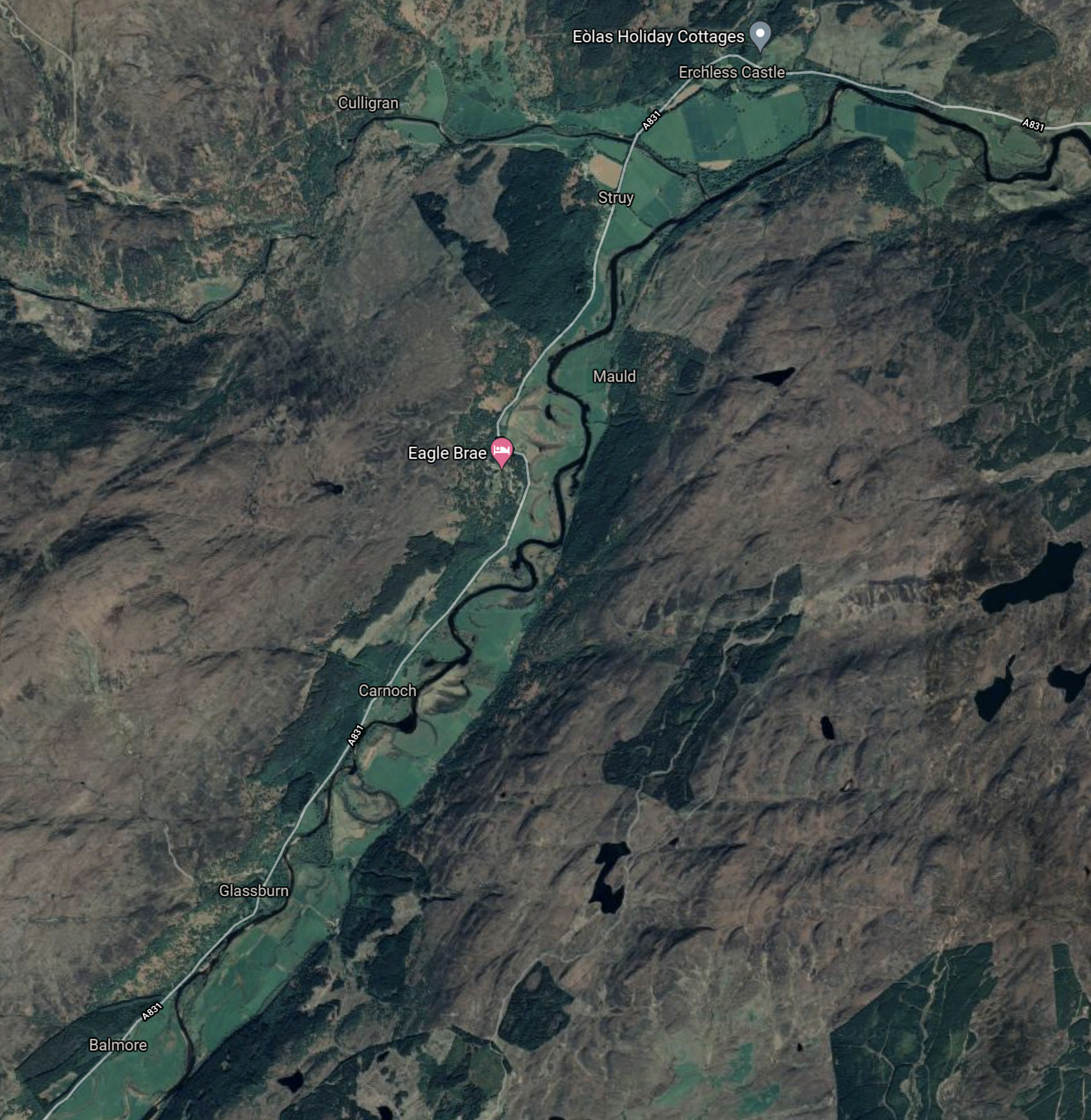
The River Glass, Strathglass joins the River Farrar near the top of the map an becomes the River Beauly.
This Google Map the River Beauly to Kilmorack.
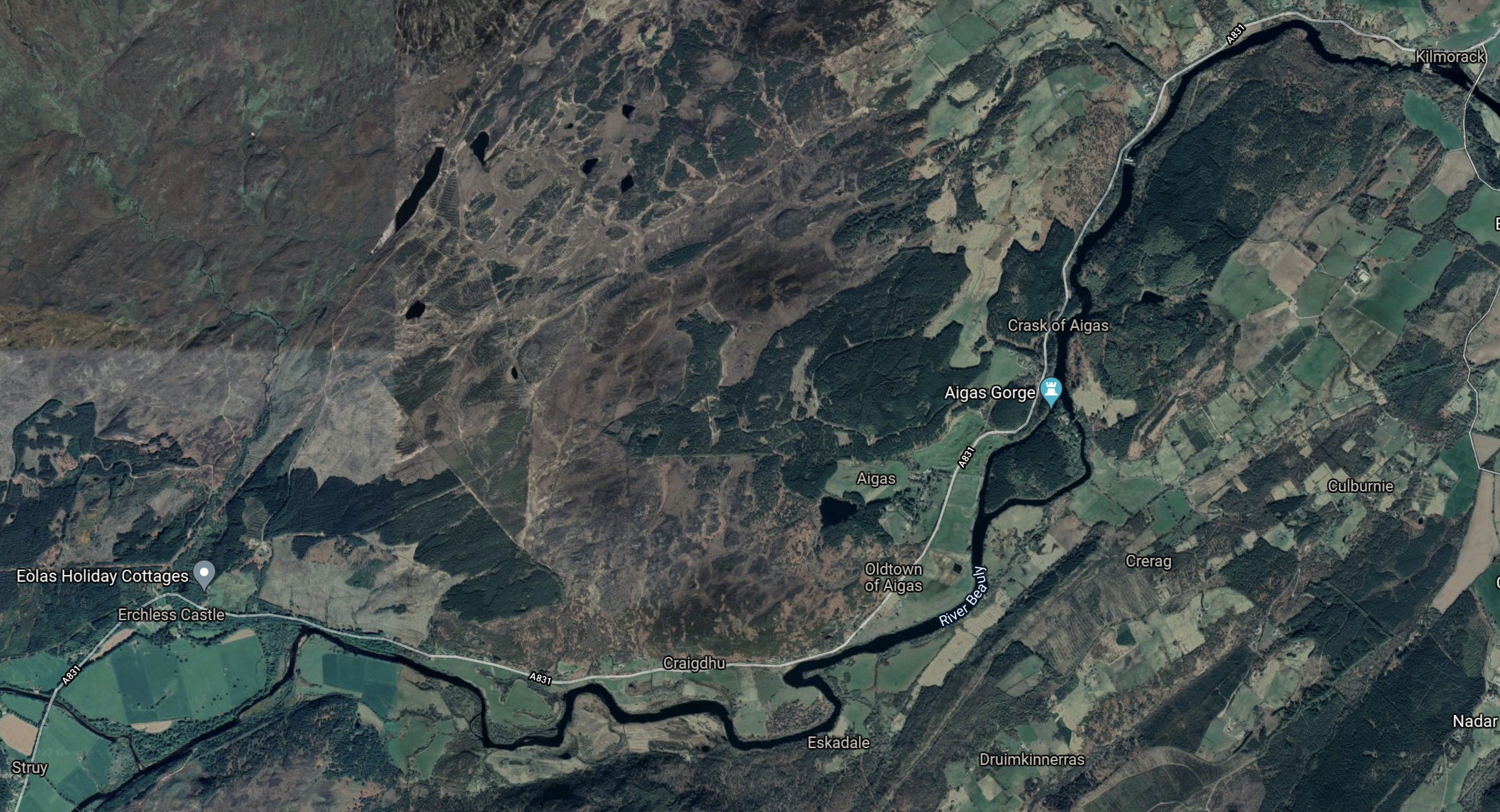
Wikipedia says this about this section of the River Beauly.
The river is part of the Affric-Beauly hydro-electric power scheme, with dams and power stations at Aigas and Kilmorack. Both have 20MW generators and include fish ladders to allow salmon to pass, the Aigas fish ladder is open to visitors in the summer.
This last Google Map shows the Beauly Firth.
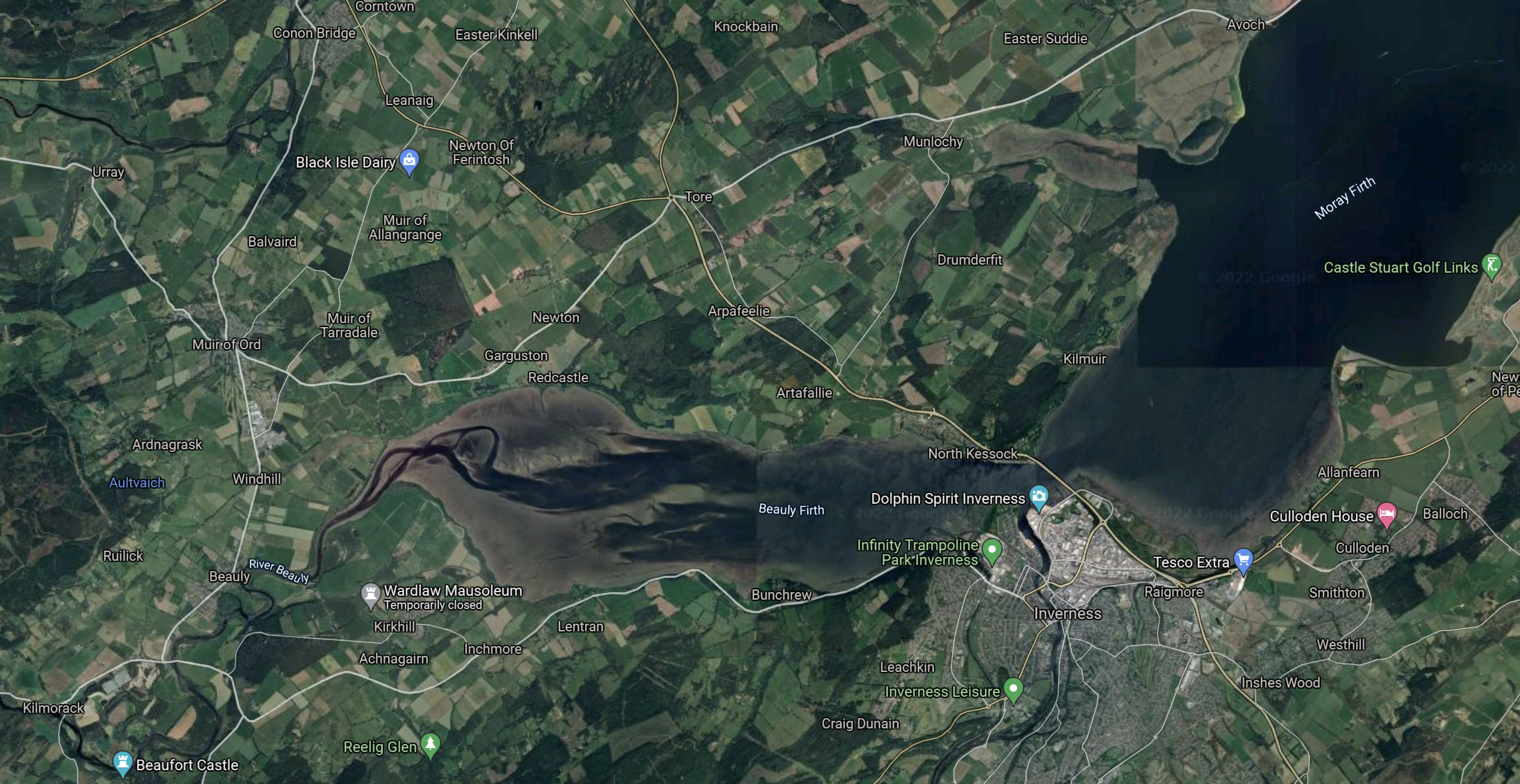
Note.
- Kilmorack is in the South-West corner of the map.
- The River Beauly flows into the Beauly Firth and ultimately out to see in the Moray Firth.
- The water flows past Inverness to the North.
It does strike me, that a lot of the water collected in the dams to the West of Fasnakyle, flows out to sea.
Strathclyde University And Pumped Storage Power For Scotland
This page on the Strathclyde University gives a list of the pumped storage potential for Scottish hydrogen-electric dams and power stations.
A figure is given for only one dam or power station in the Affric/Beauly scheme.
- Fasnakyle – 78 GWh
That would be a lot of pumped storage.
Water Flows In The Affric/Beauly Scheme
Looking at the SSE Renewables map of the Conon scheme, water flows appear to be as follows.
- Loch Monar to Loch Beannacharan via Deanie power station
- Loch Beannacharan to River Beauly via Culligran power station
- Lochs Mullardoch and Beinn a’ Mheadhoin both supply water to the Fasnakyle power station
- Fasnakyle power station to River Beauly via the River Glass, Strathglass.
- River Beauly to Beauly Firth via Aigas and Kilmorack power stations.
Note.
- Water from Loch Moray goes via Deanie , Culligran, Aigas and Kilmorack power stations on its journey to the sea.
- Water from Loch Mullardoch goes via Mullardoch , Fasnakyle, Aigas and Kilmorack power stations on its journey to the sea.
- Water from Loch Beinn a’ Mheadhoin goes via Fasnakyle, Aigas and Kilmorack power stations on its journey to the sea.
Fasnakyle, Aigas and Kilmorack power stations must work very hard.
Refurbishing And Repurposing The Affric/Beauly Scheme
Perhaps as the power stations are now over fifty years old, one simple way to increase the generating capacity of the Affric/Beauly scheme might be to selectively replace the turbines, with modern turbines, that can generate electricity more efficiently.
I suspect that SSE Renewables have an ongoing program of improvements and replacements for all of their hydro-electric stations in Scotland. Some turbines at Sloy power station have already been replaced with larger ones.
I also suspect that the whole scheme has a very sophisticated control system.
Consider.
- There is a need to control water levels to agreed minimum levels for the Atlantic salmon.
- Hydro-electric power stations have the ability to get to full power quickly, to cover sudden demands for more electricity.
- Electricity only needs to be generated if it can be used.
- Water might be held in Lochs Mullardoch and Beinn a’ Mheadhoin, as a reserve, as it goes through three or four power stations when it is released.
Over the years, SSE Renewables will have developed very sophisticated control philosophies.
Adding Pumped Storage To The Affric/Beauly Scheme
To do this a source of fresh-water must be pumped into Loch Mullardoch or Beinn a’ Mheadhoin, when there is a surplus of electricity.
It looks from Google Maps, that the river system between Fasnakyle and Aigas power stations has been effectively turned into a canal.
- I wonder, if it is deep enough to contain enough water to act as the lower level reservoir of a pumped-storage system.
- The higher level reservoir would be Loch Mullardoch.
- There would be a height difference of 200 metres.
- Calculations show around 1850 cubic metres of water would need to be pumped into Loch Mullardoch to store one MWh.
So long as enough water is left for the salmon, I suspect that if a way of pumping water from the River Glass to Loch Mullardoch, that an amount of pumped-storage can be added.
Conclusion
There would appear to be only one scheme, but if it was built it could add over 50 GWh of pumped storage.
Repurposing The Conon Hydro-Electric Scheme
The Conon hydro-electric scheme was built in the 1950s, by the North of Scotland Hydroelectric Board.
- The scheme is now owned by SSE Renewables and has a page on their web site.
- There are six individual power stations; Achanalt, Grudie Bridge, Mossford, Luichart, Orrin and Torr Achilty.
- There are six dams; Glascarnoch, Vaich, Luichart, Meig, Torr Achilty and Orrin.
This map from the SSE Renewables web site shows the layout of the dams and power stations.
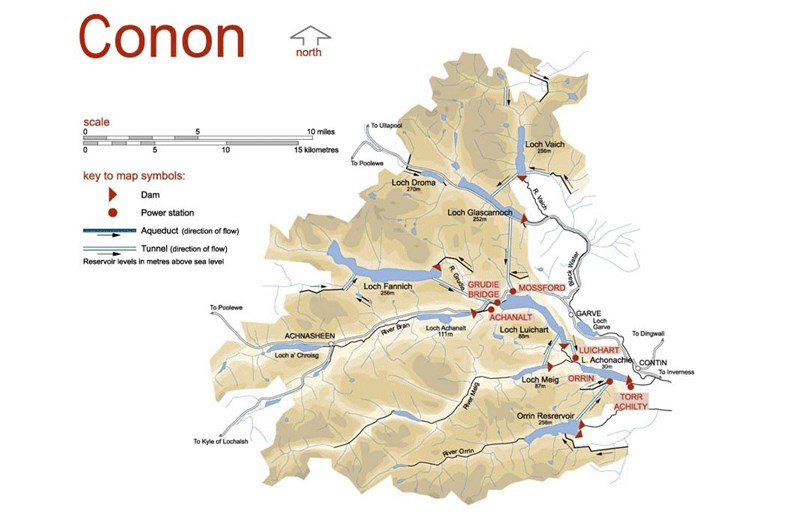
The sizes of the power stations in the scheme are as follows.
- Achanalt – 3 MW
- Grudie Bridge – 18.6 MW
- Mossford – 18.6 MW
- Luichart – 34 MW
- Orrin – 18 MW
- Torr Achilty – 15 MW
This gives a total power of 107.2 MW.
This Google Map shows the same area as the SSE Renewables Map.
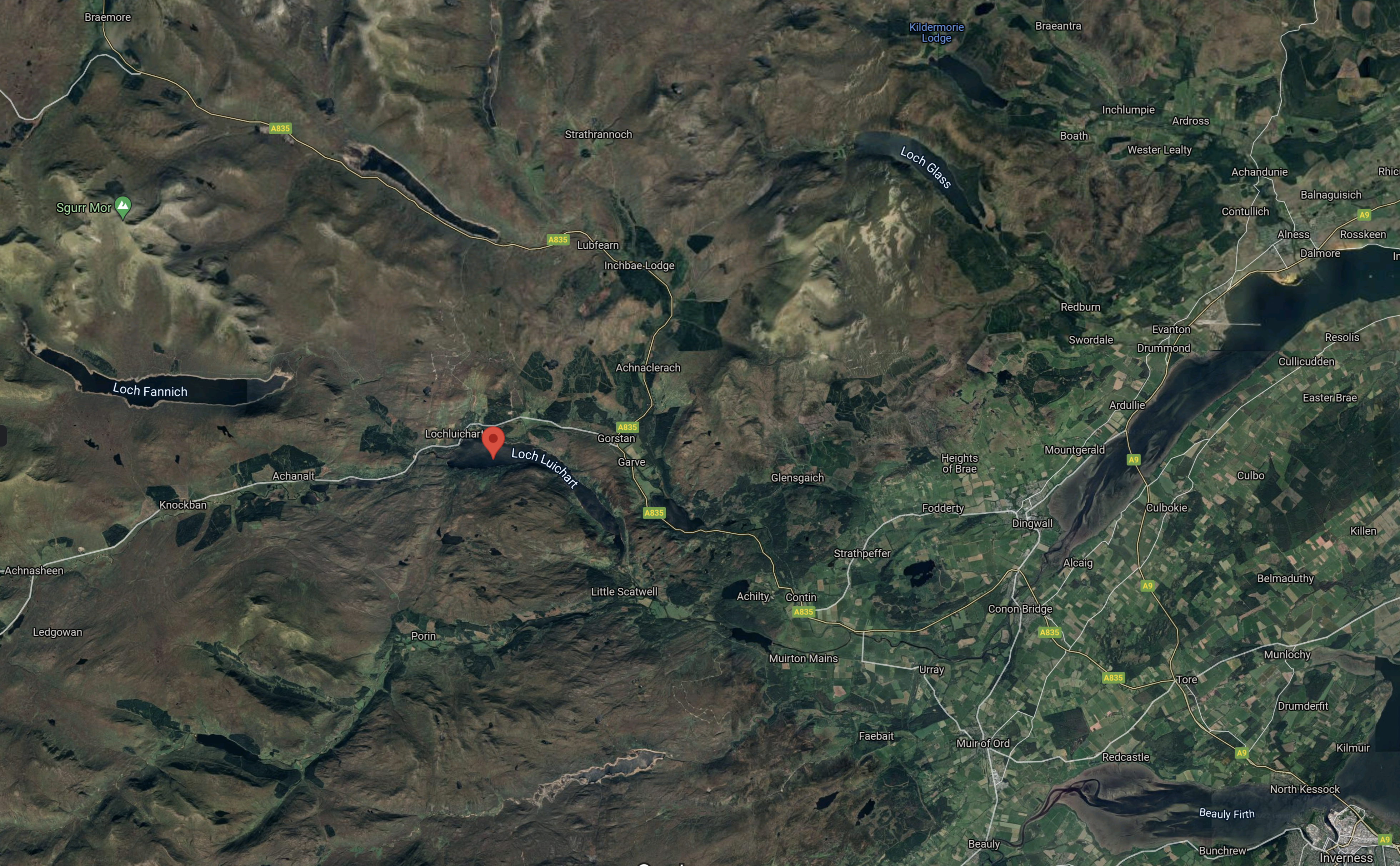
Note.
- Inverness is in the South-East corner of the map.
- The red arrow indicates the Western end of Loch Luichart.
- Loch Fannich is the large loch to the West of Loch Luichart.
- Loch Glascarnoch is the East-West loch to the North of Loch Luichart
- Loch Vaich is the North-South loch to the North of Loch Glascarnoch.
Is Inverness a City substantially powered by renewables?
Strathclyde University And Pumped Storage Power For Scotland
This page on the Strathclyde University gives a list of the pumped storage potential for Scottish hydrogen-electric dams and power stations.
These figures are given for the dams and lochs in the Conon scheme.
- Glascarnoch – 23 GWh
- Luichart – 38 GWh
- Fannich – 70 GWh
It would appear that based on research from Strathclyde University, that the Conon scheme could support up to 131 GWh of pumped storage.
This Google Map shows the three lochs and Loch Vaich.
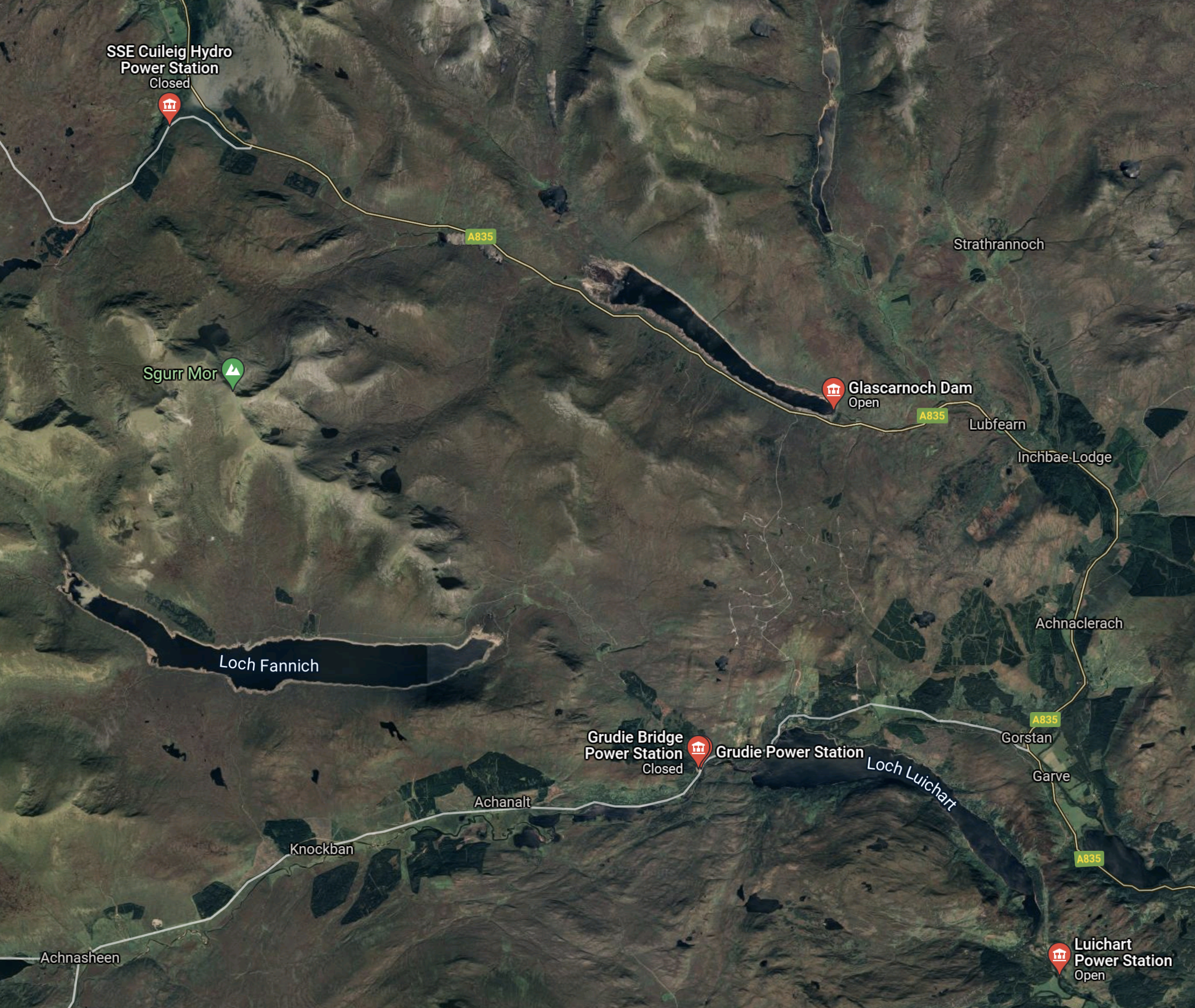
Note.
- Lochs Fannich and Luichart are named.
- Loch Glascarnoch is the East-West loch to the North of Loch Luichart
- Loch Vaich is the North-South loch to the North of Loch Glascarnoch.
- The locations of several power stations are shown.
- Cuileig is a 3.2 MW power station built in 2002.
This Google Map shows Loch Fannich.
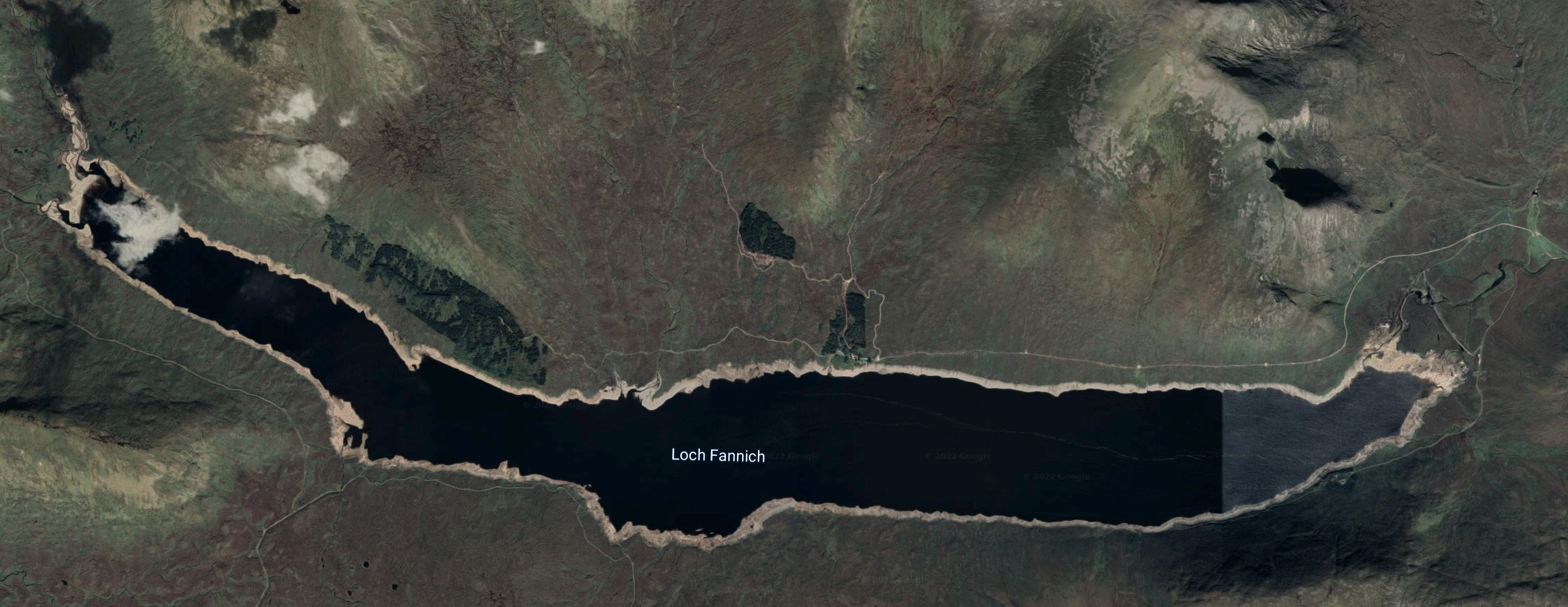
Wikipedia says this about the loch.
Loch Fannich was dammed and its water level raised as part of the Conon Hydro-Electric Power Scheme, built by the North of Scotland Hydro-Electric Board between 1946 and 1961. An underground water tunnel leading from Loch Fannich to the Grudie Bridge Power Station required blasting out a final mass of rock beneath the loch, a procedure which was referred to popularly as “Operation Bathplug”.
The dam appears to be at the Eastern end of the loch, as this Google Map shows.
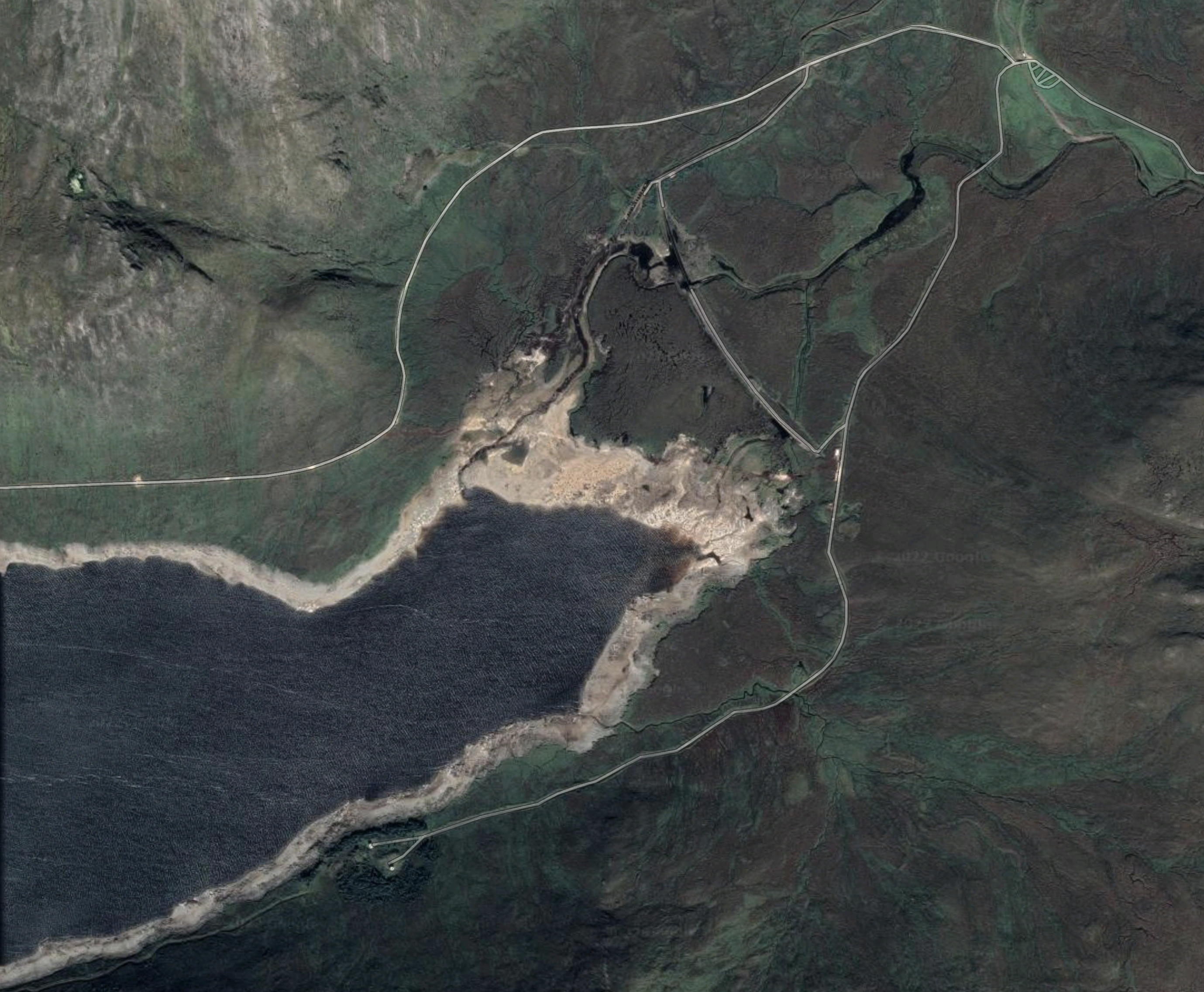
I wouldn’t be surprised to find that to obtain the potential 70 GWh of storage, that the dam will need to be raised.
This Google Map shows Loch Glascarnoch.
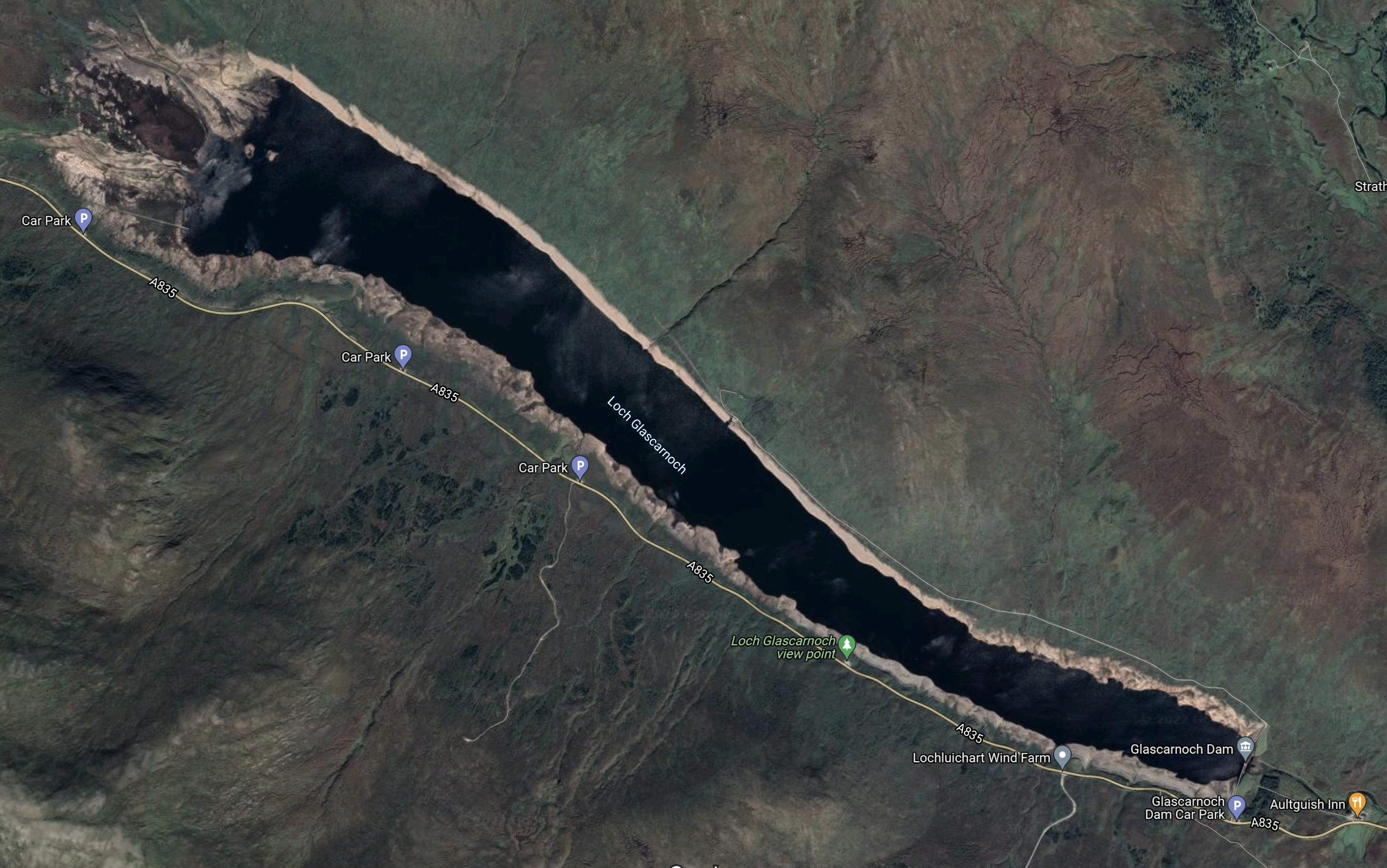
Loch Glascarnoch may be more difficult to expand, as a road runs along the Southern side of the loch.
This Google Map shows Loch Luichart
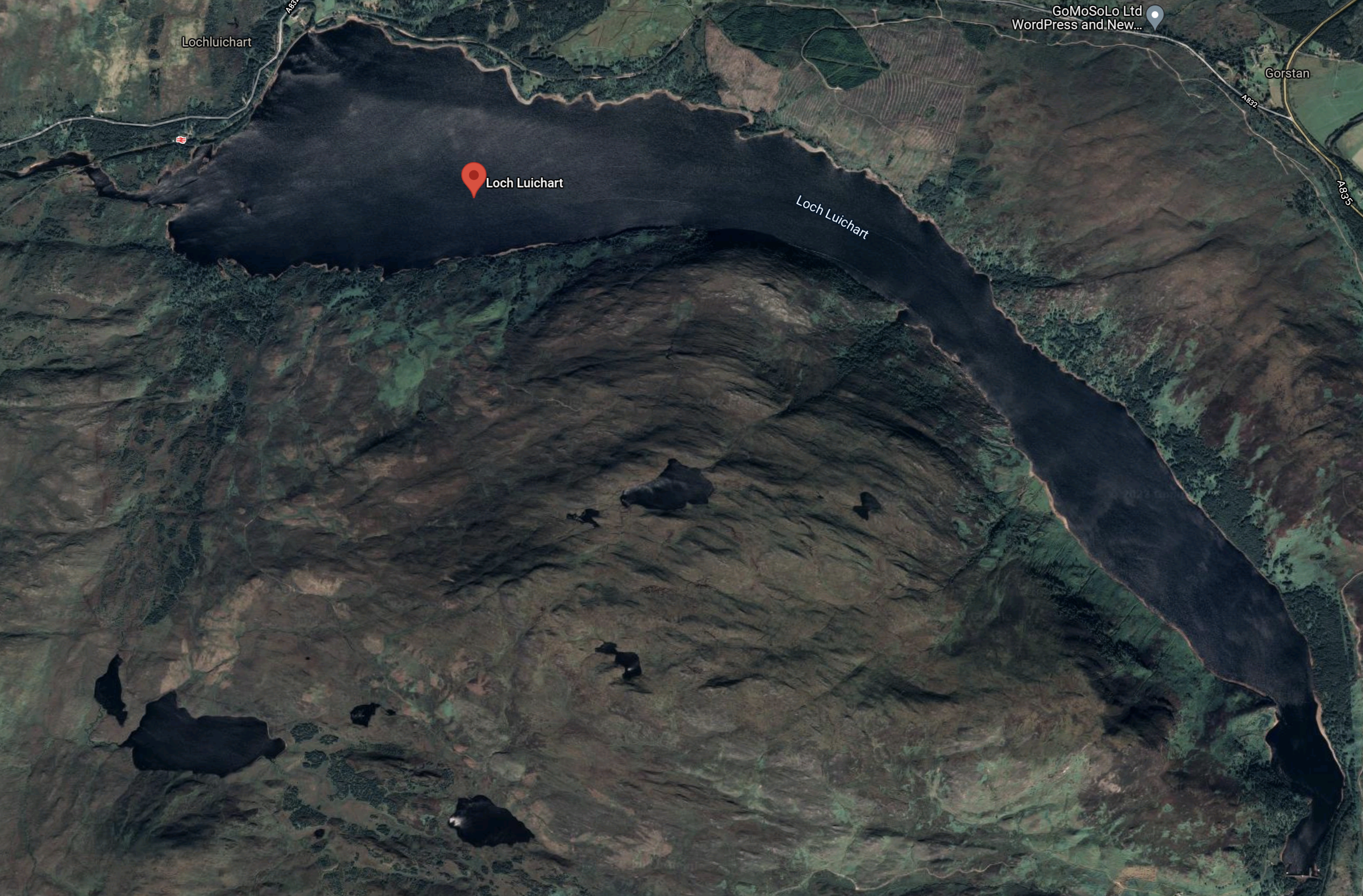
Lock Luichart may have possibilities as it is wide and could be deep.
But it will all be about the shape of the loch and the mathematics of the water.
Water Flows In The Conon Scheme
Looking at the SSE Renewables map of the Conon scheme, water flows appear to be as follows.
- Loch Vaich to Loch Glascornoch
- Loch Droma to Loch Glascornoch
- Loch Glascornoch to Loch Luichart via Mossford power station
- Loch Fannich to Loch Luichart via Grudie Bridge power station
- Loch Achanalt to Loch Luichart via Anchanalt power station
- Loch Meig to Loch Luichart
- Loch Luichart to Loch Achonachie via Luichart power station
- Orrin Reservoir to Loch Achonachie via Orrin power station
- Loch Achonachie to River Conon and eventually the Cromarty Firth via Torr Achilty power station
Note that all the power stations date from the 1950s.
Repurposing The Conon Scheme
Perhaps as the power stations are now over sixty years old, one simpler way to both increase the generating capacity of the Conon scheme and add a degree of pumped storage might be to selectively replace the turbines, with modern pump/turbines, that can both generate electricity and pump the water back up into the mountains.
It should also be noted that Loch Vaich, Loch Glascornoch, Loch Fannich and the Orrin Reservoir are all about 250 metres above sea level, with the others as follows.
- Loch Achanalt – 111 metres
- Loch Luichart – 56 metres
- Loch Meig – 87 metres
- Loch Achonachie – 30 metres
Loch Droma is the highest loch at 270 metres.
These height differences could create opportunities to put in extra tunnels and power or pumping stations between the various levels.
As water pumped to a greater height has a higher potential energy, perhaps it would be an idea to give Loch Droma, which is the highest loch, a bigger role.
Conclusion
I believe these improvements are possible.
- Adding a pumped storage facility to the Conon hydro-electric scheme, with a capacity of upwards of 30-40 GWh.
- Increasing the generating capacity by replacing the elderly turbines.
- Improving control of the scheme, by replacing 1950s control systems.
It may even be possible to substantially improve the performance of the scheme without any expensive rock tunnelling.
A Lower-Cost Pumped Hydro Storage System
Whilst writing some of the posts recently about pumped storage I came across the Loch Sloy Hydro-Electric Scheme.
This is the introductory sentence in Wikipedia.
The Sloy/Awe Hydro-Electric Scheme is a hydro-electric facility situated between Loch Sloy and Inveruglas on the west bank of Loch Lomond in Scotland.
This page on the Greenage web site gives comprehensive details of the power station and is well worth a read.
This Google Map shows the Lochs Sloy and Lomond.
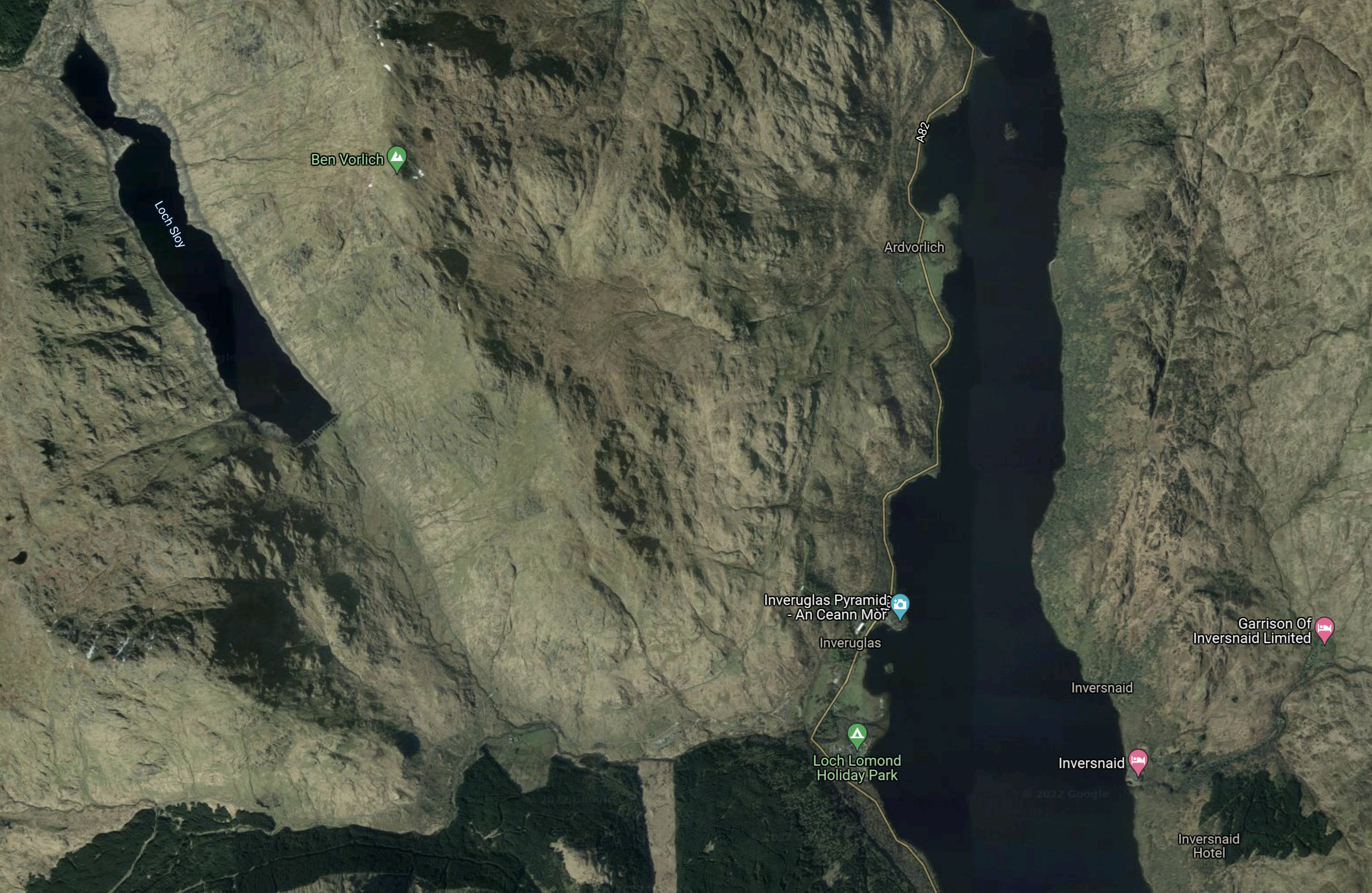
Note.
- Loch Sloy is in the North-West corner of the map.
- The page on Greenage says that Loch Sloy can store 14 GWh of electricity
- Loch Lomond is the body of water towards the Eastern side of the map.
- Inverglas is on the West bank of Loch Lomond to the North of the Loch Lomond Holiday Park, which is indicated by the green arrow with a tent.
This second Google Map shows the power station and Inverglas.
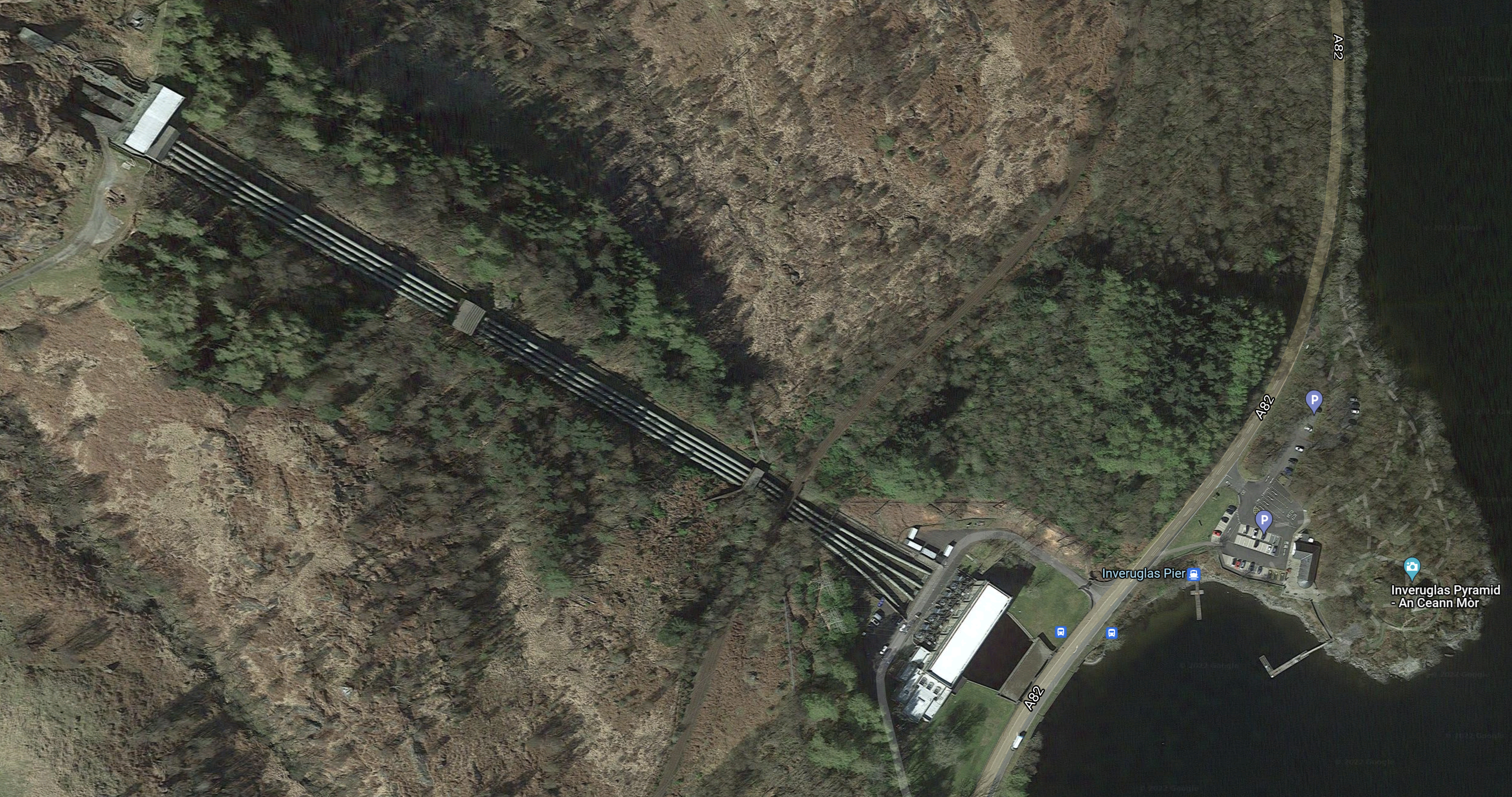
Note.
- It is a classic layout for a hydro-electric power station.
- In the North West corner of the map is the valve house, which is connected to Loch Sloy by a three kilometre tunnel.
- The valve house controls the water flows to the power station by Loch Lomond.
- There are four two-metre pipes running down the hill, one for each of the four turbines.
- According to the page on Greenage, the power station has three 40 MW turbines and one 32 MW turbine, which gives a total output of 152 MW.
- The water discharges into Loch Lomond after doing its work in the power station.
Loch Sloy is the largest conventional hydroelectric power plant in the UK.
Extending The Loch Sloy Hydro-Electric Scheme
This page on Hydro Review, which is dated the 10th of November 2010, is entitled SSE Gets Government Consent For Sloy Pumped-Storage Hydropower Project.
These are the first paragraph.
SSE Generation Ltd., the wholly owned generation business of Scottish and Southern Energy, has received consent from the Scottish Government to develop a 60-MW pumped-storage hydro project at its existing Sloy hydropower station at Loch Lomond, SSE reported.
Note.
- Two 30 MW pumps will be added to the power station to pump water up the hill from Loch Lomond to Loch Sloy.
- According to the page on Greenage, if the two pumps worked together for six hours, they would transfer 432,000 m3 of water. Note that a cubic metre of water weighs a tonne.
- Water would be transferred, when there was a surplus of energy being generated over the demand.
It would appear to be a simple scheme, as it is just adding two pumps to pump the water up the hill.
- As pumps rather than pump/turbines as at Foyers are used, there is no corresponding increase in generating capacity.
- Water also appears to be pumped up to the valve house in the existing pipes.
- Loch Sloy and Loch Lomond would not need major works to enable the scheme..
The page on Greenage gives the cost at just £40 million.
Originally, the project was supposed to have started in 2012, but as there are environmental problems with the fish, the work has not started.
These problems are detailed on the page on Greenage.
Conclusion
For £40 million, 14 GWh of pumped storage can be created at Sloy.
- But it could be bigger than 14 GWh, as this page on the Strathclyde University web site, says 20.4 GWh is possible.
- This would surely, be a project that could be first in the queue, once the environmental problems are solved.
20 GWh of pumped storage would be nice to have reasonably quickly.
A Brief History Of Scottish Hydropower
The title of this post, is the same as that of this page on the Drax Group web site.
This is the introductory paragraph.
Over the last century, Scottish hydro power has played a major part in the country’s energy make up. While today it might trail behind wind, solar and biomass as a source of renewable electricity in Great Britain, it played a vital role in connecting vast swathes of rural Scotland to the power grid – some of which had no electricity as late as the 1960s. And all by making use of two plentiful Scottish resources: water and mountains.
These are some points from the page.
- The first scheme was built in the last years of the nineteenth century and provided power for aluminium smelting.
- The first modern scheme was the Lanark Hydro Electric Scheme, which was built in the 1920s and is still running today, under the ownership of Drax Group.
- In 1935, the Galloway scheme, set the tone for later projects with architecture including stylised dams and modernist turbine halls.
- The North of Scotland Hydroelectric Board was founded in 1943.
- Sloy, the largest conventional hydro-electric station opened in 1950 and has a capacity of 152.5 MW.
- Building the dams and power stations appears to have been hard but well-paid work.
- By the mid Sixties, the North of Scotland Hydroelectric Board had built 54 main power stations and 78 dams. Northern Scotland was now 90% connected to the national grid.
- In 1965, the world’s then largest reversible pumped storage power station opened at Cruachan.
- In 2009, the last major scheme at Glendoe opened.
The schemes are a working catalogue of everything you can do with water to generate and store electricity.
Future development now seems to be moving in two directions.
The Drax page says this about new hydro-electric schemes.
In recent years, however, the real growth has been in smaller hydro-electric schemes that may power just one or a handful of properties – with more than 100 MW of such generation capacity installed in the Highlands since 2006.
On the other hand, several large pumped storage schemes are under development.
- Balliemeanoch – 1.5 GW/45 GWh
- Coire Glas – 1.5 GW/30 GWh
- Corrievarkie – 600 MW/14.5 GWh
- Red John – 450 MW/2.8 GWh
Note.
These schemes add up to an output of just over 4 GW and a colossal 92.3 GWh of storage.
The existing Foyers scheme and the under-development Coire Glas and Red John schemes. all use Loch Ness as the lower reservoir.
Two of these under-development schemes will be larger than the current largest pumped storage system in the world; Bath County Pumped Storage Station in Virginia in the United States, which is a 3 GW/24 GWh system.
Conclusion
Adding large numbers of wind turbines and tens of GWs to Scotland’s existing pumped storage could transform not just Scotland’s but most of Western Europe’s green energy production.
Fortescue Expands Green Energy Into PNG
The title of this post is the same as that of this article on Perth Now.
This is the first paragraph.
Mining magnate Andrew “Twiggy” Forrest’s Fortescue Future Industries plans to develop more than a dozen hydropower and geothermal energy projects in Papua New Guinea.
Other points from the article include.
- Green hydrogen and ammonia will be created.
- This will create a domestic and export industry for a country that relies heavily on imported oil.
- Papua New Guinea will become a leader in the world’s renewable energy transition.
- The target is 2.3 million tonnes of green hydrogen a year.
There is also a commitment to the various communities of Papua New Guinea of training, employment and business development opportunities.
I estimate that to produce 2.3 million tonnes of green hydrogen a year, would need around 600 MW of electricity twenty-four hours a day on every day of the year.
Do BP And The Germans Have A Cunning Plan For European Energy Domination?
The headline of this post may be slightly tongue in cheek, but I believe that a plan is being hatched.
Preamble
I’ll start with a preamble, where I’ll outline some of the factors behind what may be happening.
Decarbonisation
It is generally accepted by most people that there is a need to decarbonise everything we do.
And large oil companies like Shell, BP and others are starting to move in the same direction.
Hydrogen
Using hydrogen instead of fossil fuels is becoming one of the major routes to decarbonisation.
Hydrogen can be used for the following.
- Provide power for cars, buses, trucks, trains, locomotives and ships.
- Hydrogen can be used in steelmaking instead of coking coal.
- As a chemical feedstock to make ammonia, fertiliser and a large range of petrochemicals.
- I believe that hydrogen could be a viable fuel to power aircraft over thousands of miles.
Hydrogen will become the most common zero-carbon fuel.
Hydrogen And Natural Gas
In many applications hydrogen can replace natural gas, so for large users of natural gas, hydrogen offers a route to decarbonisation.
But hydrogen can also be mixed up to a level of around twenty percent in natural gas for partial decarbonisation of applications like space heating. Most industrial uses, boilers and appliances can be made to work very successfully with this mixture.
I grew up in the 1950s with coal gas, which according to Wikipedia had this composition.
- hydrogen 50%
- methane 35%
- carbon monoxide 10%
- ethylene 5%
- When we changed over in the 1970s, all my appliances were converted.
This is the UK government description of natural gas.
It contains primarily methane, along with small amounts of ethane, butane, pentane, and propane. Natural gas does not contain carbon monoxide. The by-products of burning natural gas are primarily carbon dioxide and water vapour. Natural gas is colourless, tasteless and odourless.
As with the conversion from coal-gas to natural gas, conversion from Natural gas to a hydrogen/natural gas mixture and eventually to hydrogen, will be a relatively painless process.
Note that carbon monoxide is a nasty poison and is not contained in either natural gas or hydrogen.
Green Hydrogen And Electrolysis Of Water
Green hydrogen is hydrogen produced exclusively from renewable energy sources.
Typically green hydrogen is produced by electrolysis of water using electricity produced by hydro, solar, tidal or wind.
The largest factory building electrolysers is owned by ITM Power.
- It is located in Rotherham.
- The factory has the capacity to build 1 GW of electrolysers in a year.
- Typical electrolysers have a capacity of several MW.
Ryze Hydrogen are building an electrolyser at Herne Bay, that will consume 23 MW of solar and wind power and produce ten tonnes of hydrogen per day.
Blue Hydrogen
‘Blue hydrogen is produced through a production process where carbon dioxide is also produced then subsequently captured via carbon capture and storage. In many cases the carbon dioxide is stored in depleted gas fields, of which we have plenty in the North Sea. Over the last few years, research has been ongoing into using the carbon dioxide. Applications in horticulture and agriculture, carbon structures and sustainable aviation fuel are being developed.
Shell have also developed the Shell Blue Hydrogen Process, where the carbon is extracted from methane as carbon dioxide and then stored or used.
CO2 In Greenhouse Horticulture
This paper from The Netherlands is called CO2 In Greenhouse Horticulture.
Read it and you might believe me, when I say, we’ll eat a lot of carbon in the form of tomatoes, salads and soft fruit. We’ll also buy flowers grown in a carbon-dioxide rich atmosphere.
Hydrogen As An Energy Transfer Medium
Every kilogram of natural gas when it burns releases energy, as it does in your boiler or gas hob. So it transfers energy in the form of gas from the gas well or storage tank to your house.
Electricity can also be transferred from the power station to your house using wires instead of pipes.
Hydrogen is being put forward as a means of transferring energy over hundreds of miles.
- Electricity is converted to hydrogen, probably using an electrolyser, which would be powered by zero-carbon electricity.
- The hydrogen is transferred using a steel pipe.
- At the destination, the hydrogen is either distributed to end-users, stored or used in a gas-fired power station, that has been modified to run on hydrogen, to generate electricity.
It sounds inefficient, but it has advantages.
- Long underwater cables have energy losses.
- Electrical connections use a lot of expensive copper.
- Re-use of existing gas pipes is possible.
- Oil and gas companies like BP and their contractors have been laying gas pipes on land and under water for decades.
If hydrogen has a problem as an energy transfer medium, it is that it us difficult to liquify, as this statement from Air Liquide illustrates.
Hydrogen turns into a liquid when it is cooled to a temperature below -252,87 °C. At -252.87°C and 1.013 bar, liquid hydrogen has a density of close to 71 kg/m3. At this pressure, 5 kg of hydrogen can be stored in a 75-liter tank.
To transport, larger quantities of hydrogen by ship, it is probably better to convert the hydrogen into ammonia, which is much easier to handle.
The Germans and others are experimenting with using liquid ammonia to power large ships.
Hydrogen As An Energy Storage Medium
The UK has a comprehensive National Transmission System for natural gas with large amounts of different types of storage.
This section of the Wikipedia entry is entitled Natural Gas Storage and lists ten large storage facilities in salt caverns and depleted onshore gas fields. In addition, several depleted offshore gas fields have been proposed for the storage of natural gas. Rough was used successfully for some years.
I can certainly see a network of hydrogen storage sites being developed both onshore and offshore around the UK.
Iceland
With its large amount of hydro-electric and geothermal energy, Iceland can generate much more electricity, than it needs and has been looking to export it.
The UK is probably the only country close enough to be connected to Iceland to buy some of the country’s surplus electricity.
There has been a proposal called Icelink, that would build an electrical interconnector with a capacity of around a GW between Iceland at the UK.
But the project seems to have stalled since I first heard about it on my trip to Iceland in 2014.
Could the engineering problems just be too difficult?
The Waters Around The Northern Parts Of Great Britain
Look at a map of the UK and particularly Great Britain and there is a massive area of water, which is not short of wind.
Between Norway, Denmark, Germany, The Netherlands, the East Coast of England, the Northern Coasts of Scotland and Iceland, there are only a few islands.
- Faroes
- Orkney
- Shetlands
To be complete we probably must include hundreds of oil and gas rigs and platforms and the Dogger Bank.
- Oil and gas companies probably know most there is to know about these waters.
- Gas pipelines connect the production platforms to terminals at Sullom Voe and along the East Coast from St. Fergus near Aberdeen to Bacton in Norfolk.
- Many of the oil and gas fields are coming to the end of their working lives.
I believe that all this infrastructure could be repurposed to support the offshore wind industry.
The Dutch Are Invading The Dogger Bank
The Dogger Bank sits in the middle of the North Sea.
- It is roughly equidistant from Norway, Denmark, the Netherlands and the UK.
- The Western part is in UK territorial waters.
- The Eastern part is mainly in Dutch territorial waters.
On the UK part, the Dogger Bank Wind Farm is being developed.
- The turbines will be between 78 and 180 miles from the shore.
- It could have a capacity of up to 5 GW.
- It would be connected to East Yorkshire or Teesside.
On their side of the Dogger Bank, the Dutch are proposing the North Sea Wind Power Hub.
- It is a collaboration between the Dutch, Germans, and Danes.
- There have been reports, that up to 110 GW of turbines could be installed.
- It will be connected to the Dogger Bank Wind Farm, as well as The Netherlands.
It is also planned that the connections to the Dogger Bank will create another interconnector between the UK and the Continent.
The Shetland Islands
The Shetland Islands are the only natural islands with a large oil and gas infrastructure in the waters to the North of Great Britain.
They have a large gas and oil terminal at Sullom Voe.
- Oil is transported to the terminal by pipelines and tanker.
- Oil is exported by tanker.
- Gas is imported from oil and gas fields to the West of the islands through the West of Shetland Pipeline.
- The gas-fired Sullom Voe power station provide about 80 MW of power to the islands.
This document on the APSE web site is entitled Future Hydrogen Production In Shetland.
It describes how the Shetland Islands can decarbonise and reposition themselves in the energy industry to be a major producer of hydrogen.
It gives these two facts about carbon emissions in the Shetlands Islands and Scotland.
- Annual per capita CO2 emissions in the Shetland Islands are 17 tonnes.
- In Scotland they are just 5.3 tonnes.
By comparison, the UK average is 5.55 and Qatar is 37.29.
Currently, the annual local market for road, marine and domestic fuel calculated
at around £50 million.
These are the objectives of the Shetland’s plan for future hydrogen production.
- Supply 32TWh of low carbon hydrogen annually, 12% of the expected UK total requirement, by 2050
- Provide more than 3GW of wind generated electrical power to Shetland, the UK grid, generating green hydrogen and electrification of the offshore oil and gas sector
- Enable all West of Shetland hydrocarbon assets to be net zero by 2030 and abate 8Mt/year CO2 by 2050
- Generate £5bn in annual revenue by 2050 and contribute significantly to the UK Exchequer.
They also envisage removing the topsides of platforms, during decommissioning of mature East of Shetland
oil fields and repurposing them for hydrogen production using offshore wind.
That is certainly a powerful set of ambitions.
This diagram from the report shows the flow of electricity and hydrogen around the islands, terminals and platforms.
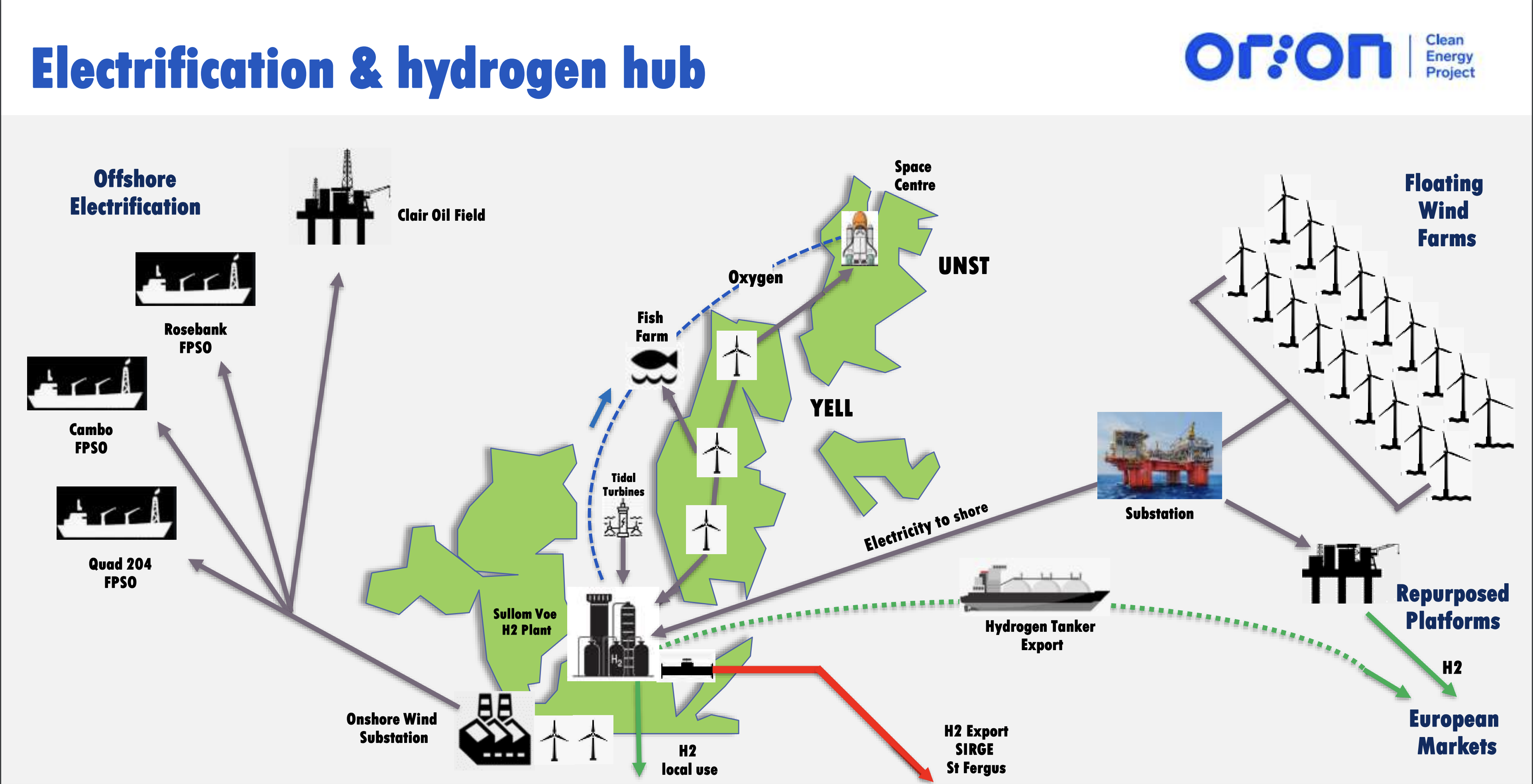
Note these points about what the Shetlanders call the Orion Project.
- Offshore installations are electrified.
- There are wind turbines on the islands
- Hydrogen is provided for local energy uses like transport and shipping.
- Oxygen is provided for the fish farms and a future space centre.
- There is tidal power between the islands.
- There are armadas of floating wind turbines to the East of the islands.
- Repurposed oil platforms are used to generate hydrogen.
- Hydrogen can be exported by pipeline to St. Fergus near Aberdeen, which is a distance of about 200 miles.
- Hydrogen can be exported by pipeline to Rotterdam, which is a distance of about 600 miles.
- Hydrogen can be exported by tanker to Rotterdam and other parts of Europe.
It looks a very comprehensive plan!
The German Problem
Germany has an energy problem.
- It is a large energy user.
- It has the largest production of steel in Europe.
- It prematurely shut some nuclear power stations.
- About a quarter of electricity in Germany comes from coal. In the UK it’s just 1.2 %.
- It is very reliant on Russian natural gas.
- The country also has a strong Green Party.
- Germany needs a lot more energy to replace coal and the remaining nuclear.
- It also needs a lot of hydrogen to decarbonise the steel and other industries.
Over the last few months, I’ve written these articles.
- Sale To Linde Of World’s Largest PEM Electrolyser
- Uniper To Make Wilhelmshaven German Hub For Green Hydrogen; Green Ammonia Import Terminal
- WindH2 Hydrogen Project Commissioned In Germany
- Morocco Could Produce Up To 4% Of World’s Green Hydrogen By 2030
- Get H2 Partners Propose Green Hydrogen Pipeline In Europe
- Alstom Hydrogen Trains Complete Trials
Germany seems to have these main objectives.
- Increase their supply of energy.
- Ensure a plentiful supply of hydrogen.
They appear to be going about them with a degree of enthusiasm.
BP’s Ambition To Be Net Zero By 2050
This press release from BP is entitled BP Sets Ambition For Net Zero By 2050, Fundamentally Changing Organisation To Deliver.
This is the introductory paragraph.
BP today set a new ambition to become a net zero company by 2050 or sooner, and to help the world get to net zero. The ambition is supported by ten aims
The ten aims are divided into two groups.
Five Aims To Get BP To Net Zero
These are.
- Net zero across BP’s operations on an absolute basis by 2050 or sooner.
- Net zero on carbon in BP’s oil and gas production on an absolute basis by 2050 or sooner.
- 50% cut in the carbon intensity of products BP sells by 2050 or sooner.
- Install methane measurement at all BP’s major oil and gas processing sites by 2023 and reduce methane intensity of operations by 50%.
- Increase the proportion of investment into non-oil and gas businesses over time.
I would assume that by gas, they mean natural gas.
Five Aims To Help The World Get To Net Zero
These are.
- More active advocacy for policies that support net zero, including carbon pricing.
- Further incentivise BP’s workforce to deliver aims and mobilise them to advocate for net zero.
- Set new expectations for relationships with trade associations.
- Aim to be recognised as a leader for transparency of reporting, including supporting the recommendations of the TCFD.
- Launch a new team to help countries, cities and large companies decarbonise.
This all does sound like a very sensible policy.
BP’s Partnership With EnBW
BP seemed to have formed a partnership with EnBW to develop offshore wind farms in the UK
Their first investment is described in this press release from BP, which is entitled BP Advances Offshore Wind Growth Strategy; Enters World-Class UK Sector With 3GW Of Advantaged Leases In Irish Sea.
This is the first five paragraphs.
bp and partner EnBW selected as preferred bidder for two highly-advantaged 60-year leases in UK’s first offshore wind leasing round in a decade.
Advantaged leases due to distance from shore, lower grid cost, synergies from scale, and faster cycle time.
Projects expected to meet bp’s 8-10% returns aim, delivering attractive and stable returns and integrating with trading, mobility, and other opportunities.
Annual payments expected for four years before final investment decisions and assets planned to be operational in seven years.
In the past six months bp has entered offshore wind in the UK – the world’s largest market – and the US – the world’s fastest-growing market.
Note.
- EnBW are Energie Baden-Wuerttemberg AG, who, according to Wikipedia, are the third largest utilities company in Germany.
- It also appears, that EnBW have developed wind farms.
BP have issued this infographic with the press release.
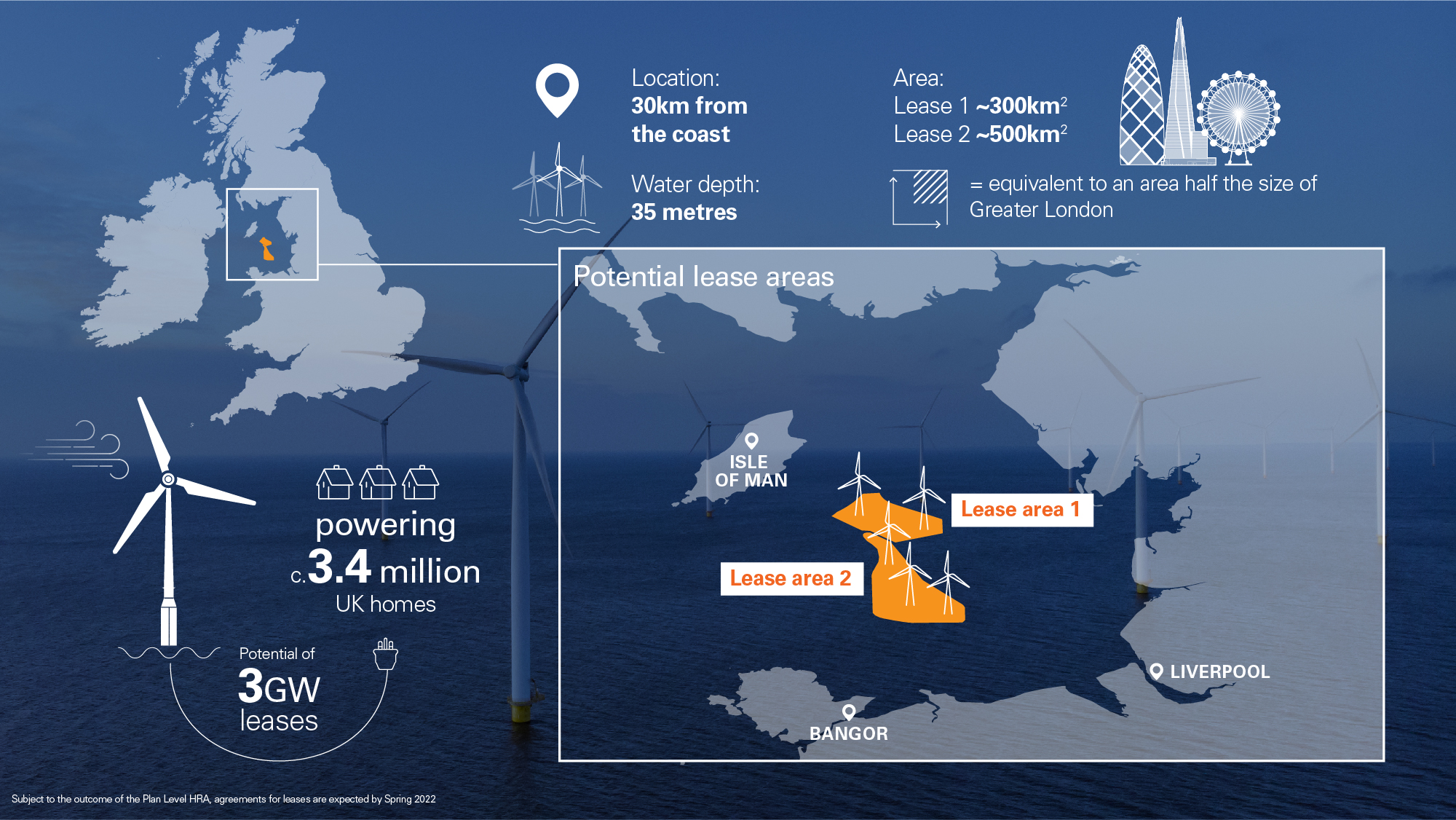
Note.
- The lease areas don’t appear to be far from the Morecambe Bay gas field.
- The Morecambe Bay gas field is coming to the end of its life.
- The Morecambe Bay gas field is connected to the Rampside gas terminal at Barrow-in-Furness.
- At peak production 15 % of the UK’s natural gas came from Morecambe Bay.
I just wonder, if there is a cunning plan.
Could the platforms be repurposed to act as electrical hubs for the wind turbines?
- 3GW of electricity would produce 55 tonnes of hydrogen per day.
- The hydrogen would be exported to the Rampside gas terminal using the existing pipelines.
- There may be savings to be made, as HVDC links are expensive.
- BP either has the engineering to convert the platforms or they know someone who does.
- Would the industrial complex at Barrow-in-Furnace and the nearby Sellafield complex have a use for all that hydrogen?
- Or would the hydrogen be used to fuel Lancashire’s buses and trucks on the M6.
It certainly looks to me, that it could be a possibility, to bring the energy ashore as hydrogen.
BP Seeking Second Wind Off Scotland
The title of this section, is the same as that of this article in The Times.
These are the first two paragraphs.
BP is preparing to bid for the rights to build wind farms off Scotland as it signals no let-up in expansion after a £900 million splurge on leases in the Irish Sea.
The London-based oil giant caused waves in February by offering record prices to enter the UK offshore wind market through a Crown Estate auction of seabed leases off England and Wales.
As I said earlier.
- The Shetland Islands are developing themselves as a giant hydrogen factory.
- There are pipelines connecting platforms to the Sullom Voe Terminal.
- There are plans to convert some of the redundant platforms into hydrogen production platforms.
- The islands will be developing ways to export the hydrogen to the South and Europe.
BP also operates the Schiehallion oil and gas field to the West of the Shetlands, which is connected to the Sullom Voe Terminal by the West of Shetland pipeline.
Could BP and EnBW be coming to the party?
They certainly won’t be arriving empty-handed.
Does BP Have Access To Storage Technology?
I ask this question because both the Morecambe Bay and Shetland leases could be built with co-located depleted gas fields and offshore electrolysers.
So could hydrogen gas be stored in the gas fields?
I think it could be a possibility and would mean that hydrogen would always be available.
Could Iceland Be Connected To Schiehallion Via A Gas Pipeline?
I estimate that Iceland and Schiehallion would be about six hundred miles.
This wouldn’t be the longest undersea gas pipeline in the world as these two are longer.
- Langeled – 725 miles
- Nord Stream – 759 miles
The Langeled pipeline cost £1.7 billion.
Conclusion
I think there’s more to the link-up between BP and EnBW.
I am fairly certain, that BP are thinking about converting some redundant gas platforms into hubs for wind turbines, which use the electricity to create hydrogen, which is then exported to the shore using existing gas pipelines and onshore terminals.
Could it be said, that BP will be recycling oil and gas platforms?
I feel that the answer is yes! Or at least maybe!
The answer my friend is blowing in the wind!
Tesla And PG&E Are Working On A Massive ‘Up To 1.1 GWh’ Powerpack Battery System
The title of this post, is the same as that of this article on electrek.
This is the first two paragraphs.
For the past few months, Tesla and CEO Elon Musk have been teasing a giant battery project that would dwarf even the company’s 129 MWh Powerpack project in Australia.
Today, we learn that Tesla is working with PG&E on a massive battery system with a capacity of “up to 1.1 GWh” in California.
It certainly, is a big lithium-ion battery.
- It will be able to provide 182.5 MW for four hours.
- It looks like it could be the largest lithium-ion battery in the world.
It is worth comparing with the Castaic Power Plant, which is also in California.
- This is a pumped storage plant.
- It can produce 1566 MW and has a capacity of 12470 MWh.
This Google Map shows the plant.
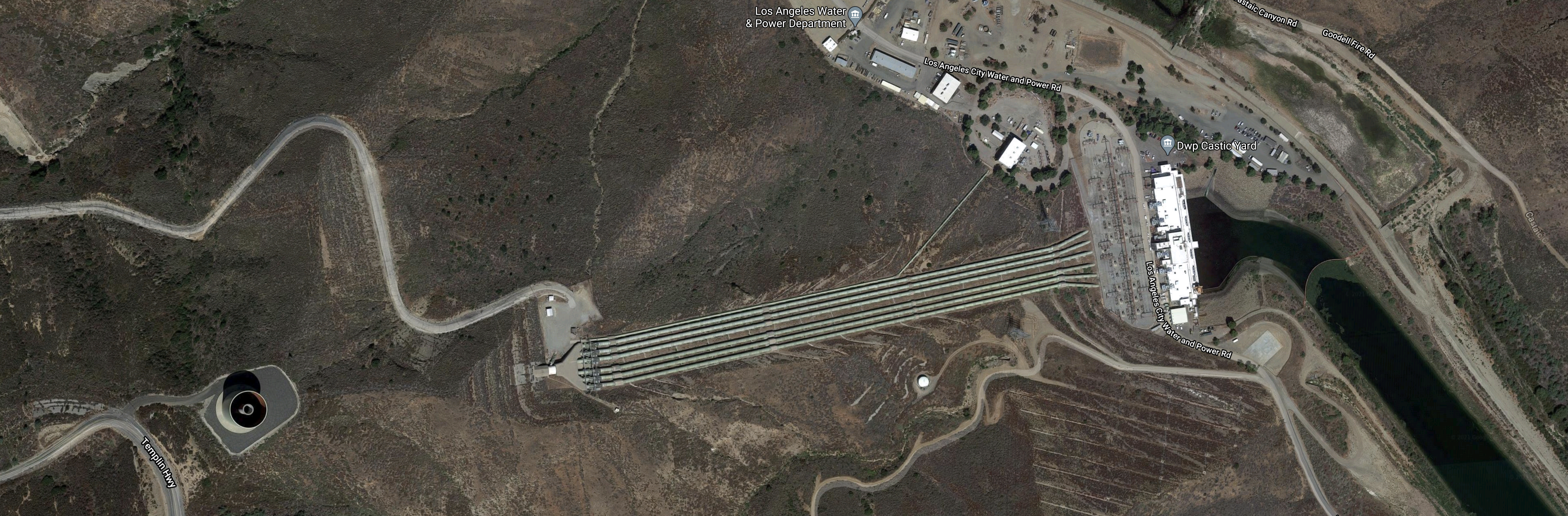
Note.
- The power plant is also part of the California State Water Project, which transfer water from North to South.
- The low-lake is Elderberry Forebay to the East.
- The high-lake is Pyramid Lake to the North.
It is a complicated system that includes the Angeles Tunnel, which takes water between Pyramid Lake and the Castaic power plant.
It cost a lot more than the 1.1 GWh battery, but it can generate a lot more power.
Reclassify Hydropower Now – As Renewable Energy
The title of this post, is the same as that of this article on Cal Matters.
It is written by a politician and details the mess California seems to be in over energy policy.
In the UK and Europe in general, hydro-electric power is generally considered to be renewable.
But not always in California, where environmentalists are against dams. So in the last heatwave, California was importing hydropower from places like the Hoover Dam.
We must get our policies and definitions right on what is and what isn’t renewable energy.
Engie Partners Innovate UK For £4 Million Energy Transition Competition
The title of this post is the same as this article on Current News.
- This is an interesting link-up between the UK Government Agency; Innovate UK and the French energy giant; Engie.
- Wikipedia defines energy transition as a long-term structural change in energy systems.
- It is the first time Innovate UK has secured overseas private funding.
- It aims to fund the very best of \british innovation in clean growth innovation.
- Grants of between £100,000 and £1.2 million will be awarded.
- There appears to be no mention of Brexit!
It looks to me, like a very strong endorsement of British innovation and the British energy industry by the French.
I also think, that if there is one industry where the British and the French should be linked, it is energy.
The UK has the following energy sources and resources.
- Offshore and onshore oil and gas.
- Redundant gas fields for carbon capture and storage.
- Offshore and onshore wind.
- Large areas of sea for offshore wind.
- We have 8,183 MW of installed offshore wind capacity, which is the largest in the world.
- The possibilities of tidal and wave power from a long Western coast.
- Vast experience in building off-shore structures in some of the worst weather on the planet.
- Interconnectors to Norway and Iceland to import their surplus geothermal and hydroelectric energy.
Could we become a renewable-energy powerhouse?
The French have the following.
- Nuclear power, some of which will need replacing.
- Only 500 MW of offshore wind.
- More solar power than we have.
- Easy connection to North Africa for solar power.
But in some ways, most important is the several interconnectors between the UK and France, with more planned.
Conclusion
Between the UK and France, with help from Ireland, Spain and Portugal, can develop a massive Western European renewable energy powerhouse, backed by the following, non-renewable or external sources.
- French nuclear power.
- North African solar.
- Icelandic geothermal power
- Icelandic hydro-electric power
- Norwegian hydro-electric power
It should be noted that in a few years, the UK will have joined Iceland, Norway and North Africa outside of the European Union.
I believe that Sovereign Wealth Funds, Hedge Funds, Pension Funds, Insurance Companies and other individuals, groups and organisations will increasingly see renewable energy as good places for long-term investment of their funds.
The two big problems are as follows.
- What happens when all these renewable energy sources are producing more energy than we can use?
- What happens when there is an energy deficit?
Energy storage is the solution, but the amount needed is massive.
In Airport Plans World’s Biggest Car Parks For 50,000 Cars, I looked at the mathematics in using car parks for electric cars for energy storage.
These are a few figures.
- Electric Mountain is the UK’s largest electricity storage scheme with a capacity of 9.1 GWh.
- The largest battery in the world is the Bath County Pumped Storage Station with a capacity of 24 GWh, which works on similar principles to Electric Mountain.
- Building another Electric Mountain would cost £1350 million, if we could find somewhere to put it.
But supposing half the 35.5 million cars and light goods vehicles in the UK were replaced by new electric vehicles containing a battery of around 20 kWh, that would be a total storage of 355 GWh or nearly forty Electric Mountains.
Conclusion
Harnessing all of these batteries will be an enormous challenge, but it will be ideas like this, that will enable the world to go carbon neutral by 2050.
But I don’t think we’ll ever see Trump or Xi Jinping in an electric limousine..
 The Anonymous Widower