Go-Ahead Adds 20 FC Buses To Gatwick Fleet
The title of this post, is the same as that of this article on electrive.com.
I described my ride on these buses in My Second Ride In A Wrightbus Single-Decker Hydrogen Bus.
I am publishing this post for this key paragraph on the electrive.com article.
When the order was placed in 2021, Martin Harris, Managing Director of Brighton & Hove and Metrobus, already specified why hydrogen buses were now being used for the first time: “We run services 24 hours a day, with hilly terrain, heavy passenger loads and duty cycles well in excess of the national average at up to 370 miles per day. Those provide really challenging conditions for any technology but we concluded that hydrogen provides the most efficient replacement for our diesel buses.”
It is interesting to note, that the hydrogen buses in Birmingham, Dublin and Liverpool are used on longer routes.
My Second Ride In A Wrightbus Single-Decker Hydrogen Bus
Or it might have been the third or fourth, but it was the first outside of London in a single-decker Wrightbus hydrogen bus. The earlier rides were in the RV1 route, which I wrote about in London’s Hydrogen Buses.
I took these pictures.


















Note.
The trip was in Crawley and Go-Ahead are building a network of hydrogen buses to link the town and Gatwick Airport.
- It was a high quality bus.
- It was busy.
- It was the first bus, I’d seen in the UK, with a detailed route.
Someone had been thinking about how to design a bus route.
Could Hydrogen Trains Be Used As Pathfinders?
I must admit, I have a soft-spot for hydrogen transport, but I suppose most people look back on their first real job with a certain affection.
The only new hydrogen train under development for the UK Is the Alstom Hydrogen Aventra, which was announced in this press release in November 2021 and is entitled Alstom And Eversholt Rail Sign An Agreement For The UK’s First Ever Brand-New Hydrogen Train Fleet.
Little is known about these trains, except what is in the original press release.
- Ten trains have been ordered.
- Each will be three-cars.
- Contracts will be signed in 2022, which didn’t happen.
Nothing is said about the following important features.
- What will be the operating speed?
- What will be the range on a fill of hydrogen?
- Will the trains have a pantograph, so they can be run on electrified lines with 25 KVAC overhead electrification?
All are important to train operating companies, who along with the Department for Transport need to be able to plan.
What Do I Mean By A Pathfinder?
I will look at the service between Reading and Basingstoke.
- It is 15.4 miles long.
- There are four stops, which will soon be five, with the addition of Reading Green Park.
- The line is partly-electrified.
- The service is only hourly and probably needed to be two trains per hour (tph).
- It is currently run by diesel trains.
In a decarbonised railway, there are only two options for running this line.
- Use hydrogen trains.
- Electrify and use electric trains.
Note.
- The cost of the two options will be different.
- If the hydrogen and electric trains are both quality trains, the passenger experience will be similar.
- To run two tph, track and signalling modifications will be needed.
- These modifications would also allow a two tph diesel service.
- There is no way to accurately determine, how many passengers would use a two tph hydrogen and electric service.
So suppose the following plan were to be enacted.
- Upgrade the track and signalling to allow a two tph service.
- Run the two tph service with diesel trains.
- Install hydrogen infrastructure for the route. In this case, it would probably be at the nearby Reading depot.
- Run the two tph service with hydrogen trains.
Hopefully on the completion of some months of successful running of the hydrogen trains, the number of passengers to be expected will have been predicted to a better accuracy than UK railways normally manage.
Then the decision between hydrogen and electric trains can be taken.
If hydrogen trains are the decision, the trains could stay in service, but if electrification is the solution, then once the electric service is operating, the hydrogen trains would move on to the next line to be decarbonised.
Why The Alstom Hydrogen Aventra’s Need To Be Able To Use Electrification
If you look at routes, where hydrogen trains could be used as Pathfinders, they could include, some partially-electrified routes.
- Reading and Bedwyn
- Reading and Oxford
- Reading and Gatwick
- London Bridge and Uckfield
- Ashford and Eastbourne
- Preston and Blackpool South
- Wisbech and Cambridge
- Dereham and Norwich
- Basingstoke and Exeter
- Romsey and Salisbury
- York and Scarborough
This list includes both routes with both types of electrification; 25 KVAC overhead and 750 VDC third rail.
But if the electrification is there and not used, the exercise will be labelled as greenwashing, by some.
Mercedes eCitaro Fuel Cell Will ‘See The Light’ At UITP Summit 2023
The title of this post, is the same as that of this article on Sustainable Bus.
This is the first paragraph.
Daimler Buses will unveil the Mercedes eCitaro fuel cell at UITP Global Public Transport Summit in early June. At the group’s stand, visitors will have the opportunity to see the first series-production eCitaro electric bus with a fuel cell as a range extender. First order for the vehicles dates back to October 2022.
This paragraph describes the bus.
The Mercedes eCitaro in fuel cell bus version offers a stated range of approximately 350 kilometers without the need for recharging. This goes together a passenger capacity, on the articulated version, of up to 128 passengers. The difference between the eCitaro fuel cell project and most of the fuel cell buses on the market stay in the battery capacity: while it’s common to feature a small LTO battery (below 50 kWh) accompanying the fuel cell module, the eCitaro is equipped with a battery capacity similar to its battery-electric counterpart (up to 392 kWh for the 18-meter).
It looks an impressive bus with a generous capacity and range.
But I doubt we’ll see many in the UK.
- Motorists object to their blocking of junctions.
- They were easy for dodging fares.
- In London, they were dubbed Ken’s Chariots of Fire.
I don’t think politicians will chance them in the UK!
ULEZ: Impact Of Mayor’s Expansion Questioned
The title of this post, is the same as that of this article on the BBC.
This is the sub-heading.
One in six cars registered in outer London did not meet Ultra Low Emission Zone (ULEZ) standards last year, according to figures from the Society of Motor Manufacturers and Traders
These paragraphs outline the analysis.
The data was released following a Freedom of Information request by the BBC to Transport for London (TfL).
It comes amid a dispute over whether existing data used by City Hall and TfL is accurate.
However, London Mayor Sadiq Khan said the newly released data was unreliable.
From the end of August, all those driving vehicles within Greater London that do not meet ULEZ pollutant limits will face a £12.50 daily charge or a £180 fine.
I’m sure that any Professor of Statistics from London’s universities or an expert from the Royal Statistical Society, could give a definitive answer on the statistics.
But then Khan is a lawyer and will hide behind the law in this case, by claiming he is both judge and jury.
If Khan really cared about London’s air, he would have a hydrogen policy, which would enable London’s local cement, construction and refuse trucks to be replaced or converted to hydrogen, so that the city’s air improved.
It would also make it easier to introduce more hydrogen-powered buses.
Companies like Tesco and Marks & Spencer, who regularly run trucks into London, should be encouraged to convert their delivery trucks to zero-carbon, by adjustment of the ULEZ charges.
The ULEZ has been badly thought out and needs to be realigned with what is practical and reduces the pollution.
Articles From The Engineer
I generally read articles from The Engineer once a week.
Here’s a few that are worth reading.
12th Feburuary 2023 – Hydrogen Ambulance Set For London
A project led by hydrogen fuel specialists ULEMCo is aiming to deliver the UK’s first zero emission hydrogen ambulance later this year
There is an interesting discussion, as to whether hydrogen or battery ambulances are better. Range and hotel power issues seem to favour hydrogen.
11th May 2023 – Bramble Energy Secures £12m For Hydrogen Bus
Bramble Energy has joined forces with Equipmake, Aeristech and Bath University to develop a new hydrogen double-deck bus integrating its printed circuit board fuel cell (PCBFC) technology
Bramble Energy can create bespoke fuel cell stacks in a ‘matter of days at scale and low-cost’.
12th May 2023 – Cornish Geothermal Project Leads Government Heat Scheme
The UK’s first deep geothermal heat network is one of seven new projects to receive funding as part of a new government programme to decarbonise buildings across England.
The full list of projects to receive support today via the Green Heat Networks Fund is detailed.
17th May 2023 – Ricardo Joins Pan-European Hydrogen Shipping Consortium
UK engineering firm Ricardo is set to play a key role in the sustainable HYdrogen powered Shipping (sHYpS) project being funded by the EU’s Horizon Europe programme.
One thing that is disclosed in the article, is that Ricardo have a new 400kW hydrogen fuel cell test chamber at the company’s UK headquarters.
Toyota And VDL Groep To Convert Heavy-Duty Vehicles Into Hydrogen Fuel Cell Trucks
The title of this post, is the same as that of this article on Hydrogen Fuel News.
This is the first paragraph.
Toyota Motor Europe (TME) and Dutch VDL Groep have teamed up to covert VDL’s existing heavy-duty trucks into hydrogen fuel cell trucks using Toyota’s fuel cell modules, with a goal to accelerate decarbonizing the road logistics sector while also breaking into Europe’s zero-emission heavy duty H2 trucks market.
Note.
- According to their Wikipedia entry, VDL Groep seem to manufacture buses, coaches, chassis modules and vehicle components.
- In Ricardo Supports Toyota To Develop Its First UK-Based Hydrogen Light Commercial Vehicle, I wrote about conversion of the Toyota Hilux to hydrogen.
- There are a large number of companies all over the world, who will convert vehicles to hydrogen.
- It could be argued that Wrightbus and Alexander Dennis, have designed hydrogen buses, that could be conversions of existing designs.
- Cummins are selling diesel engines, that can be converted to hydrogen.
Could these points indicate, that one of the main routes to the decarbonisation of the heavier end of the commercial vehicle sector will be conversion of existing vehicles to hydrogen fuel?
And will this lead to smaller conversion kits to decarbonise vehicles like Land Rovers, Range Rovers, larger BMWs, Jaguars and Mercedes?
If you consider, that when I was growing up in the 1950s, you rarely saw a small diesel vehicle and how diesel came to grab a large market share, due to good engineering and some misguided tax changes from Gordon Brown, I don’t think it is unreasonable to believe that good engineering and perhaps well-thought out tax changes could create an affordable route to decarbonise a large proportion of vehicles.
If I was still driving and lived away from dreaded ULEZs, then I would be keeping my reliable diesel Jaguar estate.
Hydrogen Buses Start Running Across Region
The title of this post, is the same as that of this article on the BBC.
These are the main points.
-
A fleet of 20 hydrogen powered buses start running in Merseyside
-
The zero emission buses will improve air quality, Mayor Steve Rotheram said
-
He wants the Liverpool City Region to be net zero carbon by 2040
The buses will operate on the 10A route between St Helens, Knowsley and Liverpool city centre.
I wonder, if they’ll go past my old digs on Huyton Lane.
South Korea Targets Over 2,000 Hydrogen Buses By 2026
The title of this post, is the same as that of this news item from Argus Media.
This is the sub-heading.
South Korea plans to convert more than 250 commuter buses intro hydrogen-fuelled buses by this year and more than 2,000 by 2026, in a concerted effort to raise the uptake of hydrogen vehicles.
It appears to be a well-thought plan.
This last paragraph gives South Korea’s long-term objective.
A higher uptake of hydrogen vehicles is in line with the hydrogen roadmap the government released in November 2022, where it envisioned the transportation sector as one of the key drivers of large-scale hydrogen demand. South Korea aims to raise its supply of high-mobility vehicles such as hydrogen buses and trucks, with a goal of producing 30,000 hydrogen commercial vehicles and building 70 liquid hydrogen refuelling stations in the country by 2030.
We need an ambitious plan like this in the United Kingdom.
As the UK population is thirty percent larger than South Korea’s we probably need one with similar but larger ambitions.
Riding The X26 Bus Between West Croydon Bus Station And Heathrow Airport
I did this journey, which will be part of the Superloop, in the pouring rain yesterday, and took these were the awful pictures.









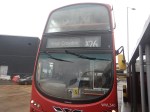


Note.
- The rain didn’t help, but the journey was so slow and it is timetabled for an hour and forty minutes.
- There was a lot of traffic and this meant we were a few minutes late.
- I was sitting up front, with another pensioner, who was going to have lunch with mates in Kingston.
It may be an express bus, but I can’t see the speed of this section attracting a lot of passengers.
When I took my ride across Birmingham in a hydrogen bus, which I wrote about in Riding Birmingham’s New Hydrogen-Powered Buses, where I said this about the Wrightbuses.
I very much feel that the buses are the best hydrogen-powered vehicles, that I’ve travelled in, as they are smooth, comfortable, quiet and seem to have excellent performance.
There were some sections of dual-carriageway in Birmingham, where the buses were able to use their excellent acceleration to get through the traffic and make up many seconds.
It should also be noted, that Dublin uses the same hydrogen buses for a long-distance commuter bus.
 The Anonymous Widower