The World’s First Bi-Mode Hydrogen-Electric Train
This news page on the University of Birmingham web site is entitled HydroFLEX Secures Funding For Hydrogen-Powered Train Design.
The page is mainly about the new funding from Innovate UK, that I wrote about in First Of A Kind Funding Awarded For 25 Rail Innovation Projects, but it also includes this significant paragraph.
As well as being the UK’s first hydrogen-powered train, HydroFLEX is also the world’s first bi-mode electric hydrogen train. It will be undergoing mainline testing on the UK railway in the next few weeks.
One of my disappointments in the design of the Alstom Coradia iLint, is that, it is designed as a hydrogen-power only train, where it could surely have had a pantograph fitted, for more efficient working.
Consider.
- I suspect many hydrogen-powered trains will only be doing short distances, where electrification is not available, so daily distances under hydrogen power could be quite short.
- In the UK, a smaller hydrogen tank would certainly ease the design problems caused by a large fuel tank.
- There have been improvements in hydrogen storage in recent years.
The funding award to the project talks about raft production, so are the engineers, aiming to design a hydrogen power-pack on rafts, that could be fitted underneath the large fleets of retired electric multiple units, that are owned by Porterbrook.
Now that would be a game changer.
- Porterbrook have thirty-seven Class 350 trains, that will be replaced in the next few years by new trains. The electric trains are less than a dozen years old and Porterbrook have been talking about fitting batteries to these trains and creating a battery/FLEX train. Would making these trains bi-mode hydrogen-electric trains be better?
- Birmingham wants to open up new rail routes in the city on lines without electrification. What would be better than a hydrogen powered train, designed in the city’s premier university?
- Routes from Birmingham to Burton-on-Trent, Hereford, Leicester, Shrewsbury, Stratford-on-Avon and Worcester would be prime candidates for the deployment of a fleet of bi-mode hydrogen-electric trains.
- Birmingham have already asked ITM Power to build a hydrogen filling station in the city for hydrogen buses.
Alstom And Snam To Develop Hydrogen Trains In Italy
The title of this post, is the same as that of this article on H2 View.
This paragraph sums up the agreement.
As part of the agreement, Alstom will manufacture and maintain newly built or converted hydrogen trains, while Snam will develop the infrastructures for production, transport and refuelling.
It does appear that Alstom is setting up similar deals across Europe, with now Germany, the Netherlands, the UK and Austria being prepared for hydrogen trains, manufactured or converted by Alstom.
The only recent reference, that I can find to the Alstom Breeze for the UK, is this article in Electric And Hybrid Vehicle Technology International, which is entitled Is Post-Covid The Perfect Time To Start A Hydrogen Transportation Revolution?
There is just a new visualisation pf the train to illustrate an article.
Reintroduction Of Passenger Rail Services On The Waterside Line
This is one of the successful bids in the First Round of the Restoring Your Railway Fund.
At first I wasn’t sure, which line was referred to as the Waterside Line. But then I looked at the Fawley Line on Wikipedia.
This is the opening paragraph.
The Fawley branch line, also known as the Waterside line is a standard-gauge railway line to Fawley, in the English county of Hampshire. It is on the opposite side of Southampton Water from the city of Southampton itself, in an area known as Waterside. For 40 years a passenger service operated, but this was withdrawn with the exception of the occasional enthusiasts’ railtour. The line serves the freight needs of Marchwood Military Port, having also served the same function for Fawley Refinery until 2016.
I explored this line in Reopening The Fawley Branch Line.
The Wikipedia entry, also gives details under Future, of a plan by the Association of Train Operating Companies to reopen the line.
The proposals in Wikipedia included.
- Reopening of all former stations along the line; Marchwood, Hythe, Hardley Halt and Fawley
- A new station in Totton called Totton West, sited just west of the junction with the main line.
- A new train service from Fawley or Hythe to Totton and on via Southampton Central, Southampton Airport Parkway, Eastleigh, Chandlers Ford and Romsey before returning to Southampton Central, Totton and Fawley or Hythe, also serving other intermediate stations.
The service was planned to run half-hourly during peak times and hourly at other times.
The Route
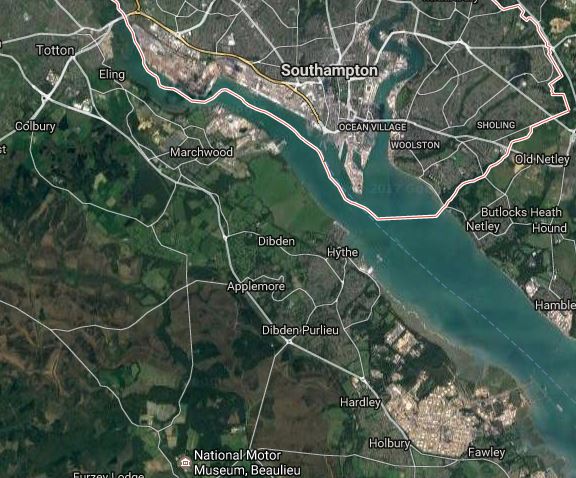
This Google Map shows the area of the Waterside Line
Note.
- The line starts at Totton and there used to be stations at Marchwood, Hythe, Hardley and Fawley.
- All the places with stations are named on the map.
- The line is about seven miles in length.
- From my helicopter, it looks to be single-track most, if not all the way.
- There is a ferry between Hythe and Southampton.
This picture shows where the Waterside Line joins the main line.
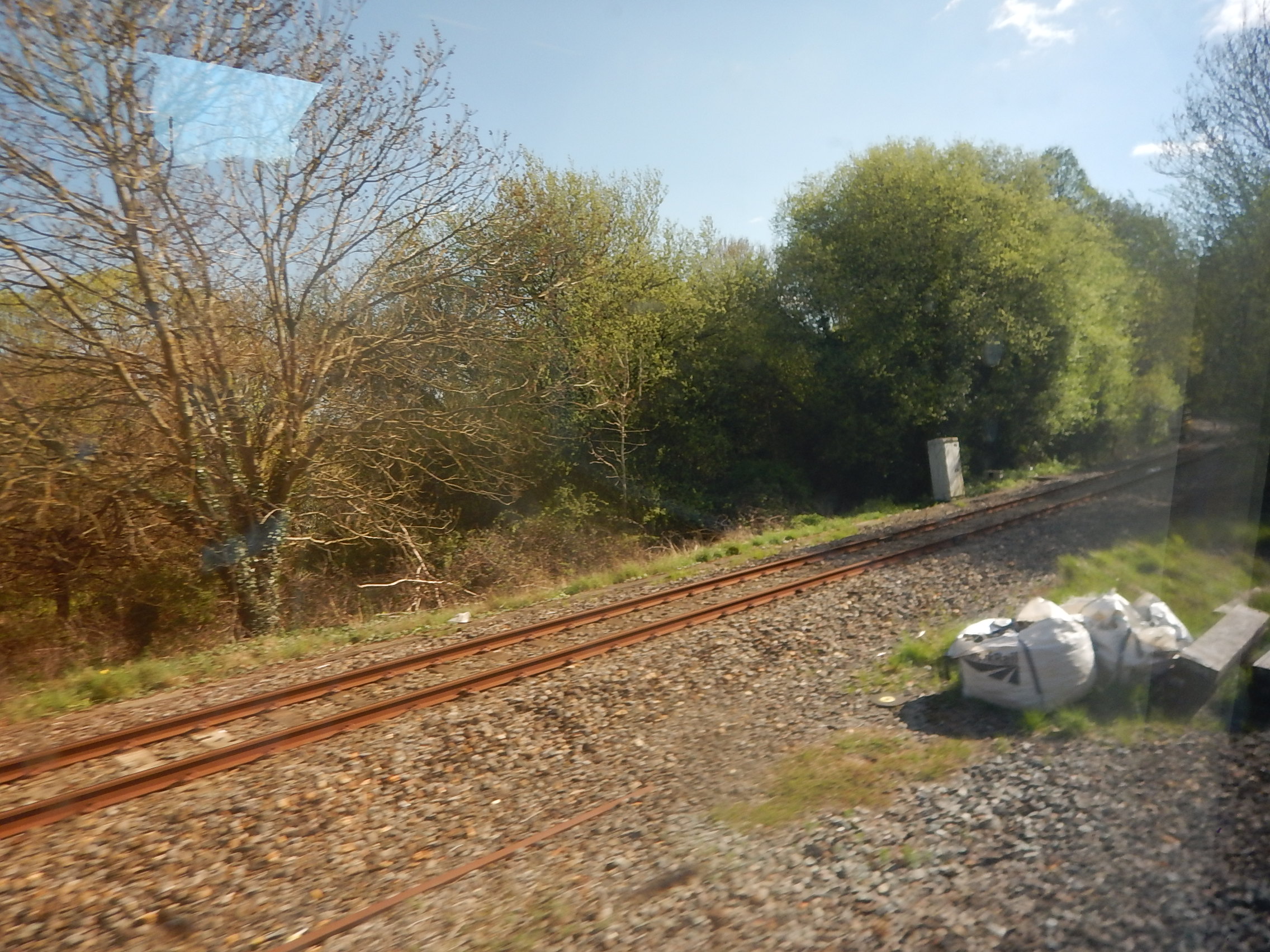
It all looks pretty tidy and in good condition, so making the connection to the main line wouldn’t be too difficult.
The line passes through Hythe about two hundred metres from the water.
This Google Map shows Hythe.
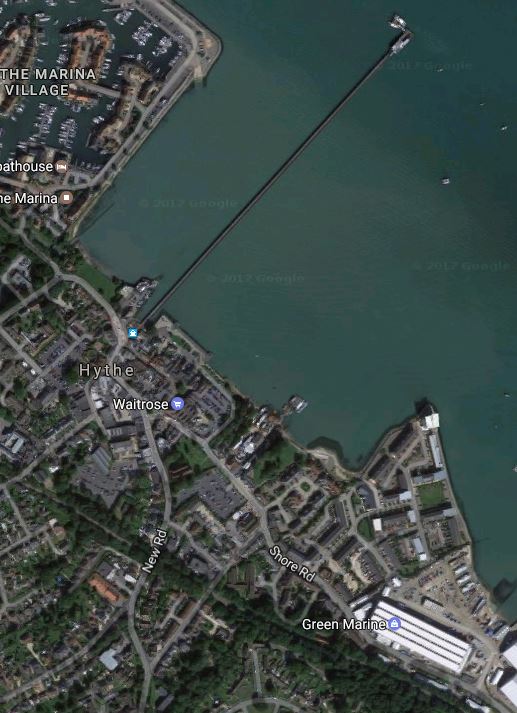
The railway can be picked out as the green scar going across the bottom of the map.
I took these pictures, when I visited Hythe in February 2017.

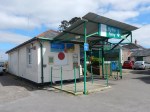
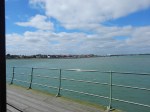
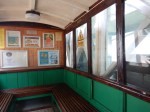
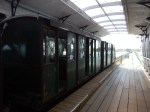
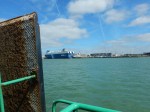

I’m not sure, where the new Hythe station would go.
As the Waterside Line was still fully in use to Esso Fawley until four years ago, I should suspect that updating the track and signalling for passenger trains wouldn’t be the most challenging of projects.
The Trains
Wikipedia says this about the trains to be used.
The service would be operated by the then franchisee; South West Trains using diesel multiple units (DMUs)
This means they will be Class 158 or Class 159 trains, as South West Trains doesn’t have any other DMUs.
This picture shows a newly-liveried Class 159 train at Corfe Castle station.
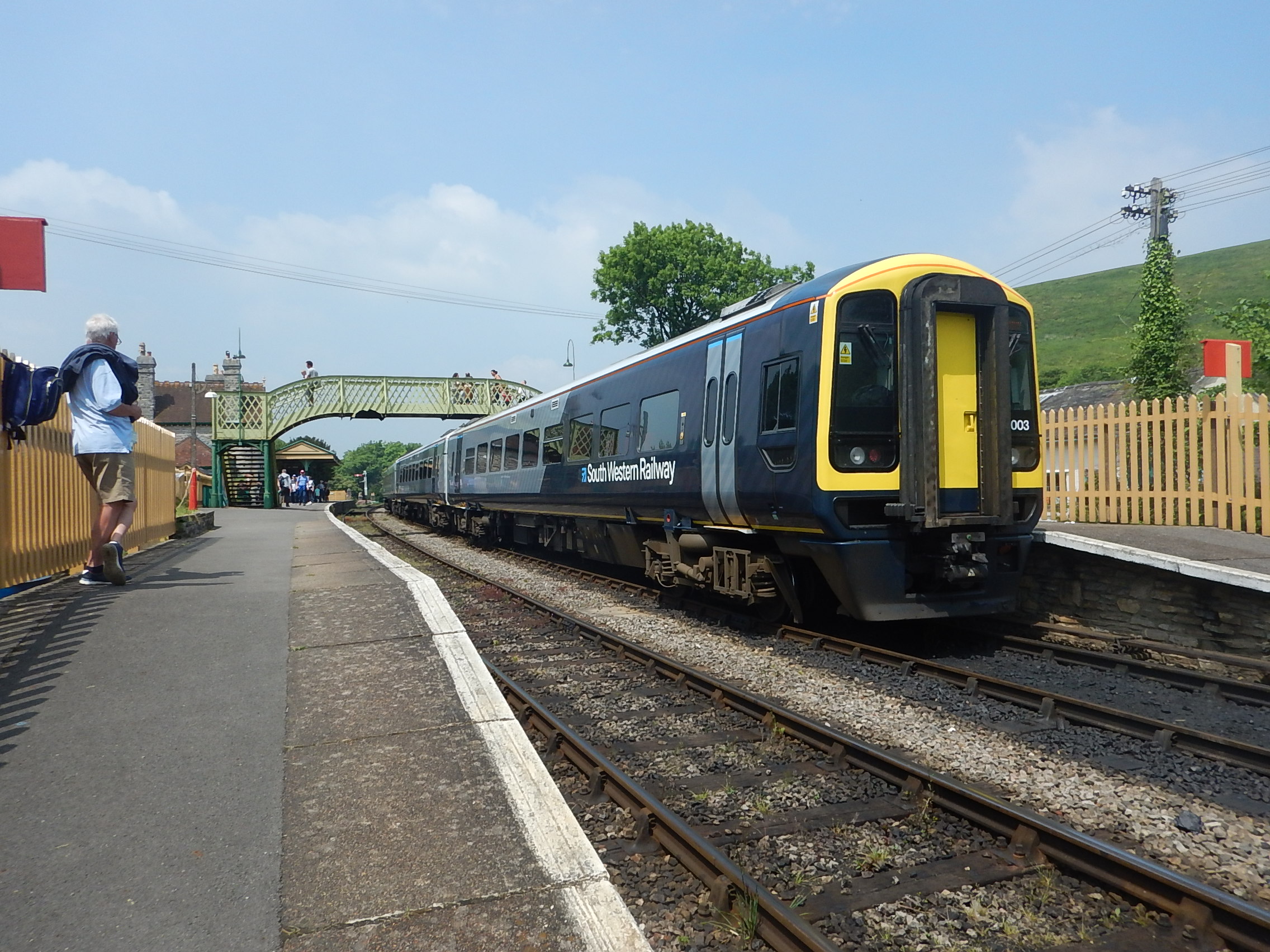
The Class 158/159 trains would certainly do a job, but I believe that any solution must be zero-carbon, to meet the UK’s target of being carbon neutral by 2050.
The Use Of Battery Trains
Consider.
- Fawley and Totton West Junction are seven files apart. As there are five stations, I will assume three minutes per station of a journey of fifteen minutes.
- Totton West and Eastleigh are ten miles apart and fast trains take seventeen minutes.
- Eastleigh and Romsey are seven miles apart and fast trains take fourteen minutes.
- Only the section between Totton West and Eastleigh is electrified.
- Adding up the times gives a journey time between Fawley and Romsey of forty-six minutes.
- Add in fourteen minutes to turn the trains and each Fawley and Romsey takes an hour with a two-hour round trip. This is all very convenient!
- For example, an hourly service, would need two trains and they could leave Fawley and Romsey at the same time.
- It could also be arranged, that only one train was on the single-track Waterside Line at any one time.
- The fourteen minutes being used to turn the train, could also be used to charge the batteries on a battery-electric train.
- In each two-hour round trip between Fawley and Romsey, trains would spent thirty-four minutes connected to electrification and twenty-eight minutes connected to chargers. This means that there is plenty of time to charge the batteries.
- It should be noted that the train runs on a busy main line between Totton West and Eastleigh, so good acceleration and 90-100 mph capability would probably be needed, by any trains shuttling between Fawley and Romsey.
With charging facilities at Romsey and Fawley, I would be certain, that a two battery-electric trains could provide an hourly service on the route.
Candidates would probably include battery-electric versions of a Bombardier Aventra or Electrostar, a CAF Civity or a Siemens Desiro City. I doubt, that the performance of a Class 230 train is enough to keep out of the way of fast expresses.
The Use Of Hydrogen Trains
The route could also be worked by a hydrogen-powered train with enough performance.
The Stations
There would need to be new stations at Totton West, Marchwood, Hythe, Hardley and Fawley.
As the first is new and the others were closed in the 1960s, they would be complete builds, rather than an easy refurbishment.
Fawley Waters
In the Wikipedia entry for Fawley station, there is a section called Proposed Reopening, where this is said.
In August 2018, it was revealed that plans to reopen the Fawley Branch Line had been resurrected as part of the redevelopment known as Fawley Waters. It proposed a half-hourly service on a Monday to Saturday from Southampton Central to Fawley. At Marchwood the journey time would take 12 minutes and the linespeed would be 60 mph (97 km/h). Fawley station, if reopened, would be known as Hythe & Fawley Parkway which would serve both Hythe and Fawley.
Now, there would appear to be two plans for the operation of the Waterside Line.
- The Association for Train Operating Companies plan, which has an hourly service to Totton, Southampton Central, Southampton Airport Parkway, Eastleigh, Chandlers Ford and Romsey, from five stations on the branch.
- The Fawley Waters plan, which has a half-hourly service to Totton and Southampton Central, from just two stations on the branch.
One plan would probably appeal to existing residents and the other to those, who bought new properties in Fawley Waters.
Conclusion
Future studies funded by the successful bid, could decide, which plan is best.
Overall though, this is a simple plan, that opens up an area to the West of Southampton for development.
Reinstatement Of The Ivanhoe Line
This is one of the successful bids in the First Round of the Restoring Your Railway Fund.
The Ivanhoe Line, is a half-completed project left over from the days of British Rail.
- The main objective appears to be to extend the current line between Lincoln and Leicester via Nottingham, East Midlands Parkway and Loughborough stations to Burton-upon-Trent along the freight-only Leicester-Burton-upon-Trent Line.
- Some new stations will be added.
In January 2020, I wrote Silent Hydrogen Trains On The Cards For New Line Linking Burton And Leicester, after reading an article on Derbyshire Live.
I finished that article by listing the possibilities.
There are a lot of possibilities to extend the Ivanhoe Line to Burton and even beyond using the South Staffordshire Line.
- Battery or hydrogen trains can be used.
- Stations can be added as required.
- The route will connect to East Midlands Airport.
- A solution for Knighton Junction can surely be devised.
Amazon are reported to be interested in the project, as they have a big depot at Coalville.
It now looks like it’s all going to be turned into a plan for reality.
I do have some questions.
What Will Be The Solution To The Knighton Junction Problem?
Sadly, when the route was closed to passengers in 1964, British Rail simplified Knighton Junction at the Leicester end of the line. Wikipedia says this.
At the Leicester end of the line, Knighton North Junction has been dismantled and the former course of the line to the junction has been sold and turned into an industrial estate. The line’s remaining connection with the Midland Main Line is Knighton South Junction, which faces southwards, away from Leicester station. Trains between Leicester and the line therefore have to reverse direction at the junction.
This Google Map shows, what’s left of the junction.
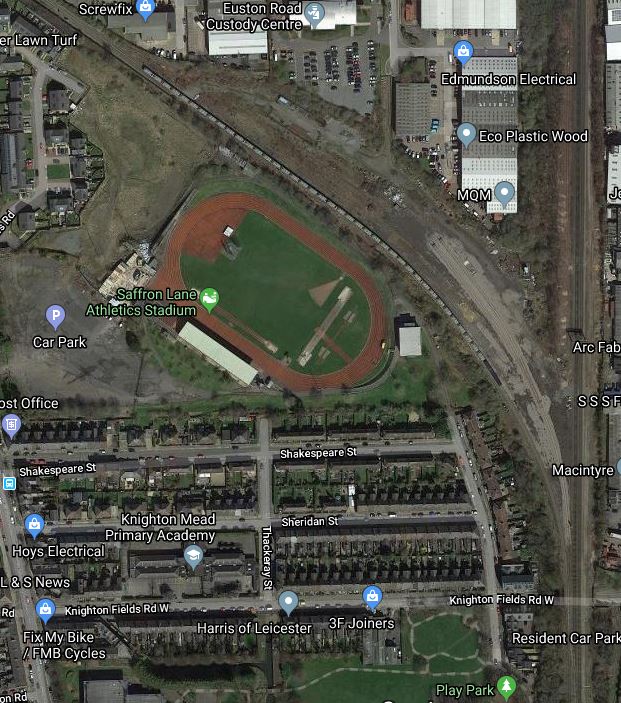
Note.
- Leicester is to the North
- Burton is to the North-West.
- Melton Mowbray and London are to the South.
It looks to me, that someone at British Rail made it absolutely certain, that the rail line could not be reopened to provide a passenger service between Leicester and Burton.
For a train to go between Leicester and Burton, it would either need to reverse as Wikipedia indicated, or the curve would have to be very tight.
It looks like the preferred solution, will be to build a new station to the South of Knighton Junction.
- The station would only need a single platform.
- It could be easily fitted in alongside the Midland Main Line.
Trains will reverse to get around the tight corner.
Will There Be A Station At Leicester City Stadium
This Google Map shows the stadium.
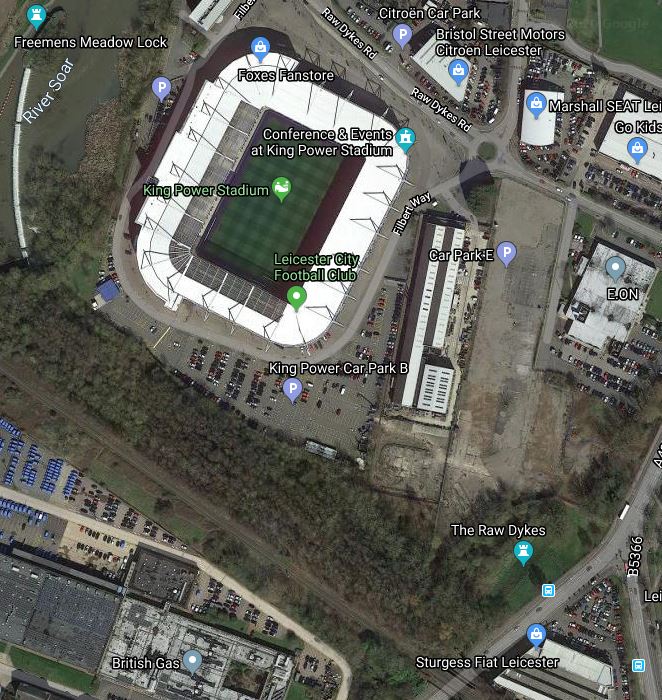
Note the rail line passing to the South of the station.
It would appear that building a new station would not be the most difficult of projects.
But after the experience of Coventry City, who were relegated twice after Coventry Arena station opened, would Leicester City want a station?
Could The Ivanhoe Line Be Connected To High Speed Two At Ashby-de-la-Zouch?
I heard an MP on the radio, who was very much against High Speed Two and that led me to write Could High Speed Two Have A Station At Ashby-de-la-Zouch?.
I think this is a serious possibility in the future.
Could East Midlands Railway Use The Route To Run A London And Burton-on-Trent Service?
Consider.
- East Midlands Railway‘s Class 810 trains could be fitted with a battery, that would give the trains a battery range of between 55 and 65 miles.
- The trains would have a charge time of perhaps 10 minutes.
- The distance between Knighton Junction and Burton-on-Trent is around 35 miles.
- The distance between Knighton Junction and the Northern limit of the electrification at Market Harborough station is fifteen miles.
- The distance between Market Harborough and Burton-on-Trent stations is 50 miles.
I think it would be possible for a battery-electric Class 810 train to run between London and Burton-on-Trent.
- The batteries would need to be charged at Burton-on-Trent.
- Perhaps, the easiest way to provide charging facilities would be to electrify the last ten miles between Ashby-de-la-Zouch and Burton-on-Trent stations
- The service could call at all or selected stations between Knighton Junction and Burton-on-Trent.
I think this could be a very useful service, even if it only ran a couple of times every day.
Could Battery-Electric Trains Run The Whole Ivanhoe Line Between Lincoln And Burton-on-Trent?
The problem is not the trains, but the lack of electrification between Market Harborough and Clay Cross North Junction.
Leicester station is an important station on the MML.
But it would be a difficult station to electrify because of a bridge with limited clearance.
In Discontinuous Electrification Through Leicester Station, I discussed how the following.
- Discontinuous electrification through Leicester station.
- Electrification between Leicester and Derby stations.
- Electrifying the High Speed Two route between Clay Cross Junction and Sheffield.
Would allow Hitachi Class 810 trains, equipped with batteries to run between London and Sheffield on electric power alone.
Consider.
- As I have said East Midland Railway’s new Class 810 trains could be fitted with batteries with a range of 55 to 65 miles.
- The gap between Leicester station and the end of the electrification at Market Harborough is sixteen miles.
- Knighton Junction is less than two miles South of Leicester station.
- Burton-on-Trent is around forty miles from Leicester station.
- All passenger trains passing through Leicester station, stop in the station to set down and pick up passengers.
It would thus appear that the following would be possible.
- A Northbound battery-electric train from St. Pancras to Leicester or further North could reach Leicester on battery power from Market Harborough.
- A Northbound battery-electric train from Burton-on-Trent to Leicester or further North could reach Leicester on battery power from Burton-on-Trent.
- A Southbound train from Leicester or further North to St. Pancras could reach Market Harborough on battery power from Leicester.
- A Southbound train from Leicester or further North to Burton-on-Trent could reach Burton-on-Trent on battery power from Leicester.
Trains leaving Leicester would need to be fully charged.
So how would this be arranged?
I think the simplest method would be to electrify the section of the Midland Main Line between Leicester and Derby stations.
- The route is probably not the most difficult to electrify.
- East Midlands Parkway has good electrical connections, as it is next to Ratcliffe-on-Soar power station.
- Nottingham is just nine miles from East Midlands Parkway.
- Derby is thirty miles from East Midlands Parkway.
- Clay Cross North Junction, where the joint electrified section with High Speed Two commences is twenty-one miles from Derby.
- Lincoln is forty-two miles from East Midlands Parkway.
- Battery-electric trains could use this electrification for both traction power and to charge their batteries.
- As the trains would use battery power between Derby and Clay Cross North Junction, the sensitive issue of electrifying through the World Heritage Site of the Derwent Valley Mills, will have been avoided.
All East Midlands Railway’s InterCity services would be totally carbon-free.
It should also be noted, that as Lincoln is only forty-two miles from East Midlands Parkway, provided there was the ability to recharge the trains at Lincoln, the whole Ivinghoe route between Lincoln and Burton-on-Trent could be run by a suitable battery-electric train.
Could Hydrogen Trains Run The Whole Ivanhoe Line Between Lincoln And Burton-on-Trent?
If the route can be run by a battery-electric train, I can see no reason, why a hydrogen-powered train couldn’t do a good job on the route.
I suspect that the Alstom Breeze and any future trains, that are designed for hydrogen power, will also be able to use electrification, where it exists.
So, if any more electrification was erected on the Midland Main Line, the hydrogen trains would take advantage.
The hydrogen trains would need to be refuelled, but because of their long range, this would probably only be a twice a day operation at most.
There is probably space for a refuelling point, at either end of the route.
Conclusion
This is a good scheme, that should have been completed decades ago.
300th Coradia Polyvalent Train Delivered By Alstom
The title of this post is the same as rgar of this article on Rail Advent.
The Polyvalent is a variety of the Alston Coradia, that was first ordered for France.
This is the description of the train in Wikipedia.
As of 2018, the Coradia Polyvalent is the latest variant in the Coradia family. It can operated at a maximum speed of 160 km/h in electric or bi-mode at voltages of 25 kV and 1,500 kV; a cross-border version capable of operating at a voltage of 15 kV, suitable for the German and Swiss rail networks, has also been made available. The low integrated floor of the carriages provides improved accessibility and a high level of visibility to passengers. As a measure to restrict vibrations and noise levels, motorised bogies are placed at both ends of each carriage.
The Rail Advent article adds this.
In response to the hydrogen plan by the French Minister, Alstom is now looking to incorporate a dual-mode hydrogen version of the Coradia Polyvalent range.
I would assume, this means an electric train, that can use hydrogen power, when the electrification stops.
This is how a hydrogen train should work and from reports, it appears the Alstom Breeze based on a rebuilt Class 321 train, will work like this.
The Alstom Coradia iLint may have proved the concept of hydrogen power, but compared to other hydrogen and battery powered buses and trains, I’ve ridden, it scores poorly in terms of noise, vibration and harshness.
‘World First’: SGN Launches Bid For 300 Green Hydrogen Homes Project In Fife
This title of this post, is the same as that of this article on Business Green.
This is the introductory paragraph.
Around 300 homes in Scotland could soon have their heating and cooking powered by green hydrogen produced from renewable electricity under proposals for “the world’s first green hydrogen-to-homes network” unveiled today by SGN.
A few points from the article.
- Construction could start in the winter of 2020/21.
- The project will take two or three years.
- The modified houses appear to be in Levenmouth.
- The project has been dubbed H100 Fife.
- The hydrogen will be produced by electrolysis using electricity generated by offshore wind.
The article also gives a round-up of the state of hydrogen in the UK.
This is the home page of the H100 Fife project web site.
Could This Have Other Implications For Levenmouth?
In Scottish Government Approve £75m Levenmouth Rail Link, I discussed the rebuilding of the Levenmouth Rail Link.
I suggested that the route could be run by Hitachi Class 385 trains with batteries, which Hitachi have stated are being developed. I covered the trains in more detail in Hitachi Plans To Run ScotRail Class 385 EMUs Beyond The Wires.
If there were to be a source of hydrogen at Levenmouth, could hydrogen-powered trains be used on the route?
- The simplest rail service could be a hydrogen-powered shuttle train between Levenmouth and Glenrothes with Thornton stations.
- I estimate that the five-mile route could support two trains per hour, using a single train.
- Trains could be an Alstom Breeze, a Class 799 train or a hydrogen-powered Class 230 train.
The Levenmouth Rail link could be a prototype for other short rail links in Scotland.
In
A Hydrogen Mobility Roadmap For North-West England
In the last few days, the North West Hydrogen Alliance has published a document entitled A Hydrogen Mobility Roadmap.
Some information from a well-written and very informative document.
Vehicle Types Covered In The Roadmap
A composite picture at the start of the document shows the following hydrogen-powered vehicles.
- A double-deck bus.
- A heavy goods vehicle.
- A passenger car.
- A passenger train.
Other vehicles, which exist or are under development, could have been added.
- A refuse truck.
- A high capacity fork lift or dump truck.
- A freight locomotive.
- The availability of hydrogen fuel in an area, must encourage the use of hydrogen-powered vehicles.
Comparison Of Electric And Hydrogen
The document gives a comparison between electric and hydrogen power.
Speed Of Refuelling
- Electric – The current long duration of battery recharges rules out many forms of transport
- Hydrogen – Hydrogen refuelling speed is largely similar to current petrol and diesel fuelling
Distance On Single Charge/Tank
- Electric – At the present time, cars will travel 150-250 miles per charge, but current battery weight means they are unsuitable for HGVs
- Hydrogen – Vehicles can travel 500+ miles on a single tank of hydrogen, which can be scaled up to suit vehicle size
Availability Of Fuel
- Electric – Growing network of charge points, but this is creating problems for power networks
- Hydrogen – Only 12 refuelling stations in the UK
Availability Of Vehicles
- Electric – Various cars to choose from, buses and trains readily available, with HGVs and ships in development
- Hydrogen – Cars, buses and trains largely available. HGVs and ships in development
Note.
- The speed of refuelling and the range for hydrogen.
- The need for more hydrogen refuelling stations.
- Both battery and hydrogen ships are in development.
I think their points are fair.
Road, Rail And Marine
The document discusses the various modes of transport and how hydrogen can help, with respect to both carbon-emissions and pollution.
The Alstom Breeze Trains
This picture is a visualisation of the Alston Breeze.
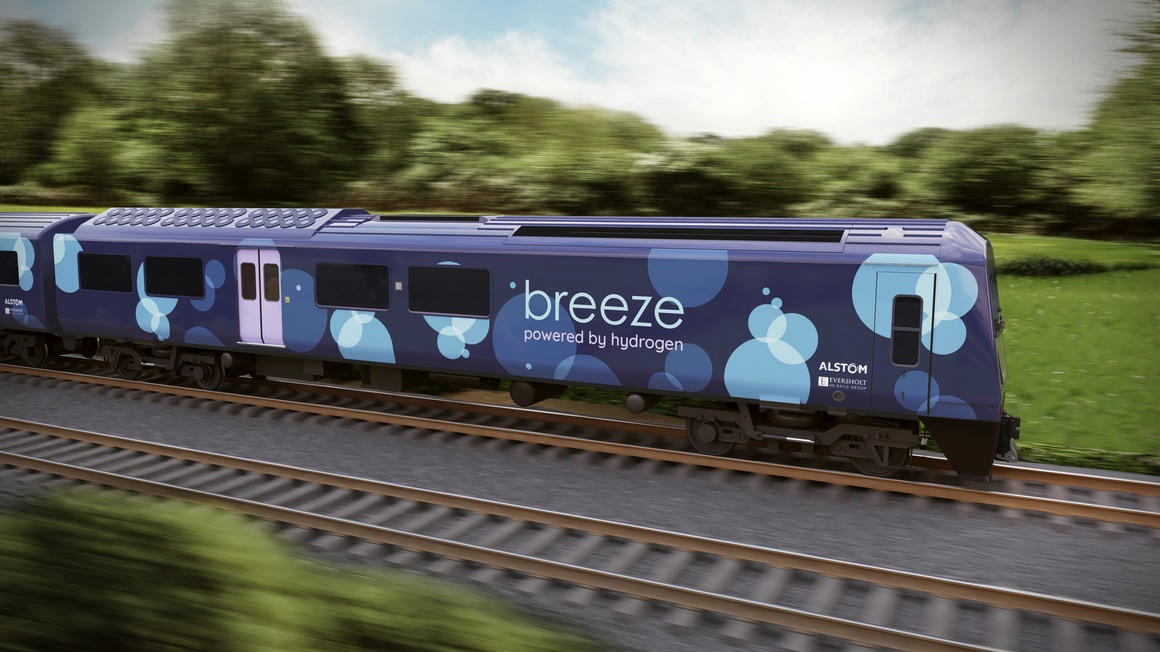
This is said about the Alstom Breeze trains.
Alstom in Widnes is ready to deploy its new Breeze trains and is working with Northern Rail to identify routes that are suitable for conversion to hydrogen.
A map also shows hydrogen train symbols on the Liverpool and Manchester Line, that goes via Widnes and Warrington and conveniently passes the Alstom factory at Widnes.
I wonder, if we’ll see an acceleration of this project?
Consider.
- Northern Rail is now directly controlled by the Government.
- Some Class 321 trains for conversion, will surely be available this summer.
- The updating of the trains, except for the hydrogen system has been developed in the Renatus project.
- Alstom have the experience of the successful hydrogen-powered Alstom Coradia iLint from Germany.
- Supplying the Alstom factory with hydrogen, shouldn’t be too difficult.
- I doubt any extra infrastructure is needed to run the trains.
- Alstom have sold two or three fleets of iLints on the back of a successful introduction into service of two prototype trains.
I don’t think, Alstom and all the various partners and stakeholders would object if the project were to be accelerated.
What’s Already Happening In The North West?
These hydrogen-powered projects are mentioned.
- Twenty double-deck buses for Liverpool City Centre.
- Alstom Breeze trains.
- storengy refuse trucks for Cheshire.
- ULEMCo are converting trucks and ferries.
- Port of Liverpool air quality.
It does seem to be that if you give an area a hydrogen network, possible users will find ways to use it to their advantage.
Rising To The Challenge
This section answers these questions.
Where Will The Hydrogen Come From?
Initially from INEOS at Runcorn, where I used to work around 1970 and BOC at St. Helens.
How Will It Be Transported?
Mainly by innovative use of new and existing pipelines.
How Do We Get To Critical Mass?
It looks like they’ll start slowly with hydrogen from Runcorn and St. Helens and build from there.
I would add a further question.
Will They Be Adding Hydrogen Filling Stations To The Network?
The North West needs them!
Hydrogen Storage
This is said about storing hydrogen.
Geologically, Cheshire is one of the few places in the UK where major underground gas storage in salt caverns has been delivered, paving the way for potential hydrogen storage, which is already done at scale elsewhere.
When I worked at ICI, I was given a tour of one of salt caverns. One is rumoured to be large enough to enable a full-size replica of Salisbury cathedral to be built inside.
Research
This is said about research.
Esteemed universities, and a wealth of innovative research companies, mean the region can deliver new hydrogen technologies. With academia working side-by-side with industry, the North West’s institutions can equip the next generation of skilled workers to support the hydrogen economy.
As a graduatev of one of those esteemed universities, how can I disagree?
Carbon Capture And Storage
This is said about carbon capture and storage.
Offshore reservoirs in the East Irish Sea can store carbon dioxide (CO2) produced from hydrogen production. Carbon Capture Utilisation and Storage (CCUS) is essential technology to help the UK in its fight against climate change. CCUS can capture up to 95% of the CO2 emissions associated with producing hydrogen from natural gas.
Whether you want to produce hydrogen this way is another matter. But the oil refineries and chemical plants along the Mersey are surely prime candidates for CCUS.
An Alliance
Not for nothing is the project called the North West Hydrogen Alliance!
Sixteen partners are mentioned at the end of the document.
The Definitive Hydrogen Train
There is only one hydrogen-powered train in service and that is the Alstom Coradia iLint, which is running in Germany.

I feel it is very much an interim design, as Alstom has taken a diesel-mechanical Lint train and swapped the diesel for a hydrogen-powered electricity generator and an electric motor.
Alstom are converting electric Class 321 trains into a hydrogen-powered version called Breeze.
A typical train would be three cars. The visualisation shows one of the two driver cars, that contain a large hydrogen tank behind the cab.
Between the two driver cars would be a trailer car.
Using Electrification
Nothing has been disclosed yet, but it would surely be easy to allow this hydrogen train to keep its pantograph on the trailer car and be able to use electrification if it is installed.
This would increase the range of the train and might allow a version with a smaller hydrogen tank and a greater passenger capacity.
Charging Batteries
In a definitive hydrogen-powered train, which had been designed from scratch to use hydrogen, I could envisage, that the batteries could also be charged, when the train is connected to either electrification or a charging station.
A Smart Computer
The train would have a very smart computer, which would do the following.
- Manage the various power sources.
- Choose the appropriate source for the route, weather, passenger load, fuel and battery levels.
- Raise and lower the pantograph automatically.
- Control the trains systems to minimise electricity use.
This is little different to many trains, built in the last few years.
Conclusion
The definitive hydrogen-powered train will be a battery-electric-hydrogen hybrid train.
Tees Valley Wins £1.3million Project To Bring Hydrogen Vehicles To The Region
The title of this post, is the same as that as this article on the Tees Valley Combined Authority web site.
This is the introductory paragraph.
Hydrogen vehicles and refuelling stations will soon be coming to Tees Valley after it was today (February 5) announced that a £1.3million bid to Government had been successful.
The next two paragraphs give more detail.
Tees Valley Mayor Ben Houchen welcomed the result of a Government competition that will see two refuelling stations built in Middlesbrough and Redcar, plus a fleet of cars which use hydrogen technology for long-range travel (300+ miles) and fast refuelling capability.
The new refuelling stations could allow cars, buses, bin lorries and even trains to be powered by the super fuel.
This later paragraph details the expected economic benefits.
Figures from a draft report commissioned by the Combined Authority and produced by KPMG suggest that exploiting the opportunities of the hydrogen economy could add up to £7billion to the region’s economy by 2050, with the creation of as many as 1,000 jobs.
These figures seem to say hydrogen is good for the economy and jobs.
BCRRE Recognised for its HydroFLEX Work
The title of this post, is the same as that of this article on H2-View.
This is the introductory paragraph.
The Birmingham Centre for Railway Research and Education (BCRRE) at the University of Birmingham has been recognised in the Guardian University Awards 2020 for its work in the UK’s first hydrogen powered train, HydroFLEX.
From my monitoring of the various hydrogen developments and their prominence, it appears that all questions are being explored and that hydrogen will have an extensive future on both rail and the road.
 The Anonymous Widower