First French Region Signs Hydrogen Train Contract
The title of this post, is the same as that of this article on the International Railway Journal.
This is the introductory paragraph.
The Bourgogne-Franche Comté region has signed a contract with Alstom, through operator French National Railways (SNCF), for the supply of three Coradia Polyvalent electro-hydrogen dual-mode multiple units.
These are some points from the article.
- The three trains are from an order for 14 from four French regions.
- The trains can use 1500 VDC and 25 KVAC electrification.
- They will be able to use hydrogen power, where there is no electrification.
- Range on hydrogen will be 400-600 km.
- Operating speed will be up to 160 kph.
- Trains will be four cars, with a capacity of 220 passengers.
- Trains will start test running in 2024 on the 19km non-electrified Auxerre – Laroche – Migennes line.
As with the Alstom Class 600 hydrogen trains for the UK, deliveries don’t seem to be fast.
I wrote Hydrogen Trains Ready To Steam Ahead in January 2019. This is the first few paragraphs.
The title of this post is the same as that of an article in today’s copy of The Times.
This is the first two paragraphs.
Hydrogen trains will be introduced in as little as two years under ambitious plans to phase out dirty diesel engines.
The trains, which are almost silent and have zero emissions, will operate at speeds of up to 90 mph and release steam only as a by-product. The new trains, which will be called “Breeze” will be employed on commuter and suburban lines by early 2021.
Wikipedia is now saying, that these trains will enter service in 2024.
As Alstom haven’t got any orders for the train, I will be very surprised if they achieve that date.
Is it Alstom, French project management or problems with hydrogen?
I don’t think it’s anything to do with hydrogen, as the Germans built the successful iLint for Alstom and Birmingham University put together a hydrogen demonstration train in double-quick time.
Given all the problems that the French are having with rolling out the Covid-19 vaccine could it be that the French have a Can’t Do! attitude, rather than most other countries, which seem to have a Can Do! attitude.
Are Hydrogen-Fuelled Vehicles A Waste Of Our Time And Energy?
The title of this post, is the same as that of this article on Engineering & Technology, which is the magazine of the Institution of Engineering and Technology. So it should be authoritative.
This is the concluding paragraph.
Cars account for 61 per cent of surface transport emissions, HGVs only 17 per cent, buses 3 per cent, and rail 2 per cent (CCC, December 2020) so for cost/benefit it cannot be worthwhile switching to hydrogen fuel cell buses and trains. Through any impartial lens of engineering science, hydrogen fuel cell cars do not appear to be a transport winner and the Government should revisit decisions it has made about related funding. But then there is political virtue signalling.
It is a must-read contribution to the debate, as to whether hydrogen or battery power, is best for surface transport.
I don’t believe there is a simple answer, because for some applications, battery electric power is not feasible because of reasons of power or range.
- Would a battery-electric truck, be able to haul a forty-four tonne load between the Channel Tunnel and Scotland?
- Would a battery-electric locomotive be able to haul a thousand tonne aggregate or stone train for anything but a few tens of miles?
- Is it possible to design a a battery-electric double-deck bus, that can carry seventy passengers?
I believe there are applications, where battery-electric is not a feasible alternative to the current diesel traction.
It is worth noting, that truck-maker; Daimler is planning to have both battery and hydrogen heavy trucks in its product line.
Users will choose, what is the best zero-carbon transport for their needs.
The Black Cab Driver’s Answer
It is always said, that, if you want to know the answer to a difficult question, you ask the opinion of a black cab driver.
So as the new electric black taxis, are the most common electric vehicle, that the average Londoner uses, what do the guys up-front say about their expensive vehicles.
- Regularly, cab drivers complain to me about the range and having to use the diesel engine to charge the battery or power the car.
- Some suggest to me, that hydrogen might be a better way to make the vehicles zero-carbon.
I think they may have a point about hydrogen being a better method of powering a black taxi, when you look at the pattern of journeys and the battery size and charging limitations of the vehicle.
These limitations may reduce in the future, as the technology gets better, with higher density batteries and faster charging.
We could even see a design and sales war between battery and hydrogen black cabs.
It always pays to follow the money!
Italy’s Hardest-Hit Covid-19 Region To Become ‘Hydrogen Valley’
The title of this post, is the same as that of this article on Energy Live News.
This is the first paragraphs.
Lombardy, Italy’s hardest-hit Covid-19 region, will soon become home to the ‘country’s first hydrogen valley’.
Enel Green Power has signed a memorandum of understanding (MoU) with the Italian transport group FNM, to purchase new hydrogen-powered trains, replace the current diesel-powered trains and build hydrogen production facilities powered by renewable energy.
These facilities will be constructed to support the journeys of hydrogen trains.
It sounds like good thinking.
Germany Tasks TÜV With Finding Standards For H2 Trains
The title of this post, is the same as that of this article on Electrive.
This is the introductory paragraph.
TÜV Rheinland InterTraffic has been commissioned to develop a standard for hydrogen applications in rail vehicles. Until now, authorities have had to rely on technical regulations and standards from the automotive industry for conformity assessments.
As hydrogen trains have entered service in Germany and have been trialled on rail networks in Austria, Italy, The Netherlands and the UK, this is probably about time, especially as Spain and Switzerland will soon be joining the club.
As most of Europe has the same loading gauge, it looks to me that the German standard will be a de-facto European standard, that could also be used for countries like Australia, Canada and the United States.
But in the UK, we have a smaller loading gauge, so will the German standard be application to the UK?
As some German S-bahn trains are not much bigger than say a Siemens-built Class 700 train, I suspect that the Germans could write a dual standard, that covered the following.
- Standard UK-sized trains.
- Standard EU-sized trains.
- Standard German S-bajm-sized trains.
After all, if it could be arranged, one world-wide standard would probably be a good idea.
Alstom Calls For Hydrogen Rail Fleets In The UK
The title of this post, is the same as that of this article on H2View.
These are the first three paragraphs.
Alstom has called for a £10bn investment programme in UK rail and mass transit systems, through which it would like fleets of clean, zero emission hydrogen trains to replace pouting diesel alternatives.
Titled: The UK’s New Green Age; A Step Change in Transport Decarbonisation, the report states that 300-400 hydrogen trains could be launched simply with a like for like replacement of diesels and would deliver huge environmental benefits.
The report was released after recent research revealed that the UK is lagging behind surrounding countries in comparable infrastructure. For example, France has over double the number of mass transit systems as the UK, whilst Germany has four.
There is a rapidly developing argument between the proposers of hydrogen and battery trains.
Consider.
- Both types of train can ve a straight replacement for diesel trains, often with very little modification to stations.
- As both hydrogen and battery trains have electric traction, they could have improved performance, so tracks and signalling might need upgrades to make full use of that performance to provide a better service for passengers.
- Hydrogen trains will need a refuelling strategy.
- Hydrogen trains need to carry a large tank of hydrogen.
- Battery trains may well need charging systems or extra lengths of electrification for charging.
- The UK will have plenty of green hydrogen and zero carbon electricity.
I also believe that hydrogen and battery trains designed from scratch will be much better than conversions of existing stock.
Conclusion
I think the environment will win this argument.
I can see cost and local circumstances deciding, whether to use battery or hydrogen trains.
For instance, Ipswich and Norwich, where there are an electrified main lines, might become battery train hubs, whereas Middlesbrough, where there is a plentiful supply of hydrogen, might use hydrogen trains for local services.
Shooter Urges Caution On Hydrogen Hubris
The title of this post is the same as that of an article in the January 2021 Edition of Modern Railways.
This is the first paragraph.
Vivarail Chairman Adrian Shooter has urges caution about the widespread enthusiasm for hydrogen technology. In his keynote speech to the Golden Spanner Awards on 27 November, Mr. Shooter said the process to create ‘green hydrogen’ by electrolysis is ‘a wasteful use of electricity’ and was skeptical about using electricity to create hydrogen to then use a fuel cell to power a train, rather than charging batteries to power a train. ‘What you will discover is that a hydrogen train uses 3.5 times as much electricity because of inefficiencies in the electrolysis process and also in the fuel cells’ said Mr. Shooter. He also noted the energy density of hydrogen at 350 bar is only one-tenth of a similar quantity of diesel fuel, severely limiting the range of a hydrogen-powered train between refuelling.
Mr. Shooter then made the following points.
- The complexity of delivering hydrogen to the railway depots.
- The shorter range available from the amount of hydrogen that can be stored on a train compared to the range of a diesel train.
- He points out limitations with the design of the Alstom Breeze train.
This is the last paragraph.
Whilst this may have seemed like a challenge designed purely to promote the battery alternatives that Vivarail is developing, and which he believes to be more efficient, Mr. Shooter explained: ‘I think that hydrogen fuel cell trains could work in this country, but people just need to remember that there are downsides. I’m sure we’ll see some, and in fact we should because competition improves the breed.’
i think Mr. Shooter may have made several good points.
These are my thoughts.
Creating Green Hydrogen
I haven’t done an analysis of the costs of creating green hydrogen from electrolysis, but I have a feeling, that electrolysis won’t be the only way to create large amounts of carbon-free hydrogen, in a few years.
These methods are currently available or under development or construction.
- The hydrogen tram-buses in Pau have a personal electrolyser, that provides hydrogen at 350 bar.
- London’s hydrogen buses will be provided with hydrogen from an electrolyser at Herne Bay by truck. Will the trucks be hydrogen-powered?
Some industrial processes like the Castner-Kellner process create hydrogen as a by-product.
In Shell Process To Make Blue Hydrogen Production Affordable, I describe the Shell Blue Hydrogen Process, which appears to be a way of making massive amounts of carbon-free hydrogen for processes like steel-making and cement production. Surely some could be piped or transported by truck to the rail depot.
In ITM Power and Ørsted: Wind Turbine Electrolyser Integration, I describe how ITM Power and Ørsted plan to create the hydrogen off shore and bring it by pipeline to the shore.
Note.
- The last two methods could offer savings in the cost of production of carbon-free hydrogen.
- Surely, the delivery trucks if used, must be hydrogen-powered.
- The Shell Blue Hydrogen Process uses natural gas as a feedstock and converts it to hydrogen using a newly-developed catalyst. The carbon-dioxide is captured and used or stored.
- If the local gas network has been converted to hydrogen, the hydrogen can be delivered to the depot or filling station through that gas network.
I very much feel that affordable hydrogen can be supplied to bus, train, tram or transport depot. For remote or difficult locations. personal electrolysers, powered by renewable electricity, can be used, as at Pau.
Hydrogen Storage On Trains
Liquid hydrogen could be the answer and Airbus are developing methods of storing large quantities on aircraft.
In What Size Of Hydrogen Tank Will Be Needed On A ZEROe Turbofan?, I calculated how much liquid hydrogen would be needed for this ZEROe Turbofan.
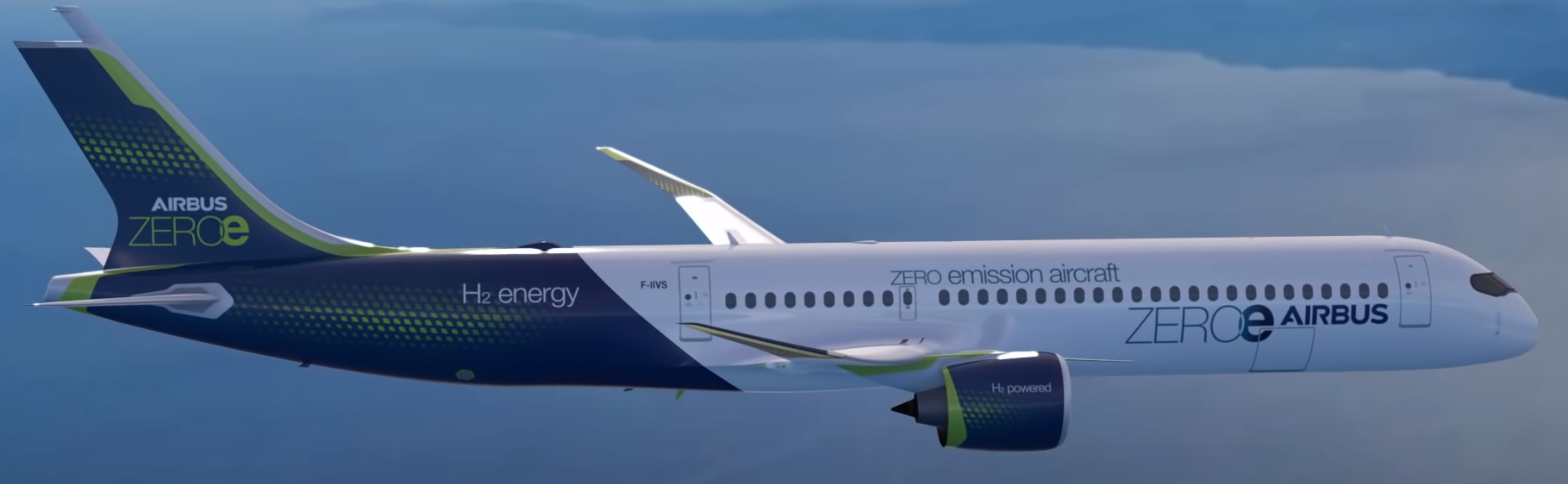
I calculate that to carry the equivalent amount of fuel to an Airbus A320neo would need a liquid hydrogen tank with a near 100 cubic metre capacity. This sized tank would fit in the rear fuselage.
I feel that in a few years, a hydrogen train will be able to carry enough liquid hydrogen in a fuel tank, but the fuel tank will be large.
In The Mathematics Of A Hydrogen-Powered Freight Locomotive, I calculated how much liquid hydrogen would be needed to provide the same amount of energy as that carried in a full diesel tank on a Class 68 locomotive.
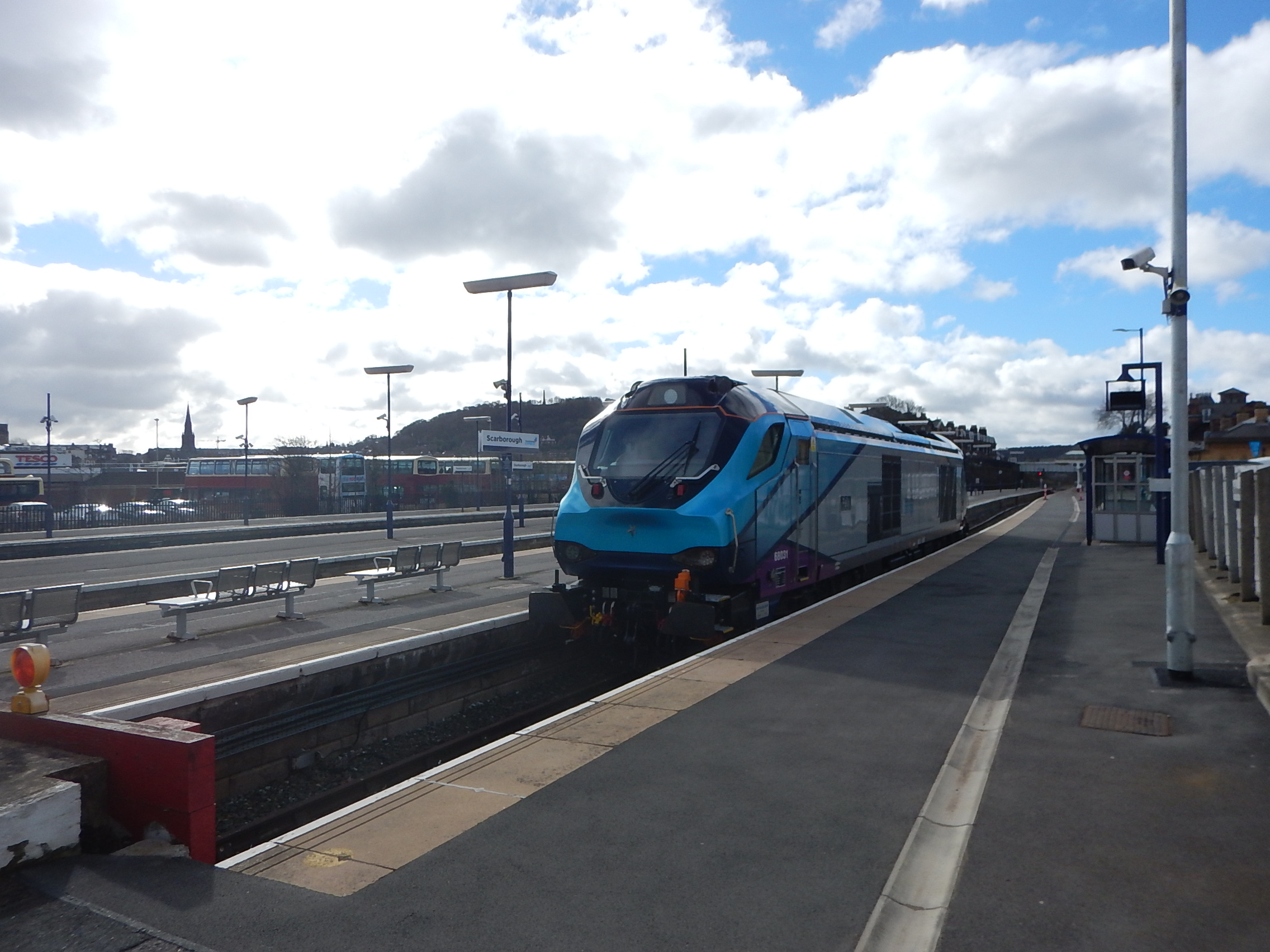
The locomotive would need 19,147 litres or 19.15 cubic metres of liquid hydrogen, which could be contained in a cylindrical tank with a diameter of 2 metres and a length of 6 metres.
Hydrogen Locomotives Or Multiple Units?
We have only seen first generation hydrogen trains so far.
This picture shows the Alstom Coradia iLint, which is a conversion of a Coradia Lint.

It is a so-so train and works reasonably well, but the design means there is a lot of transmission noise.
This is a visualisation of an Alstom Breeze or Class 600 train.
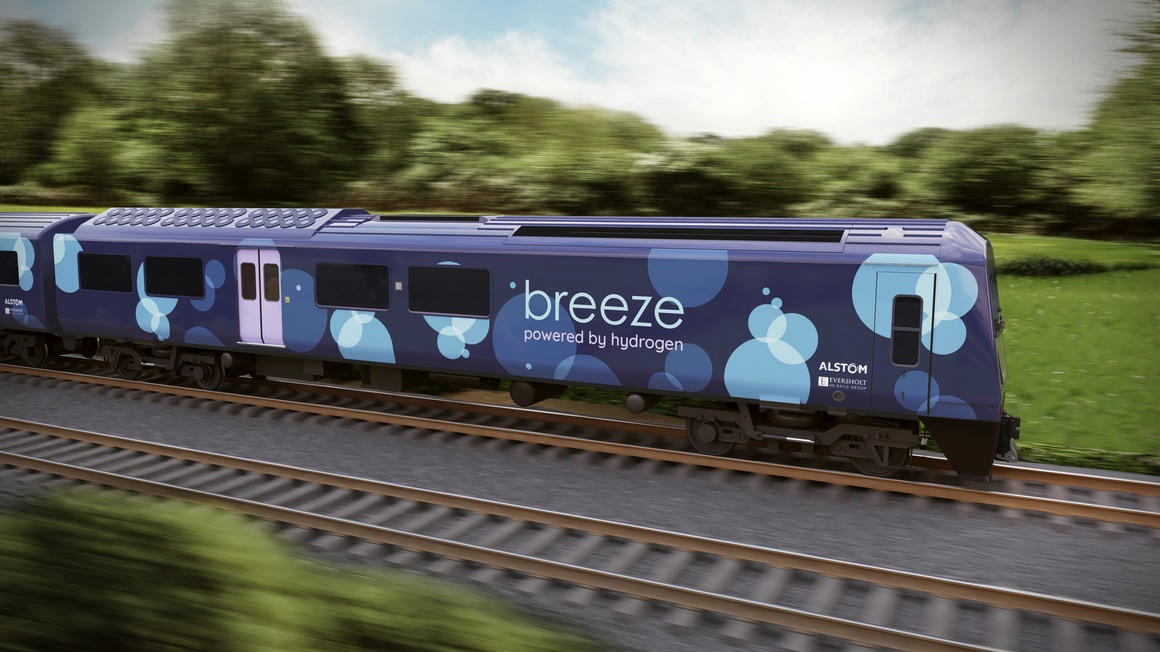
Note that the front half of the first car of the train, is taken up with a large hydrogen tank. It will be the same at the other end of the train.
As Mr. Shooter said, Alstom are converting a three-car train into a two-car train. Not all conversions live up to the hype of their proposers.
I would hope that the next generation of a hydrogen train designed from scratch, will be a better design.
I haven’t done any calculations, but I wonder if a lighter weight vehicle may be better.
Hydrogen Locomotives
I do wonder, if hydrogen locomotives are a better bet and easier to design!
- There is a great need all over the world for zero-carbon locomotives to haul freight trains.
- Powerful small gas-turbine engines, that can run on liquid hydrogen are becoming available.
- Rolls-Royce have developed a 2.5 MW gas-turbine generator, that is the size of a beer-keg.
In The Mathematics Of A Hydrogen-Powered Freight Locomotive, I wondered if the Rolls-Royce generator could power a locomotive, the size of a Class 68 locomotive.
This was my conclusion.
I feel that there are several routes to a hydrogen-powered railway locomotive and all the components could be fitted into the body of a diesel locomotive the size of a Class 68 locomotive.
Consider.
- Decarbonising railway locomotives and ships could be a large market.
- It offers the opportunities of substantial carbon reductions.
- The small size of the Rolls-Royce 2.5 MW generator must offer advantages.
- Some current diesel-electric locomotives might be convertible to hydrogen power.
I very much feel that companies like Rolls-Royce and Cummins (and Caterpillar!), will move in and attempt to claim this lucrative worldwide market.
In the UK, it might be possible to convert some existing locomotives to zero-carbon, using either liquid hydrogen, biodiesel or aviation biofuel.
Perhaps, hydrogen locomotives could replace Chiltern Railways eight Class 68 locomotives.
- A refuelling strategy would need to be developed.
- Emissions and noise, would be reduced in Marylebone and Birmingham Moor Street stations.
- The rakes of carriages would not need any modifications to use existing stations.
It could be a way to decarbonise Chiltern Railways without full electrification.
It looks to me that a hydrogen-powered locomotive has several advantages over a hydrogen-powered multiple unit.
- It can carry more fuel.
- It can be as powerful as required.
- Locomotives could work in pairs for more power.
- It is probably easier to accommodate the hydrogen tank.
- Passenger capacity can be increased, if required by adding more coaches.
It should also be noted that both hydrogen locomotives and multiple units can build heavily on technology being developed for zero-carbon aviation.
The Upward Curve Of Battery Power
Sparking A Revolution is the title an article in Issue 898 of Rail Magazine, which is mainly an interview with Andrew Barr of Hitachi Rail.
The article contains a box, called Costs And Power, where this is said.
The costs of batteries are expected to halve in the next years, before dropping further again by 2030.
Hitachi cites research by Bloomberg New Energy Finance (BNEF) which expects costs to fall from £135/kWh at the pack level today to £67/kWh in 2030 and £47/kWh in 3030.
United Kingdom Research and Innovation (UKRI) are predicting that battery energy density will double in the next 15 years, from 700 Wh/l to 1400 Wh/l in 2-35, while power density (fast charging) is likely to increase four times in the same period from 3 kW/kg to 12 kW/kg in 2035.
These are impressive improvements that can only increase the performance and reduce the cost of batteries in all applications.
Hitachi’s Regional Battery Train
This infographic gives the specification of Hitachi Regional Battery Train, which they are creating in partnership with Hyperdrive Innovation.

Note that Hitachi are promising a battery life of 8-10 years.
Financing Batteries
This paragraph is from this page on BuyaCar, which is entitled Electric Car Battery Leasing: Should I Lease Or Buy The Batteries?
When you finance or buy a petrol or diesel car it’s pretty simple; the car will be fitted with an engine. However, with some electric cars you have the choice to finance or buy the whole car, or to pay for the car and lease the batteries separately.
I suspect that battery train manufacturers, will offer similar finance models for their products.
This paragraph is from this page on the Hyperdrive Innovation web site.
With a standardised design, our modular product range provides a flexible and scalable battery energy storage solution. Combining a high-performance lithium-ion NMC battery pack with a built in Battery Management System (BMS) our intelligent systems are designed for rapid deployment and volume manufacture, supplying you with class leading energy density and performance.
I can envisage that as a battery train ages, every few years or so, the batteries will get bigger electrically, but still be the same physical size, due to the improvements in battery technology, design and manufacture.
I have been involved in the finance industry both as a part-owner of a small finance company and as a modeller of the dynamics of their lending. It looks to me, that train batteries could be a very suitable asset for financing by a fund. But given the success of energy storage funds like Gore Street and Gresham House, this is not surprising.
I can envisage that battery electric trains will be very operator friendly, as they are likely to get better with age and they will be very finance-friendly.
Charging Battery Trains
I must say something about the charging of battery trains.
Battery trains will need to be charged and various methods are emerging.
Using Existing Electrification
This will probably be one of the most common methods used, as many battery electric services will be run on partly on electrified routes.
Take a typical route for a battery electric train like London Paddington and Oxford.
- The route is electrified between London Paddington and Didcot Junction.
- There is no electrification on the 10.4 miles of track between Didcot Junction and Oxford.
If a full battery on the train has sufficient charge to take the train from Didcot Junction to Oxford and back, charging on the main line between London Paddington and Didcot Junction, will be all that will be needed to run the service.
I would expect that in the UK, we’ll be seeing battery trains using both 25 KVAC overhead and 750 VDC third rail electrification.
Short Lengths Of New Strategic Electrification
I think that Great Western Railway would like to run either of Hitachi’s two proposed battery electric trains to Swansea.
As there is 45.7 miles pf track without .electrification, some form of charging in Swansea station, will probably be necessary.
The easiest way would probably be to electrify Swansea station and perhaps for a short distance to the North.
This Google Map shows Swansea station and the railway leading North.
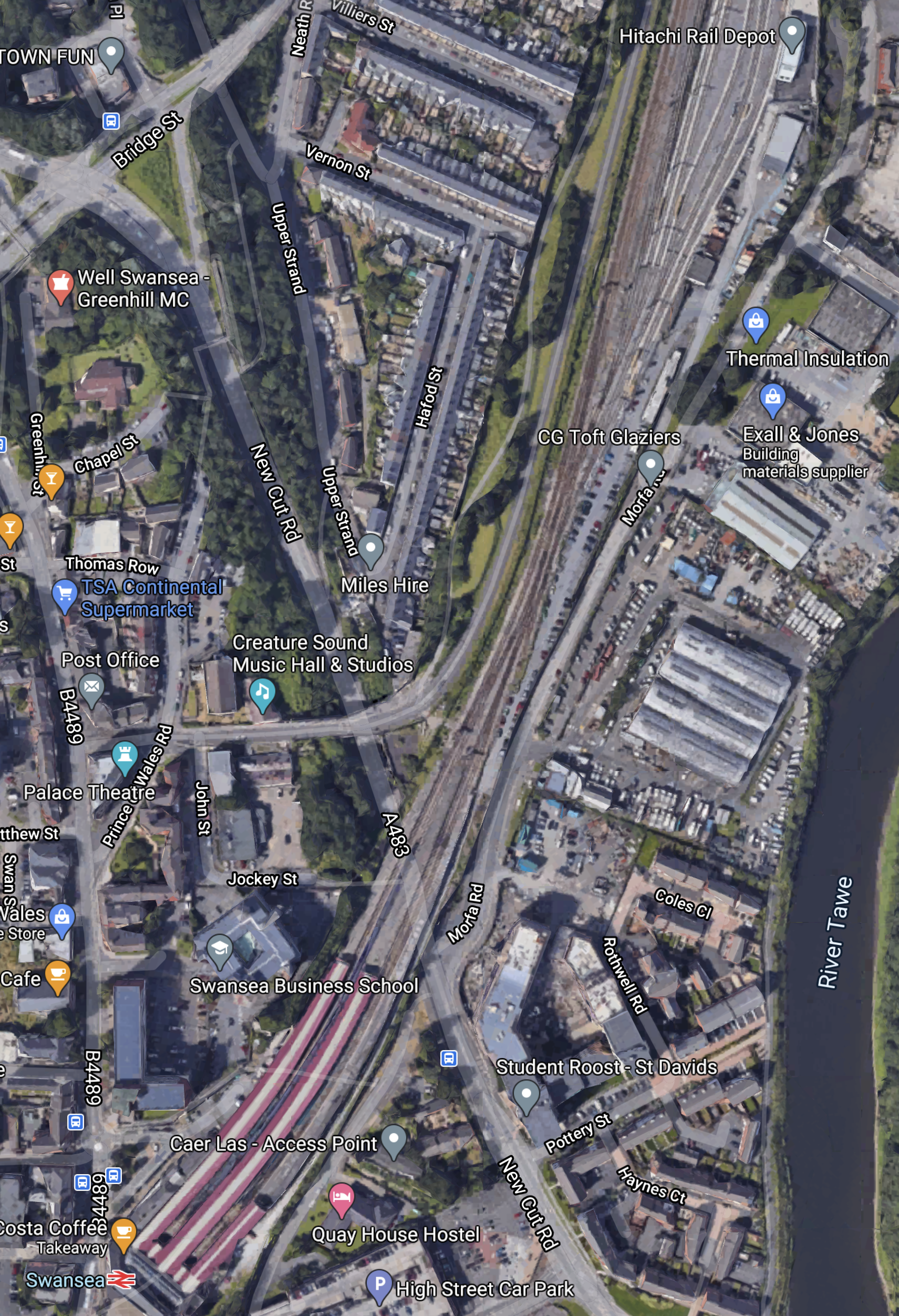
Note.
- There is a Hitachi Rail Depot at the Northern edge of the map.
- Swansea station is in South-West corner of the map.
- Swansea station has four platforms.
Swansea station would probably make an excellent battery train hub, as trains typically spend enough time in the station to fully charge the batteries before continuing.
There are other tracks and stations of the UK, that I would electrify to enable the running of battery electric trains.
- Leeds and York, which would enable carbon-free London and Edinburgh services via Leeds and help TransPennine services. This is partially underway.
- Leicester and East Midlands Parkway and Clay Cross North Junction and Sheffield – These two sections would enable EMR InterCity services to go battery electric.
- Sheffield and Leeds via Meadowhall, Barnsley Dearne Valley and the Wakefield Line, which would enable four trains per hour (tph) between Sheffield and Leeds and an extension of EMR InterCity services to Leeds.
- Hull and Brough, would enable battery electric services to Hull and Beverley.
- Scarborough and Seamer, would enable electric services services to Scarborough and between Hull and Scarborough.
- Middlesbrough and Redcar, would enable electric services services to Teesside.
- Crewe and Chester and around Llandudno Junction station – These two sections would enable Avanti West Coast service to Holyhead to go battery electric.
- Shrewsbury station – This could become a battery train hub, as I talked about for Swansea.
- Taunton and Exeter and around Penzance, Plymouth and Westbury stations – These three sections would enable Great Western Railway to cut a substantial amount of carbon emissions.
- Exeter, Yeovil Junction and Salisbury stations. – Electrifying these three stations would enable South Western Railway to run between London and Exeter using Hitachi Regional Battery Trains, as I wrote in Bi-Modes Offered To Solve Waterloo-Exeter Constraints.
We will also need fast chargers for intermediate stations, so that a train can charge the batteries on a long route.
I know of two fast chargers under development.
- Opbrid at Furrer + Frey
- Vivarail’s Fast Charge, which I wrote about in Vivarail’s Plans For Zero-Emission Trains.
I believe it should be possible to battery-electrify a route by doing the following.
- Add short lengths of electrification and fast charging systems as required.
- Improve the track, so that trains can use their full performance.
- Add ERTMS signalling.
- Add some suitable trains.
Note.
- I feel ERTMS signalling with a degree of automatic train control could be used with automatic charging systems, to make station stops more efficient.
- In my view, there is no point in installing better modern trains, unless the track is up to their performance.
Talgo Unveils Plan To Have Vittal-One Hydrogen Train Operational By 2023
The title of this post, is the same as that of this article on Hydrogen Fuel News.
This is the most important paragraph of the report.
The company explained that the fuel cell technology it designed for its train is modular. In this way, the tech can be installed on any type of existing train. In this way, the transition away from diesel and into hydrogen fuel. That said, Talgo did underscore that its Vittal platform was the primary reason for which the H2 solution was designed. The company is hoping to win several Spanish tenders, as well as those in other countries, for this regional and commuter train.
Talgo hopes to start testing their train next year.
They certainly seem to have got their skates on, or whatever the Spanish say!
A Hydrogen Train For Scotland
Consider.
- Scotland has a major need for a large number of zero-carbon trains to decarbonise routes outside the Central Belt, which is extensively electrified.
- Talgo are building a factory at Longannet in Scotland.
- Talgo’s Vittal-One train has a modular hydrogen traction system, but the train is designed for European standards.
- This page on the Talgo web site, describes the design philosophy behind the Talgo Vittal. After reading that page, I feel Talgo could build a version of the train for the UK. There are already standard gauge versions in Germany and they’d just need to make a different body, that was about a 100 mm. narrower.
- The Talgo Vittal is a 100 mph train, which is what Scotland needs.
So I feel that Talgo have the technology to build a hydrogen-powered regional train for the UK. And the island of Ireland, which uses a 1600 mm track gauge, which is not far from the Iberian gauge of 1668 mm gauge!
The question has to be asked about, when Talgo chose the location for the factory, were there any nods and winks with the Scottish Government about the country’s future train needs?
It certainly appears that Scotland has the need and the hydrogen, and Talgo has the technology, to decarbonise the railways North and South of the Central Belt in Scotland.
Fuel Cell Mireo Plus H To Be Trialled In Baden-Württemberg
The title of this post, is the same as that of this article on Railway Gazette.
This is the opening paragraph.
Deutsche Bahn and Siemens Mobility are to trial a fuel cell powered regional trainset in revenue service between Tübingen, Horb and Pforzheim in 2024, along with a green hydrogen fuelling plant.
These two paragraphs describe the train.
Siemens Mobility is to supply a two-car Mireo Plus H trainset derived from its Mireo Plus regional multiple-unit family, equipped with a newly developed hydrogen fuel cell drive and a lithium-ion battery.
The 1·7 MW traction power rating is expected to offer a comparable performance to the electric version, with an acceleration rate of 1·1 m/s² and a maximum speed of 160 km/h. Sufficient hydrogen will be stored onboard to give an operating range of up to 600 km, with the promoters envisaging that a three-car variant could have a range of 1 000 km.
The article doesn’t say anything about, whether the train can use electrification, but as the train is based on a conventional electric train, I would assume it is possible.
Italian Operator Orders Hydrogen Fuel Cell Trains
The title of this post, is the same as that of this article on Railway Gazette.
This is the introductory paragraph.
Alstom is to supply Ferrovie Nord Milano with six hydrogen fuel cell multiple-units for use by the Lombardia regional operator’s Ferrovienord subsidiary on the non-electrified Brescia – Iseo – Edolo line from 2023.
The trains will be based on the Alstom Coradia Stream train, with technology coming from the Alstom Coradia iLint
Talgo: Our Hydrogen Train Will Be Ready In 2023
The title of this post, is the same as that of this article on Railway News.
This sentence from the opening paragraph, gives and explains the name.
The train will be called Talgo Vittal-One, which Talgo says is a reference to hydrogen’s atomic number.
It appears to be a commuter and regional train.
 The Anonymous Widower