Is The Pfizer Vaccine The New Betamax?
To me, the Pfizer vaccine may work well, but the precautions needed to deliver it safely are so onerous, I can’t see it being the most successful of vaccines.
If healthcare professionals and GP surgeries in the UK, are saying that the minus seventy delivery route is going to be difficult, then how difficult is it going to be to deliver it, in parts of India, Africa and South America.
I can’t see the current Pfizer vaccine lasting very long, before it is either overtaken by one of the many others vaccines under development or Pfizer reformulate it, so it has an easier method of delivery.
It truly is the new Betamax.
New Device Separates Hydrogen From Natural Gas When The Two Gases Are Blended In Pipelines
The title of this post, is the same as that of on this article on Hydrogen Fuel News.
This is the introductory paragraph.
With clean hydrogen gaining recognition worldwide as the carbon-free fuel capable of making a significant contribution to addressing climate change, Southern California Gas Co. (SoCalGas) today announced it will field test a new technology that can simultaneously separate and compress hydrogen from a blend of hydrogen and natural gas.
It may sound rather mundane, but it means, you can convert surplus electricity into hydrogen and blend it with natural gas and distribute it in the local natural gas grid.
- As natural gas grids can contain a proportion of hydrogen, this shouldn’t be a problem.
- Any user, who needs hydrogen connects one of these clever devices to the grid and it separates out the hydrogen, for your use.
- All very simple and efficient, as you don’t need a second gas grid for hydrogen.
I very much like this idea, which was developed by a Dutch company called HyET Hydrogen.
There is also an explanatory video.
This invention could change the world!
This Company May Have Solved One Of The Hardest Problems In Clean Energy
The title of this post is the same as that of this article on Vox.
I found the article about an American company called Hytech Power, very interesting.
The company has developed technology called Internal Combustion Assistance (ICA), that improves the fuel consumption and emissions performance of diesel engines, by injecting small amounts of hydrogen and oxygen into the cylinders at the right time.
This is a paragraph from the article, which gives the performance improvements.
HyTech’s offer to that market is pretty remarkable: it claims that its ICA can improve the fuel efficiency of a diesel engine between 20 and 30 percent, reduce particulate matter by 85 percent, and reduce NOx by between 50 and 90 percent. In concert with a DPF and some SCR, it can yield a diesel engine that meets official California standards for an “ultra-low emissions” vehicle.
Note.
- A DPF is a diesel particulate filter.
- SCR is selective catalytic reduction fluids.
Both are expensive!
This paragraph from the article gives some customer feedback.
The ICA has been listed by the EPA as a candidate for emissions-reduction technology; respected testing firm SGS found that the ICA boosted the fuel efficiency of a FedEx delivery truck by 27.4 percent; FedEx is currently road testing the ICA on a fleet of trucks and finding 20 to 30 percent better fuel economy and substantially reduced DPF maintenance costs. In third-party testing, and in limited local sales around Redmond, the ICA has performed as promised.
It never hurt a company to have FedEx on their side! Later on, the article says that Caterpillar are on board and their engines, generators and equipment features heavily on the Hytech Power web site.
If you look at the Wikipedia entry for Hydrogen Fuel Enhancement, you read a lot of sceptical words about this technology.
I would suggest that you read the Vox article, Hytech Power’s web site and the Wikipedia entry in detail before making your mind up.
My decision has been to file Hytech Power in a box, called Must Watch and set up a Google Alert.
For three of the last ten companies, I did that for, I made an investment in the shares. None are trading badly!
This Material Can Store The Sun’s Energy For Months, Maybe Even Years
The title of this post, is the same as that of this article on Anthropocene.
This is the sub-title.
Thin coatings of the material could soak up sun in summer months and provide heat to buildings in winter, all without using fuel or electricity.
This sounds like something to file under Too Good To Be True.
But the research does come from the University of Lancaster and uses a type of material called a metal-organic framework.
Conclusion
Increasingly, it seems to me, that we’re seeing lots of outstanding chemistry coming to the fore.
Start-up Bags $7m To Bring Tourists To Edge Of Space On A Balloon
The title of this post is the same as that of this article on SiliconRepublic.
This paragraph describes it.
The start-up aims to use a series of space balloons – attached with a pressurised capsule – to fly equipment and tourists to the edge of space on a six hour flight. The company’s first test flight of its Neptune 1 craft is expected towards the end of Q1 2021 from NASA’s Kennedy Space Center Shuttle Landing Facility. While the first test will consist of an uncrewed, unpressurised capsule, Space Perspective hopes to begin crewed operations by 2024.
What a concept!
- It’s affordable edge of space travel for all!
- Learn more from their web site.
- From the pictures, it looks like each trip would carry about ten passengers, in normal clothes,
- I can see lots of these installed over the world.
- When can I book, a trip on one of these from Central London? Or from somewhere in say the mountains of Switzerland?
On this page of their web site, they describe a typical flight.
Flown by a pilot, Neptune takes up to eight passengers called “Explorers” on a six-hour journey to the edge of space and safely back, where only 20 people have been before. It will carry people and research payloads on a two-hour gentle ascent above 99% of the Earth’s atmosphere to 100,000 feet, where it cruises above the Earth for up to two hours allowing passengers to share their experience via social media and with their fellow Explorers. Neptune then makes a two-hour descent under the balloon and splashes down, where a ship retrieves the passengers, the capsule, and the balloon. Neptune’s commercial human spaceflight launches are regulated by the FAA Office of Commercial Spaceflight.
Note.
I’ve already flown at 60,000 feet in an aircraft. In Concorde!
Even a humble Airbus A320 can fly at 41,000 feet.
Splashdown in the Thames Estuary or Lake Geneva? Why not?
No-one ever had a worthwhile idea or made a useful fortune by thinking with the herd.
Battery Life: The Race To Find A Storage Solution For A Green Energy Future
The title of this post, is the same as that of this article on the Financial Times.
It is a long article, that gives a good review of the technologies available to store energy from wind and solar power.
It gives a lot more details and an image of the Siemens Gamesa hot rock energy storage system in Hamburg.
- It uses a thousand tonnes of volcanic rock.
- It can store 130 MWh of electricity.
The system has apparently been designed to re-use the turbines from closing coal-fired power stations, which is an innovative idea.
And Now Geothermal Rum From Cornwall!
This article on ThinkGeoenergy is entitled New Project To Bring You “Tropically” Matured Rum From Cornwall’s Geothermal Heartland.
This is the introductory paragraph.
What a product addition to the United Downs Deep Geothermal Project? Distillery startup Cornish Geothermal Distillery Company is pushing forward with plans to produce “tropically” mature rum using heat from the UK’s first geothermal power facility.
The Cornish Geothermal Distillery Company has a web site for more information.
This is a paragraph from the Think Geoenergy article.
In the release shared with us it is reported that Matthew Clifford, founder of the Cornish Geothermal Distillery Company (CGDC), has submitted outline plans for an ultra high-tech biome which would incorporate his patent-pending, carbon-neutral rum “cask maturation pods” designed by Grimshaw Architects alongside Buro Happold – globally recognised for innovative architecture that respects the planet’s resources whilst being functional and awe inspiring.
It seems to be an ambitious carbon-neutral project that could create up to a hundred jobs.
Holy Grail Of Energy Storage Receives Two Grants
The title of this post, is the same as that of this article on Off Grid Energy Independence.
This is the introductory paragraph.
RheEnergise is one of only a select handful of businesses to have been awarded grants under both the Sustainable Innovation Fund & the Small Business Research Initiative.
So what have RheEnergise developed?
The home page of their web site, is surprisingly detailed, unlike those of some other companies with new ideas, and not just energy storage companies!
This is the first paragraph on their home page.
RheEnergise is bringing innovation to pumped hydro storage. We call our new solution High-Density Hydro ™.
I think that is a good start, as although pumped hydro storage is well proven and the UK has the 1,728 MW Dinorwig Power Station, which has a storage capacity of 9.1 GWh, building new large pumped storage systems is fraught with difficulties and the technology has seen only modest innovation in the last few decades.
The next paragraph on their home page describes their innovation.
HD Hydro ™ uses our proprietary HD Fluid R-19 ™, which has 2.5x the density of water. R-19 gives RheEnergise projects 2.5x the power and 2.5x the energy when compared to water.
This means that for the same size of pumped hydro storage power station, you get 2.5 times the amount of energy storage.
Alongside a diagram of the system, the advantages of their systems is stated.
Projects can be installed on hills 2.5x lower than a project using water and still achieve the same power – for example, there are so many more hills at 150m than at 375m.
2.5x smaller, by volume, meaning dramatically lower construction costs, faster build times, easier reinstatement and easier landscaping – projects can be entirely hidden.
A very simple innovation has greatly increased the possibilities of pumped hydro storage.
The home page also gives a typical capacity.
RheEnergise projects provide 10MW to 50MW power and 2 to 10 hours of storage capacity.
These systems are in the same range as those of Highview Power, who are building a 50 MW system, with a five hour capacity at Carrington near Manchester, that I wrote about in Highview Power Breaks Ground on 250MWh CRYOBattery Long Duration Energy Storage Facility.
Both have the advantage, that they are easily scalable.
With RheEnergise’s HD Hydro ™, the size of the upper reservoir would need to be increased and with Highview Power’s CRYOBattery, more tanks for the liquid air would need to be added.
The Technology
I certainly agree with the principle behind ReEnergise, both mathematically and practically.
My interest scientifically, is what is the fluid they use?
- Pure water has a specific gravity of one and everything else is measured with respect to this.
- So aluminium, which has a specific gravity of 2.7, is 2.7 times as heavy as water.
- Many of us will be familiar with mercury, which is a metal, that is liquid at room temperature.
- Mercury has a specific gravity of 13.56.
It puzzles me, how someone has created a liquid, almost as heavy as aluminium, that can be pumped and handled like water, as it would need to be, to make a pumped storage system work.
Microwaves Could Turn Plastic Waste Into Hydrogen Fuel
This headline from this article in The Times could be the headline of the day!
Although thinking about it, it wouldn’t be a good idea to put all your plastic waste in the microwave and switch it on. It might catch fire or even worse create lots of hydrogen in your kitchen, which could be followed by a mini-Hindenburg disaster in the kitchen.
These are the introductory paragraphs.
From the yellowed bottles in landfill to the jellyfish-like bags clogging the oceans, plastics pollution is an apparently intractable problem.
Yet, chemists lament, it shouldn’t be. Within this waste there is something extremely useful, if only we could access it: hydrogen. Now a British team of scientists believes it has found a way to get at it, and do so cheaply, thanks to tiny particles of iron and microwaves.
If their system works at scale they hope it could be a way of cheaply converting useless plastic into hydrogen fuel and carbon.
Don’t we all want to believe that this impossible dream could come true?
Some Background Information
Some of the things I talk about will be technical, so I will have a bit of a preamble.
Hydrogen; Handling And Uses
Because of pre-World War Two airships, which tended to catch fire and/or crash, hydrogen has a bad reputation.
I used to work as an instrument engineer in a hydrogen plant around 1970. To the best of my knowledge the plant I worked in is still producing hydrogen in the same large building at Runcorn.
Hydrogen is one of those substances, that if you handle with care, it can be one of the most useful elements in the world.
It is a fuel that burns creating a lot of energy.
The only by-product of hydrogen combustion is steam.
It is one of the feedstocks for making all types of chemicals like ethylene, fertilisers, ammonia, pharmaceuticals and a wide range of hydrocarbons.
Hydrogen is a constituent of natural gas and in my youth, it was a constituent of town gas.
Hydrogen and hydrocarbons are involved in the manufacture of a lot of plastics.
In the future, hydrogen will have even more uses like making steel and cement, and powering railway trains and locomotives, and shipping of all sizes.
Hydrocarbons
According to Wikipedia, hydrocarbons are compounds consisting entirely of atoms of hydrogen and carbon.
In a kitchen, there are several hydrocarbons.
- If you cook by gas, you will probably be burning natural gas, which is mainly methane, which is a hydrocarbon
- Some might use propane on a barbecue, which is another hydrocarbon.
- I suspect you have some polythene or polyethylene, to use the correct name, in your kitchen. This common plastic is chains of ethylene molecules. Ethylene is another hydrocarbon.
- There will also be some polypropylene, which as the name suggests is made from another hydrocarbon; propylene.
Hydrocarbons are everywhere
Plastics
I used to work in two ICI divisions; Mond at Runcorn and Plastics at Welwyn Garden City
- The forerunners of ICI Mond Division invented polyethylene and when I worked at Runcorn, I shared an office, with one of the guys, who had been involved before the Second World War. in the development of polyethylene.
- Plastics Division used to make several plastics and I was involved in various aspects of research plant design and production.
One day, I’ll post in this blog, some of the more interesting and funnier stories.
Many plastics are made by joining together long chains of their constituent molecules or monomer.
- Ethylene is the monomer for polyethylene.
- Propylene is the monomer for polypropylene.
- Vinyl chloride is the monomer for polyvinylchloride or PVC.
So how are the chains of molecules built?
- Polyethylene was made by ICI. by applying large amounts of pressure to ethylene gas in the presence of a catalyst.
- They used to make polypropylene in large reaction vessels filled with oil, using another catalyst.
I suspect both processes use large quantities of energy.
Catalysts
A catalyst is a substance which increases the rate of a chemical reaction.
Judging by the number of times, I find new catalysts being involved in chemical reactions, the following could be true.
- There are processes, where better catalysts can improve yields in the production of useful chemicals.
- There is a lot of catalyst research going on.
Much of this research in the UK, appears to be going on at Oxford University. And successfully to boot!
Velocys
It should be noted that Velocys was spun out of Oxford University, a few years ago.
- The company appears to have improved the Fischer-Tropsch process.
- They are building a waste-to-aviation biofuel plant in Lincolnshire.
- They are backed by British Airways, Shell and UK plc.
This infographic shows their process.
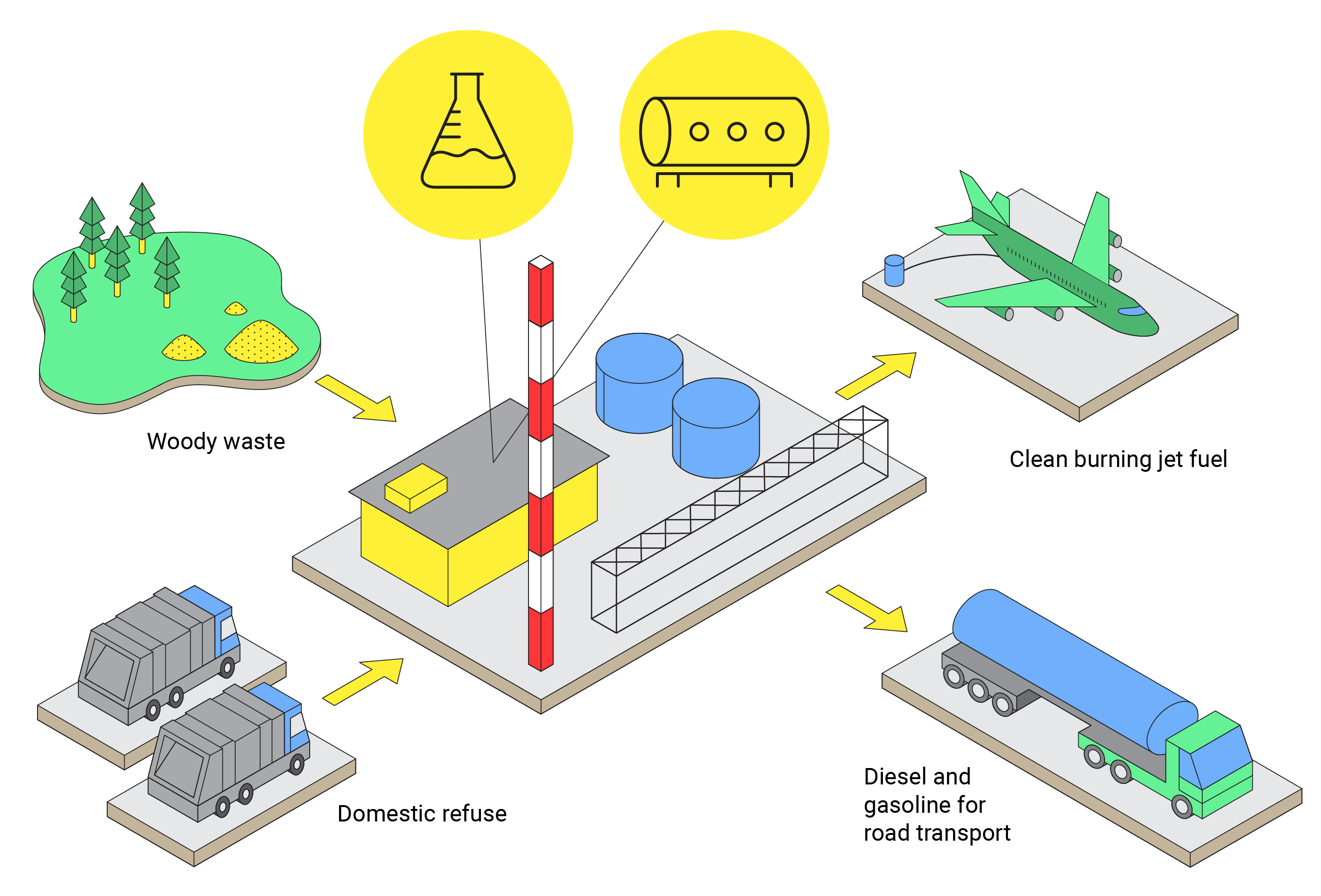
This could be a route to net-zero carbon aviation and heavy haulage.
The beauty is that there would need to be little modification to existing aircraft and trucks.
Oxford University’s Magic Process
These paragraphs from The Times article explain their process.
The clue came in research on particles of iron, and what happens when they get really small. “There’s a fascinating problem,” Professor Edwards said. “You take a bit of metal, and you break it into smaller and smaller bits. At what stage does it stop behaving like a copy of the bigger bit?”
When the particle gets below a critical size, it turns out it’s no longer a metal in the standard sense. The electrical conductivity plummets, and its ability to absorb microwaves does the reverse, increasing by ten orders of magnitude.
Professor Edwards realised that this could be useful. “When you turn on the microwaves, these things become little hotspots of heat,” he said. When he put them in a mix of milled-up plastic, he found that they broke the bonds between the hydrogen and carbon, without the expense and mess of also heating up the plastic itself.
What is left is hydrogen gas, which can be used for fuel, and lumps of carbon nanotubes, which Professor Edwards hopes might be of a high enough grade to have a use as well. The next stage is to work with industry to find ways to scale it up.
It sounds rather amazing.
Going Large!
This article from The Times on Friday, is entitled Plastic To Be Saved From Landfill By Revolutionary Recycling Plants.
These are the two introductory paragraphs.
Thousands of tonnes of plastic waste will be turned into new plastic in Britain rather than dumped in landfill sites, incinerated or sent overseas under plans for four new plants that will use cutting-edge recycling technology.
Up to 130,000 tonnes of plastic a year will be chemically transformed in the facilities, which are to be built in Teesside, the West Midlands and Perth.
It all sounds like technology, that can transform our use of plastics.
Conclusion
In the years since I left Liverpool University in 1968 with a degree in Electrical and control Engineering, it has sometimes seemed to me, that chemistry has been a partly neglected science.
It now seems to be coming to the fore strongly.
 The Anonymous Widower