Improving Trains Between London And Bradford
Current Services Between London And Bradford
LNER services run between Kings Cross and Bradford Forster Square stations.
- Two trains per day (tpd) run between Bradford and London in the early morning.
- Two tpd run between London and Bradford in the evening.
- Trains take two and three-quarter hours.
- Stops are at Shipley, Leeds, Wakefield Westgate, Doncaster, Retford Grantham and Stevenage.
- Trains seem to be generally a pair of five-car Class 801 trains.
Note.
- Trains reverse at Leeds.
- The timetable seems a bit lopsided, as there is no early morning train to Bradford or an evening one to London.
- Harrogate gets a one train per two hours (tp2h) service to and from London.
The timetable could do with an improvement.
Grand Central services run between Kings Cross and Bradford Interchange stations.
- Four tpd run between Bradford and London.
- Four tpd run between London and Bradford.
- Trains take three and a quarter hours.
- Stops are at Pontefract Monkhill, Wakefield Kirkgate, Mirfield, Brighouse, Halifax and Low Moor
- Trains are five-car Class 180 trains, which have seen better days.
Note.
- The timetable seems a bit lopsided, as there is no early morning train to Bradford or an evening one to London.
The timetable and the trains could do with an improvement.
LNER’s New Ticketing And Nine-Ten Car Trains
LNER have introduced the selling of Advanced Tickets from machines or the Booking Office as late as five minutes before the train leaves.
- My last three trips from Leeds to London cost me £33.55, £33.75 and £33.55 with my Senior Railcard.
- All were bought less than ten minutes before the train left.
- In two of the journeys, I spread out in two seats
- Trains were either a pair of five-car Class 801 trains or a nine-car InterCity 225.
I took these pictures after my last return from Leeds on Tuesday.
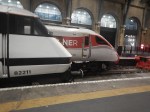

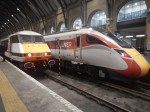
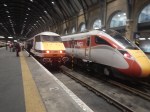
Note.
- Two of the three trains I’ve taken lately have arrived 3-4 minutes early.
- Not a great increase, but I do wonder if LNER are seeing what is possible with the new digital signalling.
- The British Rail era; InterCity 225 seems to hold its own against the new Hitachi train.
I wouldn’t be surprised that LNER intend to both run high-capacity trains between London and Leeds and fill them by competitive pricing.
A Grand Central Train Failure On Tuesday
This was my journey to Bradford on Tuesday,
- I was supposed to take the 1057 Grand Central service to Bradford Interchange, where it was timed to arrive at 1400.
- But the train didn’t run and we were all advised to get on the 1103 to Leeds and change at Doncaster.
- We arrived at Doncaster in Platform 4, a minute late at 1240 and got straight on a Grand Central train in the opposite Platform 6.
- We left Doncaster at 1251, which was sixteen minutes late.
- But we arrived in Bradford Interchange more or less on time at 1401.
Despite leaving six minutes late from Kings Cross and changing trains at Doncaster, we arrived at Bradford on time.
Battery-Electric Trains Between London and Bradford Interchange
I feel that my journey on Tuesday indicated.
- Electric trains between London and Doncaster can easily meet the current timetable.
- The Grand Central train went between Doncaster and Bradford Interchange was sixteen minutes faster than the timetable.
I wouldn’t be surprised that London and Bradford Interchange could be a few minutes under three hours.
Consider.
- It has been said that between Bradford Interchange and Leeds will be electrified.
- Bradford Interchange and Doncaster does not have electrification, but is only 52 miles.
- Electrification of Bradford Interchange station, will allow battery-electric trains to be charged in around 10-12 minutes.
- Most inter-city battery-electric trains have a battery range of at least eighty miles.
- Digital signalling is being installed between London and Doncaster to allow 140 mph running and more trains in the timetable.
I believe that a battery-electric train with sufficient range, charging South of Doncaster and at Bradford Interchange could go between London and Bradford Interchange in 5-10 minutes under three hours.
Bradford Interchange and all the other stations North of Doncaster on the route could probably also have a one tp2h service to and from London and the South.
Splitting And Joining Of Trains
Consider.
- Pairs of the Hitachi Class 801 trains have the ability to split and join en route, during a station stop extended by a few minutes.
- Platforms are long enough to handle splitting and joining at Doncaster, Leeds and York.
- Currently, three services to and from London go past Leeds; Bradford Forster Square, Harrogate and Skipton. All these services reverse in Leeds station, when they pass through.
- The reversing in Leeds station takes about 8-9 minutes.
- The track between Leeds and Bradford Forster Square is electrified.
- Leeds and Harrogate is not electrified and is 19.3 miles.
- The track between Leeds and Skipton is electrified.
- Bradford Forster Square has a service of two tpd.
- Harrogate has a service of one tp2h.
- Skipton has a service of one tpd.
In the Wikipedia entry for LNER, this is said.
From December 2019, LNER introduced a Harrogate to London service six times a day. LNER expected to introduce two-hourly services to Bradford and a daily service to Huddersfield by May 2020 when more Azuma trains had been introduced, however the latter has not yet been introduced.
Note.
- The Huddersfield service would have to reverse in Leeds station, like those to Bradford Forster Square, Harrogate and Skipton.
- Leeds and Huddersfield is not electrified and is 17.1 miles.
- Leeds and Huddersfield is being electrified.
Could LNER’s plan be to give Bradford Forster Square, Harrogate, Huddersfield and Skipton stations a two-hourly service , as the Wikipedia extract indicated, they intend to do for Bradford?
- All trains enter and leave Leeds to and from the West.
- Pairs of five-car trains would split and join at Leeds.
- Bradford Forster Square and Skipton services would be served by electric trains.
- Harrogate and Huddersfield services would be served by bi-mode or battery-electric trains.
- Horsforth, Keighley and Shipley could also get a one tp2h service to London.
It looks like services via Leeds could be much improved.
In a two-hour period the Leeds area will have the following trains to and from London Kings Cross.
- Two trains between London and Leeds via Peterborough, Doncaster and Wakefield Westgate
- One train between London and Bradford Forster Square via Stevenage, Grantham, Retford (Bradford-bound only), Doncaster, Wakefield Westgate, Leeds and Shipley.
- One train between London and Harrogate via Stevenage, Grantham, Doncaster, Wakefield Westgate, Leeds and Horsforth
- One train between London and Huddersfield via Stevenage, Grantham, Doncaster, Wakefield Westgate and Leeds
- One train between London and Skipton via Peterborough, Newark Northgate, Doncaster, Wakefield Westgate, Leeds, Shipley (London-bound only) and Keighley.
Note.
- Stops between London and Leeds would be adjusted to satisfy passenger numbers.
- Currently, there are a total of four trains in a two hour period.
- Six trains will be fitted in by having two London and Leeds trains and two pairs of five-car trains, that joined and split at Leeds.
There is still only four train paths needed in a two hour period between London and Leeds.
Digital Signalling Between London And Doncaster
The East Coast Digital Programme has its own web site, which gives this introduction to the programme.
The East Coast Digital Programme is delivering the next generation of train travel – creating a better performing East Coast Main Line for passengers and everyone else who uses and depends on it.
As part of the programme, traditional lineside signals will be removed and replaced with state-of the art digital signalling to improve the reliability of the train service.
The new technology continuously communicates with each train, providing signalling information directly to a computer screen in the driver’s cab. It boosts reliability, reduces carbon emissions and provides a more punctual service for customers.
In the first stage, digital signalling will be introduced on the Northern City Line, between Finsbury Park and Moorgate. It will then be progressively rolled out on the southern section of the East Coast Main Line (between London King’s Cross and the Stoke Tunnels, near Grantham).
It is expected that the first trains to operate on the East Coast Main Line using digital signalling technology will run in 2025, with all improvements expected to be completed by the end of the decade.
As a result of this programme, the East Coast Main Line will be GB’s first intercity mainline to be upgraded to digital. It lays the foundation for further improvements across the network, creating a more efficient railway fit for the future.
There is also a video.
Benefits of digital signalling will include.
- 140 mph running instead of 125 mph.
- An increase in the number of train paths.
- Trains will be able to be run closer together.
As a Graduate Control Engineer, I also believe that digital signalling will enable better control of trains through bottlenecks.
- Could ERTMS And ETCS Solve The Newark Crossing Problem?
- Is There An ERTMS-based Solution To The Digswell Viaduct?
A computer solution would surely be more affordable than some massive civil engineering.
What Will Be The Fastest Times Possible Between London King’s Cross And Leeds?
I put my thoughts in What Will Be The Fastest Times Possible Between London King’s Cross And Leeds?.
Conclusion
The original High Speed Two specification gave a time of one hour and twenty-one minutes between Euston and Leeds.
I suspect that time will be approached before 2040.
London North Eastern Railway Runs Trial Train To Liverpool Street
The title of this post, is the same as that of this article on Rail Advent.
These two paragraphs, describe why this was done.
In an effort to mitigate the effect on passengers during disruption to services, London North Eastern Railway (LNER) ran one of its Azuma trains from Finsbury Park to London Liverpool Street during the early hours of this morning, Friday, 14th July.
The trial run took place to determine the long-term feasibility of diverting services during periods of planned disruption or when significant engineering works were taking place.
There doesn’t seem to have been any problems.
- The route in from Finsbury Park station went through Canonbury, Dalston Kingsland, Hackney Central, Homerton, Hackney Wick, Stratford and Bethnal Green stations, which was a distance of 9.6 miles.
- The route out to Finsbury Park station went through Bethnal Green, Cambridge Heath, London Fields, Dalston Kingsland and Canonbury, what was a distance of 5.8 miles.
Note.
- Two different routes were checked.
- The Class 800 train had five cars.
- Platform 4 at Liverpool Street station was used, which is normally used by London Overground and Cambridge services.
As this comes so soon after the test run to Cleethorpes, that I wrote about in Azuma Test Train Takes To The Tracks As LNER Trials Possible New Route, I wonder if Network Rail and the train operating companies are planning for some worst case scenario, where the two or more of the West Coast Main Line, Midland Main Lone and East Coast Main Line are blocked.
LNER and Network Rail have shown the following.
- Azumas can use Cleethorpes station.
- Azumas can use Liverpool Street station.
We also know that Cleethorpes has a direct TransPennine train service across the North of England to Doncaster, Sheffield, Manchester and Liverpool.
So if say Euston has to be shut for perhaps fourteen days during the construction of High Speed Two, a service between Liverpool Street and Cleethorpes via Colchester, Ipswich, Cambridge, Peterborough and Lincoln could be used to get some passengers to and from the North.
The other big problem is the removal of the problems of the Newark Crossing, which if it results in a long blockade of the East Coast Main Line, might need services to go into an alternative London terminal.
The Powerhouse In The East
Consider.
- The importance of Cambridge to the economy of the UK is growing fast.
- The city suffers from a shortage of commercial premises, housing and staff at all levels.
- I have just looked at the non-passenger traffic on the West Anglia Main Line for all of yesterday and there were just six freight trains through Bishop’s Stortford.
I wonder, if it would be possible to run a Liverpool Street and Cleethorpes service via Cambridge, Ely, Peterborough, Spalding, Sleaford, Lincoln, Market Rasen, Barnetby and Grimsby Town?
- The service avoids the East Coast Main Line, except through Peterborough, where it would use the separate Werrington lines.
- Liverpool Street is in the heart of one of the world’s major financial centres.
- Liverpool Street is on the Elizabeth Line.
- The service could call at Stansted Airport, but a reverse would be needed.
- Peterborough is sometimes promoted in Cambridge as a city, that could be developed, to provide support for Cambridge.
- A reverse would be needed at Lincoln.
- Lincoln is developing as a university city with character.
- Grimsby and Cleethorpes are close to the fast expanding Humberside renewable energy and hydrogen cluster.
The service could be paired with a Liverpool Street and Norwich service, via Ely, Thetford, Attleborough and Wymondham.
The services could alternate every half hour or perhaps leave London as a pair and split and join at Cambridge.
Platform Availability At Kings Cross And Liverpool Street
Consider.
- Digital signalling on the East Coast Main Line will increase the number of possible trains between London and the North.
- LNER have said they want to increase services to the North and have identified a possible service to Cleethorpes.
- Grand Central would like to increase services to Bradford.
- Lumo have started services to Newcastle and Edinburgh from Kings Cross.
- The Elizabeth Line now runs less services into Liverpool Street station.
- The Elizabeth Line connects to Liverpool Street, but doesn’t connect to King’s Cross.
- Liverpool Street is to undergo a major refurbishment, which should increase the overall passenger capacity of the station.
Would it be sensible to move a small number of services from King’s Cross to Liverpool Street?
Surely, the logical service to move to Liverpool Street would be the new Cleethorpes service.
- It would route via Cambridge, Cambridge North, Ely, Peterborough, Spalding, Sleaford, Lincoln, Market Rasen, Barnetby and Grimsby Town.
- It would use the Werrington Lines through Peterborough.
- It would not need a path on the East Coast Main Line.
- The service would provide a much needed direct link between Cambridge and Lincoln via Peterborough.
- The service could also be hourly or two-hourly.
I also believe that a Liverpool Street and Cleethorpes service could be run by a battery-electric Azuma.
- The route is electrified between Liverpool Street and Ely and through Peterborough.
- Ely and Peterborough is 30 miles.
- Peterborough and Lincoln is 56.9 miles.
- Lincoln and Cleethorpes is 47.2 miles.
- There would need to be a charging station or a few miles of electrification at Cleethorpes.
- There may be 134.1 miles of unelectrified track, but there can be a Splash and Dash at Peterborough.
A Stadler Akku would be able to handle this route, so I suspect that a similar-sized battery-electric Azuma should also be able to handle the route.
Cleethorpes Station – 28th June 2023
I took these pictures at Cleethorpes station yesterday.
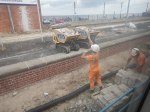
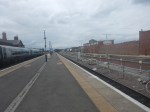
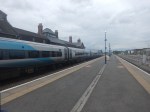
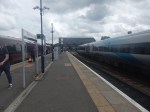
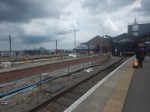
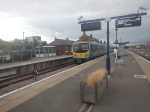
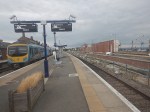
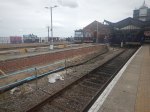
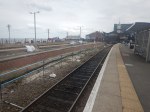
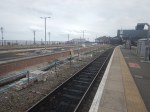
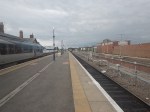
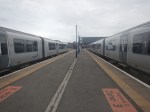
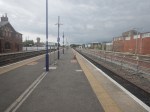
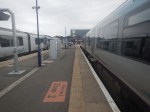
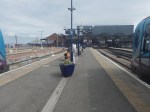
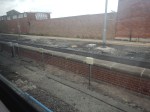
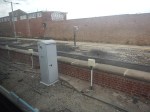
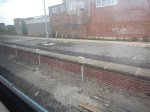
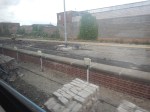
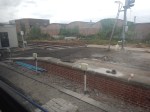
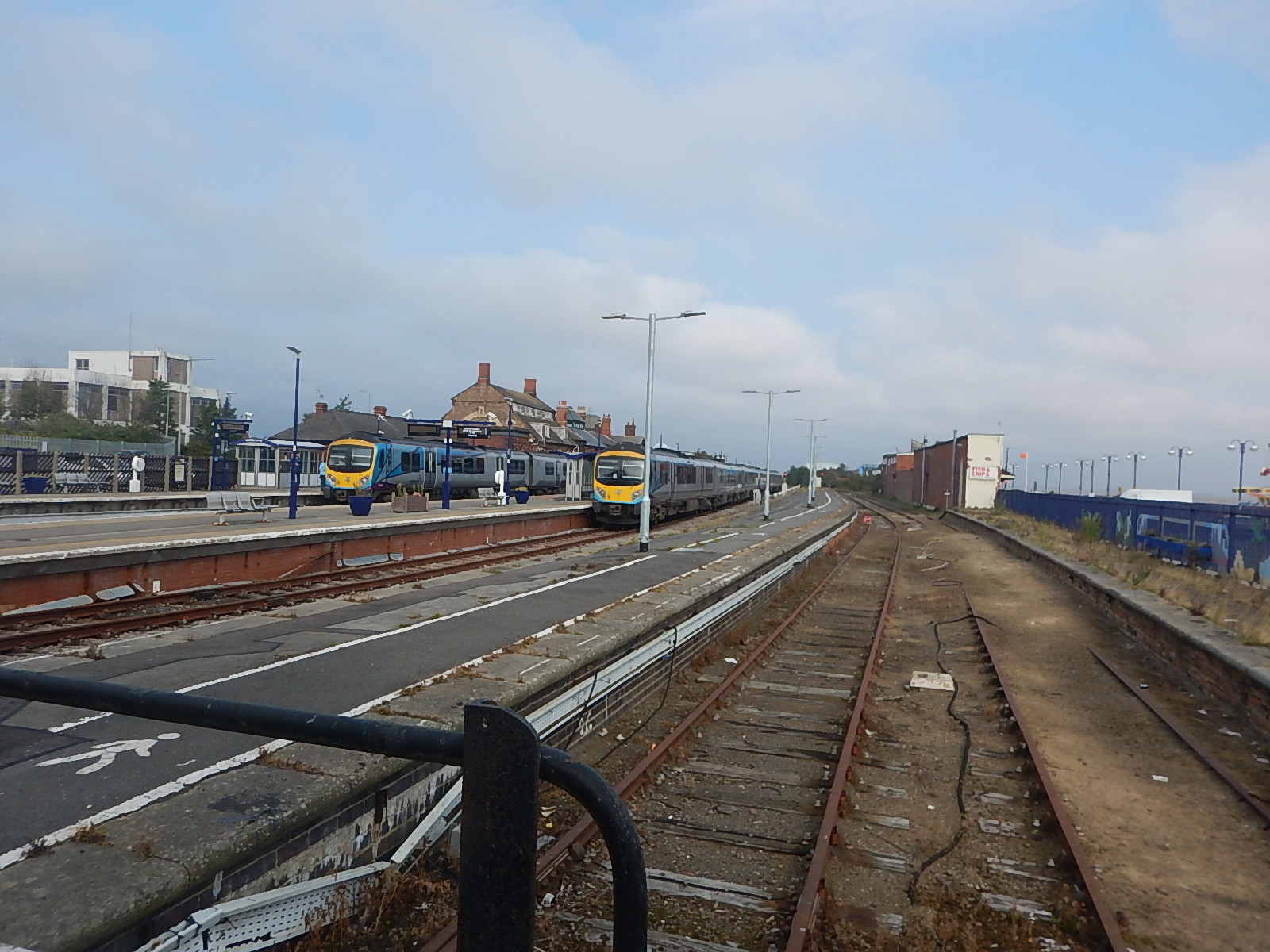
Compare them with this one taken three years ago.
Note.
- It appears a Platform 4 has been created on the seaward side of the station.
- The track in Platform 4 in yesterday’s pictures appears to be newly-ballasted, whereas three years ago it had an air of dereliction.
- There is now a smart blue wooden fence separating the tracks from the station concourse.
- Strangely, the lighting between Platforms 3 and 4 had been installed three years ago.
- There are different types of lighting on the two islands. Could this be because Network Rail are looking for the lights that perform best in a seaside environment?
This Google Map shows Cleethorpes station.
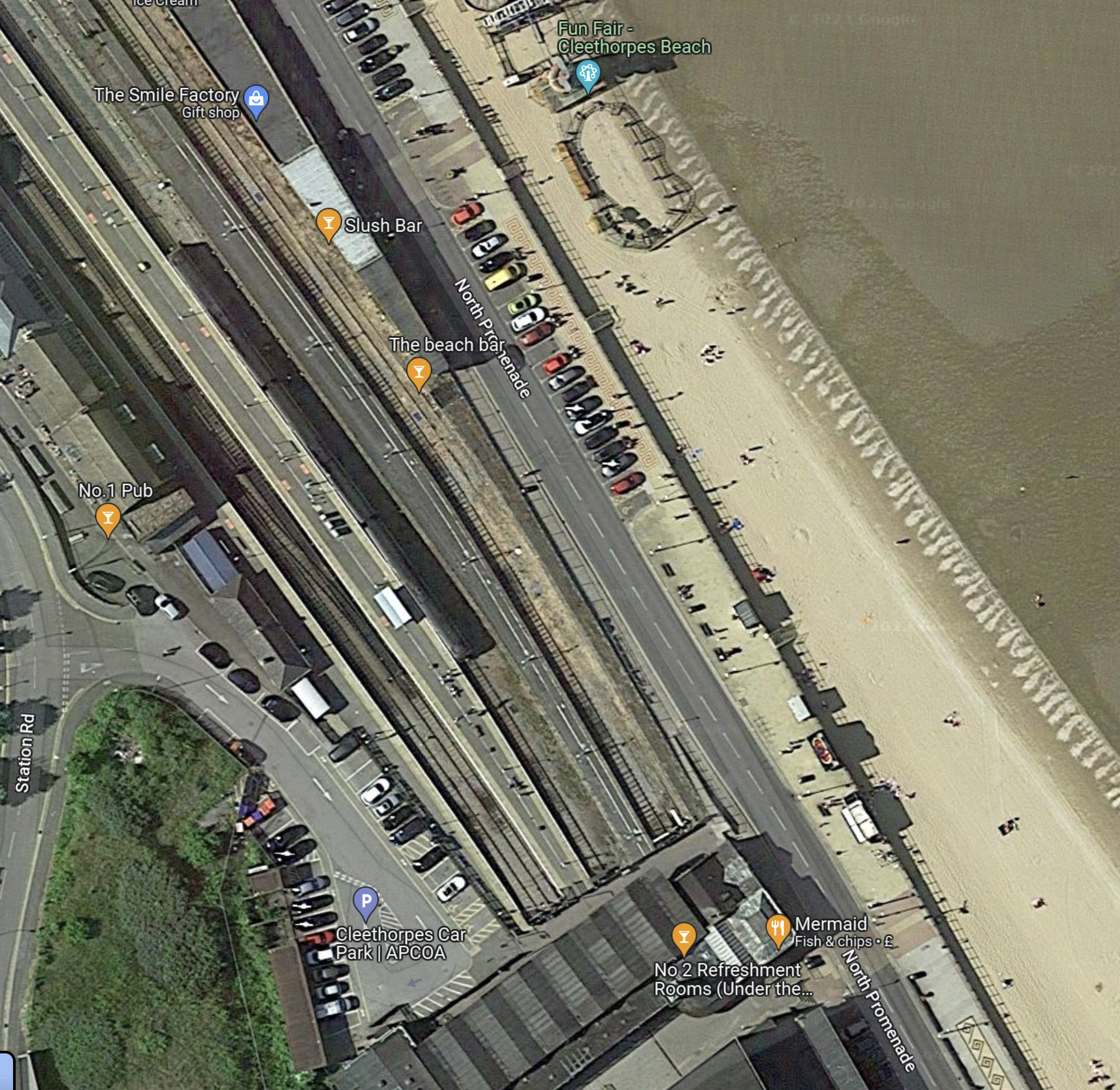
Note.
- The track in Platform 4 appears to be complete.
- The station is very handy for the beach.
In Azuma Test Train Takes To The Tracks As LNER Trials Possible New Route, I said this.
It looks like three platforms 2, 3 and 4 at Cleethorpes station were checked.
I think it is possible to say, that once Network Rail’s brickies and paviours have tidied up, that Cleethorpes station will be LNER-ready and could accept a service from London via Lincoln, Market Rasen, Barnetby and Grimsby Town.
What Will Be The Initial Service Of The London and Cleethorpes Service?
The Wikipedia entry for Cleethorpes station, says this about the London service.
In the 1970s Cleethorpes had a twice daily return service to London King’s Cross, typically hauled by a Class 55 Deltic.
Three people, I spoke to about the possible service, mentioned that two trains per day would be the frequency.
I certainly think, that this frequency, could be a sensible initial frequency.
If it worked in the 1970s, I can see why it might work in the 2020s.
- Kids still like to go to the seaside and the station is close.
- This area of North-East Lincolnshire, is getting increasingly important as an energy and hydrogen powerhouse.
- Cleethorpes station has the space to handle more train services.
- Cleethorpes station has a small depot nearby, which could ease train operations, by stabling a train overnight for an early start in the morning.
But there is one factor that could attract passengers to use the train between King’s Cross and Cleethorpes. I believe that the soon-to-be-announced Hitachi battery-electric Class 800 trains could be able to handle the route without using a drop of fossil fuel.
Running Battery-Electric Class 800 trains Between King’s Cross And Cleethorpes
Consider.
- Cleethorpes and Lincoln is 47.2 miles with three stops.
- Lincoln and Newark Northgate, where the electrification starts is 16.7 files.
- Cleethorpes and Newark Northgate is 63.9 miles, with an out-and-back trip being 127.8 miles.
- Battery-electric trains would do most of their charging between King’s Cross and Newark Northgate.
- Full or partial charging should be possible at both Cleethorpes and Lincoln.
- Battery-electric trains could give help, in cases of catenary failure on the East Coast Main Line.
- In What Will Be The Range Of A Hitachi Class 800 Battery Train?, I said that I believed a Class 800 battery train would eventually have a battery range in excess of the Stadler FLIRT Akku’s 139 miles, as no-one likes being second.
I believe these strategies are possible.
Charge A Round Trip At Cleethorpes
Consider.
- This is a range of just 63.9 miles.
- The service would use Platform 4 at Cleethorpes station.
- Charging at Cleethorpes could be by a short length of overhead electrification in Cleethorpes station or a specialist charger in the small depot.
- Charge time would be around 15 minutes.
- If charging were in the station, there would be no shunting of trains around.
This could be a simple and efficient way to run the service.
A Battery Round Trip To Cleethorpes
- This is a range of 127.8 miles.
- The service would use Platform 4 at Cleethorpes station.
- I believe that this service would need a simple charger at Cleethorpes station, as trains do get delayed and these delays on a battery-electric train, may increase the need for charging.
- Also what would happen in Grimsby Town were at home to a London club in the FA Cup?
This could be a reliable way to run the service, but I believe drivers need a charging facility at Cleethorpes as a fail-safe backup.
Electrification Between Grimsby Town And Cleethorpes
In Between Lincoln And Cleethorpes – 28th June 2023, I said this.
3.3 miles between Grimsby Town and Cleethorpes took just ten minutes.
All trains terminating at Cleethorpes would get at least twenty minutes of charging, every time, they turned round at the station.
Much of the route between Grimsby Town and Cleethorpes is only single-track, so this could be a very affordable option.
I don’t think there would be many objectors to electrifying between Grimsby Town and Cleethorpes.
An hourly train would use twenty minutes in ever hour between Grimsby Town and Cleethorpes, it looks like the limit would be three trains per hour terminating at Cleethorpes.
So could the three trains be the following?
- One train to Liverpool Lime Street.
- One train to Lincoln, with alternate trains continuing to Nottingham, Loughborough and Leicester and some trains to Kings Cross.
- One train to Barton-on-Humber.
Note.
- The Liverpool Lime Street train, would use batteries between Grimsby Town and Hazel Grove, which is 101.4 miles.
- A London King’s Cross train, would use batteries between Grimsby Town and Newark Northgate, which is 60.6 miles.
- A Leicester train, could use batteries between Grimsby Town and Leicester, which is 105.3 miles. Nottingham and Grimsby Town is 77.8 miles.
- Leicester and Nottingham services would need electrification at the Western end.
- King;s Cross, Leicester and Nottingham services would be arranged so Lincoln and Cleethorpes was an hourly service.
- A Barton-on-Humber train, would use batteries between Grimsby Town and Barton-on-Humber , which is 19.6 miles or 39.2 miles for a round trip.
Cleethorpes station could be at the centre of its own battery-electric train network, with all trains powered by just 3.3 miles of single-track electrification.
Azuma Test Train Takes To The Tracks As LNER Trials Possible New Route
The title of this post, is the same as that of this article on Rail Technology Magazine.
This is the first paragraph.
London North Eastern Railway (LNER) completed a test run from Cleethorpes in Lincolnshire and London King’s Cross, with the view to operating a direct service in the future.
These two paragraphs describe how the tests were carried out.
A first test train travelled from Doncaster on 26 June which called at Grimsby Town, Cleethorpes, Barnetby and Market Rasen. At each station, a series of platform and train validations were performed to ensure that a service could be compatible in the future.
On the journey itself, a specialist team travelled onboard, carried out a number of checks and assessments which is required for any potential new route or extension. A detailed assessment was undertaken. The findings will now be reviewed by the stakeholders.
The test run was in four sections.
- 5Q80 – Departed Doncaster Carr Lane Depot at 0817 and arrived Cleethorpes Platform 4 at 1000.
- 5Q81 – Departed Cleethorpes Platform 3 at 1054 and arrived Lincoln Central Platform 5 at 1219.
- 5Q82 – Departed Lincoln Central Platform 5 at 1226 and arrived Cleethorpes Platform 2 at 1355.
- 5Q83 – Departed Cleethorpes Platform 2 at 1528 and arrived Doncaster Carr Lane Depot at 1654.
Note.
- These details came from Real Time Trains.
- It looks like three platforms 2, 3 and 4 at Cleethorpes station were checked.
- The route between Cleethorpes and Lincoln Central was checked both ways.
- The route between Doncaster Carr Lane Depot and Cleethorpes was checked both ways.
- Typically, each station stop took around 10-12 minutes, which probably gave adequate time for the specialist team to make their checks and assessments.
- Class 800 trains run six times a day between Lincoln Central and King’s Cross, so I must assume that section is well-checked and has the correct clearances.
- Lincoln Central station is 16.7 miles from the electrified East Coast Main Line at Newark Northgate station.
- Cleethorpes station is 52.1 miles from the electrified East Coast Main Line at Doncaster station.
- The distance between Lincoln Central and Cleethorpes stations is 47.2 miles.
- The timing between Lincoln Central and Cleethorpes appears to be just under one hour and thirty minutes.
It looks like a thorough test has been performed.
I have a few thoughts.
Platforms At Cleethorpes Station
According to the Wikipedia entry for Cleethorpes station, the station has three platforms, which are numbered 1, 2 and 3.
These three pictures show Cleethorpes station in 2020.

Note.
- The two trains are Class 185 trains of TransPennine Express.
- The train in the left is in Platform 1.
- Platform 2 appears to be empty.
- The train on the right is Platform 3.
I would assume Platform 4 could be the derelict platform shown in the third picture at the right. Or it might be a typo!
But if it is felt that LNER will need their own platform, it would surely be a good idea to do all testing at the same time.
Initial Service Pattern
I would expect that the initial service pattern would follow that used for many new services.
- There will be an early morning train up to London.
- There will be a late afternoon or early evening return train.
Journey time could be around three hours and twenty minutes.
Once the demand is proven, extra trains to and from London might be added in the middle of the day.
Could This Service Be Served By Battery-Electric Class 800 Trains?
From a picture on this article on the BBC, the test run appears to have been carried out by a bi-mode Class 800 train.
The full route from Doncaster to King’s Cross has four sections.
- Doncaster and Cleethorpes – 52.1 miles – Unelectrified
- Cleethorpes and Lincoln Central – 47.2 miles – Unelectrified
- Lincoln Central and Newark Northgate – 16.7 miles – Unelectrified
- Newark Northgate and King’s Cross – 120.1 – Electrified
To go between King’s Cross and Doncaster via Cleethorpes would need a battery-electric train with a range of 116 miles.
In What Will Be The Range Of A Hitachi Class 800 Battery Train?, I came to this conclusion about the battery range of a Class 800 train.
The first version of the battery-electric train will have a range of around a hundred miles, so that they can handle the Great Northern and Great Eastern Joint Line diversion on battery power.
But fairly soon after introduction into service, I will be very surprised if they don’t claim the Guinness world record by running farther than the Stadler FLIRT Akku’s 139 miles.
Note.
- Trains would be charged using the existing electrification of the East Coast Main Line.
- No new infrastructure would be required.
But for service recovery reasons, it could be prudent to add electrification to Platform 4 at Cleethorpes station.
Could TransPennine’s Service Between Doncaster and Cleethorpes Be Served By Battery-Electric Class 802 Trains?
As it is only a round trip of 104.2 miles, I don’t see why this couldn’t be done by say 2028.
Could LNER’s Service Between King’s Cross and Lincoln Be Served By Battery-Electric Class 800 Trains?
As it is only a round trip of only 33.4 miles, this is the easy trip to decarbonise.
Ten-Car Hull Trains
On Friday, about eleven in the morning, I was standing on the platform at Finsbury Park station, when unusually I saw a pair of Hull Trains’s Class 802 trains go through as a ten-car train.
A few minutes later, I took a train to King’s Cross, where I took these pictures.

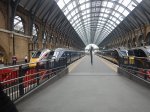
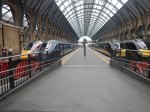
Note.
- The four platforms are numbered from 1 to 4 from the right.
- The Hull Train is in platform 3.
- The fourth picture clearly shows the 11:18 Hull Trains service has ten carriages.
Hull Trains were also selling tickets on the train.
Hull Trains Timetable On April 29th 2023
These trains ran South.
- Beverley-Kings Cross – 0557 – 5 cars
- Hull-Kings Cross – 0824 – 10 cars
- Hull-Kings Cross – 1033 – 5 cars
- Hull-Kings Cross – 1330 – 5 cars
- Hull-Kings Cross – 1531 – 5 cars
- Hull-Kings Cross – 1836 – 5 cars
And these trains ran North
- Kings Cross – 0727-Hull – 5 cars
- Kings Cross – 0948-Hull – 5 cars
- Kings Cross – 1148-Hull – 10 cars
- Kings Cross – 1448-Hull – 5 cars
- Kings Cross – 1748-Beverley – 5 cars
- Kings Cross – 1948-Hull – 5 cars
Note.
- The ten-car trains only run to Hull.
- The daily number of seats between Hull and London has been increased by 16.7 %.
- Four trains are needed to run 5 x five-car and 1 x ten-car trains in each direction.
I can see this timetable being used on other busy days.
Thoughts On Extending The Northern Line To Clapham Junction
As I wrote in Northern Line Could Be Extended To Clapham Junction In Regeneration Plans, the extension of the newly-built extension to Battersea Power Station station could be further extended to Clapham Junction station.
Railways Between Battersea And Clapham
This map from OpenRailwayMap shows the tracks that run between the two stations.

Note.
- Battersea Power Station station is in the North-East corner of the map.
- The orange and yellow lines going North from that corner go to Victoria station.
- The orange and yellow lines going North-East from that corner go to Waterloo station.
- The yellow line going West is the West London Line to Shepherds Bush and Willesden Junction stations.
- Clapham Junction station is in the South-West corner of the map.
I estimate that the distance between Battersea Power Station and Clapham Junction stations is about three kilometres.
This map from OpenRailwayMap shows an enlargement of the tracks around Battersea.
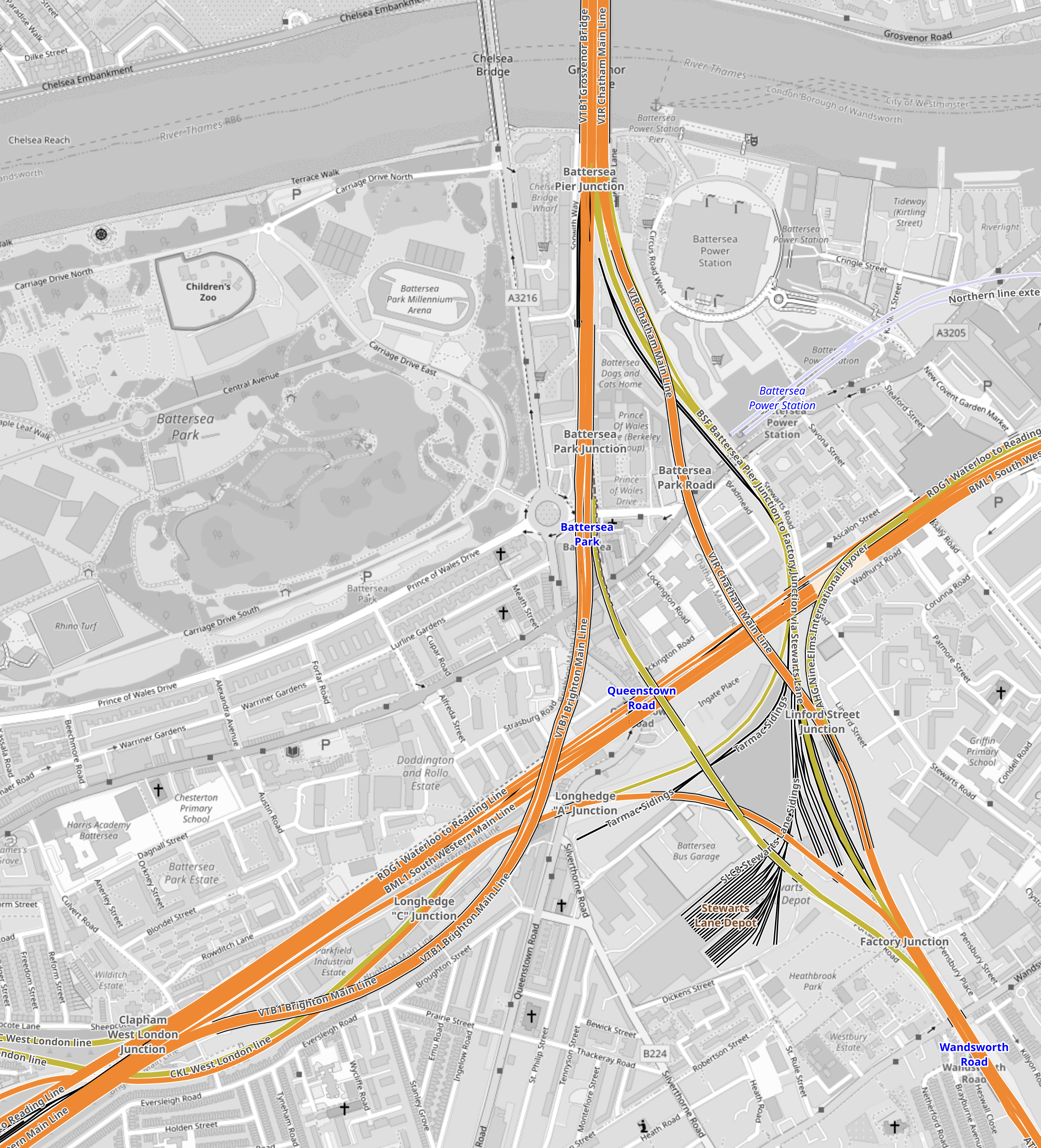
Note.
- The tracks going North over the River to Victoria station.
- The tracks going East to Waterloo station.
- The tracks going South West to Clapham Junction station.
- The tracks from Victoria pass over and then join the tracks from Waterloo to continue to Clapham Junction station.
Battersea Power Station station can be seen to the North-East of the junction.
This map from OpenRailwayMap shows an enlargement of the tracks around Battersea Power Station station.
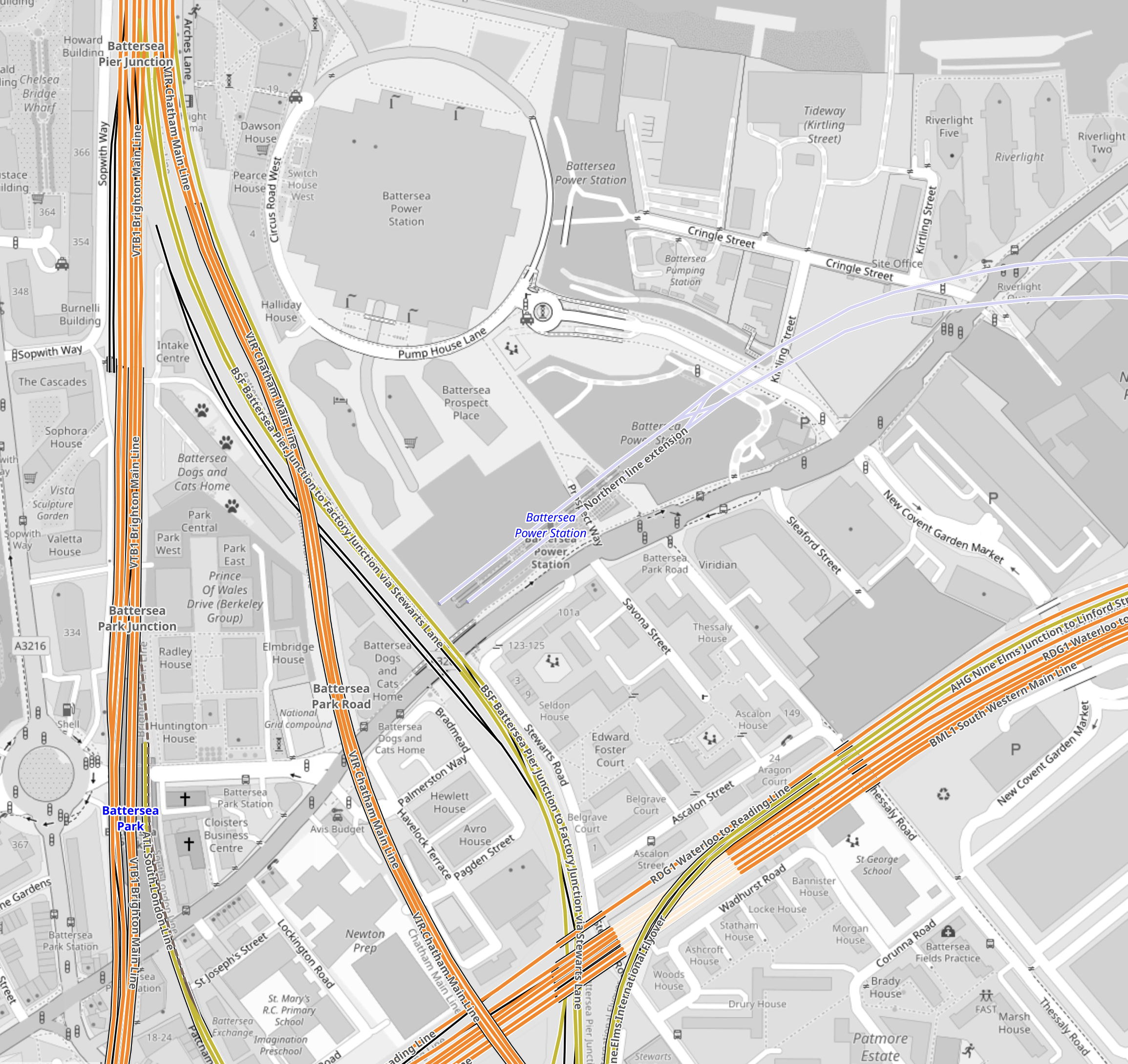
Note how the tracks go through Battersea Power Station station and terminate just before the lines into Victoria station.
It should also be noted that the platforms at Battersea Power Station station are reached using two sets of escalators, so they could be over forty metres below the surface. This would surely make the construction of tower blocks with deep foundations easier over the Northern Line.
But the depth would also enable an extended Northern Line to be below any existing or future construction.
This map from OpenRailwayMap shows the approaches to Clapham Junction station.
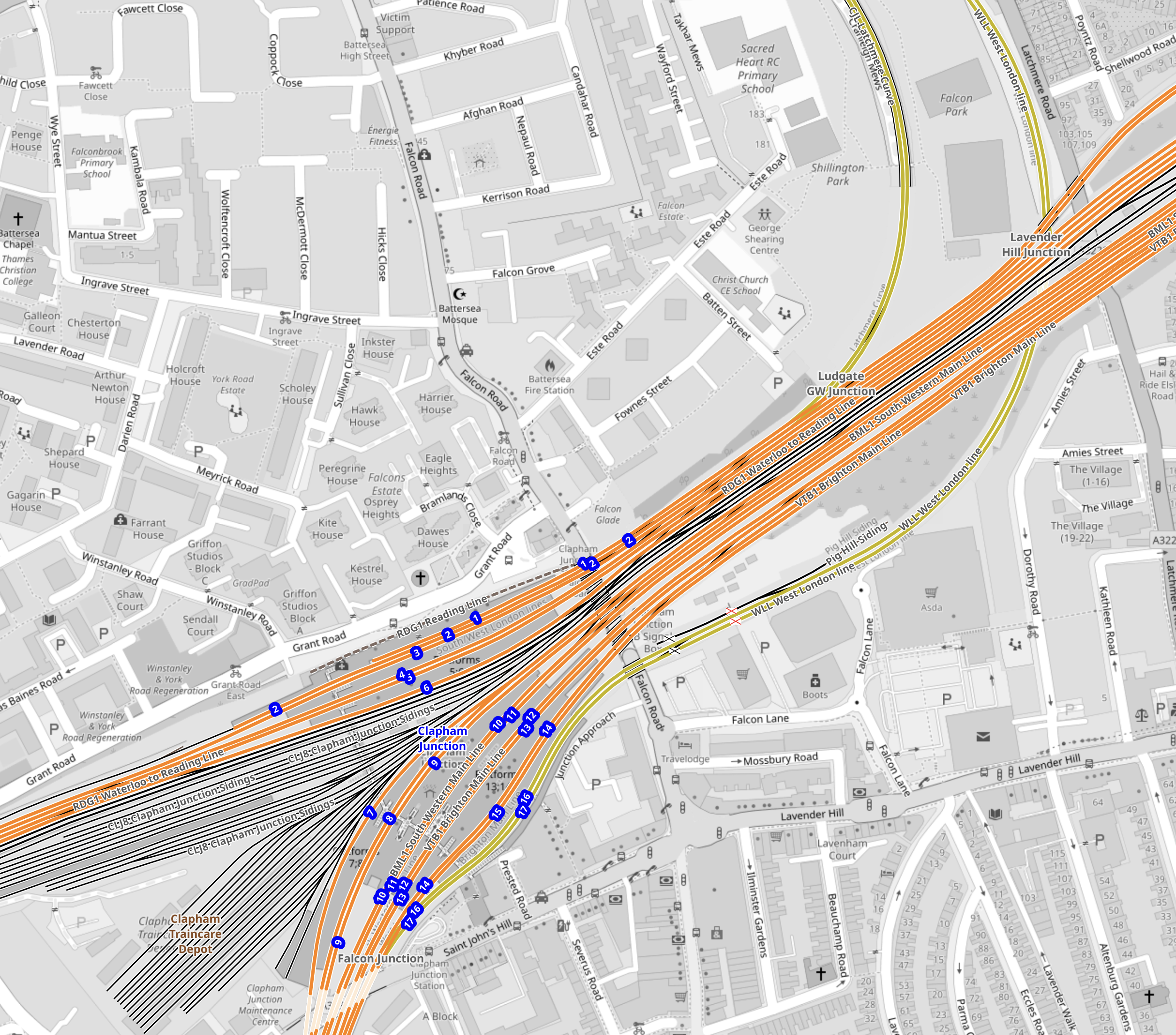
There are certainly a lot of tracks through Clapham Junction station.
Reasons For The Extension Of The Northern Line To Clapham Junction
These reasons come to mind.
To Enable Development In The Area
This is always a good reason.
In Network Rail To Outline Business Case For Clapham Junction Redevelopment, I said this.
The Rail Technology Magazine article talks of decking over the whole station and putting two million square feet of development on top. But it also cautions, it would be very expensive.
With that amount of development, there would be a need for as many transport links as possible.
To Improve Access To The Elizabeth Line For Passengers On Trains To And From Victoria
Victoria station does not have an Underground Line, that connects to easily the Elizabeth Line.
The best route to use is described in The Lizzie Line And Circle/District Line Interchange At Paddington – 1st July 2022, where you use the Circle to Paddington.
- To go to the West on the Elizabeth Line, take the Circle/District Line to Paddington.
- To go to the East on the Elizabeth Line, take the District Line to Whitechapel.
- To go to Liverpool Street take the Circle Line all the way.
Getting to the stations between Paddington and Liverpool Street means a change at either of those stations.
At Waterloo, you can use the Northern Line, which has a direct connection to Tottenham Court Road on the Elizabeth Line.
Connecting to the Northern Line at Clapham Junction will give Victoria-bound passengers, the advantages of those going to Waterloo.
An Alternative Way Of Connecting Victoria To The Elizabeth Line
The lack of an easy connection between the Victoria and the Elizabeth Line is a pain and I believe that it was a major omission in the design of the Elizabeth Line.
- Dear Old Vicky has a frequency of upwards of thirty trains per hour (tph)
- With some improvements at stations like Oxford Circus, Highbury & Islington and Walthamstow Central, the line could handle some more passengers.
- More step-free access would also help increase capacity.
- Engineers are a competitive bunch and I could see the day, when Vicky is running at 40 tph.
If Vicky was running at forty full tph, it would be moving 45120 passengers per hour.
This would mean that to match the passenger capacity of the older line, the Elizabeth Line would have to be running at a frequency of thirty tph.
As passengers at the ends of the line have difficulty getting to places like Paddington and Heathrow, a connection between the two Queens would really help.
Vicky was universe-class in the 1960s and now she needs updating to the 21st Century.
This map from cartometro shows the Lines through Bond Street and Oxford Circus stations.
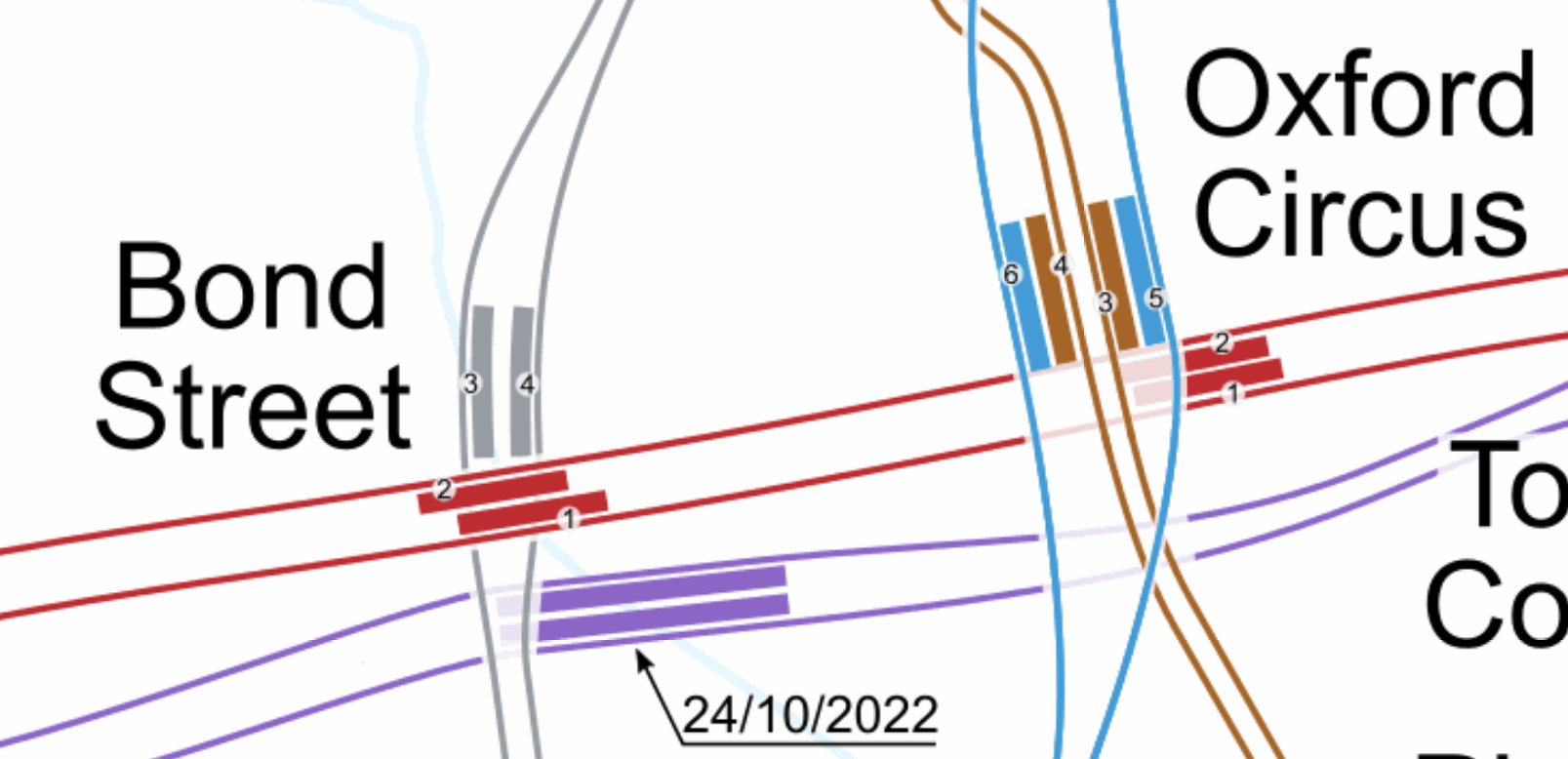
Note.
- The Bakerloo Line is shown in brown.
- The Central Line is shown in red.
- The Elizabeth Line is shown in purple.
- The Victoria Line is shown in light blue.
- The Elizabeth Line is the deepest line.
In addition, consider.
The Eastern exit of the Elizabeth Line at Bond Street station has three escalators and lifts. It also opens onto Hanover Square, so it won’t suffer from overcrowding problems outside.
- Hanover Square is just a garden, with no car park underneath, so pedestrian tunnels could pass under it
- I also suspect there are no existing or planned buildings between the two stations with deep foundations that would block a pedestrian tunnel.
- With the capability and ingenuity of three-D design software, I can see wide tunnels being created that would link Oxford Circus and the two Bond Street stations.
- The new wide tunnels at Bank station have opened up the station’s capacity and all the tunnels were dug traditionally.
- If it was felt to be needed, moving walkways could be added, just as they have been at Bank station.
I am absolutely sure, that by using the ideas and methods, that have worked so well in the upgrade of Bank station, that Oxford Circus and Bond Street stations could be turned into a London Superhub Station, that connects all the Underground lines together and has entrances all over the area.
The benefits of such a station would be.
- It would provide a high-capacity link between London’s two highest-capacity Underground Lines; Elizabeth and Victoria.
- It would provide a high-capacity link between the Elizabeth Line and Euston, St. Pancras and King’s Cross.
- It would provide a high-capacity link between the Elizabeth Line and Victoria.
- It would provide a high-capacity link between the Elizabeth Line and High Speed Two.
- Areas like Brixton, Haringey and Walthamstow would gain a much needed link to the Elizabeth Line for Heathrow and Paddington.
Wikipedia says this about the building of the Bank Station Upgrade.
As part of the development of the scheme, TfL worked with potential bidders to improve the design of the station from TfL’s original design. The design proposed in the winning bid by Dragados was 9.7% cheaper than the original design (saving TfL £60m), took 10 months less time to construct than the original design (the proposed closure of the Northern line was also 5 weeks shorter), and the layout of the station was more efficient. This substantially improved the benefit–cost ratio by 45% to 3.5:1.
The Mayor should be knocking on the door of Dragados and asking them for a price for a design and build for a West End Superhub station.
A Possible Route For The Extension Of The Northern Line To Clapham Junction
I suspect that the simplest route for the extension of the Northern Line would be to bore or dig a twin-track railway underneath the numerous other railways in the area.
It could terminate in two underground platforms at Clapham Junction station.
This is the first map of this post and it shows the tracks that run between the two stations.
Note.
- Battersea Power Station station is in the North-East corner of the map.
- Clapham Junction station is in the South-West corner of the map.
The Western of the pair of orange Lines going off the map in the North-East corner of the map is the Brighton Main Line.
It passes through Battersea Park station.
It passes over the South Western Main Line out of Waterloo.
It then loops to the West and joins the lines to Clapham Junction on the Southern side.
It serves four platforms at Clapham Junction; 12 and 14 are up platforms and 13 and 15 are down platforms.
This Google Map shows an overview of Clapham Junction station.
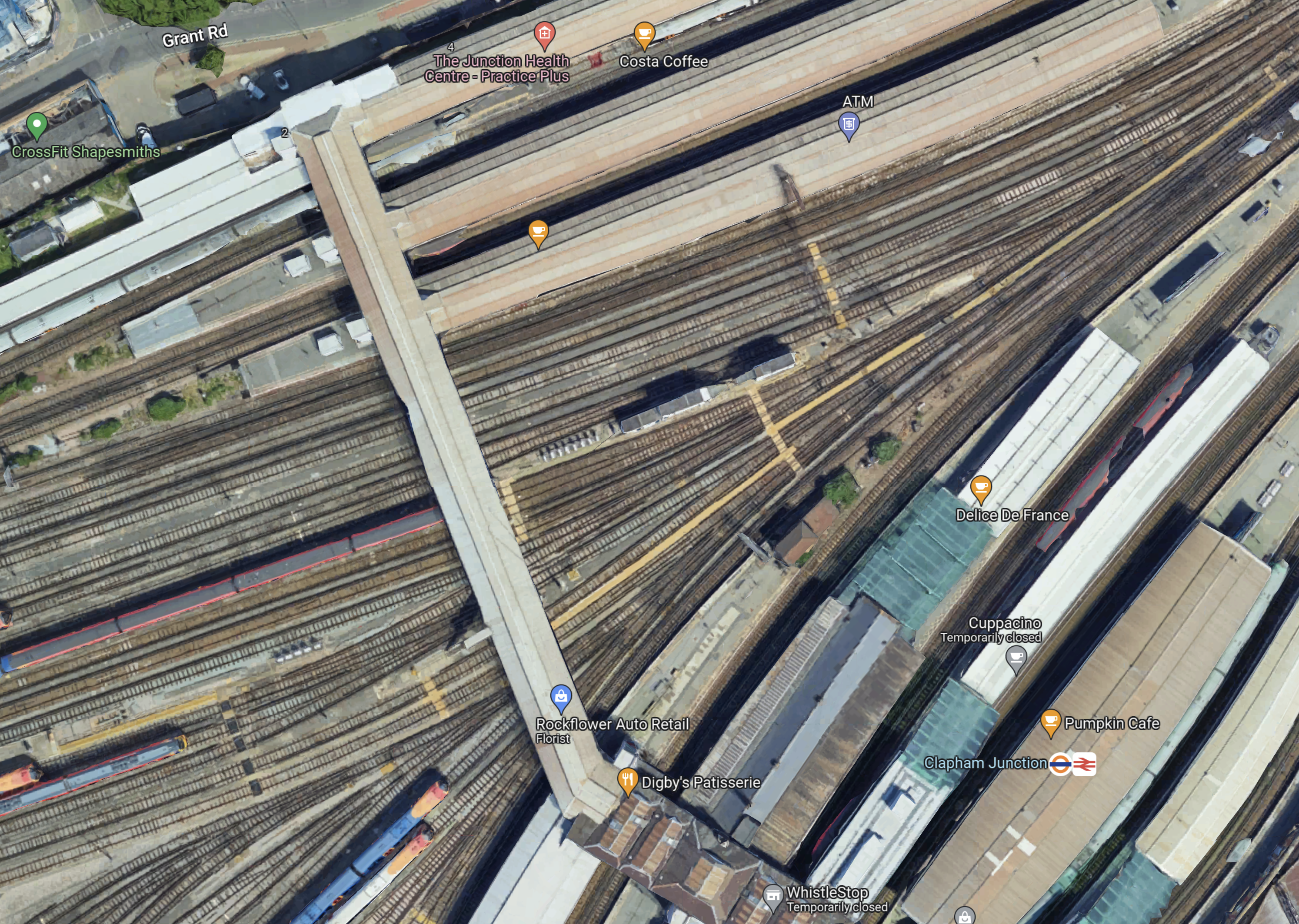
Note.
- Platforms 1 and 2 at the top of the map, handle London Overground services.
- Platforms 3 to 11 handle South Western Train services.
- Platforms 12 to 17 handle Southern services.
- Platforms 9 and 10 have a Delice de France cafe.
- Platforms 11 and 12 have a Cuppacino cafe.
- Platforms 13 and 14 have the logos.
- All platforms have full step-free access with lifts to the wide footbridge that connects all platforms.
The platforms don’t seem to be very wide and putting stairs and escalators down to underground platforms could be a difficult proposition.
This map from OpenRailwayMap shows shows the platforms at Clapham Junction station and the track layout to the West of the footbridge.
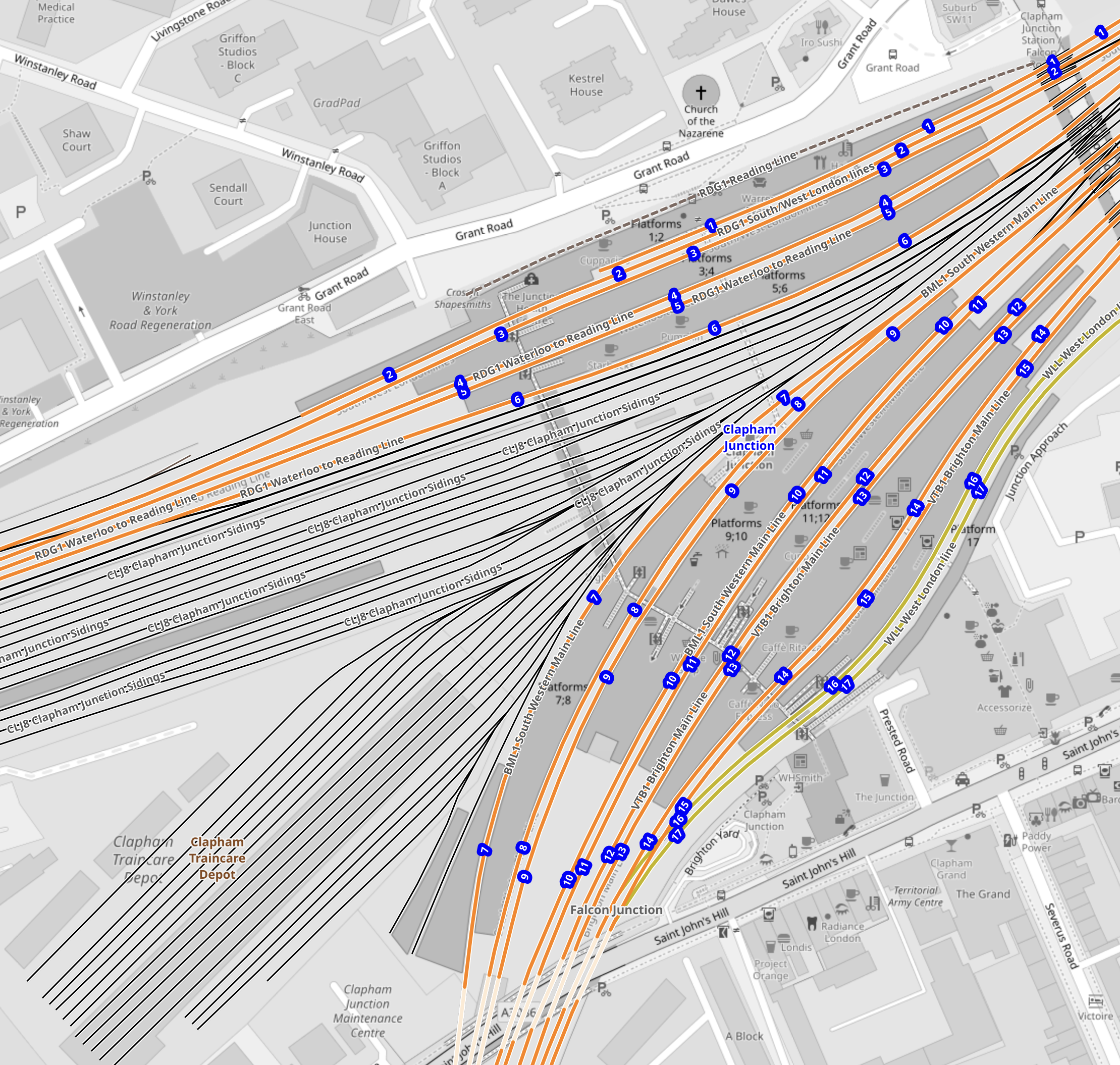
Note.
- The tracks through the platforms are shown in orange.
- The blue dots are platform numbers.
- The bridge connecting all the platforms is shown shaded in the middle of the map.
- To the West of the bridge are Clapham Junction Sidings and Clapham Traincare Depot.
These pictures were taken from the bridge.
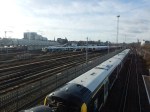
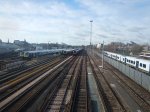
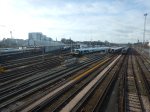
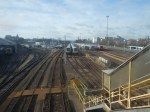
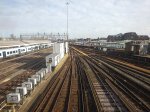
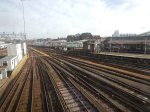
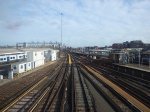
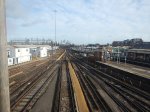
Note.
- The top row of pictures were taken looking West.
- The bottom row of pictures were taken looking East.
- Many of the tracks are electrified.
- There is a lot of space to park trains.
Will all the space be needed now, that a new depot has been built at Feltham.
Could Two New Surface Platforms Be Built For The Extension Of The Northern Line To Clapham Junction?
Consider.
- The step-free bridge across all the platforms at Clapham Junction station works well.
- It is connected to the streets around the station at both ends.
- Clapham Junction station will be redeveloped and surplus depot land could be used for housing.
- As the maps show, there is a large gap in the platforms between the South Western Railway and the Southern sides of the station.
- As Battersea Power Station station can turn services on the Northern Line with only two platforms, there would only need to be the same number of Northern Line platforms at Clapham Junction.
So could an extra pair of platforms be built under the bridge, with stairs and a lift similar to the existing platforms?
- The platform would have full step-free access.
- The platforms could be long enough for any future trains.
- There could be sidings for a few trains.
- The tunnels from Battersea Power Station would surface just outside the station.
- There would need to be a crossover or a turnback siding for operational reasons.
I also think, that once the depot and sidings at Clapham Junction have released the space, the new platforms and tracks could be installed without interrupting main line services through the station.
Would The Extension Of The Northern Line Be Electrified?
Consider.
- Merseyrail were not allowed to use third-rail electrification to Headbolt Lane station and had to use batteries.
- The Northern Line was extended to Battersea Power Station station using London’s four-rail electrified system.
- Clapham Junction station has third-rail electrification everywhere.
I think that the authorities would be very churlish not to allow electrification to Clapham Junction.
Conclusion
I believe it is possible to extend the Northern Line to two new surface platforms at Clapham Junction station.
But I also believe that using similar methods to those used in the Bank Station Upgrade, that a full interchange between the Elizabeth and Victoria Lines can be built at Oxford Circus and Bond Street.
.
A Long Journey Home
A friend had booked between London and Edinburgh today on the 13:00 LNER train from King’s Cross. She was also travelling with her miniature Schnauzer.
.We had arranged to meet at Marylebone, so I could help them across London to King’s Cross and have a much-needed hot chocolate in King’s Cross before they caught the train North and I went to a meeting organised by my cardiologist.
I had checked out King’s Cross earlier and there was trouble with srveral delayed and cancelled trains.
It wasn’t strikes or bad management from LNER and the problem is explained in this article from the Yorkshire Evening Post, which is entitled Trains From Leeds To London Cancelled Or Delayed After Thieves Steal Signalling Cables From Railway Tracks.
In the end we made the train in time and also had time to have a hot chocolate in LEON, whilst we sat out the back with the dog.
We were texting each other most of the afternoon and with assistance from Real Time Trains, the journey went as follows.
- The train left King’s Cross at 13:08, which was eight minutes late.
- By Peterborough, the train was running seventeen minutes late.
- The driver kept this delay until Retford, where he lost another eighty minutes.
- The train was now running 97 minutes late and this grew by four more minutes by Newcastle.
- My friend reported that they stopped at Newcastle, as they had no driver.
- In the end, LNER found a driver or a way for the current driver to continue to Edinburgh and the train left Newcastle after a thirty minute stop.
- The train was now two hours and ten minutes late.
- Eventually, it pulled into Edinburgh, two hours and five minutes late, after the driver had picked up a few minutes on the approach to Edinburgh.
Note.
- The incoming train that formed this service arrived in King’s Cross from Edinburgh seventy two minutes late, mainly because of the cable theft. It should have arrived and returned to Edinburgh an hour earlier. But it arrived conveniently to form the 13:00 to Scotland.
- As the train presentation team turned the train in nineteen minutes instead of twenty-one, they saved a couple of minutes.
- I suspect the delay at Retford was getting through the area without any signalling.
- Had the driver run out of hours by Newcastle, as he had been in the cab for four-and-a-half hours?
- Normally, four-and-a-half hours would have enabled the driver to have driven to Edinburgh.
These are my thoughts.
Cable Theft
In the days of British Rail, I did some work for British Rail using my software called Daisy, which led to a report entitled Failure Reporting And Analysis On British Rail, which was written by J. S. Firth CEng, MIEE, MIRSE, who worked for SigTech, which was a Business Unit of the British Railways Board.
If anybody who has a legitimate reason to read the report, I still have the complimentary copy sent to me by Mr. Firth and would be happy to provide a copy.
I did flag up a project called Unauthorised Cable Removal And Fault Triage, as one of the winners in the First Of A Kind 2022 competition organised by the Dept of BEIS.
If there is anything I can do to help, let me know.
Problems In France
A friend in France told me that there is a problem with stealing overhead electrification cables in France.
This article on RFI is entitled Copper Wire Thieves Force France’s High-Speed TGV To Go Slow.
There are several similar stories on French and other European web sites.
Signalling Using Radio
The East Coast Main Line is being signalled using modern ERTMS digital signalling, where drivers read the signals on an in-cab display, which is connected by radio to the signalling system.
This extract from Wikipedia describes the first project.
In June 2020 it was reported that the UK government would provide £350 million to fund the UK’s first digital signalling system on a long-distance rail route. The signalling is to be fitted on a 100-mile (161 km) section of the East Coast Main Line between Kings Cross, London, and Lincolnshire, which will allow trains to run closer together and increase service frequency, speed and reliability. No date for when the new technology, already in use on the Thameslink lines at London Bridge and some London Underground lines, has been given.
If the cables are removed will this reduce crime?
LNER Delay Repay
My friend will be entitled for a full refund of her single ticket.
This page on the LNER web site gives full details.
Note.
- You have 28 days to claim.
- If you have a return ticket, you may be entitled to something for that leg of the journey.
I would add, that you should always keep all your tickets, in case the return journey goes belly-up.
‘Ryanair Of Rail’ Lights Up The East Coast On Fast Track To Profit
The title of this post, is the same as that of this article on The Times.
This is the first paragraph.
A cut-price rail service between London and Edinburgh, dubbed the Ryanair of rail, is on track to turn a profit after a year in service and has helped to reverse the airlines’ previous dominance of the travel market between the capitals.
Other points from the article.
- Lumo will carry its millionth passenger in November.
- The average one-way fare has been less than £40.
- Rail is now claiming 63 % of the London and Scotland travel market.
Will this success lead to more trains attracting more rail travellers between England and Scotland?
Can Lumo Carry More Passengers?
Lumo use five-car Hitachi Class 803 trains for their services.
- Their fleet consists of five cars.
- Each five-car train can carry 402 passengers.
- Lumo run five trains per day (tpd) in both directions.
There are various ways that the number of passengers could be increased.
Could Lumo Run More Services?
This may seem to be a solution, but only a fixed number of trains can be run in every hour, between England and Scotland.
- Other train operators may also want to run more services.
- It would also mean Lumo would need to buy more trains.
On the other hand it may be possible to squeeze in perhaps one extra service.
Could Lumo Run Longer Trains?
Lumo’s Class 803 trains are unusual among the Hitachi AT 300 trains, that handle long distance services all over the UK, in that they have no diesel engines and rely on battery power for emergencies.
As the trains’ computer work out which cars are present, I wouldn’t be surprised that these trains can be lengthened or even run as a pair, as GWR’s and LNER’s five-car Hitachi trains often do.
Platforms at King’s Cross, Stevenage, Newcastle, Morpeth and Edinburgh are probably already longer than is needed for a five-car train.
I could even see Lumo adding coaches as required to satisfy the need of the day. On a day like the Calcutta Cup, they might even run ten or twelve car trains, which is the longest formation possible with the Hitachi trains. But they’d have to have enough coaches!
Lumo use a very simple catering option, which I suspect can be modified to serve a longer train.
I am fairly certain, that LUMO’s fleet has been designed for gradual lengthening to expand capacity.
Would The Lumo Model Work On The West Coast Main Line?
As the Lumo model seems to work to Edinburgh, would it work to Glasgow?
I don’t see why not! And it might improve the service from Avanti West Coast?
Grand Union have lodged an application to run four tpd between London and Stirling via at Milton Keynes Central, Nuneaton, Crewe, Preston, Carlisle, Lockerbie, Motherwell, Whifflet, Greenfaulds and Larbert with InterCity 225s.
This proposal seems to be stalled at the moment, but I do feel it is a good idea.
I would certainly use it, as the air-conditioning on the Class 390 trains, used by Avanti West Coast, makes me ill!
An Advance Single From London To York For £32.90 Bought An Hour Before The Train Left
I went to York and Manchester yesterday.
I had been planning to do this trip for a week or so, but as I have lots of other things to do, I didn’t want to decide on a date.
So on Monday, I went to King’s Cross and investigated how much a London to York single ticket would cost.
I was surprised to find, that if I bought it last minute from a ticket machine with a Senior Railcard, that travelling about eleven in the morning I could get a ticket for £55 on the 11:06, which is a service that terminates at York, but is a few minutes slower.
Everything was clear for a trip yesterday and just after ten, I turned up at King’s Cross.
The machine offered me tickets at £81.90 on the 10:30 and 11:00 services, but I was able to get a ticket for £32.90 on the 11:06.
I was also able to ask for and get a forward-facing window seat with a table.
It looks like LNER are trying to sell as many seats as possible and they have developed, an algorithm that does this.
If I look at buying a ticket for today on the 11:06 on the Internet, I’m offered the following prices.
- Advance Single – £32.90
- Super Off-Peak Single – £81.90
- Anytime Single – £94.35
There is even a First Class Advance Single at £45.90.
Conclusion
It pays to do your research.
It looks like a one-way journey by an electric car would take four hours and cost around £20.
Is This One Of The Most Useful Lifts In London?
This lift at King’s Cross station must be one of the most useful lifts in London’s extensive public transport system.
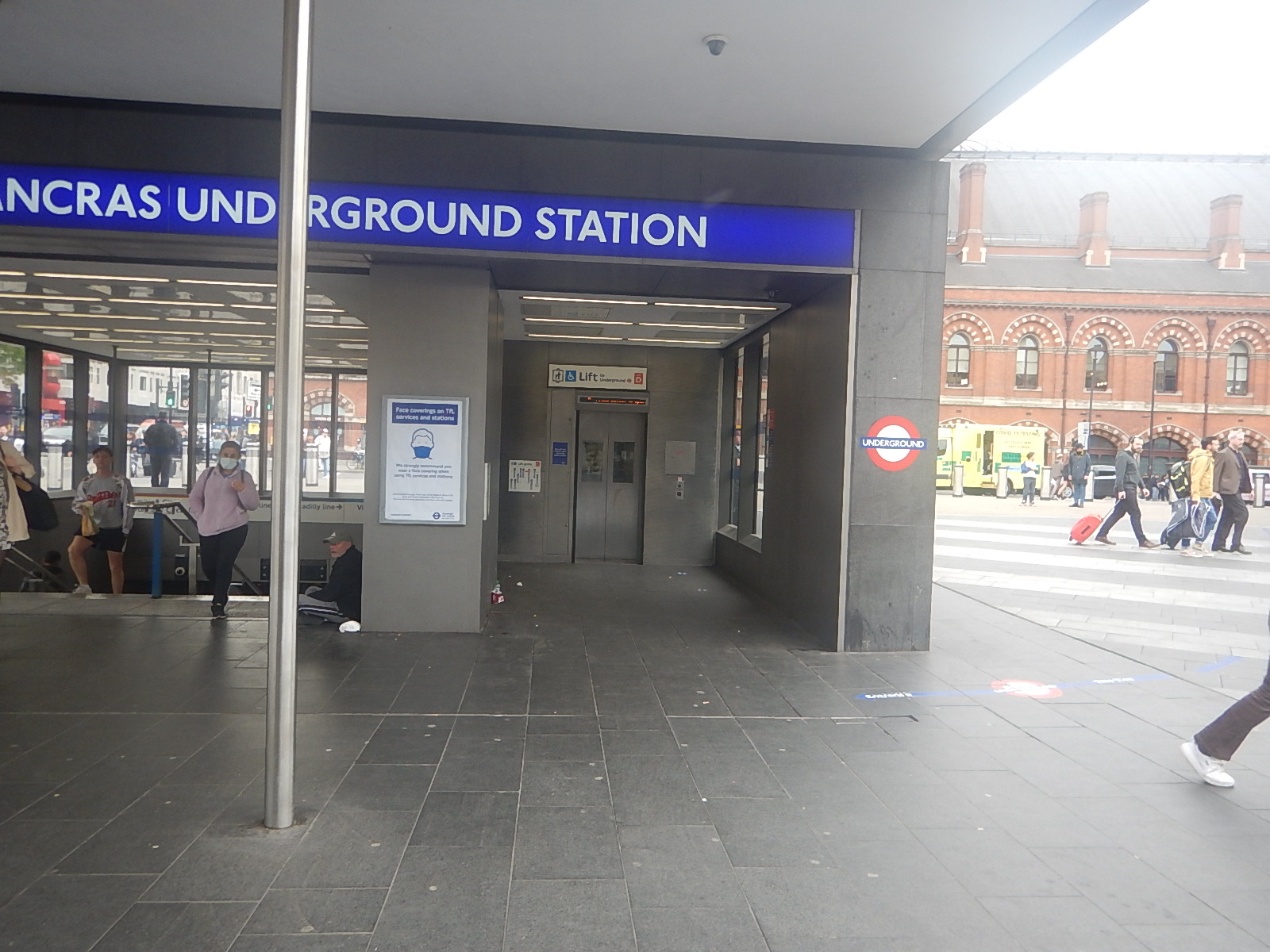
At the top-level it comes out into King’s Cross Square and it is a level walk to the following.
- All the platforms in King’s Cross National Rail station.
- The shops, which include Leon, Marks and Spencer, Waitrose and W H Smith, in King’s Cross National Rail station.
- The taxi rank.
- The Eastbound buses, which line up at their stops along the side of King’s Cross Square.
I was using it yesterday, to get a bus to Boots at the Angel, as I had a prescription to pick up. The 30 or 73 bus is quicker than the Northern Line, as that is a long walk and a road crossing at the Angel.
I’d arrived at King’s Cross on the Circle Line from Paddington and the bottom level of this lift is by the ticket gates under King’s Cross Square, that give access to all lines through King’s Cross Underground station.
There is also a middle level on the lift, that takes you under Euston Road to get a Westbound bus or gives you access to a step-free route to St. Pancras station.
 The Anonymous Widower