I Want To Go By Train Between Heathrow Airport And Central London, What is Best Train; Lizzie, Piccadilly, Or Heathrow Express?
I asked Google AI, the title of this post and received this answer.
The Elizabeth Line is generally the best balance of speed, cost, and convenience for most travelers (approx. 30–40 mins to central London,£13). The Heathrow Express is fastest (15 mins,£25) to Paddington only, while the Piccadilly Line is cheapest (hr,£6) but slowest.
Detailed Breakdown:
Elizabeth Line (Recommended): Offers direct, modern, air-conditioned trains to central hubs like Bond Street, Tottenham Court Road, and Liverpool Street without needing to change at Paddington. It is much cheaper than the Express and only slightly slower.
Heathrow Express: The fastest option, but only goes to London Paddington. It is expensive unless booked far in advance. Best if you are staying right next to Paddington station.
Piccadilly Line: The cheapest option, ideal for budget travelers, and serves all terminals. However, it is a traditional Tube train, which can be crowded and uncomfortable with heavy luggage.
Note: Fares mentioned are approximate and based on standard off-peak, single-journey, tap-on/tap-off usage.
Ask virtually anybody in London and they’ll probably give you a similar answer.
Even Larry the cat would know, as he’s probably heard the question asked thousands of times.
Does The UK Need More Passenger Rail Capacity Between London And Glasgow?
I asked Google AI this question and received this answer.
Yes, the UK requires more passenger rail capacity between London and Glasgow to meet growing demand and combat overcrowding, with key improvements and new services planned on the East Coast Main Line (ECML) through 2025. Despite previous capacity constraints on main routes, rail has overtaken air as the preferred mode of travel for these journeys, necessitating increased frequency.
Key details:
Capacity Expansion: The Office of Rail and Road (ORR) approved new services for late 2025, including Lumo extending London-Edinburgh services to Glasgow.
Growing Demand: Passenger numbers on West Coast routes showed significant growth, with a 29% increase in Glasgow-London travellers reported between 2013 and 2019.
Infrastructure Constraints: While demand increases, the ORR has rejected some service proposals due to insufficient capacity on the existing, congested lines.
Future Upgrades: HS2 is expected to improve connectivity, targeting reduced journey times to under 3 hours 40 minutes by 2033.
Sustainability Shift: Increased capacity supports shifting travellers from air to rail, reducing environmental impact.
I posed this question out of curiosity, but Google AI gave me, what I think is a well-reasoned answer.
In The Last Three Months, These Two Improved Anglo-Scottish Services Have Started
In Lumo Will Extend Its King’s Cross And Edinburgh Service To Glasgow, I talk about Lumo’s extended service to Glasgow, which started on December 14th, 2025.
In Man In Seat 61: My Nail-Biting Journey To Orkney By Train And Ferry, I describe a trip by the Man In Seat 61 (Mark Smith) in the new Birmingham-Scotland Sleeper.
There Is A Third New Anglo-Scottish Service To Come
In Lumo To Expand Scotland’s Rail Network With New London-Stirling Rail Route From Spring 2026, I describe Lumo’s new Euston and Stirling open access rail route.
Man In Seat 61: My Nail-Biting Journey To Orkney By Train And Ferry
The title of this post is the same as that of this article in The Times.
This is the heading.
Now the Caledonian Sleeper connects the Midlands to Scotland in style. Mark Smith travels to the UK’s most northerly rail station and beyond
These are the first two paragraphs.
In January the Caledonian Sleeper added Birmingham to its route from London to Scotland — its first new stop in 30 years. With a ticket for one of the first departures and a bucket-list desire to see the historic naval anchorage that is Scapa Flow, I would ride the sleeper to Inverness, take Scotland’s scenic Far North Line to Britain’s northernmost station and then sail across the Pentland Firth to Stromness. I could leave my Buckinghamshire home in the evening and reach Orkney 24 hours later without setting foot on a plane. It sounded like a plan.
The Highland sleeper (which travels to the Highlands; there is also a Lowland sleeper that travels to Edinburgh and Glasgow) rolled into Birmingham International at 10.42pm on the dot. I was greeted at the door by a steward with a friendly Scottish accent and my room key. He jotted down my breakfast reservation and I headed for room 4 in car L. The Cal Sleeper is rightly proud of its Scottish-made mattresses and fluffy duvets and I drifted off to sleep in my cosy berth to the sound of steel wheel on steel rail.
I feel adding a Birmingham International stop is a masterstroke, as it gives so many travel options.
- You could of course still join in London.
- I might go to Birmingham on Chiltern, as I prefer the trains to Avanti West Coast.
- There are lots of shows and exhibitions in Birmingham.
- If you had a relative in Scotland and you lived in the far South-East of England and Wales, half of the journey would be in a comfortable bed.
- Birmingham International has regular connections to Aberystwyth, Bournemouth, Pwllheli, Shrewsbury and Wrexham General.
- Some journeys might be easier with a change between plane and sleeper train at Birmingham International.
The list is endless and will grow as travellers have other ideas.
More imagination needs to be added to train journeys.
My first thoughts are.
There needs to be a Lumo-style service between Birmingham and Scotland and a sleeper between Birmingham and Penzance.
University Of Alberta Partners With City of Edmonton And Diesel Tech Industries To Pilot Hydrogen-Diesel Bus Retrofits
The title of this post, is the same as that of this article on Pulse 2.0.
These two paragraphs introduce what is a comprehensive practical approach to decarbonising a fleet of diesel buses.
The University of Alberta is partnering with the City of Edmonton and Diesel Tech Industries to cut carbon emissions from Edmonton’s fleet of diesel-powered buses by integrating hydrogen fuel into existing combustion engines.
The initiative focuses on developing a practical retrofit approach to help transit agencies and other vehicle operators reduce emissions quickly without waiting for full fleet replacement. Project leaders say that if the pilot succeeds, the work could translate into a deployable solution for operators across Canada seeking near-term carbon reductions while maintaining current diesel assets.
Note.
- The City of Edmonton has around a thousand buses.
- Many of Edmonton’s buses have Cummins engines.
- Cummins are decarbonising the company and have developed hydrogen-conversions for some of their diesel engines.
- I am sure that this technique could be used to convert London’s thousand new Routemaster buses, with their Cummins engines.
This project seems to have a lot of possibilities to get very much larger.
How Did South East Water Become Such A Disaster?
The title of this post, is the same as that of this article in The Times.
This is the sub-heading.
As tens of thousands of homes in Kent and Sussex lose supply the company and its well-remunerated boss, David Hinton, face a torrent of anger
These two paragraphs add some detail.
Perhaps the worst moment for South East Water was when it opened a bottled water station in the wrong town. Staff set up in Tonbridge, Kent, and not Tunbridge Wells five miles away, where the company had left some 24,000 properties without drinking water for two weeks.
Or maybe it was when David Hinton, the chief executive, repeatedly called the local MP one evening not to apologise but to berate him about the crisis — not, Hinton later admitted, “my finest moment”. Or it could have been when more properties lost their supply only hours after Hinton had told MPs his company’s response to the incident should score eight out of ten.
It wasn’t exactly the water industry’s finest moment.
I played a small and hopefully professional and a hundred-percent scientifically correct manner in the formation of the modern water industry in the UK.
In the 1970s, I wrote the software, that WS Atkins rented from their time-sharing computer to the Water Resources Board at Reading to model water supply in all or part of the UK.
My differential equation solving software had been designed to handle up to around a million equations and the contact at the WRB was a Dr. David Dimeloe.
I was never given details of their model and the conclusions, but I assume they must have done a good job, as there haven’t been too many problems with actual water supply, but mainly with management, ownership and failure of ancient infrastructure.
In my 79 years in the UK, I’ve never had a problem with water supply.
Searching for the WRB on the Internet finds one in Sri Lanka.
It would be good to get a copy of that report or even talk to one of the engineers on the project.
FirstGroup Adds Leeds-based J&B Travel To Growing Coach Portfolio
The title of this post, is the same as that of this article on Route One.
These two paragraphs add more detail.
J&B Travel of Leeds is the latest coach business to be acquired by FirstGroup.
The operator, which has been established for more than 40 years, has a fleet of 15 vehicles, with work including home-to-school, private hire and FlixBus contracts.
But in some ways, the most significant thing not mentioned is that FirstGroup have now acquired seven coach firms.
- AndersonTravel in London
- EnsignBus in London
- J & B Travel in Leeds
- Matthews Coaches in County Monaghan, Ireland
- Tetley’s Coaches in Leeds
- York Pullman in Harrogate, Hull, Leeds and York
Note.
- MatthewsCoaches are about halfway between Dublin and Belfast.
- Three of the English acquisitions are in Yorkshire and two are in London.
- Leeds isn’t far off being halfway between London and Central Scotland.
This looks like the first part of a master plan.
- Leeds and County Monaghan could be ideal refuelling points for zero-carbon coaches.
- Ferrybridge, just South of Leeds is getting a hydrogen-fired power station.
- Ferrybridge is a big site with a motorway service station on the M1.
- Wrightbus are building an electrolyser at Ballymena, which is 81 miles from Matthews Coaches.
- Wrightbus have said that Dublin and Cork would be an ideal route for a hydrogen coach.
- Wrightbus have said that Heathrow and Gatwick would be an ideal route for a hydrogen coach.
This plan could be built-on with routes to various cities and attractions.
I have some further sorts and questions.
Could The First Obvious Routes Be Run By Hydrogen Coaches?
From what Wrightbus have indicated, I would rate the obvious routes as.
- Dublin and Belfast – 103 miles or 206 miles round trip
- Dublin and Cork – 107 miles or 340 miles round trip
- Leeds and Glasgow – 224 miles or 448 miles round trip
- Leeds and Edinburgh – 222 miles or 444 miles round trip
- Leeds and London – 197 miles or 396 miles round trip
- Heathrow and Gatwick – 40 miles or 80 miles round trip
Note.
The longest route is 714.5 km.
It would appear that, if the hydrogen-powered coach had a range of 1,000 km. all routes would be possible.
How Far Would A Hydrogen Coach Get On A Tankful From London?
A thousand kilometres is 621.4 miles.
These are the distances from Scottish cities to London.
- Aberdeen – 537 miles
- Dundee – 472 miles
- Dunfermline – 430 miles
- Edinburgh – 410 miles
- Glasgow – 404 miles
- Inverness – 561 miles
- John O ‘Groats – 678 miles
- Perth – 451 miles
- Stirling – 418 miles
I’ve added John O’Groats for completeness, but all cities would be reached.
How Far Would A Hydrogen Coach Get On A Tankful Going West From London?
These are the distances from Western towns and cities to London.
- Aberystwyth – 236 miles
- Fishguard – 255 miles
- Holyhead – 289 miles
- Lands End – 310 miles
- Penzance – 307 miles
I’ve added Lands End for completeness, but all towns and cities would be reached.
John O’Groats And Lands End In A Hydrogen Coach
I asked Google AI how far the journey was and received this answer.
The distance from Land’s End to John o’ Groats varies by transport: about 837-874 miles (1347-1407 km) by road, roughly 600 miles (970 km) as the crow flies, and around 1,200 miles (1900 km) for an off-road walking route, with cyclists typically taking 10-14 days and walkers 2-3 months.
So it looks, like there will be a need for a refuel, but that would give 2,000 kilometres, which is more than the 1,347-1,407 kilometres needed.
Ferrybridge Could Be An Ideal Refuelling Point
I suspect, even in fifty years you could name the places in the UK, where you will be certain of refuelling any hydrogen vehicle on the fingers of one hand.
The list would include.
- Ferrybridge in Yorkshire, where SSE are building a hydrogen-fired power station.
- Felixstowe Docks in Suffolk, where there will be a need to fuel hydrogen trucks.
- Keadby in Lincolnshire, where SSE are building a hydrogen-fired power station.
- Kintore in Aberdeenshire, where an electrolyser is being built.
- Runcorn in Cheshire, where there was an electrolyser in 1968, when I worked there.
This web site lists all the UK hydrogen projects.
This Google Map shows the location of the Ferrybridge hydrogen-powered power station site in relation to Barnsley, Doncaster, Leeds and other towns and cities of Yorkshire.

Note.
- The red arrow indicates the former coal-fired power station site.
- Leeds is in the North-West corner of the map.
- Barnsley and Stocksbridge are in the South-West corner of the map.
- The city of Sheffield is to the South-West of Stocksbridge.
- Doncaster is in the South-East corner of the map.
Last September I wrote Visiting The Consultation For Ferrybridge Next Generation Power Station At Knottingley.
In that post, I wrote about supplying both the power station and the motorway services with hydrogen and felt that it could use one of two methods.
- A pipeline from the hydrogen storage in East Yorkshire.
- Some form of train from a hydrogen production site.
Recently, Network Rail have been conducting tests on the movement of hydrogen by train, which I wrote about in Network Rail’s Test Track Take Centre Stage As Hydrogen Is Delivered By Rail For The First Time.
The Ferrybridge Site Has most things needed.
This map shows the site.
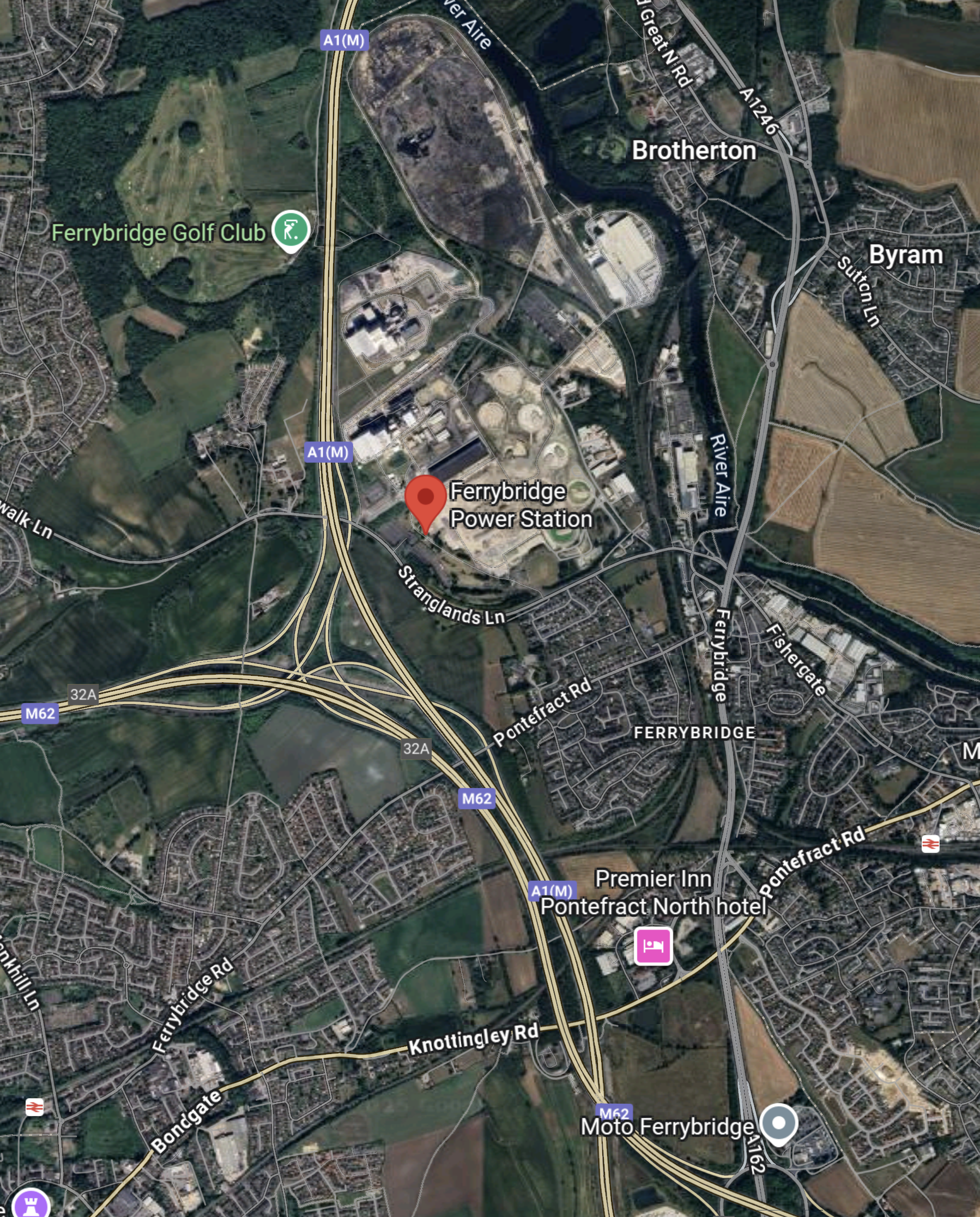
Note.
- The impressive motorway junction, where the North-South M1 crosses the East-West M62.
- Liverpool and Manchester are to the West.
- Leeds, Newcastle and Scotland is to the North.
- Hull is to the East.
- London is to the South.
- There is a Moto Services.
- There is a Premier Inn.
There is even two railway stations on the map.
This reply from Google AI gives the details of the distance between Ferrybridge and the South-West.
The driving distance from Ferrybridge, Yorkshire, to Land’s End is roughly 470 to 500 miles, taking about 8-9 hours, primarily via motorways like the M1, M5, and A30, though exact times and routes vary by real-time traffic and specific starting/ending points.
I am absolutely certain, that if you have a vehicle like a hydrogen coach and you want to go anywhere between A to B on the UK mainland, then if there is hydrogen-refuelling at Ferrybridge, you will be able too do the journey with a refuel at Ferrybridge.
Expensive Bikes To Be Banned From Cycle To Work Scheme
The title of this post, is the same as that of this article in The Times.
This is the sub-heading.
Rachel Reeves is said to be targeting rich commuters by limiting the amount you can claim for bike gear through salary sacrifice
These two paragraphs add some detail.
Workers could be banned from buying ultra-expensive bikes through salary sacrifice schemes amid government concerns that they are being exploited by “high earners in the Surrey Hills”.
The Treasury is understood to be considering limiting the generosity of the government’s Cycle to Work scheme, which allows employees to buy bikes and accessories through an interest-free loan from their employer.
Over the years, I’ve worked with many, who have cycled to work and in the early 1970s, I regularly cycled to my clients in London.
Rachel from Accounts seems to have a death wish for the electoral chances of the Labour Party.
Congestion Charge Set To Rise By 20% To £18
The title of this post, is the same as that of this article on the BBC.
This is the sub-heading.
The Congestion Charge should rise by a fifth to £18, Transport for London (TfL) has proposed.
These three introductory paragraphs add more details.
On 2 January, the daily £15 fee for drivers of vehicles in central London will increase, the first such rise since June 2020 when the charge jumped 30% from £11.50.
If the charge is not paid within 48 hours, drivers face a penalty of £180, reduced to £90 if paid within 14 days. It operates between 07:00 and 18:00 on weekdays and 12:00 and 18:00 on weekends.
Drivers of electric cars, who currently travel free in the zone, were expecting to start paying the full charge from December but will now receive a 25% discount provided they are registered for auto pay. HGVs and vans will get a 50% discount.
I won’t be surprised to find, that there are a lot of quality cars going cheap.
This though is surely the most odious part of the new plans in the last paragraph.
Applications for new residents’ discounts from petrol and diesel car owners are set to be abolished altogether in March 2027. A public consultation, external will run until 4 August.
As I read that, it means if you had to move into London because of your job, you will have to buy an electric car.
It doesn’t bother me, as I don’t drive or own a car.
Swiss Federal Railways Targets London As It Seeks More Cross-Border High Speed Trains
The title of this post is the same as that of this article on the Railway Gazette.
This is the introductory paragraph.
Swiss Federal Railways is looking at ordering up to 40 high speed trainsets for use on international services to Italy and France, and ’potentially for other destinations such as Barcelona and London’.
There also three paragraphs, which talk about Switzerland and London services.
SBB has also examined the possibility of launching a direct service between Switzerland and London, concluding that this would be technically feasible but challenging.
The need to provide security and border controls at all the stations served has long been a barrier to new services through the Channel Tunnel. However, SBB believes this may be possible at Zürich HB, Basel SBB and Genève Cornavin.
SBB would like to offer such a service and is to further develop its plans, but implementation is not seen as possible until the 2030s at the earliest.
These are my thoughts.
The Channel Tunnel Is Being Opened Up For Other Operators
The Channel Tunnel is at last looking to put on other services.
Switzerland could be easy technically, but there is the security and border controls, as the article points out.
But I see sorting security and border controls as an opportunity, not a problem.
Surely, a workable solution would have export potential all round the world.
London And Geneva Is Only Six Hours On The Train
Six hours in comfort on a train, would not bother me!
Switzerland And London Are Both Suitable Destinations For Year-Round, Short-Break Trips
C and myself were always popping off for short breaks, as it suited our work patterns.
She would sometimes say, that a case had come out and we would nip off somewhere for a couple of days.
I think, that more people will work flexibly and will have more gaps, where two days in Geneva or Zurich would fit. Provided, they could just turn up and go.
I also have done several business and leisure trips to Switzerland.
Fast Direct Trains To Switzerland Would Make Italy More Accessible
I have taken trains to Italy and it is a long way.
But breaking the journey in Switzerland could make the journey easier and you could use one city going South and another going North.
When I stayed in Geneva to go to CERN, I got a free day ticket for the buses and trams thrown in, which was very useful.
Will The Swiss Offer A Rail Pass For All Their High Speed Trains?
I wonder, if the Swiss have this in mind, as they already offer passes that include all Swiss public transport including all the cable cars.
A Swiss High Speed Rail Pass might allow me to go London and Florence, Naples or Rome and return all on one ticket.
Americans wanting to get away from Trump could fly to Switzerland and then explore Europe in Swiss trains, with no worries.
Conclusion
The Swiss should take their fingers out and go for it!
The Lady On The Train
One of the most amazing people, I’ve ever met was a New York State Supreme Court Judge. It is wrong to guess a lady’s edge, but she was about my age; late seventies, black, well-dressed and sat down next to me in Second Class with the biggest smile on her face on the train between Cambridge and London.
She was at a legal conference of senior judges from all over the world at Cambridge University and was going exploring in London.
The reason for the smile was extraordinary. When she went to the ticket counter, she was surprised that the Pakistani-as-she-described him ticket guy asked for her age. He then asked, if she would be doing any other travelling in the UK and when she said yes, he sold her a Senior Railcard as well. She had found it such a surreal experience, that would never have happened in the States that she was still laughing, when the sat down.
She could of course have been not just a New York State Supreme Court Judge, but a full United States Supreme Court Judge and I’d misheard, although I doubt she would have been one of Trump’s picks last time around.
I do hope that when Trump finds himself in the United States Supreme Court as he inevitably will, that she is there to give her verdict.
 The Anonymous Widower