Still Going For A Quart In A Pint Pot
The title of this post is the same as that of an artticle in the November 2019 Edition of Modern Railways.
The article describes the problems of running trains through the Castlefield Corridor through Manchester Piccadilly, Manchester Oxford Road and Deansgate stations.
It is a comprehensive article, that gets to the heart of the problem of the route.
It comes to the conclusion, that there is a need for either more infrastructure or less trains, than the current fifteen trains per hour (tph).
Under more infrastructure, the author lists these projects.
- Grade separated junctions at Castlefield and other junctions.
- A centre turnback at Manchester Oxford Road station.
- A West-facing bay platform at Manchester Victoria
- Four through platforms at Manchester Oxford Road and Manchester Piccadilly.
- Improvement at Manchester Airport station.
These points should be noted.
- Options One and Four will be expensive and will probably cause massive disruption during construction for both rail and road traffic.
- The author suspects Option Four would cost almost a billion pounds and would need the grade-separated junctions to get best value.
I shall deal with options Two, Three and Five later.
Trains Through The Castlefield Corridor
Current passenger trains through the Castlefield Corridor are as follows.
- East Midlands Railway – One tph – Liverpool Lime Street and Norwich
- Northern – One tph – Hazel Grove and Blackpool
- Northern – One tph – Liverpool Lime Street and Crewe
- Northern – Two tph – Liverpool Lime Street and Manchester Oxford Road
- Northern – One tph – Manchester Airport and Blackpool
- Northern – One tph – Manchester Airport and Cumbria
- Northern – One tph – Manchester Airport and Liverpool Lime Street
- Northern – One tph – Wigan North Western and Alderly Edge
- Trains for Wales – One tph – Manchester Airport and Llandudno
- TransPennine Express – One tph – Manchester Airport and Middlesbrough
- TransPennine Express – One tph – Manchester Airport and Newcastle
- TransPennine Express – One tph – Manchester Airport and Glasgow Central or Edinburgh
This gives the following totals.
- Eleven tph – Deansgate and Manchester Piccadilly
- Two tph – Deansgate and Manchester Oxford Road
Add in a couple of freight trains and that gives 15 tph, which according to the author is the design limit.
These are frequencies from Manchester Airport.
- There are seven tph between Manchester Airport and Oxford Road via Piccadilly.
- There are three tph between Manchester Airport and Preston via Piccadilly and Oxford Road.
- There are two tph between Manchester Airport and Leeds via Piccadilly, Oxford Road and Victoria.
The author of the article also points out that Bradford is pushing for a direct service to Manchester Airport.
Frequency is important, but so is train length.
- Transpennine Express services will generally be five cars in the future.
- East Midlands Railway, Northern and Trains for Wales services will be between two and four cars.
Nothing too taxing to handle here, although Northern might decide to double trains of eight cars at times.
Comparison Of The Castlefield Corridor And The East London Line
Consider these facts about the Castlefield Corridor
- Four Southern routings; Crewe, Hazel Grove, Stockport and Manchester Airport.
- Five Northern routings; Bolton, Liverpool, Manchester Victoria, Trafford Park and Wigan North Western
- Fifteen tph of which thirteen tph are passenger trains.
- Three stations designed by Topsy, two of which are step-free.
- Not step-free between train and platform.
- Three interchange stations.
- Conventional signalling.
- Fully electrified with 25 KVAC overhead.
- Four train companies, with at least four types of passenger train.
- Bad timekeeping.
- Low customer satisfaction.
For comparison, consider these facts about the East London Line between Shoreditch High Street and Surrey Quays stations.
- Four Southern routings; Clapham Junction, Crystal Palace, New Cross and West Croydon.
- Two Northern routings; Dalston Junction and Highbury & Islington
- Sixteen tph of which all are passenger trains. Soon to be raised to twenty tph.
- Seven stations designed by various architects, two of which are step-free, with Whitechapel to soon make this three step-free.
- Some stations are step-free between train and platform.
- Two interchange stations.
- More bespoke signalling.
- Fully electrified with 750 VDC third rail.
- One train company and one type of passenger train.
- Good timekeeping.
- High customer satisfaction.
The route complexity and frequencies are fairly similar, so what are the big differences?
- Is the East London Line’s signalling better?
- The East london Line doesn’t have freight trains.
- Does one type of train with wide doors and walk-through interiors, work wonders?
- Does London’s step-free between train and platform make a difference?
I think the following actions should be looked at for the Castlefield Corridor.
- Modern digital signalling.
- All Northern services to be run using Class 195 or Class 331 trains, which look the same to passengers, despite one being electric and the other diesel.
- TransPennine Express will be running three different type of train all with single doors, through the Castlefield Corridor. Ways of reducing the number of types must be found.
What idiot decided to buy three incompatible fleets? Surely, an order for a larger number of Hitachi trains would have been better?
My Behaviour In Manchester
I know Manchester’s trams and trains, but I haven’t a clue about the City’s buses, which seem to be reserved for the locals.
I regularly find myself using stations in the Castlefield Corridor and I have developed certain rules.
- Never use Oxford Road, unless you’re lost and end up there by chance. It must be the worst designed modern station in Europe.
- Never use the route unless you’ve already bought the ticket some time before.
- Use Deansgate if possible, as it has a good connection to Manchester Metrolink.
- Give yourself plenty of time to catch a train from platforms 13 and 14 at Piccadilly.
- Make sure you know what platform your train is using at Piccadilly.
I also tend to avoid catching any train from platform 13 or 14 at Piccadilly.
Passenger Problems On Platforms 13 and 14 At Manchester Piccadilly
One of the reasons, I avoid these platforms, is that they are always crowded and at weekends, there seems to be a lot of occasional travellers, often with heavy cases and babies in buggies.
I remember having a chat with a station guy there in a quiet time and it turned out that he’d also worked on platforms on the London Underground.
One point he made was that Londoners get back from the platform edge, when told, but Mancunians are slower to act.
He said trains were often delayed because of passengers struggling to get on.
Could Other Actions Be Taken To Ease The Overcrowding?
These are various ideas suggested in the article or some of my own.
Run Less Trains Through The Castlefield Corridor
This would ease the problem, but it would make it more difficult for passengers to travel where they wanted and needed.
Build A Centre Turnback At Manchester Oxford Road
Consider
- It would mean that trains turning back at Oxford Road, wouldn’t have to cross tracks, entering or leaving the turnback.
- It could probably turn up to four tph.
- It might also help in service recovery.
The author obviously likes this idea and I suspect it is possible, because he mentions it more than once.
Completely Rebuild Manchester Oxford Road Station
Manchester Oxford Road is certainly not fit for purpose.
This is an extract from the Wikipedia entry.
The station, a Grade II listed structure, requires frequent maintenance. In 2004, the station roof was partially refurbished to prevent leaking. In 2011, the platform shelters, seats and toilets were refurbished at a cost of £500,000.[36] In 2013, the station received a £1.8 million renovation to improve access, including lifts and an emergency exit.
In my view, the station needs the following.
- Step-free access.
- Longer platforms.
- Higher capacity platforms.
- Much better signage and maps.
- The turnback described earlier.
No wonder I avoid it like the plague.
A completely rebuilt station with excellent step-free access might encourage more passengers to use the station, rather than the overcrowded Piccadilly.
Improve Deansgate Station
Deansgate station is not bad, but it could be improved to encourage more passengers.
Over the next few years, as the Metroilink expands, It could become a better interchange.
Step-Free Access Between Train And Platform Must Be Achieved
This picture shows access to a new Class 195 train at Manchester Airport.
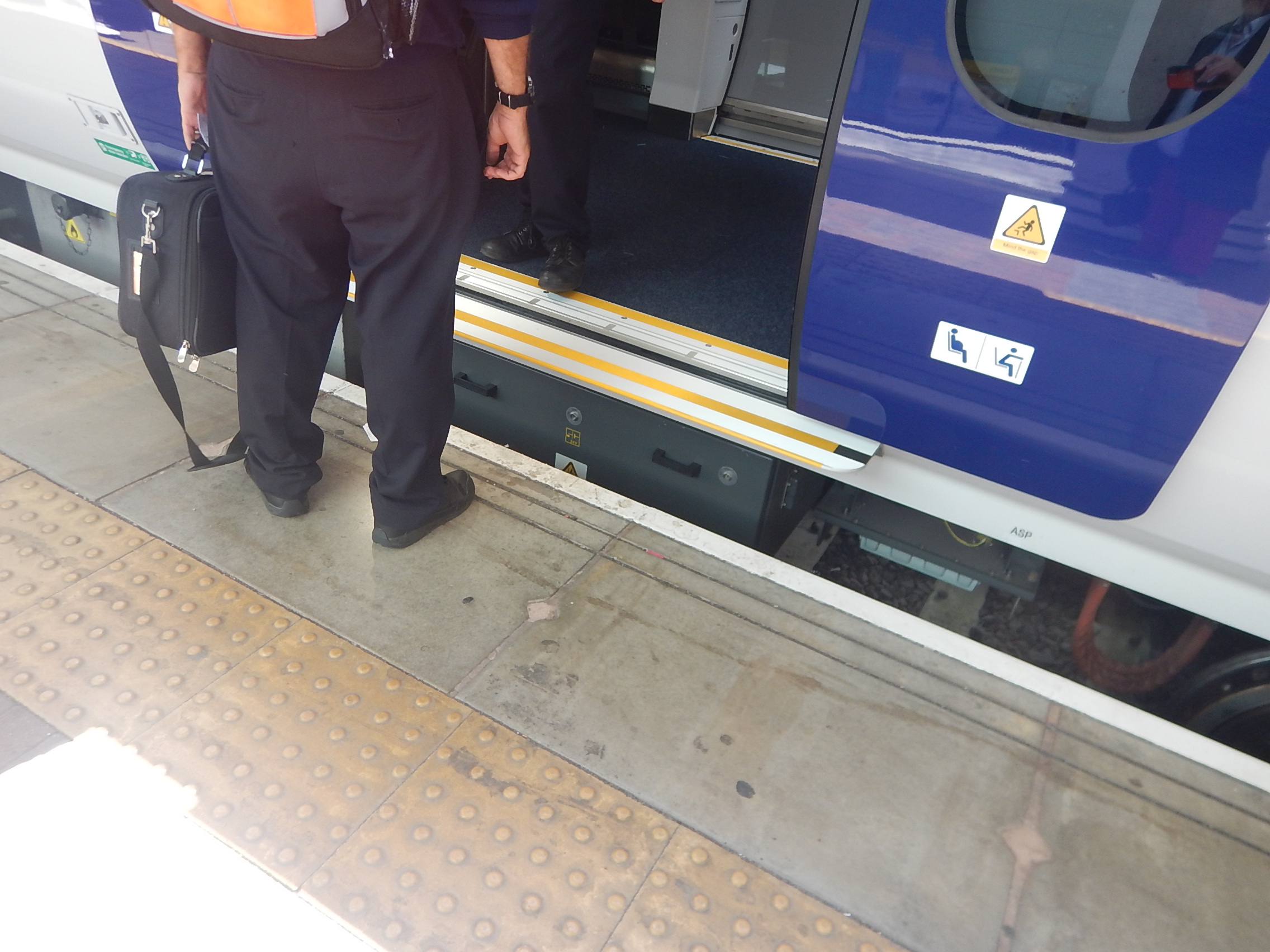
With new trains, there is no excuse for not having level access, where someone in a wheelchair can just wheel themselves across.
Level access should reduce loading delays, as it eases loading of buggies, wheelchairs and wheeled cases.
If Merseyrail, Greater Anglia and some parts of the London Overground can arrange it, then surely Manchester can?
Nova Problem
The author also talks about possible problems with TransPennine’s new Nova trains, which have single end doors, which could prove inadequate in busy times.
Build A West-Facing Bay Platform At Manchester Victoria Station
The author suggests this could be used to run a frequent shuttle service between Manchester Victoria and Manchester Airport via Deansgate, Oxford Road and Piccadilly.
It might mean that TransPennine services stopped short in Manchester and passengers would change for the Airport.
But it would solve the problems of the capacity in the Castlefield Corridor and platform availability at Manchester Airport
Could Passengers Be Nudged Towards The Metrolink?
I have watched the sheer number of passengers delay trains at Manchester Piccadilly, several times.
Would it ease delays if passengers used the Metrolink to Manchester Airport?
Perhaps, the journey by Metrolink could be made more affordable?
Conclusion
It’s a mess and as the author says in his title, quarts don’t fit into pint pots.
At least though, if High Speed Two is built to link up with Northern Powerhouse Rail and together they run London, Birmingham or Liverpool to Hull via Manchester Airport, Manchester City Centre, Huddersfield, Bradford and Leeds, this would solve the problem of the Castlefield Corridor by bypassing it for long-distance trains.
What Will Boris Do About The Proposed Third Runway At Heathrow?
I have tackled this before in October 2016 in a post called Changing Sides.
This was how I started that post.
There is an interesting article in The Sunday Times today, entitled Boris Retreats In Fight Against Third Runway.
Boris is apparently saying he won’t oppose a third runway at Heathrow, so if anything he’s being consistent in changing horses, just as he did with Michael Gove.
But perhaps more surprisingly, Willie Walsh, the Chief Executive of IAG, who own BA, is quoted as calling Heathrow a fantasy project, which has been gold-plated and inflated by the owners to maximise their returns, at the expense of the airlines.
The paper also says that Gatwick will build a new runway anyway.
Remember, it was written before Theresa May’s government decided to allow Heathrow’s Third Runway.
Since the decision to allow Heathrow to build a Third Runway was made nearly three years ago in October 2016, there have been a lot of changes.
Notably, Boris has gone from Foreign Secretary and an MP in a Heathrow Expansion-opposing constituency to Prime Minister.
As Prime Minister he is supposed to look at the bigger picture.
Unless he’s totally stupid he must have noted the following.
Brexit Has Changed From A Simple Quick Exit Into A Slow And Very Tortuous Process
I would expect an opinion poll would show that the UK population thinks that sorting out Brexit is a much more important problem, than the decision on a new runway in the South East of England.
So will Boris put Heathrow’s Third Runway on the back burner, given the following factors
Gatwick Will Build A Second Runway Anyway
In the Wikipedia entry for Gatwick Airport, there is a section entitled Expansion Proposals, where this is the first paragraph.
Gatwick has been included in a number of reviews of airport capacity in southeastern England. Expansion options have included a third terminal and a second runway, although a 40-year agreement not to build a second runway was made in 1979 with West Sussex County Council. Expanded operations would allow Gatwick to handle more passengers than Heathrow does today, with a new terminal between two wide-spaced runways. This would complement or replace the South Terminal, depending on expected future traffic.
My project management knowledge tells me, that Gatwick could add a second runway and upgrade the terminals in a shorter time, than Heathrow can build a third runway.
But more importantly, Gatwick Airport could build the extra runway and terminal without disruption to airport passengers, aircraft and road traffic on the nearby M23.
Boris’s only problem with Gatwick expansion, is the amount of post he’ll get from Disgusted of Tunbridge Wells.
Disruption Must Be Avoided
Recent timetabling and construction fiascoes on Thameslink and Northern Rail should have sent a message to politicians, that large infrastructure projects must be created without disrupting train or air passengers and road traffic.
Can Heathrow Be Built Without Disrupting Traffic On The M25?
It is interesting to look back at the basic facts at the construction of Heathrow Terminal 5.
- A public enquiry into the project lasted 525 days.
- The terminal sits on a 260 hectare site.
- Construction started in 2002.
- The terminal opened in 2008.
- Construction finisged in 2011.
- The terminal cost £4.2billion.
The construction of Terminal 5, also needed the M25 to be widened and linked to the terminal.
This Google Map shows Heathrow Terminal 5 and its relationship to Heathrow’s current two runways and the M25.
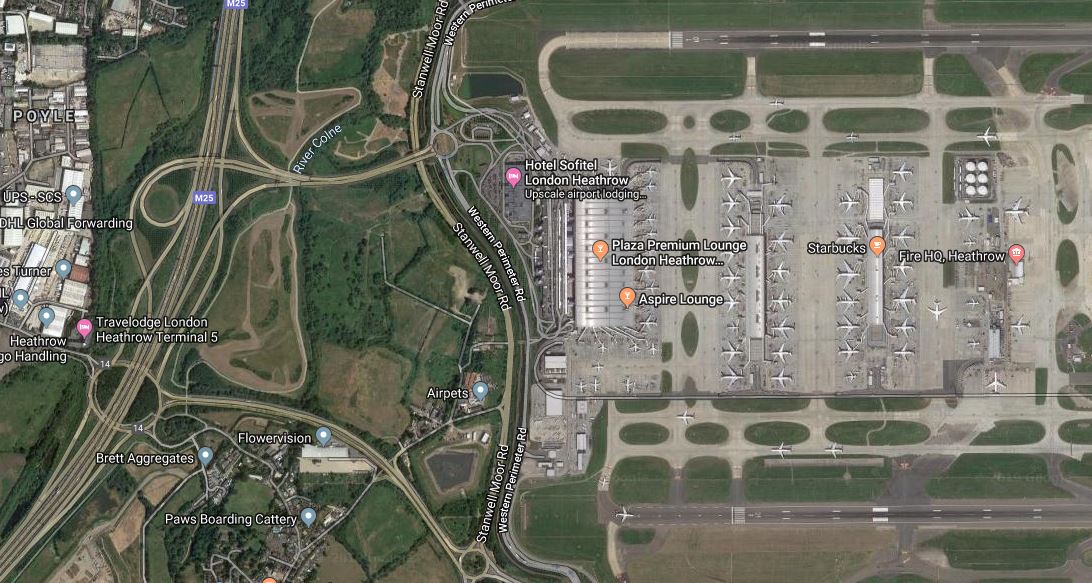
I remember the construction of Terminal 5 well, if only because, I was stuck in or moving slowly along that section of the M25 so many times.
As this immense construction project, is probably in living memory of much of the population of West London, how will they react to the thought of all the disruption, that building the third runway will cause.
Would Uxbridge, throw Boris out, if he approved the building of a third runway at Heathrow?
Heathrow Is A Pollution Blackspot
Various factors mean, that the surroundings of Heathrow are a pollution blackspot, mainly caused by the large number of diesel vehicles on the M4 and M25 motorways and others bringing passengers and goods to the airport.
I believe that any Planning Permission for the third runway, will require Heathrow to do something about the pollution. This could be easier than anybody thinks, as more of us will be using electric vehicles by the time the runway opens.
Heathrow are already proposing their ULEZ or Ulta Low Emission Zone.
Heathrow Rail Access Will Improve
Crossrail will eventually serve Heathrow in a year or so and this will improve rail access to the Airport significantly.
Other rail links are also in prospect.
- The Western Rail Approach to Heathrow could be open by 2024.
- Heathrow Southern Railway could be built.
- The West London Orbital could be built.
The first two would be privately financed.
This better rail access may reduce the traffic and pollution around the airport, but it will make it easier, for passengers to use the airport and traffic will grow.
High Speed Rail
Increasingly, Heathrow and the other London airports, will come under competition from High Speed Rail.
Eurostar has upwards of seventy percent of the London-Paris and London-Brussels passenger markets.
I have travelled a few times from London to Amsterdam on Eurostar and feel that four hours is my limit for comfortable train travel.
I estimate the following journeys would be possible on Eurostar.
- London and Cologne via Brussels in four hours
- London and Bordeaux via Paris in four and a half hours.
- London and Frankfurt in Five hours.
Another competitor to air services out of London will be London and Edinburgh services on the East Coast Main Line, which are being updated with new faster trains and journey times under four hours.
Air Cargo And Heathrow
I looked up air cargo in Wikipedia and these points are there.
- Fifty-percent of all air frieght is belly-cargo on airlines.
- An industry expert estimates that 15-20 tonnes of air cargo is worth 30-40 economy passenger seats, when both are on passenger planes.
- In 2017, the IATA observed a 9% rise in freight tonne kilometres
- Boeing is doubling its 767F production since 2016 to three per month in 2020.
Heathrow dominates the air cargo traffic into and out of the UK and last year it handled 1,788,815 tonnes of cargo, which was a 5.3% increase in tonnage on 2017.
However, it does appear that the second largest cargo airport in the UK; East Midlands, handled about the same amount of freight as Heathrow in April 2018.
There is also the East Midlands Gateway close to that airport, which will be a massive logistics park., with a rail connection.
Perhaps the pressures of the congested Heathrow, with some nudging from the Government could remove the cargo aircraft from the airport to more suitable airports like East Midlands and Doncaster Sheffield.
Manchester Airport Is The Most Important Airport North Of London
Manchester Airport is the busiest Airport after Heathrow and Gatwick and over the next few years it will catch up to a certain extent.
In Changes Signalled For HS2 Route In North, I said this about Manchester Airport’s rail connectivity if High Speed Two and Northern Powerhouse Rail are combined across the Pennines.
If High Speed Two and Northern Powerhouse Rail are developed as laid out in the Transport for the North report, the following cities will be connected to Manchester Airport.
- Birmingham – High Speed Two
- Blackpool – Northern Powerhouse Rail/West Coast Main Line
- Bradford – High Speed Two/Northern Powerhouse Rail
- Carlisle – Northern Powerhouse Rail/West Coast Main Line
- Edinburgh – Northern Powerhouse Rail/East Coast Main Line
- Glasgow – Northern Powerhouse Rail/West Coast Main Line
- Hull – High Speed Two/Northern Powerhouse Rail
- Leeds – High Speed Two/Northern Powerhouse Rail
- London – High Speed Two
- Newcastle -High Speed Two/Northern Powerhouse Rail
- Preston – Northern Powerhouse Rail/West Coast Main Line
- Sheffield – Northern Powerhouse Rail
- Sunderland – Northern Powerhouse Rail
- York – High Speed Two/Northern Powerhouse Rail
Manchester Airport will probably become the most important station in the North with High Speed connections to a large part of England and Scotland.
Heathrow and Gatwick will find they have a very big and well-connected Northern competitor.
Extinction Rebellion And Other Environmental Protesters
Most of the environmental protesters like Extinction Rebellion seem to have focused their attention on Heathrow, where airports are concerned.
They will fight tooth and nail to stop Heathrow’s third runway.
Will Heathrow Get The Planning Permission They Need?
I think that this is the sort of planning decision, that will end up with the Secretary of State for Environment, Food and Rural Affairs; Theresa Villiers.
Her Wikipedia entry says this.
Villiers favours construction of a high-speed rail link from London to Birmingham and Manchester, arguing that flyers could use capacity at airports such as Birmingham International and Manchester International Airport.
She is also quoted as being against a third runway at Heathrow, when she was a member of Davisd Cameron’s cabinet.
Grant Schapps, who is the current Secretary of State for Transport, could be more supportive to Heathrow’s application.
The Mood Of The UK About The Environment
The view of the average UK voter on the environment has changed markedly in the last few years, driven by documentaries, events and politics from around the world.
Boris’s father; Stanley Johnson has written books on the environment and received the Greenpeace Award for Outstanding Services to the Environment, so this could fit with his opposition to a third runway at Heathrow, when he was Mayor of London.
Do Heathrow Airport Have A Plan B?
In Heathrow Plans Runway Over M25 In 30-Year Expansion, I outlined how I thought the runway would be built.
The Times says this about the construction program.
Only the runway would be built by the opening date of early 2026.
Other facilities such as new terminals, car parks, hotels and transit systems would open from 2030, with an expansion of Terminal 5 the priority
This means that the extra runway capacity can be used initially to better accommodate the same number of flights.
Perhaps Plan B would mean changing the order of construction, leaving a space for the third runway and getting Planning Permission to build it in perhaps starting in 2028.
Conclusion
This is a tough one to call and I know what I would do. I would just let it fester until the decision was forced by another factor.
But Boris is the Prime Minister and will have to make a decision!
D
Will HS2 And Northern Powerhouse Rail Go For The Big Bore?
Different Versions Of This Post
The original post was published on the 25th August 2019.
It has been updated on the 21st November 2020 to reflect changes made to High Speed Two (HS2).
It has been updated on the 13th January 2023 for piggy-back freight trains.
The Merging Of High Speed Two And Northern Powerhouse Rail
It looks to me that there will be increasing links and merging between High Speed Two (HS2) and Northern Powerhouse Rail (NPR).
This report on the Transport for the North web site, is entitled At A Glance – Northern Powerhouse Rail.
Proposals and possibilities include.
- NPR will have a Western terminal at a new station in Liverpool City Centre.
- HS2 trains would access Liverpool and Manchester via a junction between HS2 and NPR at High Legh.
- There will be six trains per hour (tph) between Liverpool and Manchester via Manchester Airport.
- The route between Manchester and Manchester Airport is planned to be in tunnel.
- There will be six tph between Manchester and Leeds.
In addition, Boris has made positive noises about a high speed line between Manchester and Leeds being of a high priority.
So will the planners go for the logical solution of a High Speed tunnel between Manchester Airport and Leeds?
- There could be a theoretical capacity of perhaps 18 tph, which is the design capacity of High Speed Two.
- Speeds of up to 125 mph or more could be possible. The Gottard Base Tunnel has an operating speed for passenger trains of 125 mph.
- Stations could be at Manchester Airport, Manchester Piccadilly/Piccadilly Gardens/Victoria, Huddersfield, Bradford and Leeds.
- West of Manchester Airport, the route appears easier and the tunnel would emerge close to the airport. High Speed Two is planning that the tunnel emerges just to the North of the Airport and that the station is below ground level.
- East of Leeds the tunnel would join up with existing routes to Doncaster, Hull, Newcastle and York.
- Freight trains would be allowed at speed of up to 100 mph.
I believe such a tunnel could be built without disrupting existing rail services and passengers. Remember building Crossrail’s tunnels in London was an almost invisible process.
It would result in two rail systems across Northern England.
- Upgraded Classic Rail Routes
- The Big Bore
My thoughts on the two systems follow.
Upgraded Classic Rail Routes
This could include improvements such as these,
- Extra passing loops.
- Selective electrification
- Improved stations
- Comprehensive in-cab digital signalling
- More paths for passenger and freight trains.
Which could be applied to routes, such as these.
- The Huddersfield Line
- The Chat Moss Line
- The Calder Valley Line
- The Hope Valley Line
- The Dearne Valley Line
- The Selby Line
- The Midland Main Line North Of Clay Cross
In addition, there could be the reopening of some closed or freight routes to passenger trains.
This article on Rail Technology Magazine is entitled Network Rail Reveals Detailed £2.9bn Upgrade Plans For TransPennine Route.
It is a comprehensive upgrade that includes.
- Improvement between Huddersfield and Westtown, which is near Dewsbury
- Grade separation or a tunnel at Ravensthorpe
- Rebuilding and electrification of eight miles of track.
- Possible doubling the number of tracks from two to four.
- Improved stations at Huddersfield, Deighton, Mirfield and Ravensthorpe.
This project would be a major improvement to the Huddersfield Line.
In Sheffield Region Transport Plan 2019 – Hope Valley Line Improvements, I talked about planned improvements to the Hope Valley Line, which should begin in the next couple of years.
These improvements are given in detail under Plans in the Wikipedia entry for the Hope Valley Line.
The Hope Valley Improvements will cost in the region of tens of millions of pounds and Wikipedia sums up the benefits like this.
These changes to allow three fast trains, a stopping train and freight trains each hour were also supported in a Transport for the North investment report in 2019, together with “further interventions” for the Northern Powerhouse Rail programme.
It seems like good value to me!
So could we see other multi-million and billion pound projects created to improve the classic routes across the Pennines?
Projects would be fully planned and the costs and benefits would then be assessed and calculated.
Then it would be up to the Project Managers to devise the optimal structure and order in which to carry out all the projects.
I wouldn’t be surprised to see the following techniques used.
- Discontinuous electrification to avoid bridge reconstruction.
- Intelligent, hybrid diesel/electric/battery trains from Bombardier, CAF, Hitachi or Stadler, capable of 125 mph running and changing mode at speed.
- Modular digital signalling
- Factory built stations and step-free bridges.
- Removal of all level crossings.
- All stations updated for step-free access between train and platform.
The objectives would be as follows.
- More train paths, where needed.
- Faster line speed.
- Less running on diesel.
- Fast station stops.
Hopefully, the upgrading could be done without too much disruption.
Remember though, that disruption to existing users during a project, is most likely down to bad project management.
The Big Bore
The Central Core tunnel of Crossrail between Royal Oak and East London, was virtually a separate project before Crossrail’s stations and much of other infrastructure was built.
I believe that digging the tunnel first gave a big advantage, in that it could be constructed as an independent project, provided that the logistics of delivering the components and removing the junk was done efficiently.
But it did mean that travellers wouldn’t see any benefits until the project was almost complete.
HS2 and NPR are different in that they also envisage upgrading these routes.
- The Huddersfield Line
- The Chat Moss Line
- The Calder Valley Line
- The Hope Valley Line
- The Dearne Valley Line
- The Selby Line
- The Midland Main Line North Of Clay Cross
Only the Huddersfield Line is directly affected by the Big Bore.
Effectively, the Big Bore will provide a by-pass route for passenger trains between Leeds and West of Manchester Airport, to take the fast trains of HS2 and NPR underneath the congested classic lines.
In Changes Signalled For HS2 Route In North I said this about a tunnel between Leeds and Manchester.
To get a twenty-five minute time between Leeds and Manchester with a ten minute frequency, which I believe is the minimum service the two cities deserve, would be like passing a whole herd of camels through the eye of a single needle.
The Swiss, who lets face it have higher hills, than we have in Northern England would create a new route mainly in tunnel between the two cities, with perhaps an underground station beneath the current Grade I Listed; Huddersfield station.
The transport for the North report suggests Bradford Low Moor station, as an intermediate station, so why not Bradford Low Moor and Huddersfield stations?
Note that the Gotthard Base Tunnel, which opened a couple of years ago, deep under the Alps, is about the same length as a Leeds and Manchester tunnel, and cost around eight billion pounds.
It would be expensive, but like Crossrail in London, the tunnel would have big advantages.
- It could be built without disrupting current rail and road networks.
- It would have a capacity of up to thirty tph in both directions.
- Unlike Crossrail, it could handle freight trains.
- It would unlock and join the railway systems to the East and West.
I believe, it would be a massive leap forward for transport in the North of England.
It would be a very big project and probably one of the longest rail tunnels in the world.
Comparison With The Gotthard Base Tunnel
But surely, if a small and rich nation like Switzerland can build the Gotthard Base Tunnel, then we have the resources to build the Big Bore between Manchester Airport and Leeds.
Consider these facts about the Gotthard Base Tunnel.
- It is two single track bores.
- Each bore has a track length of around 57 kilometres or 35 miles.
- The tunnel may be deep, but it is direct and level.
- The maximum speed is 250 kph or 160 mph.
- The operational speed for passenger trains is 200 kph or 125 mph.
- The operational speed for freight is 100 kph or 62 mph.
- It can take the largest freight trains.
To make numbers even more impressive it is joined to the shorter Ceneri Base Tunnel, to provide an even longer route.
Manchester Airport And Leeds Direct
Now consider Manchester Airport and Leeds.
- The current rail distance is 56 miles.
- There are stops at Manchester Piccadilly, Manchester Oxford Road, Manchester Victoria and Huddersfield stations.
- Journey time is eighty minutes.
But the direct distance is only 68 kilometres or forty-three miles.
Surely if the Swiss can blast and dig two 57 km. single-track rail tunnels through solid rock, we can go eleven kilometres further with all the recent experience of tunnelling around the world.
The lengths of the various legs would be as follows.
- Manchester Airport and Manchester – 14 km.
- Manchester and Huddersfield – 35 km.
- Huddersfield and Bradford – 17 km.
- Bradford and Leeds – 13 km
Trains running on the various legs at 200 kph, which is the cruising speed of a 1970s-built InterCity 125, could take the following times for the various legs.
- Manchester Airport and Manchester – 4.2 minutes
- Manchester and Huddersfield – 10.5 minutes
- Huddersfield and Bradford – 5.1 minutes
- Bradford and Leeds – 13 km – 3.9 minutes
Leeds and Manchester Airport would be under thirty minutes apart, even allowing two minutes each for the three stops.
Looking at NPR between Liverpool and Hull, times could be as follows.
- Liverpool and Manchester – 26 minutes
- Manchester and Leeds – 20 minutes
- Leeds and Hull – 38 minutes
Or a Coast-to-Coast time of under ninety minutes.
Train Frequencies
HS2 is being designed to handle eighteen tph, although slower intensive railways in the UK can handle up to twenty-four tph.
At the current time or certainly in a few years time, the theoretical maximum frequency through the Big Bore should be between these two figures. I will assume at least eighteen tph in this post.
The At A Glance – Northern Powerhouse Rail report talks about the following frequencies.
- Liverpool and Manchester via Manchester Airport – Six tph.
- Manchester and Leeds – Six tph
- Leeds and Hull – Two tph
This is all so lacking in ambition. It is like building a new high capacity road and only allowing those with status to use the road.
If Leeds and Manchester Airport can handle eighteen tph, why not use some of it to create an Express Metro under the Pennines?
To me, if the Big Bore is built, nothing short of twelve tph or a train every five minutes is acceptable, at Liverpool, Manchester Airport, Manchester, Huddersfield, Bradford and Leeds stations.
The extension to Hull could be reduced to perhaps six tph, but with the upgrading of the Hull and Leeds Line to perhaps 140 mph, I’d be bold and create a true TransPennine Express;
Hull and Liverpool every five minutes would be the ultimate Marketing Man’s dream.
The Underground Stations
Manchester Airport, Manchester, Huddersfield, Bradford and Leeds would all be through stations deep underground.
- They would be connected to the surface by lifts and escalators.
- Some entrances to the stations would connect to existing stations and others might emerge in City squares like Manchester’s P:iccadilly Gardens.
- Most stations would be just two platforms, as all trains would pass through on either side of a large underground concourse.
- Bay platforms could be added as required.
- All stations would have platform edge doors.
- Passengers would be able to reverse direction by just walking across the concourse.
Stations would build on the lessons learned from Crossrail. But then NPR is closer to Crossrail than a Classic High Speed Line.
Weston Williamson’s Vision For Manchester Piccadilly Station
I wrote about this in The Rival Plans For Piccadilly Station, That Architects Say Will ‘Save Millions’.
I believe that this is the way to create an underground station.
The Terminal Stations
The two main terminal stations for NPR and trains running through the Big Bore would be the proposed High Speed station at Liverpool and the existing Hull station.
But one other terminal station is being created; Edinburgh.
I have been going to Edinburgh station to and from England for perhaps thirty years and the capacity of the station has constantly increased.
Recent developments have been an extended Platforms 5 and 6, that can take the longest LNER trains.
I wouldn’t be surprised to find out that with the application of digital signalling, that there is capacity for at least eight tph between Edinburgh and Newcastle.
There would certainly be capacity for at least two tph between Liverpool and Edinburgh via Manchester Airport, Manchester, Huddersfield, Bradford, Leeds, York and Newcastle.
In the East the other possibilities for terminals are Doncaster, Newcastle and York.
- I would discount Newcastle, as it lacks capacity and its location would make it difficult to add more.
- Doncaster has good connectivity and space, but do Leeds and Hull offer similar connectivity?
So that leaves Hull, Edinburgh and York, as the only Eastern terminals.
In the West, there is probably a need to connect to the Northern section of the West Coast Main Line (WCML).
- Glasgow Central is probably the obvious terminal, but it would need an extra connection at the junction of HS2, NPR and WCML at High Legh.
- If necessary Preston could be used, as it has space and lots of connectivity.
- Why not use Blackpool North, as it sits on a large site and is fully electrified. It could certainly take four tph?
- A lot of the things I said for Blackpool, also apply to Chester, which would give a gateway to Mid and North Wales!
The trains through the Big Bore could fan out at both the East and West.
Tunnel Size
As Manchester will be served by High Speed Two’s Full-Size trains from Birmingham and London, both Manchester stations will need to be built to accept these trains.
I feel that the whole tunnel between Manchester Airport and Leeds, should be built to the High Speed Two size, so that it can accept the largest possible passenger and freight trains, in the future.
That would obviously include the ability to handle piggy-back freight trains.
Integration Of HS2 and NPR
The At A Glance – Northern Powerhouse Rail report is proposing this and it looks that the following HS2 services could be possible between Euston and Manchester.
- Two tph – Euston and Hull via Old Oak Common, Manchester Airport, Manchester, Huddersfield, Bradford and Leeds
- Two tph – Euston and Edinburgh via Old Oak Common, Manchester Airport, Manchester, Huddersfield, Bradford, Leeds, York and Newcastle.
Note.
- Manchester Airport, Manchester, Huddersfield, Bradford and Leeds would all have four tph to and from London, by the Western arm of HS2’s Y.
- If in addition there were two tph between Liverpool and Hull and Liverpool and Edinburgh, this would mean four tph from the Big Bore of NPR to both Hull and Edinburgh.
- None of these core services need to terminate in the Big Bore.
I very much feel that integrating HS2 and NPR is the way to go.
Could We See A High Speed Northern Metro?
If we assume that the Big Bore could handle the HS2 frequency of at least eighteen tph, then it would be possible to create a high speed service across the Pennines with the following Metro-like frequencies.
- Liverpool and Hull – 4 tph
- Liverpool and Edinburgh – 2 tph
- Glasgow and Hull – 2 tph
- London Euston and Hull – 2 tph
- London Euston and Edinburgh – 2 tph
- London Euston and Glasgow – 2 tph
This would result in the following frequencies
- Liverpool – 6 tph
- Glasgow – 4 tph
- London Euston – 4 tph
- Manchester Airport – 12 tph
- Manchester – 12 tph
- Huddersfield – 12 tph
- Bradford – 12 tph
- Leeds – 12 tph
- Hull – 8 tph
- York – 4 tph
- Newcastle – 4 tph
- Edinburgh – 4 tph
What would these frequencies do for train travel in the North of England?
Freight
The Gotthard Base Tunnel has been designed so that both freight and passenger trains can use the route.
There is a need for extra freight capacity across the country and I wonder if freight trains could use the Big Bore.
I estimate that the Big Bore would be 68 kilometres if bored straight and level between West of Manchester Airport and Leeds.
Lets assume it is seventy kilometres or 43.5 miles.
So times, through the tunnel at various average speeds would be.
- 125 mph – 21 minutes
- 110 mph – 23.7 minutes
- 100 mph – 26.1 minutes
- 90 mph – 29 minutes
- 80 mph – 32.6 minutes
- 62 mph (Gotthard Base Tunnel speed for freight) – 42 minutes.
Could it be mandated that freight trains can use the tunnel, if they could maintain a particular speed?
Consider.
- A 125 mph train with stops at Manchester Airport, Manchester, Huddersfield, Bradford and Leeds would probably take thirty minutes to transit the tunnel.
- A freight train running at 90 mph would take more or less the same time.
- Fifteen tph would mean a train every four minutes.
- Automatic control of all trains in the tunnel would be a possibility. It appears to work on the much more complicated Thameslink.
I think with the following conditions, one or even two freight trains per hour, in addition to the passenger trains, can pass through the Big Bore in each direction.
- The locomotives have the performance of at least the Class 93 locomotive, which is currently being built.
- Freight trains can be hauled through at a minimum speed, which could be between 90 and 110 mph.
- The passenger trains and train and platform staff work together to produce very short station dwell times.
- All passenger trains are identical.
- Station platforms are designed so that passengers can leave and enter the trains rapidly.
It will be a Big Bore with a capacity to match!
What About Sheffield?
I haven’t forgotten Sheffield, but I think it could be linked across the Pennines by another route.
Under the upgrades for Northern Powerhouse Rail, it is proposed that services between Sheffield and Leeds become 4 tph in 25 minutes along the Dearne Valley Line.
Does Boris Know More Than He Lets On?
The headline on the front cover of Issue 885 of Rail Magazine is Boris Backs New Pennine Railway.
There is also a sub-heading of PM commits to Leeds-Manchester line.
Boris didn’t apply any substance to the speech, except to say that it will be funded.
Conclusion
I believe that my naïve analysis in this post shows that a TransPennine tunnel is possible.
But I believe that the right tunnel could have one big advantage.
Suppose it was built to handle the following.
- A capacity of eighteen tph, which is the same as High Speed Two.
- An operating speed of 140 mph or more. The Gotthard Base Tunnel has a maximum operating speed of 160 mph.
- High Speed Two’s Full-Size trains.
- The largest freight trains.
It would be future proofed for longer than anybody could envisage.
There are also other smaller advantages.
- It would by-pass a lot of difficult areas.
- It would cause very little aural and visual disruption.
- If it were designed with care, it would not affect the flora and fauna.
- As with the Swiss tunnel, it could be dug level, which would save energy and allow trains to run faster.
- It could be running twelve tph between Leeds and Manchester Airport via Bradford, Huddersfield and Manchester Piccadilly.
- Existing surface railways at the Eastern end could serve Cleethorpes, Darlington, Doncaster, Edinburgh, Hull, Middlesbrough, Newcastle, Scarborough, Sheffield and York
- Existing surface railways at the Western end could serve Barrow, Blackpool, Carlisle, Chester, Glasgow, Liverpool. North Wales, Preston and Wigan.
It would be more like Thameslink for the North turned on its side, rather than Crossrail for the North.
Japanese Car Rental Firms Discover New Trend Of Renting Vehicles For A Nap Or Quiet Lunch
The title of this post is the same as that of this story on The World News.
It was flagged up first on BBC Breakfast.
But is it any difference to my behaviour?
I generally get up, do all my daily chores and have a bath.
Then, I’ll go out about nine and take an Overground train or a bus to somewhere quiet for breakfast.
I will sometimes go as far as Richmond for breakfast in Leon.
And if the weather is hot like is it is now, I might even just sit on an air-conditioned train and read my paper or watch the news on my phone, stopping where I fancy for a coffee or a drink.
All I need to ensure, is that at some point, I stop off at a Marks and Spencer to get the food I need for supper.
Courtesy of my Freedom Pass, all this travel costs me a big fat zilch.
I call it Freedoming.
Today, though I’m roaming a bit further; Manchester. Hopefully, I’ll get a ride in one of the new Class 195 trains to Manchester Airport.
Plans Revealed For £10bn High-Speed Railway To Connect Britain’s Busiest Airports, HS1 and HS2
The title of this post is the same as this article on Global Rail News.
This is the first two paragraphs.
Developers are submitting plans for a new high-speed line to the UK’s Department for Transport (DfT) in response to a call for market-led proposals.
Named ‘HS4Air’, the proposed £10 billion railway will connect HS1 at Ashford to HS2 North West of London with stops at Heathrow and Gatwick airports and a spur connection to the Great Western main line.
This map from Expedition Engineering shows the route.

To minimise environmental disruption, the following should be noted.
- There is a North-South tunnel under Heathrow Airport.
- HS4Air follows the M25 to the South-West of London.
- Several miles of the route between Heathrow and Gatwick is in tunnel to the West of Horsham.
- There is a West-East tunnel under Gatwick Airport.
- The Ashford to Tonbridge Line would become part of HS4Air.
There will also be stations at Ashford, Tonbridge, Gatwick and Heathrow.
This further diagram from Expedition Engineering shows the various possible routes.
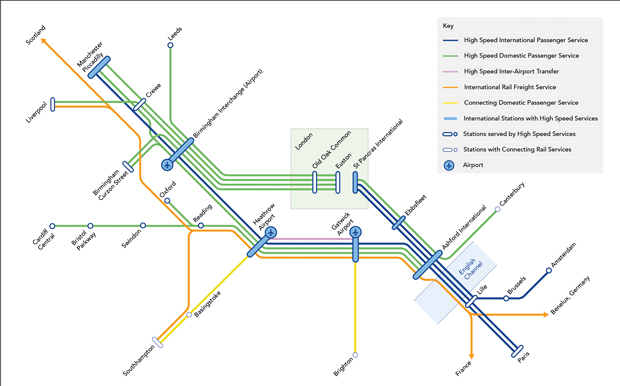
Note the following about HS4Air.
- Four major airports; Gatwick, Heathrow, Birmingham and Manchester, will be connected to the Channel Tunnel.
- Wikipedia suggests, that the line could be extended to a reopened Manston Airport.
- A Paris to Manchester passenger service via Gatwick, Heathrow and Birmingham, is proposed.
- High-speed connecting services from Cardiff, Oxford and Manchester to Ashford are proposed.
- HS2’s major interchanges of Birmingham International and Crewe, are served.
- Freight routes from Liverpool and Southampton to the Channel Tunnel will be enabled.
It looks a good basis to connect the rest of the UK to the services through the Channel Tunnel.
The article also gives some sample journey times.
- Ashford-Gatwick: 25 minutes
- Manchester-Heathrow: 1 hour 10 mins
- Heathrow-Gatwick: 15 minutes;
- Cardiff-Heathrow: 1 hour 40 mins
- Birmingham-Paris: 3 hours
- Manchester-Paris: 3 hours 40 minutes (My Estimate)
Intriguingly, the Manchester-Paris time, is the same as Eurostar’s current time between London and Amsterdam.
Conclusion
The plan seems to be well-thought out and it gives a good increase in connectivity from Wales, the West Country and the Midlands and North of England to Heathrow, Gatwick and the Channel Tunnel.
But I can see a few problems.
- Will the residents of the North Downs accept a high-speed railway through their area?
- If freight routes from Liverpool and Southampton to the Channel Tunnel are established, will residents object to masses of noisy freight trains?
- Will there be pressure for more tunnels?
On the other hand Expedition Engineering are saying that needed extensions to the UK’s electricity grid can be laid underground along the same route.
Capacity Crunch At Chester – Mid-Cheshire Line
The Capacity Crunch At Chester article in the July 2017 Edition of Modern Railways has a section about the Mid-Cheshire Line.
The section opens with this paragraph.
Trains on the Mid-Cheshire Line, from Chester to Manchester via Stockport and Altrincham, provide interchange with Manchester Metrolink at Altrincham, but the average speed from Chester to Altrincham is 30 mph, which again is uncompetitive with car journey times.
Despite this and only an hourly service, Knutford station has in a footfall in excess of 500,000.
There are other problems.
- The train timetable is not commuter-friendly to Chester.
- Connections to and from London are bad at Chester.
- Sunday services are two-hourly.
But Network Rail are on the case and are lengthening platforms, so frequencies can be increased.
Manchester Airport Western Link
The Wikipedia entry for the Mid-Cheshire Line talks about a western link to Manchjester Airport, which would start from near Mobberley.
Conclusion
Upgrading the Mid-Cheshire Line and Sandbach To Northwich must have possibilities.
By Rail Between Derby And Manchester via Sheffield
In his article entitled Connecting The Powerhouses in the June 2017 Edition of Modern Railways, Colin Boocock, says that the one rail route between Derby and Manchester, is to go via Sheffield.
There is one train an hour that takes one hour 38 minutes with a change at Sheffield. The two legs appear to take 33 and 52 minutes respectively with a thirteen minute wait at Sheffield station, which is a well-equipped station.
Change the destination to Manchester Airport and it’s still one train an hour and the journey takes two minutes over two hours.
Incidentally, the fastest trains to Manchester and Manchester Airport via Sheffield seem to be the same trains.
Improving the times on this route will not be easy.
- Stops are minimal at only Chesterfield, Stockport, Manchester Piccadilly and Manchester Airport.
- The service uses the 90 mph Hope Valley Line between Sheffield and Manchester.
- The only electrification is between Stockport and Manchester Airport.
- Electrification from Sheffield to Stockport on the Hope Valley Line will be difficult because of the terrain and the countryside lobby.
- Electrification from Derby to Sheffield will be difficult, as the line goes through a World Heritage Site.
The closure of the electrified Woodhead Line to passenger traffic in 1970, with the benefit of hindsight, now looks to be a crass decision of the highest order. I assume that, the great friend of the railways; Harold Wilson was in charge!
Conclusions
Going between Derby and Manchester by rail is a practical proposition, but it is a route, which would be difficult to improve.
By Rail Between Derby And Manchester via Stoke
In his article entitled Connecting The Powerhouses in the June 2017 Edition of Modern Railways, Colin Boocock, says that the best rail route between Derby and Manchester, is to go via Stoke.
There is one train an hour that takes one hour 44 minutes with a change at Stoke. The two legs appear to take 51 and 42 minutes respectively with an eleven minute wait at Stoke station, which is a well-equipped Virgin station.
Change the destination to Manchester Airport and there is an extra change of train and a journey which is at least half-an-hour longer.
You can actually do Derby to Manchester Airport in a couple of minutes over two hours, if you go via Sheffield.
But it does seem a bit crazy, as Manchester Airport is actually eight miles closer to Derby if you drive.
Stoke is well connected to Manchester with up to four trains per hour to Manchester Piccadilly, some of which take just forty minutes. Manchester Airport takes just over the hour with a change at Crewe or Manchester Piccadilly.
The Crewe to Derby Line links Derby and Stoke via Uttoxeter.
This description of the route comes from this section in Wikipedia.
The route is double track for all of its length except for a three-mile section between Alsager and Crewe, which was singled by British Rail. Whilst the majority of the route is not electrified, the section between Stoke Junction and Crewe is as this is a part of the West Coast Main Line.
This means that it should be possible to run electric trains between Manchester Airport and Stoke. As there would be no chnge at Crewe using best times on Stoke-Crewe and Crewe-Manchester Airport giives a time of about fifty minutes.
The route between Stoke and Derby is not electrified and the operating speed of the line is given as 70 mph.
Surely, as it connects Derby and Nottingham to Stoke and the electrified West Coast Main Line, it should have a faster operating speed. In an ideal world, Derby to Stoke must be a prime candidate for electrification. Some of London Overground’s redundant 100 mph Class 317 trains could probably do Derby to Stoke in perhaps thirty-five minutes.
So with electrification all the way, a time of about one hour twenty -five minutes between Derby and Stoke would be possible in a train, that once graced the Stansted Express. So it’s even got luggage racks.
But Derby to Stoke won’t be electrified for years, so could the current service get passengers to Stoke?
There is a section called Services in the Wikipedia entry for the Crewe-Stoke Line. This is said.
The line sees a basic hourly service in each direction with trains calling at all stations on the route however Peartree which is served by 2 Derby bound trains and 3 Crewe bound trains per weekday.
The majority of services on the route since December 2008 have been provided by Class 153 “Super Sprinter” Diesel Multiple Units however Class 158 “Express Sprinter” and Class 156 “Super Sprinter” units are occasionally used. Overcrowding remains a major issue on the route, particularly in the morning and evening peak and a weekends. Passengers are occasionally left behind.
That is a truly pitiful service, as the main rail route from Derby to Manchester is run by a single-coach Class 153 train at times.
It’s amazing anybody trusts the line enough to use it.
As with the Derwent Valley Line, which I wrote about in Exploring The Derwent Valley Line, the problem is probably down to a shortage of suitable trains.
The line needs a suitable bi-mode train.
- At least four-cars.
- Airport interior with luggage racks.
- Possibly a First Class compartment.
- Ability to do the forty miles between Stoke and Nottingham on diesel.
A Flex version of a Class 317 train would do nicely and could probably do Nottingham to Manchester Airport in two hours. This would mean.
- Four trains could provide an hourly service.
- Eight trains would provide a two trains per hour service.
Would you believe that London Overground will release the eight Class 317/7 trains with the Airport interior next year, when they are replaced by new Class 710 trains?
Conclusion
The more I do little exercises like this, the more I believe that Porterbrook’s Flex concept is not only high-class engineering, but it is a idea, that has arrived at exactly the right time.
The only problem with converting Class 317 trains, is they are owned by Angel Trains! I’m sure that that is not an insurmountable problem!
Metro Development With Flex Trains
The June 2017 Edition of Modern Railways gave a few more details of the Class 319 Flex trains, that are being created for Northern.
- The trains now have their own TOPS-number of 769, which must be a seal of approval.
- Northern have ordered eight Class 319 Flex trains as part of or in addition to a fleet of thirty-two Class 319 trains.
- These eight trains will be delivered by the end of May 2018.
- A Class 319 Flex train can be produced every two weeks.
It is also likely, that by the end of this year, Network Rail will have completed the following.
- The Ordsall Chord connecting Manchester Victoria and Piccadilly stations.
- Electrification between Manchester and Preston.
- Electrification from Preston to Blackpool North station.
- Electrification from Manchester Victoria to Stalybridge.
This will mean electric trains like the Class 319 train and bi-mode trains like the Class 319 Flex train, can go between Hazel Grove, Manchester Airport and Stockport to Blackpool North, Liverpool Lime Street, Manchester Victoria, Preston and Wigan North Western.
The Class 319 Flex trains using their diesel power will also be able to extend the electric network to Blackburn, Blackpool South, Burnley Manchester Road, Clitheroe, Southport, Stalybridge, Wigan Wallgate and Windermere, without any additional electrification.
There will be benefits for passengers.
- The Class 319 trains and Class 319 Flex trains will be faster and journey times will be shorter.
- Services run by elderly two-car trains will now be run by refurbished four-car trains.
- Most journeys across Manchester will be continuous or with a single same-platform change at a convenient station.
How will various routes be affected?
Cross-Manchester Travel
Cross-City lines revolutionise city travel and the Ordsall Chord will do the same for Manchester.
This map from Wikipedia shows the location of the Ordsall Chord and how it is connected to exotic places like Bolton, Leeds, Liverpool, Manchester Airport, Stockport and Warrington.
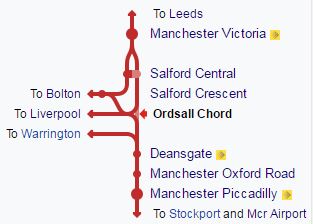
Mancunians will have to learn how to use the link, but they won’t take long to do that!
You may be lucky and your journey will be available from your local station.
But if it requires a change, you will probably take a train to the central core stations of Victoria, Deansgate, Oxford Road or Piccadilly and change for your ultimate destination.
- For many changes, you will just get off one train, wait on the platform for a few minutes and then board another train.
- Some stations will be better interchanges than others.
- Platforms 13 and 14 at Piccadilly may be crowded, but they are at least an island platform allowing a change of direction.
- Platforms at Deansgate and Oxford Road may need widening.
- Other stations like Salford Crescent and Salford Central will also get used as interchanges.
If there is one problem with the Ordsall Chord, it is the name.
Perhaps it should be called the Mancunian Chord?
Collateral Benefits Of The Ordsall Chord
The nearest railway line in concept to the Ordsall Chord is probably Thameslink in London.
- As Thameslink has developed, it has not only provided a high-capacity North-South route across London, but it has also taken the pressure from main line stations like London Bridge, St. Pancras and Victoria, by allowing travellers to change to their long distance trains further out.
- Thmeslink has also been a major factor in improving services to Gatwick Airport.
- Gatwick Airport is building on its position to be a major rail hub South of London.
Over the years Thameslink has developed and some think in a few years time, Thameslink will be at least, if not more important than Crossrail.
Two things will definitely happen, when the Ordsall Chord opens.
As with Thameslink in London, Northern and Southern routes into the Manchester, will be linked back-to-back, to free up platforms in terminal stations.
Frequencies and capacity on many routes will increase. Stations, that have had a two-car diesel train twice an hour since the days of steam ended, will find they get a four-car electric or bi-mode train at a doubled frequency.
But long-term the Ordsall Chord will have major effects.
- Towns and areas like Blackburn, Blackpool, Burnley, Chester, Hudderfield, Kirkby, Southport, Warrington and Wigan will have frequent train services to and from the whole of Manchester City Centre and will benefit accordingly.
- Increased frequencies to Leeds and Liverpool will be easier to arrange.
- Many travellers going to and from Birmingham, London and the South will change at Stockport rather than Piccadilly.
- Few trains will reverse direction in Piccadilly.
- Just as Gatwick Airport has been envigorated by Thameslink, Manchester Airport will become a major rail hub.
- Will Preston develop into Manchester’s hub station for travellers going North or to Scotland.
- Access to the tourist areas of North Lancashire, the Peak District and Yorkshire will be improved.
The Ordsall Chord will have such major effects on Manchester, that I could see HS2 plans being changed.
Buxton To Manchester And Clitheroe To Manchester
I will treat these routes together, as I believe they are a natural fit, where back-to-back operation will be beeficial.
- Both routes are uphill away from Manchester.
- Both routes need better and faster trains.
- Both routes need more capacity.
- Class 319 Flex trains could work both routes without any infrastructure work.
Could Buxton to Clitheroe, with perhaps a two-hourly extension to Hellifield for the Settle and Carlisle Railway create a very valuable tourism asset for the North-West?
In Why Not Buxton To Hellifield?, I looked at the possibilities about running a direct back-to-back service across Manchester.
I said this.
In some ways the interesting one is the round trip from Buxton to Clitheroe, which allowing ten minutes for each turnround at Clitheroe and Buxton means that the round trip is under four hours.
This means that an hourly Buxton to Clitheroe service would need four trains and two trains per hour would need eight trains.
As the routes to Blackburn and Clitheroe in the North and Hazel Grove and Buxton in the South are very busy, four-car Class 319 Flex trains will be very welcome.
Windermere
Improving the service to Windermere station on the Windermere Branch is a complex problem.
I have been doing some analysis in Is Electrification Of The Windermere Branch Line Really Necessary?
I came to this conclusion.
I think that updating Oxenholme station with a fourth platform and using more powerful trains, would allow the frequency of trains on the Windermere Branch to be increased to one train every thirty minutes.
No electrification of the branchwould be needed.
We will know the answer, when Northern run a Class 319 Flex train in trials to Windermere.
I will not speculate on the timetable, but I’m sure Northern know about how the ideal timetable should look.
Manchester Airport to Huddersfield Via Stalybridge
Electrification to Stalybridge station is running late.
But no matter, as Class 319 Flex trains could fill in for their electric sisters.
Further Routes To The Core
Because they are bi-mode trains, the limitations of which routes can be served using Class 319 Flex trains, will be limited more by the availability of trains than anything else.
Signalling and operational procedures through the core will need to be improved, but a twin-track railway like that can take a frequency of sixteen to twenty tph over the Irwell.
After all, the East London Line has handled those frequencies in a tunnel built by Brunel’s father in the mid-1800s since 2010.
Adding New Routes
I don’t know the rail lines in Manchester at all, but so long as the track and need is there, Class 319 Fle trains can serve any route.
In the June 2017 Edition of Modern Railways, they are reporting on a plan to reopen six miles of disused railway between Irlam in Salford and Timperley in Trafford.
From the visualisation in the magazine, it looks a spectacular railway, that could provide a direct route between the West of the City and Althincham, Stockport and Manchester Airport.
Adding More Trains
I feel that Manchester will need more trains in a couple of years.
But just as Liverpool found no trouble with funding new custom-built trains for their network, when the time comes for Manchester to increase the fleet size, the city shouldn’t have a problem! Brexit permitting!
At least, if the Ordsall Chord routes are successful, they will define the specification of the new trains.
The simplest plan would see some new four-car electric units added to the fleet to release Class 319 trains for conversion to more Class 319 Flex trains.
Some of these trains could be specially designed airport trains for connecting Manchester Airport to Blackpool, Huddersfield, Liverpool and other places.
At some time in the future, all of the Class 319 trains and Class 319 Flex trains will be replaced, but will they finally see the scrapyard or will they be sent to do missionary work in places like Aberdeen, Bristol, Derby, Exeter, Lincoln, Sheffield, Stoke-on-Trent, Newcastle and other places.
Conclusion
The Class 319 Flex train may have been designed by Porterbrook and Northern to fill an enormous hole left by Network Rail’s non-performance on electrification, but like its famous predecessor, the InterCity 125 which filled the gap left by the non-performance of the Advanced Passenger Train, I feel it will set new standards in train travel. But this time on predominately urban rather than InterCity routes.
I also feel strongly, that te flexible methods being used in Manchester to develop the rail services could be used elsewhere.
From Stockport Station To Liverpool Lime Street Station By Train
In a comment a friend said this about going by train from Stockport to Liverpool.
When we first moved here, there was no direct train to Liverpool, we had to go into Piccadilly, cross to Victoria and get a train to Liverpool. And before the trams that was a complete pain!
So how is it now?
Using National Rail Enquiries, I find that every hour there is a direct train from Stockport station to Liverpool South Parkway and Liverpool Lime Street stations at around twenty-five minutes past the hour, that takes a few minutes over the hour to get to Liverpool Lime Street.
They seem to be run by East Midlands Trains, so they will be a Class 158 train, which is fine.
If say you were to drive to Manchester Airport first, you can get a refurbished electric train, that takes virtually the same time to Liverpool.
Stockport To Manchester Airport
Until I wrote this, I hadn’t realised that Airport trains don’t go via Stockport, but they use the Styal Line that by-passes Stockport.
Looking at maps of the area, it would appear that there might be a way of trains going from Manchester to the Airport via Stockport.
Trains might take the Mid-Cheshire Line and then access the Styal Line at a new junction North of Gatley station.
This Google Map shows the area where the railway lines cross.

Gatley station is at the South-West corner of the map and the Styal Line runs Northwards past the motorway junction between the M60 and the A34.
The Mid-Cheshire Line runs across the map South of the motorway junction and the Alexandra Hospital.
I suppose the cost was too high, but then how do you put all the travellers’ cars on the train?
The fact that the rail link between Stockport and Manchester Airport wasn’t created at the same time as the motorway junction is a design crime of the highest order.
It looks to me that there is even space for a Park-and-Ride for Stockport and Manchester in the area.
The Ordsall Chord
The Ordsall Chord, will link Manchester Victoria and Piccadilly stations with a huge bridge across the Irwell, before the end of 2017
It will have four trains per hour (tph) in both directions, between Manchester Airport, Manchester Piccadilly, Oxford Road, Deansgate, Salford Central and Manchester Victoria stations. There is probably capacity for this service to go to eight tph,
Initially, trains will be refurbished four-car Class 319 electric trains, that currently work Liverpool to Manchester services.
These trains are no suburban trundlers, but will be able to cruise near to 100 mph on parts of the journey, thus knocking a few minutes off the time between Manchester Piccadlly and the Airport.
What Will The Ordsall Chord Do For Stockport?
I have to ask this question and until the timetables are published late this year, everything I say here will be speculation.
- I would be very surprised if there wasn’t at least 1 electric tph that went to Manchester Victoria station.
- Eventually, this service could be made more frequent and perhaps extended to Blackburn, Burnley, Huddsersfield or Stalybridge.
- If Manchester Victoria has been designed right, there should be same-platform interchange at the station to TransPennine services to places like Hull, Leeds, Newcastle and Edinburgh.
- I also suspect train companies will use the chord to provide new services like perhaps Chester to Leeds, that could go through Stockport.
Forget HS3 for the moment, this is the reality of 2017.
Liverpool to Manchester Airport
Several stations in Liverpool have an hourly service to Manchester Airport and this will probably get better as more Class 319 and Class 319 Flex Trains are brought into service.
It’s rather ironic, but from what I have found, that it would appear that Liverpool gets at least as good a service to Manchester Airport as does the much Stockport!
And Liverpool’s service is likely to double in frequency in the near future!
The Liverpool and Stockport services to Manchester Airport, do have one thing in common though! Both have intermediate stops at Manchester Piccadilly!
But why would you want to go to Manchester Piccadilly, when you’re just going a few miles down the road? Especially, as if you’re going to Manchester Piccadilly, you already have in excess of four tph.
Leeds To Manchester Airport
Currently, Leeds to Manchester Airport has a two tph service via Huddersfield.
When the Ordsall Chord opens that Leeds to Manchester services will go to a higher frequency via Manchester Victoria, thus improving the service to the Airport from Leeds, by giving Leeds passengers access to Manchester local tram and train services to the Airport.
Conclusions
Services from Stockport through Manchester will improve, due to the opening of the Ordsall hord and other electrification works.
But, Stockport needs a quick non-stop service to the Airport with a frequency of at least two tph for economic prosperity.
Perhaps to get a good service to Manchester Airport, your city must begin with L or M.

