‘Build Greener’ You Say Boris? Got It. Just Say The Word, We’re Ready Here In North West England
The title of this post, is the same as that of this article on H2 View.
The article is written by Cadent‘s Network Director for the North West and what she says is a must-read.
Keadby 3 Low-Carbon Power Station
This article on Business Live is entitled Huge Green Power Station Proposed By SSE As It Embraces Hydrogen And Carbon Capture.
SSE Thermal is working on a low-carbon 910 MW gas-fired power station to join Keadby and Keadby 2 power stations in a cluster near Scunthorpe.
A spokesman for SSE is quoted as saying they will not build the plant without a clear route to decarbonisation.
On this page of their web site, SSE Thermal, say this about Keadby 3.
As part of our commitment to a net zero emissions future, Keadby 3 will only be built with a clear route to decarbonisation, either using hydrogen as a low-carbon fuel, or equipping it with post-combustion carbon capture technology. The project is at the early stages of development and no final investment decision has been made.
It should also be noted that SSE Renewables have also built a wind farm at Keadby. The web site describes it like this.
Keadby Wind Farm is England’s largest onshore wind farm. This 68MW renewable energy generation site can power approximately 57,000 homes.
There are a lot of good intentions here and I think that SSE haven’t disclosed the full picture.
It would seem inefficient to use hydrogen to power a gas-fired power station to achieve zero-carbon power generation.
- If you are using hydrogen created from steam reforming of methane, this creates a lot of carbon-dioxide.
- If you are using green hydrogen produced by electrolysis, then, why don’t you store the electricity in a battery?
Perhaps, SSE are trying out a new process?
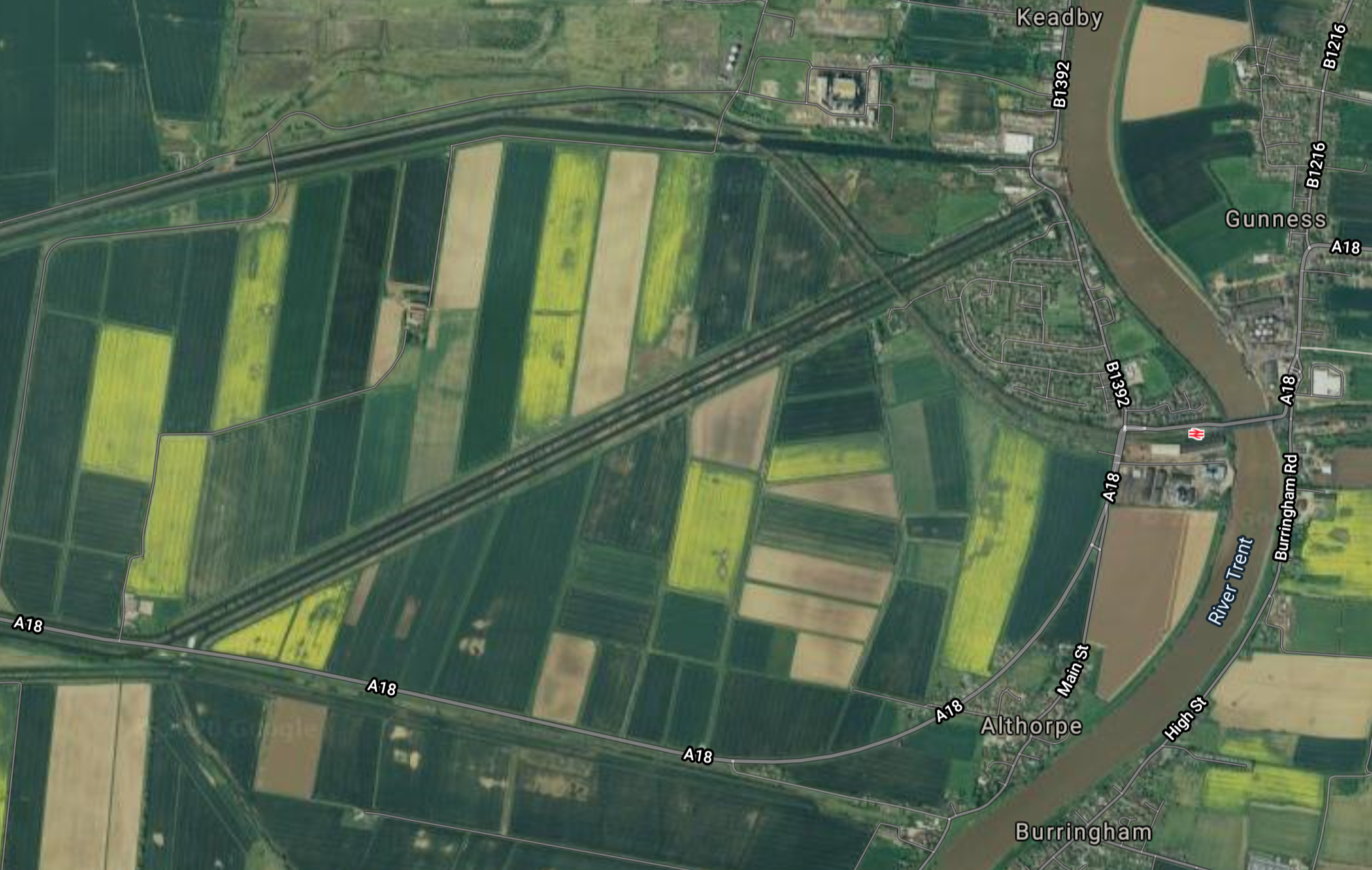
This Google Map shows the area of Keadby to the West of Scunthorpe.
Note.
- The River Trent meandering through the area.
- Althorpe station is in the bend of the River,
- I’m fairly certain, that I remember an old airfield in the area.
- Keadby power station is a bit to the North of the waterway running West from the River and close to where the railway crosses the waterway.
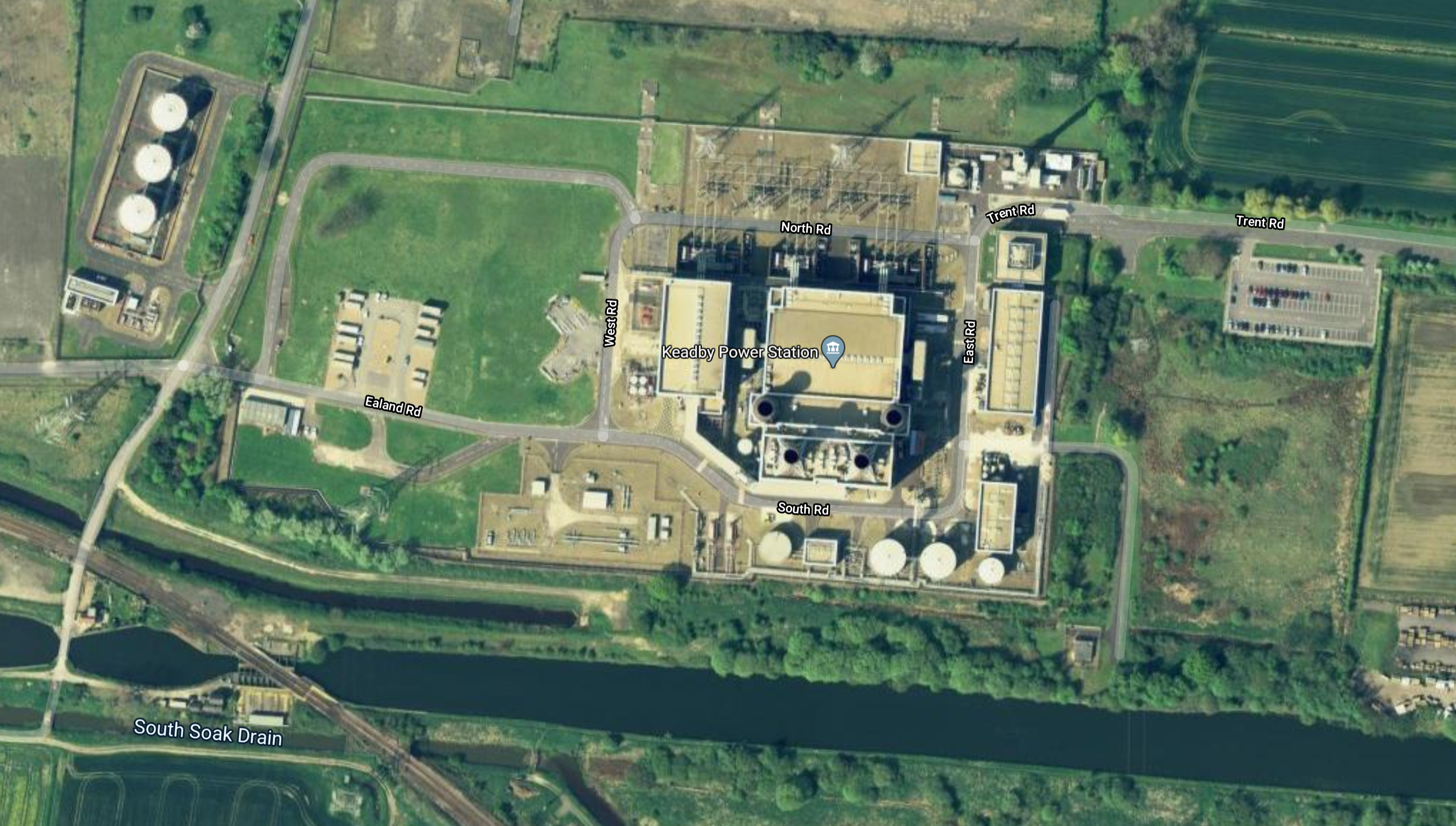
This second Google Map shows a close-up of the power station.
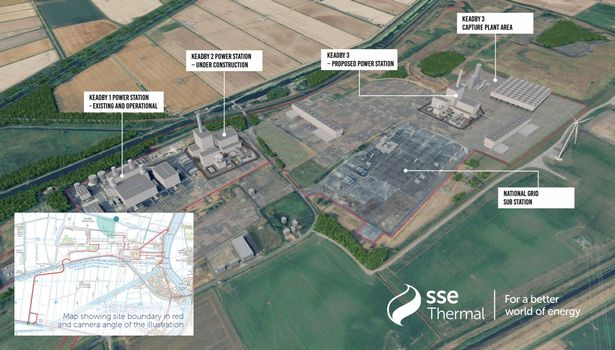
This visualisation from SSE Thermal shows how the site might look in the future.
For me the interesting location is the village of Althorpe, where C and myself had friends.
They were always getting tourists arriving in the village looking for Princess Diana’s grave!
Carbon Capture And Storage At Keadby
If SSE have three large power stations at Keadby, a shared carbon capture and storage system could be worthwhile.
- There are numerous gas fields in the area and a big gas terminal at Theddlethorpe, to where they all connect.
- I was surprised to see, that one of thee fields; Saltfleetby is owned by President Putin’s favourite gas company; Gazprom.
- Some of these fields are actually on-shore.
- The power stations probably get their gas from the same terminal.
Some of these gas fields that connect to Theddlethorpe could be suitable for storing the carbon dioxide.
As there is masses of space at Keadby, I can see more gas-fired power stations being built at Keadby.
All would feed into the same carbon capture and storage system.
If gas was needed to be imported in a liquified form, there is the Port of Immingham nearby.
Absorption Of Carbon Dioxide By Horticulture
Consider.
- Increasingly, horticulture is getting more automated and efficient.
- Automatic harvesters are being developed for crops like tomatoes and strawberries.
- Instead of storing the carbon-dioxide in worked-out gas fields, it can also be fed directly to fruit and vegetables that are being grown in greenhouses.
- Keadby is surrounded by the flat lands of Lincolnshire.
How long will it be before we see tomatoes, strawberries, peppers and cucumbers labelled as British zero-carbon products?
Offshore Hydrogen
I’ll repeat what I said in ITM Power and Ørsted: Wind Turbine Electrolyser Integration.
This is from a press release from ITM Power, which has the same title as the linked article.
This is the introductory paragraph.
ITM Power (AIM: ITM), the energy storage and clean fuel company, is pleased to share details of a short project sponsored by the Department for Business, Energy & Industrial Strategy (BEIS), in late 2019, entitled ‘Hydrogen supply competition’, ITM Power and Ørsted proposed the following: an electrolyser placed at the wind turbine e.g. in the tower or very near it, directly electrically connected to the DC link in the wind turbine, with appropriate power flow control and water supplied to it. This may represent a better design concept for bulk hydrogen production as opposed to, for instance, remotely located electrolysers at a terminal or platform, away from the wind turbine generator, due to reduced costs and energy losses.
Some points from the remainder of the press release.
- Costs can be saved as hydrogen pipes are more affordable than under-water power cables.
- The proposed design reduced the need for AC rectification.
After reading the press release, it sounds like the two companies are performing a serious re-think on how wind turbines and their links to get energy on-shore are designed.
- Will they be using redundant gas pipes to bring the hydrogen ashore?
- Will the hydrogen come ashore at Theddlethorpe and use the existing gas network to get to Keadby?
It sounds inefficient, but then the steelworks at Scunthorpe will probably want masses of hydrogen for carbon-free steel making and processing.
Boosting Power Station Efficiency
There is also a section in the Wikipedia entry for Combined Cycle Power Plant called Boosting Efficiency, where this is said.
The efficiency of CCGT and GT can be boosted by pre-cooling combustion air. This is practised in hot climates and also has the effect of increasing power output. This is achieved by evaporative cooling of water using a moist matrix placed in front of the turbine, or by using Ice storage air conditioning. The latter has the advantage of greater improvements due to the lower temperatures available. Furthermore, ice storage can be used as a means of load control or load shifting since ice can be made during periods of low power demand and, potentially in the future the anticipated high availability of other resources such as renewables during certain periods.
So is the location of the site by the Trent, important because of all that cold water?
Or will they use surplus power from the wind farm to create ice?
The Proposed North Sea Wind Power Hub
The North Sea Wind Power Hub is a proposed energy island complex on the Eastern part of the Dogger Bank.
- The Dutch, Germans and Danes are leading the project.
- Along with the Belgians, we have been asked to join.
- Some reporting on the Hub has shown, airstrips in the middle of the complex to bring the workforce to the site.
- A Dutch report, says that as much as 110 GW of wind power could be developed by 2050.
- We are also looking at installing wind farms on our section of the Dogger Bank.
Geography says, that one of the most convenient locations to bring all this electricity or hydrogen gas ashore is North Lincolnshire
A Very Large Battery
I would also put a very large battery on the site at Keadby.
One of Highview Power‘s proposed 1 GWh CRYOBatteries would be a good start. This will be four times the size of the 250 MWh CRYOBattery, which the company is currently designing and building at Carrington in Greater Manchester.
Conclusion
The three power stations at Keadby are the following sizes
- Keadby 1 – 734 MW
- Keadby 2 – 803.7 MW
- Keadby 3 – 010 MW
This adds up to a total of 2447.7 MW. And if they fit carbon capture and storage it will be zero-carbon.
Note.
- Hinckley Point C is only 3200 MW and will cost around £20 billion or £6.25 billion per GW.
- Keadby 2 power station is quoted as costing £350 million. or £0.44 billion per GW.
These figures don’t include the cost of carbon capture and storage, but they do show the relatively high cost of nuclear.
Two UK GDNs Considering New Fleet Of Zero-Emission Hydrogen Vehicles
This title of this post, is the same as that of this article on Hydrogen Fuel News.
This is the introductory paragraph.
Two UK gas distribution networks (GDNs) are investigating the potential of operating fleets of zero-emission hydrogen vehicles. The goal would be to use H2 fuel to shrink the carbon output from their fleet, aligning with the UK government’s Net Zero 2050 targets.
This surely is a good idea, as it says all the right things to their customers.
HyDeploy
I could have called this post; What Do You Do With Surplus Electricity?.
Believe it or not, one thing you can do is inject it into the gas main, by converting it into hydrogen first.
The Project
The concept is being tested in a project called HyDeploy at Keele University.
- The project has its own web site, from where I have obtained much of the information on this post.
- Keele University has its own gas network.
- Keele has a campus population similar to a small town.
- Keele University has a reputation for research excellence.
This paragraph outlines the project.
HyDeploy is a pioneering energy demonstration to establish the potential for blending hydrogen, up to 20%, into the normal gas supply so that we can reduce carbon dioxide (CO2) emissions.
A 10 month live demonstration of blended gas is taking place on part of the Keele gas network and will finish in August 2020.
HyDeploy will help to determine the level of hydrogen which can be used by customers safely and with no changes to their existing domestic appliances.
The HyDeploy project has been split into the following phases.
- Phase One will be live test using the Keele University gas network to learn about injecting hydrogen into a natural gas network.
- Phase Two will move to a larger demonstration on public network in the North East.
- Phase Three will be another large demonstration in the North West.
Once the evidence has been submitted to Government policy makers, we very much expect hydrogen to take its place alongside other forms of zero carbon energy in meeting the needs of the UK population.
The Electrolyser
ITM Power are providing the 0.5 MW electrolyser to turn electricity into hydrogen.
It’s only a small one, but this is about proving the technology.
Thoughts On Last Week’s Major Power Outage
This article on the BBC is entitled Major Power Failure Affects Homes And Transport.
This is the first two paragraphs.
Nearly a million people have been affected by a major power cut across large areas of England and Wales, affecting homes and transport networks.
National Grid said it was caused by issues with two power generators but the problem was now resolved.
This second article on the BBC is entitled UK power cut: Why it caused so much disruption, and gives these details.
It started with a routine blip – the gas-fired power station at Little Barford in Bedfordshire shut down at 16:58 BST due to a technical issue.
Then, a second power station, the new Hornsea offshore wind farm, also “lost load” – meaning the turbines were still moving, but power was not reaching the grid.
These are my thoughts on the incident.
Power Stations Do Fail
Any complex electro-mechanical system like Little Barford gas-fired power station or Hornsea offshore wind farm can fail.
- Little Barford gas-fired power station was built in 1994 and is a 746 MW gas-fired power station.
- Hornsea offshore wind farm obtained planning permission in 2014 and is being built in phases. It will eventually have a maximum capacity of 8 GW or 8,000 MW.
Compare these figures with the iconic coal-fired Battersea power station, which had a maximum output of 503 MW in 1955.
I will not speculate as to what wet wrong except to say that as the Hornsea wind-farm is relatively new, it could be what engineers call an infant mortality problem. Complex systems or even components seem to fail in the first few months of operation.
Why Do We Have Gas-Fired Stations?
According to this page on Wikipedia, there are around forty natural gas fired power stations in England.
Most gas-fired stations are what are known as CCGT (Combined Cycle Gas Turbine), where a Jumbo-sized gas-turbine engine is paired with a steam turbine powered by the heat of the exhaust from the engine.
This form of power generation does produce some carbon dioxide, but to obtain a given amount of electricity, it produces a lot less than using coal or ioil.
By combining the gas turbine with a steam turbine, the power station becomes more efficient and less carbon dioxide is produced.
Power stations of this type have three various advantages.
- They have a very fast start-up time, so are ideal power stations to respond to sudden increases in electricity demand.
- As they are a gas-turbine engine with extra gubbins, they are very controllable, just like their cousins on aircraft.
- They are relatively quick, easy and affordable to build. The Wikipedia entry for a CCGT says this. “The capital costs of combined cycle power is relatively low, at around $1000/kW, making it one of the cheapest types of generation to install.”
- They don’t need a complicated and expensive transport infrastructure to bring in coal or nuclear fuel.
- They can also be powered by biogas from agricultural or forestry waste, although I don’t think that is a comm practice in the UK.
The carbon dioxide produced is the only major problem.
Gas-Fired Power Stations In The Future
If you read the Wikipedia entry for combined cycle power plants, there is a lot of information on CCGTs, much of which is on various ways of improving their efficiency.
I believe that one particular method of increasing efficiency could be very applicable in the UK.
Under Boosting Efficiency in the Wikipedia entry, the following is said.
The efficiency of CCGT and GT can be boosted by pre-cooling combustion air. This is practised in hot climates and also has the effect of increasing power output. This is achieved by evaporative cooling of water using a moist matrix placed in front of the turbine, or by using Ice storage air conditioning. The latter has the advantage of greater improvements due to the lower temperatures available. Furthermore, ice storage can be used as a means of load control or load shifting since ice can be made during periods of low power demand and, potentially in the future the anticipated high availability of other resources such as renewables during certain periods.
The UK is the world’s largest generator of power using offshore wind and as we are surrounded with sea and wind, the UK is only going to produce more of the power it needs in this or other way.
This method could be used to store the wind energy produced when the demand is low and recover it, when it is needed.
Could The UK Develop A Chain Of Carbon-Neutral Gas-Fired Power Stations?
In parts of the UK, there is a unique mix of resources.
- A plentiful supply of natural gas, either from offshore fields or interconnectors to Norway.
- Large amounts of electricity generated by offshore wind, which will only get larger.
- Worked out gas-fields still connected to the shore, through redundant platforms and pipes.
- Closeness to agricultural areas.
Technologies under development or already working include.
- Offshore creation of hydrogen using electricity generated by offshore wind and then using the redundant gas pipes to bring the hydrogen to the shore.
- Using a hydrogen-fired CCGT power station without producing any carbon-dioxide.
- Feeding carbon dioxide to plants like salad and fruit to make them grow better.
- Using excess electricity from renewable sources to cool the air and improve the efficiency of CCGT power stations.
I can see all these technologies and development coming together in the next few years and a chain of carbon-neutral gas-fired power stations will be created
- Hydrogen produced offshore on redundant gas platforms, using electricity from nearby wind farms, will be turned back into electricity, where it is needed by onshore hydrogen-fired power stations.
- Redundant gas platforms will be refurbished and reused, rather than demolished at great expense.
- Some natural gas will still be used for power generation
- I’m not quite sure, but I think there could be dual-furled CCGTs, that could run on either hydrogen or natural gas.
- Any carbon dioxide generated will be stored in the worked out gas fields or fed to the crops.
- Gas storage onshore will ensure that the gas-fired power station can respond quickly.
I also believe that there is no technological and engineering challenges, that are too difficult to solve.
This strategy would have the following advantages.
- It should be carbon-neutral.
- Because there could have as many as two hundred individual power stations, the system would be very reliable and responsive to the loss of say a cluster of five stations, due to a tsunami, a volcanic eruption or a major eathquake.
- If power from renewable sources like offshore wind is low, extra stations can be quickly switched in.
- It is not dependent on fuel from dodgy dictators!
- It would probably be more affordable than developing nuclear power stations.
There is also the possibility of bringing more hydrogen onshore to be used in the decarbonisation of the gas-grid.
Conclusion
A chain of carbon-neutral gas-fired power stations, linked to hydrogen created offshore by wind farms is very feasible.
Last week, after the double failure, extra stations would have immediately been switched in.
Energy Storage
The fastest response system is energy storage, where a giant battery holds several gigawatt-hours of eklectricity.
Electric Mountain
The biggest energy storage facility in the UK is Dinorwig Power Station.
This is the introduction to its Wikipedia entry.
The Dinorwig Power Station , known locally as Electric Mountain, is a pumped-storage hydroelectric scheme, near Dinorwig, Llanberisin Snowdonia national park in Gwynedd, northern Wales. The scheme can supply a maximum power of 1,728-megawatt (2,317,000 hp) and has a storage capacity of around 9.1-gigawatt-hour (33 TJ)
It is large and has a rapid response, when more electricity is needed.
We probably need another three or four Electric Mountains, but our geography means we have few suitable sites for pumped-storage, especially in areas, where large quantities of electricity are needed.
There are one other pumped-storage system in Wales and two in Scotland, all of which are around 350 MW or a fifth the size of Electric Mountain.
In the Wikipedia entry entitled List Of Power Stations In Scotland, this is said.
SSE have proposed building two new pumped storage schemes in the Great Glen; 600 MW at Balmacaan above Loch Ness, and 600 MW at Coire Glas above Loch Lochy, at £800m. Scotland has a potential for around 500 GWh of pumped storage
I’m sure the Scots will find some way to fill this storage.
If all else fails, there’s always Icelink. This is the description from Wikipedia.
Icelink is a proposed electricity interconnector between Iceland and Great Britain. As of 2017, the project is still at the feasibility stage. According to current plans, IceLink may become operational in 2027.
At 1000–1200 km, the 1000 MW HVDC link would be the longest sub-sea power interconnector in the world.
The project partners are National Grid plc in the UK, and Landsvirkjun, the state-owned generator in Iceland, and Landsnet, the Icelandic Transmission System Operator (TSO)
Plugging it in to Scotland, rather than London, probably saves a bit of money!
Conclusion
Increasing our pumped-storage energy capacity is feasible and would help us to survive major power failures.
Batteries In Buildings
Tesla have a product called a Powerwall, which puts energy storage into a home or other building.
This was the first product of its kind and there will be many imitators.
The Powerwall 2 has a capacity of 13.5 kWh, which is puny compared to the 9.1 GWh or 9,100,000 kWh of Electric Mountain.
But only 674,074 batteries would need to be fitted in the UK to be able to store the same amount of electricity as Electric Mountain.
The big benefit of batteries in buildings is that they shift usage from the Peak times to overnight
So they will reduce domestic demand in the Peak.
Conclusion
Government should give incentives for people to add batteries to their houses and other buildings.
Could Hydrogen Work As Energy Storage?
Suppose you had a hydrogen-fired 500 MW hydrogen-fired CCGT with a hydrogen tank that was large enough to run it at full power for an hour.
That would be a 0.5 GWh storage battery with a discharge rate of 500 MW.
In an hour it would supply 500MWh or 500,000 kWh of electricity at full power.
In Hydrogen Economy on Wikipedia, this is said, about producing hydrogen by electroysis of water.
However, current best processes for water electrolysis have an effective electrical efficiency of 70-80%, so that producing 1 kg of hydrogen (which has a specific energy of 143 MJ/kg or about 40 kWh/kg) requires 50–55 kWh of electricity.
If I take the 40 KWh/Kg figure that means that to provide maximum power for an hour needs 12,500 Kg or 12.5 tonnes of hydrogen.
Under a pressure of 700 bar, hydrogen has a density of 42 Kg/cu. m., so 12.5 tonnes of hydrogen will occupy just under 300 cubic metres.
If I’ve got the figures right that could be a manageable amount of hydrogen.
Remember, I used to work in a hydrogen factory and I had the detailed guided tour. Technology may change in fifty years, but the properties of hydrogen haven’t!
Gas-Fired Versus Coal-Fired Power Stations
Consider.
- The problem of the carbon dioxide is easier with a gas-fired power station, than a coal-fired power station of the same generating capacity, as it will generate only about forty percent of carbon dioxide.
- Gas-fired power stations can be started up very quickly, whereas starting a coal-fired power station probably takes all day.
- Coal is much more difficult to handle than gas.
Using hydrogen is even better than using natural gas, as it’s zero-carbpn.
Conclusion
I believe we can use our unique geographic position and proven technology to increase the resilience of our power networks.
We need both more power stations and energy storage.
Cadent Launches Report Mapping Out Routes To Hydrogen Fuelled Vehicles On UK Roads
The title of this post is the same as that of this article on Gasworld.
This is the first paragraph.
A roadmap using hydrogen to decarbonise transport, particularly commercial transport, in the North West of the UK, has been unveiled by the country’s leading gas distribution network Cadent.
The article makes some points about hydrogen-powered transport.
- Using Cadent’s network to deliver hydrogen, rather than tube trailers, massively reduces the cost and makes fuel cell electric cars (FCEVs) available to the general public for around the same price as a battery electric vehicle or a conventional diesel car.
- FCEVs can travel further than battery electric vehicles and take the same time to refuel as a conventional petrol car.
- Grid-supplied hydrogen is the most cost-effective way of supplying hydrogen transport fuel at the required volume – up to six times cheaper than if delivered by trailer and 70 per cent cheaper than electrolysis.
Cadent‘s interest in all this, is not about selling gas, as their interest and income is totalling in transporting gas from producers to end users. So they don’t care whether they transport natural gas or hydrogen.
Hydrogen Storage
The article also discloses plans of INOVYN, a wholly owned subsidiary of INEOS, to develop a grid-scale hydrogen storage facility.
It will be in salt caverns in mid-Cheshire.
It will be able to hold 2,000 tonnes of hydrogen.
It is cheaper to store hydrogen in salt caverns, than on the surface.
The salt caverns have been used to store gas for decades.
This is a quote from the INOYN spokesman.
Storage is a vital component of delivering a viable hydrogen energy system in the UK.
I only had an indirect quick glimpse underground, when I worked at ICI in the area around 1970, but ICI’s salt expert, said they had enough salt in Cheshire to last 9,000 years at the current rate of extraction.
Salt in Cheshire, is a unique geological formation, that is very valuable to the UK and it looks like in the future, thar could enable hydrogen power.
Hydrogen Generation
The hydrogen will still need to be produced. Wikipedia has an entry caslled Hydrogran Production, which is fairly dismissive of electrolysis.
But in my view, hydrogen could be produced by electrolysis using wind power, as other methods like steam reforming of methane produce carbon-dioxide.
I particularly like the idea of building wind farms in clusters around offshore gas platforms, that have extracted all the gas from the fields, they were built to serve.
- Instead of running electricity cables to the wind farms, hydrogen is produced by electrolysis on the platform and this is transported to the shore using the same gas infrastructure, that brought the natural gas onshore.
- This could enable wind-farms to be developed much further offshore.
- If carbon capture is ever successfully made to work, the existing gas pipe could also be used to transfer the carbon dioxide offshore for storage in worked-out gas fields.
- The pipe between platform and shore could easily be made reversible, carrying hydrogen one way and carbon dioxide the other.
All of the technology required would also appear to be fully developed.
Conclusion
I am convinced that in the next few years, a hydrogen gas network can be created in parts of the UK.
The North West has advantages in becoming one of the first parts of the UK to have an extensive hydrogen network.
- It has the means to produce hydrogen gas.
- It has large wind farms in Liverpool Bay.
- There are worked-out gas fields, that might in the future be used for carbon storage.
- If INOVYN can store large quantities of hydrogen, this is a big advantage.
The biggest problem would be converting large numbers of houses and commercial premises from natural gas to hydrogen.
But, we’ve been through that process before, when we changed from town gas to natural gas in the 1960s and 1970s.
Should We Remove Gas From Our Houses?
I only use gas for heating.
- I feel that naked flames are not a good idea to have anywhere near people, as they can produce oxides of nitrgen, that causes health problems.
- Gas cookers are also a major cause of household fires.
- Technology is moving against cooking with gas, as more more to electric induction hobs.
- If you are fitting a new gas boiler, make sure it can be connected to hydrogen.
When I buy my next property, it will be all electric.
Writing On The Wall For Oil Say Funds
The title of this post is the same as that of an article on page 37 of today’s copy of The Times.
This is the first two paragraphs.
Several big fund managers believe that oil companies should shut themselves down because soon they will be impossible to invest in as the world switches to tenewable energy.
A survey of 39 fund managers with $10.2 trillion under manaement found that 24 per cent wanted the oil industry “to wind down their businesses and return cash to shareholders” All but two of the funds said that oil stocks would not be attrative investments within ten years if they failed to respond to climate risks.
It’s pretty strong stuff.
So could we see a reduction in the use of oil and gas as a fuel?
In some countries including Denmark, Iceland, the United Kingdom and the United States, renewable energy is growing at a good rate.
The UK did draw the full set, in being blessed with the full set of coal, oil, wind, wave and tidal. We also have a bit of geothermal, hydro and solar.
We will still extract coal, gas and oil, but not for fuel.
- Very high quality coal is needed for steel-making, where carbon-capture could be used.
- Gas and oil are used as chemical feedstock for plastics, everyday chemicals and pharmaceuticals.
Hydrogen gas, produced by electrolysis for use as fuel, a chemical feedstock and central heating.
Shell have already purchased First Energy, who are a domestic energy supplier in the UK, so are they getting out of oil?
Are fund managers and oil companies starting to go in the same direction, with a lot of the world’s drivers sticking slavishly to petrol and the dreaded diesel?
The Dutch Plan For Hydrogen
The Dutch Plan For Hydrogen
I have cut this out of The Train Station At The Northern End Of The Netherlands, so don’t read if if you’ve read it before.
Searching Google for hydrogen around Groningen, I found this document on the Internet, which is entitled Green Hydrogen Economy In The Northern Netherlands.
It is a fascinating read about what you can do with hydrogen generated from wind and biomass.
This is a sentence from the document.
Large scale green hydrogen product.ion together with harbor transport and storage facilities will be located at Eemshaven, with green chemicals production in Delfzijl
It is an ambitious statement.
Eemshaven
It also appears that Eemshaven will be the main connection point for electricity from offshore wind farms. This is said.
In the Eemshaven an offshore electricity cable from Norway, the NorNed cable with a capacity of 700 MW, comes on land. The Cobra cable, with a capacity of 700 MW, from Denmark is foreseen to connect at the Eemshaven to the onshore grid. The Gemini wind farm is connected to the grid in the Eemshaven with a capacity of 600 MW. Within 10 years it is foreseen that another 4.000 MW offshore wind will have their electricity cable to the Eemshaven.
Does all this explain, the building of a station at Eemshaven? Delfzijl station was built in 1883 and has its own connection to Groningen.
The following proposed actions are from the document
Build A 1,000 MW Electrolysis Plant
This is an extract from the of the document.
A 1.000 MW electrolysis plant that runs 8.000 hours a year, uses 8 billion kWh and 1,5 million m3 pure water to produce 160 million kg Hydrogen. A reverse osmosis plant has to produce the 1.5 million m3 pure water, using sea water or surface water as input. If an electricity price of 2‐2,5 €ct/kWh and a total investment between 500 million and 1 billion Euro with a 10 year life time is assumed, a green hydrogen cost price around 2‐3 €/kg will be the result. This is about competitive with present hydrogen prices, produced from natural gas by steam reforming.
How much energy is contained in a Kg of hydrogen?
This page on IdealHY says the following.
Hydrogen is an excellent energy carrier with respect to weight. 1 kg of hydrogen contains 33.33 kWh of usable energy, whereas petrol and diesel only hold about 12 kWh/kg.
At three euros for a kilogram of hydrogen, that works out at nine euro cents for a kWh.
Build A 1000 MW Biomass Gasification Plant
The title is a section in the document and this is an extract from the section.
Green hydrogen can be produced by electrolysis using green electricity, but can be produced also from biomass via gasification. Biomass gasifiers use solid biomass as an input and deliver a green syngas, a mixture of hydrogen, carbon‐monoxide (CO) and carbon‐dioxide (CO2), and char as an output. The CO could be used, together with water (H2O), to produce extra hydrogen. The resulting products from biomass gasification are green hydrogen and CO2. However, from CO2 and green hydrogen every chemical product could be produced. Therefore, the combination of green hydrogen and CO2 or green syngas creates the opportunity for a fully green chemical industry in the Northern Netherlands.
The process is still being developed. My first question, is can you use animal manure as a feedstock? It should be noted that The Netherlands used to have a very large and smelly manure problem.
Offshore Hydrogen Production From Far Offshore Wind Farms
The title is a section in the document and this is an extract from the section.
Offshore wind farms produce electricity which can be brought onshore via an electricity cable. Such an offshore electricity cable is expensive. The farther offshore the wind farm is located the more expensive the electricity cable cost. At the North Sea, an alternative solution for these wind farms is to convert the electricity into hydrogen at an existing oil/gas platform and to transport this hydrogen eventually mixed with gas via an existing gas pipeline. Onshore the hydrogen is separated from the natural gas and cleaned to be transported via pipeline, ship or truck to the markets.
I think that the technology and existing infrastructure could be made to work successfully.
- Europe has over fifty years experience of handling offshore gas networks.
- Recent developments have seen the emergence of floating wind turbines.
- Would it be easier to refurbish redundant gas platforms and use them to collect electricity and create hydrogen, rather than demolish them?
- Hydrogen is only produced when the wind blows.
- There is no need to store electricity and we’ve been storing gas since the Victorians.
There will be problems, like the integrity of an ageing pipeline, but I suspect that the expertise to solve them exists.
Will there be a North Sea, where every part has a large wind farm?
Note that the Hornsea Wind Farm has an area of 1830 square miles and could generate around 6 GW, when fully developed.You could fit 120 wind farms of this size into the North Sea. Even if only a small proportion could be developed, a sizeable amount of hydrogen could be produced.
A Market For 300,000‐tonnes Green Methanol + 300,000‐tonnes Green Ammonia
The title is a section in the document and this is an extract from the section.
Hydrogen (H2) and Carbon‐dioxide (CO2) can be used in chemical processes to produce a wide variety of chemical products. Two of the main building blocks in chemistry are methanol and ammonia. Methanol can be produced from H2 and CO2. Ammonia is produced from H2 and nitrogen (N2), captured from the air.
Wind power and biomass have been used tp create the basic chemicals for the petro-chemical industry.
The Construction Of Green Hydrogen Fuel Cell Balanced Data Centres
The title is a section in the document and this is an extract from the section.
Google builds a very large data center in the Eemshaven, see picture below. The reasons for Google to choose for the Eemshaven are the existence of an offshore data cable, enough space and green electricity. Google as well as other companies that install and operate data centers wants to run on green electricity. Therefore, Google has signed a power purchase agreement with Eneco to buy green electricity for 10 years. For this reason, Eneco builds an onshore wind farm nearby. On a yearly average this wind farm produces enough electricity to meet the data center demand.
However, supply and demand are not at every time in balance. At moments that there is no wind, other power plants must take over the electricity supply. Now, these are fossil fired power plants.In future, these power plants will be closed and supply and demand needs to be balanced in another way. And of course, that needs to be done with renewable electricity. This can be done by fuel cells fueled with green hydrogen. Fuel cells can follow demand and supply variations very fast with high efficiencies. Fuel cells are quiet and have no emissions, except very clean, demineralized, water.
I like this concept.
Surely, we could build a few data centres in places like Lincolnshire.
Build A Pipeline To Rotterdam And Germany
The Dutch have ambitious plans to export the hydrogen.
Other Ideas
The report is full of clever ideas and I suggest you take the time to read it fully!
Hydrogen Trains In The Northern Netherlands
The document says this about trains powered by hydrogen fuel cells.
In the Northern Netherlands, 50 diesel trains are daily operated on non‐electric lines. These trains, operated by ARRIVA have two or three carriages and a power of 450‐600KW supplied by Diesel‐Electric engines. Fuel cell‐electric hydrogen trains could replace these diesel trains. Alstom is a company that builds these fuel cell hydrogen trains and will perform a test next year on the line Groningen‐Bremen. Because the depreciation time for trains is 25 years, not all trains will be bought new. Some trains may need to be retrofitted with fuel cell‐electric power supply, which is technically feasible. When all these 50 diesel trains are replaced an investment in new and retrofitted trains of about …? Million Euros is needed. The total hydrogen consumption of these trains is about 5,000 ton.
These points are shown in a table.
- Total (diesel) trains in the Northern Netherlands is 50 units
- Hydrogen consumption approximately 25 kg H2/100km
- Train operations average 6 days per week. Train is operated approximately 1.200 km per day, based on two times per hour per trajectory of 50km.
- Train operations average 6 days per week. 330 days per year.
- Capital expenditure per train approximately …. ? 50 Units …? Million Euro
- 50,000 tonnes of hydrogen will be needed.
- The fuel bill at three euros a Kg will be 150 million euro.
Would this be economic?
From various comments, I suspect that Stadler are working on a hydrogen-powered GTW.
But failing that, as Stadler are developing a diesel/electric/battery Flirt for the South Wales Metro and some of the routes from Groningen are only about 30 km, I wouldn’t be surprised to see diesel/electric/battery GTWs running across the flat lands of the North.
Battery trains could be fitted with pantographs and recharge in Groningen, where most of the platforms are electrified.
There are a lot of possibilities and engineers will come up with the best solution with regards to operation and economics.
Conclusion
Thr Dutch have big plans for a hydrogen-based economy in the North of the Netherlands.
Where is the UK Government’s master plan for hydrogen?
Funding Nemo: £600m Power Cable Connects UK And Belgium
The title of this post is the same as this article in The Guardian.
This is the first paragraph.
A £600m cable connecting the UK and Belgium’s energy systems is about to be switched on, becoming the first of a new generation of interconnectors that will deepen the UK’s ties to mainland Europe just as it prepares to leave the EU.
It runs between Richborough in Kent and Zeebrugge in Belgium and is the fifth interconnector to be connected to Great Britain.
Other interconnectors connect to Ireland, Northern Ireland, France and the Netherlands.
In Large Scale Electricity Interconnection, I discuss the rest of the interconnectors, that are being constructed or planned.
We could see up to fifteen in operation in a few years.
As to Nemo, it was originally thought that the UK would be importing energy from Belgium, but as Belgium needs to service its nuclear power stations and will be shutting them in the next few years, the power will sometimes be flowing the other way. Especially, as more large wind farms come on stream in the UK!
It is my view that Icelink could change everything and Belgium’s possible future power shortage, makes Icelink far more likely.
Wikipedia describes the interconnector between Iceland and Scotland like this.
At 1000–1200 km, the 1000 MW HVDC link would be the longest sub-sea power interconnector in the world.
As more interconnectors are built between the UK and the Continent, including a possible link between Peterhead in North-East Scotland to Stavanger in Norway, which is called NorthConnect, the UK will begin to look like a giant electricity sub-station, that connects all the zero-carbon power sources together.
- Denmark will supply wind power.
- France will supply nuclear power.
- Iceland will supply hydro-electric and geothermal power.
- Norway will supply hydro-electric power.
- The UK will supply nuclear and wind power.
Other sources like wind power from France and Ireland and tidal and wave power from the UK could be added to the mix in the next decade.
The Consequences For Gas
Our use of gas to generate electricity in Western Europe will surely decline.
If projects, like those I discussed in Can Abandoned Mines Heat Our Future?, come on stream to provide heat, the role of gas in providing heating in housing and other buildings will decline in the UK.
We also shouldn’t forget the role of hydrogen, which could also replace natural gas in many applications. It would be created by electrolysis of water or as a by-product of some industrial processes.
Hydrogen could also become a valuable way of storing excess electricity produced by tidal, wave and wind power.
It is unlikely, we will develop a totally gas-free economy, as methane is a valuable chemical feedstock to produce other chemical products we need.
Conclusion
Not many people will be sorry, except for President Putin and a few equally nasty despots in the Middle East.
Spark Energy Supply Ceases Trading
The title of this post, is the same as that of this article on the BBC.
The important thing in the BBC’s post is this section.
Ovo Energy has confirmed it has entered into a conditional agreement to buy the company and take on its customers.
Ofgem said the energy supply for Spark’s 290,000 customers would continue as normal.
It advised customers to take meter readings, and said outstanding credit balances would be protected.
It appears that the safety-net is working.
Incidentally, I am a customer of OVO and I have had no problems, except with getting my smart meter installed.
I also have several friends, who chose OVO independently of me, who don’t seem to be having problems.
So hopefully, Spark Energy Supply’s customers will be looked after professionally.
Conclusion
My advice to anybody affected by the failure of Spark Energy or any other energy company, is make sure you have all your information with the meter numbers together.
Then sit tight for a few weeks and see how it all goes, before choosing a new supplier if you feel you need one.
It might also be a good idea to listen to Paul Lewis on Radio 4’s Moneybox today.
 The Anonymous Widower