Is Carbon Dioxide Not Totally Bad?
To listen to some environmentalists, there views on carbon dioxide are a bit like a variant of George Orwell’s famous phrase Four legs good, two legs bad from Animal Farm, with carbon dioxide the villain of the piece.
I have just read the Wikipedia entry for carbon dioxide.
For a start, we mustn’t forget how carbon dioxide, water and sunlight is converted by photosynthesis in plants and algae to carbohydrates, with oxygen given off as waste. Animals like us then breathe the oxygen in and breathe carbon dioxide out.
Various web sites give the following information.
- The average human breathes out 2.3 pounds of carbon dioxide per day.
- As of 2020, the world population was 7.8 billion.
This means humans breathe out 17.94 billion pounds of CO2 per day
This equates to 6548.1 billion pounds per year or 2.97 billion tonnes per year.
And I haven’t counted all the other animals like buffalo, cattle, elephants and rhinos, to name just a few large ones.
Wikipedia also lists some of the Applications of carbon dioxide.
- Precursor To Chemicals – Carbon dioxide can be one of the base chemicals used to make other important chemicals like urea and methanol.
- Foods – Carbon dioxide has applications in the food industry.
- Beverages – Carbon dioxide is the fizz in fizzy drinks.
- Winemaking – Carbon dioxide has specialist uses in winemaking.
- Stunning Animals – Carbon dioxide can be used to ‘stun’ animals before slaughter.
- Inert Gas – carbon dioxide has several uses, as it is an inert gas.
- Fire Extinguisher – Carbon dioxide is regularly used in fire extinguishers and fire protection systems.
- Bio Transformation Into Fuel – It has been proposed to convert carbon dioxide from power stations into biodiesel using a route based on algae.
- Refrigerant – Carbon dioxide can be used as a refrigerant. It was used before CFCs were developed and I know of a large Victorian refrigeration system on a farm in Suffolk, used on a store for apples, that still is in regular use that uses carbon dioxide.
- Dry Ice – The solid form of carbon dioxide has lots of applications, where cooling is needed.
Other important applications are under development.
- Agriculture – Carbon dioxide is piped to greenhouses to promote growth of crops. It is also used at higher concentrations to eliminate pests.
- Low Carbon Building Products – Companies like Mineral Carbonation International are developing ways of creating building products from carbon dioxide.
- Synthetic Rubber – Research is ongoing to create replacements for synthetic rubber.
I can only assume, that the demand for gaseous carbon dioxide will increase, as scientists and engineers get more innovative about using the gas.
Solving A Shortage Of Carbon Dioxide
At the present time, there is shortage of carbon dioxide, that I wrote about in Food Shortages Looming After Factory Closures Hit Production.
In the related post, I said this.
Perhaps we should fit carbon capture to a handy gas-fired power station, like SSE are planning to do at Keadby and use this carbon dioxide.
Consider.
- The Keadby complex of gas-fired power stations is close to a lot of depleted gas fields, some of which are in Lincolnshire and some are off-shore.
- Some gas fields are already being used to store natural gas imported from Norway.
- SSE plan to fit the later power stations with carbon capture.
I talk about SSE’s plans in Energy In North-East Lincolnshire.
If SSE were to build four large gas-fired power stations at Keadby, I calculated that they would produce 5.4 million tonnes of carbon dioxide per year.
It could be used or stored in depleted gas fields according to demand.
But the complex at Keadby would not release any carbon emissions.
Could Carbon Capture Be A Nice Little Earner?
If demand for carbon dioxide continues to rise, I could see power companies installing carbon capture on gas-fired power stations to generate an extra income stream.
Incidentally, there are 55 operational gas-fired power stations in the UK, that can generate a total of 30 GW, which are owned by perhaps ten different companies.
Development of carbon capture systems could be helped by Government subsidy.
Conclusion
I have long forgotten all the calculations I did with gases, but I do know that when one molecule of methane combusts it produces two molecules of water and one of carbon dioxide.
So I am fairly convinced that if you took X cubic kilometres of natural gas out of a gas field, after combustion there wouldn’t be anything like as much volume of carbon dioxide to put back, specially if a proportion could be used profitably in other processes.
If we are going to use gas to generate zero-carbon power, we probably need to do it with gas fields under our control either onshore or in the seas around our coasts. This is because the depleted gas fields can be used to store the carbon.
Gas-fired power stations with carbon capture supporting industries that need supplies of carbon dioxide will become a large part of our energy economy.
Food Shortages Looming After Factory Closures Hit Production
The title of this post, is the same as that of this article on The Times.
This is the first paragraph.
Acute food shortages were feared last night after high gas prices forced most of Britain’s commercial production of carbon dioxide to shut down.
In some ways, this is rather ironic, when on the one hand we are trying to stop the emission of carbon dioxide and on the other we haven’t got enough for important uses in the food industry.
Perhaps we should fit carbon capture to a handy gas-fired power station, like SSE are planning to do at Keadby and use this carbon dioxide.
If the shortage continues, there’ll be no dry ice for the pantomimes this Christmas.
Rye House Power Station
Rye House power station is gas-fired and I took these pictures as I passed today.





The 715 MW power station is nearly thirty years old and it will be interesting how it is replaced.
Do BP And The Germans Have A Cunning Plan For European Energy Domination?
The headline of this post may be slightly tongue in cheek, but I believe that a plan is being hatched.
Preamble
I’ll start with a preamble, where I’ll outline some of the factors behind what may be happening.
Decarbonisation
It is generally accepted by most people that there is a need to decarbonise everything we do.
And large oil companies like Shell, BP and others are starting to move in the same direction.
Hydrogen
Using hydrogen instead of fossil fuels is becoming one of the major routes to decarbonisation.
Hydrogen can be used for the following.
- Provide power for cars, buses, trucks, trains, locomotives and ships.
- Hydrogen can be used in steelmaking instead of coking coal.
- As a chemical feedstock to make ammonia, fertiliser and a large range of petrochemicals.
- I believe that hydrogen could be a viable fuel to power aircraft over thousands of miles.
Hydrogen will become the most common zero-carbon fuel.
Hydrogen And Natural Gas
In many applications hydrogen can replace natural gas, so for large users of natural gas, hydrogen offers a route to decarbonisation.
But hydrogen can also be mixed up to a level of around twenty percent in natural gas for partial decarbonisation of applications like space heating. Most industrial uses, boilers and appliances can be made to work very successfully with this mixture.
I grew up in the 1950s with coal gas, which according to Wikipedia had this composition.
- hydrogen 50%
- methane 35%
- carbon monoxide 10%
- ethylene 5%
- When we changed over in the 1970s, all my appliances were converted.
This is the UK government description of natural gas.
It contains primarily methane, along with small amounts of ethane, butane, pentane, and propane. Natural gas does not contain carbon monoxide. The by-products of burning natural gas are primarily carbon dioxide and water vapour. Natural gas is colourless, tasteless and odourless.
As with the conversion from coal-gas to natural gas, conversion from Natural gas to a hydrogen/natural gas mixture and eventually to hydrogen, will be a relatively painless process.
Note that carbon monoxide is a nasty poison and is not contained in either natural gas or hydrogen.
Green Hydrogen And Electrolysis Of Water
Green hydrogen is hydrogen produced exclusively from renewable energy sources.
Typically green hydrogen is produced by electrolysis of water using electricity produced by hydro, solar, tidal or wind.
The largest factory building electrolysers is owned by ITM Power.
- It is located in Rotherham.
- The factory has the capacity to build 1 GW of electrolysers in a year.
- Typical electrolysers have a capacity of several MW.
Ryze Hydrogen are building an electrolyser at Herne Bay, that will consume 23 MW of solar and wind power and produce ten tonnes of hydrogen per day.
Blue Hydrogen
‘Blue hydrogen is produced through a production process where carbon dioxide is also produced then subsequently captured via carbon capture and storage. In many cases the carbon dioxide is stored in depleted gas fields, of which we have plenty in the North Sea. Over the last few years, research has been ongoing into using the carbon dioxide. Applications in horticulture and agriculture, carbon structures and sustainable aviation fuel are being developed.
Shell have also developed the Shell Blue Hydrogen Process, where the carbon is extracted from methane as carbon dioxide and then stored or used.
CO2 In Greenhouse Horticulture
This paper from The Netherlands is called CO2 In Greenhouse Horticulture.
Read it and you might believe me, when I say, we’ll eat a lot of carbon in the form of tomatoes, salads and soft fruit. We’ll also buy flowers grown in a carbon-dioxide rich atmosphere.
Hydrogen As An Energy Transfer Medium
Every kilogram of natural gas when it burns releases energy, as it does in your boiler or gas hob. So it transfers energy in the form of gas from the gas well or storage tank to your house.
Electricity can also be transferred from the power station to your house using wires instead of pipes.
Hydrogen is being put forward as a means of transferring energy over hundreds of miles.
- Electricity is converted to hydrogen, probably using an electrolyser, which would be powered by zero-carbon electricity.
- The hydrogen is transferred using a steel pipe.
- At the destination, the hydrogen is either distributed to end-users, stored or used in a gas-fired power station, that has been modified to run on hydrogen, to generate electricity.
It sounds inefficient, but it has advantages.
- Long underwater cables have energy losses.
- Electrical connections use a lot of expensive copper.
- Re-use of existing gas pipes is possible.
- Oil and gas companies like BP and their contractors have been laying gas pipes on land and under water for decades.
If hydrogen has a problem as an energy transfer medium, it is that it us difficult to liquify, as this statement from Air Liquide illustrates.
Hydrogen turns into a liquid when it is cooled to a temperature below -252,87 °C. At -252.87°C and 1.013 bar, liquid hydrogen has a density of close to 71 kg/m3. At this pressure, 5 kg of hydrogen can be stored in a 75-liter tank.
To transport, larger quantities of hydrogen by ship, it is probably better to convert the hydrogen into ammonia, which is much easier to handle.
The Germans and others are experimenting with using liquid ammonia to power large ships.
Hydrogen As An Energy Storage Medium
The UK has a comprehensive National Transmission System for natural gas with large amounts of different types of storage.
This section of the Wikipedia entry is entitled Natural Gas Storage and lists ten large storage facilities in salt caverns and depleted onshore gas fields. In addition, several depleted offshore gas fields have been proposed for the storage of natural gas. Rough was used successfully for some years.
I can certainly see a network of hydrogen storage sites being developed both onshore and offshore around the UK.
Iceland
With its large amount of hydro-electric and geothermal energy, Iceland can generate much more electricity, than it needs and has been looking to export it.
The UK is probably the only country close enough to be connected to Iceland to buy some of the country’s surplus electricity.
There has been a proposal called Icelink, that would build an electrical interconnector with a capacity of around a GW between Iceland at the UK.
But the project seems to have stalled since I first heard about it on my trip to Iceland in 2014.
Could the engineering problems just be too difficult?
The Waters Around The Northern Parts Of Great Britain
Look at a map of the UK and particularly Great Britain and there is a massive area of water, which is not short of wind.
Between Norway, Denmark, Germany, The Netherlands, the East Coast of England, the Northern Coasts of Scotland and Iceland, there are only a few islands.
- Faroes
- Orkney
- Shetlands
To be complete we probably must include hundreds of oil and gas rigs and platforms and the Dogger Bank.
- Oil and gas companies probably know most there is to know about these waters.
- Gas pipelines connect the production platforms to terminals at Sullom Voe and along the East Coast from St. Fergus near Aberdeen to Bacton in Norfolk.
- Many of the oil and gas fields are coming to the end of their working lives.
I believe that all this infrastructure could be repurposed to support the offshore wind industry.
The Dutch Are Invading The Dogger Bank
The Dogger Bank sits in the middle of the North Sea.
- It is roughly equidistant from Norway, Denmark, the Netherlands and the UK.
- The Western part is in UK territorial waters.
- The Eastern part is mainly in Dutch territorial waters.
On the UK part, the Dogger Bank Wind Farm is being developed.
- The turbines will be between 78 and 180 miles from the shore.
- It could have a capacity of up to 5 GW.
- It would be connected to East Yorkshire or Teesside.
On their side of the Dogger Bank, the Dutch are proposing the North Sea Wind Power Hub.
- It is a collaboration between the Dutch, Germans, and Danes.
- There have been reports, that up to 110 GW of turbines could be installed.
- It will be connected to the Dogger Bank Wind Farm, as well as The Netherlands.
It is also planned that the connections to the Dogger Bank will create another interconnector between the UK and the Continent.
The Shetland Islands
The Shetland Islands are the only natural islands with a large oil and gas infrastructure in the waters to the North of Great Britain.
They have a large gas and oil terminal at Sullom Voe.
- Oil is transported to the terminal by pipelines and tanker.
- Oil is exported by tanker.
- Gas is imported from oil and gas fields to the West of the islands through the West of Shetland Pipeline.
- The gas-fired Sullom Voe power station provide about 80 MW of power to the islands.
This document on the APSE web site is entitled Future Hydrogen Production In Shetland.
It describes how the Shetland Islands can decarbonise and reposition themselves in the energy industry to be a major producer of hydrogen.
It gives these two facts about carbon emissions in the Shetlands Islands and Scotland.
- Annual per capita CO2 emissions in the Shetland Islands are 17 tonnes.
- In Scotland they are just 5.3 tonnes.
By comparison, the UK average is 5.55 and Qatar is 37.29.
Currently, the annual local market for road, marine and domestic fuel calculated
at around £50 million.
These are the objectives of the Shetland’s plan for future hydrogen production.
- Supply 32TWh of low carbon hydrogen annually, 12% of the expected UK total requirement, by 2050
- Provide more than 3GW of wind generated electrical power to Shetland, the UK grid, generating green hydrogen and electrification of the offshore oil and gas sector
- Enable all West of Shetland hydrocarbon assets to be net zero by 2030 and abate 8Mt/year CO2 by 2050
- Generate £5bn in annual revenue by 2050 and contribute significantly to the UK Exchequer.
They also envisage removing the topsides of platforms, during decommissioning of mature East of Shetland
oil fields and repurposing them for hydrogen production using offshore wind.
That is certainly a powerful set of ambitions.
This diagram from the report shows the flow of electricity and hydrogen around the islands, terminals and platforms.
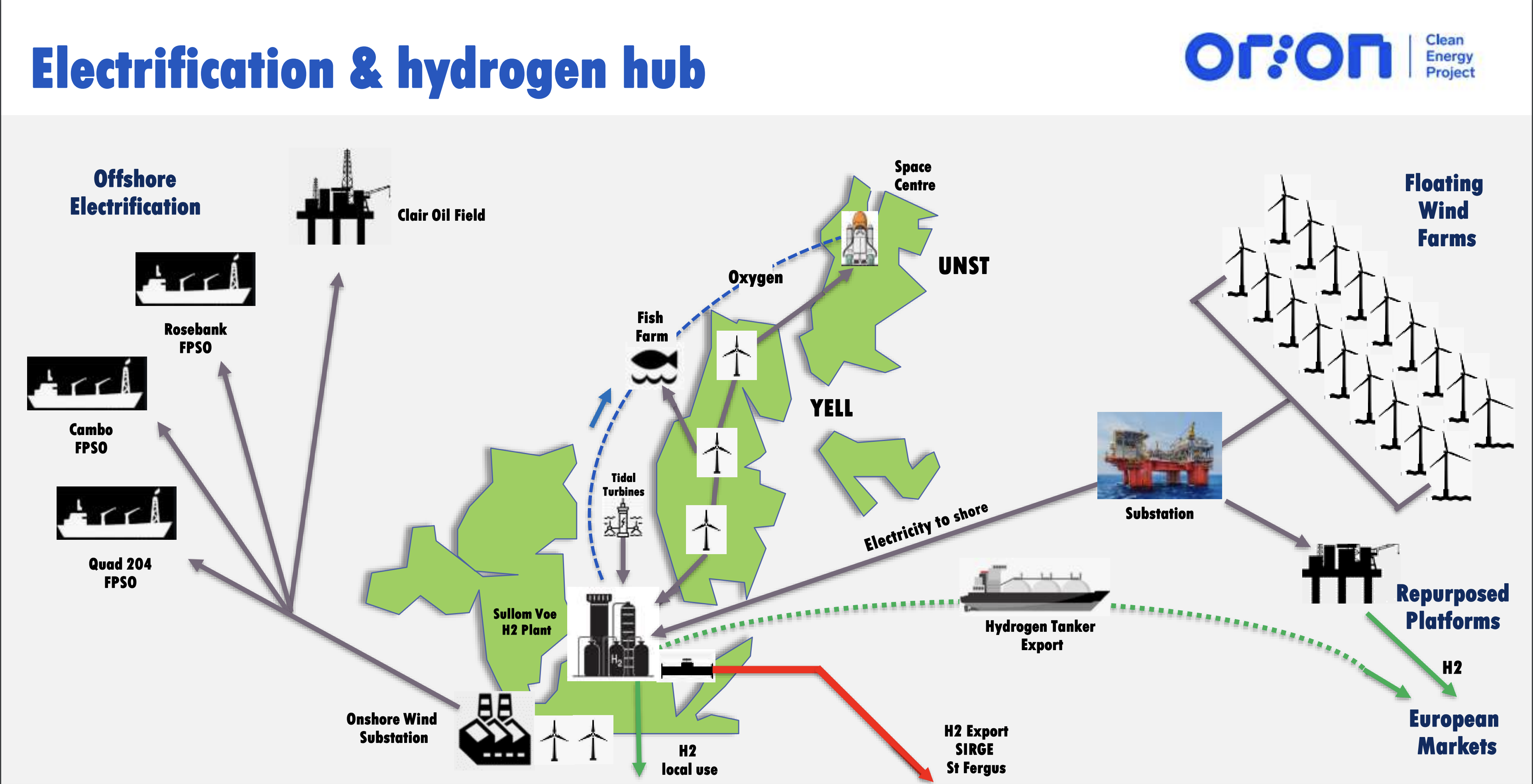
Note these points about what the Shetlanders call the Orion Project.
- Offshore installations are electrified.
- There are wind turbines on the islands
- Hydrogen is provided for local energy uses like transport and shipping.
- Oxygen is provided for the fish farms and a future space centre.
- There is tidal power between the islands.
- There are armadas of floating wind turbines to the East of the islands.
- Repurposed oil platforms are used to generate hydrogen.
- Hydrogen can be exported by pipeline to St. Fergus near Aberdeen, which is a distance of about 200 miles.
- Hydrogen can be exported by pipeline to Rotterdam, which is a distance of about 600 miles.
- Hydrogen can be exported by tanker to Rotterdam and other parts of Europe.
It looks a very comprehensive plan!
The German Problem
Germany has an energy problem.
- It is a large energy user.
- It has the largest production of steel in Europe.
- It prematurely shut some nuclear power stations.
- About a quarter of electricity in Germany comes from coal. In the UK it’s just 1.2 %.
- It is very reliant on Russian natural gas.
- The country also has a strong Green Party.
- Germany needs a lot more energy to replace coal and the remaining nuclear.
- It also needs a lot of hydrogen to decarbonise the steel and other industries.
Over the last few months, I’ve written these articles.
- Sale To Linde Of World’s Largest PEM Electrolyser
- Uniper To Make Wilhelmshaven German Hub For Green Hydrogen; Green Ammonia Import Terminal
- WindH2 Hydrogen Project Commissioned In Germany
- Morocco Could Produce Up To 4% Of World’s Green Hydrogen By 2030
- Get H2 Partners Propose Green Hydrogen Pipeline In Europe
- Alstom Hydrogen Trains Complete Trials
Germany seems to have these main objectives.
- Increase their supply of energy.
- Ensure a plentiful supply of hydrogen.
They appear to be going about them with a degree of enthusiasm.
BP’s Ambition To Be Net Zero By 2050
This press release from BP is entitled BP Sets Ambition For Net Zero By 2050, Fundamentally Changing Organisation To Deliver.
This is the introductory paragraph.
BP today set a new ambition to become a net zero company by 2050 or sooner, and to help the world get to net zero. The ambition is supported by ten aims
The ten aims are divided into two groups.
Five Aims To Get BP To Net Zero
These are.
- Net zero across BP’s operations on an absolute basis by 2050 or sooner.
- Net zero on carbon in BP’s oil and gas production on an absolute basis by 2050 or sooner.
- 50% cut in the carbon intensity of products BP sells by 2050 or sooner.
- Install methane measurement at all BP’s major oil and gas processing sites by 2023 and reduce methane intensity of operations by 50%.
- Increase the proportion of investment into non-oil and gas businesses over time.
I would assume that by gas, they mean natural gas.
Five Aims To Help The World Get To Net Zero
These are.
- More active advocacy for policies that support net zero, including carbon pricing.
- Further incentivise BP’s workforce to deliver aims and mobilise them to advocate for net zero.
- Set new expectations for relationships with trade associations.
- Aim to be recognised as a leader for transparency of reporting, including supporting the recommendations of the TCFD.
- Launch a new team to help countries, cities and large companies decarbonise.
This all does sound like a very sensible policy.
BP’s Partnership With EnBW
BP seemed to have formed a partnership with EnBW to develop offshore wind farms in the UK
Their first investment is described in this press release from BP, which is entitled BP Advances Offshore Wind Growth Strategy; Enters World-Class UK Sector With 3GW Of Advantaged Leases In Irish Sea.
This is the first five paragraphs.
bp and partner EnBW selected as preferred bidder for two highly-advantaged 60-year leases in UK’s first offshore wind leasing round in a decade.
Advantaged leases due to distance from shore, lower grid cost, synergies from scale, and faster cycle time.
Projects expected to meet bp’s 8-10% returns aim, delivering attractive and stable returns and integrating with trading, mobility, and other opportunities.
Annual payments expected for four years before final investment decisions and assets planned to be operational in seven years.
In the past six months bp has entered offshore wind in the UK – the world’s largest market – and the US – the world’s fastest-growing market.
Note.
- EnBW are Energie Baden-Wuerttemberg AG, who, according to Wikipedia, are the third largest utilities company in Germany.
- It also appears, that EnBW have developed wind farms.
BP have issued this infographic with the press release.
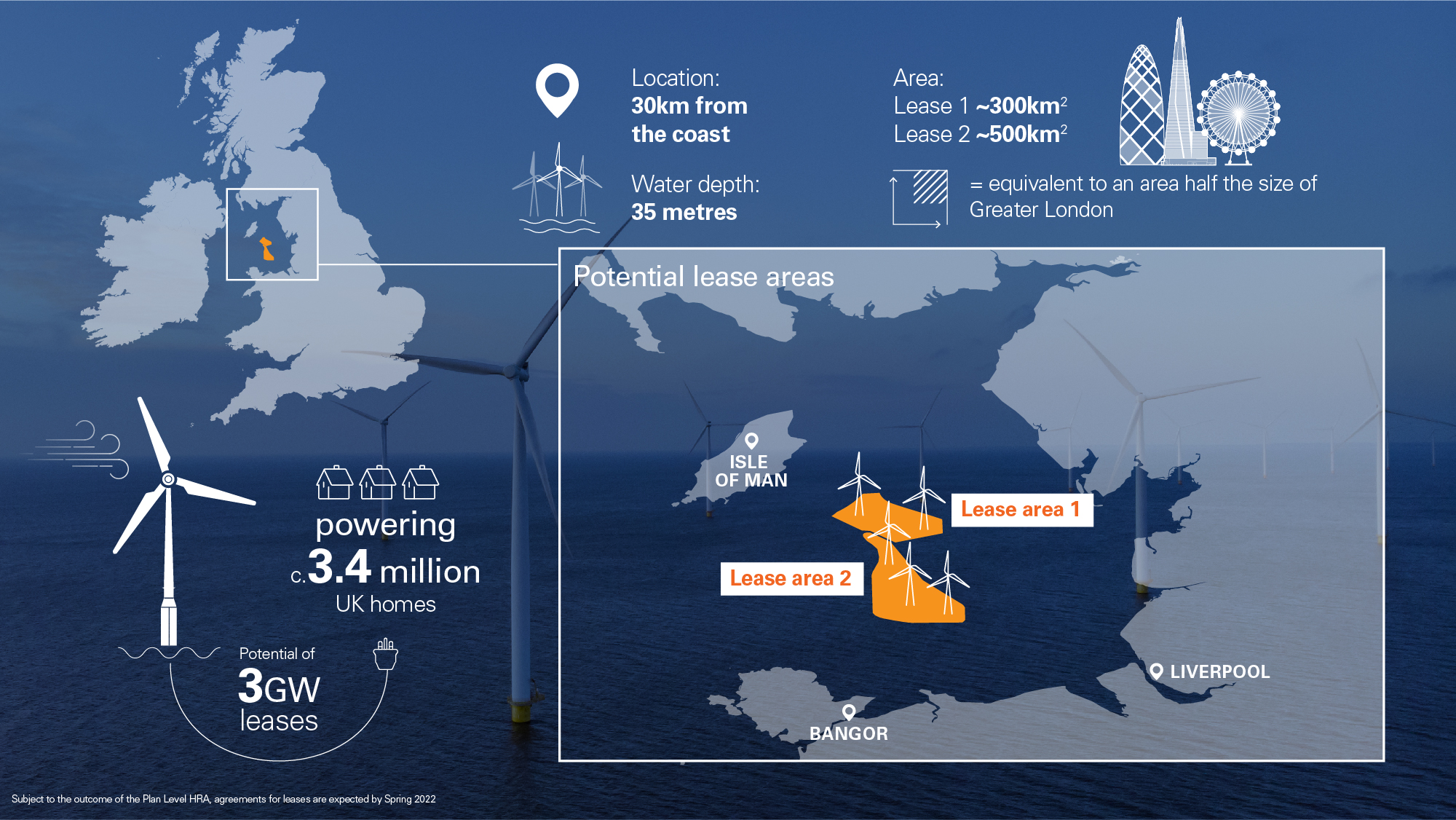
Note.
- The lease areas don’t appear to be far from the Morecambe Bay gas field.
- The Morecambe Bay gas field is coming to the end of its life.
- The Morecambe Bay gas field is connected to the Rampside gas terminal at Barrow-in-Furness.
- At peak production 15 % of the UK’s natural gas came from Morecambe Bay.
I just wonder, if there is a cunning plan.
Could the platforms be repurposed to act as electrical hubs for the wind turbines?
- 3GW of electricity would produce 55 tonnes of hydrogen per day.
- The hydrogen would be exported to the Rampside gas terminal using the existing pipelines.
- There may be savings to be made, as HVDC links are expensive.
- BP either has the engineering to convert the platforms or they know someone who does.
- Would the industrial complex at Barrow-in-Furnace and the nearby Sellafield complex have a use for all that hydrogen?
- Or would the hydrogen be used to fuel Lancashire’s buses and trucks on the M6.
It certainly looks to me, that it could be a possibility, to bring the energy ashore as hydrogen.
BP Seeking Second Wind Off Scotland
The title of this section, is the same as that of this article in The Times.
These are the first two paragraphs.
BP is preparing to bid for the rights to build wind farms off Scotland as it signals no let-up in expansion after a £900 million splurge on leases in the Irish Sea.
The London-based oil giant caused waves in February by offering record prices to enter the UK offshore wind market through a Crown Estate auction of seabed leases off England and Wales.
As I said earlier.
- The Shetland Islands are developing themselves as a giant hydrogen factory.
- There are pipelines connecting platforms to the Sullom Voe Terminal.
- There are plans to convert some of the redundant platforms into hydrogen production platforms.
- The islands will be developing ways to export the hydrogen to the South and Europe.
BP also operates the Schiehallion oil and gas field to the West of the Shetlands, which is connected to the Sullom Voe Terminal by the West of Shetland pipeline.
Could BP and EnBW be coming to the party?
They certainly won’t be arriving empty-handed.
Does BP Have Access To Storage Technology?
I ask this question because both the Morecambe Bay and Shetland leases could be built with co-located depleted gas fields and offshore electrolysers.
So could hydrogen gas be stored in the gas fields?
I think it could be a possibility and would mean that hydrogen would always be available.
Could Iceland Be Connected To Schiehallion Via A Gas Pipeline?
I estimate that Iceland and Schiehallion would be about six hundred miles.
This wouldn’t be the longest undersea gas pipeline in the world as these two are longer.
- Langeled – 725 miles
- Nord Stream – 759 miles
The Langeled pipeline cost £1.7 billion.
Conclusion
I think there’s more to the link-up between BP and EnBW.
I am fairly certain, that BP are thinking about converting some redundant gas platforms into hubs for wind turbines, which use the electricity to create hydrogen, which is then exported to the shore using existing gas pipelines and onshore terminals.
Could it be said, that BP will be recycling oil and gas platforms?
I feel that the answer is yes! Or at least maybe!
The answer my friend is blowing in the wind!
Australia’s First Net-Zero Hybrid Power Station Gets The Green Light
The title of this post, is the same as that of this article on the Australian Broadcasting Company.
This is the first paragraph.
Australia’s first power plant — capable of running on both hydrogen and natural gas — will be built in NSW, following an agreement between the private sector and both state and federal governments.
The article also makes these key points.
- The gas power plant could begin using green hydrogen as early as 2025.
- EnergyAustralia plans to buy 200,000kg of green hydrogen a year — equivalent to five per cent of the plant’s fuel use.
- The Illawarra project is expected to deliver a $300-million boost to the economy and support about 250 jobs during construction.
But it doesn’t say, where the green hydrogen is coming from.
Is it going to be produced by solar power in Australia’s hot interior or is it going to be imported by ship at the hydrogen hub at Port Kembla?
Plans Announced For ‘Low Carbon’ Power Stations In Lincolnshire
The title of this post, is the same as that of this article on the BBC.
This is the introductory paragraph.
Hundreds of jobs could be created after plans were announced to build two “low carbon” power stations in North Lincolnshire.
Last year, I only had one night away from home and that was in Doncaster, from where I explored North East Lincolnshire and wrote Energy In North-East Lincolnshire, where I made a few predictions.
These are my thoughts on my predictions and other points made in the BBC article.
Keadby 1
Keadby 1 is a 734 MW gas-fired power station, that was commissioned in 1996.
Keadby 2
- Keadby 2 will be a 840 MW gas-fired power station.
- It will be possible to add Carbon Capture and Storage technology to Keadby 2 to make the plant net-zero carbon.
- Keadby 2 will be able to run on hydrogen.
Keadby 2 is under construction.
Keadby 3 And Keadby 4
I predicted that two new power stations would be added to the Keadby cluster.
- When I wrote the other post, SSE were still designing Keadby 3, but had said it would be a 910 MW station.
- This would mean that Keadby 1, Keadby 2 and Keadby 3 would have a combined capacity of 2484 MW of electricity.
- Adding a fourth station, which I called Keadby 4, which I proposed to be the same size as Keadby 3 would give a combined capacity of 3394 MW.
This will be more than the planned capacity of the under-construction Hinckley Point C nuclear power station will be able to generate 3200 MW.
The BBC article says this about the plans for Keadby.
One plant would burn natural gas and use carbon capture technology to remove the CO2 from its emissions. The CO2 would then be transported along pipelines before being securely stored in rocks under the North Sea.
The hydrogen power station would produce “zero emissions at the point of combustion”, its developers claimed.
It looks like Keadby will have the power of a Hinckley Point nuclear station, but running on gas.
Carbon Capture And Storage
From what I read on the sseThermal web site and published in Energy In North-East Lincolnshire, it looks like Keadby 2 and Keadby 3 will use carbon capture and storage and Keadby 4 will use hydrogen.
There are plenty of depleted gas fields connected to the Easington terminal that can be used for carbon-dioxide storage.
The Zero Carbon Humber Network
The Zero Carbon Humber is going to be a gas network along the Humber, that will distribute hydrogen to large industrial users and return carbon dioxide for storage under the North Sea.
This map shows the Zero Carbon Humber pipeline layout.

Note.
- The orange line is a proposed carbon dioxide pipeline
- The black line alongside it, is a proposed hydrogen pipeline.
- Drax, Keadby and Saltend are power stations.
- Easington gas terminal is connected to around twenty gas fields in the North Sea.
- The terminal imports natural gas from Norway using the Langeled pipeline.
- The Rough field has been converted to gas storage and can hold four days supply of natural gas for the UK.
I can see this network being extended, with some of the depleted gas fields being converted into storage for natural gas, hydrogen or carbon dioxide.
Enter The Vikings
This article on The Times is entitled SSE and Equinor’s ‘Blue Hydrogen’ Power Plant Set To Be World First.
This is the introductory paragraph.
The world’s first large-scale power station to burn pure hydrogen could be built in Britain this decade by SSE and Equinor to generate enough low-carbon energy to supply more than a million homes.
This second paragraph explains the working of the production of the blue hydrogen.
The proposed power station near Scunthorpe would burn “blue hydrogen”, produced by processing natural gas and capturing and disposing of waste CO2 in a process that has low but not zero emissions. Equinor is already working on plans for a blue hydrogen production facility at Saltend in the Humber.
This may seem to some to be a wasteful process in that you use energy to produce blue hydrogen from natural gas and then use the hydrogen to generate power, but I suspect there are good reasons for the indirect route.
I believe that green hydrogen will become available from the North Sea from combined wind-turbine electrolysers being developed by Orsted and ITM Power, before the end of the decade.
Green hydrogen because it is produced by electrolysis will have less impurities than blue hydrogen.
Both will be zero-carbon fuels.
According to this document on the TNO web site, green hydrogen will be used for fuel cell applications and blue hydrogen for industrial processes.
Blue hydrogen would be able to power Keadby 2, 3 and 4.
I can see a scenario where Equinor’s blue hydrogen will reduce the price of hydrogen steelmaking and other industrial processes. It will also allow the purer and more costly green hydrogen to be reserved for transport and other fuel cell applications.
Using The Carbon Instead Of Storing
The document on the TNO web site has this surprising paragraph.
Hydrogen produced from natural gas using the so-called molten metal pyrolysis technology is called ‘turquoise hydrogen’ or ‘low carbon hydrogen’. Natural gas is passed through a molten metal that releases hydrogen gas as well as solid carbon. The latter can find a useful application in, for example, car tyres. This technology is still in the laboratory phase and it will take at least ten years for the first pilot plant to be realised.
This technical paper is entitled Methane Pyrolysis In A Molten Gallium Bubble Column Reactor For Sustainable Hydrogen Production: Proof Of Concept & Techno-Economic Assessment.
This may be a few years away, but just imagine using the carbon dioxide from power stations and industrial processes to create a synthetic rubber.
But I believe there is a better use for the carbon dioxide in the interim to cut down the amount that goes into long-term storage, which in some ways is the energy equivalent of landfill except that it isn’t in the least way toxic, as carbon-dioxide is one of the most benign substances on the planet.
Lincolnshire used to be famous for flowers. On a BBC Countryfile program a couple of weeks ago, there was a feature on the automated growing and harvesting of tulips in greenhouses.
There are references on the Internet to of carbon dioxide being fed to flowers in greenhouses to make them better flowers.
So will be see extensive building of greenhouses on the flat lands of Lincolnshire growing not just flowers, but soft fruits and salad vegetables.
Conclusion
The plans of SSE and Equinor as laid out in The Times and the BBC could create a massive power station cluster.
- It would be powered by natural gas and hydrogen.
- Blue hydrogen will be produced by an efficient chemical process.
- Green hydrogen will be produced offshore in massive farms of wind-turbine/electrolysers.
- It would generate as much electricity as a big nuclear power station.
- All carbon-dioxide produced would be either stored or used to create useful industrial products and food or flowers in greenhouses.
Do power stations like this hasten the end of big nuclear power stations?
Probably, until someone finds a way to turn nuclear waste into something useful.
Batteries Could Save £195m Annually By Providing Reserve Finds National Grid ESO Trial
The title of this post, is the same as that of this article on Current News.
The title gives the findings of the Arenko-led trial.
What Is The National Grid Reserve Service?
It’s all about providing capacity for the National Grid Reserve Service, which is described in this Wikipedia entry. This is the introductory paragraph.
To balance the supply and demand of electricity on short timescales, the UK National Grid has contracts in place with generators and large energy users to provide temporary extra power, or reduction in demand. These reserve services are needed if a power station fails for example, or if forecast demand differs from actual demand. National Grid has several classes of reserve services, which in descending order of response time are: Balancing Mechanism (BM) Start-Up, Short-Term Operating Reserve, Demand Management and Fast Reserve.
The Wikipedia entry is very comprehensive.
A Collateral Benefit
This is a paragraph from the article.
Additionally, unlike CCGT plants, batteries do not need to be producing power in order to provide Reserve as they can charge when there is abundant renewable energy on the grid, and then wait to react when needed. As CCGT’s need to be producing power to provide this service, it can led to renewables switched off in favour of the more carbon intensive fossil fuel generation, to ensure Reserve is available if needed.
The article concludes that Reserve from Storage could help National Grid ESO’s reach their target of net-zero operation by 2025.
Could We Replace CCGT Plants With Batteries?
CCGT or combined cycle gas-turbine power plants are efficient ways to turn natural gas into electricity.
- Typical sizes are around 800 MW.
- They are reasonably quick and easy to build.
- As their fuel comes by a pipeline, they don’t need to be connected to the rail network, unlike biomass and coal power plants.
Because they burn methane, they still emit a certain amount of carbon dioxide, although levels much less than an equivalent coal-fired power station.
In Energy In North-East Lincolnshire, I described the three Keadby power stations.
- Keadby – In operation – 734 MW
- Keadby 2 – Under construction – 840 MW
- Keadby 3 – In planning – 910 MW
In total, these three power stations will have a capacity of 2484 MW.
By comparison, Hinckley Point C will have a capacity of 3200 MW.
Add Keadby 4 and the four CCGTs would provide more electricity, than Hinckley Point C.
I think it would be very difficult to replace a cluster of CCGT gas-fired power stations or a big nuclear power plant with the sort of batteries being deployed today. 2.5 to 3 GW is just so much electricity!
I do believe though, that instead of building a 3200 MW nuclear power plant, you could build a cluster of four 800 MW CCGTs.
But What About The Carbon Dioxide?
Using the Keadby cluster of CCGTs as an example.
- Keadby 2 and Keadby 3 are being built to be upgraded with carbon-capture technology.
- The HumberZero gas network will take the carbon dioxide away for storage in worked-out gas fields in the North Sea.
- Some carbon dioxide will be fed to salad vegetables and soft fruits in greenhouses, to promote growth.
- Keadby 2 and Keadby 3 are being built to be able to run on hydrogen.
- The HumberZero network will also be able to deliver hydrogen to fuel the power stations.
I’m certain we’ll see some of the next generation of wind turbines delivering their energy from hundreds of miles offshore, in the form of hydrogen by means of a pipe.
The technology is being developed by ITM Power and Ørsted, with the backing of the UK government.
- Redundant gas pipelines can be used, to bring the hydrogen to the shore
- The engineering of piping hydrogen to the shore is well-understood.
- Redundant gas pipelines can be used if they already exist.
- Gas networks can be designed, so that depleted gas fields can be used to store the gas offshore, in times when it is not needed.
But above all gas pipelines cost less than DC electricity links, normally used to connect turbines to the shore.
I can see very complicated, but extremely efficient networks of wind turbines, redundant gas fields and efficient CCGT power stations connected together by gas pipelines, which distribute natural gas, hydrogen and carbon dioxide as appropriate.
Could Offshore Hydrogen Storage And CCGTs Provide The Reserve Power
Consider.
- Using a CCGT power station to provide Reserve Power is well understood.
- Suppose there is a large worked out gasfield, near to the power station, which has been repurposed to be used for hydrogen storage.
- The hydrogen storage is filled using hydrogen created by offshore wind turbines, that have built in electrolysers, like those being developed by ITM Power and Ørsted.
- One of more CCGTs could run as needed using hydrogen from the storage as fuel.
- A CCGT power station running on hydrogen is a zero-carbon power station.
Effectively, there would be a giant battery, that stored offshore wind energy as hydrogen.
I can see why the UK government is helping to fund this development by ITM Power and Ørsted.
Could We See Cradle-To-Grave Design Of Gas Fields?
I suspect that when a gas field is found and the infrastructured is designed it is all about what is best in the short term.
Suppose a gas field is found reasonably close to the shore or in an area like the Humber, Mersey or Tees Estuaries, where a lot of carbon dioxide is produced by industries like steel, glass and chemicals!
Should these assessments be done before any decisions are made about how to bring the gas ashore?
- After being worked out could the gas field be used to store carbon dioxide?
- After being worked out could the gas field be used to store natural gas or hydrogen?
- Is the area round the gas field suitable for building a wind farm?
Only then could a long-term plan be devised for the gas-field and the infrastructure can be designed accordingly.
I suspect that the right design could save a lot of money, as infrastructure was converted for the next phase of its life.
Conclusion
It does appear that a lot of money can be saved.
But my rambling through the calculations shows the following.
Wind Turbines Generating Hydrogen Give Advantages
These are some of the advantages.
- Hydrogen can be transported at less cost.
- Hydrogen is easily stored if you have have a handy worked-out gas field.
- The technology is well-known.
Hydrogen can then be converted back to electricity in a CCGT power station
The CCGT Power Station Operates In A Net-Zero Carbon Manner
There are two ways, the CCGT station can be run.
- On natural gas, with the carbon-dioxide captured for use or storage.
- On hydrogen.
No carbon-dioxide is released to the atmosphere in either mode.
The Hydrogen Storage And The CCGT Power Station Or Stations Is Just A Giant Battery
This may be true, but it’s all proven technology, that can be used as the Power Reserve.
Power Networks Will Get More Complicated
This will be inevitable, but giant batteries from various technologies will make it more reliable.
Could Hydrogen Replace The Need For An Electric Grid?
This article on Brink with this title is a definite must read!
It all boils down to the fact, that it’s cheaper to transport gas over long distances, than electricity.
I also suspect, that a steel pipe, which is full of inflammable gas is more difficult and less profitable to steal, than a nice meaty copper cable.
Renewable Hydrogen Will Replace Natural Gas In Millions Of Australian Households
The title of this post, is the same as that of this article on Hydrogen Fuel News.
This is the introductory paragraph.
Under a new Australian government-backed initiative, millions of households across the country will be supplied with renewable hydrogen in the place of natural gas.
The project will start in a small way by adding 10 % of hydrogen to the natural gas networks by the end of 2022.
Eventually, hydrogen will completely replace natural gas.
According to one of the comments to the article, ITM Power will supply the electrolysers.
That could be a nice little order.
Energy In North-East Lincolnshire
A few weeks ago, I took a train from Doncaster to Cleethorpes and back.

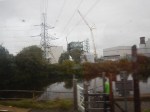



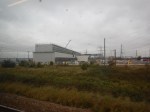
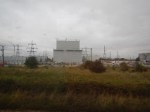







These pictures show the area is all about energy.
Keadby Power Station
Keadby power station is a 734 MW gas-fired power-station, that opened in 1996.
Keadby 2 Power Station
Keadby 2 is described on this page of the sseThermal web site.
These are the three opening paragraphs.
Keadby 2 is a new 840MW gas-fired power station in North Lincolnshire currently being constructed by our EPC contractor Siemens Energy. The project is adjacent to our operational Keadby 1 Power Station.
SSE Thermal has partnered with Siemens Energy to introduce first-of-a-kind, high-efficiency gas-fired generation technology to the UK. When completed, Keadby 2 is expected to become the cleanest and most-efficient gas-fired power station in Europe.
The station will also be capable of being upgraded to further decarbonise its generation through carbon capture or hydrogen technology, as routes to market develop.
Note.
- It will be possible to add Carbon Capture and Storage technology to Keadby 2 to make the plant net-zero carbon.
- Keadby 2 will be able to run on hydrogen.
- Keadby 2 is the under-construction power station in my pictures.
Could this be the prototype gas-fired power station of the future?
Keadby 3 Power Station
Keadby 3 is described on this page of the sseThermal web site.
These are the two opening paragraphs.
SSE Thermal is developing the option for a low-carbon combined cycle gas turbine (CCGT) at our Keadby site in North Lincolnshire, which will be known as Keadby 3.
As part of our commitment to a net zero emissions future, Keadby 3 will only be built with a clear route to decarbonisation, either using hydrogen as a low-carbon fuel, or equipping it with post-combustion carbon capture technology. The project is at the early stages of development and no final investment decision has been made.
Keadby 3 is still in the consultation and planning stage.
This newsletter on the sseThermal web site, gives some useful information about Keadby 3.
These are the first three paragraphs.
We are proposing to build a new gas fired power station at Keadby, North Lincolnshire. The project, known as Keadby 3, will have a generating capacity of up to 910 megawatts (MW) and will provide the essential back up to renewable generation and reliable and flexible energy during the country’s transition to Net Zero.
Keadby 3 will be a highly efficient gas fired power station. It will either use natural gas as the fuel and be fitted with a Carbon Capture Plant (CCP) to remove carbon dioxide (CO2) from the emissions to air from the plant, or it will be fired on primarily hydrogen, with no carbon dioxide emissions to air from its operation. Both options are currently being considered, and government is also currently considering the roles of carbon capture and hydrogen in the power sector nationally.
Keadby 3 will require connections for natural gas and possibly hydrogen fuel, water for use in the process
and for cooling and possibly for a pipeline to export the captured CO2 into a gathering network being provided by others and from there to a permanent geological storage site. An electricity connection to export the generated electricity to the UK transmission system will also be required. The plant would be capable of operating as a dispatchable low-carbon generating station to complement the increasing role of renewables in supplying the UK with electricity
Note.
- The three Keadby gas-fired power stations can generate 2484 MW of electricity in total.
- By comparison, the under-construction Hinckley Point C nuclear power station will be able to generate 3200 MW.
- The addition of a Keadby 4 power station, if it were the same size as Keadby 3, would mean the Keadby cluster of gas-fired power stations had a capacity of 3394 MW and they would be larger than the big nuclear station.
In terms of power output, it is an interesting alternative to a larger nuclear power station.
What About The Carbon?
If you’re burning natural gas, you will produce some carbon dioxide.
Power generation from natural gas creates 0.2 Kg of CO2 per kWh according to this web page.
So a 3000 MW station that produces 3000 MW, will produce 3000 MWh or 3000000 kWh in an hour.
This will create 600,000 Kg or 600 tonnes of carbon dioxide in an hour.
As there are roughly 9000 hours in a year, that is roughly 5.4 million tonnes of carbon dioxide.
This newsletter on the sseThermal web site, gives some information about sseThermal are going to do with the carbon dioxide.
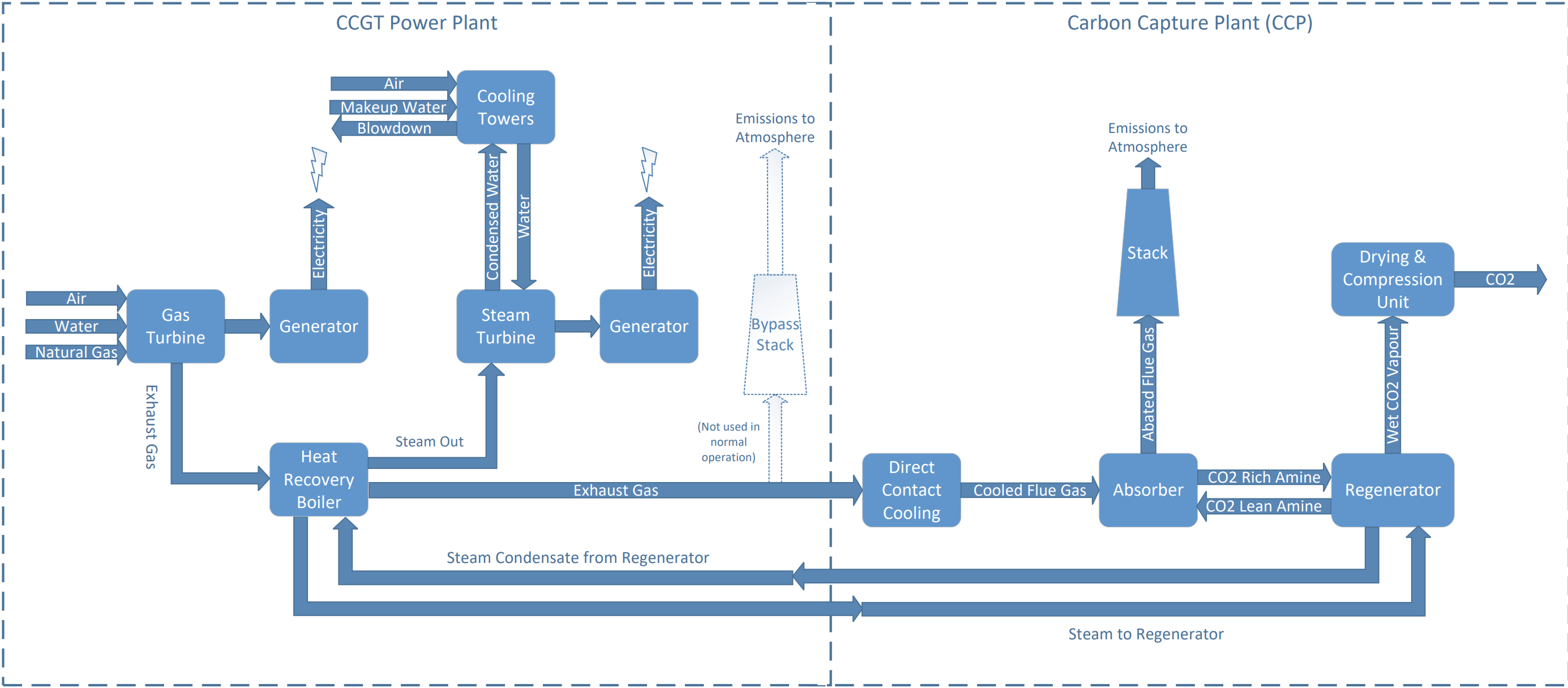
As a low-carbon CCGT, Keadby 3 comprises one high efficiency gas turbine and associated steam turbine and either the infrastructure required to allow the CCGT to fire primarily on hydrogen gas, r inclusion of a post combustion Carbon Capture Plant (CCP) in a scenario where natural gas is used as the fuel. In the latter scenario, this is required in order that CO2 emissions are captured and directed to an offshore geological store through the Humber Low Carbon cluster pipeline network being developed by National Grid Ventures and partners.
A diagram of these components, and optional components, is shown below.
Note.
- Click on the image to get a larger view.
- The CCGT Power Plant is on the left.
- Most of the power is generated by the gas-turbine.
- Heat is recovered to create steam, which drives a turbine to create more electricity
- The Carbon Capture Plant is on the right.
- Carbon dioxide is extracted from the exhaust.
There are two outputs from the plant; electricity and carbon dioxide.
As the carbon dioxide is in a pipe from the drying and compression unit, it is easy to handle.
The newsletter says this about what will happen to the carbon dioxide.
CO2 emissions are captured and directed to an offshore geological store through the Humber Low Carbon cluster pipeline network being developed by National Grid Ventures and partners.
As there are several worked out gas fields in the area, there are places to store the carbon dioxide.
Storing The Carbon Dioxide
This map shows the Zero Carbon Humber pipeline layout.
Note.
- The orange line is a proposed carbon dioxide pipeline
- The black line alongside it, is a proposed hydrogen pipeline.
- Drax, Keadby and Saltend are power stations.
- Easington gas terminal is connected to around twenty gas fields in the North Sea.
- The terminal imports natural gas from Norway using the Langeled pipeline.
- The Rough field has been converted to gas storage and can hold four days supply of natural gas for the UK.
I can see this network being extended, with some of the depleted gas fields being converted into storage for natural gas, hydrogen or carbon dioxide.
Using The Carbon Dioxide
But I would prefer , that the carbon dioxide were to be put to use. Under Carbon Capture and Utilisation on Wikipedia, a variety of uses are shown.
Surprisingly, they don’t talk about using the carbon dioxide to promote the growing of crops in green houses.
I do think, though, that some clever chemists will find ways to convert the carbon into some form of advanced engineering plastics to replace steel.
Hydrogen-Fuelled Power Stations
Note how on the map the hydrogen pipeline goes through the Keadby cluster of power stations.
- Hydrogen is a zero-carbon fuel.
- It will be produced offshore by wind turbines connected to electrolysers.
- The hydrogen will be brought ashore using the existing gas pipeline network.
- Excess hydrogen could be stored in the worked out gas fields.
I suspect there will be a massive increase in the number of wind turbines in the North Sea to the East of Hull.
Hydrogen Steelmaking
In ten years time, this will surely be the way steel will be made. British Steel at Scunthorpe would surely be an ideal site.
It would also be an ideal site for the HIsarna steelmaking process, which generates much less carbon dioxide and because it is a continuous process, what carbon dioxide is generated is easily captured.
Conclusion
Installations like this will mean that large nuclear power stations built with Chinese money are not needed.

