Plan For New Nuclear Reactors At Wylfa And Trawsfynydd A Step Closer As Natural Resource Wales Looks At Designs
The title of this post, is the same as that of this article on nation.cymru.
These are the first two paragraphs.
Plans for new nuclear power stations at Trawsfynydd and Wylfa have taken a step closer after the UK Government asked government regulators to assess designs for the reactors.
Natural Resources Wales will be among those assessing the designs by Rolls-Royce, with both Wylfa and Trawsfynydd have been named as potential sites for housing them within the UK.
These are points about the reactors.
- They will cost £1.8 billion each.
- They are capable of powering a city the size of Cardiff, which has a population of about half-a-million.
- I’ve read elsewhere that the reactors are planned to have a nameplate capacity of 470 MW.
The article did mention, that the Nimbys were lining up.
The Wylfa Site
The original Wylfa power station was a Magnox nuclear station generating 980 MW, that was decommissioned in 2015.
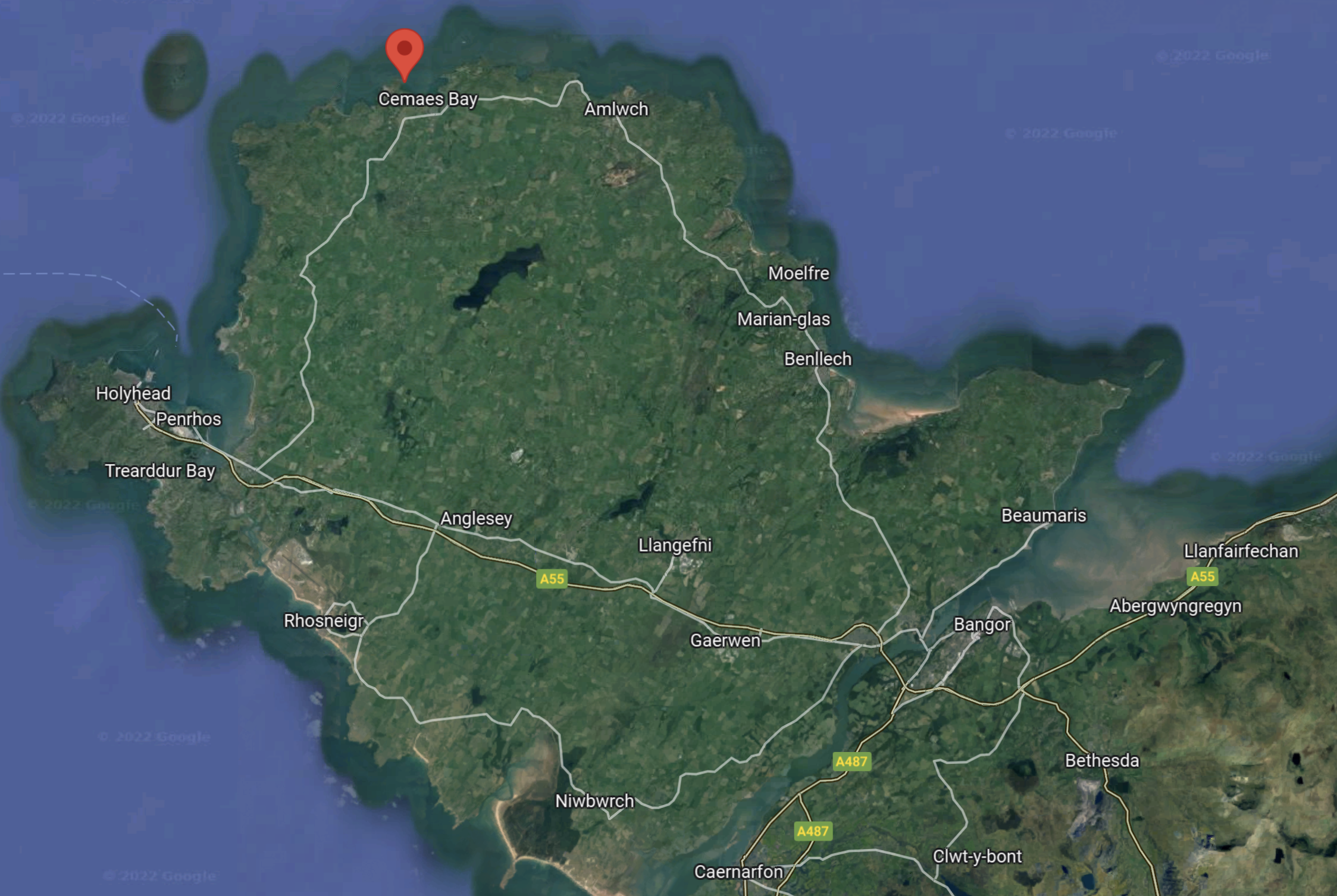
This Google Map shows the location of the site on Anglesey.
This second Google Map shows the site in more detail.
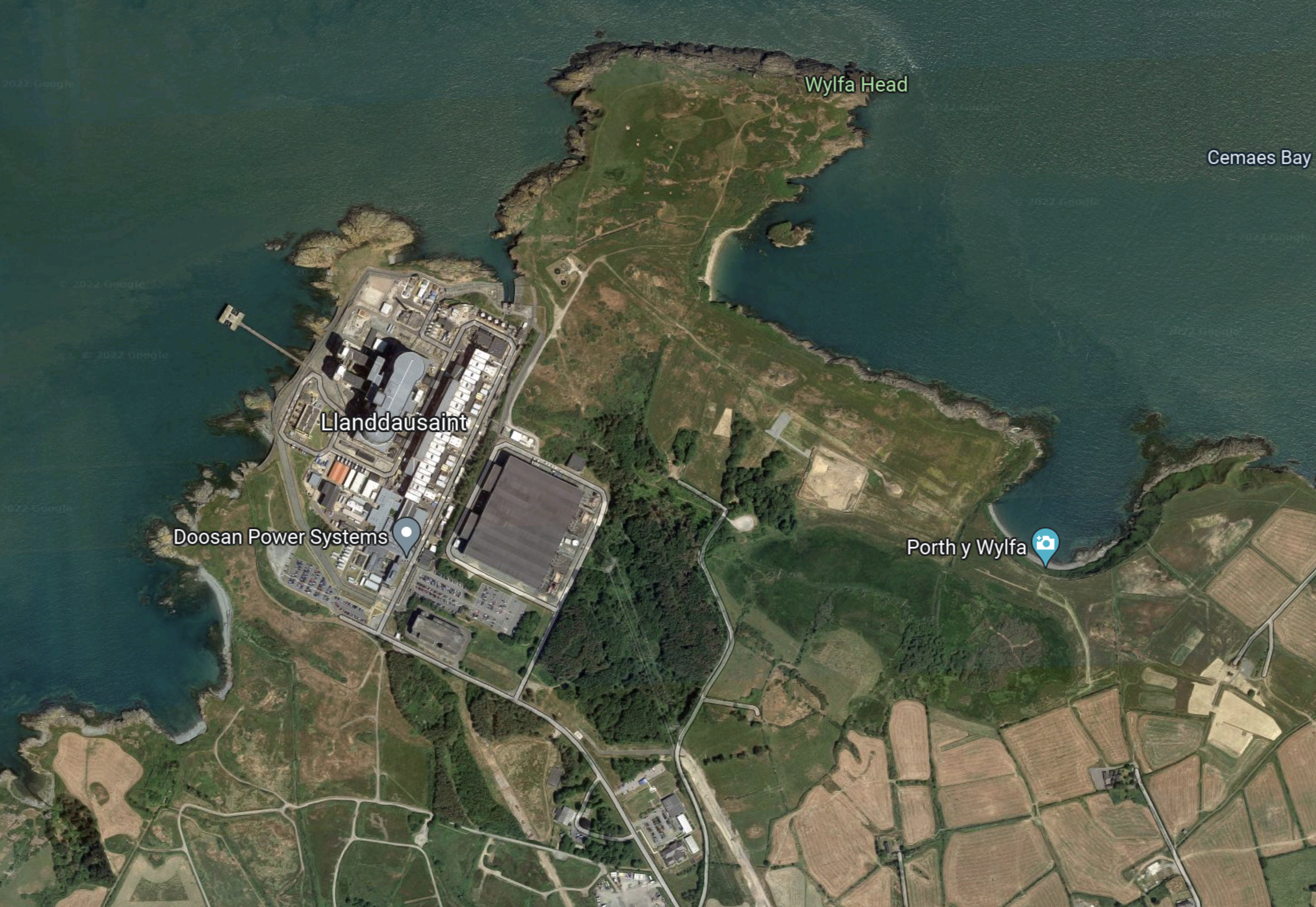
The power station doesn’t appear to have had a rail link, but there is a railway line a few miles away, with sidings that might have been used to handle fuel flasks.
There has been a proposal for a hybrid plant consisting of a wind farm and small modular nuclear reactors, which is described in this Wikipedia section, where this is said.
In January 2021, Shearwater Energy presented plans for a hybrid plant, to consist of a wind farm and small modular reactors (SMRs), to be installed adjacent to the existing Wylfa power station but separate from the proposed Wylfa Newydd site. Shearwater has signed a memorandum of understanding with NuScale Power for the SMRs. The plant could start generation as early as 2027 and would ultimately produce up to 3 GW of electricity and power a hydrogen generation unit producing up to 3 million kg of hydrogen per year.
Note.
- Wylfa Newydd was a proposal by Hitachi to build a nuclear station on the site.
- Shearwater Energy is a UK developer of energy opportunities.
- NuScale Power is an American company with its own design of small modular nuclear reactor.
In Holyhead Hydrogen Hub Planned For Wales, I talked about hydrogen and the port of Holyhead.
The Trawsfynydd Site
The original Trawsfynydd power station was a Magnox nuclear station generating 470 MW, that was decommissioned in 1991.
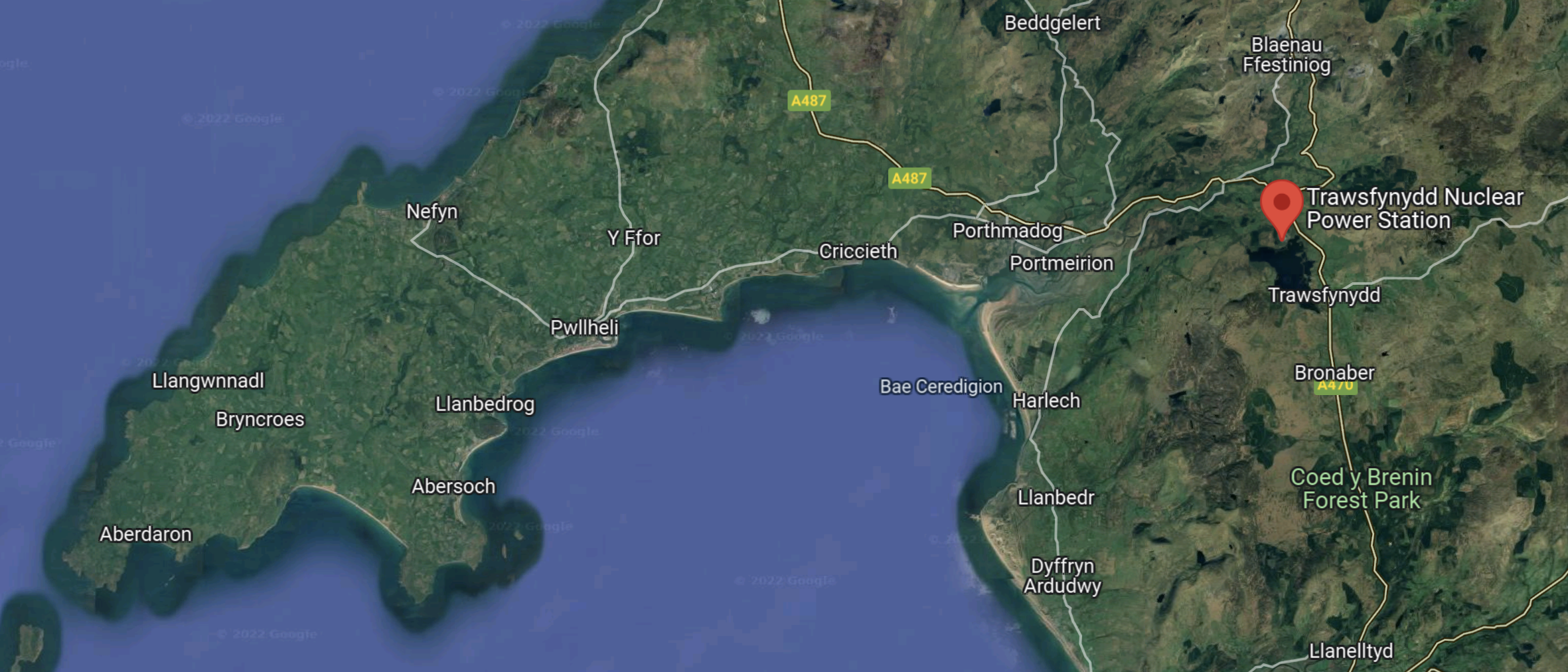
This Google Map shows the location of the site in North Wales.
This second Google Map shows the site in more detail.
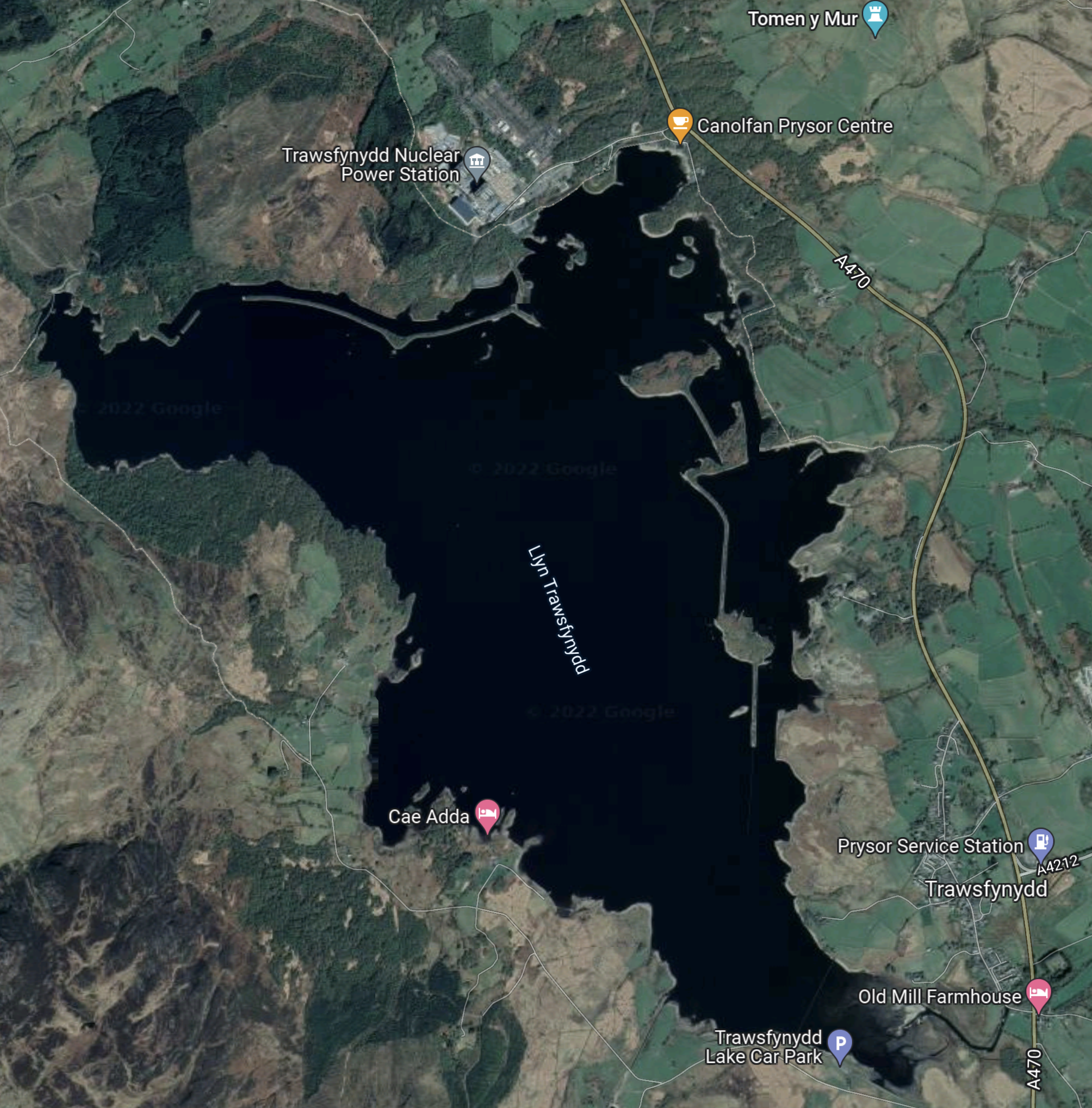
Note.
- The power station was built on the Northern shore of Llyn Trawsfynydd.
- Llyn Trawsfynydd is a man-made lake, that was built in the 1920s to supply water to the 24 MW Maentwrog hydro electric power station.
- There is a railway from near the site, that connects to the Conwy Valley Line at Blaenau Ffestiniog.
The Trawsfynydd site is a lot more than just a decommissioned Magnox power station.
Pumped Energy Storage In Snowdonia
Currently, there are two existing pumped storage in Snowdonia.
- Dinorwig power station, which is often called Electric Mountain, which has a capacity of 9.1 GWh.
- Ffestiniog power station, which has a capacity of around 1 GWh. If anybody has a better figure let me know!
A third scheme is under development at Glyn Rhonwy, which could have a capacity of 700 MWh.
Looking at the size of Llyn Trawsfynydd, I do wonder, if it could be the top lake of a future pumped storage scheme.
- Llyn Trawsfynydd, contains 40 million tonnes of water.
- There is a head of 190 metres.
That could give energy storage of 20 GWh. That sounds a lot of GWhs! But with two possible small modular nuclear reactors at possibly 500 MW each nearby and some help from windfarms, it could be filled within a day, if there is a suitable low-level reservoir.
Rolls-Royce And The Duisburg Container Terminal
In Rolls-Royce Makes Duisburg Container Terminal Climate Neutral With MTU Hydrogen Technology, I showed how Rolls-Royce and its subsidiary were providing an innovative climate neutral solution for Duisburg Container Terminal in Germany.
A North West Wales Powerhouse
Could Rolls-Royce be planning a Duisburg-style solution for North West Wales.
- Small modular nuclear reactors at Wylfa and Trawsfynydd.
- Hydrogen electrolysers to create hydrogen for the Port of Holyhead and heavy transport.
- Adequate pumped hydro storage for surplus energy.
But there could be little serious above-ground construction.
Conclusion
Something is awakening in North West Wales.
Could Norfolk And Suffolk Be Powered By Offshore Wind?
This week this article on the BBC was published, which had a title of Government Pledges £100m For Sizewell Nuclear Site.
These are the first three paragraphs.
The government is putting up £100m to support the planned Sizewell C nuclear plant in Suffolk, Business and Energy Secretary Kwasi Kwarteng has announced.
The investment marks the latest stage in efforts to build the £20bn reactor on the east coast of England.
However, it does not commit the government to approving the project, which is still subject to negotiations.
My view of the proposed Sizewell C nuclear plant is that of an engineer, who used to live within thirty minutes of the Sizewell site.
- Hinckley Point C power station, which is currently being constructed, will have a nameplate capacity of 3.26 GW.
- Sizewell C would probably be to a similar design and capacity to Hinckley Point C.
- Sizewell C would likely be completed between 2033-2036.
- Sizewell B is a 1250 MW station, which has a current closing date of 2035, that could be extended to 2055.
- East Anglia and particularly the mega Freeport East, that will develop to the South at the Ports of Felixstowe and Harwich will need more electricity.
- One of the needs of Freeport East will be a large supply of electricity to create hydrogen for the trains, trucks, ships and cargo handling equipment.
- Sizewell is a large site, with an excellent connection to the National Grid, that marches as a giant pair of overhead cables across the Suffolk countryside to Ipswich.
But.
- We still haven’t developed a comprehensive strategy for the management of nuclear waste in the UK. Like paying for the care of the elderly and road pricing, it is one of those problems, that successive governments have kept kicking down the road, as it is a big vote loser.
- I was involved writing project management software for forty years and the building of large nuclear power plants is littered with time and cost overruns.
- There wasn’t a labour problem with the building of Sizewell B, as engineers and workers were readily available. But with the development of Freeport East, I would be very surprised if Suffolk could provide enough labour for two mega-projects after Brexit.
- Nuclear power plants use a lot of steel and concrete. The production of these currently create a lot of carbon dioxide.
- There is also a large number of those objecting to the building of Sizewell C. It saddened me twenty-five years ago, that most of the most strident objectors, that I met, were second home owners, with no other connection to Suffolk.
The older I get, the more my experience says, that large nuclear power plants aren’t always a good idea.
Small Modular Nuclear Reactors
In Is Sizewell The Ideal Site For A Fleet Of Small Modular Nuclear Reactors?, I looked at building a fleet of small modular nuclear reactors at Sizewell, instead of Sizewell C.
I believe eight units would be needed in the fleet to produce the proposed 3.26 GW and advantages would include.
- Less land use.
- Less cost.
- Less need for scarce labour.
- Easier to finance.
- Manufacturing modules in a factory should improve quality.
- Electricity from the time of completion of unit 1.
But it would still be nuclear.
Wind In The Pipeline
Currently, these offshore wind farms around the East Anglian Coast are under construction, proposed or are in an exploratory phase.
- East Anglia One – 714 MW – 2021 – Finishing Construction
- East Anglia One North 800 MW – 2026 – Exploratory
- East Anglia Two – 900 MW – 2026 – Exploratory
- East Anglia Three – 1400 MW – 2026 – Exploratory
- Norfolk Vanguard – 1800 MW – Exploratory
- Norfolk Boreas – 1800 MW – Exploratory
- Sheringham Shoal/Dudgeon Extension – 719 MW – Exploratory
Note.
- The date is the possible final commissioning date.
- I have no commissioning dates for the last three wind farms.
- The East Anglia wind farms are all part of the East Anglia Array.
These total up to 8.13 GW, which is in excess of the combined capacity of Sizewell B and the proposed Sizewell C, which is only 4.51 GW.
As it is likely, that by 2033, which is the earliest date, that Sizewell C will be completed, that the East Anglia Array will be substantially completed, I suspect that East Anglia will not run out of electricity.
But I do feel that to be sure, EdF should try hard to get the twenty year extension to Sizewell B.
The East Anglia Hub
ScottishPower Renewables are developing the East Anglia Array and this page on their web site, describes the East Anglia Hub.
This is the opening paragraph.
ScottishPower Renewables is proposing to construct its future offshore windfarms, East Anglia THREE, East Anglia TWO and East Anglia ONE North, as a new ‘East Anglia Hub’.
Note.
- These three wind farms will have a total capacity of 3.1 GW.
- East Anglia ONE is already in operation.
- Power is brought ashore at Bawdsey between Felixstowe and Sizewell.
I would assume that East Anglia Hub and East Anglia ONE will use the same connection.
Norfolk Boreas and Norfolk Vanguard
These two wind farms will be to the East of Great Yarmouth.
This map from Vattenfall web site, shows the position of the two wind farms.
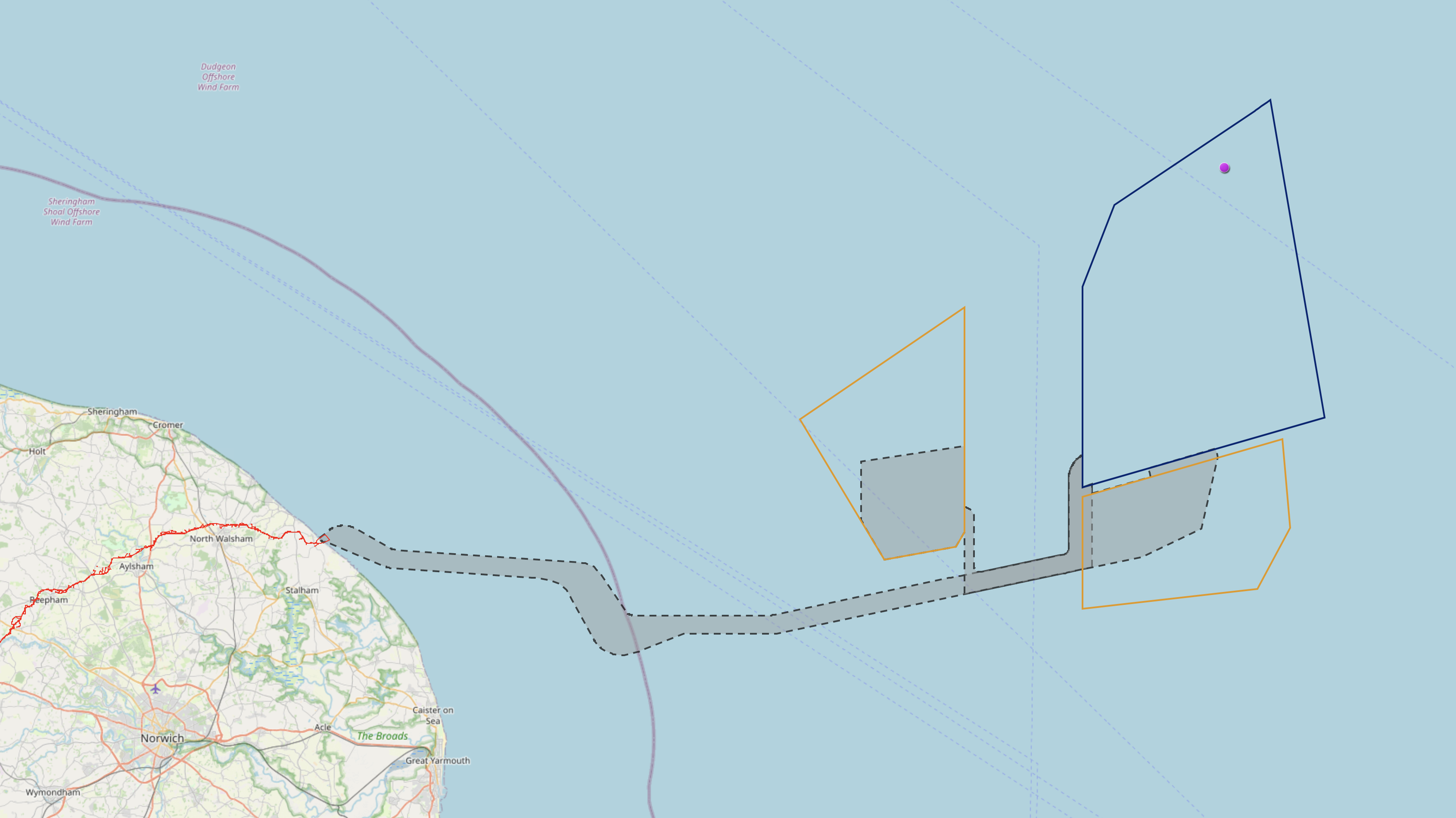
Note.
- Norfolk Boreas is outlined in blue.
- Norfolk Vanguard is outlined in orange.
- I assume the grey areas are where the cables will be laid.
- I estimate that the two farms are about fifty miles offshore.
This second map shows the landfall between Eccles-on-Sea and Happisburgh.
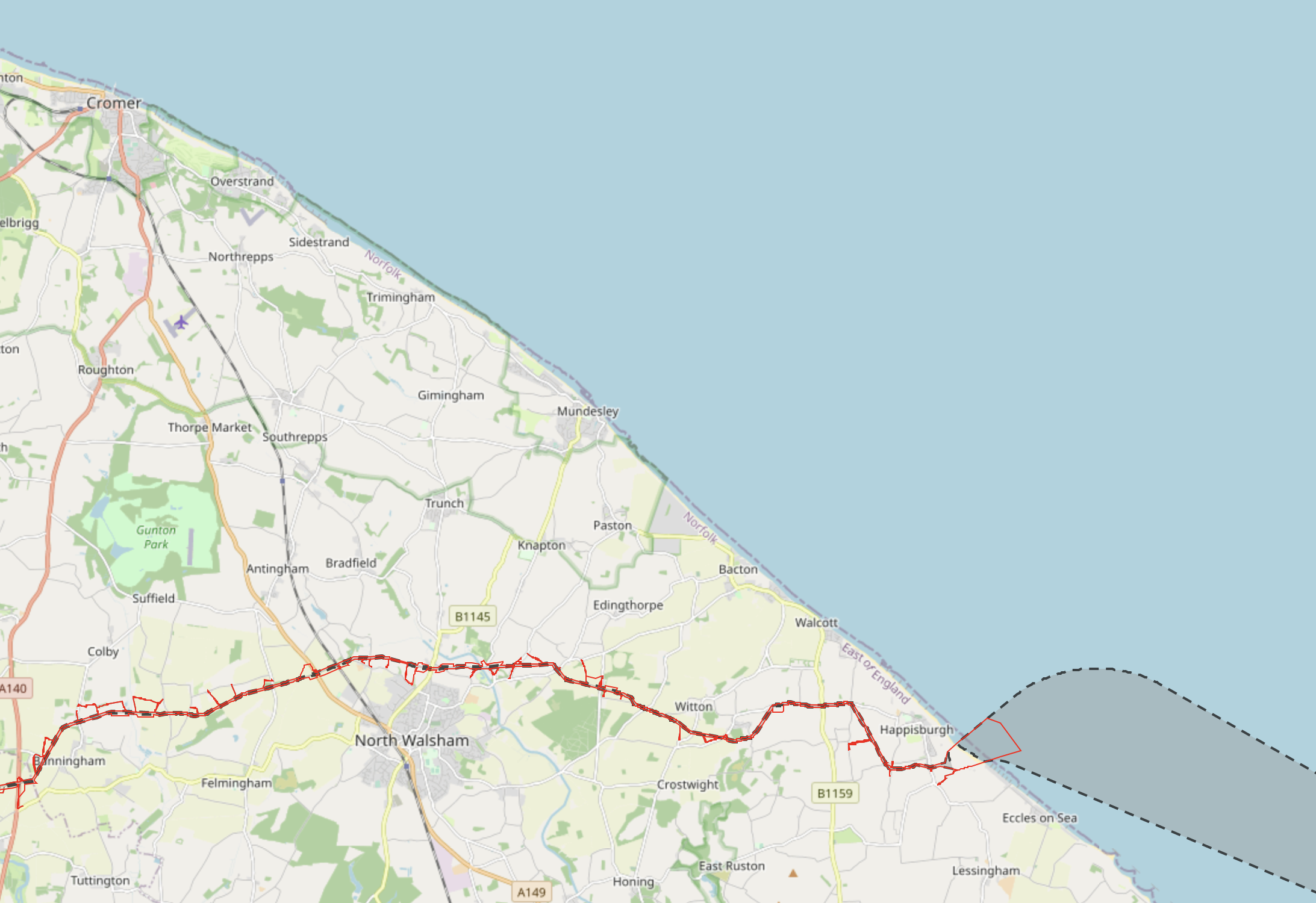
Note the underground cable goes half-way across Norfolk to Necton.
Electricity And Norfolk And Suffolk
This Google Map shows Norfolk and Suffolk.
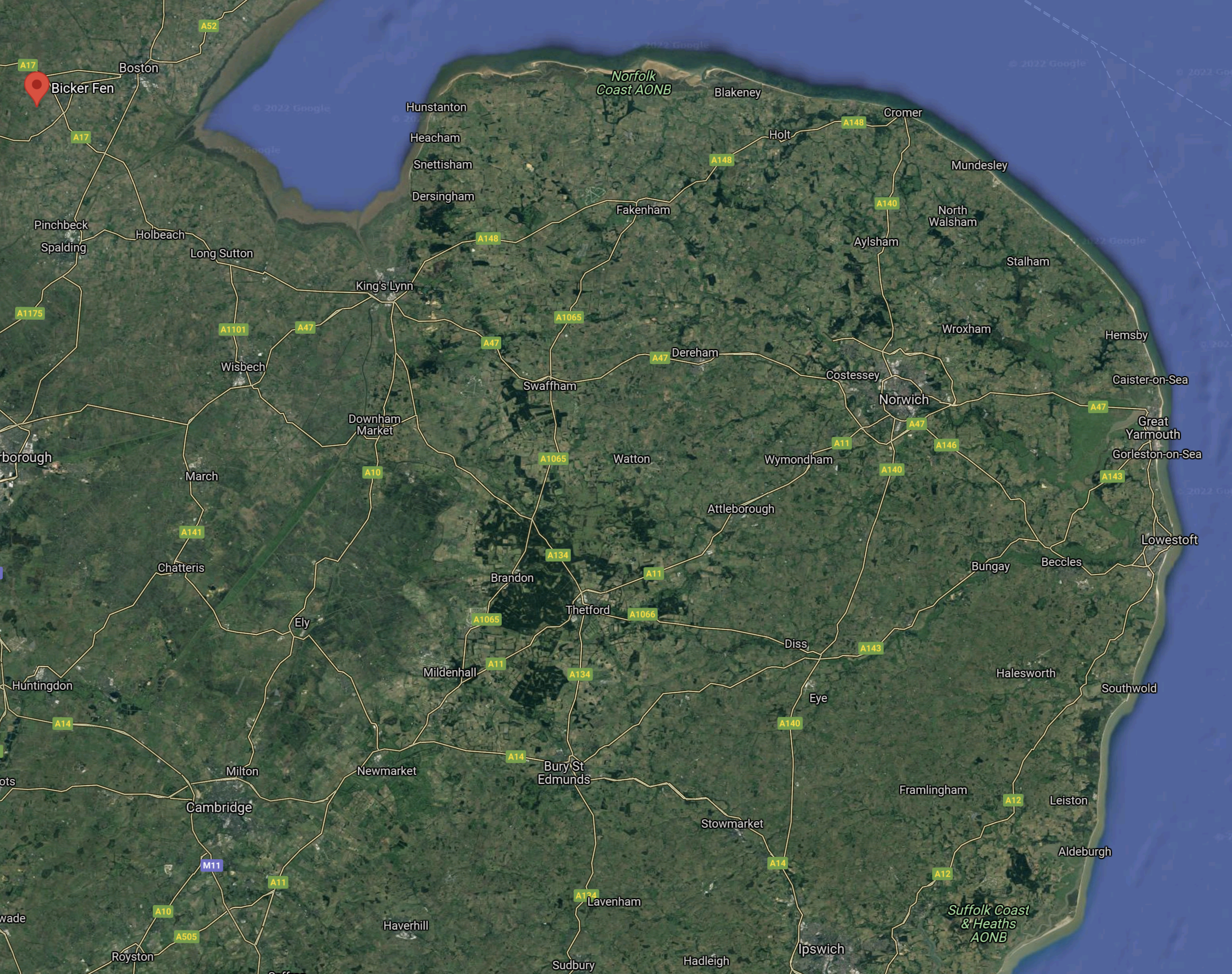
Note.
- The red arrow in the North-West corner marks the Bicker Fen substation that connects to the Viking Link to Denmark.
- The East Anglia Array connects to the grid at Bawdsey in the South-East corner of the map.
- Sizewell is South of Aldeburgh in the South-East corner of the map.
- The only ports are Lowestoft and Yarmouth in the East and Kings Lynn in the North-West.
There are few large towns or cities and little heavy industry.
- Electricity usage could be lower than the UK average.
- There are three small onshore wind farms in Norfolk and none in Suffolk.
- There is virtually no high ground suitable for pumped storage.
- There are lots of areas, where there are very few buildings to the square mile.
As I write this at around midday on a Saturday at the end of January, 49 % of electricity in Eastern England comes from wind, 20 % from nuclear and 8 % from solar. That last figure surprised me.
I believe that the wind developments I listed earlier could provide Norfolk and Suffolk with all the electricity they need.
The Use Of Batteries
Earlier, I talked of a maximum of over 7 GW of offshore wind around the cost of Norfolk and Suffolk, but there is still clear water in the sea to be filled between the existing and planned wind farms.
Batteries will become inevitable to smooth the gaps between the electricity produced and the electricity used.
Here are a few numbers.
- East Anglian Offshore Wind Capacity – 8 GW
- Off-Peak Hours – Midnight to 0700.
- Typical Capacity Factor Of A Windfarm – 20 % but improving.
- Overnight Electricity Produced at 20 % Capacity Factor – 11.2 GWh
- Sizewell B Output – 1.25 GW
- Proposed Sizewell C Output – 3.26 GW
- Largest Electrolyser – 24 MW
- World’s Largest Lithium-Ion Battery at Moss Landing – 3 GWh
- Storage at Electric Mountain – 9.1 GWh
- Storage at Cruachan Power Station – 7.1 GWh
Just putting these large numbers in a table tells me that some serious mathematical modelling will need to be performed to size the batteries that will probably be needed in East Anglia.
In the 1970s, I was involved in three calculations of a similar nature.
- In one, I sized the vessels for a proposed polypropylene plant for ICI.
- In another for ICI, I sized an effluent treatment system for a chemical plant, using an analogue computer.
- I also helped program an analysis of water resources in the South of England. So if you have a water shortage in your area caused by a wrong-sized reservoir, it could be my fault.
My rough estimate is that the East Anglian battery would need to be at least a few GWh and capable of supplying up to the output of Sizewell B.
It also doesn’t have to be a single battery. One solution would probably be to calculate what size battery is needed in the various towns and cities of East Anglia, to give everyone a stable and reliable power supply.
I could see a large battery built at Sizewell and smaller batteries all over Norfolk and Suffolk.
But why stop there? We probably need appropriately-sized batteries all over the UK, with very sophisticated control systems using artificial intelligent working out, where the electricity is best stored.
Note that in this post, by batteries, I’m using that in the loosest possible way. So the smaller ones could be lithium-ion and largest ones could be based on some of the more promising technologies that are under development.
- Highview Power have an order for a 50 MW/500 MWh battery for Chile, that I wrote about in The Power Of Solar With A Large Battery.
- East Anglia is an area, where digging deep holes is easy and some of Gravitricity’s ideas might suit.
- I also think that eventually someone will come up with a method of storing energy using sea cliffs.
All these developments don’t require large amounts of land.
East Anglia Needs More Heavy Consumers Of Electricity
I am certainly coming to this conclusion.
Probably, the biggest use of electricity in East Anglia is the Port of Felixstowe, which will be expanding as it becomes Freeport East in partnership with the Port of Harwich.
One other obvious use could be in large data centres.
But East Anglia has never been known for industries that use a lot of electricity, like aluminium smelting.
Conversion To Hydrogen
Although the largest current electrolyser is only 24 MW, the UK’s major electrolyser builder; ITM Power, is talking of a manufacturing capacity of 5 GW per year, so don’t rule out conversion of excess electricity into hydrogen.
Conclusion
Who needs Sizewell C?
Perhaps as a replacement for Sizewell B, but it would appear there is no pressing urgency.
Why Use A Hydrogen Pipeline Rather Than A Electricity Cable To Bring Electricity Ashore From A Windfarm?
A comment to the post entitled Siemens Gamesa Partners On Offshore Wind-to-Hydrogen, was as follows.
Trying to get my head around this concept. Build an electrolysis plant in the North Sea and run a hydrogen pipeline to shore, rather than generating electricity and transferring the power by undersea cable to a shore based electrolysis plant. Can it really be better technically and economically? Someone convince me.
The reasons probably all come down to saving money and hassle.
Reusing Existing Infrastructure
Supposing, you have an offshore gas field, which is on the point of being worked out.
- It has a well-maintained platform on top.
- It has a pipe to an onshore terminal that handles the natural gas and distributes it to end-users.
Supposing the following are possible.
- Building a large wind farm in the vicinity of the platform.
- Using the gas field for hydrogen storage.
- Converting the gas terminal from natural gas to hydrogen.
- The end-users can convert to hydrogen.
In some cases the end-users might even prefer hydrogen to natural gas, to help their own decarbonisation.
I would suspect that there will be a sound economic case to use hydrogen, where wind farms are developed, in the same areas as worked-out gas fields.
- Platform demolition costs are deferred.
- No HVDC link is needed, with an expensive converter station at the shore end.
- The new system comes with energy storage.
The only extra cost might be that an offshore electrolyser is more expensive than an onshore one.
Engineering Resources
The engineering resources needed for a gas pipeline are different to those needed for an electrical system.
But because gas pipelines are a declining industry, they will be readily available.
Less Planning Hassle
There have been some objections to the development of wind farm terminals by Nimbies.
If a terminal is converted from natural gas to hydrogen, I suspect there will be fewer objections.
Better Control Of Wind Farms
There have been stories of wind farms having to be switched off because there is no-one to buy the electricity.
If some form of offshore hydrogen storage is possible, then the electricity can be used to generate hydrogen, which can be piped ashore, when it is needed.
It Won’t Be One Type Fits All
I suspect we’ll see some hybrid systems and other innovative engineering.
Conclusion
I believe that in a drive to cut costs, we’ll see a lot of energy brought ashore as hydrogen gas.
I
What Is A Pimby?
We all know that a Nimby (Not In My Back Yard!) doesn’t want fracking, a nuclear power station or a new railway to be built or something similar near to where they live.
But I believe, we could see the rise of a new type of protestor – the Pimby or a Please In My Back Yard!
I was reading this article on CleanTechnica, which is entitled Coal-Killing Long-Duration Energy Storage For Vermont (Vermont?!?).
The article is about Highview Power’s planned energy storage facility in Vermont, which I wrote about in Encore Joins Highview To Co-Develop Liquid Air Energy Storage System In Vermont.
This paragraph is from Highview.
“Unlike competing long-duration technologies, such as pumped hydro-power or compressed air, Highview Power’s CRYOBattery™ can be sited just about anywhere. The CRYOBattery has a small footprint, even at multiple gigawatt-levels, and does not use hazardous materials.”
You could imagine a community, , perhaps miles away from the nearest power station, where jobs and economic prospects are being held back by a dodgy power supply.
So the community might start to protest not about building perhaps a gas-fired station to satisfy their electricity needs, but in favour of a Highview Power system and some renewable wind or solar power.
Pimbys might also protest in favour of a new railway station or electrification of their branch line. Providing the power for the latter would be a good use for a Highview system.
Oxford’s Nimbys Are Getting Angry!
I keep finding articles on the web, like this article on the Oxford Times, which is entitled First Person: The Campaign To Keep Oxfordshire As It Is Now.
The title says it all.
It is all about opposition to the Oxford to Cambridge Expressway, which everybody wants in someone else’s back-yard.
My feelings are as follows.
- A fully-electrified freight route should be built between Southampton and the West Coast Main Line, preferably with 25 KVAC overhead wiring.
- The East West Railway should provide at least two fast trains per hour between Heathrow and Cambridge, via Reading, Oxford, Milton Keynes and Bedford.
- I would accelerate the construction of the East West Railway.
Only as a last project, would I build the Oxford to Cambridge Expressway.
How Not To Handle An Environmental Issue In A Large Project
On my holiday in Poland, I met someone, who lives on the route of HS2.
They told me that a million tons of tunnel spoil will be dumped on farmland in the Chilterns.
I was rather surprised to say the least, as having followed major projects for the best part of forty years, I know that project managers, engineers, architects and construction companies, don’t want hassle from what are collectively termed Nimbys, so they do their utmost to design projects, so that disruption and damage to the environment is minimised.
Crossrail had its problems early on, as Mayfair didn’t want the rsailway or the disruption of ten years of construction. So they devised a strategy based on openness and archaeology, which sold the project to Londoners, as something more than a railway. They have also been very helpful in giving access to the general public in events like Open House.
So I typed “HS2 tunnel spoil” into Google and found this article in the Bucks Free Press, which is entitled HS2 tunnel spoil to be dumped in Chilterns AONB. This is an extract from the article.
The announcement was made by HS2 Ltd’s Country South Area Manager Neil Cowie at a community forum in Little Kingshill on Tuesday.
He said it would be placed within a ‘sizeable area’ within two or three miles of the planned tunnel portal at Mantles Wood near Amersham – but he added HS2 Ltd did not want the location to be made public yet.
Mr Cowie said: “Rather than taking it longer distance along highways, we’ve taken some additional land alongside the route which we will landscape.
“When it’s finished it will be properly landscaped and will look very nice.”
I’m no diplomat, but it does seem a rather poor statement, which probably came out of a forum, where things were not up to scratch.
I’ve been to several Transport for London foums about projects like Camden Town station, Crossrail 2 and Hackney station and at each one, there has been an architect, engineer or project planner, who understands in detail what is proposed.
A later statement in the article says this.
In a later statement, HS2 Ltd said: “We will not being be depositing spoil/excavated materials from tunnelling in the AONB – it will be excavated materials from the cuttings going through the AONB. All tunnelling excavated materials from that part of the line will be taken out via the Colne Valley construction site.”
When dealing with any sensitive project from a children’s playground upwards, you must get your facts right! Once errors are in the local culture, they can only be eradicated with great difficulty and tremendous expense.
With respect to HS2, my project management and engineering instincts lead me to the conclusion, that HS2 will probably come up with an innovative and non-disruptive way to remove the tunnel spoil from the area.
If they don’t, then they don’t deserve to be building the line.
These Protesters Give Nimbys A Bad Name
I did laugh when I saw this article about Crossrail 2 in the Metro.
It is the sort of selfish protest that gives protesters and Nimbys a bad name.
As someone, who has lived through the upgrading of the North and East London Lines to create the London Overground, I have seen how better transport links create prosperity for a wide range of people of all levels of wealth.
But then any poor people have been ridden out of Chelsea on a rail!
If I’m still alive when Crossrail 2 opens, I will take the line to Chelsea and stare at my betters. Probably with my tongue out.london.
On second thoughts I won’t, as Chelsea is jammed solid with Chelsea tractors. Protesters like those, will only be satisfied if they had a free motorway to the rest of
Fracked Or Fiction
I went to the London Geological Society today to see a lecture called.
Fracked or fiction: so what are the risks associated with shale gas exploitation?
The lecture is described here on their web site.
They will put up a video in two or three weeks, which you can watch to make your own mind up.
My overwhelming conclusion after the lecture was that before we can embrace fracking in earnest, we must collect a lot more information. For example, we don’t know the background levels ofearthquakes and natural gas seepage in this country. So if say it is thought, that fracking had caused a small earthquake, can we be sure that that isn’t one that we habitually get in this country.
A secondary conclusion, is that my engineering knowledge indicated that there are several very fruitful areas for the development of new technological solutions to mitigate some of the possible problems of fracking.
Stopping fracking is probably an easy task for opponents, as it can be portrayed as dangerous in several ways, that appeal to the sensationalist media. And of course the benefits of low gas prices aren’t so obvious, until they actually happen.
You can compare fracking with that other nimby-opposed project; HS2. This can be opposed in terms of noise, vibration and construction and visual disturbance cost, but the benefits of better and faster journeys is easier to understand by the man on the Birmingham train.
And We Think We’ve Got Nimbys!
This article on the BBC’s web site shows that nimbys get everywhere, even in Italy. But it is a fascinating article about a rail tunnel between Italy and France. Christian Fraser, the author, puts this case in favour of the tunnel.
The pro-tunnellers employ a mixture of hyperbole and hard-nosed economic home truths as they argue for the project. The Atlantic will reach out to the Urals via this new link, they cry. Freight trains will zoom to and fro, boosting the shambling economies of southern Europe. Of greater interest to British tourists – skiers like me – is that the journey time from London to Milan will be cut to just six hours.
With those against as follow.
The naysayers insist that the tunnel will be an ugly, expensive white elephant. They point out that the existing trans-Alpine road and rail routes seem to cope very nicely, thank you. They claim that projections of traffic were drawn up 20 years ago and are hopelessly out-of-date. And they are worried about potentially dangerous minerals that are buried underneath the mountains being released into the air and water.
Hand on heart, even the keenest of protesters would struggle to claim the Susa Valley was an area of outstanding beauty. A narrow pass, it is already crammed with the clutter of human development – a motorway stalks across the valley floor on gigantic stilts, elevated above railway lines, quarries and factories.
But he also describes the action taking place.
In Italy, they have lobbied tenaciously – and at times violently – in their fight against the rail link between Lyon and Turin. Some 400 people were injured in clashes with the police last year when the tunnel site was first fenced off.
I know that area reasonably well, as I’ve driven through it and flown over it in a light aircraft several times. It is one of those areas, where if asked to dig a tunnel, your first action would be to ask if there was an easier route.
I don’t know the economics of this rail route, but I suspect that in the future some route will be completed to allow passengers to take the train from London and Paris to Rome or Milan.
Effect Of Freight on Rail
A few years ago there were only three freight trains a day out of Felixstowe. Now because of new infrastructure in the docks, there are over thirty.
One side effect of this, has been a very large reduction of trucks on the A14.
Before we build large numbers of new roads, we should make sure that the rail freight network is as efficient as possible.
One trouble with rail freight is that it needs terminals for local distribution near major conurbations and these developments tend to bring out the nimbys in large numbers.
But you can’t have truck-free main roads, without interfaces between long-distance freight trains and local deliveries.
 The Anonymous Widower