Morecambe Offshore Windfarm
I found this article on beyondradio, which is entitled Plans Unveiled To Build New Offshore Windfarms Off Morecambe Bay.
These care the first two paragraphs.
Plans are being developed to build new offshore windfarms off the Morecambe Bay coast.
Proposals have been unveiled for ‘Morecambe’ and ‘Morgan’, two new offshore wind farms being developed in the Irish Sea.
I’ve discussed Morgan and its sister; Mona before in Mona, Morgan And Morven, which describes the three projects BP are developing in a joint venture with enBW.
I haven’t come across the Morecambe Offshore Windfarm before and it has its own web site.
It has this summary of the wind farm.
Renewable energy is central to supporting the UK’s ambitions to lead the world in combatting climate change, reducing our reliance on fossil fuels and embracing a future where renewable energy powers our homes and businesses.
Morecambe Offshore Windfarm which has a nominal capacity of 480MW. That’s enough to power over half a million households. It will also contribute to the UK Government’s commitment to:
- Generate 50GW of power from offshore wind by 2030
- Reach net zero by 2050.
It is located approximately 30km from the Lancashire coast.
This EnBW-BP infographic describes the Morgan and Mona projects.

it appears that the proposed Morecambe Offshore Windfarm will fit in the notch on the Eastern side of EnBW-BP’s two wind farms; Mona and Morgan.
- All three wind farms are fixed foundation wind farms.
- They have a total output of just under 3.5 GW.
- Could they share infrastructure like cables and substations?
- Heysham 1 is a 485 MW nuclear station, that will be decommissioned in 2024.
- Heysham 2 is a 1815 MW nuclear station, that will be decommissioned in 2028.
- What’s left of the two Heysham nuclear stations can probably generate 2.3 GW
Could it be that over 2.3 GW of wind power is being planned in the Irish Sea to make up for the loss of the four reactors at Heysham?
Could also the 480 MW Morecambe Bay wind farm be replacing what’s left of Heysham 1?
There would probably need to be a battery at Heysham, but it looks like the wind farms could be replacing the Heysham nuclear power station!
There will be consultation with the locals about the Morecambe ans Morgan wind farms, which will take place on Saturday, November 19, 2.30pm – 6.30pm, at Morecambe War Memorial Hall on Church Street.
I think, I might go!
Is This The World’s Best Renewable Energy Video?
This is a promotional video from Minesto about their Deep Green technology.
Is it a serious proposition or is it just kite-flying?
After reading their web site in detail, I think they are serious.
Here’s why!
The Company Is A Well-Backed Spin-Out from Swedish Aerospace Company SAAB
These two paragraphs are from the About Us page.
Minesto is a marine energy technology developer, founded in 2007 as a spin-off from Swedish aerospace manufacturer Saab. Since then, Minesto has successfully developed its unique Deep Green technology.
The company has operations in Sweden, Wales, Northern Ireland and Taiwan, with headquarters in Gothenburg, Sweden. Main owners are BGA Invest and Midroc New Technology. The Minesto share is listed on the Nasdaq First North Growth Market in Stockholm.
A company rarely succeeds without appropriate and sufficient financial backing.
One Of Their Target Markets Is Powering Remote Islands
This page from World Atlas is entitled Which Countries Have The Most Islands?
These are the top five countries.
- Sweden – 267,570
- Norway – 239,057
- Finland – 178,947
- Canada – 52,455
- United States – 18,617
Note.
- That’s a lot of islands.
- The United Kingdom is 26th with a thousand islands.
- Scandinavia has 685574 islands or 686993 if you include Denmark.
Sweden has a thousand inhabited islands, so that means that in Scandinavia alone, there are about 2,500 inhabited islands. How many need a reliable decarbonised power supply?
In the UK, we are developing Remote Island Wind to serve similar locations, which I wrote about in The Concept Of Remote Island Wind.
The UK and Minesto are both looking at the supply of power to remote islands.
One of Minesto’s projects is in the Faroe Islands and it is described in this page on the Minesto web site, which has a title of Faroe Islands – Tidal Energy To Reach 100% Renewable By 2030.
These are the first two paragraphs.
In the Faroe Islands, Minesto is part of one of the world’s most ambitious energy transition schemes.
Collaborating with the electric utility company SEV, Minesto is working to pave the way for tidal energy to become a core part of the Faroese energy mix, allowing them to reach 100% renewable energy by 2030.
Onshore wind and tidal could be an ideal combination, if they worked together.
At the bottom of the Faroe Islands page, the web site talks about The Deep Green Island Mode Project, where this is said.
In June 2019, Minesto was awarded a €2.5 million grant from the European Commission’s SME Instrument programme. The awarded funding will support the installation of Minesto’s technology in the Faroe Islands together with the utility company SEV. The aim of the project, called Deep Green Island Mode (DGIM), is to install Minesto’s first two commercially viable microgrid units in a production and customer environment.
Successful demonstration of DGIM will act as a first step to developing commercial ties with utilities across Europe, both for smaller-scale microgrid systems and as a catalyst for the market up take of larger utility-scale Deep Green systems.
This is also said about the number of installations in Europe.
15 million Europeans live on Europe’s 2,400 inhabited islands, at an average of approximately 1,500 households per island. As recognised by the European Commission, island energy is expensive, polluting, inefficient and dependent on external supply, with significant negative impacts on emissions, the competitiveness of businesses, and the economy.
It appears to me, that Minesto have researched their market well.
Minesto Can Provide Baseload Power
Another of Minesto’s projects is in Taiwan and it is described in this page on the Minesto web site, which has a title of Taiwan – Replacing Nuclear With Renewable Baseload.
These are the first two paragraphs.
In Taiwan, Minesto is carrying out site development with the purpose to establish the first tidal energy arrays with Minesto’s technology in Asia – and to demonstrate renewable baseload generation from the continuously-flowing Kuroshio current.
The conditions for extracting marine energy in Taiwan are very good due to access to both tidal streams and continuous ocean currents. Taiwan aims to produces 20% of electricity from renewable sources by 2025 and has decided to scrap its nuclear power capacity within the same timeframe. Today, 97.5 percent of the country’s total energy use comes from imported fossil fuels.
Taiwan has a well-developed industrial infrastructure and a number of stakeholders in the private and public sectors are active in marine energy.
Decarbonising Taiwan and removing nuclear is a tough ask!
Conclusion
Minesto may be kite-flying in an unusual way, but they appear to be a very serious Swedish company.
Berwick Bank Wind Farm Could Provide Multi-Billion Pound Boost To Scottish Economy And Generate Thousands Of Jobs
The title of this post, is the same as that of this press release from SSE.
This press release is all about numbers.
- 307 turbines
- 4.1 GW nameplate capacity
- 5 million homes will be powered
- 8 million tonnes of carbon dioxide avoided
- Up to £8.3 billion to the UK economy
- 4650 potential jobs in Scotland
- 9300 potential jobs in the UK
These are all large figures.
This map from SSE shows the location of the wind farm.
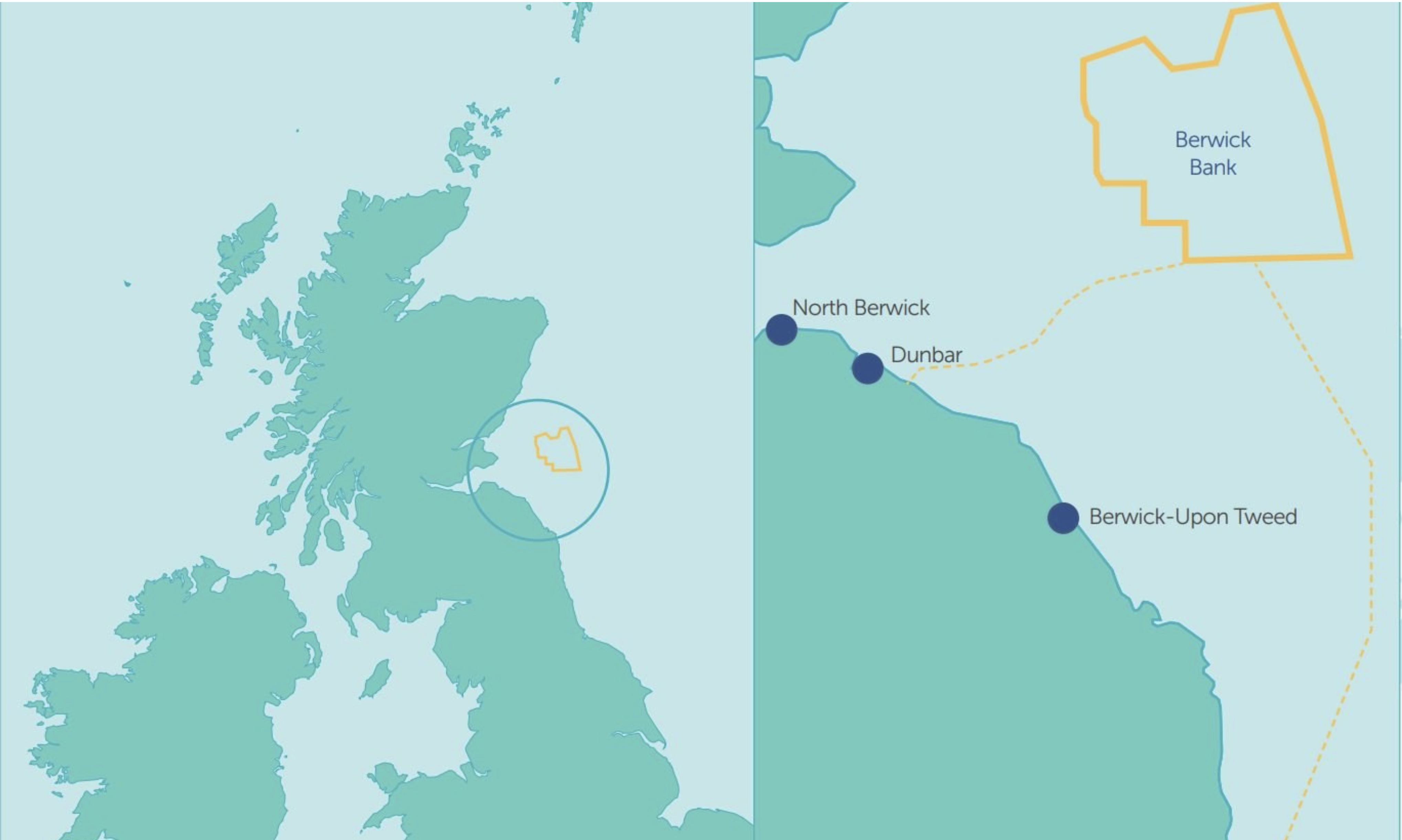
The press release says this about connections to the grid.
Berwick Bank has secured a grid connection at Branxton, near Torness, in East Lothian. A second grid connection will be required for the project, which has been determined as Blyth, Northumberland.
Note, that Torness is the site of Torness nuclear power station.
- It has a nameplate capacity of 1.29 GW.
- It is scheduled to be shutdown in 2028.
This Google Map shows the coast between Dunbar and Torness nuclear power station.
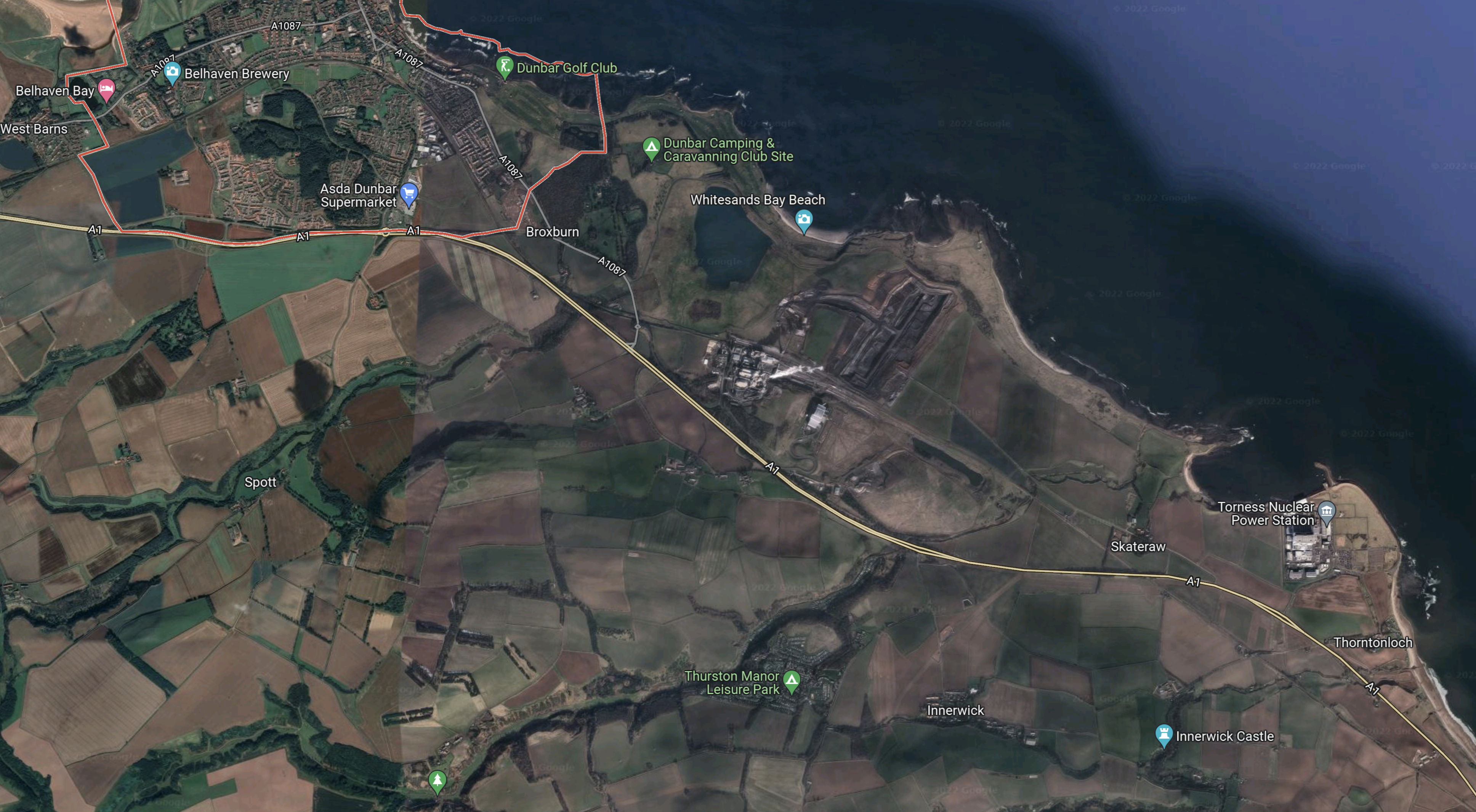
Note.
- The town of Dunbar is outlined in red.
- The yellow line running diagonally across the map is the A1 road.
- Torness nuclear power station is in the South-East corner of the map to the North of the A1.
This second Google Map shoes an enlargement of the South-East corner of the map.
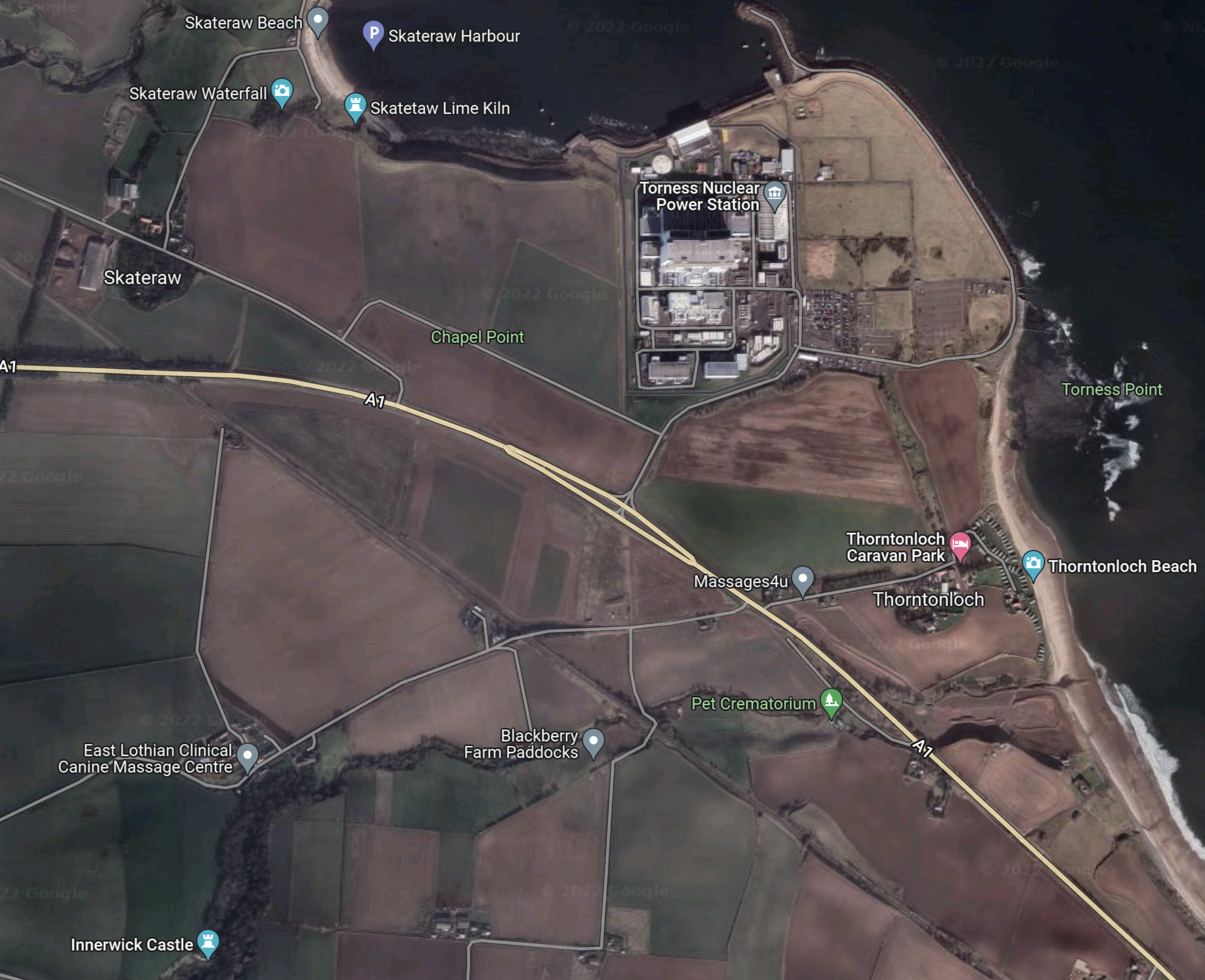
Note.
- Torness nuclear power station at the top of the map.
- The A1 road running across the map.
- The East Coast Main Line to the South of the A1.
- Innerwick Castle in the South-West corner of the map.
This Google Map shows the location of Branxton substation in relation to Innerwick Castle.
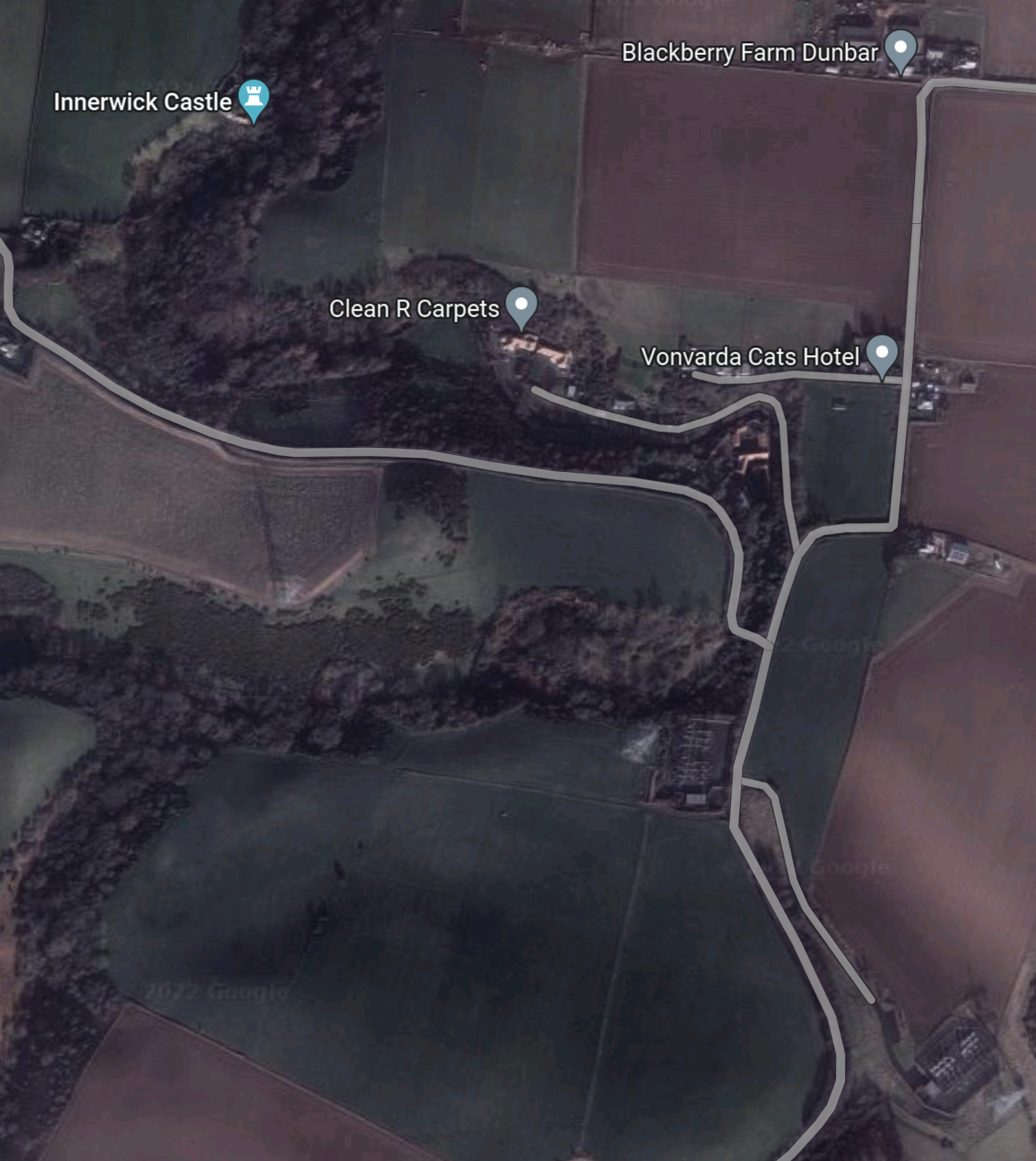
Note.
- Innerwick Castle is in the North-West corner of the map.
- Branxton substation is in the South-East corner of the map.
I estimate that the distance between Torness nuclear power station and Branxton substation is about five kilometres. The cable appears to be underground.
I have some thoughts.
Will The Connection Between Berwick Bank Wind Farm And Branxton Substation Be Underground?
If SSE follows the precedent of Torness nuclear power station, it will be underground.
Or will they use T-pylons?
This page on the National Grid web site is entitled What’s A T-Pylon And How Do We Build Them?.
From an engineering point of view, I suspect T-pylons could be used, but aesthetics and local preference may mean the cable is underground.
It should be noted that Torness nuclear power station will be shutdown in 2028. So will the current underground cable for the nuclear power station be repurposed after shutdown for the Berwick Bank wind farm?
This would mean, that the Southern connection cable to Blyth could be built first to support the first turbines erected in the wind farm.
When Will Berwick Bank Wind Farm Be Commissioned?
This page on the Berwick Bank wind farm web site is a briefing pack on the project.
The page gives construction and commission dates of 2026-2030.
Will There Be A Battery At Torness?
As we are talking about the latter half of the current decade for completion of the Berwick Bank wind farm, I believe that a substantial battery could be installed at Torness to smooth the output of the wind farm, when the wins isn’t blowing at full power.
One of Highview Power’s 2.5 GW/30 GWh CRYOBatteries could be about the right size if it has been successfully developed, but I am sure that other batteries will be of a suitable size.
If there is a case for a battery at Torness, there must surely be a case for a battery at Blyth.
Will Berwick Bank Wind Farm Be A Replacement For Torness Nuclear Power Station?
Consider.
- Torness nuclear power station is shutting down in 2028.
- Berwick Bank wind farm will be fully operational by 2030.
- Berwick Bank wind farm could use a repurposed connection to Branxton substation, if the nuclear power station no longer needs it.
- There is space on the Torness site for a large battery.
, it looks like Torness nuclear power station could be replaced by the larger wind farm.
Should The World Call A Halt To Large Nuclear Power Stations?
When I left Liverpool University in the 1960s with an engineering degree, my fellow graduates and myself felt that nuclear power would be a sensible way to provide the electricity we need. Aberfan and other disasters had ruined coal’s reputation and not one of my colleagues joined the National Coal Board.
Over the intervening years, nuclear power has suffered a greater proportion of adverse events compared to other forms of electricity generation.
Large nuclear has also suffered some of the largest time and cost overruns of any energy projects.
My optimism for nuclear power has declined, although I do hope and feel, that small modular factory-built reactors, like those proposed by Rolls-Royce and others, might prove to be as reliable and economic as gas-fired, hydro-electric and tidal power stations, or solar and wind farms.
The smaller size of an SMR could be advantageous in itself.
- Smaller factory-built power stations are more likely to be built on time and budget.
- The amount pf nuclear material involved is only about twenty percent of that of a large nuclear station.
- A smaller site would be easier to protect from terrorists and Putinistas.
- Would the risk of a serious accident be reduced?
- SMRs would be less of a blot on the landscape.
- SMRs would not need such a high-capacity grid connection.
- An SMR integrated with a high temperature electrolyser could be the easiest way to generate hydrogen for a large customer like a steelworks.
Overall, I believe an SMR would be involve less risk and disruption.
Zaporizhzhya
Zaporizhzhya is probably the last straw for large nuclear, although the incident isorchestrated by an evil dictator, who is much worse, than any of James Bond’s cruel adversities.
I doubt Putin would get the same leverage, if Zaporizhzhya were a gas-fired or hydroelectric power station.
Conclusion
I feel, the world must seriously question building any more large nuclear power stations.
The Rolls-Royce SMR Web Site
Rolls-Royce now have a web site for their proposed small modular reactor (SMR) design.
This page is entitled Why Rolls-Royce SMR?, has this outline of the reactor program.
Rolls-Royce SMR offers a radically different approach to delivering nuclear power, we have drastically reduced the amount of construction activities and transformed the delivery environment, from a large complex infrastructure programme into a factory built commoditised product.
Our design has evolved in response to a definitive set of market driven outcomes, this is not technology for technology’s sake, but innovation, to create a transformational clean energy solution that will deliver clean affordable energy for all.
This would appear to be an approach driven by proven engineering principles and excellence, good low-risk design, backed up by the best project management.
These are all traditions inherent in the Rolls-Royce DNA.
But I also believe that Rolls-Royce have looked at the world market for nuclear reactors and designed a product to fit that market.
This paragraph is in a long section entitled Global & Scalable.
The compact footprint increases site flexibility and maximises potential plant locations, including replacement for existing coal or gas-fired plants.
Many things said on the Rolls-Royce SMR Web Site, appear to be very much market led.
In my view, this is the web site of a product designed to dominate the world market for nuclear energy.
Sizewell C Nuclear Plant Campaigners Challenge Approval
The title of this post, is the same as that of this article on the BBC.
These three paragraphs introduce the article.
Campaigners against the Sizewell C nuclear power station have written to Business Secretary Kwasi Kwarteng to legally challenge his decision to give the scheme the go-ahead.
The £20bn project for the Suffolk coast was given government approval in July.
However, the decision was against the advice of the Planning Inspectorate and those against the scheme said the consent was therefore “unlawful”.
I summed up my attitude to nuclear power in Sizewell C: Nuclear Power Station Plans For Suffolk Submitted, where I said this.
As a well-read and experienced engineer, I am not against the technologies of nuclear power.
But I do think, by the time it is completed , other technologies like wind and energy storage will be much better value. They will also be more flexible and easier to expand, should we get our energy forecasts wrong.
I wrote that in May 2020, which was before Vlad the Mad started his war in Ukraine. So our energy forecasts are totally wrong! Thanks for nothing, Vlad!
In Plan To Build £150m Green Hydrogen Plant At Felixstowe Port, I talked about ScottishPower’s plan to build a large electrolyser at Felixstowe.
The Port of Felixstowe has in the past talked of using electricity from Sizewell C to create hydrogen.
So is the port backing another horse or just playing safe?
Rolls-Royce Chief Warren East Spies Rebound For Air Travel
The title of this post, is the same as that of this article on The Times.
It is a must-read article.
This is the first paragraph.
Warren East, the outgoing chief executive of Rolls-Royce, has sounded a bullish note on aviation’s recovery from Covid-19, reporting increased demand from the jet-engine maker’s airline customers and expressing his belief that China will gradually open up to international travel.
Certainly, with all the chaos at the Channel this weekend, people are starting to travel again.
Support For The Military
This is a paragraph in the article.
Tom Bell, head of Rolls-Royce Defence, said the company was in talks with the US and UK militaries about supplying “deployable” reactors for military bases.
I’m sure that a reactor would have advantages to a large diesel or gas-turbine generator to power a military base.
- Military bases need a lot of power.
- It would not need refuelling every day.
- It could be connected to an electrolyser, to generate hydrogen for vehicles.
- It would be a lot quieter.
- I wonder, if it could be transported in a large transport aircraft.
But I feel, it might have other applications.
- It could provide power support after a large earthquake or natural disaster.
- It could provide power in remote or difficult locations.
- If the only power station for a remote community had a catastrophic failure, a deployable reactor could be brought in.
- It could provide power for a large construction site, which would help to decarbonise the construction.
- Power would be zero-carbon at point of generation.
The reactors might even be rail-transportable, so they could be moved to where they are needed safely and quickly.
But I don’t think they would necessarily be the same size as the Rolls-Royce SMRs, which are 470 MW.
A Scalable Reactor
This is a paragraph in the article.
Rolls also has a contract with the UK Space Agency to develop a “micro reactor” for space vehicles and satellites, Bell added. “These are really exciting opportunities for us to not only perpetuate our business undersea, at sea, on land, in the air, but also to go to space,” he said. East noted the advantage of nuclear reactors in space: “You can’t have air-breathing engines on the moon.”
Note.
- East is Warren East, who is the outgoing Chief Executive of Rolls-Royce.
- Nuclear power sources have been used in space before, usually by using an isotope, that gives out heat, as it decays.
- How small is micro?
- The US deployed a 1.75 MW nuclear power plant in Antarctica under the Army Nuclear Power Program. That reactor also provided heating and hot water. It is worth reading the Wikipedia entry, especially the section about the MM-1 reactor.
It does seem that Rolls-Royce are designing a reactor that can be scaled in size, to cover a whole spectrum of applications.
Could Rolls-Royce SMRs Be The Solution To Europe’s Gas Shortage?
Of all the offshore wind farms, that I’ve looked at recently, I find Magnora’s ScotWind N3 wind farm the most interesting.
I wrote about it in ScotWind N3 Offshore Wind Farm.
I said this.
In any design competition, there is usually at least one design, that is not look like any of the others.
In the successful bids for the ScotWind leases, the bid from Magnora ASA stands out.
- The company has an unusual home page on its offshore wind web site.
- This page on their web site outlines their project.
- It will be technology agnostic, with 15MW turbines and a total capacity of 500MW
- It will use floating offshore wind with a concrete floater
- It is estimated, that it will have a capacity factor of 56 %.
- The water depth will be an astonishing 106-125m
- The construction and operation will use local facilities at Stornoway and Kishorn Ports.
- The floater will have local and Scottish content.
- The project will use UK operated vessels.
- Hydrogen is mentioned.
- Consent is planned for 2026, with construction starting in 2028 and completion in 2030.
This project could serve as a model for wind farms all round the world with a 500 MW power station, hydrogen production and local involvement and construction.
I very much like the idea of a concrete floater, which contains a huge electrolyser and gas storage, that is surrounded by an armada of giant floating wind turbines.
These are my thoughts.
Floating Concrete Structures
To many, they may have appear to have all the buoyancy of a lead balloon, but semi-submersible platforms made from concrete have been used in the oil and gas industry for several decades.
Kishorn Yard in Scotland was used to build the 600,000-tonne concrete Ninian Central Platform,in 1978. The Ninian Central Platform still holds the record as the largest movable object ever created by man.
The Ninian Central Platform sits on the sea floor, but there is no reason why a semi-submersible structure can’t be used.
Electrolysers
There is no reason, why a large electrolyser, such as those made by Cummins, ITM Power or others can’t be used, but others are on the way.
- Bloom Energy are working on high temperature electrolysis, which promises to be more efficient.
- Torvex Energy are developing electrolysis technology that used sea water, rather than more expensive purified water.
High Temperature Electrolysis
High temperature electrolysis needs a heat source to work efficiently and in Westinghouse And Bloom Energy To Team Up For Pink Hydrogen, I described how Bloom Energy propose to use steam from a large nuclear power station.
Offshore Nuclear Power
I’ve never heard of offshore nuclear power, but it is not a new idea.
In 1970, a company called Offshore Power Systems was created and it is introduced in its Wikipedia entry like this.
Offshore Power Systems (OPS) was a 1970 joint venture between Westinghouse Electric Company, which constructed nuclear generating plants, and Newport News Shipbuilding and Drydock, which had recently merged with Tenneco, to create floating nuclear power plants at Jacksonville, Florida.
Westinghouse’s reactor was a 1.150 MW unit, which was typical of the time, and is very similar in size to Sizewell B.
The project was cancelled before the reactors were towed into position.
Nuclear Knowledge Has Improved
Consider.
- In the fifty years since Offshore Power Systems dabbed their toes in the water of offshore nuclear power, our knowledge of nuclear systems and engineering has improved greatly.
- The offshore oil and gas industry has also shown what works impeccably.
- The floating offshore wind industry looks like it might push the envelop further.
- There has been only one nuclear accident at Fukushima, where the sea was part of the problem and that disaster taught us a lot.
- There have been a large number of nuclear submarines built and most reached the planned end of their lives.
- Would a small modular nuclear reactor, be safer than a large nuclear power plant of several GW?
I would suggest we now have the knowledge to safely build and operate a nuclear reactor on a proven semi-submersible platform, built from non-rusting concrete.
An Offshore Wind Farm/Small Modular Reactor Combination Producing Hydrogen
Consider.
- A typical floating offshore wind farm is between one and two gigawatts.
- A Rolls-Royce small modular reactor is sized to produce nearly 0.5 GW.
- The high temperature electrolyser will need some heat to achieve an optimum working temperature.
- Spare electricity can be used to produce hydrogen.
- Hydrogen can be stored platform.
- Hydrogen can be sent ashore using existing gas pipes.
- Hydrogen could even be blended with natural gas produced offshore to create a lower-carbon fuel.
- It would also be possible to decarbonise nearby offshore infrastructure.
A balance between wind and nuclear power can be obtained, which would provide a steady output of energy.
Conclusion
There are a large numbers of possibilities, to locate a Rolls-Royce small modular reactor close to a wind farm to use high temperature electrolysis to create green hydrogen, which can be used in the UK or exported through the gas network.
Nuclear-Enabled Hydrogen – How It Helps To Reach Net Zero
The title of this post, is the same as that of this article on Power Engineering.
These are the first two paragraphs.
Nuclear enabled hydrogen is zero carbon, has low cost energy input, is large scale and offers co-location synergy and energy system connectivity.
With the revival of interest in nuclear energy, interest is growing in the potential for nuclear-enabled hydrogen, otherwise sometimes known as ‘pink’ hydrogen, to meet the anticipated demand for hydrogen at scale.
The article is certainly a must-read.
Topics covered include.
- Co-location of pink hydrogen production with industrial clusters, where heat can also be provided.
- The production of hydrogen on a large scale.
- The use of high temperature electrolysis, using steam from the nuclear plant.
I particularly like the idea of combining a small modular nuclear reactor with high temperature electrolysis to generate hydrogen for local industry like a steelworks or chemical plant.
Westinghouse And Bloom Energy To Team Up For Pink Hydrogen
The title of this post, is the same as that of this article on Hydrogen Fuel News.
This is the introductory paragraph.
Westinghouse Electric Company and Bloom Energy Corporation have announced that they have signed a letter of intent together for the production of pink hydrogen in the commercial nuclear power market.
Note.
- Westinghouse Electric Company is an American builder of nuclear power stations.
- Bloom Energy Corporation make a solid-oxide electrolyser.
- Pink hydrogen is green hydrogen produced using nuclear power.
Figures on the Bloom web site, claim that their electrolysers could be upwards of twelve percent more efficient than PEM electrolysers, as produced by companies like ITM Power.
Bloom Energy Vice President of Hydrogen Business Rick Beuttel, is quoted as saying this.
We are proud Westinghouse has turned to Bloom and our solid oxide technology to supercharge the clean hydrogen economy. Solid oxide technology is well suited for nuclear applications, efficiently harnessing steam to further improve the economics of hydrogen production. High temperature electrolysis is already garnering attention and accolades as a cost-effective and viable solution to create low-cost, clean hydrogen, which is critical to meeting aggressive decarbonization goals.
It sounds that by integrating the nuclear power station and the electrolyser, there are cost savings to be made.
Conclusion
I think this could turn out to be a significant development.
Some countries, like Iceland, Indonesia, New Zealand, Philippines and the United States, who can generate large amounts of electricity and steam from geothermal energy, Bloom’s technology must surely be a way of electrolysing hydrogen.
 The Anonymous Widower