Delta And Centrica Launch Scalable Off-Grid Fuel Cell Power Solution
The title of this post, is the same as that of this news item from Centrica.
The news item is accompanied by this picture.
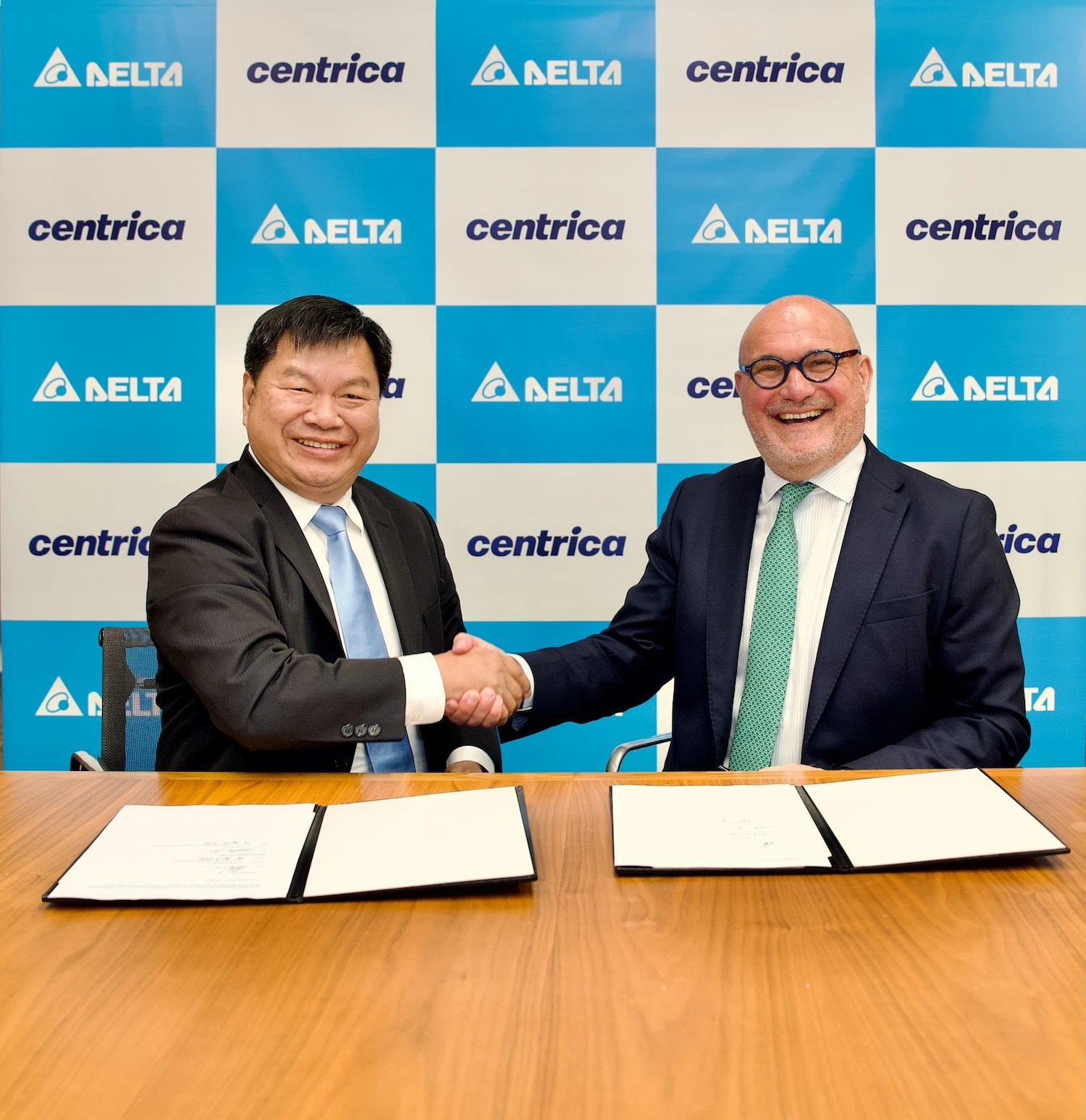
So who is the happy oriental-looking guy sitting with the equally-happy Robert Booker, who is Chief Strategy and Transformation Officer at Centrica?
He is Charles Tsai, General Manager of Hydrogen Energy BD at Delta Electronics Inc.
Google AI produces this answer to “Who Are Delta Electronics Inc.”
Delta Electronics, Inc. is a Taiwan-based global leader in power and thermal management solutions, founded in 1971. Renowned as the world’s top provider of switching power supplies and DC brushless fans, they focus on energy-efficient, IoT-based smart solutions for industrial automation, EV charging, data centers, and renewable energy.
Core Business Areas
Power Electronics: A global leader in switching power supplies, thermal management, and components for cloud computing and electric vehicles (EVs).
Automation: Offers industrial and building automation systems to enhance manufacturing efficiency.
Infrastructure: Provides data center infrastructure, EV charging solutions, and telecom power systems.
Key Facts and Highlights
Market Position: Often cited as the world’s largest provider of computer power supplies, with significant market share in server power units.
Sustainability Focus: Dedicated to “innovative, clean and efficient energy solutions” with a strong ESG (Environmental, Social, and Governance) focus.
Global Presence: Operates manufacturing plants and R&D centers worldwide, including Taiwan, China, Thailand, Mexico, India, and Europe.
Financials: Publicly listed on the Taiwan Stock Exchange (code: 2308).
Delta Electronics serves industries looking for energy-efficient, AI-ready, and sustainable technology solutions.
Delta Electronics has had an R & D facility in East Kilbride in Scotland for nearly ten years.
This is the sub-heading of Centrica’s news item.
Centrica and Delta Electronics, Inc. today announced an infrastructure partnership to serve the data centre market and energy intensive industries in the UK and Europe, launching with Solid Oxide Fuel Cells (SOFCs) for off-grid energy generation.
These two paragraphs add more detail to the partnership.
This partnership creates a pathway for offering customers competitively priced, on-site power generation, significantly reducing exposure to wholesale electricity market volatility and grid capacity constraints. The partners plan to establish a demonstration site in the UK within the next 12 months, with a medium-term goal of delivering MW-scale, rapidly deployable ‘gas-to-power’ solutions within the next three to five years.
Delta’s SOFCs, licensed by British solid oxide technology leader Ceres, provide stable, low-carbon energy fuelled by natural gas and reach 60% electrical efficiency – significantly higher than the open-cycle gas turbines typically used for on-site and back up generation (35%-42%). These cells are designed to meet the growing power demands of data-intensive digital infrastructure in the UK and Europe which underpin economic growth, digital sovereignty and the energy transition.
This partnership appears to be a partnership of three world-leading companies doing what they do best, to efficiently satisfy the enormous power need for data centres and energy intensive industries.
- Centrica will make sure, that there is enough natural gas. They have a strong reputation for trading gas and source it from all over the world.
- Ceres will provide the Solid Oxide Fuel Cells (SOFCs), that will efficiently convert this natural gas into electricity. Ceres’s SOFCs are fifty percent more efficient than open-cycle gas turbines, which is a large improvement.
- Delta Elctronics then work their high power electronic wizardry to supply the electricity.
Nothing is said about what happens to all the carbon dioxide. It will certainly be captured and will probably be of food grade, but this could be the next piece of the jigsaw that Centrica are putting together.
Is This The World’s Best Renewable Energy Video?
This is a promotional video from Minesto about their Deep Green technology.
Is it a serious proposition or is it just kite-flying?
After reading their web site in detail, I think they are serious.
Here’s why!
The Company Is A Well-Backed Spin-Out from Swedish Aerospace Company SAAB
These two paragraphs are from the About Us page.
Minesto is a marine energy technology developer, founded in 2007 as a spin-off from Swedish aerospace manufacturer Saab. Since then, Minesto has successfully developed its unique Deep Green technology.
The company has operations in Sweden, Wales, Northern Ireland and Taiwan, with headquarters in Gothenburg, Sweden. Main owners are BGA Invest and Midroc New Technology. The Minesto share is listed on the Nasdaq First North Growth Market in Stockholm.
A company rarely succeeds without appropriate and sufficient financial backing.
One Of Their Target Markets Is Powering Remote Islands
This page from World Atlas is entitled Which Countries Have The Most Islands?
These are the top five countries.
- Sweden – 267,570
- Norway – 239,057
- Finland – 178,947
- Canada – 52,455
- United States – 18,617
Note.
- That’s a lot of islands.
- The United Kingdom is 26th with a thousand islands.
- Scandinavia has 685574 islands or 686993 if you include Denmark.
Sweden has a thousand inhabited islands, so that means that in Scandinavia alone, there are about 2,500 inhabited islands. How many need a reliable decarbonised power supply?
In the UK, we are developing Remote Island Wind to serve similar locations, which I wrote about in The Concept Of Remote Island Wind.
The UK and Minesto are both looking at the supply of power to remote islands.
One of Minesto’s projects is in the Faroe Islands and it is described in this page on the Minesto web site, which has a title of Faroe Islands – Tidal Energy To Reach 100% Renewable By 2030.
These are the first two paragraphs.
In the Faroe Islands, Minesto is part of one of the world’s most ambitious energy transition schemes.
Collaborating with the electric utility company SEV, Minesto is working to pave the way for tidal energy to become a core part of the Faroese energy mix, allowing them to reach 100% renewable energy by 2030.
Onshore wind and tidal could be an ideal combination, if they worked together.
At the bottom of the Faroe Islands page, the web site talks about The Deep Green Island Mode Project, where this is said.
In June 2019, Minesto was awarded a €2.5 million grant from the European Commission’s SME Instrument programme. The awarded funding will support the installation of Minesto’s technology in the Faroe Islands together with the utility company SEV. The aim of the project, called Deep Green Island Mode (DGIM), is to install Minesto’s first two commercially viable microgrid units in a production and customer environment.
Successful demonstration of DGIM will act as a first step to developing commercial ties with utilities across Europe, both for smaller-scale microgrid systems and as a catalyst for the market up take of larger utility-scale Deep Green systems.
This is also said about the number of installations in Europe.
15 million Europeans live on Europe’s 2,400 inhabited islands, at an average of approximately 1,500 households per island. As recognised by the European Commission, island energy is expensive, polluting, inefficient and dependent on external supply, with significant negative impacts on emissions, the competitiveness of businesses, and the economy.
It appears to me, that Minesto have researched their market well.
Minesto Can Provide Baseload Power
Another of Minesto’s projects is in Taiwan and it is described in this page on the Minesto web site, which has a title of Taiwan – Replacing Nuclear With Renewable Baseload.
These are the first two paragraphs.
In Taiwan, Minesto is carrying out site development with the purpose to establish the first tidal energy arrays with Minesto’s technology in Asia – and to demonstrate renewable baseload generation from the continuously-flowing Kuroshio current.
The conditions for extracting marine energy in Taiwan are very good due to access to both tidal streams and continuous ocean currents. Taiwan aims to produces 20% of electricity from renewable sources by 2025 and has decided to scrap its nuclear power capacity within the same timeframe. Today, 97.5 percent of the country’s total energy use comes from imported fossil fuels.
Taiwan has a well-developed industrial infrastructure and a number of stakeholders in the private and public sectors are active in marine energy.
Decarbonising Taiwan and removing nuclear is a tough ask!
Conclusion
Minesto may be kite-flying in an unusual way, but they appear to be a very serious Swedish company.

