Rolls-Royce And Duisport Launch CO2-Neutral, Self-Sufficient Energy System For New Port Terminal
The title of this port is the same as that of this press release from Rolls-Royce.
These two bullet points act as sub-headings.
- First mtu hydrogen CHP units, battery storage systems and fuel cell systems from Rolls-Royce in operation.
- Benchmark for sustainable energy supply in logistics centers worldwide.
These three paragraphs give more details of the project.
Rolls-Royce and Duisburger Hafen AG have opened a CO2-neutral and self-sufficient energy system for the new Duisburg Gateway Terminal, located in the Rhine-Ruhr industrial region of Germany. The core components are two mtu combined heat and power units designed for operation with 100 percent hydrogen, which are being used here for the first time worldwide. The system is supplemented by an mtu battery storage system, mtu fuel cell systems and a photovoltaic system integrated via an intelligent energy management system.
The Enerport II flagship project, funded by the German Federal Ministry for Economic Affairs and Energy, is setting new standards for sustainable energy supply in large logistics centers and is considered a model for other ports, infrastructure projects and industrial facilities. Project partners include the Fraunhofer Institute UMSICHT, Westenergie Netzservice GmbH, Netze Duisburg GmbH, Stadtwerke Duisburg AG, and Stadtwerke Duisburg Energiehandel GmbH.
“The launch of this carbon-neutral energy system at the Duisburg Gateway Terminal is a big step toward a more climate-friendly, resilient energy supply. Together with our partner duisport, we’re showing how scalable technologies from Rolls-Royce can really help transform critical infrastructure – and help make the energy transition happen,” said Dr. Jörg Stratmann, CEO of Rolls-Royce Power Systems.
Note.
- It is carbon-neutral.
- The system uses both hydrogen and solar power.
- What has been created at the Port of Duisburg is considered by the German Federal Ministry for Economic Affairs and Energy to be a model for other ports, infrastructure projects and industrial facilities.
- It surely must help sales, that the flagship project is up and running.
In November 2021, I wrote about this project in Rolls-Royce Makes Duisburg Container Terminal Climate Neutral With MTU Hydrogen Technology, which included this graphic.

It seems that Heathrow Airport could have a use for this technology.
I have one important thought.
Where Will The Port Of Duisburg Get The Hydrogen It Needs?
In the graphic an Electrolyser and H2 Storage are clearly shown, as are the two H2 Combined Heat and Power Units.
So it looks like the Port of Duisburg will be generating their own green hydrogen.
Alternatively in April 2021, I wrote Uniper To Make Wilhelmshaven German Hub For Green Hydrogen; Green Ammonia Import Terminal.
Uniper’s plans for the Wilhelmshaven hydrogen hub include a 410 MW hydrogen electrolyser.
The Germans are also developing a project called AquaVentus to bring green hydrogen to Germany from the North Sea.
I asked Google AI, where AquaVentus would make landfall in Germany and got this answer.
The AquaVentus project’s planned offshore hydrogen pipeline, AquaDuctus, is intended to make landfall in the greater Wilhelmshaven or Büsum area in Germany, according to the AquaDuctus website. This pipeline is part of a larger plan to transport green hydrogen produced from offshore wind farms in the North Sea to the German mainland for distribution and use.
Wilhelmshaven and Duisburg is 194 miles.
Hydrogen could be delivered onward from Ludwigshaven to Southern Germany by a pipeline network called H2ercules.
I asked Google AI if the H2ercules hydrogen pipeline will connect to Duisburg and got this answer.
Yes, the H2ercules hydrogen network will connect to Duisburg. Specifically, a new 40-kilometer pipeline will be constructed from Dorsten to Duisburg-Walsum, connecting to the steelworks there, as part of the GET H2 pipeline extension according to thyssenkrupp Steel. This connection is part of the larger H2ercules project, which aims to create a hydrogen infrastructure backbone for Germany and beyond. The pipeline is scheduled to be operational in 2027, with thyssenkrupp Steel being connected in 2028.
It would appear that at some date in the not too distant future that the Port of Duisburg could be powered by green hydrogen from the North Sea, imported into Germany at Wilhelmshaven.
The German plans for hydrogen are extensive and it appears that the Port of Duisburg could have two sources for the hydrogen it needs.
Would You Buy A Battery Energy Storage System From Rolls-Royce?
I don’t often click on adverts that appear in web pages.
But I had to click on one from Rolls-Royce mtu, which advertised Battery Energy Storage Systems.
I wonder what the Honourable Charles Rolls would have thought of adverts on the Internet for the company he jointly founded?
I suspect he would have liked the idea, as Rolls was very much a promoter of motoring and aviation and opened one of the first car dealerships in the UK, according to his Wikipedia entry.
The Wikipedia entry for his business partner; Sir Henry Royce starts with this sentence.
Sir Frederick Henry Royce, 1st Baronet, OBE (27 March 1863 – 22 April 1933) was an English engineer famous for his designs of car and aeroplane engines with a reputation for reliability and longevity.
He is also described as a perfectionist.
This sentence from the Wikipedia entry, describes how he started the design of the legendary “R” engine.
In October 1928, he began design of the “R” engine while walking with some of his leading engineers on the beach at West Wittering, sketching ideas in the sand. Less than a year later, the “R” engine, designed in his studio in the village, set a new world air speed record of 357.7 miles per hour and won the Schneider Trophy of 1929.
Later with help from the maddest person my father ever met (his words, not mine!) ; Lady Houston, the Supermarine S.6B won the trophy in 1931 and then broke the world speed record at over 400 mph. Not bad for a seaplane. Take the floats off an S.6B and you almost have a Spitfire.
The Wikipedia entry also describes how the “R” engine was developed into what many engineers believe was the finest internal combustion engine of all time; the Rolls-Royce Merlin.
Following the success of the “R” engine, it was clear that they had an engine that would be of use to the Royal Air Force. As no Government assistance was forthcoming at first, in the national interest they went ahead with development of what was called the “PV-12” engine (standing for Private Venture, 12-cylinder). The idea was to produce an engine of about the same performance as the “R”, albeit with a much longer life. Rolls-Royce launched the PV-12 in October 1933 and the engine completed its first test in 1934, the year after Royce died. The PV-12 became the Rolls-Royce Merlin engine.
Where would we have been in the Battle of Britain without the Merlin engine?
Since 1969, the engineers at Rolls-Royce have followed Sir Henry’s example of perfection and developed the revolutionary RB-211 into the modern day Trent, which is now about to take a big leap into a low-carbon future with the UltraFan.
If the quality of Rolls-Royce mtu’s Battery Energy Storage System matches the levels of perfection Rolls-Royce achieved with the Merlin and the Trent, then I suspect that Sir Henry would have given his approval.
This picture is shown on the web page for the Battery Energy Storage System.

These two paragraphs introduce, what Rolls-Royce mtu are calling the mtuEnergyPack.
In today’s world of economic growth and increasing populations, the demand for electricity is soaring. Governments and industries globally shift to distributed renewable energy, challenging centralized grids. To adapt to this changing energy landscape, the mtuEnergyPack offers an ideal solution.
It integrates renewable sources like solar and wind power, paving the way for future-ready sustainable power systems. The mtu EnergyPack is a scalable, all-in-one solution for autonomous off-grid facilities. It ensures reliable power through peak shaving, load-shifting, and grid stabilization, making it suitable for various applications.
These are my thoughts.
What Is The Output And The Storage Capacity?
This paragraph on this page gives this answer.
It efficiently stores electricity from distributed sources and delivers on demand. The mtu EnergyPack is available in different sizes: The QS and the QL, ranging from 200 kVA to 2,000 kVA, and from 312 kWh to 2,084 kWh, and the QG for grid scale storage needs, ranging from 4,400 kVA and 4,470 kWh to virtually any size.
It seems that you specify your requirements and Rolls-Royce mtu should be able to satisfy it.
What Devices Can Be Connected?
This paragraph on this page gives this answer.
The mtu EnergyPack serves as a key component in enhancing the reliability and profitability of microgrids and energy systems. It stores electricity generated by distributed power sources, including gensets, wind turbines, or solar panels, and delivers it when needed.
In the 1970s, when I was working at ICI, others in the section were working on a system called MEDIA, where every sensor on a chemical plant was connected to the central computer, through its own analog-to-digital computer. It would now be called plug-and-play by some.
I believe that Rolls-Royce mtu are using similar ideas to connect equipment to the control computer.
These are my thoughts about connecting various equipment.
- Hydrogen-powered generators and electrolysers as Rolls-Royce mtu are using at Duisburg, which I wrote about in Rolls-Royce Makes Duisburg Container Terminal Climate Neutral With MTU Hydrogen Technology.
- Could Rolls-Royce’s beer keg-sized 2.5 MW electrical generator based on a Super Hercules engine, be connected?
- Could a Rolls-Royce Trent be connected?
- Could one of Rolls-Royce’s small modular nuclear reactors be connected?
- In Rolls-Royce To Play Key Role In US Department Of Defense Nuclear Microreactor Program, I talk about developing a 1-5 MW nuclear reactor for US Department of Defense. Could these be connected?
I don’t see why every device can’t work to the same protocol.
What Is The Power Density Like?
This paragraph on this page gives this answer.
The mtu EnergyPack’s compact battery system designs suit projects with limited space and logistical restrictions.
In ‘Spirit of Innovation’ Stakes Claim To Be The World’s Fastest All-Electric Vehicle, I talked about Rolls-Royce’s record-breaking electric plane called Spirit of Innovation.
Has what has been learned about energy storage in the confined spaces of an aeroplane been applied to a Battery Energy Storage System?
What Do Rolls-Royce mtu Consider To Be Important Features?
On this page, they list these features.
- Power Density
- Digitally Connected
- Multilevel Safety
- Black Start Capability
- Scalability
- Ultra-Fast Response
- Flexible Use
- Plug-And-Play Installation
The design seems to have everything covered.
Can Similar Systems Be Designed By Others?
I would expect that similar systems can be designed, as technology like batteries is available to all and the operation is only as good as the software controlling the various components of the system.
But similar systems will be without the famous Rolls-Royce logo.
Could One Of These Systems Decarbonise A Village?
I once lived in a village with about fifty houses and perhaps a hundred inhabitants.
- There was an old World War Two airfield, that could probably accommodate a small wind farm of perhaps 20 MW.
- There were a couple of barns and large sheds, that could have solar panels similar to those I described in Bedford Depot’s Massive Solar Roof Helps Thameslink On Way To Net Zero.
I suspect an mtuEnergyPack could control all these inputs and provide the village with the following.
- Enough electricity to power all the needs of the inhabitants, businesses and their vehicles.
- If an electrolyser were to be provided, it could probably produce enough hydrogen to power every boiler and hydrogen-powered vehicle.
Note.
- Farmers would like the local availability of hydrogen, as it will be ideal for tractors and agricultural machinery.
- I actually believe that if a village had a reliable and affordable hydrogen supply, that a large proportion of the inhabitants would switch to hydrogen-powered vehicles.
There would still be the National Grid there for backup.
Conclusion
If I needed an mtuEnergyPack, I’d certainly give one a close look.
Rolls-Royce Successfully Tests mtu Engines With Pure Hydrogen
The title of this post, is the same as that of this press release from Rolls-Royce.
These are the two bullet points.
- mtu gensets and cogeneration units to be further developed for 100% hydrogen use
- First use in the new CO2-neutral container terminal in the German inland port of Duisburg
This is the first paragraph.
Rolls-Royce (LSE: RR., ADR: RYCEY) today announces that it has conducted successful tests of a 12-cylinder gas variant of the mtu Series 4000 L64 engine running on 100% hydrogen fuel. The tests, carried out by the Power Systems business unit, showed very good characteristics in terms of efficiency, performance, emissions and combustion. These tests mark another important step towards the commercial introduction of hydrogen solutions to meet the demand of customers for more sustainable energy.
Note.
- Rolls-Royce mtu have converted and tested a natural gas version of the Series 4000 L64 engine.
- The Class 43 power cars used in the iconic InterCity 125 train and powered by mtu V16 4000 R41R engines.
Are the two engines related? If so, can Rolls-Royce mtu build a hydrogen engine that could power an InterCity 125?
It was a rapid development.
Andrea Prospero, an engineer at Rolls-Royce responsible for the development of the hydrogen engine, is quoted as saying.
We are very pleased with the rapid progress. The very low engine emissions are well below the strict EU limits, no exhaust gas aftertreatment is required.
Due to the different combustion behaviour of hydrogen compared to natural gas, some engine components including fuel injection, turbocharging, piston design and control, were modified in the test engine. However, by using proven technologies within the Power Systems’ portfolio, such as mtu turbochargers, injection valves, and engine electronics and control, the development of the engine to use hydrogen was advanced quickly and efficiently.
Diesel and natural gas internal combustion engine manufacturers like Cummins, Rolls-Royce mtu and several other companies, have a long history of research, that they have the knowledge to convert diesel or natural gas engines to hydrogen.
So far only Cummins, JCB and Rolls-Royce mtu have disclosed a multi-fuel line of engines.
First Deployment For CO2-Neutral Power Supply At Duisport
There is a section in the press release called First Deployment For CO2-Neutral Power Supply At Duisport, where this is said.
Duisport, one of the world’s largest inland ports, is working with several partners to build a hydrogen-based supply network for its new terminal, ready for operation in 2024. In the future, most of the electricity required by the port itself will be generated directly on site from hydrogen in a CO2-neutral manner. This will be achieved by two combined heat and power plants with mtu Series 4000 hydrogen engines (with a total installed capacity of 2MW) as well as three mtu fuel cell systems (with a total installed capacity 1.5MW).
As part of its sustainability program, Rolls-Royce is realigning the product portfolio of Power Systems towards more sustainable fuels and new technologies that can further reduce greenhouse gas emissions.
There is also this Rolls-Royce graphic, which shows the energy sources.
It would appear batteries, combined heap and power (CHP), grid electricity, hydrogen electrolyser, hydrogen storage and renewable electricity are being brought together to create a climate-neutral energy system.
Is this a world-first, where hydrogen engines and fuel cell systems will be working together?
Rolls-Royce To Develop mtu Hydrogen Electrolyser And Invest In Hoeller Electrolyser
The title of this post, is the same as that of this press release from Rolls-Royce.
These are the three main points in the press release.
- Holdings in start-up companies in northern Germany secure Rolls-Royce Power Systems access to key green hydrogen production technology.
- Electrolysis systems for several megawatts of power.
- First demonstrator in 2023 using a Hoeller stack.
This is the introductory paragraph to the deal.
Rolls-Royce is entering the hydrogen production market and acquiring a 54% majority stake in electrolysis stack specialist Hoeller Electrolyzer, whose innovative technology will form the basis of a new range of mtu electrolyzer products from its Power Systems division. Hoeller Electrolyzer, based in Wismar, Germany, is an early-stage technology company that is developing highly efficient polymer electrolyte membrane (PEM) stacks, under the brand name Prometheus, for the cost-effective production of hydrogen.
This page on the Hoeller Electrolysis web site gives details of Prometheus.
- Hoeller are planning small, medium and large electrolyser modules, the largest of which is rated at 1.4 MW.
- Load changes of between 0 and 100 % within seconds.
- Cold start capability.
- It will produce 635 Kg/day.
- They are talking of a cost of 4€/Kg.
It all sounds good to me.
This paragraph is from the press release.
Founded in 2016, Hoeller Electrolyzer has positioned itself, with Prometheus, as one of the few highly specialized expert players in the field of high-efficiency PEM electrolysis stacks. Its founder, Stefan Höller, has more than a quarter of a century’s experience of developing electrolysis technology and has already registered 14 patents connected with Prometheus. Particularly high efficiency is promised by special surface technologies for the bipolar plates which significantly reduce the use of expensive precious metals platinum and iridium as catalysts, as well as increased output pressure.
I know a small amount about electrolysis and feel that Rolls-Royce may have got themselves a high-class deal.
Rolls-Royce’s large German presence in companies like mtu, will also help to smooth any doubts about the deal.
This paragraph indicates a shared belief.
Rolls-Royce and Hoeller Electrolyzer are united by a shared belief in the opportunity of zero-carbon energy – both for power supply and the propulsion of heavy vehicles. With decades of experience and systems expertise, Rolls-Royce is going to develop a complete electrolyzer system and has a global sales and service network, which opens up the potential for significant worldwide sales.
But perhaps, this is the most significant paragraph of the press release.
Armin Fürderer, who heads up the Net Zero Solutions business unit of Power Systems, said: “We’re going to launch electrolyzers with several megawatts of power right from the start. A total output of over 100 megawatts is conceivable by combining several electrolyzers.”
A quick search of the Internet, indicates that 100 MW is the size of the world’s largest electrolysers.
Applications
I can see applications for these large electrolysers.
Rolls-Royce Power Systems
This is a sentence from the press release.
Hoeller Electrolyzer, whose innovative technology will form the basis of a new range of mtu electrolyzer products from its Power Systems division.
The Rolls-Royce Power Systems web site, has this mission statement.
The Power Systems Business Unit of Rolls-Royce is focused on creating sustainable, climate neutral solutions for drive, propulsion and power generation.
In Rolls-Royce Makes Duisburg Container Terminal Climate Neutral With MTU Hydrogen Technology, I describe one of Rolls-Royce Power Systems projects.
The title of this post, is the same as this press release from Rolls-Royce.
This is the first sentence.
Rolls-Royce will ensure a climate-neutral energy supply at the container terminal currently under construction at the Port of Duisburg, Germany.
There is also this Rolls-Royce graphic, which shows the energy sources.
It would appear batteries, combined heap and power (CHP), grid electricity, hydrogen electrolyser, hydrogen storage and renewable electricity are being brought together to create a climate-neutral energy system.
Note.
- The system uses a large hydrogen electrolyser.
- I suspect the hydrogen will be generated by off-peak electricity and local renewables.
- Hydrogen will probably power the container handling machines, ships, trucks, vehicles and other equipment in the port.
Hydrogen appears to be used as a means of storing energy and also for providing motive power.
I would suspect, the ultimate aim is that the port will not emit any carbon dioxide.
Other ports like Felixstowe and Holyhead seem to be going the hydrogen route.
Refuelling Hydrogen Buses and Charging Electric Buses
If you look at the Duisburg system, I can imagine a similar smaller system being used to refuel hydrogen buses and charge electric ones.
- The hydrogen electrolyser would be sized to create enough hydrogen for a day or so’s work.
- Hydrogen would be generated by off-peak electricity and local renewables.
- If an operator bought more buses, I’m certain that the architecture of the electrolyser would allow expansion.
- Hydrogen fuel cells would boost the electricity supply, when lots of buses needed to be charged.
- Any spare hydrogen could be sold to those who have hydrogen-powered vehicles.
- Any spare electricity could be sold back to the grid.
It should be noted that manufacturers like Wrightbus have developed a range of hydrogen and electric buses that use the same components. So will we see more mixed fleets of buses, where the best bus is assigned to each route?
I have used buses as an example, but the concept would apply to fleets of cars, trucks and vans.
Green Hydrogen
Large efficient electrolysers will surely be the key to producing large quantities of green hydrogen in the future.
It appears that about 55 MWh is needed to produce a tonne of green hydrogen using existing electrolysers.
The Hoeller electrolyser appears to be about 53 MWh, so it is more efficient.
Green Hydrogen From An Onshore Wind Farm
If you look at the average size of an onshore wind farm in the UK, a quick estimate gives a figure of 62 MW. I shouldn’t expect the figure for much of the world is very different, where you ignore the gigafarms, as these will distort the numbers.
An appropriately-sized electrolyser could be added to onshore wind farms to provide a local source of hydrogen for transport, an industrial process or a domestic gas supply for a new housing estate.
A single 5 MW wind turbine with a capacity factor of around 30 % would produce around 680 Kg of green hydrogen per day.
Green Hydrogen From An Offshore Wind Farm
There are basic methods to do this.
Put the electrolyser onshore or put the electrolyser offshore and pipe the hydrogen to the shore.
I think we will see some innovative configurations.
In ScotWind N3 Offshore Wind Farm, I described how Magnora ASA are developing the ScotWind N3 wind farm.
The floating turbines surround a concrete floater, which in the future could contain an electrolyser and tankage for hydrogen.
The ScotWind N3 wind farm is designed to be a wind farm rated at 500 MW.
I can see an electrolyser on the floater, of an optimal size to make sure all electricity is used.
Pink Hydrogen
Pink hydrogen, is zero-carbon hydrogen produced using nuclear-generated electricity.
There are industrial processes, like the making of zero-carbon chemicals, concrete and steel, that will require large quantities of zero-carbon green or pink hydrogen.
Rolls-Royce are developing the Rolls-Royce SMR, which will be a 470 MW small modular nuclear reactor.
One of these placed near to a steel works and coupled to one or more 100 MW electrolysers could provide enough zero-carbon electricity and hydrogen to produce large quantities of zero-carbon green steel.
Manufacturing
Rolls-Royce and their subsidiaries like mtu, seem to be extensive users of advanced manufacturing techniques and I would expect that they can improve Hoeller’s manufacturing.
Research And Development
The press release says this about the founder of Hoeller.
Its founder, Stefan Höller, has more than a quarter of a century’s experience of developing electrolysis technology and has already registered 14 patents connected with Prometheus.
If Rolls-Royce can develop and support Stefan Höller and his team, development could easily go to a higher level.
Conclusion
I think that Rolls-Royce have taken over a company, that will in the end, will design excellent efficient electrolysers.
Lithuania To Germany Intermodal Service To Launch In April
duiThe title of this post, is the same as that of this article on Railway Gazette.
These are the first two paragraphs.
Lithuanian national railway’s freight business LTG Cargo is to launch a service carrying containers and semi-trailers from the Kaunas Intermodal Terminal to Duisburg in Germany on April 4.
Trains with a capacity of up to 36 semi-trailers and containers will run thrice-weekly on the 1 500 km route. This will be LTG Cargo’s first westward service operating in three countries, with operations in Poland and Germany handled by its LTG Cargo Polska subsidiary.tail
These are more information and my thoughts.
The Route
The route appears to follow a route from Kaunas to Warsaw via
- Marijampolė
- Šeštokai
- Mockava
- Suwalki
- Buchwalowo
- Bialystok
Note.
- The links on the names are to the town’s Wikipedia entry.
- The border between Lithuania and Poland is between Mockava ans Suwalki.
- There are freight yards and change of gauge facilities at Šeštokai and Mockava.
Some of these towns are probably worth a visit, especially if like me, you have Jewish ancestors from the area.
My father’s great-great-grandfather possibly came from Konigsberg in East Prussia and arrived in the UK around 1800.
The Russian And Standard Gauge Solution
Consider.
- Estonia, Latvia and Lithuania have Russian gauge railways which is 1520 mm.
- Poland, Germany, France, Italy and the UK have standard gauge railways, which is 1435 mm.
The solution has been to build between Kaunus and Šeštokai, to build Russian gauge and standard gauge tracks side by side.
Kaunas Intermodal Terminal
This Google Map may show the Kaunas Intermodal Terminal.
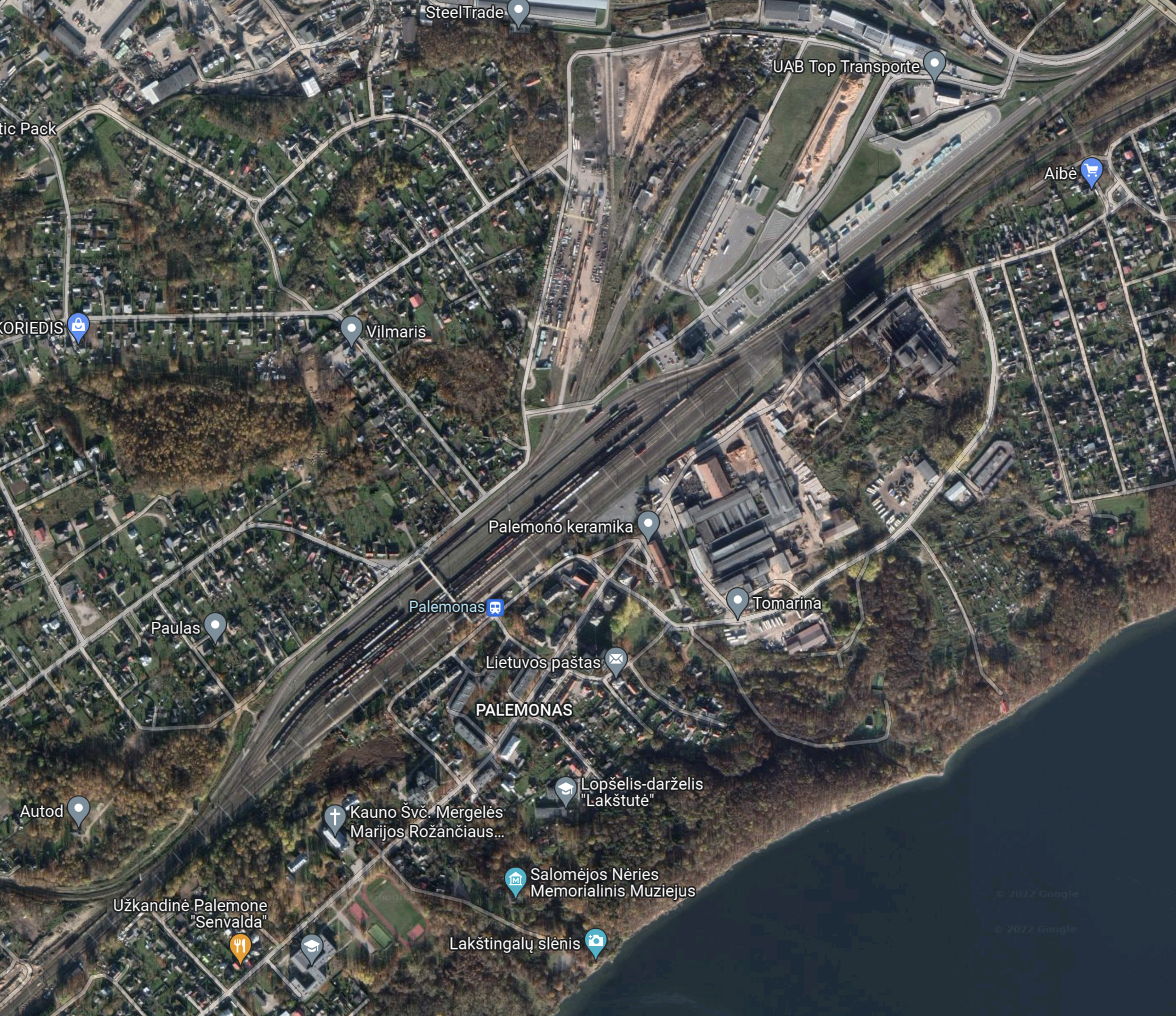
Note the rail yards in the middle of the map, have both Russian and standard gauge tracks.
Rail Baltica
The route taken is the standard gauge route of Rail Baltica, which is an EU project.
- It will run between Helsinki and Warsaw.
- Intermediate stops will be Pärnu, Riga, Riga International Airport, Panevėžys, Kaunas and Bialystok
- Vilnius will be served by a branch from Kaunus.
- The line will be double track.
- The line will be electrified with 25 KVAC overhead.
- Passenger trains will operate at up to 249 kph.
- Freight trains will operate at up to 120 kph.
- A tunnel will be built later between Helsinki and Tallinn.
Completion of the route between Warsaw and Tallinn is planned for 2026.
Rail Baltica I
Rail Baltica I is the first section of the route to be opened and is described like this in Wikipedia.
The name Rail Baltica is also sometimes used to mean the first phase of European gauge railway construction from the Poland-Lithuania border to Kaunas in Lithuania.
It opened in October 2016.
The new freight service will use this route to connect to Bialystok and Warsaw.
Conclusion
I have been on the roads in this area of Poland and rail freight services are needed to take the pressure off the roads.
Rolls-Royce Makes Duisburg Container Terminal Climate Neutral With MTU Hydrogen Technology
The title of this post, is the same as this press release from Rolls-Royce.
This is the first sentence.
Rolls-Royce will ensure a climate-neutral energy supply at the container terminal currently under construction at the Port of Duisburg, Germany.
There is also this Rolls-Royce graphic, which shows the energy sources.
It would appear batteries, combined heat and power (CHP), grid electricity, hydrogen electrolyser, hydrogen storage and renewable electricity are being brought together to create a climate-neutral energy system.
- As the graphic was named hydrogen technology for ports, I would assume that this is a Rolls-Royce mtu system that will be deployed at more than one port around the world.
- Note the H2 CHPs in the graphic. Could these be applications for Rolls-Royce’s beer keg-sized 2.5 MW electrical generator based on a Super Hercules engine?
- One of Rolls-Royce’s small modular nuclear reactors could be ideal for a large port outside Germany.
This is the last paragraph of the press release.
“Hydrogen technology is no longer a dream of the future, but hydrogen technology will prove itself in everyday use in Duisburg. The parallel use of fuel cell solutions and hydrogen engines shows that we have taken the right path with our technology-open approach to the development of new solutions for the energy supply of the future,” says Andreas Schell, CEO of Rolls-Royce Power Systems.
Rolls-Royce mtu appear to be very serious about the possibilities of hydrogen.
 The Anonymous Widower