Unlocking Efficiency With Cryogenic Cooling Of GaN Traction Inverters
The title of this post, is the same as this insight on the Ricardo web site.
This is the introduction.
As the mobility sector accelerates toward zero-carbon propulsion, hydrogen fuel cell systems (HFCS) are emerging as a cornerstone technology for aviation, marine, and long-haul road transport. Among the most promising innovations in this space is the use of liquid hydrogen (LH₂) not only as a fuel source but also as a cryogenic coolant for electric powertrains. This dual-purpose approach offers transformative potential in system efficiency, packaging, and weight reduction—especially when paired with Gallium Nitride (GaN) semiconductors.
It is a very simple concept, but it appears to give worthwhile efficiency gains.
This was the article’s conclusion.
Ricardo’s cryogenic GaN inverter concept represents a bold leap toward ultra-efficient, lightweight, and integrated hydrogen propulsion systems. While challenges remain in materials, packaging, and reliability, the experimental results are compelling. With efficiencies nearing 99.8% and mass reductions over 50%, cryogenic cooling could redefine the future of electric mobility.
As the hydrogen economy matures, innovations like this will be pivotal in delivering clean, scalable, and high-performance solutions across all mobility sectors.
I very much suggest, that you take the time to read the whole insight.
Using The Concept In a Liquid Hydrogen Carrier
This Wikipedia entry describes the design and operation of an ocean-going liquid hydrogen carrier.
This is a paragraph.
Similar to an LNG carrier the boil off gas can be used for propulsion of the ship.
Ricardo’s concept would appear to be advantageous in the design of liquid hydrogen carriers and I would expect, it could also be applied to the design of LNG carriers.
I would not be surprised to see liquid hydrogen and LNG carriers were the first application of Ricardo’s concept.
This Wikipedia entry describes the Suiso Frontier, which is the world’s only liquid hydrogen carrier.
I believe that Ricardo’s concept could lead to the construction of a more of these ships. Will they mean that liquid hydrogen carriers will deliver hydrogen from sunny climes to places like Europe, Japan, Korea and Canada.
The concept would also enable efficient small liquid hydrogen carriers, that could deliver hydrogen on routes like the North of Scotland to Germany.
Using The Concept In A Railway Locomotive
I could see freight locomotives being designed as a large liquid hydrogen tank with appropriately-sized fuel cells and added electrical gubbins.
- They would be self-powered and would not require any electrification.
- They would be much quieter than current diesels.
- They could pull the heaviest freight trains, between Europe and Asia.
- They could even pull passenger trains, if an electrical hotel supply were to be arranged.
- They could be designed with very long ranges.
But above all they would be zero-carbon.
Note that I’ve written about long freight routes before.
- China, Russia And The EU’s Intermarium Bloc
- How To Move 100,000 Containers A Year Between Germany And China
- Georgia, Azerbaijan and Iran Discuss New Freight Corridor To link India And Europe
- Finland And Norway To Explore Building Arctic Rail Link
- A New Gateway To China: Europe Prepares For The Launch Of Baku–Tbilisi–Kars Railway
I believe that a long-distance liquid-hydrogen locomotive, that was based on the Ricardo concept, would be ideal for some of these routes.
A Specialised Hydrogen Delivery Train
In April 2022, I wrote The TruckTrain, where this is a simple description of the concept.
The Basic Design Concept
The leaflet on their web site describes the concept.
This visualisation at the bottom of the leaflet shows four TruckTrains forming a train carrying twelve intermodal containers, each of which I suspect are 20 feet long.

I believe that the TruckTrain concept could be converted into a hydrogen delivery train.
- It would be an appropriate length.
- It would be powered by the on-board hydrogen.
- The hydrogen would be stored as liquid hydrogen.
It would be able to go most places on the UK rail network.
Conclusion
Ricardo’s concept could revolutionise the use of hydrogen.
Gatwick’s Hydrogen Advantage Over Heathrow
The Future Of Hydrogen In Aviation
I believe that hydrogen will have a big future in aviation.
Powering Aircraft
It will be some years, but not as many as some people think, before we see hydrogen-powered aircraft in the air.
Airbus have produced this infographic of three possible hydrogen-powered aircraft.

Discover the three zero-emission concept aircraft known as ZEROe in this infographic. These turbofan, turboprop, and blended-wing-body configurations are all hydrogen hybrid aircraft.
I wrote a bit more about these three hydrogen-powered concepts in ZEROe – Towards The World’s First Zero-Emission Commercial Aircraft.
My best estimate is that we’ll see hydrogen-powered aircraft in the air by 2035.
Towing Aircraft Around
Most aircraft are very heavy and towing them around needs a lot of zero-carbon energy.
So I think it is likely, that at some time in the near future,tugs to tow large aircraft around an airport will be hydrogen powered.
If you type “hydrogen-powered aircraft tug” into Google, you get several sensible product developments, including ones from.
- Exeter Airport
- Teesside Airport
- The Royal Air Force.
- The US Air Force
Note.
- The involvement of the military.
- At least two of the tugs are conversions of existing equipment.
- The extra weight of the battery in an electric-powered tug, may make the realisation of a viable electric aircraft-tug difficult.
I suspect we’ll see hydrogen-powered aircraft tugs in use on airports around the world in the near future.
Long-Term Car-Park Buses
I would have thought that using hydrogen-powered or battery-electric buses to serve long-term car-parks at an airport would be an obvious application. But it does appear that airports using zero-carbon buses to serve long-term car-parks are not very common.
- Gatwick uses a large fleet of hydrogen buses to bring passengers and staff to the airport, but these don’t appear to be linked to car parking.
- Incheon Airport in Korea does appear to use hydrogen-powered buses.
Please let me know, if you know of any other uses of hydrogen-powered vehicles at airports.
Hydrogen For Heathrow
This Google Map shows Heathrow Airport.

Note.
- The M4 going across the map.
- The two main runways.
- A new third runway would go between the M4 and the Northern runway.
It is likely if the third runway goes ahead, the village of Harmondsworth will be flattened.
It is likely that supplying hydrogen to Heathrow will mean a hydrogen terminal somewhere South of the M4, which could be supplied by rail tankers.
Hydrogen For Gatwick
This Google Map shows Gatwick Airport.

Note.
- The current main runway with the emergency runway to its North.
- Because the runways are too close together they cannot be used simultaneously.
- To create a second runway, the two runways would be moved further apart and the current emergency runway would be enlarged.
- The Brighton Main Line runs North-South past the Eastern end of the main runway.
Gatwick’s expansion plan doesn’t appear to require any properties outside the airport boundaries to be demolished.
This Google Map shows Sussex between Gatwick Airport and Brighton.
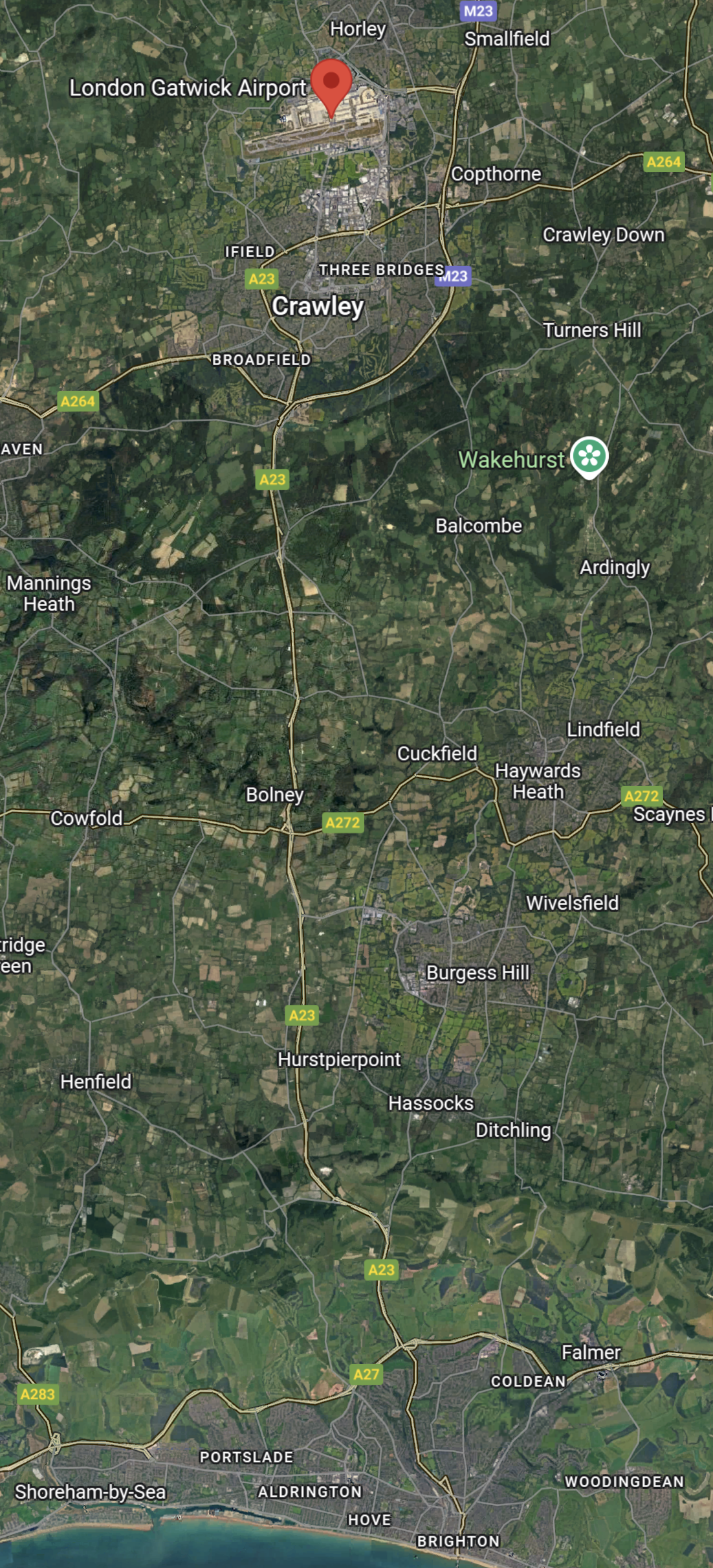
Note.
- Gatwick Airport is indicated by the red arrow at the top of the map.
- Gatwick’s runways can be picked out under the red arrow.
- The South Coast is at the bottom of the map.
- The M23 and the Brighton Main Line connect Gatwick Airport and Brighton.
- Shoreham and Brighton are on the South Coast.
- Click the map to show on a larger scale.
Under current plans, the Ramplion offshore wind farm off the South Coast is going to be increased in size to 1.6 GW.
The simplest plan to provide large amounts of green hydrogen to Gatwick would be to build a large electrolyser in the Port of Shoreham and pipe it along the railway to Gatwick Airport. Hydrogen could also be shipped at night into the Airport using rail tankers.
There’s no doubt in my mind, that it will be much easier to supply large quantities of hydrogen to Gatwick, rather than Heathrow.
In 2023, I wrote Discover How Greater Brighton Is Championing The Transition To Hydrogen, which probably indicates that the locals and their politicians, would welcome the investment in hydrogen in their city.
It should also be noted that world class consultants Ricardo, who are very much involved in the development and promotion of hydrogen technology are based in Shoreham.
Liquid hydrogen could also be imported and distributed from the Port of Shoreham.
Brighton could end up as the South of England’s Hydrogen City.
The End Of EVs Has Come, And It’s Toyota’s Fault – They’re Going To Change Everything, And It’s Going To Be Hydrogen
The title of this post, is the same as that of this article on El Diario 24.
These are the first two paragraphs.
The future of environmentally sustainable vehicles appears to be hydrogen based and Toyota is the frontrunner in developing this new technology.
The development of electric battery powered vehicles was a gamechanger for the industry and signified the first big shift since the introduction of fossil fuel powered vehicles all those years back. The current downside to electric vehicle, is of course, charging times as well as infrastructure to support charging stations. Japanese automaker, Toyota, has decided to switch lanes on the road to sustainability by investing research and funds into the development of a hydrogen powered system. This model has great potential in terms of environmental sustainability and user-friendliness but are the initial roll outs proving to be a success?
The article is from Argentina, which is a big country and range and charging could be a bigger factor, than in some countries.
But then Ricardo take a similar view to Toyota on hydrogen.
I also believe that hydrogen internal combustion engines will provide an alternative route to affordable zero-carbon vehicles, that are of all sizes.
I’m with Toyota on this one and the article is a must read.
Ricardo Signs Deal To Support Singer With Bespoke Manual Transmissions
The title of this post, is the same as that of this press release from Ricardo.
These three paragraphs give more details of the deal.
Ricardo, a global strategic, environmental, and engineering consulting company has signed a deal to supply bespoke, manual transmissions to Singer’s operations in the US and UK.
The transmissions will be exclusive to Singer and will initially be available to owners who request Singer’s Classic Turbo or DLS Turbo restoration services for their Type 964 Porsche 911.
Singer arrived on the automotive scene with their Classic services in 2009. Since then, the company has developed restoration services allowing owners to personalise both naturally aspirated and turbocharged cars. A Porsche 911 Reimagined by Singer is a rare machine, bringing together iconic design with twenty-first century engineering and material science.
I owned two Porsche 911s. The picture shows my 1969, 911T on the Isle of Skye.

I last heard of it about thirty years ago and it was still going strong in New Zealand.
Are Classic Cars The Future?
Seeing that top-class engineering companies, such as Ricardo, are getting involved, does it mean that rather than drive around in soulless electric cars, drivers will prefer something more interesting.
The Singer web site, certainly has lots of images of Automotive Pornography.
Ricardo’s Hydrogen Fuel Cell Module Successfully Reaches Full Power
The title of this post is the same as that of this press release from Ricardo.
This is the sub-heading.
Ricardo, a global strategic, environmental, and engineering consulting company, today announces a significant milestone in clean energy innovation with its new high-powered, multi-stack hydrogen fuel cell module technology successfully reaching 393kW of net electrical power, achieved within three months development from initial start-up.
These are the first two paragraphs.
This achievement was made possible due to Ricardo’s virtual engineering toolchain, which reduces physical prototyping costs and risks, accelerates development timelines, and provides a deeper understanding of system behaviours under diverse conditions.
Initially developed as part of the Sustainable Hydrogen Powered Shipping (sHYpS) Horizon Europe project for the maritime sector, Ricardo’s multi-stack hydrogen fuel cell module is designed to deliver high energy output with zero emissions. Its modular architecture integrates multiple fuel cell stacks to provide unmatched power density, and scalability while meeting the evolving energy demands of diverse applications, such as maritime, stationary power generation, rail and off-highway.
It certainly looks like Ricardo have developed a heavy end hydrogen fuel cell, that can be applied to a range of applications, in a very short time. Now that’s what I call world class engineering.
The last paragraph of the press release indicates what is possible.
To support the adoption of hydrogen technology, Ricardo has also developed a containerised solution, able to combine multiple fuel cell modules, enabling power output to be scaled up to 3MW per container, with the DC-DC power conversion on board, all without sacrificing efficiency or durability. When scaled up to incorporate multiple fuel cell modules housed within two bespoke containers, a total net electrical plant output of 6MW can be delivered. This is sufficient to power a 50,000 tonne 1,000 passenger cruise ship through important zero-emission mission cycles.
Although, this family of fuel cells, was originally developed for maritime applications, as an example of the flexibility of the system, it would surely be applicable for replacing any diesel engine from 2 MW upwards in a large number of rail, stationary and on and off-road applications.
This picture shows one of several hundred Class 66 locomotives on UK railways.

As they have an electric transmission, the 2 MW diesel engine could be fairly easily changed for a hydrogen fuel-cell of an appropriate size.
Scotch Whisky Is In A Unique Position
Scotland has so much zero-carbon energy now, let alone in a few years, that Scotch whisky would not be the most difficult of industries to make completely zero-carbon, which could marketing-wise completely trump any tariffs, that Trummkopf might impose.
- Already some small distilleries are using hydrogen to distill the whisky.
- Some glass bottles are already made using hydrogen instead of natural gas to make zero-carbon malt whiskies.
- I’m sure Cummins in Darlington, JCB in Rocester and Ricardo in Sussex will be pleased to help make farm machinery, mechanical handling and road transport zero carbon.
- Soft fruit like raspberries are already used to absorb the carbon dioxide from the distillation process in some areas of Scotland. I’m sure dealing with more quality raspberries would not be a problem.
- A large electrolyser is planned for Kintore in the North of Scotland. Think of the good publicity for say Centrica or SSE, if they built the world’s largest hydrogen plant to help make zero-carbon whisky.
These are some more thoughts.
Taste Is Everything
As only the method of providing heat and electricity will have been changed, I can’t see there will be any change to the taste.
It’s Already Happening
This page on the Annandale Distillery web site is entitled Annandale Distillery Pioneers Zero-Carbon Whisky Production with EXERGY 3 Project.
The Kintore Electrolyser
These figures summarise the Kintore Electrolyser.
- Total Electrolyser Capacity – 3 GW
- First Phase – 500 MW
- Hydrogen – 200 kTonnes per year
Explore the Kintore Hydrogen web site.
Marketing Advantage
Scotland, is probably, the only country, where the main ingredients for whisky come together in abundance ; barley, energy, tradition and water.
It also is all produced in a single country in many different brands and types, which could all be produced in a zero-carbon manner.
Conclusion
Let’s give Trump a beating and the planet a kiss.
Ricardo’s Hydrogen Fuel Cell Module Celebrates Key Milestone To Successfully Generating Power
The title of this post, is the same as that of this press release from Ricardo.
This is the sub-heading.
Ricardo’s ground-breaking high-powered multi-stack hydrogen fuel cell module has reached a new milestone. Following its initial activation, the module is generating significant power output.
These are the first two paragraphs.
Initially developed to generate high energy output with zero-emissions for the maritime sector as part of the Sustainable Hydrogen Powered Shipping (sHYpS) project, the core technology is suitable for a wide range of high-power applications. Ricardo is already seeing strong interest from sectors including, stationary power, rail, off-highway and high-performance vehicles.
The module has already achieved Lloyd’s Register’s Approval in Principle for the system’s safety and certification approach for ocean-going applications. As well as the fuel cell power plant, the sHYpS project is developing a novel swappable liquid hydrogen storage solution, which can be adapted to multiple types of vessels and accelerate the achievement of the International Maritime Organisation’s decarbonisation targets.
Note.
- It seems to be a versatile fuel cell module.
- Ricardo also seem to have designed or sourced a novel refuelling solution.
- The power of the fuel cell module is not given.
I can see a lot of applications for a large fuel cell module.
Hydrogen Bus Fleet Project Gains Momentum
The title of this post, is the same as that of this article from Energy Live News.
This is the sub-heading.
Luxfer Gas Cylinders and Ricardo have formed a partnership to advance a project that aims to deploy 150 hydrogen-powered buses on UK routes by 2024
I first came across this project in June 2022 and wrote Ricardo Repowers Double Decker Diesel Bus With Hydrogen Fuel Cells, where I said this.
The title of this post, is the same as that of this press release from Ricardo.
Ricardo, a global strategic, environmental, and engineering consulting company, in partnership with Stagecoach North East, has repowered a diesel, double decker bus with a hydrogen fuel cell propulsion system. Delivering zero tailpipe emissions, Ricardo is now seeking to secure customers to invest in the production of a fleet of passenger vehicles fit for the future of sustainable shared mobility.
The project, part funded by the Department of Transport, through its Hydrogen Transport Hub Demonstration competition, saw Ricardo, working with Stagecoach North East to retro-fitted hydrogen fuel cell technology into an existing double decker bus. It created a zero emissions demonstrator that is now undergoing a ten-week test and demonstration programme around the Tees Valley and Brighton and Hove. Feedback and data from the trials will support the team to explore future market opportunities and applications with bus operators and other partners across the UK and beyond.
Given that there are around 38,000 existing buses in the UK, many of which still have a few years of life left, this surely must be an affordable way of creating more zero-carbon hydrogen buses.
It appears that Ricardo are aiming to have an initial batch of 150 buses in service from late 2024.
It looks to me, that this project is certainly gaining momentum.
Rolls-Royce And Zero Petroleum Join Forces To Develop Sustainable Future
The title of this post, is the same as that of this press release from Rolls Royce.
This is the sub-heading.
Rolls-Royce has entered a landmark agreement with breakthrough Energy company Zero Petroleum to promote further development of the company’s power and propulsion solutions with fossil-free synthetic fuels.
These two paragraphs outline the agreement.
The new agreement will see the two parties collaborate to demonstrate Rolls-Royce engines for aviation, marine and defence with Zero® synthetic fuels.
This has the potential to include Zero’s entire range of synthetic fuels – petrol, diesel and jet fuel – with data gathered from engine testing used to prove the credentials required to achieve international fuel certification standards. Synthetic fuels deployed by Rolls-Royce in engine tests will directly reduce associated carbon emissions.
Are Rolls-Royce going to do their engine testing using synthetic fuels to reduce their carbon emissions?
It certainly looks like they might and I suppose it does two tests at the same time.
Rolls-Royce Seem To Be Using Technology To Save The Company
Big companies like Rolls-Royce, who are very much toed up with fossil fuels have two options; give up or fight using the only weapons they have; superb technology and a lot of experience.
There are only a small group, that seem to be fighting to succeed. To Rolls-Royce, I would add Cummins, Fortescue Future Industries, Ricardo and SSE, and possibly BP and Centrica.
Toyota Unveils Prototype Hydrogen Fuel Cell Hilux
The title of this post, is the same as that of this article in The Engineer.
This is the sub-heading.
Toyota has today (September 5, 2023) unveiled a prototype hydrogen fuel cell-powered Hilux at Toyota Manufacturing UK’s Burnaston car plant in Derby.
This is the first paragraph.
The pick-up has been developed in a joint project with consortium partners Ricardo, ETL, D2H Advanced Technologies and Thatcham Research. and funding from the government via the Advanced Propulsion Centre (APC).
It would appear to be a consortium of some of the important great and good of British automobile engineering.
- Ricardo are a well-respected environmental and engineering consultancy, who probably know more about powering vehicles, than most companies have forgotten.
- Thatcham Research is the motor insurers’ automotive research centre.
- The Advanced Propulsion Centre collaborates with UK government, the automotive industry and academia to accelerate the industrialisation of technologies.
To my mind, the great advantage is that they are starting with a vehicle that has a formidable reputation.
When I outlined, the product to a friend, who had owned vehicles of this type, his reply was “Wow!”
Points from the article include.
- The expected driving range is more than 365 miles.
- The project began in early 2022 with a feasibility study undertaken by TMUK and Toyota Motor Europe with the consortium partners.
- Design and development started at July 1, 2022.
- Prototype construction began on June 5, 2023.
- The first vehicle was completed in three weeks.
- Ten preproduction examples will be produced before the end of the year.
- Ricardo supported preparations for the prototype build and will undertake complete evaluation of the vehicle over the coming months.
- Thatcham Research supported the project through the provision of sustainable repair consultancy and the preparation of hydrogen training for the repair market.
On paper, it looks like the consortium have taken an extremely useful vehicle and updated it for the 21st century.
Inly time will tell, if the design is right.
I have a few questions.
What Is The Towing Performance?
In my experience, many owners will want to tow heavy trailers, horse boxes or portable cafes and toilets for events like music festivals and agricultural and country shows.
If the towing performance matches that of a diesel Hilux, Toyota will probably have got it right.
How Many Miles Does The v Average Small Builder Or Smallholder Do In A Week?
Toyota must know this from servicing records of the diesel HiLux fleet.
I would suspect for many, 365 miles would allow a weekly or twice weekly refuelling!
Where Would Owners Refuel Their Hydrogen-Powered HiLux?
I suspect that Toyota dealerships Selling Hydrogen-Powered HiLux and Mirai, would make their own arrangements.
Would A Hydrogen-Powered HiLux Help To Decarbonise Work Sites?
I suspect it would and the electrical system could probably be used to power and charge small electrical tools.
Would A Hydrogen-Powered HiLux Be An Ideal Farm Runabout?
I am thinking about a friend of mine, who is a Suffolk farmer, who farms rare breed sheep.
He uses a big pick-up to tow a large trailer to take the sheep to market and shows and to move them around the country to other breeders. He has in the past used a golf buggy to check on his flocks and help with the welfare of the animals.
Some of his sheep are raised on the saltings, which gives them a unique flavour, but does involve the occasional accident, and sometimes needs a tricky recovery.
I spoke to him last night and he will be looking at this Toyota. His current vehicle does tend to frighten the sheep as it is too noisy.
Would A Hydrogen-Powered HiLux Work Well In Hot Countries?
The current HiLux is built in South Africa and those for Europe were generally made there.
So I would expect some African examples could have been made there.
Some hydrogen fuel cells need to be cooled, so would this be a problem in hot countries?
On the other hand , it does seem that hydrogen production in hot countries, with all that sun, might not be a problem.
Would A Hydrogen-Powered HiLux Make A Good Technical?
Diesel HiLux are popular as technicals and I suspect that the hydrogen-powered HiLux will be just as good.
Although the low-down mounting of the hydrogen tanks may make them susceptible to landmines.
Why Is It Not Called A HyLux?
I couldn’t resist asking that.
Conclusion
I like the hydrogen-powered HiLux and feel it will be a winner.
 The Anonymous Widower