Fresh Air Fuels Global
Because of its history, South Africa has developed technology to create biofuels, as alternatives to diesel.
If you read the Wikipedia entry for South African chemical company; SASOL, you’ll see the things that South African chemists did, to get round the sanctions imposed because of apartheid.
SASOL has advanced the Fischer–Tropsch process and uses it to produce diesel and other fossil fuels.
Note that Velocys have also developed this process to make sustainable aviation fuel in the UK.
Fresh Air Fuels Global have a page on the G-volution web site.
The page is dominated by an infographic, which shows organic waste (animals and plants) going into an anaerobic digester, which produces.
- Biogas, which is used to create heat, electricity, CO2, biomethane, fuel and gas for the grid.
- Digestate, which is used for fertiliser and livestock bedding.
It almost sounds too good to be true.
This is the mission statement below the graphic.
Our mission: To be the most reliable producer of energy secure low carbon fuels.
There is then these paragraphs, which explain the relationship between G-volution and Fresh Air Fuels Global.
Global energy security concerns and climate targets necessitate countries and businesses to transition away from high-cost fossil fuels towards low-carbon alternatives.
Over more than a decade, Cape Advance Engineering South Africa (CAE) have been developing an incredibly cost-effective Anaerobic Digestion (AD) technology, which has proven to generate renewable energy from organic waste in the form of gas, heat and electricity that is cost competitive with fossil fuels.
G-Volution has partnered with CAE to form Fresh Air Fuels Global (FAFG), with aim of introducing the CAE technology to international markets that the G-Volution already have a foothold, constructing AD plants and creating carbon neutral biofuel from waste that can be used in dual fuel engines.
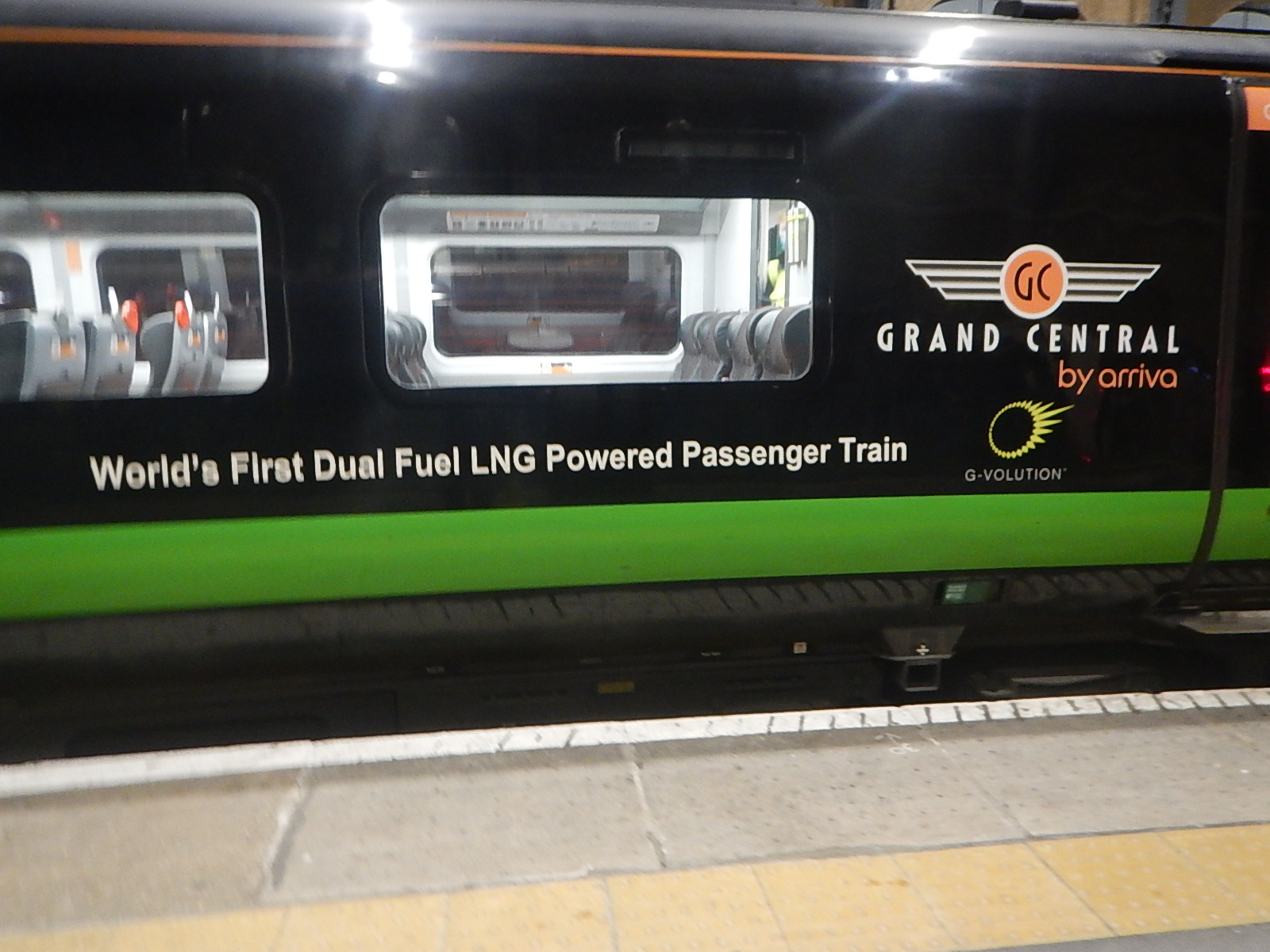
In Grand Central DMU To Be Used For Dual-Fuel Trial, I describe how G-volution’s dual fuel technology has been applied to one of Grand Central’s Class 180 train.
This picture I took after travelling in a Grand Central Class 180 train, shows that G-volution don’t hide their light under a bushel.
Note.
- This train appears to run on diesel and liquified natural gas.
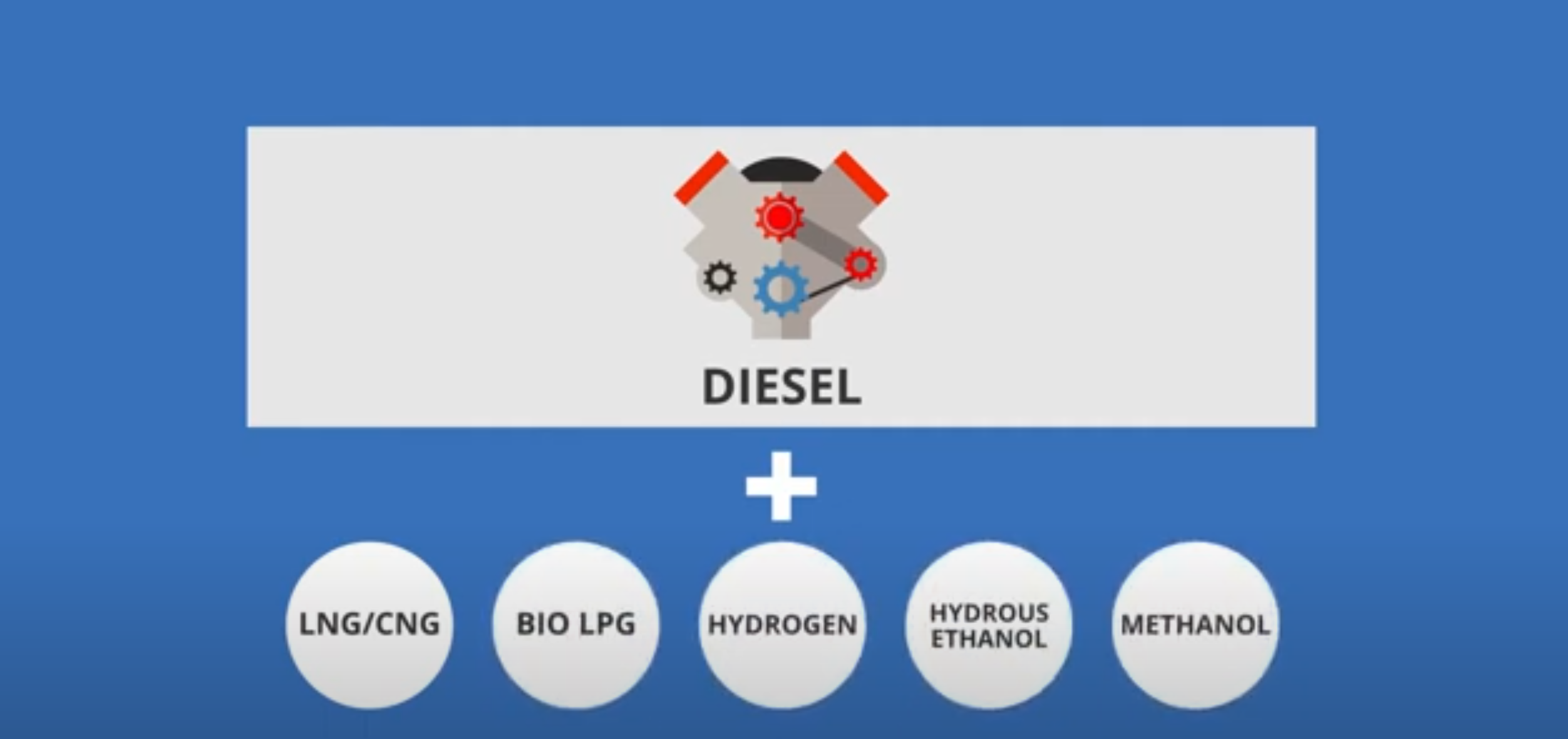
- This G-volution video gives more details.
This clip from the video, shows the possible fuels.
Note.
- Can the dual fuel engine use biodiesel or HVO instead of diesel?
- It looks like the Fresh Air Fuels Global process can produce biomethane, which could be liquified as LNG.
- Hydrogen is the only true zero-carbon secondary fuel.
- There is a Wikipedia entry for ethanol fuel.
- Hydrous ethanol is about 95% ethanol and 5% water and is used as a fuel in Brazil in petrol cars.
- There is a Wikipedia entry for the use of methanol as fuel.
Have G-volution got access to the technology to both reduce the fuel consumption of diesel engines and run them on zero-carbon fuel?
UK Trains That Have Cummins QSK-19 R Diesel Engines
Grand Central’s Class 180 trains have a Cummins QSK-19 R diesel engine.
All these trains have the same engine.
- 14 – Class 180 trains
- 51 – Class 185 trains
- 34 – Class 220 trains
- 44 – Class 221 trains
- 27 – Class 222 trains
In addition, Class 175 trains have a different engine made by Cummins.
Conclusion
If G-volution’s technology can be made to work successfully, it could play a large part in the decarbonisation of UK passenger trains.
Work Begins In South Africa On Largest Fuel-Cell Vehicle In The World
The title of this post, is the same as that of this article on Hydrogen Fuel News.
This is an explanatory paragraph.
The Anglo American mining company in South Africa is seeking to lead the way in reducing its greenhouse gas emissions. It will be starting this effort with a 210 metric ton truck. The fuel-cell vehicle is the largest in the world and will operate at the Mogalakwena platinum mine.
These are some points from the article.
- The nuGen haul truck began as a Komatsu 930E with a diesel-electric powertrain.
- The haul truck’s traction motors are now powered by eight 100-kilowatt hydrogen fuel cell modules. The modules were provided by Ballard.
- They are complemented by a Williams Advanced Engineering lithium-ion battery pack capable of outputting 1.1MW.
- The components were integrated in Seattle by First Mode.
- The fuel-cell vehicle’s powertrain is 2MW (2,682 hp).
- That is adequate for the haul truck to keep up its rating of 300 metric tons.
- The truck and payload will reach 510 metric tons combined.
There are a lot of heavy numbers there.
There is this video from Anglo American.
South Africa’s Excess Deaths A Fifth Of Earlier Waves
The title of this post is that of a small section deeply buried in the January 7th Edition of The Times.
South Africa’s excess death rate from the Omicron variant has began to fall after reaching only a fifth of the level caused by the worst version. It is another indication that although highly infectious Omicron is not as life-threatening as other types of coronavirus.
Surely, this good news should be more prominent in the paper and published with a full explanation.
How To Tell A Valid Year-End Forecast From A Vague, Unreliable Prediction
The title of this post, is the same as that of this article in The Times.
It is a thought-provoking must-read article.
Gravitricity Celebrates Success Of 250kW Energy Storage Demonstrator
The title of this post, is the same as that of this article on the Solar Power Portal.
I have already posted about this success in Gravitricity Battery Generates First Power At Edinburgh Site.
But the news story has now been mentioned in several respected publications and web sites.
So this idea, based on traditional Scottish products of heavy weights and girders seems to be getting valuable publicity.
The demonstrator is only small and uses two 25 tonne weights and a fifteen metre tower.
This is only a storage capacity of only 2.04 kWh, but the company is talking of weights totalling up to a massive 12,000 tonnes.
With a fifteen metre tower, that would be 490 kWh.
Note.
- The shafts at Kellingley Colliery in Yorkshire are 800 metres deep.
- The TauTona mine in South Africa is 3.9 kilometres deep
- In this article in The Engineer, Gravitricity talk about weights of up to 12,000 tonnes.
These are typical storage capacities.
- Kellingley – 50 tonnes – 109 kWh
- Kellingley – 12,000 tonnes – 26.15 MWh
- TauTona – 50 tonnes – 531 kWh
- TuaqTona = 12,000 – 127.5 MWh
Accountants before they invest in a company look at the financial figures. As an engineer, I look at the numbers in the science behind their claims.
If the engineering can be made to work, these figures are to say the least; very promising.
They are also beautifully scalable.
If say your application needed a 2 MWh battery and you had a 400 metre shaft available, you can calculate the weight needed. It’s around 1836 tonnes.
The Solar Power Portal article finishes with these two paragraphs.
The company will now look to rollout the technology in a series of full-scale 4-8MW projects, with conversations already underway with mine owners in the UK, Scandinavia, Poland and the Czech Republic, it said. Additionally, in South Africa Gravitricity is working closely with mine operator United Mining Services as part of a programme funded by an Innovate UK Energy Catalyst programme to identify potential schemes.
“A key feature of our full-scale projects will be their long life” added Blair. “Once built, our system can last for over 25 years, with no loss in output or degradation over time. This makes gravity storage cost-effective. And unlike batteries, we have no reliance on rare metals such as cobalt and nickel which are becoming increasingly scarce in the global drive to electrification.”
Note.
- I assume that they are 4-8 MWh projects.
- Charlie Blair is the Managing Director of Gravitricity.
- A weight of 1836 tonnes would give 4 MWh in the 800 metre shaft at Kellingley.
I wouldn’t be surprised that those owning a deep empty hole in the ground will be starting conversations with Gravitricity!
Conclusion
I am not worried, that I bought a few shares in Gravitricity in the crowd-funding last year!
All this good publicity from the BBC, Good News Network, Science, The Engineer, The Times and other media sites won’t harm my investment.
Proudly South African Hydrogen Breakthrough With Shell’s Backing
The title of this post, is the same as that of this article on Creamer Media’s Mining Weekly.
This is the introductory paragraph.
At this time of huge coronavirus uncertainty, the chests of a group of engineers here must surely be bulging with pride following their major Proudly South African world breakthrough that could speed up the global deployment of hydrogen as a competitive universal and environment-friendly energy carrier.
I think it got a bit jumbled in the typing.
Reading the article it does seem that various developments are coming together in South Africa.
- A much simple electrolyser to produce hydrogen.
- South Africa’s platinum for catalysts.
- Large amounts of renewable energy.
The aim is to produce hydrogen at a comparable price with petrol.
This paragraph stands out.
South Africa has the combined solar and wind potential to produce competitive hydrogen, which can meet the world’s new environmental requirements.
The article talks about exporting hydrogen to Japan.
Conclusion
South Africa is a country that needs all the good news it can get.
This looks like it could be some of the best.
But how many other hot countries can take advantage of what looks like a breakthrough in the electrolysis of water to produce hydrogen for a fuel?
The Three Smallest Books In The World
In the 1970s, when we were on holiday in Crete, a South African, who was probably Jewish told me a joke about the three smallest books in the world.
They were.
- The Biafran cookbook.
- The Israeli book of Arab human rights.
- The Afrikaans book of humour and culture.
Politically incorrect they may be, but what would the three books be today?
- The Yemeni cookbook.
- The Middle East book of human rights.
- Donald Trump’s book of courtesy and sense.
Technology and wealth may have progressed in the last forty years, but some things only change for the worse!
Gravitricity Sets Sights On South Africa To Test Green Energy Tech
The title of this post, is the same as that of this article on ESI Africa, which describes itself as Africa’s Power Journal.
This is the first two paragraphs.
Disused mine shafts in South Africa have been identified as an ideal location to test UK-based energy start-up Gravitricity’s green energy technology.
The company announced plans to transform disused mine shafts into hi-tech green energy generation facilities through a system that uses gravity and massive weights.
This is surely a classic fit, as Africa has plenty of sun and some of the mine shafts in South Africa, like the TauTona mine are getting towards two miles deep.
A weight of 1,000 tonnes in a two mile deep shaft would store nearly nine MWh. By comparison, Dinorwig Power Station or Electric Mountain, has a capacity of 500 MWh.
But Electric Mountain was built in the 1970s, cost £425 million and took ten years to construct.
I’m Suffering From Mandela Fatigue
No matter what you thought of him and I liked him, the obsessive media coverage of the death of Nelson Mandela is now boring me stiff.
It was the same with Princess Diana’s tragic death. We were on holiday at the time of the funeral in Northumberland and I deliberately chose to go and sit on the beach by myself on Holy Island, to get away from it all.
Death is a personal thing and we all have our own ways of coping with grief.
I just get on with life, as there is no other positive thing to do.
I shall go for a walk by the river, have some lunch and then bring my shopping home and watch the football all afternoon.
I dread to think what fuss, we’re going to see, when some of the great and good of this world die. They’ll all be out to outdo South Africa’s borefest for Mandela.
Jury Trials In South Africa
I was just listening to reports of the Oscar Pistorius case on the radio and was surprised to hear that there are no jury trials in South Africa. This explains, why much of the evidence against the athlete has been fully discussed in the media, as the case will be decided by a magistrate.
There’s more about juries in South Africa here. Juries were abolished in 1969, in the apartheid era.
 The Anonymous Widower