North Sea Wind Power Hub
I have just found the web site for the North Sea Wind Power Hub.
The Aim
This introductory paragraph details the aim of the project.
A coordinated roll-out of North Sea Wind Power Hubs facilitates an accelerated deployment of large scale offshore wind in the North Sea required to support realizing the Paris Agreements target in time, with minimum environmental impact and at the lowest cost for society (urgency & cost savings), while maintaining security of supply.
There is a lot to read on the site, however this article on the Daily Mail gives a good summary with lots of drsawings.
This is the sub-headline.
The world’s biggest wind farm? ‘Crazy’ artificial power island in the North Sea that could supply renewable energy to 80 million people in Europe is set to open in 2027.
Crazy comes from this paragraph of the article.
In an interview at the time, Torben Glar Nielsen, Energinet’s technical director, told the Independent: ‘Maybe it sounds a bit crazy and science fiction-like but an island on Dogger Bank could make the wind power of the future a lot cheaper and more effective.’
Another quote sums up the engineering problems as the Dutch sea it.
Addressing the engineering challenge ahead, Mr Van der Hage said: ‘Is it difficult? In the Netherlands, when we see a piece of water we want to build islands or land. We’ve been doing that for centuries. That is not the biggest challenge.’
Having spoken to one of the engineers, who planned and developed the Dutch sea defences after the floods of the 1950s, I’ll agree with that statement.
The Dutch Plan For Hydrogen
The Dutch Plan For Hydrogen
I have cut this out of The Train Station At The Northern End Of The Netherlands, so don’t read if if you’ve read it before.
Searching Google for hydrogen around Groningen, I found this document on the Internet, which is entitled Green Hydrogen Economy In The Northern Netherlands.
It is a fascinating read about what you can do with hydrogen generated from wind and biomass.
This is a sentence from the document.
Large scale green hydrogen product.ion together with harbor transport and storage facilities will be located at Eemshaven, with green chemicals production in Delfzijl
It is an ambitious statement.
Eemshaven
It also appears that Eemshaven will be the main connection point for electricity from offshore wind farms. This is said.
In the Eemshaven an offshore electricity cable from Norway, the NorNed cable with a capacity of 700 MW, comes on land. The Cobra cable, with a capacity of 700 MW, from Denmark is foreseen to connect at the Eemshaven to the onshore grid. The Gemini wind farm is connected to the grid in the Eemshaven with a capacity of 600 MW. Within 10 years it is foreseen that another 4.000 MW offshore wind will have their electricity cable to the Eemshaven.
Does all this explain, the building of a station at Eemshaven? Delfzijl station was built in 1883 and has its own connection to Groningen.
The following proposed actions are from the document
Build A 1,000 MW Electrolysis Plant
This is an extract from the of the document.
A 1.000 MW electrolysis plant that runs 8.000 hours a year, uses 8 billion kWh and 1,5 million m3 pure water to produce 160 million kg Hydrogen. A reverse osmosis plant has to produce the 1.5 million m3 pure water, using sea water or surface water as input. If an electricity price of 2‐2,5 €ct/kWh and a total investment between 500 million and 1 billion Euro with a 10 year life time is assumed, a green hydrogen cost price around 2‐3 €/kg will be the result. This is about competitive with present hydrogen prices, produced from natural gas by steam reforming.
How much energy is contained in a Kg of hydrogen?
This page on IdealHY says the following.
Hydrogen is an excellent energy carrier with respect to weight. 1 kg of hydrogen contains 33.33 kWh of usable energy, whereas petrol and diesel only hold about 12 kWh/kg.
At three euros for a kilogram of hydrogen, that works out at nine euro cents for a kWh.
Build A 1000 MW Biomass Gasification Plant
The title is a section in the document and this is an extract from the section.
Green hydrogen can be produced by electrolysis using green electricity, but can be produced also from biomass via gasification. Biomass gasifiers use solid biomass as an input and deliver a green syngas, a mixture of hydrogen, carbon‐monoxide (CO) and carbon‐dioxide (CO2), and char as an output. The CO could be used, together with water (H2O), to produce extra hydrogen. The resulting products from biomass gasification are green hydrogen and CO2. However, from CO2 and green hydrogen every chemical product could be produced. Therefore, the combination of green hydrogen and CO2 or green syngas creates the opportunity for a fully green chemical industry in the Northern Netherlands.
The process is still being developed. My first question, is can you use animal manure as a feedstock? It should be noted that The Netherlands used to have a very large and smelly manure problem.
Offshore Hydrogen Production From Far Offshore Wind Farms
The title is a section in the document and this is an extract from the section.
Offshore wind farms produce electricity which can be brought onshore via an electricity cable. Such an offshore electricity cable is expensive. The farther offshore the wind farm is located the more expensive the electricity cable cost. At the North Sea, an alternative solution for these wind farms is to convert the electricity into hydrogen at an existing oil/gas platform and to transport this hydrogen eventually mixed with gas via an existing gas pipeline. Onshore the hydrogen is separated from the natural gas and cleaned to be transported via pipeline, ship or truck to the markets.
I think that the technology and existing infrastructure could be made to work successfully.
- Europe has over fifty years experience of handling offshore gas networks.
- Recent developments have seen the emergence of floating wind turbines.
- Would it be easier to refurbish redundant gas platforms and use them to collect electricity and create hydrogen, rather than demolish them?
- Hydrogen is only produced when the wind blows.
- There is no need to store electricity and we’ve been storing gas since the Victorians.
There will be problems, like the integrity of an ageing pipeline, but I suspect that the expertise to solve them exists.
Will there be a North Sea, where every part has a large wind farm?
Note that the Hornsea Wind Farm has an area of 1830 square miles and could generate around 6 GW, when fully developed.You could fit 120 wind farms of this size into the North Sea. Even if only a small proportion could be developed, a sizeable amount of hydrogen could be produced.
A Market For 300,000‐tonnes Green Methanol + 300,000‐tonnes Green Ammonia
The title is a section in the document and this is an extract from the section.
Hydrogen (H2) and Carbon‐dioxide (CO2) can be used in chemical processes to produce a wide variety of chemical products. Two of the main building blocks in chemistry are methanol and ammonia. Methanol can be produced from H2 and CO2. Ammonia is produced from H2 and nitrogen (N2), captured from the air.
Wind power and biomass have been used tp create the basic chemicals for the petro-chemical industry.
The Construction Of Green Hydrogen Fuel Cell Balanced Data Centres
The title is a section in the document and this is an extract from the section.
Google builds a very large data center in the Eemshaven, see picture below. The reasons for Google to choose for the Eemshaven are the existence of an offshore data cable, enough space and green electricity. Google as well as other companies that install and operate data centers wants to run on green electricity. Therefore, Google has signed a power purchase agreement with Eneco to buy green electricity for 10 years. For this reason, Eneco builds an onshore wind farm nearby. On a yearly average this wind farm produces enough electricity to meet the data center demand.
However, supply and demand are not at every time in balance. At moments that there is no wind, other power plants must take over the electricity supply. Now, these are fossil fired power plants.In future, these power plants will be closed and supply and demand needs to be balanced in another way. And of course, that needs to be done with renewable electricity. This can be done by fuel cells fueled with green hydrogen. Fuel cells can follow demand and supply variations very fast with high efficiencies. Fuel cells are quiet and have no emissions, except very clean, demineralized, water.
I like this concept.
Surely, we could build a few data centres in places like Lincolnshire.
Build A Pipeline To Rotterdam And Germany
The Dutch have ambitious plans to export the hydrogen.
Other Ideas
The report is full of clever ideas and I suggest you take the time to read it fully!
Hydrogen Trains In The Northern Netherlands
The document says this about trains powered by hydrogen fuel cells.
In the Northern Netherlands, 50 diesel trains are daily operated on non‐electric lines. These trains, operated by ARRIVA have two or three carriages and a power of 450‐600KW supplied by Diesel‐Electric engines. Fuel cell‐electric hydrogen trains could replace these diesel trains. Alstom is a company that builds these fuel cell hydrogen trains and will perform a test next year on the line Groningen‐Bremen. Because the depreciation time for trains is 25 years, not all trains will be bought new. Some trains may need to be retrofitted with fuel cell‐electric power supply, which is technically feasible. When all these 50 diesel trains are replaced an investment in new and retrofitted trains of about …? Million Euros is needed. The total hydrogen consumption of these trains is about 5,000 ton.
These points are shown in a table.
- Total (diesel) trains in the Northern Netherlands is 50 units
- Hydrogen consumption approximately 25 kg H2/100km
- Train operations average 6 days per week. Train is operated approximately 1.200 km per day, based on two times per hour per trajectory of 50km.
- Train operations average 6 days per week. 330 days per year.
- Capital expenditure per train approximately …. ? 50 Units …? Million Euro
- 50,000 tonnes of hydrogen will be needed.
- The fuel bill at three euros a Kg will be 150 million euro.
Would this be economic?
From various comments, I suspect that Stadler are working on a hydrogen-powered GTW.
But failing that, as Stadler are developing a diesel/electric/battery Flirt for the South Wales Metro and some of the routes from Groningen are only about 30 km, I wouldn’t be surprised to see diesel/electric/battery GTWs running across the flat lands of the North.
Battery trains could be fitted with pantographs and recharge in Groningen, where most of the platforms are electrified.
There are a lot of possibilities and engineers will come up with the best solution with regards to operation and economics.
Conclusion
Thr Dutch have big plans for a hydrogen-based economy in the North of the Netherlands.
Where is the UK Government’s master plan for hydrogen?
From Groningen To Leer By Train
On my recent trip to the Netherlands and Germany, I didn’t get to do this trip by train and had to make do with a slow bus ride.
However I’ve just found this video on YouTube.
The Freisenbrücke is about an hour from the start of the video.
I should fast forward, as there is only so much travelling on a single-track rail line, that you can watch before falling asleep.
I got this impression of the route in the video, which was made in October 2014.
- The route is mainly single-track, with some passing loops at stations.
- the track is not electrified, except for short sections at either end.
- The track was almost straight.
- The track, stations and signalling appear to be in good condition.
- There were a large number of level crossings.
- The train took around one hour and twenty minutes between Groningen and Leer stations.
I can imagine that Deutsche Bahn and Arriva Netherlands were a good bit more and just annoyed, when the MV Emsmoon destroyed the bridge.
Wikipedia says this about the accident.
On 3 December 2015, Emsmoon collided with the Friesenbrücke [de], which carries the Ihrhove–Nieuweschans railway over the Ems. The cause of the accident was reported to be miscommunication between the bridge operator and pilot on board the ship. The bridge could not be raised as a train was due, but the ship failed to stop and collided with the bridge, blocking both railway and river. The bridge was so severely damaged that it will have to be demolished. Replacement is expected to take five years
I suspect, it’s not just an massive inconvenience for the railway, as a couple of miles South on the River Ems, is the Meyer Werft shipyard, where cruise ships up to 180,000 tonnes are built.
I found this document on the NDR.de web site and gleaned the following information.
- The cost of rebuilding could be up to eight million euros.
- The new bridge will be finished in 2024, if all goes well.
- Environmentalists are bringing lawsuits against the construction of the bridge.
It will be a challenge to rebuild this bridge.
This video shows the new bridge
Let’s hope that one of those large cruise ships doesn’t hit the bridge.
Conclusion
This surely has been a very costly accident.
Third Degree Murder
The title of this post is the same as that of an article by Ian Walmsley in the April 2019 Edition of Modern Railways.
In the article Ian has a heavyweight go at the Office of Road and Rail about their policy towards third rail electrification.
As a Control and Electrical Engineer, I agree with a lot he says, especially as I believe modern control systems and good design can improve safety of third rail systems to a high level.
I also believe the following.
- In some places third-rail electrification, which is only live when a train is protecting the rails from morons, is safer than any other electrification system.
- In some places, like on top of high viaducts third-rail electrification is safer for engineers installing and maintaining it, than overhead electrification.
- Some battery charging systems will be designed around third-rail electrification.
Ian’s article gives various reasons for using third-rail electrification.
He also proposes the radical innovation of using a voltage of 1500 VDC, which he calls 2XV.
I like it and agree with his reasoning..
It sounds radical, but it is not a new idea.
An article on Wikipedia is entitled Rail Transport In The Netherlands.
This is said.
Most of the network is electrified at 1.5 kV DC (which limits interoperability with neighbouring countries), although Belgian trains – built for 3 kV DC – can run on the Dutch network at reduced power. Both the HSL-Zuid and the Betuweroute have been electrified at 25 kV AC; although conversion of existing electrified lines to 25 kV AC was considered in 1997, 2005 and 2012 at a cost of over €10 billion, a 2015 proposal (revised in 2017) is to convert to 3 kV DC at a 2017 cost of €1 billion. The higher DC voltage would reduce power losses and have faster acceleration above 60 to 70 kilometres per hour (37 to 43 mph), so stopping trains would save seven to 20 seconds per stop.
Are the Dutch implementing their proposal?
Groningen Station
Groningen station sits at the centre of a rail network reaching to Delfzijl, Eemshaven, Harlingen,, Leer, Leeuwarden, Veendam and Zwolle.
These pictures show the station.
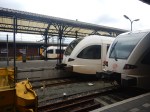
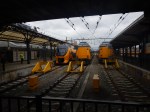



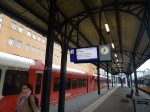

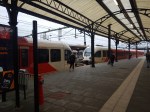
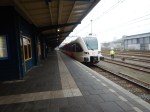
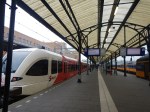
Note.
- The large numbers of Stadler GTW trains, which Arriva call Spurt.
- The decoration in the Booking Hall.
- The multiple bay platforms, some of which are electrified.
It is certainly a station worth a visit.
The Harlingen–Nieuweschans Railway
Groningen station is on the Harlingen–Nieuweschans Railway.
- It stretches from Harlingen. on the Ijsselmeer in the West to Leer in Germany in the East.
- The distance is around eighty miles.
The railway was originally built for trade between the port at Harlingen and Cerntral Europe.
Unfortunately, the Eastern section is cut-off as the freighter; MV Emsmoon, destroyed a bridge. Wikipedia says this about the accident.
On 3 December 2015, Emsmoon collided with the Friesenbrücke [de], which carries the Ihrhove–Nieuweschans railway over the Ems. The cause of the accident was reported to be miscommunication between the bridge operator and pilot on board the ship. The bridge could not be raised as a train was due, but the ship failed to stop and collided with the bridge, blocking both railway and river.[4] The bridge was so severely damaged that it will have to be demolished. Replacement is expected to take five years.
Was für ein Haufen Wichser!
And we think, we have problems with level crossings!
Conclusion
Groningen would make a base from where to tour the area. But it will be even better, when the bridge over the River Ems has been rebuilt!
The Train Station At The Northern End Of The Netherlands
Eemshaven station is the northernmost station in the Netherlands.


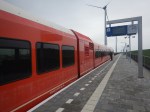
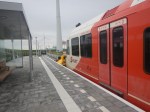
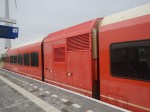
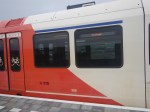
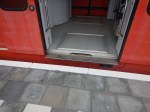

One of the reasons I went, was that the station is only a year old and I wanted to see how the Dutch build new stations.
Note this about the station.
- It is very basic, with few facilities.
- The single platform is very long.
- The station is surrounded by oil and gas installations on one side and the sea on the other.
It appears that for a lot of the day, the station gets two trains per hour.
This Google Map shows the station by the beach.
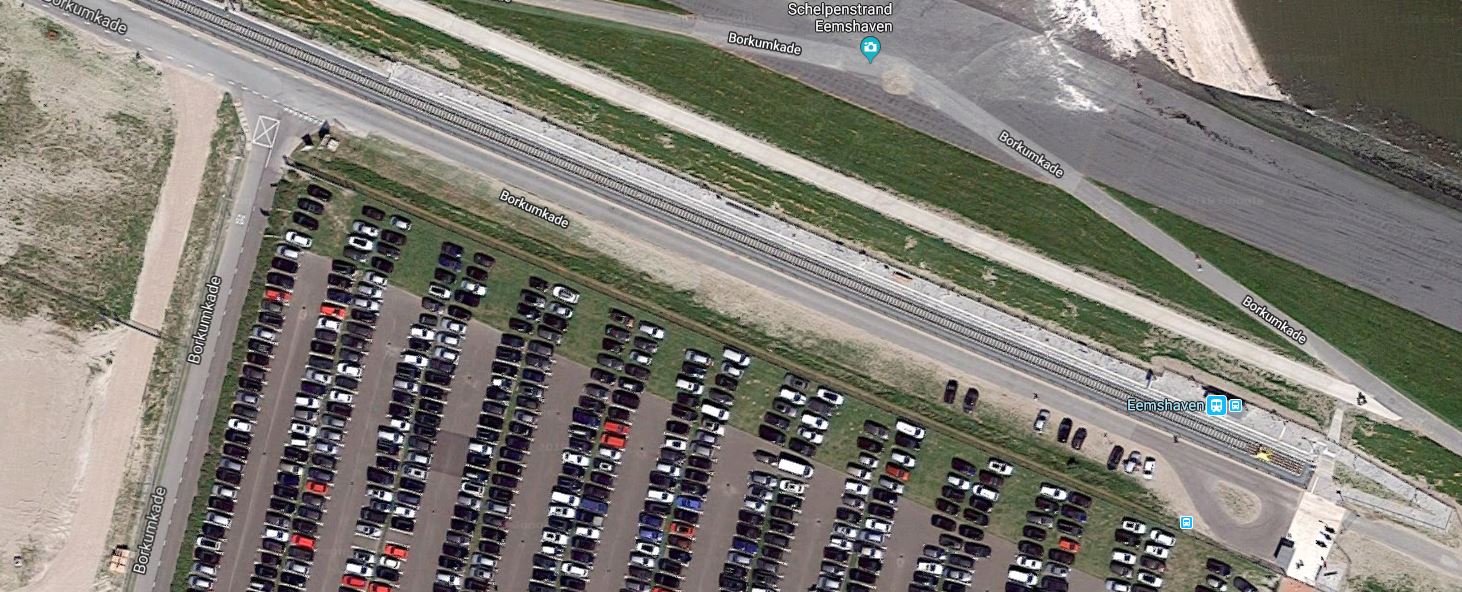
I would assume that most of the cars are those of workers at the oil and gas complex.
I returned on the train, I had arrived on, after a few minutes taking the pictures.
The Stadler GTW Train
Shown in the pictures is one of the Stadler GTW trains,which work the services in the North of the Netherlands.
- They are electric trains, with their own diesel power pack in the middle.
- This train had three passenger cars, but some only have two.
- Noise from the engine was noticeable and probably about the same in a Class 170 train.
- Ride quality wasn’t bad, considering the unusual configuration. But then the track looked very neat and tidy.
- Arriva call the trains Spurt.
Stadler have not stood still, since they built these trains and Greater Anglia’s new Class 755 trains are built by Stadler to similar principles.
At the turnround at Eemshaven with the driver. He indicated that there had been speculation about battery and hydrogen trains in the North of The Netherlands.
Level Crossing Accidents
An interesting aside is to look at the Wikipedia entry for Spurt.
Three of the trains have been involved in serious level crossing accidents.
The Dutch Plan For Hydrogen
This now a separate post at The Dutch Plan For Hydrogen.
Is This Stadler’s Plan For A Multi-Mode Future?
We have not seen any of Stadler’s bi-mode Flirts in service yet although Greater Anglia’a Class 755 trains have been rumoured to be speeding between London and Norwich in ninety minutes from this May!
Today, I rode on one of Stadler’s diesel GTWs between Groningen and Eemshaven in the Netherlands, which I wrote about in The Train Station At The Northern End Of The Netherlands.
GTWs are a diesel electric train with a power-pack car in the middle of the three car train. The diesel electric Flirts are a later train with a similar layout to the GTW.
So are the diesel GTWs and Flirts just a bi-mode without a pantograph? Or more likely the bi-mode is a diesel electric train with the addition of a pantograph and extra electrical gubbins.
Looking at the visualisations on Wikipedia of the bi-mode Class 755 train and the all-electric Class 745 train, it appears that the next-to-end car has the pantograph.
Are these cars with the pantograph identical on both the bi-mode and the all-electric versions? It would certainly be sensible from a engine erring point of view.
So could it be that all that is needed to convert a diesel electric Flirt into a bi-mode Flirt is to add the pantograph car and swap the power pack car for a bi-mode one? The old power pack car could then be converted into another bi-mode power pack car to convert another train.
But the power pack cars are not as simple as they look. They have four slots for diesel engines. Three-car and four-car Class 755 trains have two and four engines respectively.
I believe that one or more of the slots can be filled with a battery to create Flirts like the tri-mode ones proposed for South Wales.
So could we see some of the Greater Anglia Flirts converted in this way? Surely, Colchester Town to Sudbury could be a service that could benefit from battery power West of Marks Tey?
Today, I had a chat with a GTW driver, who said that the train he’d been driving was diesel-electric and that he had heard that batteries or hydrogen power could be used on the eoute.
The lines around Groningen seem to employ quite a few GTWs and distances are not overly long. So could some be converted to 1500 VDC electric/diesel/battery tri-modes? There is electrification at Groningen station and some of the bay platforms used by GTWs already have wires.
If the conversion is successful, then Stadler could be on a Swiss roll, as there are a lot of GTWs and Flirts out there, many of which are diesel-electric, like the one I rode today.
Would a train operator prefer to upgrade a diesel electric train that works well or buy a new bi-mode from another train manufacturer?
Could also an electric Flirt be converted into a bi-mode, by splitting the train and sticking a power pack car in the middle. Engineering common sense says that the passenger cars must be very similar to those of diesel Flirts to simplify manufacture of the trains.
We already know, that four-car Flirts are only three-car trains with an extra passenger car. Stadler could mix-and-match passenger, pantograph and power pack cars to give operators what they need.
Intelligent computer software would choose which power option to be used and the driver would just monitor, that the train was behaving as needed.
Looking at my route yesterday between Groningen and Eemshaven, it is a route of just under forty kilometres or twenty-five miles. Adrian Shooter is talking of ranges of sixty miles with battery versions of Class 230 trains. So I don’t find it impossible to create a tri-mode GTW or Flirt for this lonely route at the very North of the Netherlands.
Conclusion
Stadler seem to have created a very imitative modular train concept.
As some Flirts can travel at 125 mph, could they be serious bidders to provide the new trains for the Midland Main Line?
ProRail And Arriva Launch Automation Trials
The title of this post, is the same as that of this article on Railway Gazette.
I have posted this article, because it lays out in a simple way, the benefits of digital signalling and Automatic Train Operation.
Engine Change At Bad Bentheim
I’m on a train frim Amsterdam to Osnabruck. The train, which goes all the way to Berlin, is not very fast, but they’ve now stopped for ten minutes, whilst the Dutch engine is changed for a German one! Can’t both railway companies use the dame Euro-blighter and just have a change of drivers, as we do on Anglo-Scottish services.
Surely, these are the problems that the EU should solve. Or do German and Dutch rail unions make the RMT look like pussy-cats?
Express London-Amsterdam Eurostar Service Being Explored
The title of this post is the same as the title of this article on Global Rail News.
This is the first paragraph.
Nederlandse Spoorwegen (NS) has said it is in discussions with Eurostar to boost the number of journeys from Amsterdam to London in 2019.
The aim is to do the following.
- Speed up the call at Brussels.
- Increase services from two to three per day.
- Reduce journey times from four to three and a half hours.
All very worthy, but I think Amsterdam even in three and a half hours may be a bit far, as the time by air is probably quicke.
 The Anonymous Widower