Three Steps To Unlocking The Potential Of High-Power Wind Turbines
The title of this post is the same as that of this article on offshireWIND.biz.
This is the first paragraph.
The critical role of wind in the world’s future energy needs is clear: the Ocean Renewable Energy Coalition states that 1,400 gigawatt (GW) of offshore wind power will sustain one tenth of global electricity demand by 2050. Key to achieving this is the upward power rating of wind turbines, which we anticipate will reach an individual turbine capacity of 20 GW within the next five years.
The article is a must-read.
After reading the article, I am convinced that there will be 20 MW turbines in five years.
When turbines of this size are readily available, it is likely that the rate of installation of wind turbines will increase.
BP, Equinor And Ithaca To Explore Electrification Options Of West Of Shetland Oil And Gas Fields
The title of this post is the same as that of this article on offshoreWIND.biz.
Increased CCS Can Decarbonise GB Electricity Faster On Route To Net Zero
The title of this post, is the same as that of this news item on the SSE web site.
This is the first paragraph.
Building more power carbon capture and storage plants (Power CCS) could significantly accelerate the UK’s plans to decarbonise the GB electricity system on route to net zero, according to new analysis commissioned by SSE.
I am not surprised, as in my time, I have built several production, storage and distribution mathematical models for products and sometimes bringing things forward has beneficial effects.
These three paragraphs summarise the findings.
The UK Government’s proposed emissions reductions from electricity for 2035 could be accelerated to 2030 by combining its 50GW offshore wind ambition with a significant step up in deployment of Power CCS. This would require 7-9GW (equivalent to 10-12 plants) of Power CCS compared to the current commitment of at least one Power CCS plant mid-decade, according to experts at LCP Delta.
Replacing unabated gas with abated Power CCS generation will deliver significant reductions in greenhouse gas emissions. The analysis suggests that adding 7-9GW Power CCS to the UK’s 2030 offshore wind ambition will save an additional 18 million tonnes of CO2 by 2040, by preventing carbon emissions during periods when the sun isn’t shining, and the wind isn’t blowing.
Gas consumption for electricity generation would not significantly increase, given the 7-9GW Power CCS would displace older and less efficient unabated gas power stations already operating and reduce importing unabated gas generation from abroad via the interconnectors. Importantly, Power CCS can provide a safety net to capture emissions from any gas required to keep the lights on in the event of delays to the roll out of renewables or nuclear.
The report is by LCP Delta, who are consultants based in Edinburgh.
The report says this about the transition to hydrogen.
Power CCS also presents significant opportunities to kickstart, then transition to, a hydrogen economy, benefitting from the synergies between CCS and hydrogen, including proximity to large-scale renewable generation and gas storage facilities which can support the production of both electrolytic and CCS-enabled hydrogen.
And this about the reduction in carbon emissions.
The existing renewables ambition and the accelerated Power CCS ambition are expected to save a total of 72 million tonnes of CO2 by 2040 compared to commitments in the UK’s Net Zero Strategy from October 2021.
I don’t think there’s much wrong with this analysis.
But of course the greens will trash it, as it was paid for by SSE.
I have a few thoughts.
Carbon Capture And Use
I believe we will see a great increase in carbon capture and use.
- Carbon dioxide is already an ingredient to make Quorn.
- Carbon dioxide is needed for fizzy drinks.
- Carbon dioxide can be fed to tomatoes, salad plants, herbs and flowers in giant greenhouses.
- Carbon dioxide can be used to make animal and pet food.
- Carbon dioxide can be used to make building products like plasterboard and blocks.
- Carbon dioxide can be added to concrete.
- Carbon dioxide can be used as a refrigerant and in air-conditioning. There are one or two old Victorian systems still working.
Other uses will be developed.
Carbon Capture Will Get More Efficient
Carbon capture from power stations and boilers, that use natural gas is a relatively new process and its capture will surely get better and more efficient in the next few years.
Gas From INTOG
I explain INTOG in What Is INTOG?.
One of INTOG’s aims, is to supply electricity to the oil and gas rigs and platforms in the sea around the UK.
Currently, these rigs and platforms, use some of the gas they produce, in gas turbines to create the electricity they need.
- I have seen reports that ten percent of the gas that comes out of the ground is used in this way.
- Using the gas as fuel creates more carbon dioxide.
Decarbonisation of our oil and gas rigs and platforms, will obviously be a good thing because of a reduction of the carbon dioxide emitted. but it will also mean that the gas that would have been used to power the platform can be brought ashore to power industry and domestic heating, or be exported to countries who need it.
Gas may not be carbon-neutral, but some gas is more carbon-neutral than others.
SSE’s Plans For New Thermal Power Stations
I have taken this from SSE’s news item.
SSE has deliberately chosen to remain invested in the transition of flexible thermal electricity generation due to the key role it plays in a renewables-led, net zero, electricity system and is committed to decarbonising the generation.
Together with Equinor, SSE Thermal is developing two power stations equipped with carbon capture technology. Keadby 3 Carbon Capture Power Station is based in the Humber, the UK’s most carbon-intensive industrial region, while Peterhead Carbon Capture Power Station is located in the North East of Scotland. Combined, the two stations could capture around three million tonnes of CO2 a year.
Studies have shown that Keadby and Peterhead Carbon Capture Power Stations could make a lifetime contribution of £1.2bn each to the UK economy, creating significant economic opportunity in their respective regions. Both will be vital in supporting the huge amount of renewables which will be coming on the system.
SSE Thermal and Equinor are also collaborating on Keadby Hydrogen Power Station, which could be one of the world’s first 100% hydrogen-fuelled power stations, and Aldbrough Hydrogen Storage, which could be one of the world’s largest hydrogen storage facilities.
Note.
- SSE appear to think that gas-fired power stations with carbon capture are an ideal backup to renewables.
- If gas is available and it can be used to generate electricity without emitting any carbon dioxide, then why not?
- Hydrogen is coming.
Things will get better.
Is A Virtuous Circle Developing?
Consider.
- Spare wind electricity is turned into hydrogen using an electrolyser or perhaps some world-changing electro-chemical process.
- The hydrogen is stored in Aldbrough Hydrogen Storage.
- When the wind isn’t blowing, hydrogen is used to backup the wind in Keadby Hydrogen power station.
- The other Keadby power stations can also kick in using natural gas. The carbon dioxide that they produce, would be captured for storage or use.
- Other users, who need to decarbonise, can be supplied with hydrogen from Aldbrough.
Note.
- Gas turbines are throttleable, so if National Grid wants 600 MW to balance the grid, they can supply it.
- As time progresses, some of the gas-fired power stations at Keadby could be converted to hydrogen.
- Rough gas storage is not far away and could either store natural gas or hydrogen.
- Hydrogen might be imported by tanker from places like Africa and Australia, depending on price.
Humberside will be levelling up and leading the decarbonisation of the UK.
If you have an energy-hungry business, you should seriously look at moving to Humberside.
Powerhouses Clash Offshore California In Bid To Build Wind Farms
The title of this post, is the same as that of this article on offshoreWIND.biz.
Gasunie Investigates Hydrogen Network In North Sea
The title of this post, is the same as that of this news article on the Gasunie web site.
Scotland’s Largest Offshore Wind Farm Entering Home Stretch
The title of this post, is the same as that of this article on offshoreWIND.biz.
EuroLink, Nautilus And Sea Link
EuroLink, Nautilus and Sea Link are three proposed interconnectors being developed by National Grid Ventures.
EuroLink
EuroLink has a web site, where this is said.
To support the UK’s growing energy needs, National Grid Ventures (NGV) is bringing forward proposals for a Multi-Purpose Interconnector (MPI) called EuroLink, which will deliver a new electricity link between Great Britain to the Netherlands.
EuroLink could supply up to 1.8 gigawatts (GW) of electricity, which will be enough to power approximately 1.8 million homes, as well as contribute to our national energy security and support the UK’s climate and energy goals. We’re holding a non-statutory public consultation to inform you about our EuroLink proposals, gather your feedback to help refine our plans and respond to your questions.
Note, that EuroLink is a Multi-Purpose Interconnector (MPI) and they are described on this page of the National Grid website.
In EuroLink’s case, this means it is basically an interconnector between the UK and The Netherlands, that also connects wind farms on the route to the shore.
- Coastal communities get less disruption, as the number of connecting cables coming ashore is reduced.
- Less space is needed onshore for substations.
- Electricity from the wind farms can be directed to where it is needed or can be stored.
As an Electrical and Control Engineer, I like the MPI approach.
The technology to implement the MPI approach is very much tried and tested.
There are many references to EuroLink terminating at Friston.
Nautilus
Nautilus has a web site, where this is said.
Nautilus could connect up to 1.4 gigawatts (GW) of offshore wind to each country through subsea electricity whilst connecting to offshore wind farm/s at sea. By combining offshore wind generation with interconnector capacity between the UK and Belgium, Nautilus would significantly reduce the amount of infrastructure and disruption required both onshore and offshore.
With this new technology, we hope to reduce the impact of infrastructure on local communities and the environment, as well as support the government’s net zero and energy security targets. We are already working closely with other developers in the area to coordinate activities and minimise impact on local communities. We believe that through improved coordination, the UK government can achieve and support the co-existence of renewable energy with coastal communities.
Nautilus is another MPI.
This is said on the web site.
Last year, National Grid Ventures ran a non-statutory consultation for Nautilus, which proposed a connection at Friston.
NGV holds a connection agreement on the Isle of Grain in Kent as part of its development portfolio and we are currently investigating if this could be a potential location for Nautilus. Until this is confirmed to be technically feasible, Nautilus will be included as part of our coordination work in East Suffolk.
So it looks like, Nautilus could connect to the UK grid at Friston or the Isle of Grain.
Sea Link
Sea Link has a web site, and is a proposed interconnector across the Thames Estuary between Suffolk and Kent.
This is said on the web site about the need for and design of Sea Link.
The UK electricity industry is evolving at pace to help lead the way in meeting the climate challenge, whilst also creating a secure energy supply based on renewable and low carbon technologies.
The demands on the electricity network are set to grow as other sectors of the economy diversify their energy consumption from using fossil fuels towards cleaner forms, the move towards electric vehicles being just one example.
Where we’re getting our power from is changing and we need to change too. The new sources of renewable and low-carbon energy are located along the coastline. We need to reinforce existing transmission network and build new electricity infrastructure in these areas in order to transport the power to where it’s needed. This is the case along the whole of the East Coast including Suffolk and Kent.
To allow this increase in energy generation, we need to reinforce the electricity transmission system. Sea Link helps to reinforce the electricity network across Suffolk and Kent.
Our proposals include building an offshore high voltage direct current (HVDC) link between Suffolk and Kent with onshore converter stations and connections back to the national electricity transmission system.
On the web site, in answer to a question of What Is Sea Link?, this is said.
Sea Link is an essential upgrade to Britain’s electricity network in East Anglia and Kent using subsea and underground cable. The proposal includes approximately 130km of subsea cables between Sizewell area in East Suffolk and Richborough in Kent. At landfall, the cables would go underground for up to 5 km to a converter station (one at each end). The converter station converts direct current used for the subsea section to alternating current, which our homes and businesses use. A connection is then made to the existing transmission network. In Suffolk, via the proposed Friston substation; in Kent via a direct connection to the overhead line between Richborough and Canterbury.
Note, that from Kent electricity can also be exported to the Continent.
All Cables Lead To Friston In Suffolk
It looks like EuroLink, Nautilus and Sea Link could all be connected to a new substation at Friston.
But these will not be the only cables to pass close to the village.
This Google Map shows the village.
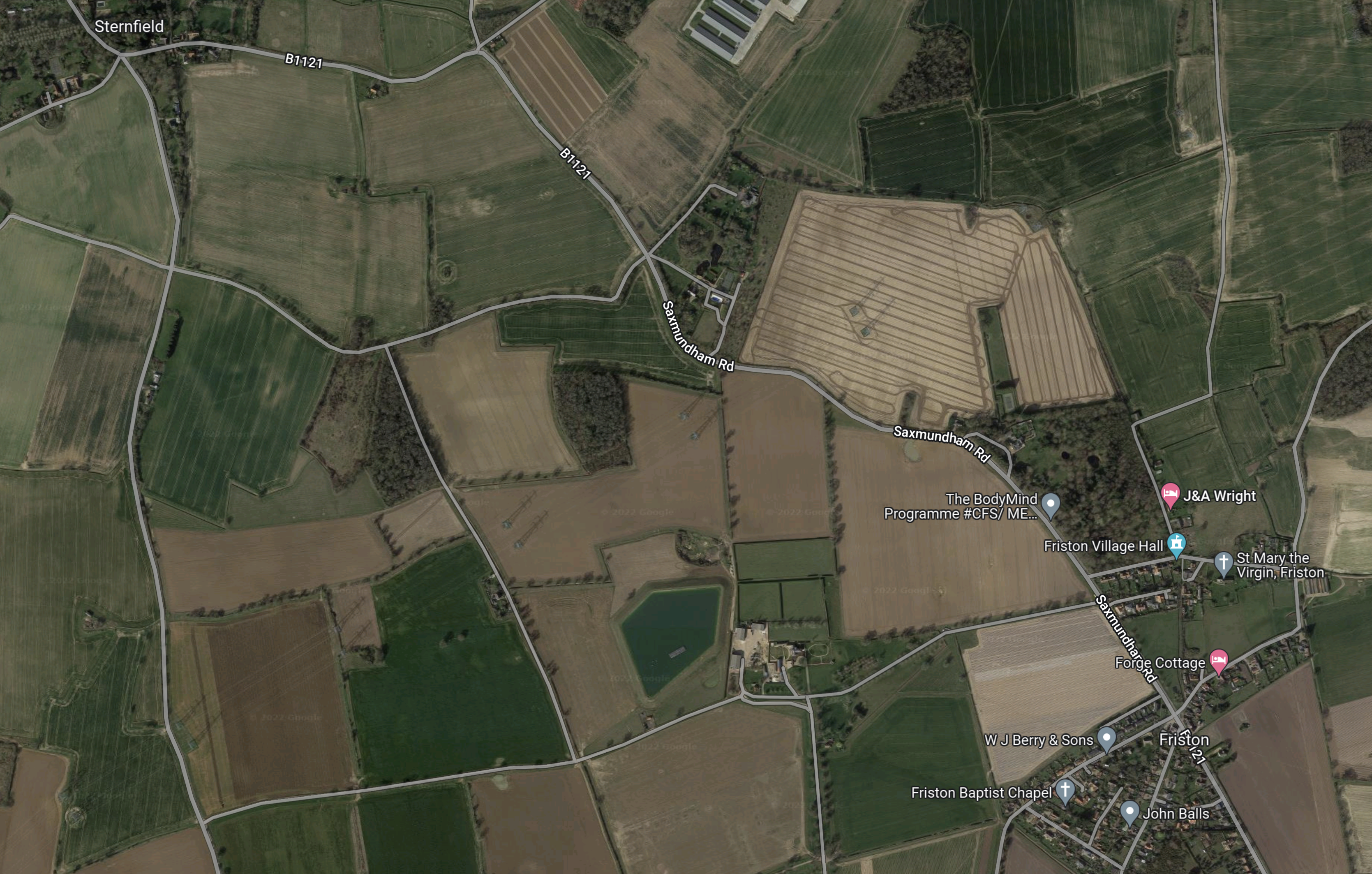
Running South-West to North-East across the map can be seen the dual line of electricity pylons, that connect the nuclear power stations at Sizewell to the UK electricity grid.
Has Friston been chosen for the substation, so that, the various interconnectors can be connected to the power lines, that connect the Sizewell site to the UK electricity grid.
This would enable EuroLink, Nautilus and/or Sea Link to stand in for the Sizewell nuclear stations, if they are shut down for any reason?
It does appear from reports on the Internet that the Friston substation is not welcome.
Exploring Opportunities For Coordination
The title of this section is a heading in the EuroLink web site, where this is said.
In response to stakeholder feedback, NGV’s Eurolink and Nautilus projects and NGET’s Sea Link project are exploring potential opportunities to coordinate. Coordination could range from co-location of infrastructure from different projects on the same site, to coordinating construction activities to reduce potential impacts on local communities and the environment.
That sounds very sensible.
Project To Develop 20+ MW Floating Offshore Wind Technology Kicks Off
This is the introductory paragraph.
Highview Power In The Daily Express
This article in the Daily Express is entitled The Storage Sites Around The UK That Could Provide Cheap Power To Millions Of Homes.
Highview Power gets a large mention for its plan for twenty storage sites around the UK.
This is said about their planned sites at Carrington and on Humberside.
It is hoped that the first plant, a £250million Manchester station, will come online as early as 2024. It will have a 30megawatts capacity, able to store 300megawatt hours of electricity, enough to supply 600,000 homes with clean power for an hour.
The next plants will be even larger in scale, with four a five planned for Humberside with a 200megawatt/2.5gigwatt hour capacity. The CRYOBattery site would be able to store excess energy generated by the Dogger Bank, Hornsea and Sofia wind farms.
There is also a comprehensive map, with sites indicated at places like Aberdeen, Anglesey, Inverness, Liverpool, Montrose, Norfolk and Sizewell.
The sites seem to be following the wind, which is where excess power needs to be stored and released, when the wind is on strike.
The Celtic Cluster Launches New Regional Strategy To Maximise Offshore Wind Benefits
The title of this post, is the same as that of this article on offshoreWIND.biz.
This is the sub-heading.
The Celtic Sea Cluster has released a new Regional Strategy that outlines how Wales and South West England can maximise floating offshore wind technology benefits, in line with the forthcoming Celtic Sea leasing process being delivered by the Crown Estate.
Who comprise the Celtic Cluster? This paragraph gives the answer.
According to the Cluster, which is led by its founding partners, the Welsh Government, Cornwall, Isles of Scilly Local Enterprise Partnership, Celtic Sea Power, Marine Energy Wales, and the Offshore Renewable Energy Catapult, the strategy will allow the region’s stakeholders to ensure their activities are aligned and can achieve their common objectives.
I am surprised the Irish aren’t involved politically.
- The Irish Republic has a coastline on the Celtic Sea.
- There are a lot of Irish companies, finance and engineers involved in wind farm development.
But the cluster does have a firm ambition, according to the article.
The Cluster’s ambition is to establish the Celtic Sea region as a world leader in floating offshore wind by 2030 and to deliver 4 GW of floating wind in the Celtic Sea by 2035, with the potential to grow to 20 GW by 2045.
Note.
- The Wikipedia entry for the Celtic Sea, gives the sea an area of 300,000 km2.
- 20 GW or 20,000 MW is to be installed by 2045.
That is an energy density of just 0.067 MW/km2.
In ScotWind Offshore Wind Leasing Delivers Major Boost To Scotland’s Net Zero Aspirations, I calculated that ten floating wind farms had an average energy density of about 3.5 MW per km².
I wouldn’t bet against a few more floating wind turbines being squeezed into the Celtic Sea.

