How Flower Power Is Being Used To Fight Terrorists
The title of this post, is the same as that of an article on pages 38-39 of yesterday’s copy of The Times.
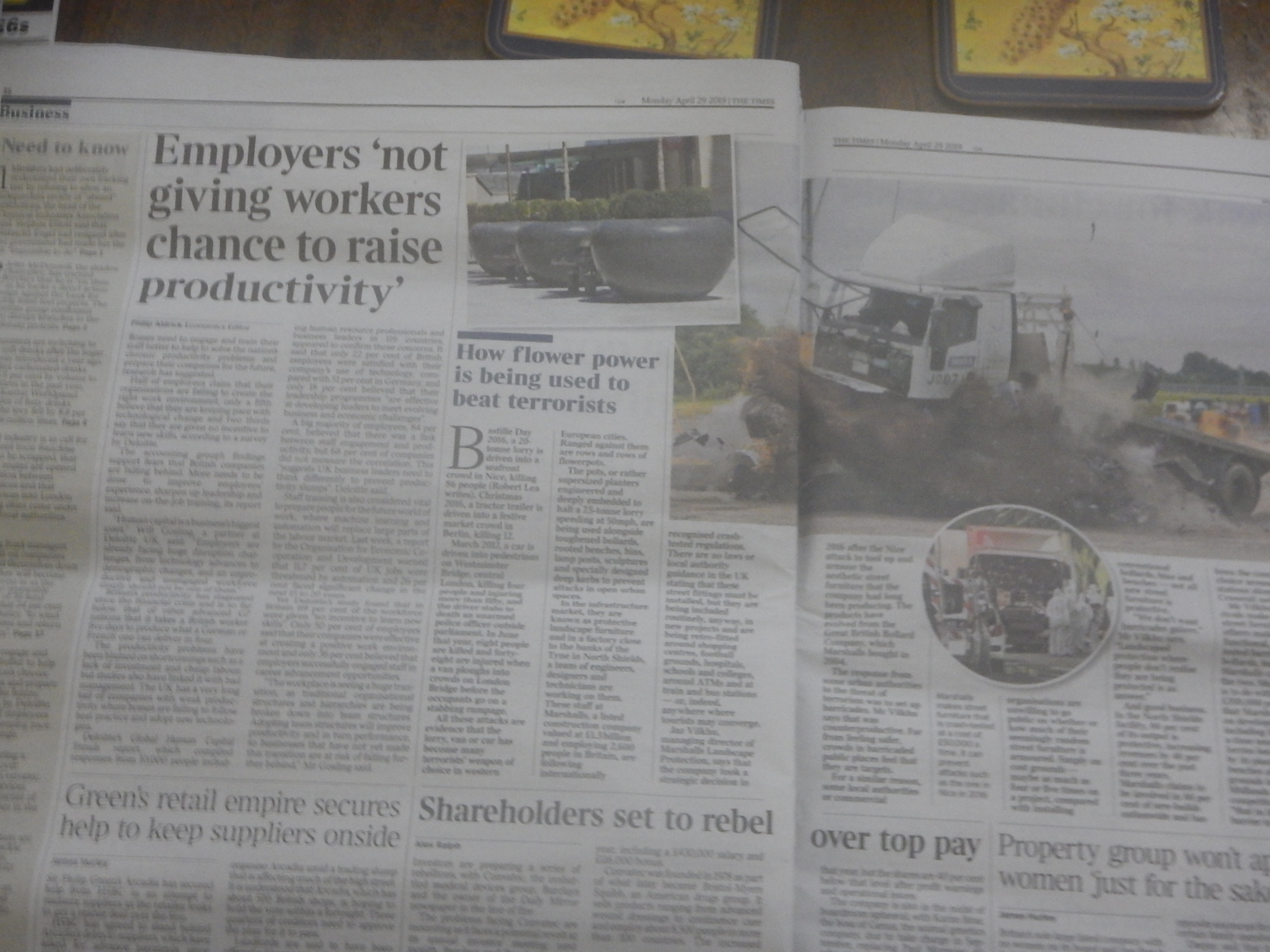
It describes how Marshalls and the wonderfully-names subsidiary; The Great British Bollard Company are using giant planters to stop terrorist attacks using trucks.
The pictures with the article show some gigantic planters stopping a large vehicle.
Are Network Rail And Heathrow Southern Railway Moving Towards A Joint Project On Western And Southern Access To Heathrow Airport?
In Could Rail Access To Heathrow Be Formed Of The Best Bits Of Various Schemes?, which I wrote in August 2018, I came to an extensive series of conclusions, which I have now changed as HS4Air and Windsor Link Railway have now been consigned to the landfill site of unbuilt projects.
In Could Rail Access To Heathrow Be Formed Of The Best Bits Of Various Schemes, But Discounting HS4Air And Windsor Link Railway?, I give my latest views.
These were my conclusions.
Heathrow Connectivity
Heathrow needs a very high level of connectivity, for passengers, workers and freight.
The two major schemes, that are left, provide that.
- Heathrow Southern Railway, which extends Heathrow Express to the South West and provides links to Waterloo and Greater South London.
- Western Rail Approach To Heathrow does what it says in the name.
Both schemes would share the same Western access route to Terminal 5 station and this could be modified to serve a new rail terminal under the new third runway.
What About The Workers?
Heathrow’s other big need is rail access for the increasing numbers of people, who work at the airport and live locally.
- Heathrow Southern Railway links the airport to South West London.
- Western Rail Approach To Heathrow links the airport to Reading and Slough.
- Crossrail links the airport to Old Oak Common with its housing developments and rail connections with High Speed 2 and the London Overground.
- West London Orbital Railway will bring more workers and passengers to Old Oak Common from all over North West and South West London.
Old Oak Common will be important for many working at the airport.
Pollution Solution
As the airport develops, Heathrow Southern Railway and Western Rail Approach To Heathrow could together make a substantial reduction in the pollution emitted by the airport.
Old Oak Common station
Old Oak Common station will become an important interchange for workers and passengers travelling to and from Heathrow.
- It must be totally step-free.
- Some of the long interchange walks on current plans should be augmented by travelators.
- Crossrail is planning six tph between Old Oak Common and Heathrow. Is that enough?
Get Old Oak Common right and all those needing to go to and from Heathrow will benefit.
Heathrow And Gatwick
The connection between Heathrow and Gatwick airports is tortuous at present, but will get better as the years progress, as Crossrail and Thameslink improve.
As the airports grow, with a third runway at Heathrow and a second one at Gatwick, how many people will want to travel quickly between the two airports, as increasingly, both airports will offer services to more destinations?
As a Londoner, I also believe that we will see more split flights, where passengers stopover in London for a night or two, when they are going halfway around the world.
Terminal London will be the best airport transfer terminal in the world.
Heathrow And High Speed One
I will be very surprised if many travellers need to go quickly between Heathrow and High Speed One.
For those that need to do it, using an extended Crossrail between Heathrow and Ebbsfleet will probably be good enough.
Heathrow And High Speed Two
For all sorts of reasons Heathrow needs good connectivity to High Speed Two.
With the elimination of direct access to the airport by High Speed Two, a short journey between Heathrow Airport and Old Oak Common stations will have to be acceptable.
It should also be noted, that Network Rail’s Western Approach To Heathrow (WRAtH) and Heathrow Southern Railway (HSR) would share the following infrastructure or interests.
- Heathrow Terminal Five station.
- The Western access tunnel and track to Heathrow.
- Network Rail is planning a flyover at Woking, which would help HSR’s plans.
If a rail terminal were to be built under a new third runway, that too would be shared.
An Update On Heathrow Southern Railway
In the May 2019 Edition of Modern Railways there is an article which Is entitled Time For Action On Heathrow’s Southern Link.
Most of the article takes the form of an interview with Graham Cross, who is the Chief Executive of HSR.
The first part is a call to the Government to make a decision soon, as otherwise HSR’s funding and timescale will be at risk.
In the rest of the article, Mr. Cross talks about the project and introduces some changes.
More Tunnels
This is an extract from the Modern Railways article.
The line would be mainly in tunnel to minimise environmental impact. “We would need to tunnel under certain obstacles anyway, and once you’ve set up tunnel boring machines, you might as well stay underground.” says Mr.Cross.
Could this move to tunnels also be driven by improved tunnelling techniques and cost savings, in addition to the environmental impact?
If so, will we be seeing more new tunnels in the UK, for rail, roads, electricity and sewage?
This Google Map shows the Northern section of the HSR route.
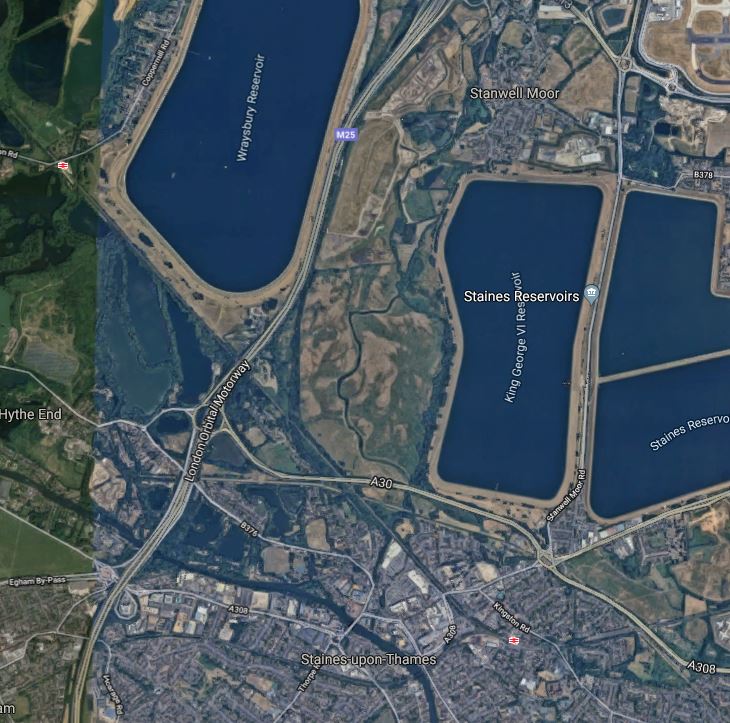
Note
- The South-Western corner of Heathrow Airport can just be seen in the North-Eastern corner of the map.
- Wraysbury station is towards the North-Western corner of the map.
- The M25 running North-South
- Staines station is the station South of the King George VI Reservoir
- The Staines-Windsor Line running North-West from Staines station.
- The Waterloo-Reading Line running West from Staines station.
The HSR would need to thread its way on the Eastern side of the M25.
From the map in the Modern Railways article, it appears that the route from Heathrow Terminal 5 station splits into two Southerly routes a short distance to the East of the point where the Staines-Windsor Line goes under the M25.
This map from carto.metro.free.fr may help to make everything clearer.
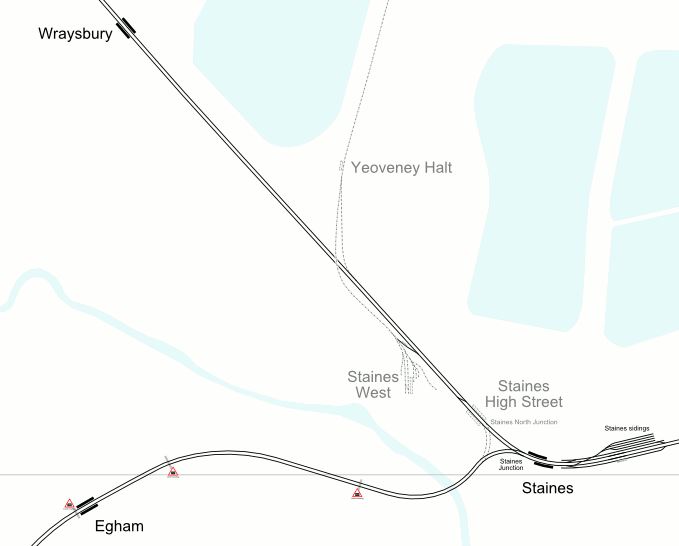
Note.
- The reservoirs are shown.
- The troublesome level crossings between Staines and Egham.
- It also spears that there is a disused railway going North through Yeovenney Halt.
- Yeovenney Halt would not be far from the route of the HSR to the East of where the M25 and the Staines-Windsor Line cross.
This Google Map shows the area in detail.
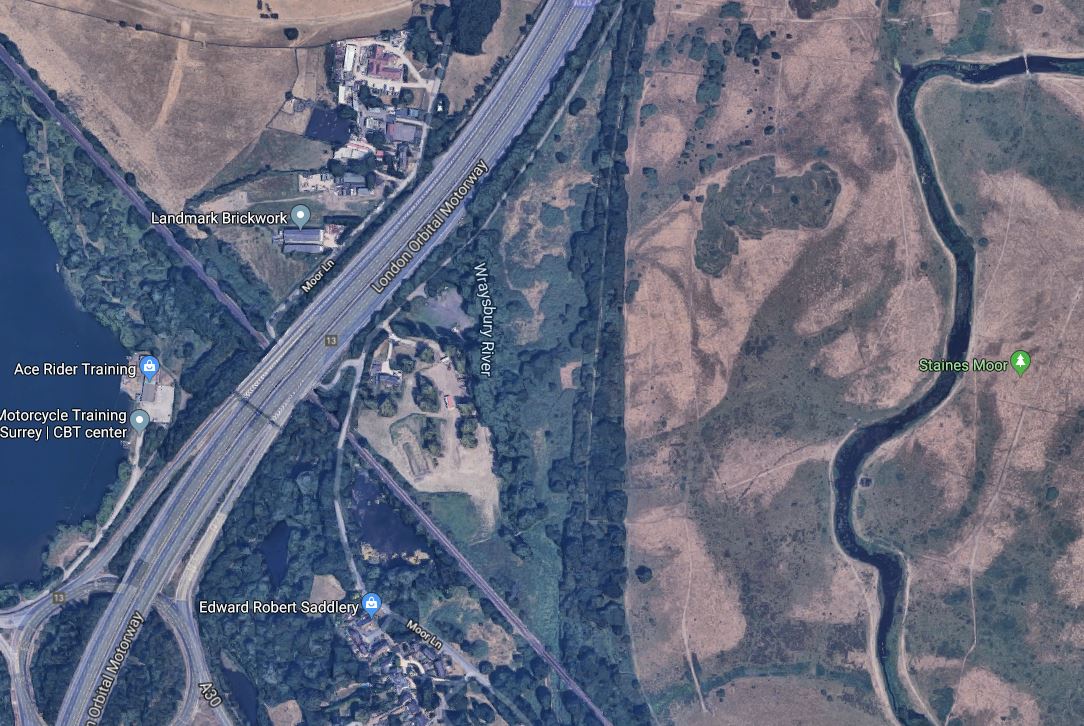
It’s not an area that with large numbers of houses and businesses.
Two routes are shown for HSR on the map in Modern Railways from the area to the East of where the M25 and the Staines-Windsor Line cross.
- One route joins the Staines- Windsor Line to take trains to and from Staines station.
- A second route is shown passing under the Staines-Windsor Line.
Note.
- As there is plenty of space, a flyover could be built if needed to connect Heathrow Airport to Staines station.
- The space would also be useful for creating a tunnel portal to continue the route to the South.
Two options are shown on the map in Modern Railways, to connect Heathrow to the Chertsey Branch Line.
Option 3 connects to North of Virginia Water station.
Option 8 connects to North of Chertsey station.
This Google Map shows Virginia Water and Staines stations and the area in between.
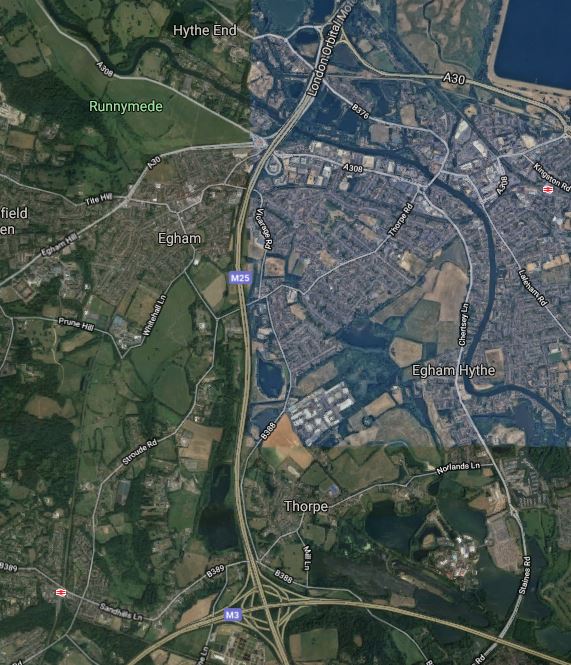
Note
- Virginia Water station is towards the bottom-left of the map,
- Staines station is towards the top right.
- The area of Yeovenney Halt can just be seen.
This Google Map shows the area between M25 and Chertsey station.

Note that Chertsey station is in the South-East corner of the map.
It looks like one or even both of the routes from Yeovenney Halt to the Chertsey Branch Line could be fairly easy to dig.
- There could be suitable sites at both Virginia Water and Chertsey.
- The distance is under ten miles.
- Much of the work could probably be done without closing the railways.
- There’s space for a flyover at both locations.
- Very few, if any business or residents would need to sell up and move.
- The tunnels could even be under the M25.
As Mr. Cross said, tunnelling could be a good option.
As WRAtH will also be tunnelled could both twin bore tunnels be dug with the same tunnel boring machines? Or as part of the same contract?
There certainly seem to be options for co-operation between the two projects to save money.
No West-Facing Triangular Junction At Staines
This is an extract from the Modern Railways article.
An earlier idea to create a triangular junction with a west-facing connection towards Egham did not command local aupport and was dropped.
I described this previously in Heathrow Southern Railway’s Proposed Chord At Staines.
It was intended to enable a two tph service between Weybridge and Heathrow Terminal 5 stations.
I would assume passengers are happy to change trains at Staines, which is step-free.
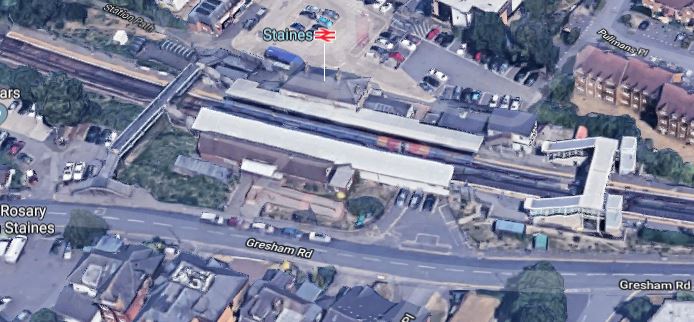
The Google Map visualisation, shows the footbridge at Staines station.
Waterloo To Heathrow Services
This is an extract from the Modern Railways article.
The first would comprise a four trains per hour (tph) service from Waterloo to Heathrow Terminal 5 as an extension of existing SWR services, with 2 tph running via Twickenham and 2 tph via Hounslow. HSR envisages these services would be formed of SWR’s new Class 701 trains.
Note.
- Ten-car Class 701 trains will probably be used.
- These trains have 556 seats and can accommodate 740 standees, which is nearly 1300 passengers.
The frequency and capacity compares well with Crossrail to the Airport.
Heathrow Express Extension To Woking, Guilford and Basingstoke
This will become two services wit a frequency of two tph.
- Paddington and Guildford via Old Oak Common, Heathrow, Woking and Basingstoke.
- Paddington and Guildford via Old Oak Common, Heathrow, Woking and Guildford.
Note.
- Basingstoke, Guildford and Paddington get a direct train to Heathrow, Old Oak Common and Paddinhgton.
- Twelve car Class 387 trains would work the service.
- My rough estimate says thirty four-car sets would be needed.
- A twelve-car Class 387 train has sixty percent more seats than a nine-car Class 332 train.
It is also said in the article, that a flyover could be built at Woking in CP6, which would help the Heathrow Express services.
Crossrail Extension To A Bay Platform At Staines Station
In Heathrow Southern Railway’s Plans For Staines, I discussed a plan to extend Crossrail services from Heathrow Terminal 5 station to a bay platform at Staines station.
It is not mentioned in the Modern Railways , so am I right to think, it is not going to happen.
- The proposed Waterloo to Heathrow Terminal 5, will provide a capacity of 5,200 passengers per hour between Staines and Heathrow Terminal 5
- Do WRAtH intend to run the two tph, that HSR wanted for Staines, to Slough and Reading to provide Western access to Heathrow?
So dropping the original plan is probably a reasonable decision.
How Many Trains Will Use Heathrow Terminal 5 Station
Currently, the service to Heathrow Terminal 5 station is as follows.
- 4 tph – Heathrow Express – Paddington and Terminal 5
- 2 tph – TfL Rail – Paddington and Terminal 5
There is also a shuttle to Terminal 4 station, running approximately every fifteen minutes.
Crossrail
After Crossrail opens the service will be.
- 4 tph – Heathrow Express – Paddington and Terminal 5
- 2 tph – Croosrail – Paddington and Terminal 5
Only the name on the train and the train type will have changed.
WRAtH
According to Wikipedia, WRAtH will have the following services.
t is envisaged that there would be a service of four trains an hour from Heathrow to Slough and Reading. Earlier publicity also suggested there would be two trains per hour to Twyford and Maidenhead.
Heathrow Express have offered to run services to Reading which would stop only at Slough.
I have I have a few thoughts.
- A service from Reading must have access to all terminals at Heathrow.
- All stations between Langley and Reading need at least two tph to Heathrow.
- Should services between Paddington and Heathrow be extended to Reading?
- Services must run on a 24/7 basis, to allow people to get to and from work and passengers on seriously delayed flights to get to their destination..
One way to provide a good basic service would be to combine the shuttle between Terminal 4 and 5 with the service to Slough and Reading.
- A train starting at Reading would call at a number of stations including Slough on its way to Heathrow Airport.
- It would then call at the following station in order; Heathrow Terminal 5, Heathrow Central, Heathrow Terminal 4, Heathrow Central and Heathrow Terminal 5.
- It would then return to Reading via Slough.
The stopping pattern between Langley and Reading would be arranged to suit passenger needs.
Advantages of this extended shuttle are as follows.
- All terminals are served by services originating in the West.
- The four tph shuttle is matched with four tph on WRAtH to and from Reading.
- No Westward-facing bay platform is needed at Terrminal 5 to turn trains from Reading.
- A Westward-facing bay platform might be useful for service recovery.
All trains using WRAtH to and from Reading would use through platforms at Terminal 5.
HSR
HSR will have the following services.
- 2 tph – Heathrow Express – Paddington and Basingstoke via Woking
- 2 tph – Heathrow Express – Paddington and Guildford via Woking
- 2 tph – SWR – Waterloo and Terminal 5 via Hounslow and Staines
- 2 tph – SWR – Waterloo and Terminal 5 via Twickenham and Staines
Note.
- The Heathrow Express services will use through platforms.
- The Waterloo services could use a bsay platform.
This map from carto.metro.free.fr shows the current layout of platforms at Heathrow.
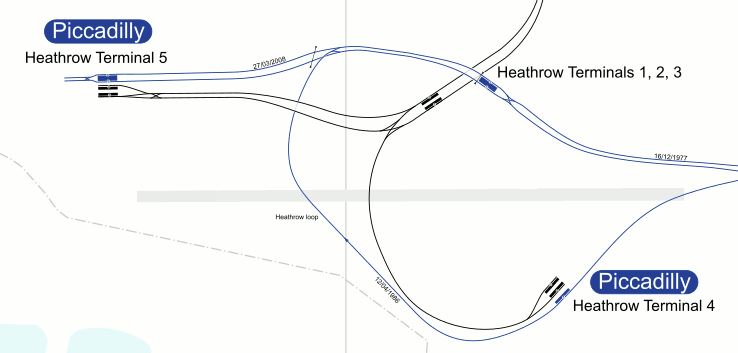
Adding all the requirements together, the following platforms will be needed.
Two through platforms for the following services.
- 2 tph – Heathrow Express – Paddington and Basingstoke via Woking
- 2 tph – Heathrow Express – Paddington and Guildford via Woking
- 4 tph – Crossrail – WRAtH services between Reading and all terminals
Note.
- Eight tph would not be difficult to handle.
- Heathrow Express and the WRAtH services would alternate.
- There would be same platform interchanges between Heathrow Express and WRAtH services.
In addition, there would be the following.
- A bay platform for Waterloo services.
- Possibly another platform for service recovery.
Ther could also be extra platforms for long distance services between Heathrow Terminal 5 and destinations like Bristol, Cardiff, Oxford and Plymouth
It has amazed me, how by combining HSR, Crossrail, Heathrow Express and WRAtH services together needs so few platforms in Terminal 5 station.
Conclusion
Network Rail’s Western Appoach To Heathrow and Heathrow Southern Railway may currently be two separate schemes with different funding models, but they have a lot of shared infrastructure, interests and objectives.
Both projects would surely be better with strong co-operation.
Judging by how well it all seems to fit, it does seem that they are talking.
Could Rail Access To Heathrow Be Formed Of The Best Bits Of Various Schemes, But Discounting HS4Air And Windsor Link Railway?
This post is an updated version of Could Rail Access To Heathrow Be Formed Of The Best Bits Of Various Schemes?, which has been written to fit with the situation as it exists in April 2019.
- HS4Air has not been accepted.
- Windsor Link Railway has not been accepted.
- The scheme is Heathrow-only.
Various schemes have been proposed to improve rail access to Heathrow.
- Heathrow Southern Railway
- HS4Air – Now not accepted!
- Western Rail Approach to Heathrow
- Windsor Link Railway – Now not accepted!
There are also two schemes in progress, that will improve rail access to Heathrow.
- Crossrail, which will open to Heathrow in 2019.
- Piccadilly Line Upgrade, which will be complete in 2025.
I also believe that if the West London Orbital Railway is created, then this could have a positive affect on travelling to and from Heathrow.
Heathrow In The Future
Heathrow are disclosing a master plan, for rebuilding a lot of the airport to make it more efficient and up with the best.
- There will be two main terminals; Heathrow West and Heathrow East with satellites in between handling the actual planes.
- These two terminals and the satellites will be between the two existing runways, with a passenger and baggage transport system beneath.
- Terminal Five will become Heathrow West.
- An extended Terminal Two will become Heathrow East.
- Crossrail, Heathrow Express and the Underground will serve both main terminals.
I believe that this rebuilding will happen, whether or not a third runway is built and it could start in the next few years.
Heathrow’s Pollution Footprint
Heathrow is a big polluter, but it is not so much the planes, as the diesel cars, buses and trucks serving the airport.
Heathrow’s Third Runway
Heathrow’s third runway and another terminal could be built North of the current two runways.
These factors would effect the chance of it being built and the eventual opening date.
- The development of extra services on High Speed One.
- The opening of High Speed Two.
- The building of a second runway at Gatwick.
- Extra capacity at other London airports, like City, Luton, Southend and Stansted.
- Politics, as many possible leaders of the Conservative and Labour parties don’t want it built.
I have a feeling that Heathrow’s Third Runway could be a back-burner project for decades.
I do think though, that the space underneath the third runway could be used as a rail terminal.
Uses For Improved Rail Access
There are several uses for improved rail access to Heathrow.
Passengers
Many passengers feel they must drive to and from Heathrow.
Next year, Crossrail will connect Heathrow directly to the City of London, Canary Wharf, the West End and to the heart of London’s Underground, Overground and National Rail system.
An example journey will be Bond Street to Heathrow Central in twenty-six minutes.
New trains on the Piccadilly Line are planned to enter service in 2023 and will offer more capacity and more pleasant journeys.
Currently, Piccadlly Circus to Heathrow Central takes fifty-two minutes and I would hope that this time is reduced to perhaps 40-45 minutes.
I think, these two upgrades will change the way many in Central, North East, East and South East London access the airport.
- Trains will be more comfortable.
- Trains will be frequent.
- Crossrail will be completely step-free.
- The Piccadilly Line will have more step-free stations.
- The Crossrail trains will have masses of space.
- Trains will take passengers to all the terminals
But Crossrail and the Piccxadilly Line upgrade, will do little for those in North West and South West London and those living to the West of the airport.
Workers
Workers at Heathrow, range from highly-paid pilots down to lowly-paid cleaners, with a full spectrum in between.
Many though have a problem, in that they need to get to and from the airport at times, that are inconvenient for public transport.
A station guy at Staines said that getting between there and Heathrow for an early start or after a late finish is difficult.
The lower-paid workers also need good links to areas of lower-cost housing.
In an ideal world, Crossrail and Piccadilly Line services, should run on a twenty-four hour basis, with appropriate frequencies.
Supplies For The Airport And The Aircraft
I wonder what percentage of the supplies for Heathrow is brought in by diesel truck.
In the Heathrow of the Future, surely many supplies could be loaded onto smart trolleys and taken on electric freight trains to delivery points under the airport.
Air Cargo
Heathrow is an important air cargo terminal, but as with supplies, surely the cargo can be collected outside of the airport and delivered by electric shuttle trains.
Could Heathrow Go Diesel-Free?
I believe that if a well-designed rail-terminal was built under a new third runway, the extra rail capacity could enable, Heathrow to go substantially zero-carbon on the ground!
- All vehicles bringing passengers to the Airport would have to be zero-carbon powered.
- Hybrid vehicles would have to use battery power within a few miles of the Airport.
- Air cargo and airport supplies would be shuttled into the Airport by electric train to the rail terminal under the third runway.
- All vehicles serving the planes would be zero-carbon powered.
- Even giant aircraft tugs for Boeing 747s and Airbus A380s can be battery-powered.
- We are probably talking several years before a third runway would open! So why not?
It is disruptive innovation on a grand scale!
Airports built to these principles and there will be several before 2030, will have a massive marketing advantage.
The Best Bits Of The Various Actual And Proposed Rail Routes Into Heathrow
Crossrail
- Connectivity to large parts of London and the East.
- Connectivity to lower-cost housing areas in East and West London.
- High capacity.
- Frequent trains
- Modern trains
- All terminals served
- Extra trains could be added.
The capability for 24 hour operation has hopefully been built in.
Heathrow Southern Railway
- Connectivity to Waterloo, Clapham Junction, South and South West London
- Extends Heathrow Express to Woking and Basingstoke
- Adds a new route for commuters into Paddington.
- Extends Crossrail from Heathrow to Staines.
- It will be built alongside the M25 with a tunnel to Terminal Five.
- All terminals served
- Provides a freight route into the airport from the South West.
- Privately funded.
Heathrow Southern Railway would also be able to serve any future rail terminal under a new third runway.
Piccadilly Line Upgrade
- Connectivity to West and North London
- Connectivity to lower-cost housing areas in West London
- Frequent trains
- All terminals served.
- No new infrastructure
The Piccadilly Line probably needs 24 hour operation.
Western Rail Approach To Heathrow
- Connectivity to Slough and Reading and further West with a change.
- All terminals served.
- Provides a freight route into the airport from the West.
- Network Rail’s proposed scheme.
- Government funded (?)
As with the Heathrow Southern Railway, Western Rail Approach To Heathrow would also be able to serve any future rail terminal under a new third runway.
West London Orbital Railway
- Connectivity to North West London with a change at Old Oak Common.
- Connectivity to low-cost hosting areas in West London.
- Created as part of the Overground.
- Eight trains per hour (tph) through Old Oak Common.
- Connectivity for high-value passengers in affluent parts of North London.
- Connectivity for important workers in less-affluent parts of North West London.
- Probably, Transport for London funded.
- No difficult construction.
The West London Orbital Railway should go ahead, because it connects so much of West London to Crossrail, Old Oak Common and High Speed Two.
Conclusions
I have seen railway stations and airports all over Europe.
Many airport stations are cramped, as they have been built as an afterthought.
But some like Schipol and Frankfurt have a comprehensive station, where you can get trains to a very long list of places without a change.
Heathrow Connectivity
Heathrow needs a very high level of connectivity, for passengers, workers and freight.
The two major schemes, that are left, provide that.
- Heathrow Southern Railway, which extends Heathrow Express to the South West and provides links to Waterloo and Greater South London.
- Western Rail Approach To Heathrow does what it says in the name.
Both schemes would share the same Western access route to Terminal 5 station and this could be extended to also serve a new rail terminal under the proposed third runway.
What About The Workers?
Heathrow’s other big need is rail access for the increasing numbers of people, who work at the airport and live locally.
- Heathrow Southern Railway links the airport to South West London.
- Western Rail Approach To Heathrow links the airport to Reading and Slough.
- Crossrail links the airport to Old Oak Common with its housing developments and rail connections with High Speed 2 and the London Overground.
- West London Orbital Railway will bring more workers and passengers to Old Oak Common from all over North West and South West London.
Old Oak Common will be important for many working at the airport.
Pollution Solution
As the airport develops, Heathrow Southern Railway and Western Rail Approach To Heathrow could together make a substantial reduction in the pollution emitted by the airport.
Old Oak Common station
Old Oak Common station will become an important interchange for workers and passengers travelling to and from Heathrow.
- It must be totally step-free.
- Some of the long interchange walks on current plans should be augmented by travelators.
- Crossrail is planning six tph between Old Oak Common and Heathrow. Is that enough?
Get Old Oak Common right and all those needing to go to and from Heathrow will benefit.
Heathrow And Gatwick
The connection between Heathrow and Gatwick Airports is tortuous at present.
- It will get better, as Crossrail and Thameslink improve.
- As the airports grow, with a third runway at Heathrow and a second one at Gatwick, how many people will want to travel quickly between the two airports, as increasingly, both airports will offer services to more destinations?
- As a Londoner, I also believe that we will see more split flights, where passengers stopover in London for a night or two, when they are going halfway around the world.
Terminal London will be the best airport transfer terminal in the world.
Heathrow And High Speed One
I will be very surprised if many travellers need to go quickly between Heathrow and High Speed One.
For those that need to do it, using an extended Crossrail between Heathrow and Ebbsfleet will probably be good enough.
Heathrow And High Speed Two
For all sorts of reasons Heathrow needs good connectivity to High Speed Two.
With the elimination of direct access to the airport by High Speed Two, a short journey between Heathrow Airport and Old Oak Common stations will have to be acceptable.
Rugby Goal-Light Technology Trial At Principality Stadium
The title of this post is the same as that on this article on the BBC.
This is the first paragraph.
New technology to light up rugby posts in different colours to show whether a kick is successful was trialled at Cardiff’s Principality Stadium.
Although, I’m not registered blind, I do have problems with spotting movement in certain light conditions and at certain angles.
If I regularly went to rugby, these lights could improve my experience.
They are a good idea.
What puzzles me, is that the post says they could be used in American Football.
You’d have thought that the Americans would have already done it, but obviously they haven’t!
Crossrail Ltd Outlines Plan To Complete The Elizabeth Line
The title of this post is the same as this statement on the Crossrail web site.
These are a few points from the statement.
The Opening Date Of The Central Section
This is a sentence from the statement.
Crossrail Ltd has identified a six-month delivery window with a midpoint at the end of 2020. Crossrail will be making every effort to deliver the service as early as possible.
Does that meet some date between the 1st October 2020 and 31st March 2021?
And what will open on that date?
There is then this paragraph.
The central section of the Elizabeth line will open between Paddington and Abbey Wood and link the West End, the City of London, Canary Wharf and southeast London with initially 12 trains per hour during the peak.
Twelve trains per hour (tph) gives a capacity of 18,000 passengers per hour, which compares with the 36 tph and 31,500 passengers per hour of the Victoria Line.
Practically, this means that a twelve tph Crossrail could be carrying sixty percent of the number of passengers of the Victoria Line. It’s better than a kick in the teeth!
But then Dear Old Vicky is the Platinum Standard with lots of encrusted diamonds!
Bond Street Station
This is a sentence from the statement.
It is expected that all stations on the route will open except for Bond Street which is delayed because of design and delivery challenges.
The stations are designed so that trains can pass through, so this is not a problem.
Western Branch Services
This is a paragraph from the statement.
TfL Rail services between Paddington and Reading will commence in December 2019 with a frequency of 4 trains per hour in the peak. Testing of the signalling system continues to allow the new class 345 trains to be extended from Hayes & Harlington to Heathrow.
When Crossrail is fully open, the Western Branch frequencies are planned to be as follows.
- Reading and Abbey Wood – 4 tph in the Peak and 2 tph in the Off Peak
- Maidenhead and Abbey Wood – 2 tph all day
- Heathrow Terminal 4 and Abbey Wood – 4 tph all day.
- Heathrow Terminal 5 and Abbey Wood – 2 tph all day.
Currently, TfL Rail’s services are as follows.
- Heathrow Terminal 4 and Paddington – 2 tph all day
- Hayes & Harlington and Paddington – 2 tph all day
It appears that the two Hayes & Harlington services are designed and timed, so they can be extended to Heathrow Terninal 5, with trains leaving Paddington at these times.
- XX:08 – Heathrow Terminal 4
- XX:10 – Heathrow Terminal 5
- XX:23 – Heathrow Terminal 4
- XX:38 – Heathrow Terminal 4
- XX:42 – Heathrow Terminal 5
- XX:53 – Heathrow Terminal 4
Perhaps, if the signalling had worked as intended, we would now be seeing Class 345 trains working as follows.
- Heathrow Terminal 4 and Paddington – 4 tph all day
- Heathrow Terminal 5 and Paddington – 2 tph all day
Once the signalling works as needed and signed off in blood, sweat and tears, the difficult part of the job has been done.
The Reading and Maidenhead services could then be added to the mix. Especially, as no problems have been admitted or rumoured with running to these destinations.
These would mean twelve trains per hour in the Peak and ten trains per hour in the Off Peak needing to be handled at the London end of the Western Branch of Crossrail.
Paddington Station Or Central Tunnel?
The twelve tph in the Peak and ten in the Off Peak is an interesting frequency.
In If Crossrail Opens To Reading In December 2019, How Will It Terminate In Paddington?, I describe how Heathrow and Reading services at a frequency of twelve tph, could run into Platforms 12 and 14 at Paddington.
This was my conclusion.
Platform 12 and 14 at Paddington could be converted into a two-platform Crossrail station handling seven-car Class 345 trains, at a frequency of twelve tph, with its own gate line.
I’ll ralso epeat this paragraph from the statement.
The central section of the Elizabeth line will open between Paddington and Abbey Wood and link the West End, the City of London, Canary Wharf and southeast London with initially 12 trains per hour during the peak.
Twelve tph in the Peak is the maximum frequency of the Western Branch into London.
Crossrail have designed a system, where trains can initially terminate in either Paddington or Abbey Wood stations.
Tp give themselves all options and get the Western Branch running, Crossrail would need to complete and certify the following.
- Get the signalling working to Heathrow.
- Make sure twelve tph could terminate in Paddington.
- Make sure twelve tph could run through the tunnel between Royal Oak and Abbey Wood.
This would mean it would be possible to run twelve tph from Heathrow, Maidenhead and Reading in the West to either Paddington or Abbey Wood in London.
As twelve tph is only one train every five minutes, this surely could be run safely, once the three tasks above are complete and signed off.
Running A Split Service
This is said in the statement.
When the Elizabeth line opens the railway will operate as follows:
- Paddington (Elizabeth line station) to Abbey Wood via Central London
- Liverpool Street (main line station) to Shenfield
- Paddington (main line station) to Heathrow and Reading
At a first look it appears to be a sensible plan.
- All three services are independent of each other
- Liverpool Street and Shenfield is working well and will carry on regardless as long as needed at six tph.
- The Abbey Wood and Heathrow/Reading services can be run as two independent rail services.
The following will also get a thorough testing.
- Paddington (Elizabeth Line station)
- The interchange tunnel between the Bakerloo Line and Paddington (Elizabeth Line station)
- The important turnback facility at Royal Oak for trains turning in the Paddington (Elizabeth Line station)
The only problem, is that passengers will have to change trains at Paddington.
Running A Limited Preview Service In The Central Tunnel
Would it be possible to run a preview service in the Central Tunnel, after the following are tested and certified?
- The turnback facility at Royal Oak
- Paddington (Elizabeth Line station)
- The intermediate stations.
- The operation of trains in the tunnel at twelve tph.
- Abbey Wood station.
- The turnback facility at Abbey Wood.
A frequency of four or six tph may give the station systems a thorough testing.
Rolling Out The Full Service
This is a paragraph from the statement.
Once the central section opens, full services across the Elizabeth line from Reading and Heathrow in the west to Abbey Wood and Shenfield in the east, will commence as soon as possible.
I would assume stations and extra services will be added as soon as testing is complete and drivers and station staff are fully-trained.
Conclusion
The plan is good, as it allows these and other systems to be tested independently.
- The signalling into Heathrow.
- Twelve tph trains to and from Heathrow, Maidenhead and Reading.
- Operation of the platforms in Paddington (main line station)
- Operation of the turnback facility at Royal Oak
- Operation of the platforms in Paddington (Elizabeth line station)
- Handling of twelve tph and the signalling in the Central Tunnel.
- Operation of the turnback facility at Abbey Wood.
I wouldn’t be surprised, that if all goes well, we may be seeing a very limited Crossrail service earlier than anybody currently thinks.
It would also appear to get the Western and Shenfield branches working independently to provide much needed, more frequent and quality services,.
These will then be joined by services in the Central Tunnel, which initially will be run independently.
As I said earlier a twelve tph Crossrail between Paddington and Abbey Wood through the Central Tunnel, would carry sixty percent of the passengers of the Victoria Line!
Grand Union Seeks ’91s’ To Cardiff
The title of this post is the same as that of an article in the May 2019 Edition Of Modern Railways.
These are points fro the article.
- Grand Union Railway is a new open access operator.
- Trains will be formed of a Class 91 locomotive, nine Mark 4 coaches and a driving van trailer.
- Trains will go between London and Cardiff, stopping at Bristol Parkway, Severn Tunnel Junction and Newport
- Trains will leave Paddington hourly from 07:35 to 21:35
- Trains will leave Cardiff hourly from 06:35 to 19:35
- The journey time will be one hour and forty-five minutes.
- To run this timetable would appear to need four trains. Grand Union will probably have a fifth train, to allow for one in maintenance.
The service is subject to regulatory approval.
Note that the company has been formed by Ian Yeowart, who was previously Managing Director of Grand Central.
Currently, Great Western Railway (GWR) runs the following trains to South Wales
- Paddington and Cardiff via Reading, Didcot Parkway, Swindon, Bristol Parkway and Newport
- Paddington and Swansea via Reading, Swindon, Bristol Parkway, Newport, Cardiff, Bridgend, Port Talbot Parkway and Neath
Services will soon be run exclusively by Class 800 or Class 802 trains.
Note.
- Some of the Swansea services are extended to Carmarthen and Pembroke Dock.
- Paddington to Cardiff takes two hours and eight minutes.
- Paddington to Swansea takes just under three hours.
- These times will be improved when the the electrification is completed between Paddington and Cardiff
Paddington and Cardiff will be getting three trains per hour (tph) and two operators
Great Western Railway And Grand Union Services Compared
It is interesting to compare the two services.
Journey Times
Consider.
- The Grand Union service at one hour forty-five minutes appears to be quicker than the GWR service at two hours eight minutes.
- But are we comparing times after full electrification of the route to Cardiff, which the Class 91 locomotives will need to operate?
- There is also the possibility of digital signalling being fitted to both sets of trains.
- Both trains can run at 140 mph with in-cab signalling
- The Grand Union service has less stops than the GWR service.
Will the trains settle for a draw and have the same journey times?
Capacity
The seating capacity of the two trains are as follows.
- GWR Class 800/802 train – 655 seats
- Grand Union – InterCity 225 – 535 seats
My only thought, is that is there enough space in the GWR train or all luggage.
Bicycles And Bulky Luggage
Tourists with cycles are increasing in number and Wales will become a destination.
Hitachi Class 800 trains do not have much space for bicycles and bulky luggage.
On the other hand, the driving van trailer of an InterCity225 can swallow a lot.
Will There Be Sufficient Demand For An Extra Service between London and Cardiff?
A friend asked.
Is there actually a market/capacity for an extra hourly service?
I made these points in reply.
- The South Wales Metro will be one of the best City metros in the world and will improve feeder services to Cardiff Central dramatically.
- The M4 is getting busier between Bristol and Cardiff, partly due to the abolition of tolls on the Severn Bridge.
- The Principality Stadium
- Tourism to South Wales is growing.
- Business and finance in Wales is finally looking up.
- All trains will be at 140 mph for long stretches, so journey times will be one hour forty-five minutes.
- Paddngton is not an attractive place to arrive at in London, but after Crossrail opens, all should be different.
- City of London to City of Cardiff in two hours.
- Cardiff will be closer to the City of London, than Brussels, Leeds, Liverpool, Manchester or Paris!
- Heathrow’s Third Runway.
- Four wheels bad, rails good
- Kids are getting to like trains, just as we did.
- The next generation of on-train Internet will be much faster for working and keeping kids of all ages amused.
- GWR, Grand Union and the Welsh Government could market the route as High Speed Wales!
Will three tph be enough?
My Prediction In October 2013
In October 2013, I wrote Will We Get HSW Before HS2?
This was the conclusion of that post.
So I believe that even if it still goes slower on opening, trains to Bristol and Wales will be doing 225 kph before the end of this decade.
If that isn’t a high speed railway like HS1, I don’t know what is?
But whatever we call it, it’ll be here several years before HS2!
I think we need to call for three cheers for Brunel, who got the route right in the first place.
I felt the biggest problem would be the Severn Tunnel! I got that wrong, as that difficult job is now done.
Conclusion
I like this proposal.
- The important Paddington and Cardiff route gets a fifty percent increase in train frequency.
- There could be genuine competition on the route.
- Grand Union would be using five of the thirty InterCity225 sets, which are in good condition, judging by my recent journeys.
- Could we see a customer service and catering war between the two operators?
If Grand Union Railway runs to Cardiff, I’ll give it a go.
Lessons From Extinction Rebellion
I only came across Extinction Rebellion once and I took these pictures.








Oxford Circus was totally blocked.
So what have we learned?
A Relatively Small Largely Peaceful Group Can Bring A British City To A Halt
By not using any violence or threats of violence, the good nature of the Metropolitan Police meant that the protest was able to continue, despite the large number of arrests.
It also seemed that many after arrest, went back to the protest.
The Great British Public Didn’t Seem To Be Too Annoyed
Although, one or two celebrities, white van and black cab black drivers seemed to be annoyed, when they were interviewed, the Great British Public seemed to take it on the chin.
Crime Didn’t Seem To Rise In Areas Unaffected By The Protests
I’m not sure of this, but do-called newspapers like the Express, Mail and Sun didn’t seem to have any screaming headlines on the subject.
At The Right Time These Protests Can Be Cleared Without Heavy Police Force
In the end, the Oxford Street and Waterloo Bridge protests, were cleared by strength of numbers and no use of pepper spray, baton rounds or water cannon.
The Future Of Protest
I think we will see more protests of this type against or for such issues as Brexit, Remain and onald Trump.
Would the Met be able to cope with simultaneous protests for the first two groups?
Thinking About Climate Change
Will the Extinction Rebellion protests make us think more about climate change?
Investing In Renewable Energy
One trend I have noted over the past few years, is companies like Aviva, are investing large amounts of our pension funds in large renewable energy projects.
I wrote about one project in World’s Largest Wind Farm Attracts Huge Backing From Insurance Giant.
The Extinction Rebellion protests, must make it easier for Aviva and their like, to justify their investment decisions.
I feel that if the Government sets the right guidelines and tax rules, that companies like Ariva with their billions of pounds of funds, have more power than the Government to change the future.
Politicians
politicians in the UK are like a load of peasants on bicycles trying to put on a synchronised cycling display in a heavy thunderstorm.
They are morons led by mules!
I regularly use this phrase.
Engineering is the science of the possible, whereas politics is dreams of the impossible.
You can substitute lots of other professions for engineering.
But what we need is politician, who think in scientifically-correct pathways.
After all, you can’t disobey the laws of maths, physics, chemistry, biology and human nature.
But politicians believe you can otherwise racism, Marxism and Fascism wouldn’t exist.
Mondeo Man And Woman Living In A Comfortable House
Are these the real problem, as they drive around in their diesel car, live in very eco-unfriendly houses and fly to their holidays in America and the Far East?
How many of the vast majority of the UK population, even accept that climate change exists?
If they do, they always point to places like China and the United States, who carry on as normal!
Conclusion
There will be more and bigger protests, until politicians manage the art of synchronised bicycle riding!
A Neat Cup-Holder On Chiltern Railways
The picture shows a cup-holder on a Chiltern Railways’ train.
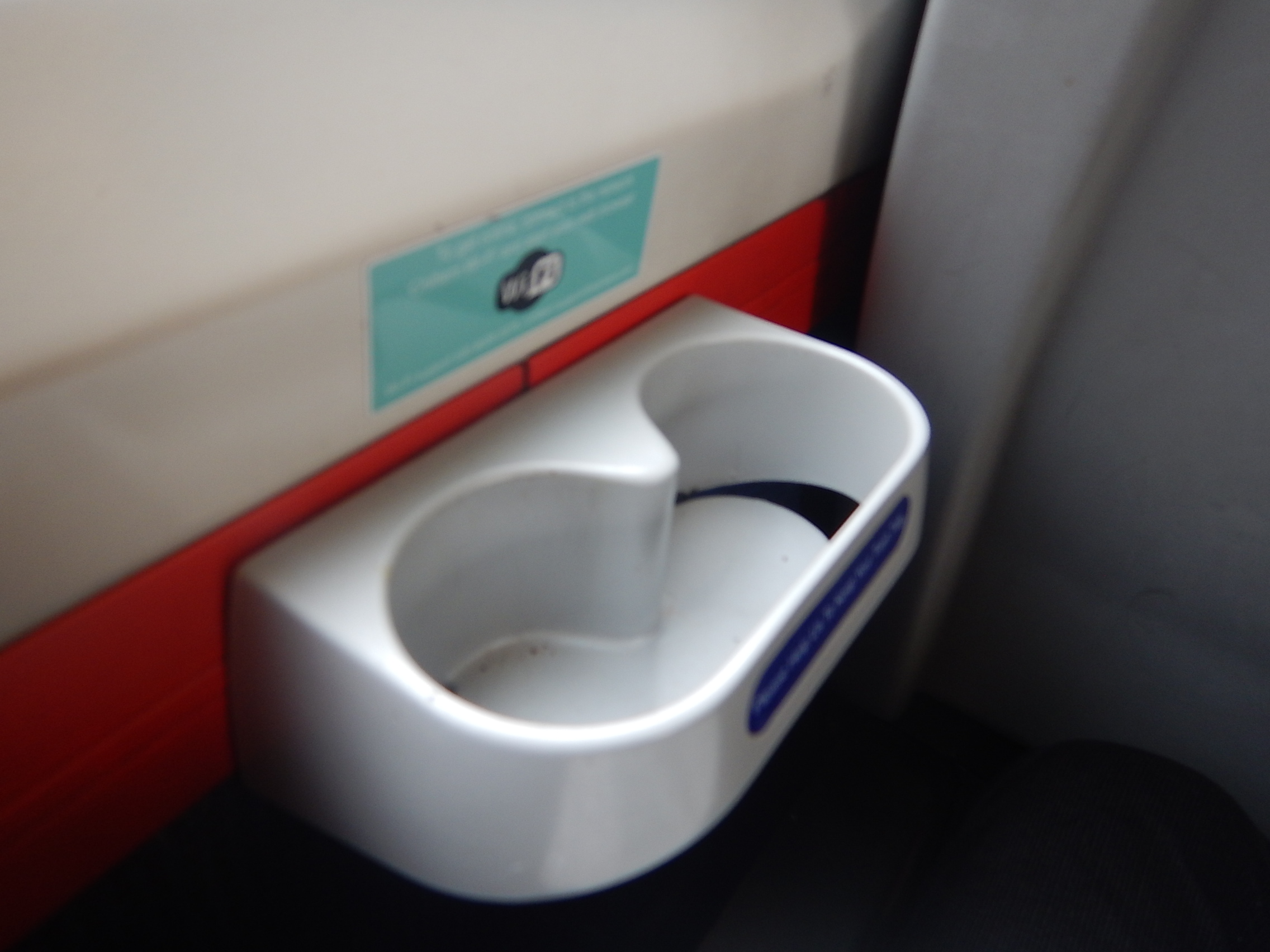
It is neat and well-designed.
It probably didn’t cost a fortune too!
World’s First Solar-Powered Train
This video was pointed out by an eFriend.
The discussion is interesting in the video and gives quite a few technical details.
Byron Bay Railroad would be a place I’d like to visit, but Australia is too far to go to see a technological development. Hamburg was another thing!
What Would Be The Best Result In The Manchester Derby?
Despite supporting Ipswich since our next door neighbour in Felixstowe took me at the end of the Ramsey era, I have affections for two other clubs.
As a child and teenager living in London, I did what my father had done in his youth and regularly went to see Spurs at White Hart Lane.
My father would tell stories about how he was at the Cup Final in 1921 and how before the Great War, his father would take them to the game in a pony and trap. My grandfather would give a kid a shilling to hold the horse’s head during the match.
Then in the 1960s at Liverpool University, I regular went to see both of the Liverpool clubs, although I identified more with Liverpool.
Perhaps because inh those years they played the better football and were more successful!
So who do I want to win the Manchester Derby?
Certainly not United, as in the 1950s, I lived next door to the most obnoxious United supporter, who rammed them down mine and my father’s throats at every opportunity.
I actually think, that both Spurs and Liverpool, would be happy with an extremely hard-fought goal-less draw at Old Trafford tonight!
 The Anonymous Widower