Dutch Stop Offshore Wind Turbines To Protect Migratory Birds In ‘International First’
The title of this post, is the same as that of this article on offshoreWIND.biz.
This is the sub-heading.
The wind turbines at Borssele and Egmond aan Zee offshore wind farms were stopped for four hours on 13 May, to help migrating birds pass by safely.
These three paragraphs outline the measures taken to protect the migrating birds.
According to the Dutch Government, this is the first time such a measure has been applied and is in line with the approach of the government and participating companies to increasingly focus on ecology and biodiversity in offshore wind farms.
The wind turbines’ speed will be reduced to a maximum of two rotations per minute during the predicted night-time peak migration to give the birds a safe passage.
The shutdown was part of a pilot phase, which could become standard this autumn and will also include wind farms that are still being built or will be constructed in the future.
I wonder how this Dutch action fits with research from Vattenfall, that I wrote about in Unique Study: Birds Avoid Wind Turbine Blades.
Plan To Develop New ‘Southern Gateway’ Through Station In City Centre
The title of this post, is the same as that of this article in the Bradford Telgraph and Argus.
This is the sub-heading.
Work to develop a new city centre rail station in Bradford could soon be back on the rails, despite the Government cancelling the local Northern Powerhouse Rail line
These are the first two paragraphs.
It has today been announced that the UK Infrastructure Bank will be working with Bradford Council to plan and develop a proposed “Southern Gateway” station in the city centre.
Although few details have been announced so far, the station is expected to be a through station, and is likely to be on the site off Wakefield Road currently occupied by St James’ Wholesale Market.
This sounds like an updating with finance of a plan I wrote about in Bradford Seeks Support On Rail Project Which Could Deliver £30bn Benefits.
This map from OpenRailwayMap shows the rail lines in the Bradford area.
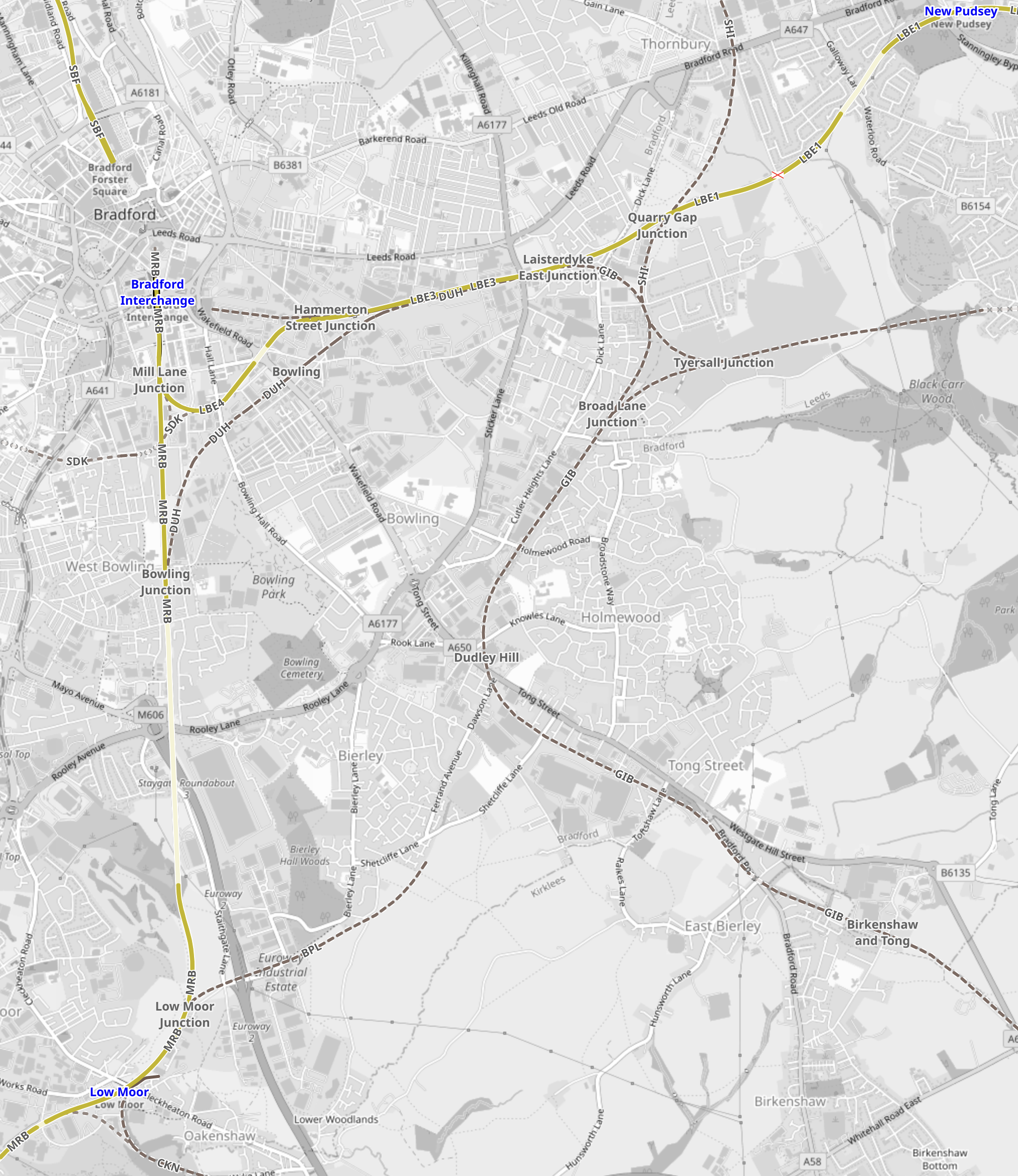
Note.
- New Pudsey station is in the North-East corner of the map.
- Bradford Foster Square and Bradford Interchange stations are in the North-West corner of the map.
- Low Moor station is in the South-West corner of the map.
This second OpenRailwayMap shows an enlargement of the lines across Bradford.
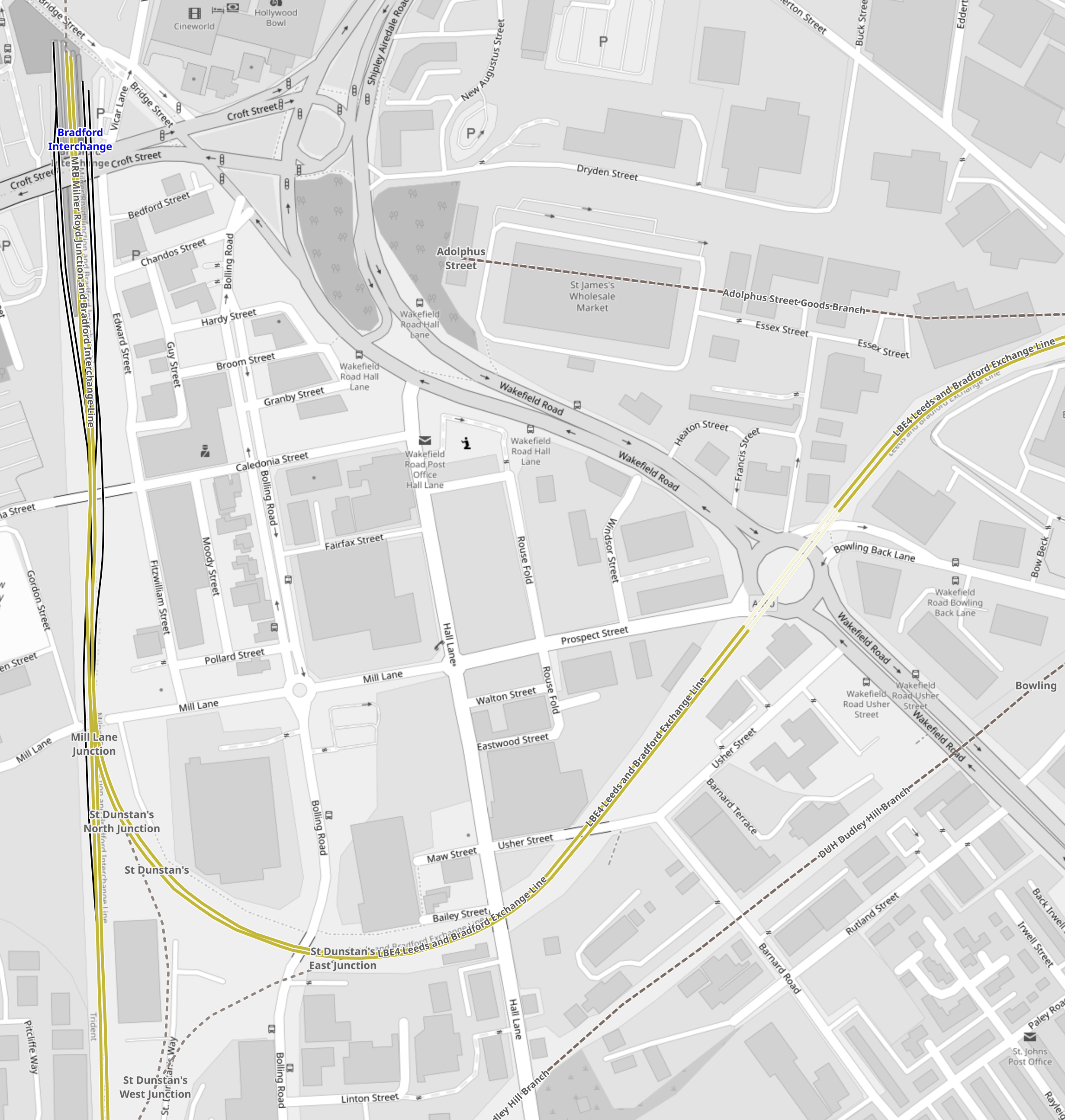
Note.
- Bradford Interchange station is in the North-West corner of the map.
- The railway lines are shown in yellow.
- New Pudsey station is off the map to the East and on the way to Leeds.
- Some trains between Leeds and Bradford are routed via New Pudsey station and the loop in this map.
- The railway between New Pudsey and Bradford Interchange stations goes under a roundabout on the Wakefield Road.
This Google Map shows St. James Wholesale Market and the railway to the North-East of the roundabout.
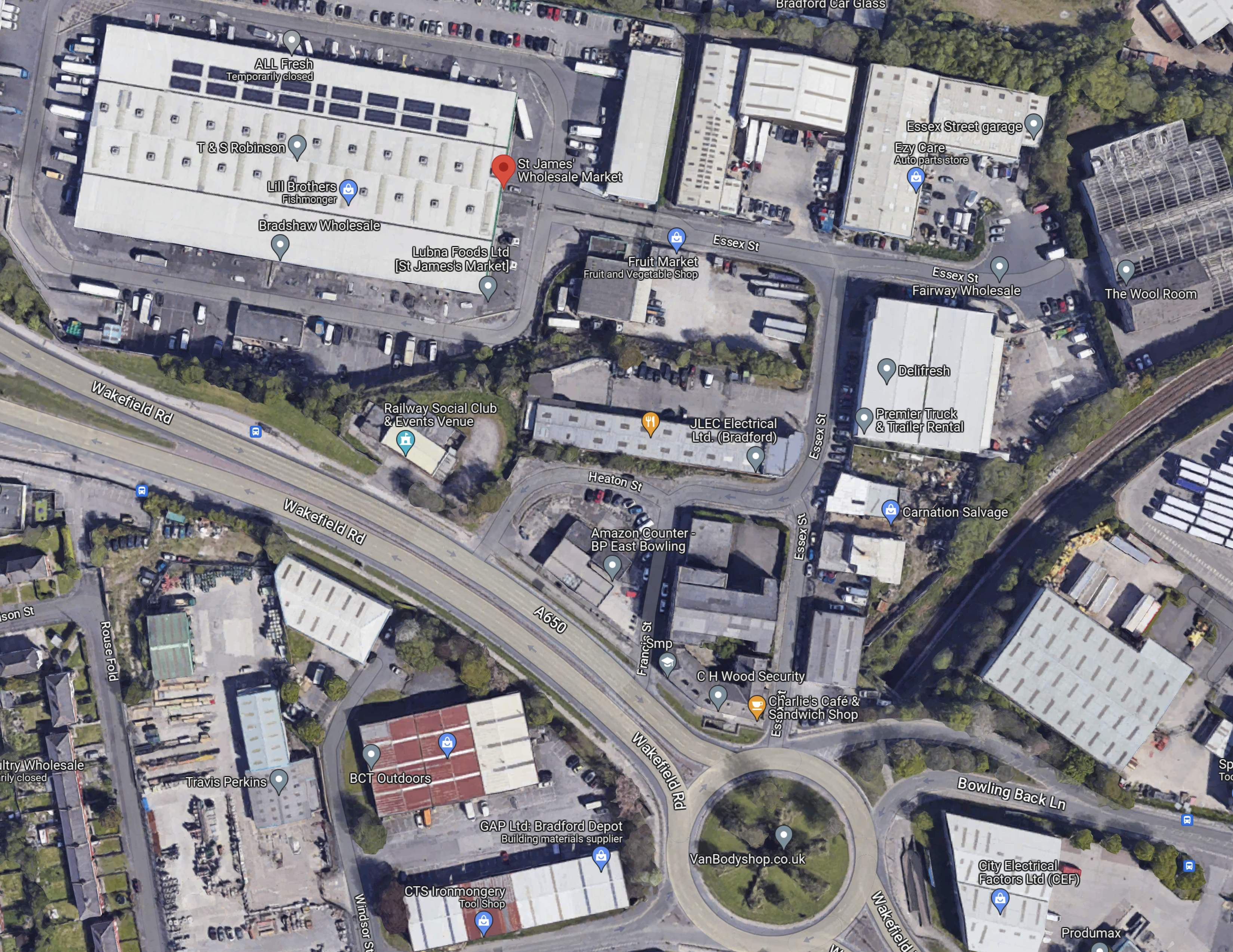
Note.
- St. James Wholesale Market is marked by the red arrow.
- The railway between New Pudsey and Bradford Interchange stations goes under the roundabout at the bottom of the map.
There’s certainly a lot of space to the East of the market. Could the new station be built with a lot of adjacent open space like King’s Cross and Liverpool Lime Street.
These are further thoughts.
Will There Be A New Chord South Of Bradford Interchange Station?
This section is an edited version of a section from Bradford Seeks Support On Rail Project Which Could Deliver £30bn Benefits.
This Google Map, shows Mill Lane Junction, where the lines from New Pudsey and Bradford Low Moor stations join South of Bradford Interchange station.
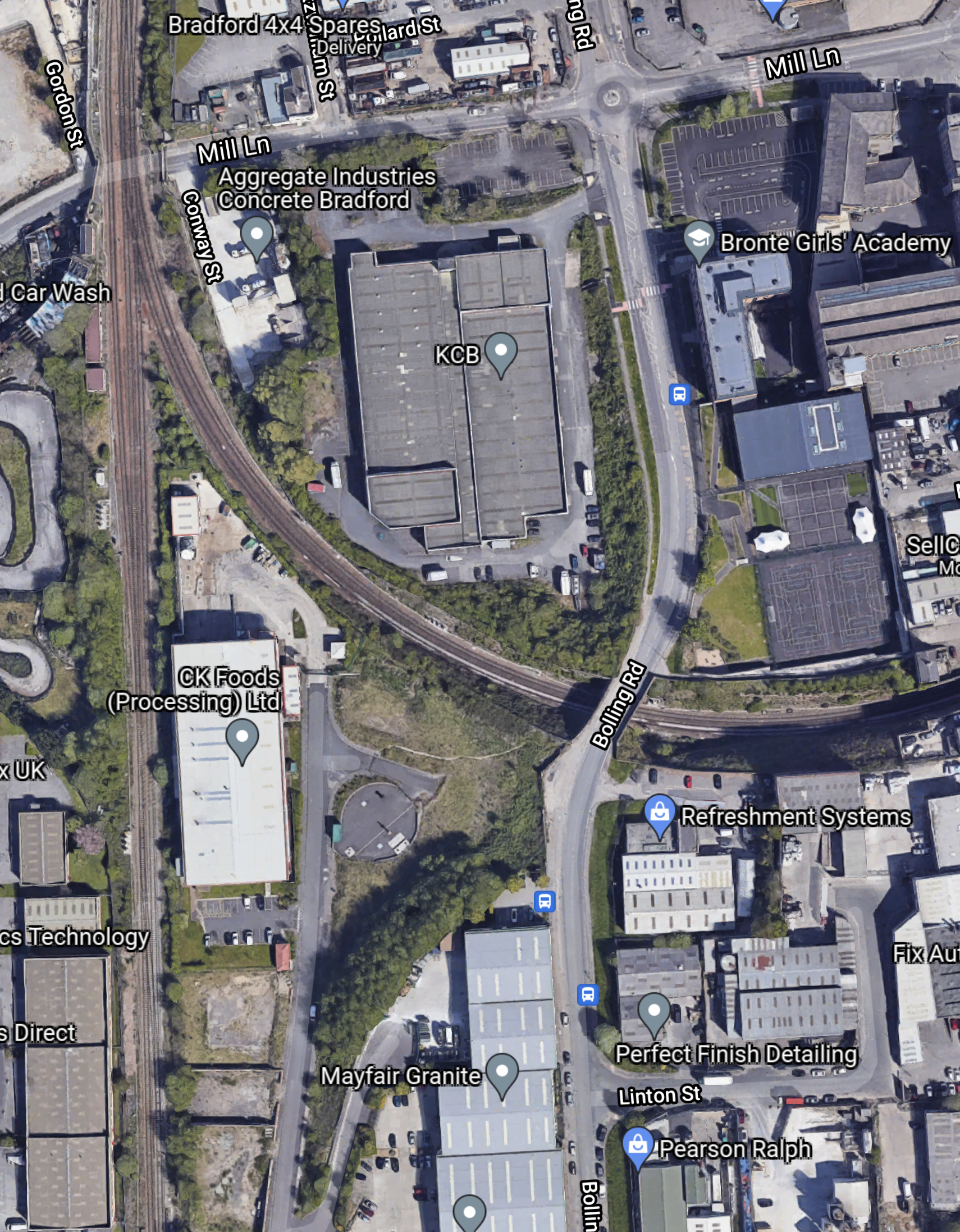
Note.
- Bradford Interchange station is on the rail line to the North.
- The proposed new Bradford station and the existing New Pudsey station are on the rail line to the East.
- Bradford Low Moor station is on the rail line to the South.
It would appear that an extra chord should be added to the junction to allow trains between Manchester Victoria and Leeds running via the Calder Valley Line to call at the new station in Bradford.
Current trains between Manchester Victoria and Leeds using this route have to reverse at Bradford Interchange. The new station and the extra chord would avoid this.
Will Bradford Interchange Station Be Closed?
That is a big question and depends on the overall plan.
I await the full plan with interest.
But building the new chord, closing Interchange station and avoiding the reverse will speed up services.
What Trains Will Call At The New Station?
Currently, only these trains from Northern, go through the station site.
- Hull and Halifax
- Leeds and Chester
- Leeds and Manchester Victoria
- York and Blackpool North
Note.
- All have a frequency of one train per hour (tph)
- All currently reverse at Bradford Interchange.
- All call at Leeds, New Pudsey and Halifax.
- Three tph call at Bramley and Hebden Bridge.
- Two tph call at Manchester Victoria, Rochdale and Todmorden.
- One tph calls at Low Moor.
I suspect these service could be augmented to perhaps give the following.
Four tph to Hebden Bridge, Rochdale and Manchester Victoria.
The only other trains passing though the area are Grand Central’s four trains per day (tpd) between London King’s Cross and Bradford Interchange via Low Moor.
- If these trains terminated in a bay platform at the new station, would this enable their frequency to be increased?
- Or could the services be extended to Leeds?
The new station certainly opens up possibilities.
Vauxhall-Maker Says UK Needs To Change Its Brexit Deal
The title of this post, is the same as that of this article on the BBC.
This is the sub-heading.
One of the world’s biggest carmakers has called on the government to renegotiate part of the Brexit deal or risk losing parts of its car industry
These four paragraphs explain the problem.
Stellantis, which makes Vauxhall, Peugeot, Citroen and Fiat had committed to making electric vehicles in the UK.
But it has now said it is no longer able to meet Brexit trade rules on where parts are sourced.
The government is “determined” that the UK will remain competitive in car manufacturing, a spokesperson said.
Stellantis called on the government to come to an agreement with the EU to keep rules as they are until 2027.
Because, there is not enough battery capacity in the UK and possibly the EU, everything has gone pear-shaped.
I think there are three possible solutions.
- Build more battery factories.
- Change the regulations.
- Develop hydrogen internal combustion engines.
Note.
- Could a battery factory be built fast enough? I doubt it!
- Could the regulations be changed? Possibly!
- Could hydrogen internal combustion engines be developed quickly enough? Ask Cummins, JCB, Ricardo and Toyota.
It is highly likely that there will be much higher demand for batteries, than anybody expects, as innovators develop more applications.
Chiltern Electrification Alternatives Studied
The title of this post, is the same as that of this article on Railway Gazette.
These are the first two paragraphs.
Chiltern Railways is working to present the Department for Transport with options for a fleet renewal programme, with London Marylebone being the only non-electrified London terminal and pressure for the withdrawal of diesel trains continuing to mount, particularly from local residents.
Industry insiders report that this could see at least the 39 two and three-car Class 165 diesel multiple-units replaced.
Note.
- The Class 165 trains were built in 1990-1992 and refurbished around the turn of the century.
- Chiltern Railways have 28 two-car and 11 three-car Class 165 trains.
- Chiltern Railways also have ten similar two-car, nine three-car and nine four-car Class 168 trains.
- In addition, Great Western Railway has 20 two-car and 16 three-car Class 165 trains, and 23 Class 166 trains.
- The Class 165 and Class 166 trains are 90 mph units, whereas the Class 168 trains are 100 mph units.
As Chiltern’s study would appear to rule out electrification, could all of these trains be replaced with an appropriate number of a new class of 100 mph zero-carbon independently-powered multiple units?
In Alstom And Eversholt Rail Sign An Agreement For The UK’s First Ever Brand-New Hydrogen Train Fleet, I talked about a proposed hydrogen train fleet.
These trains are described as three-car in Alstom’s press release.
- Most Aventras are 100 mph trains.
- They could easily be lengthened to four cars by the addition of an extra car.
- It may even be possible, that these trains could be fitted with a pantograph for working on electrified lines.
The only problem, I can envisage, is that a two-car version might not have enough space for the hydrogen and electrical gubbins.
Chiltern’s Locomotive-Hauled Mark III Stock
Greater Anglia have replaced locomotive-hauled Mark III stock with multiple units and it appears to have been successful.
Could Chiltern’s locomotive-hauled Mark III stock be replaced by six-car hydrogen-powered Aventras, with a long-distance interior?
Other Routes
Alstom and Eversholt Rail announced their agreement in November 2021.
Since then, I have written these posts, where the proposed Alstom Hydrogen Aventra could have an application.
- Adding Buxton And Manchester Piccadilly To The Bee Network
- ‘Castle’ HSTs To Be Withdrawn By Great Western Railway
- Proposals Submitted To Create Darlington To Dales Rail Link
- Alstom Hydrogen Aventras And Teesside
- Alstom Hydrogen Aventras And The Reopened Northumberland Line
- Alstom Hydrogen Aventras And Extension Of The Birmingham Cross-City Line
- Alstom Hydrogen Aventras And Great Western Branch Lines Between Paddington And Oxford
- Alstom Hydrogen Aventras And The Uckfield Branch
Note.
- A two-car version would surely increase the number of applications.
- A 110 mph capability would allow the trains to mix it with high speed trains on fast lines.
- Bombardier proposed a 125 mph bi-mode Aventra. Could this be achieved with hydrogen power?
I feel the eight applications, I listed, could be the start of something a lot bigger.
Conclusion
Alstom and Eversholt Rail Group appear to have done their research.
SSE Renewables Announces Construction Of Second Utility-Scale Battery Storage System
The title of this post, is the same as that of this news item from SSE Renewables.
These three paragraphs outline the project and its current status.
SSE Renewables has taken a Final Investment Decision to proceed with, and entered into contracts to deliver, its second battery energy storage system (BESS). The 150MW project is located at the site of SSE’s former Ferrybridge coal-fired power station in West Yorkshire, England.
The investment is part of SSE’s £12.5bn Net Zero Acceleration Programme and means construction will now commence later this month at the iconic site.
For decades the Ferrybridge coal-fired power station was a prominent feature of the West Yorkshire landscape, before being decommissioned by SSE in 2016. Now SSE Renewables’ plans to build a new 150MW battery storage project at Ferrybridge will provide flexible generation for Britain’s national grid and a new era for the site.
This Google Map shows the site.
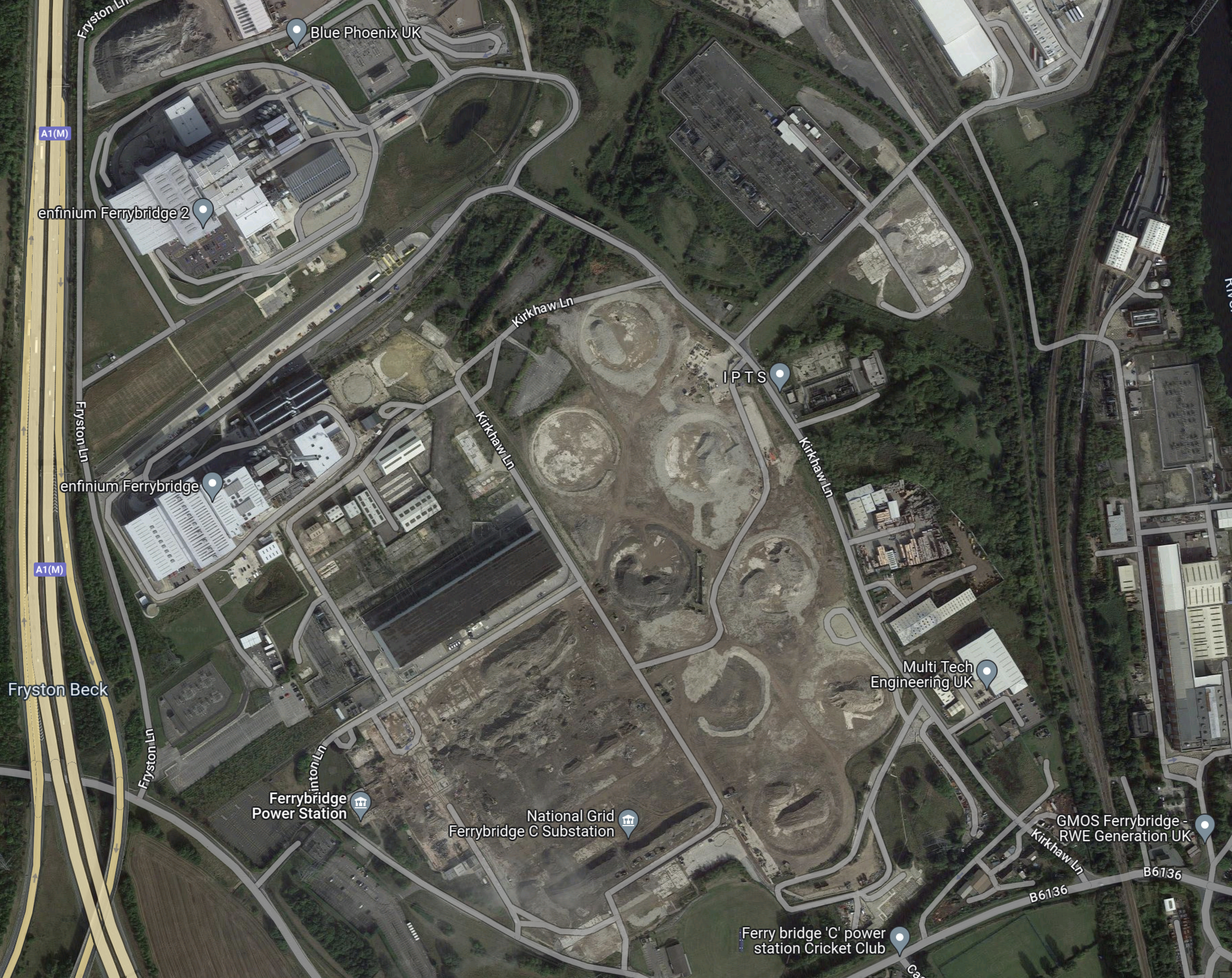
Note.
- The A1(M) runs up the West side of the map, with the East Coast Main Line going up the East.
- The circular structures in the middle of the map appear to be the bases and remains of the eight cooling towers.
- There are a lot of labels saying Ferrybridge power station.
- One existing and one demolished sub-stations can be located.
- The last Ferrybridge power station; C had a capacity of just over 2 GW.
The Wikipedia entry for Ferrybridge C, is worth a read, as it details the struggles of various owners and their engineers to generate electricity efficiently and with regard to the regulations.
The site’s use since 2016 seems to have been varied with two multi-fuel power stations, that were designed to burn mixed fuel including biomass, general waste and waste wood, a carbon capture experiment for Chris Huhne and now the 150 MW battery, which other sources give as having a storage capacity of 300 MWh.
It looks to me that SSE still own the large site and I wonder what their plans envisage for the site.
- A large electrolyser to produce hydrogen could be invaluable for decarbonising the heavy industry in the area.
- According to Wikipedia, there was a plan to build the gas-fired Ferrybridge D and a gas pipeline to connect it to the gas transmission system, but neither were built.
- So could the gas pipeline be built to distribute the hydrogen?
- Or could a large hydrogen store and a small hydrogen-powered power-station be built at Ferrybridge to back up the renewables
- Alternatively, more batteries could be added to the site.
The size of the site, gives lots of possibilities.
New Jersey Police Apprehend A Suspected Meteorite
This article on The Times is entitled Stone Me! Meteorite Crashes Into New Jersey Bedroom.
These are the first two paragraphs.
Police were called early on a Monday afternoon after a break-in, of sorts, at a small house in New Jersey.
Something had come through the roof at tremendous speed and into an upstairs bedroom where it dented the polished wood floor, bounced up and struck the ceiling and then came to rest.
This was the response of officers at the Hopewell Township Police Department.
They telephoned Shannon Graham at the nearby physics department of the College of New Jersey, telling her they had apprehended a suspected meteorite.
It doesn’t appear that they shot it!
Note
Toyota And VDL Groep To Convert Heavy-Duty Vehicles Into Hydrogen Fuel Cell Trucks
The title of this post, is the same as that of this article on Hydrogen Fuel News.
This is the first paragraph.
Toyota Motor Europe (TME) and Dutch VDL Groep have teamed up to covert VDL’s existing heavy-duty trucks into hydrogen fuel cell trucks using Toyota’s fuel cell modules, with a goal to accelerate decarbonizing the road logistics sector while also breaking into Europe’s zero-emission heavy duty H2 trucks market.
Note.
- According to their Wikipedia entry, VDL Groep seem to manufacture buses, coaches, chassis modules and vehicle components.
- In Ricardo Supports Toyota To Develop Its First UK-Based Hydrogen Light Commercial Vehicle, I wrote about conversion of the Toyota Hilux to hydrogen.
- There are a large number of companies all over the world, who will convert vehicles to hydrogen.
- It could be argued that Wrightbus and Alexander Dennis, have designed hydrogen buses, that could be conversions of existing designs.
- Cummins are selling diesel engines, that can be converted to hydrogen.
Could these points indicate, that one of the main routes to the decarbonisation of the heavier end of the commercial vehicle sector will be conversion of existing vehicles to hydrogen fuel?
And will this lead to smaller conversion kits to decarbonise vehicles like Land Rovers, Range Rovers, larger BMWs, Jaguars and Mercedes?
If you consider, that when I was growing up in the 1950s, you rarely saw a small diesel vehicle and how diesel came to grab a large market share, due to good engineering and some misguided tax changes from Gordon Brown, I don’t think it is unreasonable to believe that good engineering and perhaps well-thought out tax changes could create an affordable route to decarbonise a large proportion of vehicles.
If I was still driving and lived away from dreaded ULEZs, then I would be keeping my reliable diesel Jaguar estate.
Vattenfall: Dolphins Unfazed By Offshore Wind Construction Work
The title of this post, is the same as that of this article on offshoreWIND.biz.
This is the sub-heading.
Concerns have been raised that the installation of the monopiles of the Vesterhav North wind farm offshore Denmark could cause a small pod of dolphins to leave the area. The dolphins have, however, neither left the area nor have they changed their behaviour, Vattenfall, the owner and developer of the wind farm, said.
These are the first two paragraphs.
In 2020, wildlife and underwater photographer Lars Mikkelsen discovered a pod of seven Common Bottlenose dolphins during a sailing trip in the canal between the North Sea and the Limfjord at the Danish coastal town of Thyborøn. Since then, Mikkelsen has been closely following the dolphins that are rare guests in the seas around Denmark.
The small pod of dolphins has for the past three years established residence in the area of the Danish part of the North Sea where Vattenfall is constructing its Vesterhav offshore wind farms.
This Google Map shows the Limfjord, which stretches between the North Sea and the Kattegat.
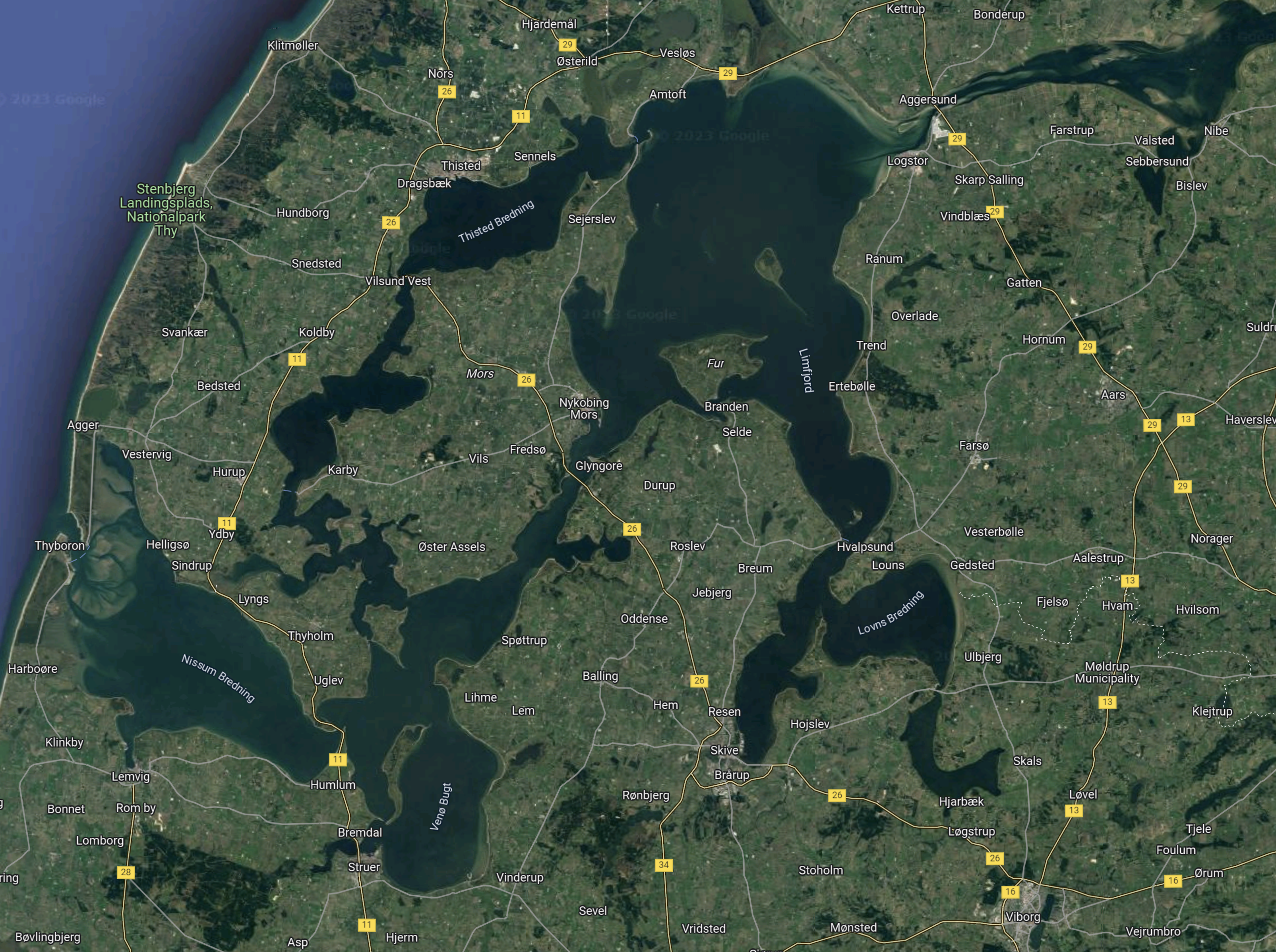
Thyborøn, is at the Western entrance to the Limfjord, which leads into the large area of water in the South-West of the map.
From its Wikipedia entry, the Limfjord seems to be an ecologically-interesting place.
This paragraph sums up how the construction affected the dolphins.
So, when concerns were raised that the installation of the wind farm’s monopiles could cause the dolphins to leave the area, Vattenfall initiated a collaborative monitoring effort. Fortunately, it showed that the dolphins were still present and have not changed behaviour after completion of the monopile installation.
Note.
- Vattenfall did adopt measures to mitigate the noise, as is detailed in the article.
- A university also took a series of measurements.
But the exercise does show it is possible to install offshore wind farms without disturbing the inhabitants.
Green Hydrogen Project Win
The title of this post, is the same as that of this news item from Nova Innovation.
These are the first two paragraphs.
Nova and consortium partners The University of Strathclyde, Shetland Islands Council and Ricardo Energy, have been awarded funding from the Scottish Government’s Emerging Energy Technologies Fund – Hydrogen Innovation Scheme for their GHOST project.
The GHOST project (Green Hydrogen and Oxygen Supply from Tidal Energy) will look at the potential of producing green hydrogen and oxygen from Nova’s tidal energy projects in Shetland.
They plan to generate hydrogen from tidal energy around the island of Yell. The oxygen, which is often just released into the air, will be used in aquaculture and possibly as rocket fuel at SaxaVord Spaceport.
This map shows Shetland.
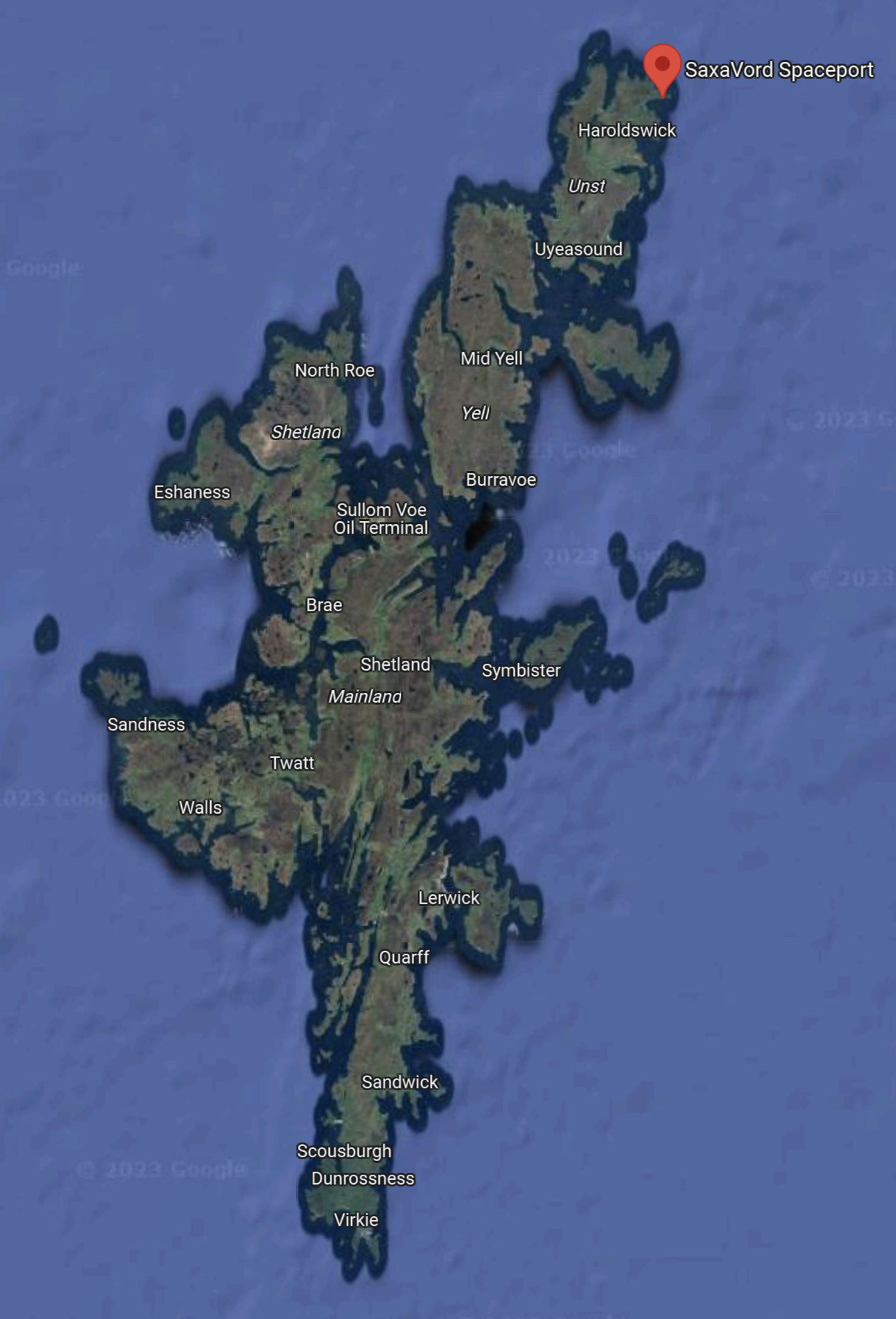
SaxaVord Spaceport is marked by the red arrow at the North end of the archipelago on the island of Unst and Yell is the next island to the South.
If GHOST is successful, it looks like they will have a ready market for their fuel.
Hydrogen Buses Start Running Across Region
The title of this post, is the same as that of this article on the BBC.
These are the main points.
-
A fleet of 20 hydrogen powered buses start running in Merseyside
-
The zero emission buses will improve air quality, Mayor Steve Rotheram said
-
He wants the Liverpool City Region to be net zero carbon by 2040
The buses will operate on the 10A route between St Helens, Knowsley and Liverpool city centre.
I wonder, if they’ll go past my old digs on Huyton Lane.
 The Anonymous Widower